
Police Facial Recognition: UK Vans Jump 10 to 50
Quick answer
Is police facial recognition accurate when it flags someone in the UK?
It depends on what is counted. Police report very few false alerts across all faces scanned, while independent reviewers found high error rates among people actually flagged and stopped. A match score is a measurement, not identification, so a flagged person should be checked by a human alongside other evidence.
Picture this: you're walking through a train station, grabbing coffee, minding your business. A van with a camera on top scans your face. Somewhere in a server, a number gets calculated, a match score (basically, a number that says how alike two faces are), and if it's high enough, an officer walks up and asks you to prove you're not the person on a watchlist. That's not a hypothetical. That's Tuesday in parts of the UK right now, and it's why facial recognition and the recognition technology behind it are getting so much scrutiny.
Police facial recognition is expanding fast across the UK, vans are set to jump from ten to fifty, with no specific law yet governing how it's used, which means a face match can trigger a real stop before anyone's sure it's actually you.
Police facial recognition in the UK is scaling up faster than lawmakers can write rules for it, and the gap between "the system flagged you" and "the system was right" is where people get hurt.
Here's the part that should make you sit up: this isn't a small pilot program anymore. It's spreading to Greater Manchester, West Yorkshire, Bedfordshire, Surrey, Sussex, Thames Valley, and Hampshire. The number of live scanning vans is set to jump from ten to fifty, backed by £26 million in government money for a national system, according to Biometric Update. The Metropolitan Police alone scanned 1.7 million faces in 2026, an 87% jump from the year before, according to reporting from ResultSense. NYPD uses a related but separate set of facial recognition tools domestically, which is worth noting when people compare UK and US policing approaches.
So here's your first real question, the one you'd actually ask a friend at 11pm: if this camera flags my face by mistake, do I have to prove it's wrong, or does the system have to prove it's right? Right now, in the UK, the burden lands on you. If you get flagged, an officer stops you and you're the one showing ID to clear your name. Not the algorithm, and that gap is precisely what makes police facial recognition so controversial as it scales up.
Police Facial Recognition Is Expanding, But Nobody Agrees on What "Accurate" Means for Law Enforcement
Police say their police facial recognition system is basically flawless. Using a confidence threshold (a cutoff number the software uses to decide "close enough to flag") of 0.6, the Metropolitan Police reported 2,067 out of 2,077 alerts in 2024-25 were correct, a false-positive rate of just 0.0003%. Sounds great, right?
But independent researchers looked at the same kind of technology and found something wildly different. Big Brother Watch found that in some deployments, 63.64% of stops were based on inaccurate matches, and in one South Wales Police case, the false match rate hit 89.9%, according to Big Brother Watch. How can both numbers be true? Because they're measuring completely different things. Police count false positives against every face the camera *sees*, millions of them, most never flagged. Researchers count false positives against faces that were actually flagged and led to a police stop. One measures a haystack. The other measures the needle in facial images captured every day.
Is police facial recognition even legal in the UK right now under current law?
Not exactly settled. There's no specific law that spells out how live facial recognition (LFR technology) can be used, police forces are deploying it anyway, under general policing powers. A public consultation on new rules closed in February, and the results haven't been published. Biometrics commissioners say a real law is likely at least three years away. This article is part of a series, start with Deepfake Audio.
A Face Match Isn't Proof, It's the Start of a Conversation You Didn't Ask For
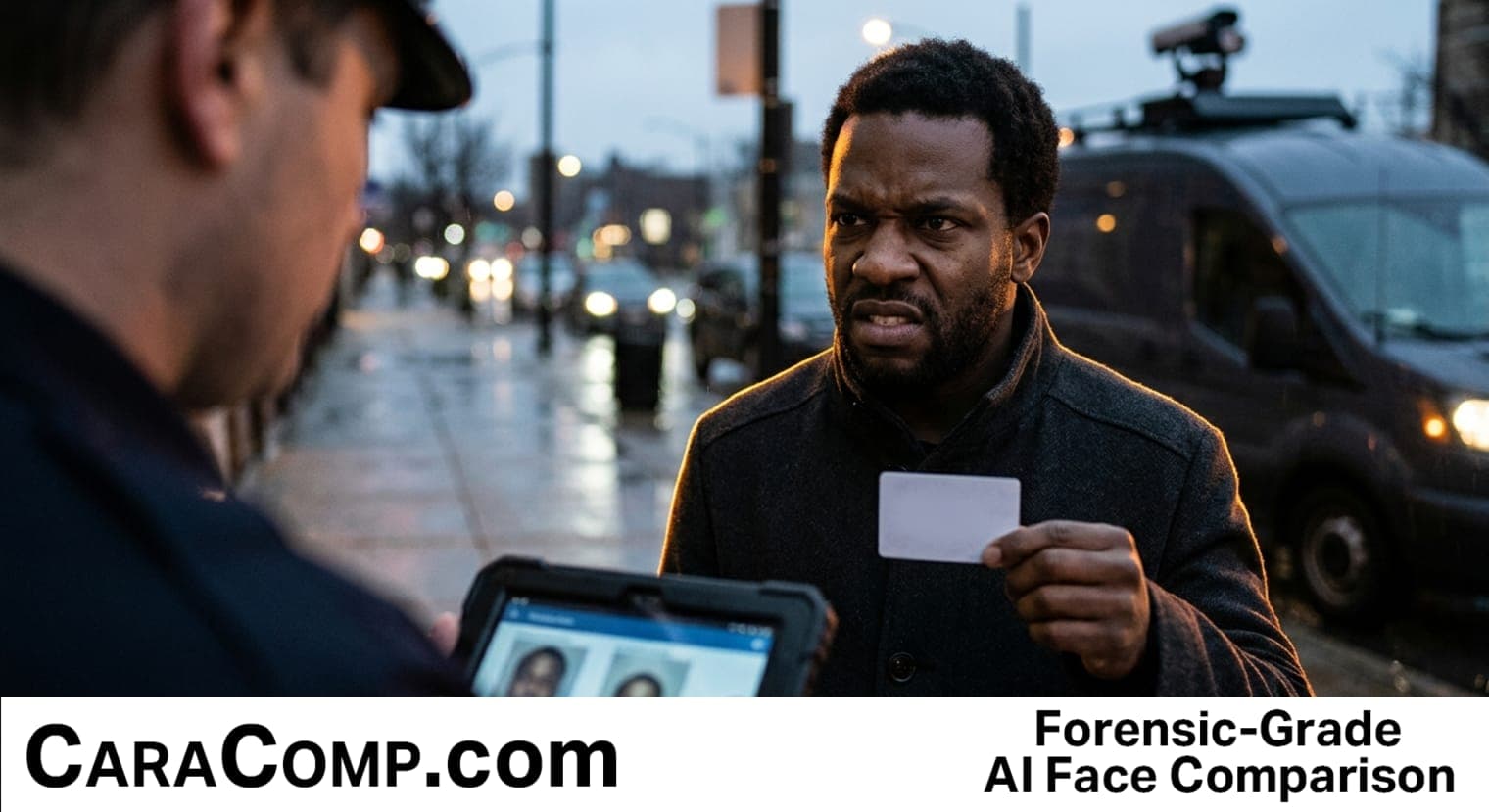
Let's be clear about what actually happens on the ground. The camera scans faces passing by. When one matches someone on a watchlist, the system captures the image and an officer walks over. That officer then gives the flagged person a chance to prove they are not the wanted individual, meaning you could be standing on a sidewalk digging through your bag for your passport because a computer thought you looked like someone else based on their face.
In 2024, that's exactly what happened to a Black anti-knife crime community worker in London, detained after a facial recognition system produced a false match, according to reporting cited by London Assembly. This wasn't a lab test. This was a real guy, doing real community work, stopped on a real street because of one wrong number in one wrong system, the kind of face surveillance error that policing critics keep flagging.
Over half of all live facial recognition deployments in 2024 took place in areas with higher-than-average Black populations. cited by London Assembly member Zoe Garbett, London.gov.uk
That's not a footnote. That's the whole ballgame. If the cameras get pointed at some neighborhoods more than others, then "accuracy" stops being a fair measurement for anyone, it becomes a pattern of who gets stopped and who doesn't, and it raises real questions about policing priorities.
How does facial recognition technology actually flag someone as a suspect?
The camera doesn't "recognize" you the way a friend would. It converts your face into a set of measurements, compares that set against a watchlist, and spits out a match score using recognition software built for exactly this comparison. If that score clears the threshold, you get flagged. It's math, not memory, and math can be wrong, especially on darker skin tones, at odd angles, or in bad lighting.
What Police Say vs. What Independent Reviewers Found About Law Enforcement Claims
Here's where it gets genuinely confusing if you're just trying to figure out whether to trust this stuff. Police point to real wins: Greater Manchester Police used live facial recognition at Manchester's Caribbean Carnival in August, where tens of thousands showed up, and say only "a fraction" of people flagged were actually arrested. Since February 2026, vans made 17 visits to Bradford, leading to 29 arrests and flagging 21 people subject to Sexual Harm Prevention Ordersa legal restriction placed on someone with a record of sexual offending. The UK's privacy regulator, the Information Commissioner's Office, even said police use of the tech mostly meets compliance standards, a claim law enforcement agencies point to often.
But "mostly compliant" and "always accurate" are not the same sentence. And that's the tension nobody's resolving:
| What police measure | What independent reviewers measure |
|---|---|
| False positives against every face the camera scans (millions) | False positives against faces actually flagged for a stop |
| 0.0003% error rate at Metropolitan Police, 2024-25 | 63.64% of stops based on inaccurate matches, per Big Brother Watch review |
| "Compliance" with privacy rules, per ICO review | 50.7% false positive rate in real conditions vs. lab testing, per Essex Police audit |
| Arrests and recoveries framed as public safety wins | Disproportionate deployment in areas with higher Black, Asian, and Mixed ethnic populations |
Essex Police's own numbers are the scariest part of that table. An audit found a 50.7% false positive rate in actual field use, compared to whatever number the lab tests produced, meaning the system that looked great on paper fell apart once it hit real streets with real weather, real crowds, and real camera angles, according to State of Surveillance. Previously in this series: California Deepfake Law 47 Million Views Before Deletion.
Why Police Facial Recognition and Facial Recognition Technology Matter for Everyone, Not Just Suspects
- ⚡ No specific law yetpolice are deploying this facial recognition technology under general powers, not rules written for it
- 📊 Measurement mismatch"accurate" depends entirely on which faces you count in the denominator
- 🔮 Uneven deploymentcameras show up more in some neighborhoods, which skews who gets flagged by policing efforts
- 🚨 Real consequencesa wrong match already led to a real person being detained on a real street
The CaraComp Take: A Face Match Should Be a Lead, Not a Verdict
If you've ever wondered whether a photo or a profile online is really who it claims to be, you already understand the exact question at the center of this story: a match is information, not truth. Facial recognitionwhether it's a police van scanning a street or a tool checking whether a profile picture is real, should hand you a lead (a starting point worth checking further), never a final answer on its own. This is exactly why face recognition has been used cautiously by agencies that understand its limits.
Here's the one useful thing you can actually do with this, no product pitch attached: if you're ever told a camera or system "matched" you to something, ask specifically what the match score was and what threshold they used to flag it. A match score close to the cutoff line is a coin flip dressed up as certainty. Knowing that number, and that it's not the same thing as identification, is the single best question you can ask before a stressful moment turns into a legal one, whether the concern is facial recognition or plain old face recognition marketed under a different name.
Can facial recognition help identify people accurately in public spaces under current policing rules?
Sometimes, yes, under good lighting, clear angles, and high-quality watchlist photos, matches can be genuinely useful and help law enforcement generate leads. But "sometimes accurate" is not the same as "always accurate," and real-world conditions rarely match lab conditions. That gap is exactly why independent audits keep finding numbers so different from police-reported ones, and why law enforcement agencies keep facing scrutiny over their facial recognition technology claims.
Where Police Facial Recognition Goes Next in the UK
Scotland is now weighing its own live facial recognition (LFR) policies, with police there separately requesting a mask ban and an ethics study launching alongside it. Meanwhile, handheld facial recognition apps are reportedly in the pipeline too, letting individual officers scan faces from a phone rather than a van, a move that would put this power in far more hands, far more often, according to Liberty Investigates.
Look, nobody's saying facial recognition technology should never exist. It's genuinely helped with real investigations, facial recognition has been used to make arrests and locate missing people, and Greater Manchester Police's Serious Crime Order alert system secured its first arrest using exactly this approach. But there's a real difference between a detective comparing photos side by side to build probable cause (a legal standard, enough solid reason to justify an arrest) in one specific case, and a van scanning every face in a crowd because it might catch someone. One is investigation, grounded in actual law and evidence. The other is a dragnet with a friendly name, and it's why law enforcement agencies need clearer rules around policing with this technology.
Police facial recognition is expanding across the UK faster than any law governs it, and a face match alone should never be treated as proof, it's a lead that demands a human check before it becomes a police stop.
So the next time someone tells you a camera "recognized" you, remember what actually happened: a machine did math, matched a number, and handed the real decision, the human decision, to whoever was standing closest with a badge on. Fifty vans are coming. The law explaining what they're allowed to do to you isn't here yet. Which one do you think shows up first? Up next: Behavioral Biometrics.
Police Facial Recognition: Frequently Asked Questions
Is a police facial recognition platform being introduced across all UK forces, or just a few?
It's expanding beyond the first trial cities into Greater Manchester, West Yorkshire, Bedfordshire, Surrey, Sussex, Thames Valley, and Hampshire, with the number of vans rising from ten to fifty. It's not nationwide yet, but the direction is clearly toward one national facial recognition platform built on shared recognition technology rather than scattered local trials, and it's reshaping policing conversations across the country.
What does it mean when police say facial recognition technology helped identify people or make arrests?
It means the software flagged a possible match, and an officer then investigated further, checking ID, asking questions, sometimes making an arrest. The system itself doesn't make arrests; it generates a suspect using points of comparison against a watchlist photo, and a human decides what happens next. That human step is exactly where mistakes involving facial recognition can be caught, or missed.
Do UK police need probable cause under law to stop someone flagged by facial recognition?
Not in the same formal sense used in places like the US. In the UK, an officer can approach someone based on a facial recognition alert and ask them to confirm their identity, without a separate legal probable cause requirement in the way American courts use that term. This is part of why there's no specific law spelling out exactly what protections apply during that stop, leaving policing practice to fill the gap.
Has facial recognition been used by law enforcement agencies outside the UK too?
Yes, law enforcement agencies in the US, several EU countries, and elsewhere have tested or deployed similar biometrics-based systems, though rules vary a lot by country. NYPD uses a version of this facial recognition technology domestically, while some countries ban live public scanning entirely; others, like the UK, allow it without a dedicated law yet. The UK's rapid expansion without settled legislation is unusual even by international standards.
Can facial recognition technology tell if a match is actually the right person?
Not on its own. The technology can only produce a match score based on how alike two facial images are in its database, it can't confirm identity by itself. That's why every flagged match is supposed to go through a human officer for identification, though critics argue that step doesn't catch every biometrics error, especially with skewed deployment in specific neighborhoods under current policing practice.
Why do privacy and civil liberties groups oppose live facial recognition and face surveillance in public?
Groups like Big Brother Watch argue the technology threatens both privacy and safety by scanning ordinary people going about their day, without their consent, in the name of crime prevention. Their research also found deployment is uneven, used more in some communities than others, which raises fairness concerns on top of the accuracy debate around law enforcement's growing reliance on facial recognition.
Ready for forensic-grade facial comparison?
Full forensic reports with detailed similarity scoring. Results in seconds.
Run My First SearchMore News
Social Media Age Verification: Apps Want Parents' IDs Next
The "enter your birthday" box is on its way out. Here is what social media age verification and parental consent could ask of your family, and what to check before you hand anything over.
ai-regulationAI Voice Cloning: 3 Seconds of Audio Can Fake a Loved One
Lithuania wants people to have legal rights over their own voices. That tells us a familiar voice on the phone is no longer proof of who is calling.
ai-regulationDeepfake: Fake Kiss Photo of Georgia Mayor Outran the Law
A fake photo of College Park's mayor spread before anyone was held accountable. Here's why that could happen to anyone, and what to do first.