
Free AI Face Shape Detector — Find Your Face Shape From a Photo
Your complete guide to AI-powered face shape detection — discover your oval, round, square, heart, diamond, or oblong face type in seconds.
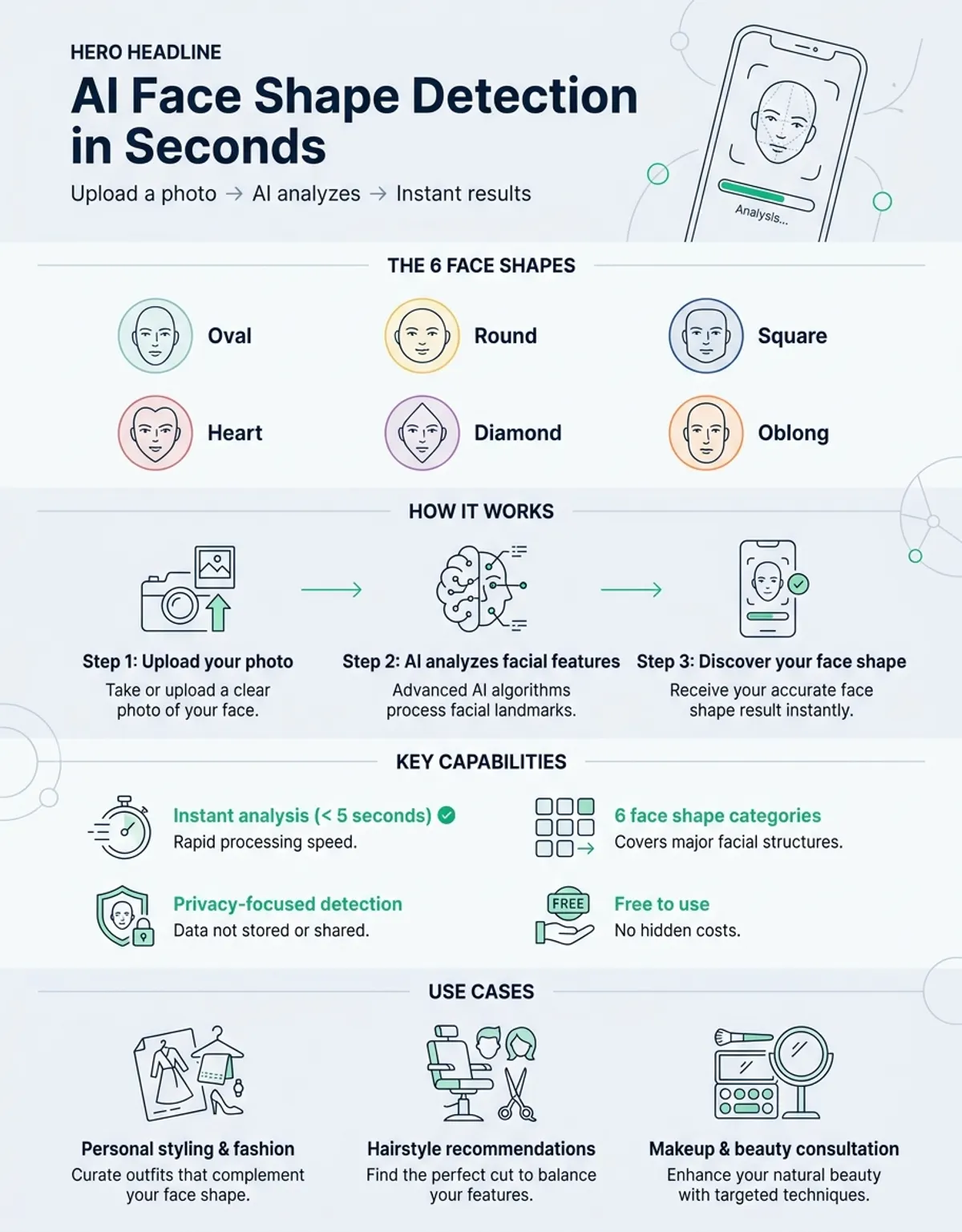
Discover your unique facial structure with a free AI face shape detector that analyzes your photo in seconds. This advanced ai-powered face shape analyzer uses computer vision to examine your facial features, jawline width, and proportions to deliver instant results. Whether you need to find face shape for choosing the perfect hairstyle or selecting flattering eyewear, the face shape tool provides accurate recognition of oval, round, square, heart, diamond, and oblong faces. Upload any image and the powerful face shape finder will analyze your face using cutting-edge ai algorithms. No special equipment needed—just a clear photo and you’ll instantly discover which of the six face shapes matches your unique facial structure.
The face shape tool has become essential for anyone wanting personalized style recommendations. Instead of guessing which shaped faces category you belong to, the detector examines key facial measurements like cheekbone width, forehead proportions, and jawline definition. The tool processes your image through sophisticated recognition software that maps your facial features with precision. Within moments, you’ll receive detailed results showing whether you have an oval face, round face, square face, heart shaped face, diamond face, or oblong face. This information helps you make informed decisions about hairstyles, glasses, and accessories that complement your natural facial structure.
What a Face Shape Detector Does (and How AI Reads Your Image)
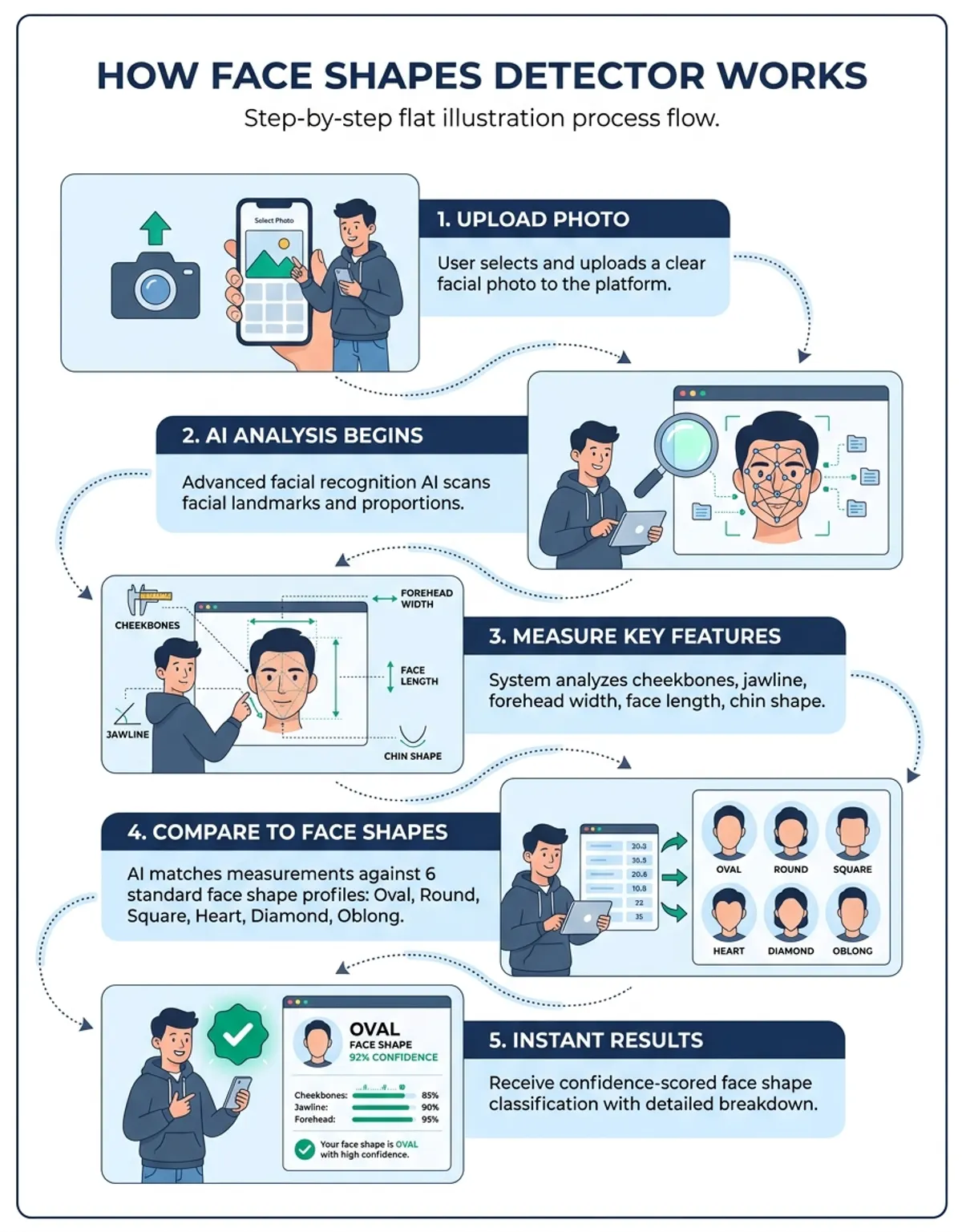
A face shape tool analyzes the geometric proportions of your facial structure by examining key measurements from a photo you upload. The it uses ai algorithms to identify critical facial landmarks including the width of your forehead, cheekbones, and jawline, along with the overall length of your face. Modern face detection systems employ computer vision to create a detailed map of your facial features, measuring the relationships between different points on your face. The recognition software compares these measurements against established patterns for the six primary face shapes, delivering results that indicate which category best matches your facial structure.
When you submit an image to the face shape detector, the ai algorithms first locate your face within the photo and then identify dozens of reference points across your features. The tool measures the width at various horizontal planes—across your forehead, at your cheekbones, and along your jawline. It also calculates the vertical proportions from your hairline to your chin. These measurements are processed through neural networks trained on thousands of faces to recognize patterns associated with oval, round, square, heart, diamond, and oblong shaped faces. The classification system generates results showing your face shape classification along with specific details about your proportions.
The accuracy of a face analyzer depends heavily on the quality of the image you provide and the sophistication of the identification algorithms. Advanced detectors use multiple neural network layers to filter out variables like lighting, camera angle, and photo resolution that might skew measurements. The tool analyzes your structure from the uploaded photo, compensating for common issues like tilted heads or inconsistent lighting. By focusing on the fundamental geometric relationships between your forehead, cheekbones, and jawline, the face detection system can deliver reliable results even from casual photos. The generated results typically include your primary face shape classification and may also note secondary characteristics or proportions that slightly differ from the standard template.
Understanding how the ai-powered analyzer reads your image helps you appreciate why certain photo qualities matter more than others. The detection software performs best when it can clearly see the full outline of your face from a frontal view. The tool needs to measure width accurately at multiple points, so photos where hair obscures your forehead or where your face is turned at an angle may produce less precise classification. Modern face shape detectors include preprocessing filters that enhance the image quality and normalize lighting conditions before the actual feature analysis begins. This ensures that the findings you receive reflect your true face proportions rather than artifacts from poor photography.
Modern face shape detectors include preprocessing filters that enhance image quality and normalize lighting conditions — ensuring findings reflect your true face proportions, not artifacts from poor photography.
How to Use the Free Face Shape Detector in Seconds
Using the free ai face shape detector requires just a few simple steps to analyze your face and get instant output. First, select a clear photo of yourself where your face is visible from a frontal angle with your hair pulled back to reveal your forehead and hairline. Click the upload button on the face detector interface and choose your snapshot from your device. The detector immediately begins processing your photo using computer vision algorithms that scan for landmarks. Within seconds, the analysis system analyzes your proportions and generates analysis showing your face shape classification—whether oval, round, square, heart, diamond, or oblong.
The interface is designed for speed and simplicity. After you upload your photo, the ai algorithms automatically detect your face within the photograph and apply filters to enhance your feature visibility. You don’t need to manually mark any points or adjust settings—the advanced face detection system handles everything automatically. The software maps your forehead width, cheekbone prominence, and jawline definition, comparing these measurements to standard face shape patterns. The data appear on screen typically within 3-5 seconds, displaying your primary face shape along with specific details about your feature proportions.
For the most accurate classification from the face shape system, ensure your photo meets basic quality standards. Use a picture with good lighting that clearly shows your face features without heavy shadows. The analyzer works best with photos taken at eye level from about 3-4 feet away, creating a natural perspective without distortion. Tie back long hair so the detector can accurately measure your forehead and hairline. While the classification system includes filters to handle various lighting conditions, starting with a well-lit photo reduces the processing needed and typically yields more precise findings. The detector can analyze faces from casual photos, but professional headshot-quality images tend to produce the highest accuracy.
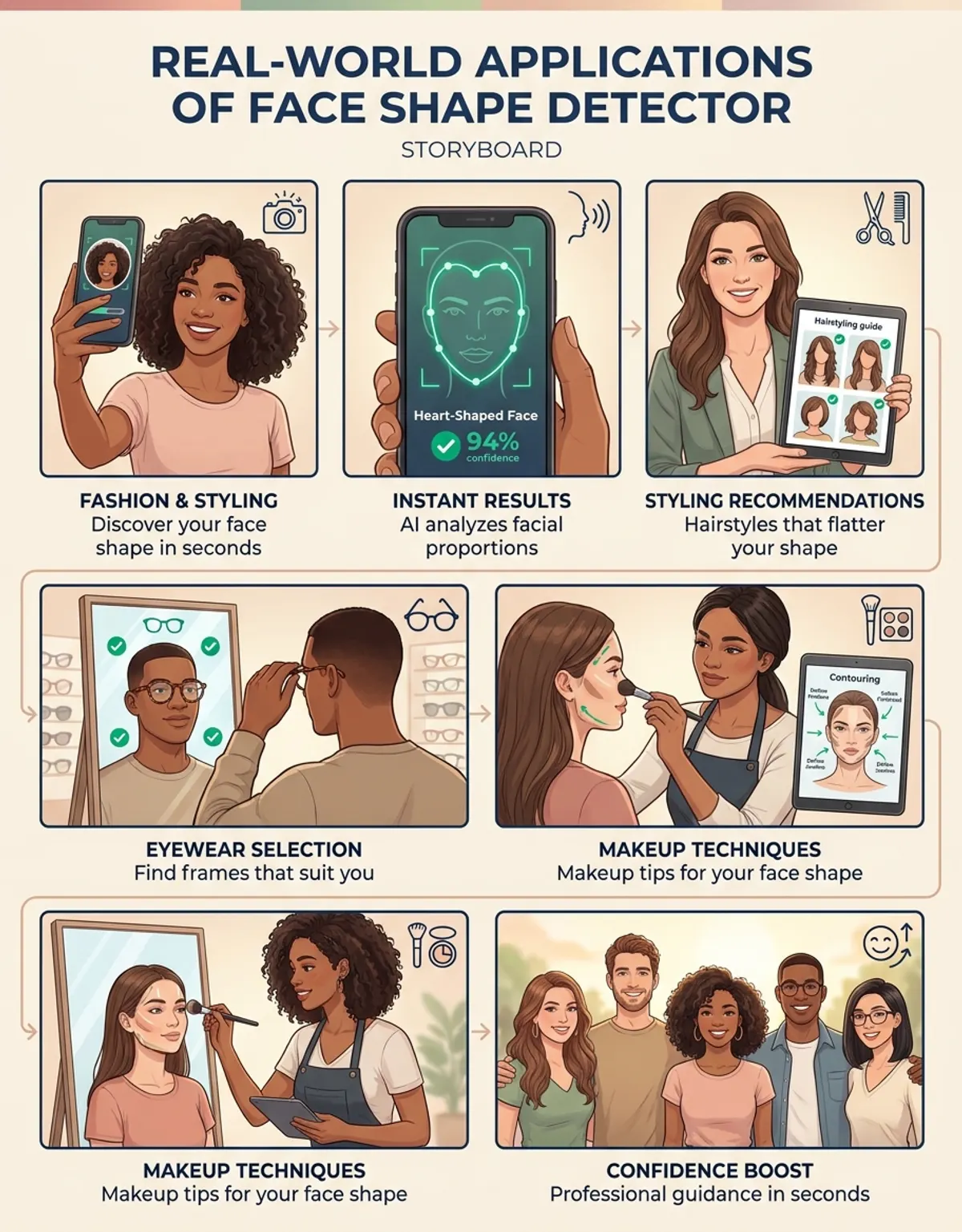
Once the face shape detector delivers your output, you can immediately use that information to explore hairstyle recommendations, glasses frame suggestions, and makeup techniques suited to your structure. Many users save their analysis or screenshot the detailed analysis for future reference when shopping for accessories or consulting with stylists. The system generates comprehensive data that go beyond just naming your face shape—it often provides specific measurements and proportions that help you understand why you were classified in a particular category. This educational component helps you recognize your own characteristics and make better style decisions independently. Explore all our tools at CaraComp.
The Six Face Shapes: Oval, Round, Square, Heart, Diamond, Oblong
Face shape detectors categorize shaped faces into six primary types based on the proportions between your measurements at different points and overall face length. An oval face is considered the most balanced, with forehead and jawline of similar proportion and gently rounded features. A round face shows nearly equal dimension and length measurements with soft, curved lines and full cheeks. A square face displays strong angular features with a wide forehead, prominent cheekbones, and a broad jawline all measuring approximately the same size. These three face shapes represent the most common categories identified by feature identification systems.
The remaining three face shapes have more distinctive proportions. A heart shaped face features a wider forehead with high, prominent cheekbones that taper down to a narrow, pointed chin. The measurement decreases significantly from the forehead to the jaw, creating the characteristic heart silhouette. A diamond face is the rarest type, characterized by narrow forehead and jaw measurements with dramatically wide, high cheekbones creating angular lines. An oblong face (sometimes called rectangular) shows greater length than width with a straight face outline—the forehead, cheekbones, and chin area all measure similar in proportion but the face is noticeably longer than wide, creating an elongated appearance. Explore our complete diamond face shape guide to learn tailored hairstyles and styling tips for this distinctive facial structure.
Understanding these six face shape categories helps you interpret the classification from a face shape detector. Each type has specific characteristics related to dimension at key horizontal planes and the ratios between those measurements. The detector identifies which pattern your proportions most closely match. Many faces don’t fit perfectly into just one category—you might have characteristics of two face shapes. For example, you could have the lower face of a square face but the overall proportions closer to an oval face. The detection system typically identifies your dominant face shape while noting any secondary characteristics that blend features from multiple categories.
The proportions that define each face shape relate directly to the size measurements at three key points—forehead, cheekbones, and jaw—along with the overall length from hairline to chin. Types with balanced measurement and moderate length fall into the oval category. Those with nearly equal width and length and soft curves become round profiles. Strong proportion with angular features creates square features. The three less common shapes—heart, diamond, and oblong—each have unique dimension distribution patterns. A face shape analyzer measures these proportions from your photo and calculates which of the six standard patterns best matches your structure, delivering findings that classify your face type and explain the specific measurements that led to that classification.
Reading Your Results: Width, Proportions, and Feature Measurements
When you receive analysis from a face shape detector, the analysis breaks down your face proportions into specific measurement ratios. The detector identifies the width of your forehead (measured at the widest point near your hairline), the proportion across your cheekbones (at the most prominent point), and the dimension of your chin area (measuring across your jaw at its broadest). These three horizontal measurements form the foundation of face shape classification. The analysis system also calculates your face length from hairline to chin point, then compares all these measurements to determine which of the six face shapes best matches your proportions.
Understanding how size variations define different face shapes helps you interpret your data accurately. If your forehead, cheekbones, and lower face all measure approximately the same measurement, you likely have a square or oblong face—the distinguishing factor is length. When your cheekbone width significantly exceeds both forehead and jaw measurements, you probably have a diamond face. If your forehead is the widest point and your jaw is the narrowest, that indicates a heart shaped face. The classification from the detector show not just which face shape you have, but also the specific proportion measurements that led to that classification, helping you understand your structure in concrete terms.
Your chin area plays a particularly important role in face shape classification. A strong, angular lower face with sharp corners indicates square or heart shaped types. A rounded, soft jaw suggests oval or round profiles. A narrow, pointed chin is characteristic of heart and diamond features. The face shape analyzer analyzes the contour of your chin area from the photo, measuring both its dimension and its angular versus curved qualities. The findings often include specific notes about your lower face characteristics because this feature strongly influences which hairstyles and glasses frames will be most flattering for your structure.
The feature proportions revealed in your output go beyond simple size measurements to include ratios and relationships between different features. For instance, the ratio of face length to cheekbone measurement helps distinguish between round profiles (ratio closer to 1:1) and oblong types (ratio significantly above 1:1). The ratio of forehead width to jaw proportion helps separate heart shaped profiles (large ratio) from square features (ratio near 1:1). Professional detectors calculate multiple proportional relationships from your selfie and use these ratios to refine the classification. The analysis you receive synthesizes all this data into a clear face shape identification along with the key measurements and proportions that define your unique face structure.
Professional face shape detectors calculate multiple proportional relationships from your selfie — the ratio of face length to cheekbone width, forehead to jawline — and synthesize all this data into a clear, actionable face shape classification.
How AI and Computer Vision Power the Face Shape Analyzer
Modern face shape detectors rely on sophisticated ai algorithms and computer vision techniques to analyze facial structure from a snapshot. The classification process begins with face detection—locating the face within the photo and isolating it from the background. Computer vision systems use convolutional neural networks trained on millions of images to identify your face boundaries with high precision. Once the face is isolated, the ai algorithms place landmark points on key facial features including the corners of your eyes, the tip of your nose, your mouth, and the contours of your forehead, cheekbones, and jawline. These landmarks provide the reference points for all subsequent measurements.
The face identification component uses deep learning models to classify face types into shape categories. These ai algorithms were trained by processing thousands of photos labeled with their correct face shapes, learning to recognize the patterns of dimension and proportions associated with oval, round, square, heart, diamond, and oblong profiles. When you upload your snapshot, the computer vision system extracts the measurements from your facial landmarks and feeds them into the neural network. The detection model compares your proportions against the learned patterns and calculates probability scores for each face shape category. The data show the highest-probability match along with the confidence level of that classification.
Advanced face shape detection systems incorporate multiple neural network architectures to improve accuracy. Some use ensemble methods that combine classification from several different analysis models, while others employ hierarchical classification that first determines broad categories (angular versus rounded) before refining to specific face shapes. The computer vision preprocessing includes multiple filter algorithms that normalize for lighting variations, color balance, and picture resolution, ensuring the ai algorithms receive consistent input regardless of the original photograph quality. These sophisticated systems can handle photos taken in various conditions and from slightly different angles, using geometric correction to estimate what the proportions would look like from a perfect frontal view.
The visual representation component of modern detectors extends beyond simple classification to create overlays on your facial structure. Using computer vision, the system can overlay measurement lines on your face, showing the width at different feature levels. Some advanced systems generate a simplified geometric outline of your face, making it easy to see how your proportions compare to the standard templates for each face shape. The ai algorithms can also produce comparison images showing your face alongside the ideal examples of each shape category, helping you understand why the classification system classified you in a particular way. These visual findings complement the numerical measurements, giving you a comprehensive understanding of your face structure.
Choosing Glasses Frames That Suit Your Face Shape
Once you know your face shape from the detector output, you can select glasses frames that complement your structure. The fundamental principle is contrast—choosing frame shapes that balance your natural proportions. For oval shaped features with balanced measurement and length, most frame styles work well, but rectangular or geometric glasses add definition without overwhelming your soft features. Round profiles benefit from angular, rectangular frames that add length and create the illusion of a slimmer face. Square types look best in round or oval eyewear that soften strong jaw angles and add curved lines to contrast with your natural structure.
Heart shaped profiles, with their wide forehead and narrow lower face, need styles that add width at the bottom. Aviator glasses or styles that are wider at the bottom than the top help balance proportions. Rimless or light-colored frames also work well by not emphasizing the upper face. Diamond features, with wide cheekbones and narrow forehead and jaw, suit oval or cat-eye eyewear that emphasize the eyes and brow line while not adding additional proportion at the cheeks. Oblong profiles benefit from large, deep styles with decorative temples that make the face appear shorter and wider, creating better balance between length and dimension.
Frame selection also depends on the specific size measurements revealed in your face shape detector analysis. If your analysis shows that your forehead is significantly wider than your jaw, even within the oval or round face categories, you can apply principles from heart shaped face recommendations. When choosing eyewear, consider not just the shape name but the actual proportions identified in your data. A wide design can overwhelm a narrow face, while a small style can look lost on a face with broad features. The detector classification helps you understand your actual measurement at different points, guiding you toward frame sizes that create harmony with your natural proportions.
Color and thickness of glasses frames also interact with your face shape. Bold, thick eyewear adds visual weight and can emphasize strong features like a pronounced jaw or wide cheekbones. Thin styles or rimless designs create a lighter look that doesn’t compete with your natural shaped face characteristics. If your detector findings show you have balanced proportions (oval face), you have more flexibility with design thickness and color. For shaped types with more extreme proportions—very round, very angular, or very long—choosing frame thickness becomes more critical. Medium-weight glasses in colors that complement your skin tone often provide the best balance, letting both the glasses and your face structure shine without one overpowering the other.
Finding the Right Hairstyle for Your Face Shape
Your face shape detector output provides valuable guidance for choosing a hairstyle that enhances your natural features. The goal is to create balance and proportion, using hair volume and style to complement the width and length measurements identified in your analysis. For oval shaped profiles, which already have balanced proportions, almost any hairstyle works—you can experiment with length, texture, and volume without worrying about throwing off your harmony. Round features benefit from hairstyles that add height and length, such as long layers or styles with volume at the crown, which make the face appear less circular and more elongated.
Square faces with a strong, angular lower face look best with hairstyles that soften those angles. Long, side-swept bangs and layers that frame the face create curved lines that balance the proportion of the jaw and forehead. Avoid blunt cuts at jaw level, which emphasize the square proportions. Heart shaped types need hairstyles that add dimension at the narrow jaw while minimizing the broader forehead. Side-parted styles with volume at chin level, or shoulder-length cuts with outward-curving ends, create balance. Wispy bangs can soften a wide forehead without overwhelming the delicate chin area that characterizes this face shape.
Diamond profiles benefit from hairstyles that add size at the forehead and lower face while not emphasizing the already-wide cheekbones. Side-swept bangs help broaden the forehead area, while chin-length bobs or styles with fullness at the jaw create better proportions. Avoid styles that pull hair tightly back from the face or add significant volume at ear level, as these emphasize the natural measurement at the cheekbones. Oblong features need hairstyles that add width rather than height—think horizontal rather than vertical emphasis. Blunt bangs shorten the appearance of a long face, while layered cuts with volume at the sides expand the perceived proportion, creating a more balanced look.
The specific dimension measurements from your face shape detector analysis help you fine-tune hairstyle choices beyond just the face shape category. If your data show your forehead is particularly wide compared to your jaw, even within a balanced face shape, you can incorporate elements that minimize that difference. Adding volume at the chin area through layers or keeping hair forward along the sides of your face can create the perception of greater width there. Understanding exactly where your face is widest—forehead, cheekbones, or lower face—lets you use hairstyle strategically to enhance your best features and create the illusion of ideal proportions regardless of your natural face shape.
Selfie Tips for the Most Accurate Face Shape Classification
To get the most accurate findings from a face shape detector, start with a high-quality snapshot that clearly shows your entire face. Use a camera at eye level positioned about 3-4 feet away to avoid distortion that occurs with closer distances or extreme angles. Ensure the picture is well-lit with soft, even lighting that doesn’t create harsh shadows on one side of your face, as shadows can make your measurements appear different on each side and throw off the analyzer’s calculations. Natural window light or soft indoor lighting works better than bright flash or direct sunlight. Pull your hair completely back from your face so the detector can accurately measure your forehead width and hairline.
The angle and orientation of your picture significantly impact the identification accuracy. Face the camera straight on rather than turning at an angle, as the detector needs to measure the true proportion of your forehead, cheekbones, and jaw from a frontal perspective. Tilting your head up or down also distorts the feature proportions that the detector analyzes. Keep your head level and look directly at the camera. Avoid filters or image manipulation that might alter your face features—the detection algorithms work best with natural, unedited photos. Modern detectors include preprocessing filters that can compensate for some snapshot quality issues, but starting with a clear, natural image improves the reliability of your output.
Background and framing affect how easily the face shape detector can isolate your face within the photograph. Use a plain, solid-colored background that contrasts with your skin tone and hair color, making it easier for the detection algorithms to identify the boundaries of your face. Frame the selfie to include your full head from the top of your hair to below your chin, with some space around the edges. Cropping too tightly can interfere with the system’s ability to locate reference points. The ideal picture shows just your face and shoulders against a simple background, similar to a passport snapshot but without the ultra-strict requirements.
Image resolution and format matter less than you might think, as most modern face shape detectors automatically resize and optimize uploaded photos. However, very low-resolution images (smaller than 400x400 pixels) may not provide enough detail for accurate landmark identification. The analyzer can work with photos from smartphones, digital cameras, or scanned images, but ensure the file isn’t overly compressed, which can introduce artifacts that interfere with your analysis. If you’re choosing between several photos, select the one where your face is largest in the frame, the lighting is most even, and your expression is neutral or gently smiling. Extreme expressions can temporarily change feature dimension measurements—for instance, a big smile can make the lower face appear wider than it naturally is at rest, potentially skewing your analysis toward a rounder or squarer face shape classification.
For the highest accuracy, use a photo taken at eye level from 3–4 feet away with even lighting, hair pulled back, and a neutral expression — extreme expressions can temporarily widen the lower face and skew classification results.
Comparison Table: Face Shapes at a Glance
| Face Shape | Key Traits | Best Frames | Best Hairstyles |
|---|---|---|---|
| Oval | Balanced proportions; forehead and chin area similar measurement; gently rounded features | Most frame styles work; rectangular or geometric eyewear add definition | Almost any style works; experiment freely with length and volume |
| Round | Equal width and length; soft curves; full cheeks; rounded lower face | Angular, rectangular styles that add length and create slimmer appearance | Styles with height and length; long layers; volume at crown |
| Square | Strong angular features; wide forehead, cheekbones, and jaw of similar proportion | Round or oval frames that soften jaw angles and add curved lines | Long side-swept bangs; layers that frame face; avoid blunt cuts at jaw level |
| Heart | Wide forehead tapering to narrow, pointed chin area | Aviator or bottom-heavy frames; rimless styles that don’t emphasize upper face | Side-parted with chin-level volume; wispy bangs; avoid top-heavy styles |
| Diamond | Narrow forehead and lower face; dramatically wide, high cheekbones; angular lines | Oval or cat-eye eyewear that emphasize eyes and brow without adding cheek width | Side-swept bangs; chin-length bobs; fullness at forehead and jaw |
| Oblong | Greater length than width; straight outline; forehead, cheekbones, chin similar measurement | Large, deep styles with decorative temples that make face appear shorter and wider | Blunt bangs; layered cuts with side volume; horizontal rather than vertical emphasis |
Frequently Asked Questions
How does a free AI face shape detector work?
A free ai face shape detector uses computer vision and face detection algorithms to analyze your uploaded picture and identify your face shape. The detector locates your face in the snapshot, places landmark points on key facial features, and measures the width of your forehead, cheekbones, and chin area along with your overall face length. These measurements are compared against learned patterns for oval, round, square, heart, diamond, and oblong faces. The ai algorithms calculate which face shape category best matches your proportions and deliver data showing your classification along with the specific measurements that determined it.
How do I find my face shape from a single photo?
To find your face shape from a selfie, upload a clear, frontal photograph to an ai-powered face shape analyzer. The detector will automatically identify your face, measure your proportions, and classify your shape as oval, round, square, heart, diamond, or oblong. For the most accurate classification, use a snapshot with your hair pulled back, good lighting, and a straight-on camera angle at eye level. The advanced face detection system analyzes the proportion at your forehead, cheekbones, and lower face, plus your overall face length, to determine which of the six standard face shapes matches your structure.
Can the system analyze your face with computer vision instantly?
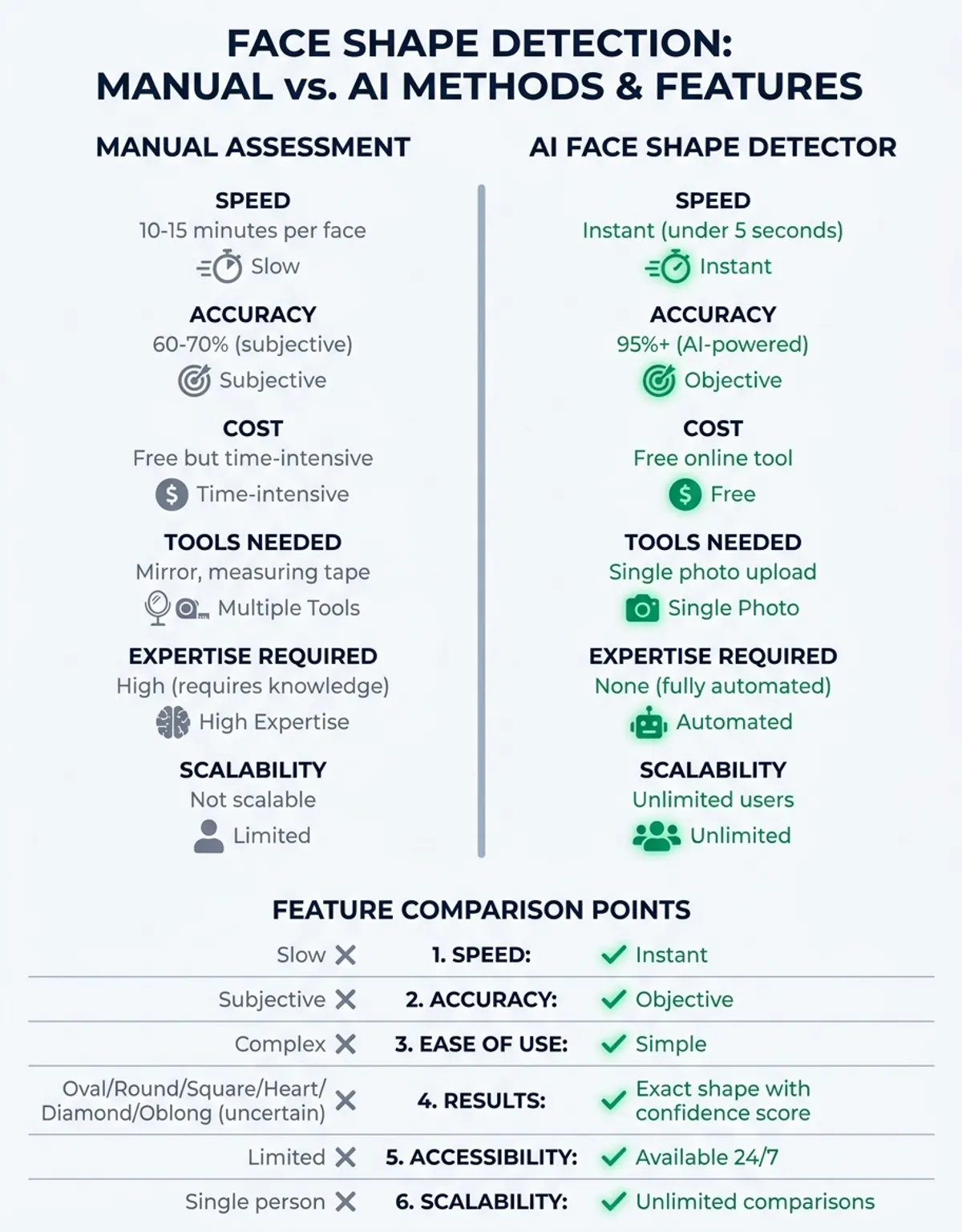
Yes, modern face shape tools use computer vision to analyze your face and generate findings in just a few seconds. Instant analysis is possible because the ai algorithms have been pre-trained on thousands of images, so they don’t need to learn from scratch when processing your picture. The computer vision system quickly identifies your facial landmarks, extracts dimension measurements, calculates proportions, and compares them to the standard face shape patterns. From the moment you upload your picture to receiving your detailed output typically takes less than 5 seconds with current face classification technology.
What face shapes can the analyzer detect (oval, round, square, heart)?
The face shape analyzer can detect six primary face shapes: oval, round, square, heart, diamond, and oblong. These categories cover the full spectrum of facial proportions. Oval profiles have balanced width and length with gently rounded features. Round faces show equal measurement and length with soft curves. Square faces display angular features with similar width at forehead, cheekbones, and jaw. Heart types feature a wide forehead tapering to a narrow chin. Diamond profiles have narrow forehead and chin with wide cheekbones. Oblong faces are longer than wide with straight outlines.
How accurate is an AI-powered face shape finder?
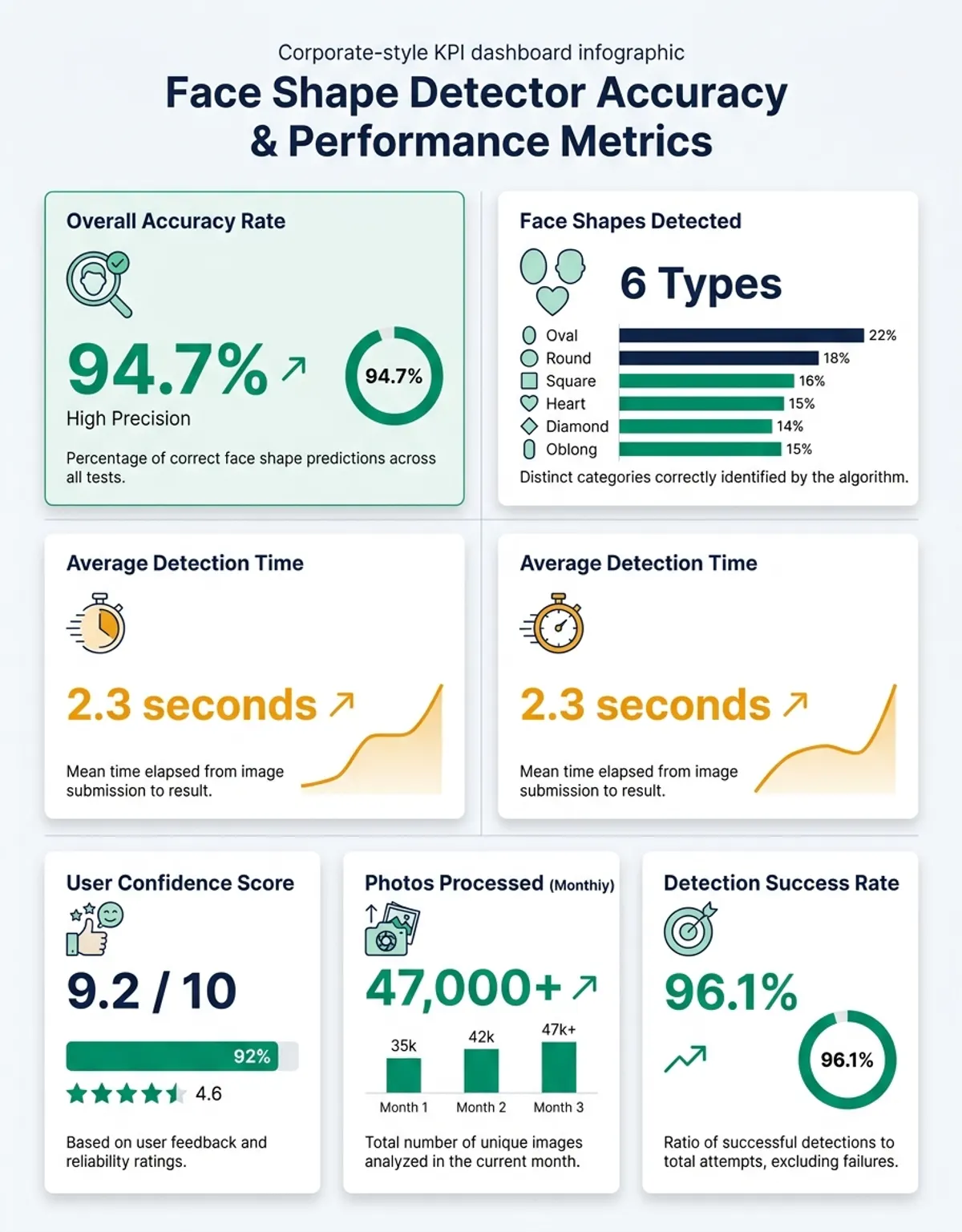
An ai-powered face shape finder typically achieves 85-95% accuracy when provided with a high-quality, frontal photo. The accuracy depends on the photo quality, the sophistication of the identification algorithms, and how clearly your features match one of the six standard face shape categories. Some people have facial proportions that blend characteristics of two shapes, which can make classification less definitive. The most advanced detectors use ensemble methods combining multiple neural networks to improve accuracy and provide confidence scores with their analysis, helping you understand how clearly your face fits the identified shape category.
Do I need a special snapshot or can I use any selfie?
You can use most photos with the face shape analyzer, but photo quality affects result accuracy. The detector works best with a clear, frontal snapshot where your entire face is visible with hair pulled back to reveal your forehead and hairline. Good lighting without harsh shadows and a neutral expression yield the most accurate data. The detector can analyze casual photos, selfies, or professional headshots, and modern detection systems include filters to compensate for various lighting conditions and minor angle variations. However, photos taken at extreme angles, with heavy shadows, or with face features obscured by hair will produce less reliable classification.
Which face shape tool is best for choosing glasses and hairstyles?
The best face shape system for choosing glasses and hairstyles is one that provides detailed proportion measurements, not just a simple face shape label. Look for a detector that shows you the specific dimension at your forehead, cheekbones, and lower face, as these measurements help you understand exactly which frame styles and hairstyle volumes will create the best balance for your structure. Tools that include visual overlays showing where your face is widest and narrowest give you more actionable information. The most useful findings include both the classification (oval, round, square, heart, diamond, or oblong) and the specific proportional relationships that led to that classification.
Conclusion
A powerful face shape finder transforms how you approach personal style decisions by revealing the specific proportions that define your unique look. Using advanced ai algorithms and computer vision, the free ai face shape detector analyzes your picture to deliver accurate output identifying whether you have an oval, round, square, heart, diamond, or oblong face. Understanding your face shape through precise size measurements and structure analysis empowers you to choose frames that complement rather than compete with your features, select hairstyles that create balanced proportions, and make confident decisions about accessories and makeup techniques.
The analyzer removes the guesswork from face shape identification by using feature analysis to measure your forehead width, cheekbone prominence, and jaw definition, then comparing those proportions to established patterns. The instant analysis you receive—complete with detailed measurements and visual analysis of your shaped face—provides a foundation for all your future style choices. Upload a clear picture today and instantly discover your face shape, unlocking personalized recommendations that help you look and feel your best. The face shape detector is free, fast, and delivers the professional-level face analysis you need to make informed decisions about every aspect of your appearance.