
Face Recognition Technology: Azure, Microsoft & Image Search Solutions
Your comprehensive guide to facial recognition technology, cloud platforms, and implementation strategies for modern applications.
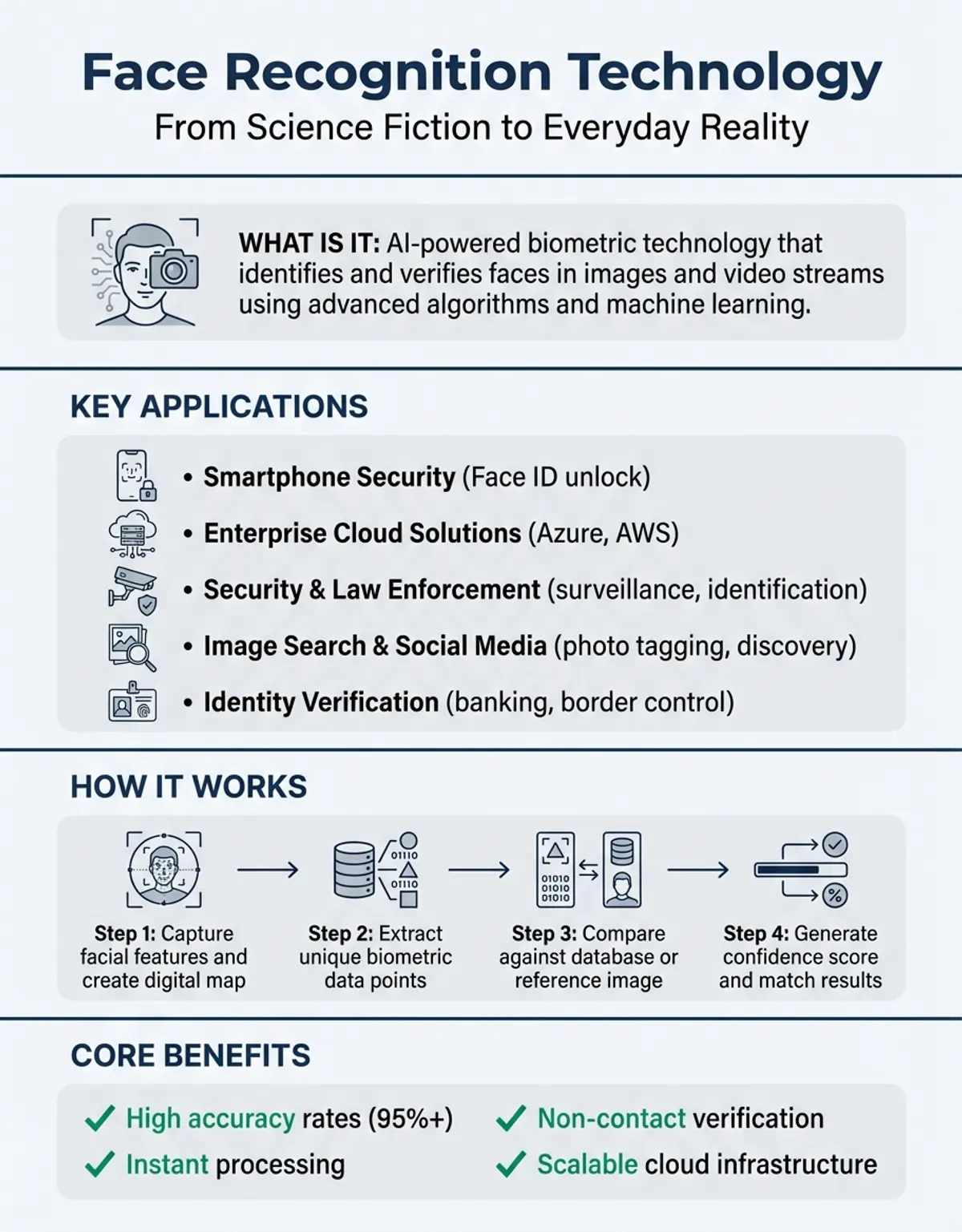
Face recognition has revolutionized how we interact with technology, providing seamless authentication and powerful search capabilities across digital platforms. From Microsoft Azure cloud solutions to advanced face search engines, this technology transforms how we identify and verify human faces in digital images and video frames. Whether you're looking to upload a photo for facial recognition or implement biometric security solutions, understanding the landscape of face recognition technology is essential for making informed decisions about software and analytics platforms.
Modern face recognition systems leverage sophisticated algorithms to detect and match facial features with remarkable accuracy. These solutions span from consumer-facing apps to enterprise-grade cloud platforms, offering capabilities ranging from simple photo organization to complex security implementations. The technology continues to evolve, with providers like Microsoft and Azure leading innovation in facial recognition analytics and identification systems.
Understanding Azure in Face Recognition
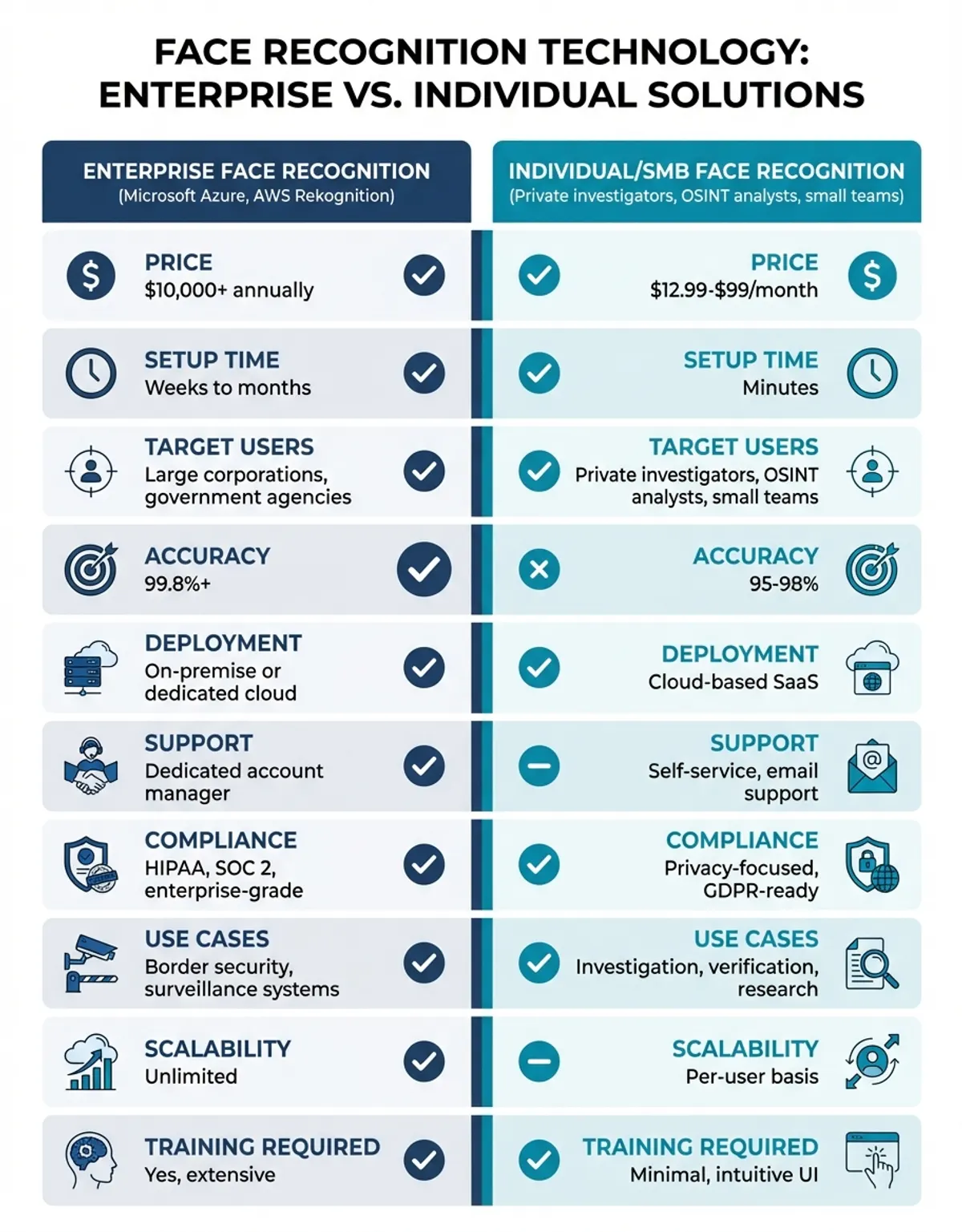
Microsoft Azure stands as one of the most comprehensive cloud platforms for face recognition technology, offering developers and enterprises robust tools for implementing facial recognition capabilities. Azure Face API provides advanced algorithms that can detect, recognize, and analyze human faces within digital images and video content. The platform integrates seamlessly with other Azure services, creating a complete ecosystem for building sophisticated biometric applications.
Azure's face recognition service excels in several key areas, including face detection that identifies human faces in images, face verification that confirms whether two faces belong to the same person, and face identification that matches a person against a database of faces. The technology behind Azure face recognition utilizes deep learning models trained on massive datasets, enabling it to handle variations in lighting, angle, and facial expressions. For organizations seeking enterprise-grade security and analytics, Azure delivers cloud-based solutions that scale efficiently while maintaining high accuracy rates.
Developers implementing Azure face recognition benefit from comprehensive documentation, sample code, and straightforward API integration. The platform supports multiple programming languages and frameworks, making it accessible whether you're building mobile apps, web applications, or backend services. Azure also provides advanced features like emotion detection, age estimation, and facial landmark identification, expanding the potential use cases beyond basic recognition. The cloud infrastructure ensures that processing power scales automatically based on demand, eliminating concerns about server capacity during peak usage periods.
Security features within Azure face recognition include encryption of facial data both in transit and at rest, compliance with major data protection regulations, and granular access controls. Organizations can configure their Azure face recognition instances to meet specific privacy requirements, including options for data residency and retention policies. The platform's analytics capabilities allow businesses to track usage patterns, monitor accuracy metrics, and optimize their facial recognition implementations over time. For companies prioritizing both functionality and data protection, Azure offers a compelling balance of advanced technology and robust security measures.
Understanding Face Search in Face Recognition
Face search represents a powerful application of face recognition technology, enabling users to locate specific individuals across vast collections of images and video content. Unlike traditional image search methods that rely on metadata or surrounding text, face search analyzes the actual visual features of human faces to find matches. This technology has applications ranging from organizing personal photo libraries to conducting security investigations, making it valuable for both consumer and professional contexts.
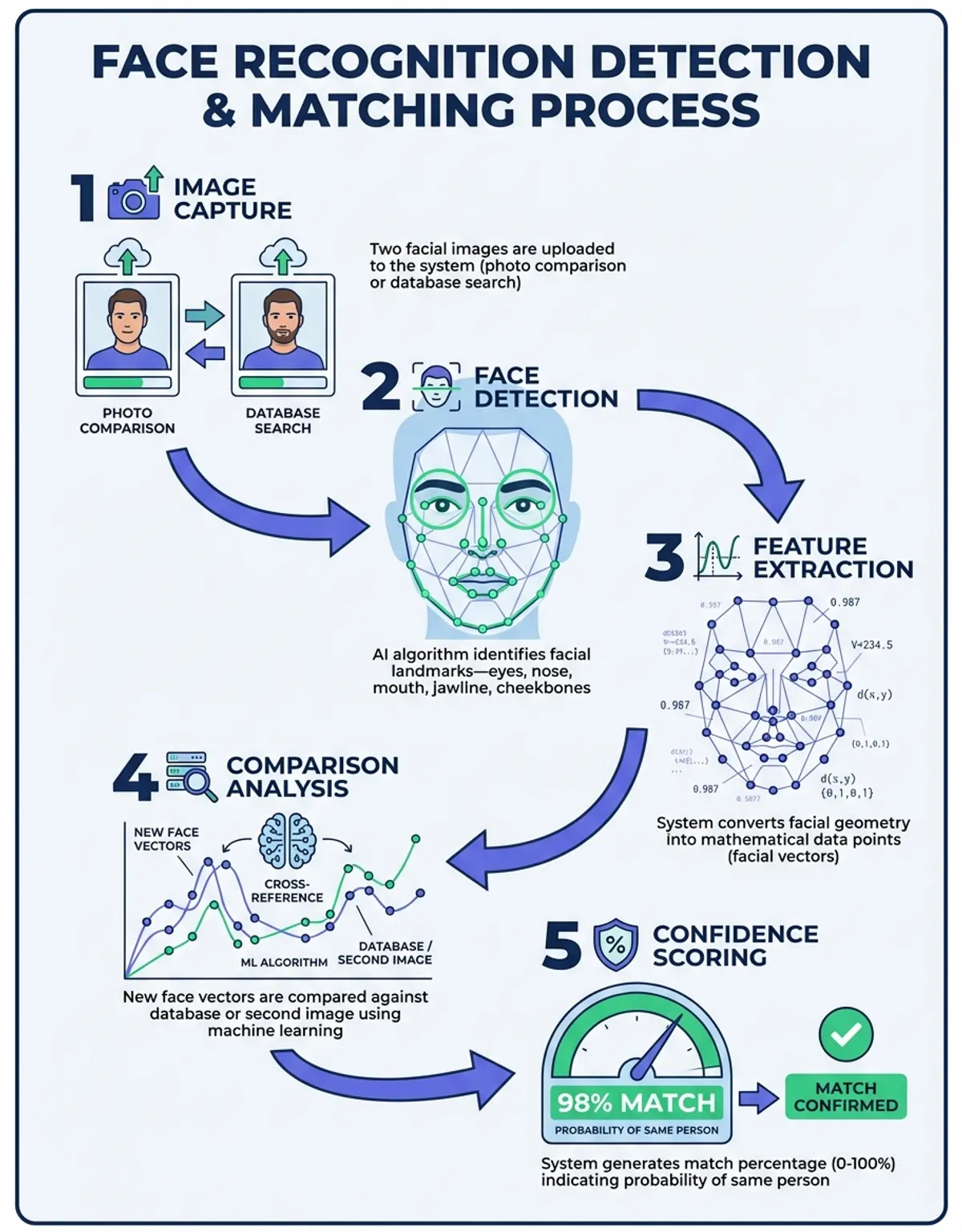
Advanced face search engines can process millions of images rapidly, comparing facial features against query photos to identify potential matches. The technology works by extracting facial landmarks—unique points like eye corners, nose tip, and mouth edges—and converting these into mathematical representations called face embeddings. When you initiate a face search, the system compares these embeddings to find similar faces, ranking results by confidence scores. Modern face search systems incorporate machine learning to improve accuracy over time, learning from user feedback and corrections.
Implementing face search requires balancing accuracy with speed, particularly when dealing with large image databases. Cloud-based face search solutions like those offered through Microsoft Azure leverage distributed computing to handle searches across billions of images within seconds. The technology must also account for variations in photo quality, facial expressions, aging, and accessories like glasses or hats. Sophisticated face search algorithms use multiple detection models to handle these challenges, ensuring reliable results even with imperfect input images.
Privacy considerations play a crucial role in face search implementations, with responsible platforms incorporating consent mechanisms and transparent data usage policies. Users should understand what happens to uploaded photos, how long facial data is retained, and who has access to search results. Leading face search platforms provide clear documentation about their data practices and offer controls for managing personal information. For organizations deploying face search technology, establishing ethical guidelines and compliance protocols is essential for maintaining user trust while leveraging the power of facial recognition analytics.
Microsoft Azure delivers cloud-based solutions that scale efficiently while maintaining high accuracy rates for facial recognition implementations.
Understanding Microsoft in Face Recognition
Microsoft has established itself as a leader in face recognition technology through continuous innovation and investment in artificial intelligence research. The company's facial recognition solutions span consumer products, enterprise platforms, and research initiatives, demonstrating a comprehensive approach to advancing this technology. Microsoft's expertise in machine learning and computer vision translates into face recognition systems that balance accuracy, speed, and ethical considerations.
Through Microsoft Azure, the company delivers cloud-based face recognition services that organizations worldwide use for security, analytics, and user experience enhancements. Microsoft Face API, part of the Azure Cognitive Services suite, provides developers with pre-trained models that can detect and recognize faces without requiring deep expertise in machine learning. This democratization of advanced technology enables smaller teams and startups to implement sophisticated facial recognition features that would otherwise require significant research and development resources.
Microsoft has also been vocal about responsible AI development, publishing principles for ethical facial recognition use and even calling for government regulation of the technology. The company's approach emphasizes transparency, accountability, and fairness, addressing concerns about bias and misuse. Microsoft invests in testing its face recognition algorithms across diverse demographics to identify and reduce potential biases, working to ensure the technology performs equitably regardless of race, gender, or age. This commitment to responsible development sets standards for the industry while advancing the technical capabilities of facial recognition systems.
Beyond Azure, Microsoft integrates face recognition into consumer products like Windows Hello, which uses biometric authentication to unlock devices. This implementation demonstrates how facial recognition can enhance security and convenience in everyday technology. The company continues to research next-generation face recognition techniques, exploring areas like 3D facial scanning, improved low-light performance, and reduced computational requirements for edge devices. Microsoft's ongoing contributions to face recognition research and practical applications position it as a key player shaping the future of this transformative technology.
Understanding Image Search in Face Recognition
Image search capabilities enhanced with face recognition technology create powerful tools for discovering visual content based on who appears in photos and videos. Traditional image search relied primarily on file names, alt text, and surrounding content, but modern systems analyze the actual visual elements, including human faces, to deliver more accurate results. This integration of facial recognition into image search transforms how users locate specific photos and how businesses organize visual content.
When you perform an image search with facial recognition, the system first detects any faces present in query images or search targets. It then extracts distinctive facial features and compares these against indexed content. Advanced image search platforms maintain databases of facial embeddings, allowing rapid matching even across massive image collections. This technology powers features like finding all photos of a specific person in a photo library or locating similar faces across different images and contexts.
Cloud platforms like Azure enable scalable image search implementations that can process millions of photos efficiently. Organizations use these capabilities for applications ranging from digital asset management to security monitoring. The technology must handle various challenges, including different image resolutions, partial face visibility, and aging progression. Machine learning models trained on diverse datasets help image search systems recognize faces across these variations, improving reliability for real-world applications.
Privacy and consent are particularly important for image search systems that incorporate facial recognition. Users should control whether their faces are indexed for searching and have mechanisms to request removal from face search databases. Responsible image search platforms provide transparency about how facial data is collected, stored, and used, along with options for managing personal information. As image search technology continues evolving, balancing powerful functionality with user privacy remains a critical challenge for developers and platform providers.
Understanding Images in Face Recognition
The quality and characteristics of images fundamentally impact face recognition performance, making understanding image requirements essential for successful implementations. Face recognition algorithms analyze digital images to identify and verify human faces, but factors like resolution, lighting, angle, and compression significantly affect accuracy. Organizations deploying facial recognition systems must consider these image-related variables when designing their solutions and setting user expectations.
High-quality images with clear facial features enable more accurate face recognition results. Systems typically perform best with well-lit, front-facing photos where the entire face is visible and in focus. However, real-world scenarios often involve less-than-ideal images—photos taken from angles, in low light, or with partial face visibility. Advanced face recognition platforms use sophisticated algorithms to extract features even from challenging images, though accuracy naturally decreases as image quality declines. Understanding these limitations helps users and developers set realistic expectations for their facial recognition applications. For important context, read our analysis of the ethical issues with face recognition technology.
Different image formats and resolutions impact face recognition processing speed and accuracy. While systems can work with various file types, certain formats preserve more image detail than others. Cloud platforms like Azure handle format conversion and optimization automatically, but being aware of how images are processed helps optimize applications. For video-based face recognition, extracting frames at appropriate intervals balances processing requirements with detection accuracy, ensuring systems can identify faces without overwhelming computational resources.
Pre-processing images before face recognition analysis can improve results significantly. Techniques like contrast enhancement, noise reduction, and face alignment help algorithms work more effectively. Many modern face recognition services include automated pre-processing, but understanding these steps helps developers troubleshoot issues and optimize their implementations. As imaging technology advances with better smartphone cameras and higher-resolution sensors, face recognition systems can leverage increasingly detailed images for more accurate and reliable facial analysis and identification.
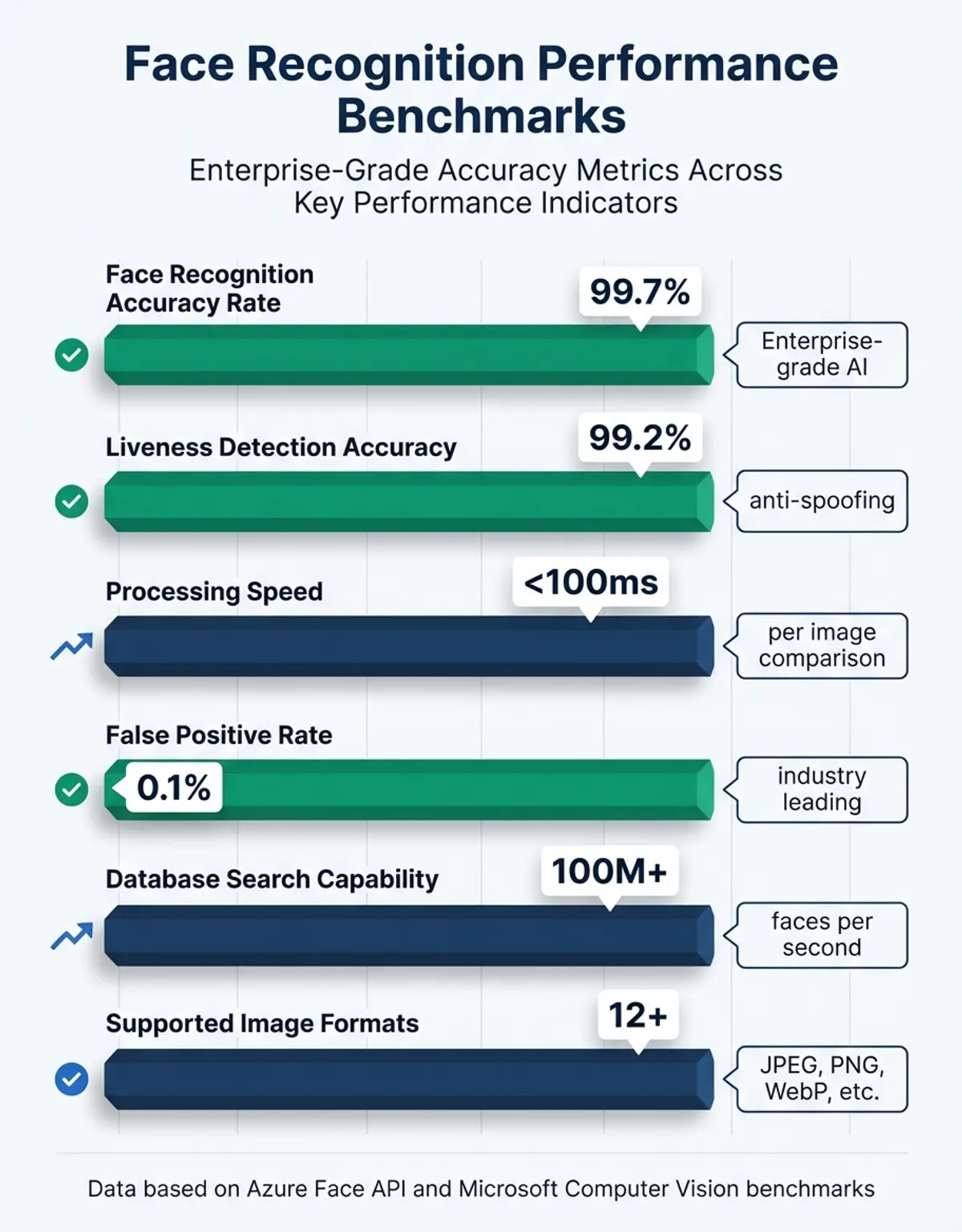
Face search technology can process millions of images rapidly, comparing facial features against query photos with remarkable precision.
Understanding Reverse Image Search in Face Recognition
Reverse image search combined with face recognition creates powerful tools for finding information about people and identifying where specific faces appear online. While traditional reverse image search finds visually similar images, adding facial recognition capability allows systems to specifically match human faces across different contexts, backgrounds, and even artistic representations. This technology serves various purposes, from verifying online profiles to finding unauthorized uses of personal photos.
When you upload a photo for reverse image search with facial recognition, the system extracts facial features and searches for matching or similar faces across indexed images. Unlike keyword-based search, this approach doesn't require any metadata—the facial features themselves serve as the search criteria. Advanced reverse image search platforms can find the same person even when they appear in completely different settings, wearing different clothing, or photographed from various angles. The technology underpinning this capability relies on sophisticated neural networks trained to recognize invariant facial characteristics.
Several specialized reverse image search engines focus specifically on facial recognition, indexing billions of publicly available images to enable face-based searches. These platforms raise important privacy considerations, as they can potentially reveal where someone's photos appear online without their explicit consent. Users should understand the implications of using reverse image search for faces, including potential privacy impacts for both themselves and others who might appear in searched images. Responsible platforms implement safeguards like requiring verification before displaying results and providing mechanisms for individuals to request removal of their images.
For businesses and organizations, reverse image search with facial recognition offers valuable applications including brand protection, identity verification, and security monitoring. Companies can detect unauthorized use of branded imagery, verify user-submitted photos, and identify potential security threats. As with other face recognition applications, implementing reverse image search requires careful attention to legal and ethical considerations, particularly regarding consent and data protection regulations. The technology continues evolving, with improvements in cross-platform searching and better handling of facial variations making reverse image search increasingly powerful and accessible.
Understanding Technology in Face Recognition
Face recognition technology builds on decades of computer vision research, combining advances in machine learning, neural networks, and image processing. Modern systems use deep learning architectures specifically designed for facial analysis, trained on massive datasets to recognize patterns and features that distinguish individual faces. Understanding the underlying technology helps users make informed decisions about which face recognition solutions best meet their needs and limitations.
At its core, face recognition technology works through several stages: face detection identifies where faces appear in images, feature extraction captures distinctive facial characteristics, and matching compares these features against known faces. Deep neural networks excel at these tasks because they can learn hierarchical representations—detecting basic edges and shapes in early layers, then progressively identifying more complex features like eyes, noses, and overall facial structure. This approach enables systems to recognize faces across variations in lighting, expression, and angle that would confuse simpler algorithms.
Cloud platforms like Microsoft Azure deliver face recognition technology as accessible APIs, abstracting away complex implementation details while providing powerful capabilities. This technology-as-a-service model allows developers to integrate sophisticated facial recognition without building and training models from scratch. The underlying technology continues advancing rapidly, with improvements in accuracy, speed, and resource efficiency. Modern face recognition systems can process images in milliseconds and achieve accuracy rates exceeding human performance in controlled conditions.
Emerging technology trends in face recognition include enhanced privacy-preserving techniques, improved performance with low-quality images, and specialized algorithms for specific use cases. Research into federated learning enables face recognition model training without centralizing sensitive facial data, addressing privacy concerns while improving system performance. 3D face recognition technology using depth sensors promises better resistance to spoofing and improved accuracy. As face recognition technology matures, we see increasing focus on responsible development, with tools for detecting and mitigating bias ensuring the technology works equitably across diverse populations. For a deeper dive into the constraints and challenges of these systems, see our comprehensive guide on limitations of face recognition software.
Understanding Security in Face Recognition
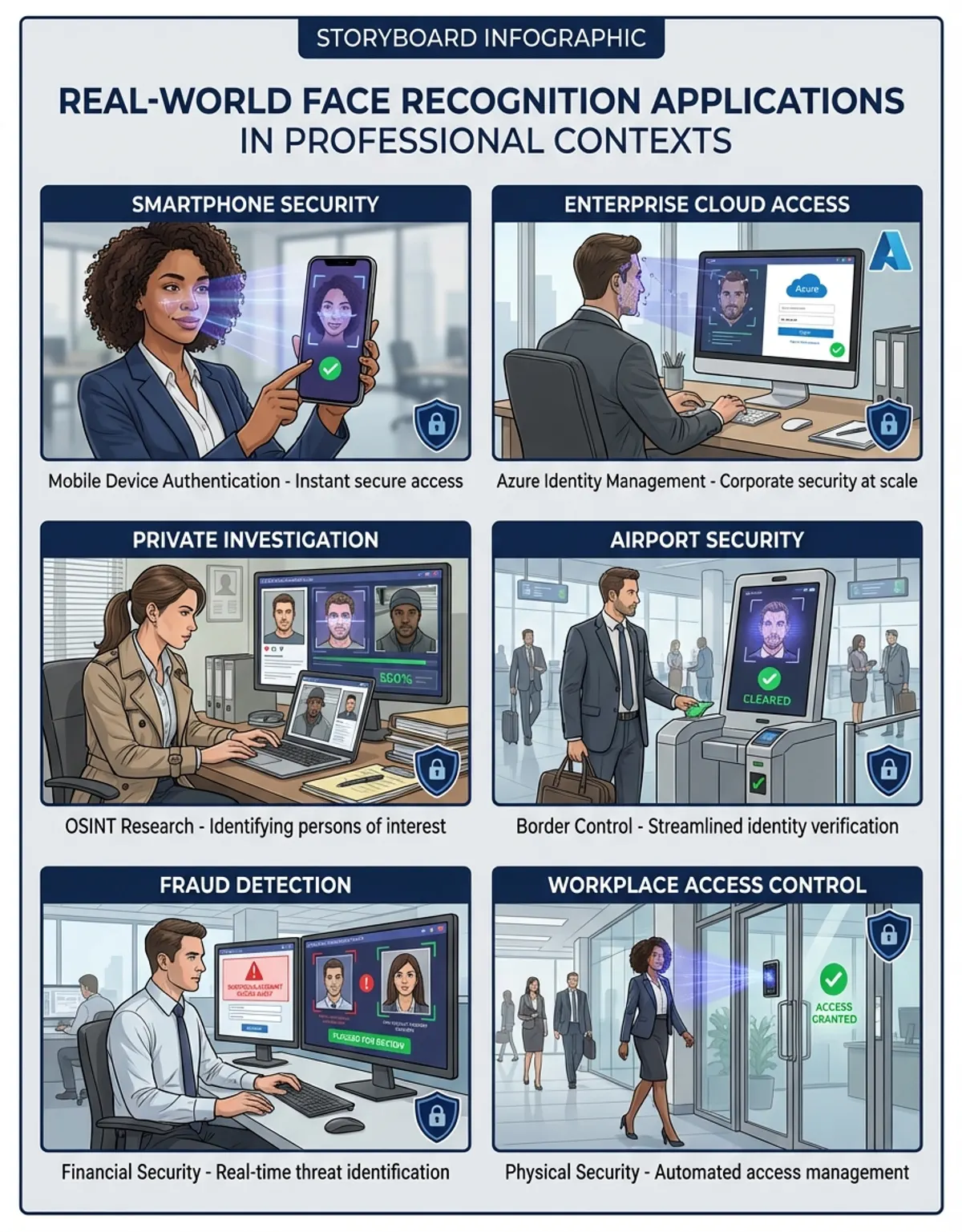
Security considerations permeate every aspect of face recognition systems, from protecting stored facial data to preventing unauthorized access and spoofing attempts. Organizations implementing facial recognition must address multiple security dimensions: safeguarding biometric data, ensuring system integrity, preventing fraudulent authentication, and complying with data protection regulations. Comprehensive security measures are essential for maintaining user trust and protecting against both technical attacks and privacy violations.
Biometric data security requires robust encryption and access controls since facial templates, if compromised, cannot be changed like passwords. Leading face recognition platforms encrypt facial data both in transit and at rest, use secure key management, and implement strict access policies limiting who can view or process biometric information. Cloud providers like Microsoft Azure maintain extensive security certifications and undergo regular audits, providing transparency about their security practices. Organizations should verify that their face recognition providers meet relevant security standards and compliance requirements for their industry and jurisdiction.
Preventing spoofing attacks—attempts to fool face recognition systems using photos, videos, or masks—represents another crucial security challenge. Advanced systems incorporate liveness detection that verifies an actual person is present rather than a representation. Techniques include analyzing micro-movements, checking for depth using structured light or infrared, and detecting unnatural patterns in images. Multi-factor authentication combining face recognition with other verification methods provides additional security layers, ensuring that even if one factor is compromised, overall system security remains intact.
Data protection regulations like GDPR and CCPA impose specific requirements on how organizations collect, store, and use biometric data including facial recognition information. Compliance requires implementing data minimization principles, obtaining appropriate consent, providing transparency about data usage, and enabling users to access and delete their data. Security practices must also address insider threats through access logging, separation of duties, and regular security training. As face recognition technology becomes more prevalent, maintaining rigorous security standards protects both organizations and the individuals whose facial data these systems process and analyze.
Modern face recognition systems achieve accuracy rates exceeding human performance in controlled conditions through deep learning advances.
Comparison of Face Recognition Platforms
| Platform | Primary Features | Pricing Model | Best For | API Availability |
|---|---|---|---|---|
| Microsoft Azure Face API | Face detection, verification, identification, emotion detection | Pay-per-use with free tier | Enterprise applications, developers needing scalable cloud solutions | REST API, SDKs for major languages |
| Amazon Rekognition | Face analysis, face comparison, face search in collections | Pay-per-image analyzed | AWS ecosystem users, video analysis | REST API, AWS SDK integration |
| Google Cloud Vision AI | Face detection, landmark detection, emotion inference | Tiered pricing based on volume | Google Cloud users, mobile apps | REST API, client libraries |
| Face++ | Face detection, recognition, analysis, 3D reconstruction | Freemium with paid tiers | Developers, Asian market applications | REST API, mobile SDKs |
| Kairos | Face recognition, emotion analysis, demographics | Subscription-based | Retail analytics, security applications | REST API, JavaScript SDK |
| OpenCV (Open Source) | Face detection, recognition algorithms | Free and open source | Developers wanting full control, research | C++, Python, Java libraries |
Frequently Asked Questions
How does digital image processing work in face recognition?
Digital image processing in face recognition begins when you upload a photo or capture a video frame. The system converts the image into a numerical representation that algorithms can analyze, typically breaking it down into pixels with specific color values. Face recognition software applies filters and transformations to enhance features, normalize lighting, and reduce noise. The processed digital image then undergoes face detection, where algorithms scan for patterns indicating the presence of human faces. Once faces are detected, the system extracts specific facial landmarks—points around eyes, nose, mouth, and face contours. These landmarks convert into mathematical descriptors that the recognition algorithm compares against stored templates. Advanced systems can process digital images in various formats and resolutions, automatically adjusting for optimal analysis.
How does human face detection and recognition technology identify individuals?
Human face detection and recognition work through a multi-stage process that mimics, and in some ways surpasses, how humans recognize faces. First, the system detects human faces within images by identifying patterns characteristic of facial structures—oval shapes, specific color distributions, and symmetry. Once a face is detected, the technology measures the geometry of facial features including the distance between eyes, nose width, cheekbone shape, and jaw line. These measurements create a unique facial signature or template. When matching faces, the system compares these templates against databases using sophisticated algorithms that account for variations in expression, angle, and lighting. Modern systems use deep learning neural networks trained on millions of human faces, enabling them to recognize individuals even years later or across significant changes in appearance. The technology achieves this by focusing on invariant features—characteristics that remain relatively stable despite aging, facial hair, or accessories.
How does video frame analysis enhance face recognition accuracy?
Video frame analysis provides significant advantages for face recognition by offering multiple images of the same person from a continuous stream. When processing video, face recognition systems extract individual frames at regular intervals, typically several frames per second. This multi-frame approach compensates for momentary poor lighting, temporary obstructions, or unfavorable angles that might affect a single photo. By analyzing multiple video frames, the system can select the best quality images for processing or combine information across frames for improved accuracy. Video frame analysis also enables tracking faces across time, following individuals as they move through a scene. This temporal information helps distinguish between different people and maintains consistent identification even when faces briefly leave the frame. Advanced systems use motion analysis from video frames to perform liveness detection, verifying that they're processing an actual person rather than a static photo, which strengthens security against spoofing attempts.
What happens when you upload a photo to a face recognition system?
When you upload a photo to a face recognition system, several automated processes occur in rapid succession. The system first receives and validates the image file, checking format compatibility and file size. Next, pre-processing algorithms prepare the image for analysis, potentially resizing, rotating, or adjusting contrast for optimal face detection. The face detection stage scans the uploaded photo for human faces, identifying their locations within the image. For each detected face, the system extracts facial features and creates a mathematical representation called a face template or embedding. Depending on the application, the system then either stores this template for future comparisons or immediately compares it against existing templates in a database. Cloud-based systems like Azure process uploaded photos on remote servers, returning results through API responses. Throughout this process, security measures encrypt the photo data to protect privacy. Most responsible platforms specify retention policies for uploaded photos, with many deleting images after processing while retaining only anonymized facial templates for matching purposes.
How does facial recognition technology differ from other biometric methods?
Facial recognition technology offers unique advantages and trade-offs compared to other biometric identification methods like fingerprints, iris scans, or voice recognition. Unlike fingerprint or iris scanning, facial recognition can work passively at a distance without requiring physical contact or user cooperation, making it more convenient for certain applications like security monitoring or photo organization. However, facial recognition typically achieves lower accuracy rates than fingerprint or iris recognition in controlled environments, though the gap narrows with advancing technology. Facial recognition also faces challenges from aging, facial hair, accessories, and expression changes that don't affect other biometrics. The technology excels in scenarios where you need to identify people in existing photos or videos, whereas other biometric methods require purpose-built capture devices. Privacy considerations differ too—faces are publicly visible and easily captured without consent, unlike fingerprints or iris patterns. Modern security implementations often combine facial recognition with other biometric or authentication methods, leveraging the convenience of face matching while maintaining high security standards through multi-factor approaches.
How does matching work in face recognition algorithms?
Matching in face recognition algorithms involves comparing facial feature representations to determine whether faces belong to the same person or to identify an individual from a database. The process begins with feature extraction, where the algorithm converts detected faces into numerical vectors called embeddings or templates. These embeddings capture distinctive facial characteristics in a format optimized for comparison. During matching, the algorithm calculates similarity scores between embeddings, typically using distance metrics like Euclidean distance or cosine similarity. A smaller distance indicates more similar faces, suggesting they likely belong to the same person. The system compares these distance values against threshold settings that balance accuracy with error rates. For verification tasks (confirming if two faces match), the algorithm makes a binary decision based on whether the similarity exceeds the threshold. For identification tasks (finding a specific person in a database), the system compares the query face against all stored templates, ranking results by similarity scores. Advanced matching algorithms use machine learning to optimize these processes, adapting thresholds based on image quality and incorporating confidence scores that help applications make informed decisions about match reliability.
How does the technology recognize a user's face across different conditions?
Recognizing a user's face across varying conditions requires sophisticated algorithms that account for changes in lighting, angle, expression, and appearance. Face recognition systems achieve this through several techniques. First, they normalize images during pre-processing, adjusting for lighting variations and standardizing face orientation. The feature extraction stage focuses on invariant characteristics—facial features that remain relatively stable despite condition changes. Deep learning models trained on diverse datasets learn to recognize faces under various conditions by seeing millions of examples with different lighting, angles, and expressions during training. When the system needs to recognize a user's face, it compares essential facial geometry and relationships between features rather than exact pixel patterns, making recognition robust to superficial changes. Advanced systems employ multiple neural network models specialized for different conditions—one for frontal faces, another for profile views, and additional models for challenging lighting scenarios. Some platforms also use 3D modeling to understand facial structure beyond what's visible in a single 2D image. By combining these approaches, modern face recognition technology successfully identifies users across the varied conditions encountered in real-world applications, from bright outdoor settings to dim indoor environments, and from straight-on selfies to angled security camera footage.
Conclusion
Conclusion
Face recognition technology has evolved into a powerful and versatile tool that transforms how we interact with digital systems, secure our devices and facilities, and organize visual content. From Microsoft Azure cloud platforms to specialized face search engines, the ecosystem of facial recognition solutions offers options for virtually every use case and scale. Understanding the underlying technology, security considerations, and practical applications enables informed decisions about implementing face recognition in business and personal contexts. Explore all our face recognition and comparison tools at CaraComp.
As you explore face recognition solutions, consider factors like accuracy requirements, privacy implications, integration complexity, and scalability needs. Cloud platforms provide accessible entry points for developers and organizations, while specialized tools address specific needs like reverse image search or video analytics. The technology continues advancing rapidly, with improvements in accuracy, speed, and ethical safeguards making facial recognition more reliable and responsible. Whether you're securing a mobile app, organizing photos, or implementing enterprise security, modern face recognition technology offers powerful capabilities backed by robust platforms like Microsoft Azure and continuously evolving artificial intelligence research.