
Diamond Face Shape: How to Identify It and Style It
One of nature's rarest silhouettes — strikingly angular, boldly photogenic, and defined by cheekbones that command every room.
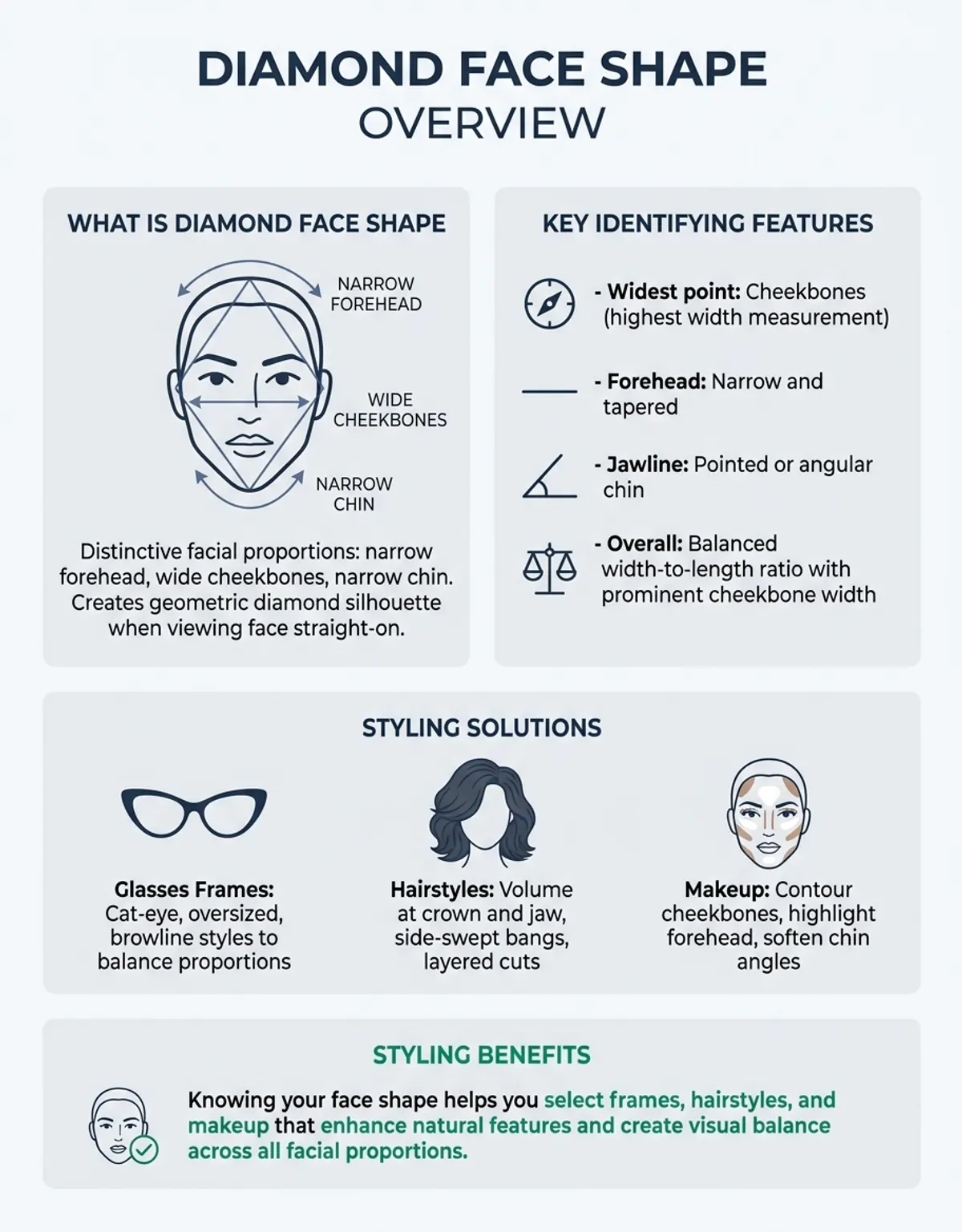
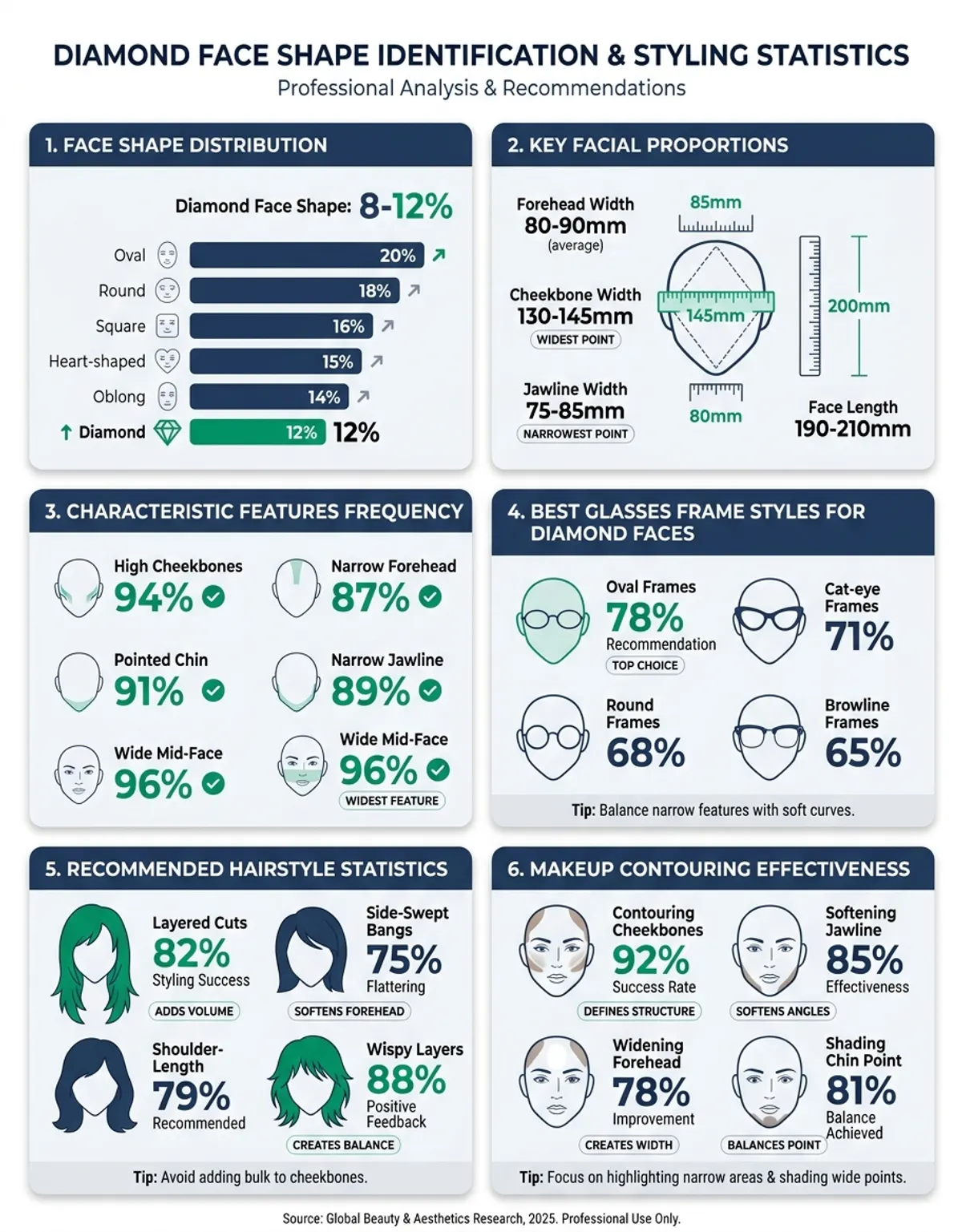
The diamond face shape stands out as one of the rarest profiles across all recognized face shapes. Defined by dramatically wide, prominent cheekbones, a narrow forehead, and a tapered, narrow chin, this face type carries a bold aesthetic that photographs well and commands attention in person. The cheekbones form the broadest horizontal point — clearly wider than both the forehead and jawline, giving the silhouette its sharp, angular quality. This resource covers how to confirm you have a diamond face, how it compares to other profiles, and which glasses frames, hairstyles, and contouring approaches work best for its distinctive proportions.
What Is a Diamond Face Shape? Understanding the Structure and Type
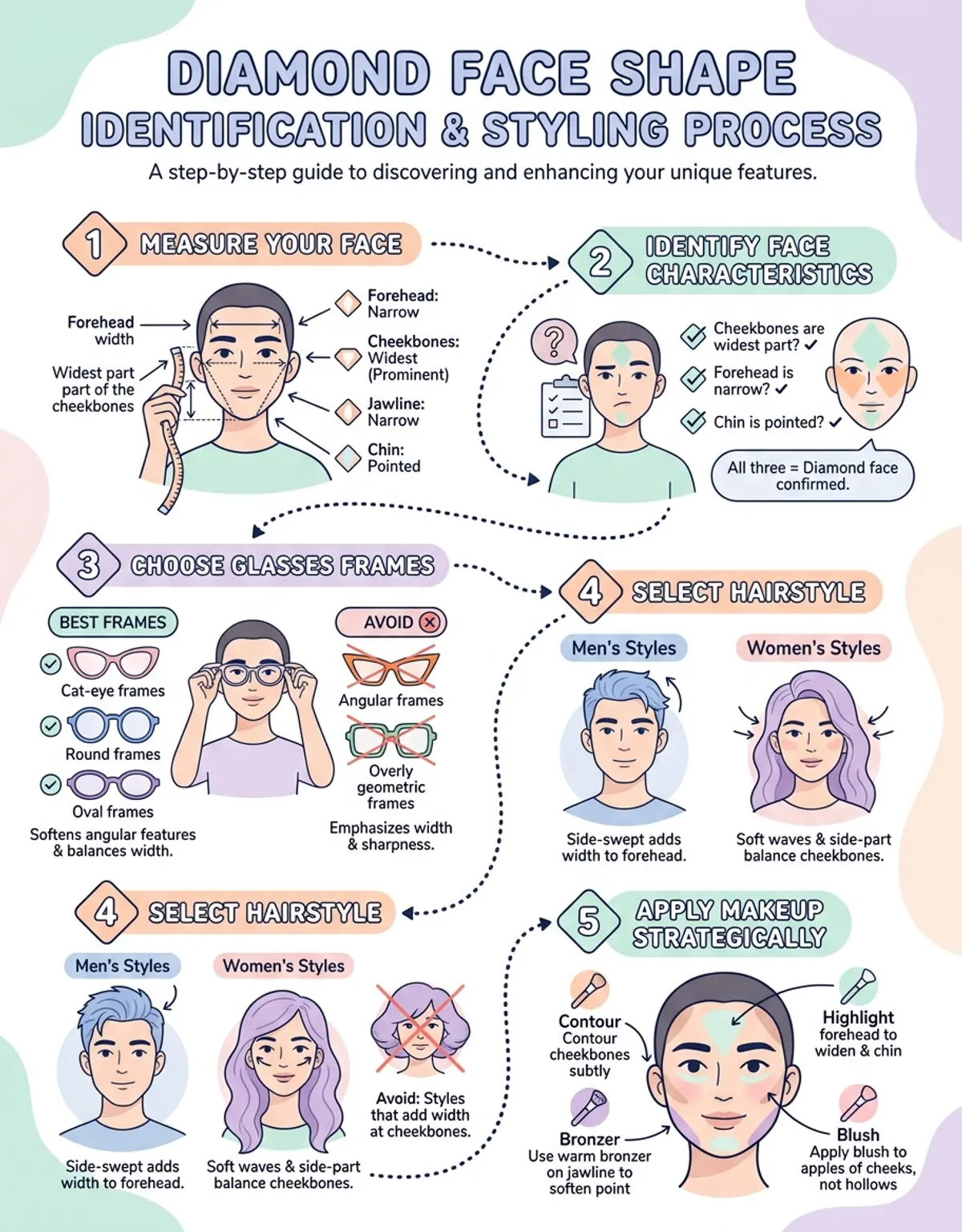
The diamond face shape takes its name from the geometric figure — narrow at both ends with the greatest width in the center. The defining structure is a narrow forehead, dramatically wide cheekbones at the face's maximum horizontal span, and a jawline that tapers to a narrow, pointed chin. The overall proportions produce a face longer than it is wide, a quality that diamond shapes share with oval facial structures but with sharper contrasts at different levels.
This structure is anchored by cheekbone dominance, the core of a diamond face shape. The cheekbones represent the face's greatest horizontal width — measurably wider than the forehead and lower jaw. Unlike oval profiles, which transition gently between measurements, the diamond shows an abrupt jump in breadth at the cheekbone level compared to the narrower regions above and below. The structural contrast between wide cheekbones and a narrow forehead is the visual signature of this diamond face shape among all face shapes.
Understanding this structural foundation informs every styling decision — from choosing frames that complement rather than compete with the cheekbones to selecting hairstyle volume placement that improves proportional balance across the face.
The structural contrast between dramatically wide cheekbones and a narrow forehead is the visual signature of the diamond face — one of the rarest and most photogenic profiles in existence.
Key Characteristics of Diamond Faces: Angular and Distinct
Diamond faces share a consistent set of recognizable traits that distinguish them from other facial profiles:
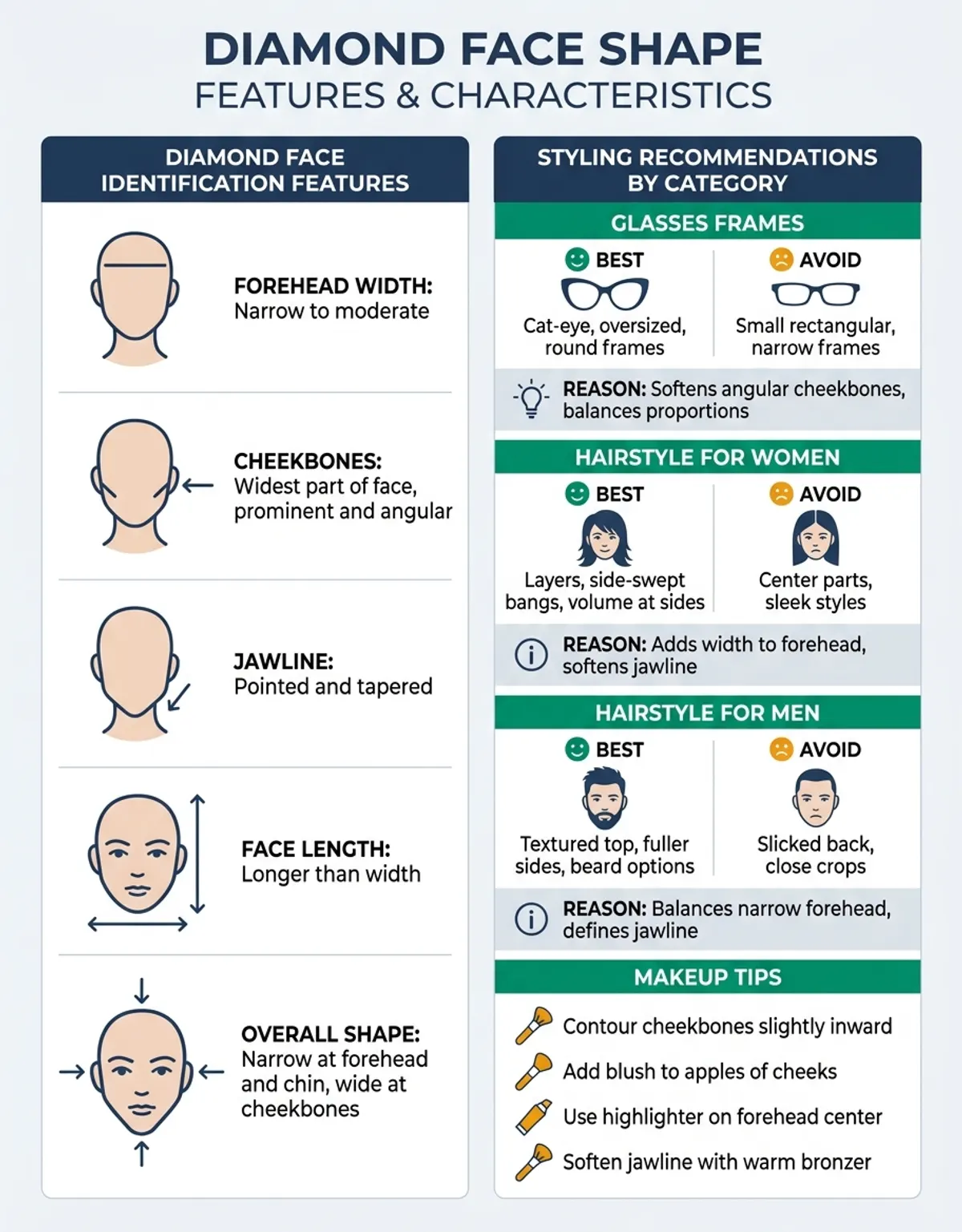
- Dramatically wide, prominent cheekbones: The cheekbones are the widest element and sit high on the face. The cheekbone width is the dominant horizontal measurement and the defining feature of this profile.
- Narrow forehead: Diamond faces have a forehead that is clearly narrower than the cheekbone span. A central hairline point can accentuate this further, making the tapering at the top even more visible.
- Narrow, pointed chin: The face narrows to a pointed chin that mirrors the narrow forehead. This tapered chin is one of the most recognizable traits of this shape.
- Angular bone structure: The overall bone structure is angular rather than soft or rounded. The sculpted angles at the cheekbones and jawline give this shape its sharp, photogenic quality.
- Longer than wide: The face length exceeds the maximum cheekbone span. This elongated proportion, combined with the dramatic cheekbone breadth, is consistent across this category of faces.
- High cheekbone placement: The cheekbones sit in the upper-middle portion of the face rather than at the midpoint. This high placement creates the characteristic elongated diamond silhouette.
These traits combine to produce one of the rarest and most visually compelling face shapes. The angular bone structure and prominent cheekbones make a diamond face highly photogenic and expressive.
How to Identify Your Diamond Face Shape at Home: Guides and Tips
You can confirm your face shape at home using a flexible measuring tape and a mirror. The following guides walk you through the key measurements:
Measuring Your Cheekbone Width and Key Facial Proportions
- Forehead width: Measure across your forehead from the outer edge of one brow arch to the outer edge of the other. Record this as your forehead width.
- Cheekbone width: Place the tape at the outermost point of one cheekbone and measure to the outermost point of the other. This cheekbone measurement is the most important measurement for identifying a diamond face shape.
- Jaw width: Measure across the widest point of your jaw, typically just below your ears. Note this jaw width value.
- Chin span: Measure the breadth of your chin at its base. Note whether the chin is narrow and comes to a point, or is fuller and rounded.
- Face length: Measure from the center of the hairline straight down to the tip of the chin. Compare this to the cheekbone breadth measurement.
If the cheekbone span is clearly the largest of the three horizontal measurements (forehead width, cheekbone measurement, jaw width), your chin is narrow and pointed, and the face length exceeds the maximum width, you very likely have a diamond face shape. If your forehead and jaw are nearly equal in breadth and the cheekbones are only marginally wider, your face type may be oval or heart-shaped instead. For an even quicker check, use our face shape detector tool to get an instant, accurate result.
For a visual check, pull all hair back and trace your diamond face shape outline on a mirror with a washable marker. Diamond profiles produce a silhouette that is wide in the center and narrow at both the top and bottom. These guides work well for most people. If you remain uncertain, CaraComp's AI diamond face shape tool delivers an objective identification from a single uploaded photo.
Diamond Face Shape vs Other Face Shapes: A Complete Guide
Comparing the diamond to other common face shapes clarifies what makes it unique and makes personal identification easier. Below is a side-by-side comparison of five shapes:
| Face Shape | Forehead | Cheekbones | Jawline / Chin | Best Frame Style |
|---|---|---|---|---|
| Diamond | Narrow | Widest point — dramatically wide, prominent | Narrow, tapered, pointed chin | Oval, rimless, cat-eye frames |
| Oval | Slightly wider than chin | Gently wider than forehead | Softly rounded jaw and chin | Most frame styles work well |
| Heart | Wide — widest point | Moderately wide | Narrow, pointed chin | Bottom-heavy frames, aviators |
| Square | Wide, similar to jaw | Wide, relatively flat | Strong, angular, square jaw | Round or oval frames |
| Round | Moderate width | Wide with soft curves | Rounded, soft jaw and chin | Angular, rectangular frames |
Among these five shapes, oval faces are the closest to the diamond. Both are longer than wide and both have their broadest point at the cheekbones. The key difference is the degree of contrast: oval faces transition gently from cheekbones to forehead and jaw with only a modest difference in span, while the diamond shows a dramatic, pronounced jump at the cheekbone level. The oval also has a softer, more rounded jaw, whereas the diamond has a pointed jaw end and sharper defined lines throughout. If your cheekbones are only slightly wider than your forehead, your face type is more likely oval than diamond. Read our dedicated guide on the oval face shape to see a detailed side-by-side comparison of these proportions.
Heart-shaped faces also have a pointed lower jaw, but the heart shape is widest at the forehead — the direct inverse of the diamond face shape. Whether your forehead or cheekbones represent the maximum horizontal span is the fastest way to distinguish this profile from others. Square and round faces have more uniform breadth across their proportions and lack the dramatic cheekbone prominence that marks all diamond face shapes.
Best Glasses and Frames for a Diamond Face Shape
Choosing the right glasses for a diamond face shape means balancing the prominent cheekbones while adding visual span to the narrower forehead and pointed lower jaw. The right frames soften the bold bone structure and create a more harmonious appearance. Here is what to look for.
Best Frame Types for Diamond Faces
- Oval frames: These glasses are among the most flattering for a diamond profile. Their curved design contrasts naturally with the prominent lines of this shape and provides a softening effect at the eye level. A rounded frame keeps attention on the eyes rather than the cheekbones.
- Cat-eye glasses: Cat-eye styles sweep upward and outward at the outer corners, adding visual span at the temple and brow level. This pulls attention upward and away from the prominent cheekbones, and also adds perceived breadth to the narrow forehead.
- Rimless and semi-rimless glasses: Because this face shape already has strong natural bone definition, rimless eyewear lets the sharp lines show through without adding competing visual elements. A delicate rimless eyewear option sits lightly without reinforcing the bold cheekbone structure.
- Browline styles: Glasses with a strong upper bar add visual emphasis to the brow area, improving the perceived width of the narrow forehead on a diamond face.
Glasses Styles to Avoid for Diamond Faces
- Narrow rectangular eyewear choices: These eyewear options over-emphasize the sculpted cheekbones and can make the narrow forehead and jaw tip appear even more pinched. Avoid any design with a particularly narrow horizontal span.
- Very small eyewear: Eyewear that sits entirely within the cheekbone line will look overwhelmed by the dominant bone profile and appear disproportionately small on a diamond profile.
When shopping for eyewear with a diamond face shape, focus on styles that sit at or beyond the outer cheekbone edge, offer curved rather than rigid lines, and add horizontal emphasis at the brow. The right pair can substantially improve the visual balance of this profile, softening the contrast between the prominent cheekbones and the narrower forehead and lower jaw.
Cat-eye glasses are the diamond face's ideal frame — sweeping upward and outward, they add perceived breadth at the brow while drawing attention away from the dominant cheekbones.
Diamond Face Shape Hairstyles and Grooming Tips
The primary goal for diamond face shape hairstyles is to add volume near the forehead and jawline while keeping emphasis off the already-prominent cheekbones. The core styling principle is the same regardless of gender — build volume where the face is naturally narrow, and hold back where it's already dominant.
Hairstyle Tips for Women with a Diamond Face Shape
Women with diamond faces have strong options for balancing their sharp features:
- Side-swept bangs: Bangs swept across the forehead from a side part add visual span to the narrow forehead and soften the defined impression at the top of the face. Side-swept bangs are among the most versatile diamond face shape hairstyles for women.
- Jaw-length bobs: A bob cut that falls at or below the jawline adds fullness at the lower face level. This draws attention downward and creates balancing volume that offsets the wide cheekbones above.
- Layered cuts with crown and jaw end volume: Layers that add body at the crown and expand again at the lower face level suit the face beautifully, placing fullness where the natural proportions are narrowest.
- Soft waves: Loose, flowing waves that widen near the forehead and jaw help distribute visual volume across the full face length, reducing the cheekbone-dominant impression.
Hairstyle Tips for Men with a Diamond Face Shape
Men with a diamond profile benefit from styles that build visual volume at the crown and brow:
- Volume at the crown: Styles that build height at the top — a quiff, textured crop, or pompadour — help balance the prominent cheekbone span by adding perceived breadth to the narrower forehead.
- Clear side part: A defined side part adds asymmetry at the forehead level, drawing the eye horizontally across the brow and improving the perceived width of the upper face.
- Fade with texture on top: A fade on the sides with textured length on top reduces emphasis at the cheekbone level while building compensating volume at the crown. This style works well for the bold bone structure of the diamond face shape.
For both men and women, one key principle is to avoid styles that emphasize the cheekbones directly — such as center-parted hair falling straight downward — since these maximize the face's widest point without adding compensating volume at the forehead or pointed lower jaw.
Styling Aesthetic: Makeup and Contouring for Diamond Faces
The makeup aesthetic for diamond faces centers on redistributing visual attention from the prominent cheekbones toward the forehead and lower jaw. With targeted contouring and highlighting, you can create a more balanced appearance while preserving the naturally striking definition that makes this profile so distinctive.
Softening the Prominent Cheekbones
Because the cheekbones are already the dominant feature, additional contouring to add definition is unnecessary in a diamond face shape. Instead, apply a matte bronzer or contour shade below and behind the cheekbone line, blending softly outward. This placement reduces the apparent prominence of the cheekbones and softens the profile toward a more elliptical aesthetic without eliminating this diamond face shape's natural bold quality.
Adding Width to the Forehead
Sweep a highlighting product across the forehead from temple to temple to add visual width to the narrower upper face. A warm-glow highlighter reads more naturally than a stark shimmer. This forehead-emphasizing technique is one of the most effective tools for improving the perceived width balance of a diamond face shape without heavy-looking makeup.
Defining the Chin and Jaw
Apply a touch of highlighter along the lower jaw and jaw edge to draw the eye toward the narrower lower face. Brightening this area creates the impression of greater breadth at the bottom, counteracting the sharp taper that is characteristic of a diamond face. A small amount of warm blush tapped onto the lower face can also add warmth and dimension, softening the pointed lower jaw. These techniques redirect the eye away from the widest point of the face — the cheekbones — and produce a more evenly distributed visual result. For more on this topic, see our guide on best glasses shape for round face.
Eye Makeup for Diamond Faces
Bold eye makeup works very well for this diamond face shape. Winged liner, defined brows, and expressive eye shadow pull attention to the upper third of the face and away from the cheekbones. Extending liner outward at the outer corners echoes the effect of cat-eye eyewear styles, adding perceived span at the brow level. Well-groomed full brows that reach the outer corner of each eye add effective horizontal emphasis to the forehead area. Because this diamond face shape has such strong bone definition, the diamond can carry bold, dramatic looks without appearing overdone.
Because this face profile has such strong bone definition, the diamond face can carry bold, dramatic makeup looks without appearing overdone — its structure is the foundation that makes everything work.
Verify Your Diamond Face Shape Instantly with CaraComp
At-home measurement and visual comparison provide a reliable starting point — and honestly, they work well for most people — but precise diamond face shape identification — especially when your proportions sit between diamond and oval, or between diamond and heart — can be difficult without an objective tool. CaraComp's AI face shape analysis removes the guesswork. Upload a photo, and the facial analysis algorithms measure the exact proportions of your forehead, cheekbones, jawline, and pointed lower jaw, comparing them against the defining characteristics of all major face shapes including the diamond face shape.
The tool returns a confirmed face shape, the proportional measurements behind the result, and personalized style guides for eyewear choices, hairstyles, and contouring matched to your exact proportions. For the diamond specifically, CaraComp confirms whether your cheekbone span truly exceeds your forehead and jaw measurements by the margin required for a diamond classification — or whether your proportions suggest a closely related shape like oval.
Whether you are shopping for new spectacles, planning a haircut, or simply curious about your facial profile, CaraComp delivers a precise result in seconds — no measuring tape required.
Frequently Asked Questions About Diamond Face Shape

How do I know if I have a diamond face shape?
The clearest indicator is that your cheekbones form the widest part — broader than both your forehead and jawline. This diamond face shape also has a narrow forehead and a narrow, pointed lower jaw. Measure the span of your forehead, cheekbones, and jaw: if the cheekbone breadth is clearly the largest measurement and the face length exceeds the cheekbone span, you very likely have this diamond face shape. For an objective result, CaraComp's AI tool can identify your diamond face shape from a photo, eliminating the need for manual measurement.
What is the widest point of a diamond face shape?
The widest point of a diamond face shape is always the cheekbones. The cheekbone span being clearly greater than both the forehead width and jawline width is the defining characteristic of this face category. This distinguishes this face shape from heart shapes (where the forehead is widest) and from square or round faces (where the forehead and jaw are roughly equal in width). On a diamond face, the dramatically wide, prominent cheekbones create the maximum horizontal measurement, with everything above and below that point tapering inward — the narrow forehead above and the narrow, pointed lower jaw below.
What glasses suit a diamond face shape best?
The best eyewear for a diamond face shape are styles that add visual span at the brow level and provide soft, curved lines to balance the sharp bone silhouette. Oval frames, cat-eye glasses, and rimless eyewear all work particularly well. Cat-eye glasses are especially flattering because they sweep upward and outward, drawing attention toward the brow and adding perceived width to the narrow forehead. When choosing eyewear for a diamond face shape, avoid narrow rectangular eyewear styles or very small eyewear — these over-emphasize the cheekbones and make the narrow forehead and jaw end appear even more pinched.
What hairstyles work for a diamond face shape?
The best diamond face shape hairstyles add volume and breadth at the forehead and jawline while reducing emphasis on the cheekbones. For women, side-swept bangs, jaw-length bobs, and layered cuts with volume at the crown and lower face are all excellent choices. For men, styles that build height and breadth at the crown — quiffs, side parts, or textured crops — help balance the wide cheekbone span. The guiding principle for diamond face shape hairstyles is to add volume where the face is naturally narrowest: at the top and the bottom. Styles that pile volume at the cheekbones should be avoided.
Is a diamond face shape rare?
Yes, the diamond face shape is considered one of the rarer shapes among the major facial categories. While balanced, round, and square faces appear frequently, the diamond profile — with its specific combination of dramatically wide, prominent cheekbones paired with a narrow forehead and a narrow, pointed lower jaw — is comparatively uncommon. This rarity contributes to the association of this shape with striking, memorable appearances. Many individuals recognized for photogenic or model-like features have diamond or near-diamond proportions, making this one of the most sought-after profiles in fashion contexts.
How is a diamond face different from an oval face?
Both diamond face shapes and oval faces are longer than they are wide and have their broadest point at the cheekbones. The key structural difference is the degree of contrast. Oval faces have a gentle, balanced silhouette — the cheekbones are only marginally wider than the forehead, and the jawline curves softly. The diamond face shape shows a much more dramatic contrast: the cheekbones are significantly wider than both the narrow forehead and the narrow, pointed jaw tip. The angular lines and sharp transitions of a diamond face stand in clear contrast to the smoother, evenly rounded shapes of this more balanced profile. If your measurements show a dramatic jump in width between the cheekbones and the forehead rather than a gradual taper, your diamond face shape differs from rounded alternatives.
What makeup tips suit diamond faces?
The most effective makeup tips for this diamond face shape focus on redistributing emphasis away from the prominent cheekbones. Apply highlighter across the forehead from temple to temple to add perceived span to the narrower upper face. Use a softening contour placed below the cheekbone line to reduce their apparent prominence. Highlight the lower jaw and jaw edge to draw the eye toward the narrower lower face and create the impression of greater breadth at the bottom. For eyes, bold liner and well-defined brows add horizontal emphasis at eye level, directing attention upward. These tips work particularly well because the strong defined bone proportions of this diamond face shape can support bold, defined looks without appearing overdone.
A diamond-shaped face carries its width at the cheekbones. If your diamond-shaped face has a narrow hairline, styles that add width at the temples balance the diamond-shaped face instantly; the same logic guides glasses, where frames slightly wider than the cheekbones flatter a diamond-shaped face. Photograph your face straight on, compare the widths, and the diamond-shaped face pattern is easy to confirm — most people with a diamond-shaped face see it at once.
For this face, diamond face, diamond face, diamond face, narrow jaw all play a part. For this face, face shape, face shape, face shape, narrow chin all play a part. For this face, cheekbones, cheekbones, cheekbones, face all play a part. For this face, face, face, chin, chin all play a part. For this face, chin, width, width, width all play a part. For this face, sunglasses, balances all play a part.