
Airport Biometrics: Biometric Gates at Airports Replace Passports for Every Traveler
Quick answer
How do biometrics at airports work, and can you refuse a face scan?
Airport biometrics use a camera to compare your live face with a photo already on file, and a match score decides whether the gate opens. You can often still use the manual lane, but it may shrink over time. Ask staff how long your image is kept.
Picture yourself at 6 a.m., bleary and holding a coffee, staring at two lines. One is long and slow. The other is short and asks you to look into a camera. That choice is spreading fast, and airport biometrics (using your face, the body stuff that's uniquely you, to prove your identity) are the reason.
Airport biometrics are expanding in the UK and India under a "faster" banner, but nobody has clearly told travelers how long face data is kept, who checks that it is deleted, or whether there is another lane.
Airport Biometrics Are Moving Past the Passport Desk: Biometric Technology in the UK and India
Here is the short version. The UK plans passport-free checks at 13 airport e-gate sites by early 2027, according to Biometric Update. India, meanwhile, is moving to require face scans for airport and airline staff, not just passengers.
Read that twice. In one country, your face becomes your ticket through the border. In the other, the people who work at the airport get scanned too. Same biometric technology, same promise of speed. It is a pattern, not a quirk of one market.
How biometric boarding and airport check-in work in the UK
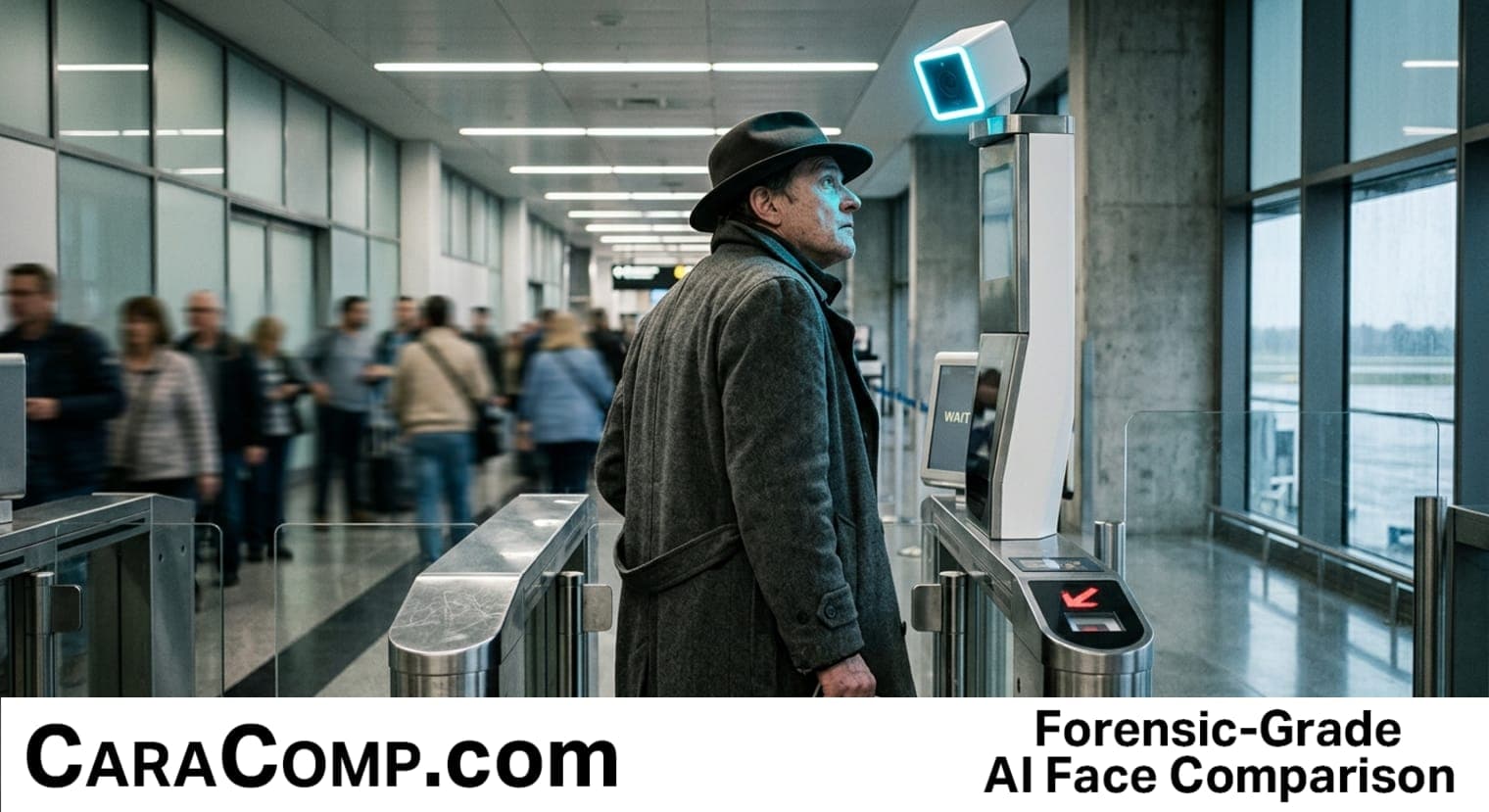
The UK setup for biometric boarding leans on airlines. They send in daily lists of passengers, and the passport photos on those lists feed a database. The gate camera compares your live face to that photo. A match score (a number for how alike two faces are) decides whether the gate opens. Details on the UK plan are in ID Tech Wire's report.
Here is what the public still can't find: whether those photos are deleted after the check, or kept. Speed gets the headline. Retention (how long they hold your data) gets silence. This article is part of a series, start with Age Verification Windows 11 Sorts Kids Into 5 Age Boxes.
India's Digi Yatra and the 24-hour identity promise
India's Digi Yatra system has passed 9 million active users, with about 30,000 new app downloads a day. That is a lot of people deciding fast. The program says face data is deleted within 24 hours of departure, as described on the Mumbai airport's Digi Yatra page.
That sounds great. But who checks? And what if your flight is delayed two days? A promise nobody audits (an audit trail is the record of who looked at what, and when) is just a promise.
Is Biometrics at Airports Safe for Passengers, and Can You Say No?
It depends on the airport, and that is the problem. The identity verification step itself usually works. The unanswered parts are retention, oversight, and whether a human lane stays open. Privacy advocates also warn that facial recognition misidentifies Black passengers more often, and the UK's biometrics commissioner has warned about risks to people's rights.
Honestly, I get why people say yes. Nobody loves a slow line. Rationally, a faster lane is a fair trade if the rules are clear. The trouble is that the rules mostly aren't.
Biometric data is deleted within 24 hours of departure.
Digi Yatra policy, as described by Adani Airports (Mumbai)
Notice the quote is a claim, not a check. It tells you what the airport says it does. Previously in this series: Biometric Digital Id One Leak Opens Every Door Forever.
When biometric systems make the fast lane the only lane
Here's where it gets interesting. Today, a face-scan lane is an option. But the UK eventually plans to extend passport-free checks to international travelers from Europe, Australia, Canada, Japan, New Zealand, Singapore, South Korea and the U.S. Once that many people use biometric systems, the slow lane gets starved of staff and attention. Choice fades without anyone voting on it.
| Old passport check | New face-scan lane |
|---|---|
| An officer looks at you and your passport | A camera compares your live face to a stored photo |
| Nothing about your face is kept by the desk | Retention policy is unclear in the UK, 24 hours claimed in India |
| You know what you handed over | You may not know what was collected |
| Slower, but the choice is obvious | Faster, but consent can feel automatic |
| An officer checks your identity by eye | Identity verification is done by a camera and a database |
Why Airport Security Biometrics Raise a Bigger Question Than Speed
An airport security angle makes this heavier. Khaleej Times reported that India is linking airport facial recognition to an intelligence grid for national security. I can't tell you from the sources how far that link goes. But that's the point: a face scan for a boarding pass and a face scan for a watchlist are very different things, and the traveler can't see which one they're getting.
Why Airport Biometrics Matter to You
- Retentionnobody has told the public whether UK gate photos are deleted or stored indefinitely.
- Oversighta 24-hour deletion promise means little without someone verifying it.
- Choicewhen most people use the fast lane, the alternative quietly shrinks.
Confirm what the technology does before you scan
If you've ever wondered whether a photo or a face is really what it claims to be, that's the exact question this tech exists to answer. And it's a fair question to turn around on the airport. Before you join a face-scan lane, ask a staff member three things: How long is my image kept? Who can see it? Is there a non-scan lane? A clear answer is a good sign. A shrug tells you something too.
Airport biometrics can make travel faster, but "faster" should never mean automatic consent. Ask how long your face data is kept and whether another lane exists before you scan.
The UK and India are betting most travelers will pick speed over questions. So here's mine: if nobody at the gate can tell you when your face is deleted, what exactly did you just trade for those saved minutes? Up next: Airport Biometrics 13 Uk Gates Scan Faces Not Passports.
Airport Biometrics: Frequently Asked Questions
What are biometrics at airports?
Biometrics at airports means using your face, fingerprints or other body features for identity verification instead of, or alongside, a passport check. In the UK and India, the most common version is a camera that compares your live face to a photo already on file. The goal is a faster line, but the unanswered questions are about storage and oversight.
How long do airports keep my face data?
It varies, and in the UK the public still has not been told clearly. India's Digi Yatra program says face data is deleted within 24 hours of departure, which sounds protective. The open question is who audits that claim and what happens if a flight is delayed or canceled. Ask at the airport before you enroll.
Can I refuse a facial recognition lane at the airport?
Often you can, since the slower manual lane usually still exists today. But the sources suggest the fast lane is becoming the default, and the manual one may get less attention over time. Ask a staff member whether a non-scan option is available and whether choosing it has any consequence for you.
Are airport face scanners accurate for everyone?
Not equally. Privacy advocates warn that facial recognition misidentifies Black passengers more often, and the UK's biometrics commissioner has warned the technology could expose the public to breaches of rights. A wrong match can mean extra questioning, so accuracy matters as much as speed.
Which countries are expanding airport face checks?
This story covers the UK, which plans passport-free checks at 13 airport e-gate sites by early 2027, and India, where Digi Yatra has passed 9 million active users. The UK also plans to extend the checks to international travelers from Europe, Australia, Canada, Japan, New Zealand, Singapore, South Korea and the U.S.
Air travel has always meant handing over proof of who you are. A biometric system only changes what that proof looks like: instead of a booklet, it is your face. Airports like this because a camera can check a passenger in seconds.
Security biometrics means using body traits to confirm a person is who they say they are. Facial biometrics is the most common kind at airports because a camera is easy to install. Fingerprints are another kind, and some border control points use them too.
Biometric facial comparison is the plain name for what a gate does. It compares your live face with the photo on file and gives a match score. That is different from searching a crowd for a stranger, and travelers should ask which one is happening.
Biometric data is special because you cannot change your face the way you change a password. If biometric data leaks, the harm can last. That is why access control matters: only named people should be able to open the stored files, and every look should be logged.
Good rules for biometric data should be simple. Who can see the photo, for how long, and for what reason? A traveler deserves those answers in writing, not just a friendly sign at the gate.
Boarding is where many passengers first meet the camera. With biometric boarding, you look at a gate instead of showing a pass. Ask whether boarding scans are matched and then erased, or kept on a server.
Passengers may be asked to submit facial scans at several points, such as check-in, security and the gate. Each step is another time your biometrics are collected. Ask whether the same scan is reused or a new one is taken each time.
Fingerprints and faces are both biometric identifiers. Fingerprints need a touch, while a face needs only a look, which is why a face feels easier to a traveler. Easy is not the same as safe, so the same questions about storage still apply.
Biometrics give speed, and the cost is your data. Keep a short list for any airport: how long is it kept, who sees it, and is there another lane. Biometrics at airports work best when the passenger understands that trade before stepping up to the camera.
Ready for forensic-grade facial comparison?
Full forensic reports with detailed similarity scoring. Results in seconds.
Run My First SearchMore News
AI Voice Cloning: 3 Seconds of Audio Can Fake a Loved One
Lithuania wants people to have legal rights over their own voices. That tells us a familiar voice on the phone is no longer proof of who is calling.
ai-regulationDeepfake: Fake Kiss Photo of Georgia Mayor Outran the Law
A fake photo of College Park's mayor spread before anyone was held accountable. Here's why that could happen to anyone, and what to do first.
digital-forensicsJanhvi Kapoor Deepfake: Any Face Online Can Be Faked
Janhvi Kapoor called deepfake abuse "bordering on sexual assault." Her point reaches far past celebrities: anyone with a photo online can be targeted, and a pause could protect you.