
Biometric Machine: Iowa Medics Get $16,510 Drug Lock
Quick answer
What is a biometric machine used for in emergency medicine?
In emergency medicine, a biometric machine controls who can open a medication cabinet and records each opening. A fingerprint scan unlocks the door, and the device logs the person, the drug taken and the time. Some units also track stock and send restocking alerts, so crews are not caught short.
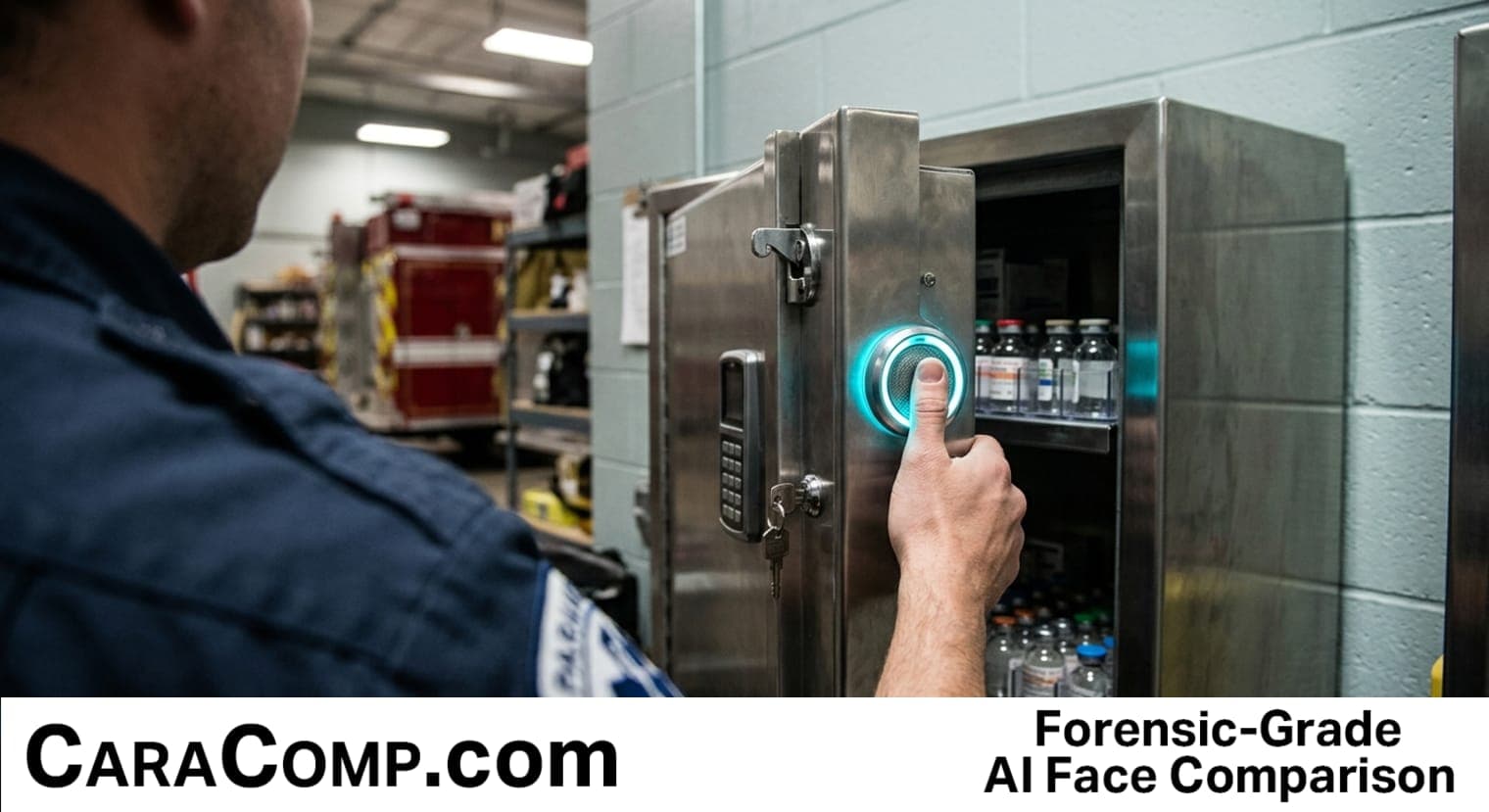
Picture a paramedic, mid-emergency, pressing a thumb against a scanner instead of fumbling with a key or a paper log, that's a biometric machine doing two jobs at once: unlocking the drug and writing down exactly who unlocked it.
A biometric machine installed in a small Iowa fire district uses a fingerprint scan to open a medication cabinet and, in the same instant, log exactly which paramedic accessed which drug and when, turning a security device into a safety record.
Here's the fact that should stop you mid-scroll: a fire district you've probably never heard of, in a town of about 25,000 people outside Des Moines, just got a $16,510.81 grant for a machine that solves a problem hospitals have been wrestling with for decades. The Johnston-Grimes Metropolitan Fire District now has a biometric medication machine serving all three of its stations, and it does something most people assume biometric tech can't do in a crisis: it grants instant access to controlled drugs while simultaneously building a machine-readable audit trail. No badge to lose. No PIN to forget. No log to alter later.
If your mental model of a biometric device is "thing that unlocks my phone," you're about to learn something that reframes the whole category.
What Is a Biometric Machine, and Why Is One Guarding Medication Cabinets?
A biometric machine is any electronic device that uses biometric identifiersyour fingerprint, your face, or your iris, to decide whether you get access to something. In this case, the "something" is a locked cabinet full of medications, some of them controlled substances that federal law tracks closely. The machine reads a fingerprint, matches it against a stored profile, and pops the door open. That part sounds simple. The part that actually matters is what happens the millisecond after the door opens.
Every time that scanner reads a print, the biometric machine writes down three things automatically: who accessed the cabinet, what they took, and the exact timestamp. Not a nurse's shaky handwriting on a clipboard. Not a "sign here" sheet that anyone with a pen could alter. A digital record created the instant the access happens, before anyone has time to think about covering their tracks.
Biometric Medication Machines Versus the Old Paper-Log System
To understand why this matters, you need to see what fire districts and ambulance crews were doing before machines like this existed. And the honest answer is: not much better than a sign-out sheet taped to a cabinet door.
| Old paper-log system | Biometric machine system |
|---|---|
| Handwritten sign-out sheet, filled in after the fact | Fingerprint scan creates a timestamped digital record instantly |
| Anyone with cabinet key can access medication | Only the enrolled clinician's biometric identity unlocks the door |
| Compliance audits require manually cross-checking logs | Access control history is pulled digitally in seconds |
| Inventory checked manually, stockouts discovered too late | Automated inventory and restocking alerts built into the machine |
| Records can be lost, altered, or simply forgotten | Digital access history is available for review after the fact |
Notice the pattern: every row on the right side is faster AND more accountable at the same time. That's rare. Usually security and speed fight each other, think of the extra thirty seconds it takes to get through TSA PreCheck versus a regular line, except in reverse. Here, the fingerprint scan is actually faster than digging for a key while also being more locked-down than a signature. That's the whole point of this biometric machine.
Why the Federal Government Cares About a Fire District's Medication Cabinet
This isn't just a nice-to-have gadget a fire chief picked because it looked slick in a catalog. There's a regulatory reason this biometric machine exists, and it explains why fire districts across the country are suddenly buying the same equipment hospitals use. This article is part of a series, start with Texas Age Verification Law 25 States Now Demand Id Checks Po.
Under a federal rule known as PPAEMA (the Preventing Prescription Drug Abuse and Meth Act), EMS agencies are now registered with the Drug Enforcement Administration the same way pharmacies are. That means a small-town fire department handling epinephrine or fentanyl during a call faces the same recordkeeping burden as a hospital pharmacy, but historically without the hospital's budget or systems. According to the guide from EMS1, ambulance crews now have to prove, with documentation, exactly who touched a controlled substance and when, every single time, or risk violating DEA compliance rules.
What You Just Learned About Biometric Medication Machines
- 🧠 Dual functionthe fingerprint scan is both the key and the witness, granting access and recording it in one motion
- 🔬 Federal triggerthe PPAEMA rule now regulates EMS agencies as DEA entities, forcing better recordkeeping
- 💡 Hidden supply chain jobthe same cabinet tracks inventory and flags restocking, preventing stockouts during a call
- 💡 Economics flipautomating this saves EMS providers real money instead of costing more, per VendNovation's cost data
Here's where it gets interesting. The Johnston-Grimes machine isn't just a lock. According to the City of Johnston's own announcement, the device also tracks inventory automatically and sends restocking alerts, which means the machine is quietly doing a second job, making sure the cabinet never runs dry between calls, so a crew doesn't roll up to an emergency only to discover the epinephrine ran out three shifts ago.
That 40% figure matters more than it looks. For years, compliance was treated as a cost that only big hospital systems could absorb, extra staff, extra paperwork, extra everything. This flips it. A fire district with a $16,510 grant can now run the same accountability infrastructure a major medical center uses, because the machine itself pays for a chunk of its own cost through reduced waste and fewer wasted goods, per the industry cost analysis from VendNovation.
How Does a Biometric Attendance Machine Differ From a Medication Cabinet?
You might wonder whether this is the same tech as the fingerprint clock people punch at work. It's related but not identical. Biometric attendance machines and advanced attendance systems just log "person X was here at time Y." A medication cabinet's biometric machine does that, plus it physically controls access to something dangerous, it's an access control system layered on top of an identity check, not just a clock.
The Real Analogy: A Lock That's Also a Witness
Think about it this way. A regular lock only asks one question: can you open this? A biometric machine asks that question too, but it also silently raises its hand afterward and says, "I saw who did it, and I wrote it down." It's less like a lock and more like a security camera bolted directly onto a doorknob, one that records each access event and does not depend on someone remembering to fill out a form. The scan grants access instantly, and the record gets created in that same instant, not sometime later when someone remembers to fill out a form.
That's the piece most people miss.
The Misconception About Biometric Machines Almost Everyone Gets Wrong
Most people assume biometric devices exist purely to answer one question: "Are you really you?" That's not unreasonable, Hollywood and every phone commercial for the last decade have trained us to think of facial recognition technology and fingerprint scanners as pure identity checkpoints, like a bouncer checking an ID at a door. Unlock the phone, cross the border, board the plane. Identity confirmed, transaction over, nothing else happens.
But that's not what's happening inside a medication cabinet. The fingerprint isn't there to prove the paramedic is who they claim to be in some abstract sense, the fire district already knows every clinician on staff. The scan exists to create a permanent link between a person, an action, and a moment in time. You cannot go back and alter a biometric access log the way you could scribble over a paper sheet. You cannot say "I don't remember who grabbed that vial" when the machine already answered that question before you finished asking it. The value isn't identity verification. It's accountability that survives scrutiny. Previously in this series: Deepfake Election Tools Now Hit 1 2 Million Schoolkids Podca.
Automated dispensing systems help EMS providers maintain full accountability for medical supplies and narcotics while cutting waste, turning DEA compliance from a cost center into a savings opportunity.
VendNovation, Fire/EMS/Medical industry resource
This is exactly the kind of layered thinking CaraComp spends its time teaching people about facial recognition, too, a face scan at a fraud checkpoint or a facility door usually isn't "surveillance" in the ominous sense people imagine. It's often the same trick: confirm access fast, and generate a record precise enough to answer hard questions later, whether that's "who accessed this file" or "who was at this location at 2:14 a.m."
Where Biometric Machines Fit Into the Bigger Identity Picture
Medication cabinets are a small, almost invisible slice of a much bigger world of biometric devices now running quietly in the background of daily life. The same underlying idea, capture a body signal, match it, log it, shows up everywhere. TSA PreCheck lines use face capture instead of a boarding pass check. Aadhaar, India's national identity system, ties over a billion people's iris and fingerprint data to digital identity records. Even REAL ID-compliant driver's licenses are edging toward biometric verification at DMV counters. Every one of these systems runs on the same basic architecture: a sensor captures something about your body, software compares it against a stored template, and a network somewhere logs the result.
What separates the Johnston-Grimes example is scale and stakes, not mechanism. A cloud-based facial recognition SDK verifying a rideshare driver's identity and a fingerprint scanner unlocking an epinephrine drawer are cousins in the same family of technology, just pointed at very different problems.
What Makes a Biometric Machine the Fastest, Most Reliable Option Here?
Speed and tamper-resistance are the two things a medication cabinet needs above almost everything else. Security best practices recommend layering a fingerprint scan with a second factor, a PIN or a proximity badge, for the highest-risk access points, according to the biometric implementation checklist from Censinet, because that combination closes the one gap biometrics alone can't: someone forcing access under duress. Even so, the fingerprint remains the anchor, since it can't be borrowed, shared, or left in a locker the way a badge can.
The Aha Moment: Speed and Accountability Aren't Actually Opposites
Go back to that paramedic reaching into the cabinet mid-emergency. For years, the instinct was to assume you had to pick one: fast access to save the patient, or careful tracking to satisfy a regulator. Pick speed, and you're flying blind on compliance. Pick paperwork, and you've slowed down the exact moment when seconds decide outcomes.
The biometric machine quietly kills that trade-off. The scan is faster than fumbling for a key. The record it creates is more reliable than any signature ever was. Nobody had to choose between saving a life and documenting who saved it, the machine does both in the same half-second.
A biometric machine guarding emergency medication isn't there to slow anyone down or watch you, it's there to answer, instantly and permanently, exactly who opened that cabinet and when, which is the kind of security identification no handwritten log could ever match. Up next: Digital Identity Security Stolen Faces Crack Open By 2035.
So next time someone tells you biometric scanners are only about surveillance or convenience, picture that Iowa paramedic's thumb on the scanner. The fingerprint didn't ask "who are you." It asked "prove this later", and answered its own question before the ambulance even left the station.
biometric machine: Frequently Asked Questions
What is a biometric machine used for in emergency medicine?
A biometric machine in emergency medicine controls who can open a medication cabinet and automatically records who accessed it and when. Fire districts and EMS agencies use fingerprint-based access control to meet DEA compliance rules under PPAEMA, prevent unauthorized access to controlled substances, and track inventory so ambulances stay stocked between calls.
Are fingerprint scanners more reliable than face capture for medication cabinets?
Fingerprint scanners are commonly used for this specific purpose because they can authenticate an enrolled user without requiring a well-lit camera view. Face-based capture works well for identity checks like TSA PreCheck or border travel, but fingerprint remains a common authentication method for locked medical storage.
Does a biometric device store my actual fingerprint image?
No. Most biometric devices, including medical dispensing cabinets, store a mathematical template derived from the fingerprint, not a photo-like image of it. The scanner captures ridge patterns, converts them into a coded template, and compares new scans against that stored code. This is standard across biometric attendance machines, phones, and access control systems alike.
How is this different from Aadhaar or a driver's license check?
Aadhaar and REAL ID-compliant driver's licenses use biometric identity to confirm who you are at a national or state level, often tied to iris or face capture and a huge government network. A medication cabinet's biometric machine works at a tiny local scale, one fire station, one enrolled staff list, using the same core technology but for immediate access control rather than broad identity verification.
Can a biometric medication machine be hacked or spoofed?
No security system is unspoofable, but layering matters. Security guidance recommends pairing a fingerprint scan with a second factor like a PIN or badge for high-risk access points, since that combination protects against a single point of failure. Because a fingerprint can't be shared or handed off the way a badge or password can, it remains a strong foundation even in high-pressure emergency settings.
Why are fire departments now regulated like hospital pharmacies?
A federal rule called PPAEMA (Preventing Prescription Drug Abuse and Meth Act) registered EMS agencies as DEA entities, meaning ambulance crews handling controlled substances face the same recordkeeping and access-control requirements as hospital pharmacies. This shift pushed smaller fire districts toward automated, biometric-based dispensing systems instead of relying on manual paper logs that regulators increasingly view as insufficient.
Ready for forensic-grade facial comparison?
Full forensic reports with detailed similarity scoring. Results in seconds.
Run My First SearchMore Education
Biometrics Appointment USCIS: 2 Things to Bring, 3 They Take
The visit takes under 30 minutes, but small mistakes before it can add months. Learn what to bring, what gets collected, and how to avoid a reschedule.
facial-recognitionBiometric Facial Recognition: 1 Bad Match, 80 Days in Jail
Brochure accuracy numbers come from labs, not streets. Learn how a face match really works, why a "93%" score isn't certainty, and how one bad match can put an innocent person in a cell.
privacyIdentity Theft Affidavit: 3 Mistakes That Sink Victims
A man reported his own identity theft to a bank and was arrested for it. Learn what an identity theft affidavit can and can't do, and the order to file things so you're never left holding only your word.