
Biometric Facial Recognition: 1 Bad Match, 80 Days Jailed
Quick answer
How accurate is biometric facial recognition on surveillance footage?
Biometric facial recognition is highly accurate on clean, matching photos but much less reliable on grainy surveillance footage. A National Academies test found 99.9 percent correct searches on quality mugshots. Poor images and older photos can make the right person score no better than a stranger, so a result is a lead to check.
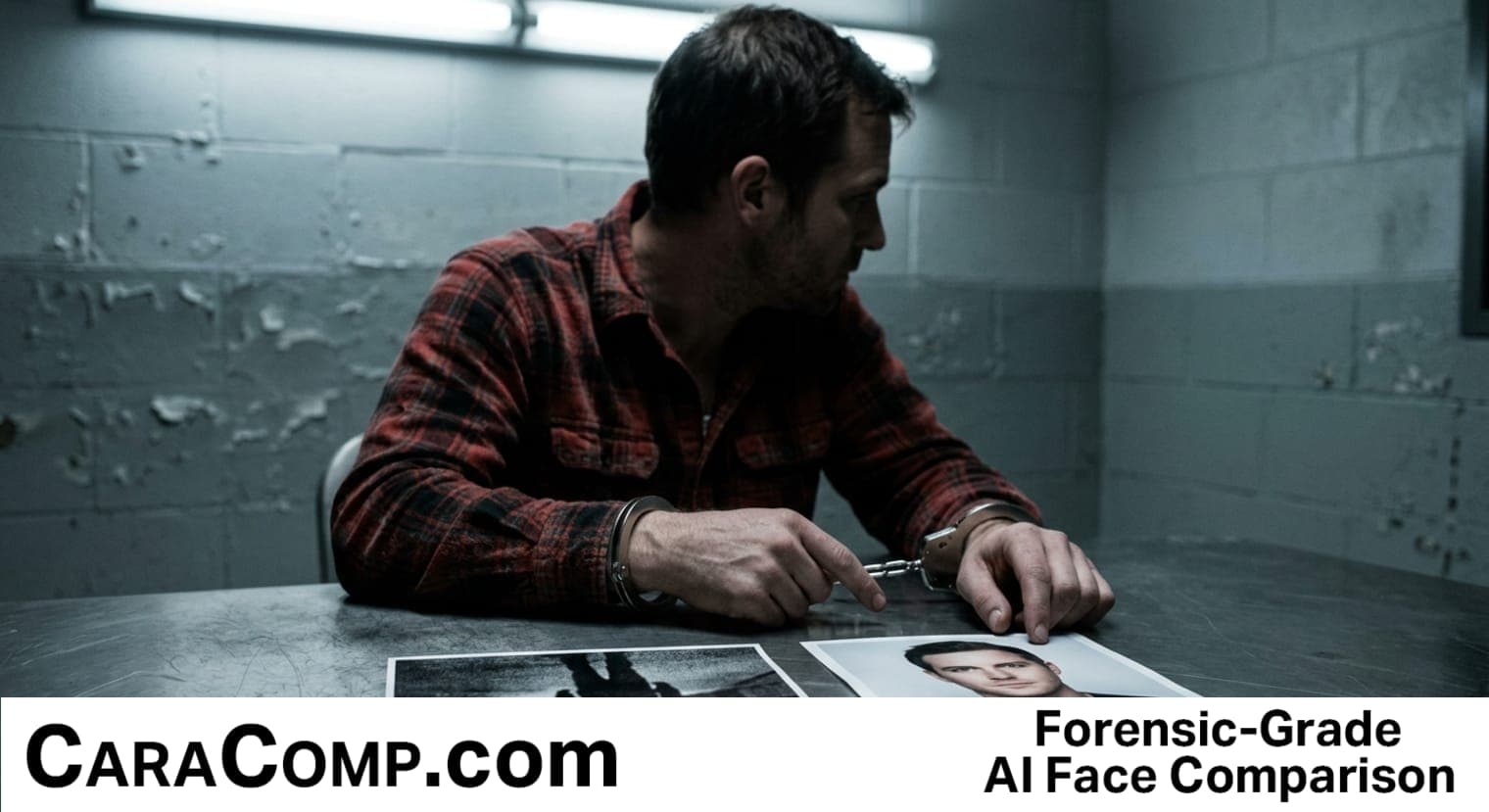
Robert Dillon was arrested at his Florida home in August 2024, with his wife watching, for a crime in a city about 300 miles away. What pointed police at him was biometric facial recognition. Software compared grainy surveillance footage with a database and offered up his face. The accuracy number in the vendor brochure comes from a lab. The crime happened on a street. That gap is the whole story, and by the end you'll be able to explain it to anyone.
Biometric facial recognition is very accurate on clean, matching photos and much shakier on grainy surveillance video, so a match score is a lead to check, never proof of who committed a crime.
Biometric facial recognition: how a face becomes data
Start with the basics. Biometric technology is a biometric identification method that confirms a person's identity using unique biological characteristics, the body stuff that is uniquely you. Biometrics (your face, voice, fingerprints) work because you carry them everywhere. Face biometrics use aspects of the face, like the spacing between a person's unique facial features, and biometric facial recognition turns that into a precise measurement. It then stores the result as data: a long string of numbers, not a picture.
How biometric recognition turns a face into numbers
Here is the process, one step at a time.
- A camera makes a captured image. That can be a photograph or a single frame pulled from video.
- Face detection software finds the face and straightens it, so a tilted head doesn't ruin everything.
- It uses algorithms (step-by-step math recipes) to turn the face into a list of numbers, often called a faceprint.
- It compares that list with stored lists and scores how close each pair is. A high score means a close match.
- A human decides what the score means. This last step is where the cases below went sideways.
That is how facial recognition technology works at its simplest: two lists of numbers and one distance between them. (Think of how far apart two dots sit on a map.) Notice what is missing. Facial recognition is a similarity meter, not a truth meter. It says "these two pictures look alike." It never says "this person did it."
Biometrics 101: why a face is not a password
Compare it with basic password authentication. A leaked password can be changed. A face can't. Biometrics are easy to carry and impossible to reset. Even so, the friendly version works well. When someone unlocks a phone, facial recognition allows a quick check: their face is scanned against one stored photo, confirming the owner is the one holding it. Many phones also try to confirm that a live person is looking at the screen. That gives stronger security than a short passcode, plus added convenience (no typing with cold thumbs). The user chose to be there, and users verify their identity on purpose, face forward, in decent light. Remember that setup. It is about to disappear.
Biometric facial recognition and police: the lab versus the street
Now flip the situation. Nobody chose to be photographed by a doorway camera. Law enforcement pulls a still from surveillance video, and the question changes from "is this the phone's owner?" to "who is this stranger?" Even remote identification, from a camera across the street, asks the software to identify people from a face alone, with no cooperation and no second chance at the shot.
Vendor claims of 95 percent or better usually describe flat, two-dimensional systems tested when both photos are straight-on, evenly lit and showing similar expressions. The best public benchmark comes from the National Academies. Using leading 2023 algorithms, a search of a 12 million identity mugshot database returned the correct entry 99.9 percent of the time. Data like that is real. It is also a best case.
The same report notes the catch. When the search photo is low quality and years have passed, the real person's score can look about as weak as a stranger's score. Translation: the right face may look no better to the software than the wrong one, and the result stops being clear. This article is part of a series, start with Deepfake Laws By State 8 States Push Chatgpt Id Checks.
Think of a driving test taken in an empty parking lot. You can score perfectly and still not be ready for rush hour in the rain. The score was honest. It just measured a different road.
Dillon's case is the rush-hour version. According to the ACLU of Florida, a faulty match from grainy surveillance footage led to his arrest, and he has since sued the police over it. He is one of about 15 people known to have been wrongfully arrested because of facial recognition in the United States. That count only includes errors somebody caught.
How camera technologies change the same face
Why does a clean mugshot work and a doorway clip fail? Because a face is not a fixed object to a camera. Light from above puts shadows where light from the front doesn't. A camera mounted high on a ceiling sees more forehead than eyes. Phone cameras forgive a lot because they automatically adjust brightness, and you hold still for them. An old camera over a counter does neither.
Recognition systems also differ in how they work. Some scan live feeds in real-time. Others work from a saved video still that someone chose. Either way, the older and blurrier the picture, the more the numbers wobble. Past research on facial recognition technology shows the same thing: accuracy holds up under controlled lighting and drops under the uncontrolled kind.
| Factor | Lab test | Real surveillance |
|---|---|---|
| Photo | Sharp mugshot, high quality data | Grainy still from surveillance video |
| Lighting | Even and consistent | Harsh shadows, shifting light, sometimes night |
| Angle | Straight-on, face forward | From above or from the side |
| Information available | Clear face and a name on file for identification | A smeared face and little else to go on |
How accurate is face recognition technology, really?
On clean, matching photos, the National Academies report found 99.9 percent correct searches in a 12 million mugshot database. On grainy surveillance stills it is far less reliable. In both cases the score is a guess about how similar two faces look. It is not a measurement of guilt.
Here is the part that surprises people. The score depends on a dial. Set the confidence threshold high and the system makes fewer false matches but misses more real ones. Set it low and it finds more real ones but flags more lookalikes. As Route Fifty explains, someone chooses where that dial sits. The software doesn't.
Police also don't usually get one answer. Systems are often set to return a list, sometimes hundreds of faces, a "digital lineup." And under NIST testing (the US government's testing lab for this stuff), a search counts as a success if the right person appears anywhere on that list. So a "93% accurate" system can still hand back plenty of wrong faces.
Why a 93% match feels like proof (and isn't)
Most of us learned in school that 93 is an A. So when Dillon's case was reported with a 93 percent candidate score, it sounds like a 93 percent chance he did it. It is not. That number is one algorithm's similarity score for one pair of images. It says nothing about the size of the database, the quality of the footage or whether the man was even in the state. Previously in this series: Age Verification Georgia Id Scanning Could Reach All Adults.
Try a simple what-if. Say a system wrongly flags one face in a million, and the database holds ten million faces. You'd expect about ten lookalikes for every search, and the actual culprit may not even be in the pile. (Those numbers are made up to show the arithmetic, not a measurement of any real product.) The bigger the database, the more strangers who happen to resemble you.
Identity verification versus identification
This is the aha. Identity verification asks "is this person who they claim to be?" That is a one-to-one check, like your phone. Identification asks "who in this giant pile is this?" That is one-to-many, and it is much harder. Every extra face in the database is another chance for a lookalike. Tools that try to identify individuals based on a stranger's face are doing the second job, but they are often marketed with numbers from the first.
Healthcare check-ins: a fair fight for the algorithm
Controlled settings show the technology at its best. In a hospital lobby, facial recognition is used to verify patient identity at check-in: one patient, one camera, a stored photo, good light, and someone looking straight ahead. It is meant to cut down on fraud, like one person using another's insurance. Face recognition access control at an office door has the same advantages, and the building management knows who is supposed to be there. Judge any tool by its application. The same math that is fair at a front desk is a gamble on a blurry street still.
Compliance checks that should come before an arrest
Compliance, meaning following written rules, matters most at the moment a score turns into a decision. Under the law, an arrest needs probable cause, which courts describe as a "fair probability" the person committed the crime. The open question is whether an officer can turn a similarity score into that probability, especially when other evidence in the file points elsewhere. A sound process treats the match as a lead and then goes looking for proof that could prove it wrong: where the person's phone was, work records, receipts. In the cases below, that kind of check would have been cheap.
What biometric facial recognition does to a witness's memory
Here is the chain reaction. An innocent person flagged by the software tends to look like the real culprit, because looking alike is exactly why the software flagged them. Put that photo in a lineup and a witness may pick it, because it fits their memory. The lineup then looks like confirmation, when it is really the same error counted twice. Reason's reporting on the case, headlined that Dillon spent over 80 days in jail, walks through how this played out.
When facial recognition produces a false match, the returned (innocent) candidate will, by algorithmic design, resemble the actual perpetrator.
Reason, analysis of the Dillon case
Dillon isn't alone. In 2022, Randal Quran Reid was arrested in Georgia and jailed for days over a theft in Louisiana, a state he had never visited, according to AP News. In 2023, Porcha Woodruff, eight months pregnant, was arrested at her Detroit home for carjacking and held for 10 hours, according to CBS News. In 2025, Angela Lipps was arrested at gunpoint in Tennessee and jailed for six months over a bank theft in North Dakota, a place she had never been. Biometric Update reports she lost her home and car while locked up. Each case began with a lead from software. Each ended with a person who had to prove where they were.
What You Just Learned About biometric facial recognition
- Lab numbers are best-case numbers: 99.9 percent describes clean mugshots, not grainy street video.
- A confidence score measures how alike two pictures look, not whether someone is guilty.
- One-to-many identification is much harder than one-to-one identity verification.
- A false match can contaminate a witness, because the lookalike resembles the real culprit.
At CaraComp, this is the lesson we teach first: comparing two faces is a measurement, and every measurement has an error range. The honest question is never "did the software say yes?" It is "how good were the two pictures, and what else backs this up?" Up next: Biometric Facial Recognition 1 Bad Match 80 Days In Jail.
Biometric facial recognition gives a similarity score, not a verdict, so every match needs human verification and evidence from somewhere else before anyone is arrested.
If an arrest happened to you tonight, would you know where to look first? Ask whether a facial recognition match started the case. Call a lawyer. Gather proof of where you were, like phone location history, receipts and work records. The "93%" was never a measurement of the man. It was a measurement of two pictures, and one of them was blurry.
biometric facial recognition: Frequently Asked Questions
If facial recognition systems can be used to track people using their biological characteristics, should the public worry?
It is a fair concern. Cameras linked to facial recognition software can compare the faces they collect against stored lists, which is a form of biometric surveillance. Some tools also observe behavioral traits, such as how a person walks. How much worry is reasonable depends on who runs the system, what they keep and what security and privacy rules apply. Asking those three questions about any camera network is a good start, and it applies to a mall system as much as a city one.
What is the identity process behind a phone's face unlock?
This facial authentication is a one-to-one verification. During setup, the phone records a faceprint of the individual using their face as the key. Later it compares a new scan against that one stored record and decides whether the biometric identity matches. Because it is checking a cooperative person against a single record, this is the easy version of the job, and it explains why phone unlock feels so reliable.
How do police identify individuals based on a surveillance photo?
They run the photo through software that compares it with a large database and returns candidates ranked by similarity. The ability of facial recognition technology to distinguish between lookalikes drops as the photo gets worse, so sharper cameras and better angles improve results. Even then, identifying someone this way produces a lead. A human still has to check it against other evidence before treating it as an answer.
Is face recognition access control the same as police surveillance?
No. Access control at a door uses a small group of enrolled people who agreed to be scanned, and building management knows who should be inside. That makes the comparison easier and the stakes lower. Police searches compare a stranger against a huge database, often with poor images. Facial recognition is built on the same underlying math in both, but the information available and the cost of a mistake are very different.
What is the safest way to treat a facial recognition match?
Treat it as a tip, not proof. Any responsible security and compliance process asks how good the photos were, what else points to the person, and whether anything points away from them. Ask the same of any claim about a tool's application. Insights like these also help in everyday life: a dating profile check, an online identity concern or a fraud worry all call for a second source before you believe a single result.
What information do these systems collect and keep?
It depends on the system. Many collect the photo itself and the faceprint, which is the string of numbers made from it. Some also store when and where a face was seen. Privacy and security rules about how long that information is kept, who may search it and what the public can learn about it vary by place and by operator. Security matters because a stored faceprint is biometric data, and if it is breached it cannot be reset the way a password can. If you are unsure about a specific system, ask the operator or check their published policy.
Ready for forensic-grade facial comparison?
Full forensic reports with detailed similarity scoring. Results in seconds.
Run My First SearchMore Education
Identity Theft Affidavit: 3 Mistakes That Sink Victims
A man reported his own identity theft to a bank and was arrested for it. Learn what an identity theft affidavit can and can't do, and the order to file things so you're never left holding only your word.
biometricsBiometric Authentication Meaning: 14 Arrests, Zero Proof
Your phone and a police search can run nearly the same math, yet one is fine and the other has jailed innocent people. Learn the match-versus-proof difference in plain English.
biometricsPassport Photo Guidelines: Why 1 in 4 Photos Get Rejected
Passport photo guidelines read like advice, but a machine often does the first check. Learn what it measures, why rejections come with no explanation, and how to fix them.