
Biometric Authentication Meaning and Facial Recognition Limits
Quick answer
What is the meaning of biometric authentication?
Biometric authentication means confirming who you are by measuring a trait that is unique to you, such as a face, fingerprint or iris, instead of relying on a password. Software compares a fresh sample with one saved sample and checks the similarity score against a cutoff. Passing that cutoff grants access.
Here's a sentence that should bother you: the tech that unlocks your phone and the tech that jailed a grandmother for six months are doing two different jobs. If you searched for the biometric authentication meaning, you want a definition, and you'll get a clean one below. But the definition hides a trap. The trap is the gap between a match and proof, and it is what puts people in cells.
Biometric authentication meaning, in one breath: your phone checks one face against one saved face, but police facial recognition searches millions of faces, so a match there is a lead to check, never proof.
Biometric Authentication Meaning: A Check Against One Person
Start with the plain version. Biometrics (measurements of your body or behavior that are uniquely you) are automated identification methods. Biometric authentication is the security method used to confirm that you are you. It is a systematic process that verifies identity using unique physical and behavioral traits: fingerprints, iris scans (a camera photographing the colored ring of your eye), facial features, even behavioral characteristics unique to you, like how you type or hold your phone.
Another way to say it: a secure personal identification process built on measurable human traits. Biometric systems let users verify their identity with unique biological traits instead of a secret you have to remember. Biometric authentication relies on any physical or biological characteristics, as long as a sensor can measure them. Industries such as banking, healthcare and transportation rely on it. At airports, it is used to compare a traveler's face with a passport photo.
Identity verification on your phone: the 1-to-1 check
When you unlock your phone, the camera runs a 1-to-1 check. One live face against one saved face. That's identity verification at its simplest: you claim to be you, and the phone tests the claim. The saved version isn't a photo, by the way. It's a template, a string of numbers that summarizes your face. The CGAP primer on biometrics explains this 1-to-1 versus 1-to-many split well, and the split is the key to everything that follows.
Biometric authentication follows three steps: capture, compare, decide
Biometric authentication follows the same three steps whether the body part is a face, a finger or an eye. First comes scanning: a sensor captures the trait. Second, the software turns the patterns it finds (distances between features, ridges, curves) into a template and compares it with the stored one. Third, it produces a similarity score and checks it against a cutoff. Above the line, the door opens. Below it, the door stays shut. A person chose where that line sits. Hold that thought.
Good systems also add detection of fakes. Liveness detection (a check that a real, living person is in front of the camera, not a photo held up to it) is the usual example. Face based authentication on a modern mobile phone does both jobs. Software built to verify user identities this way answers one narrow task: is this the owner, yes or no?
Biometric Authentication Meaning Changes When the Search Covers Millions
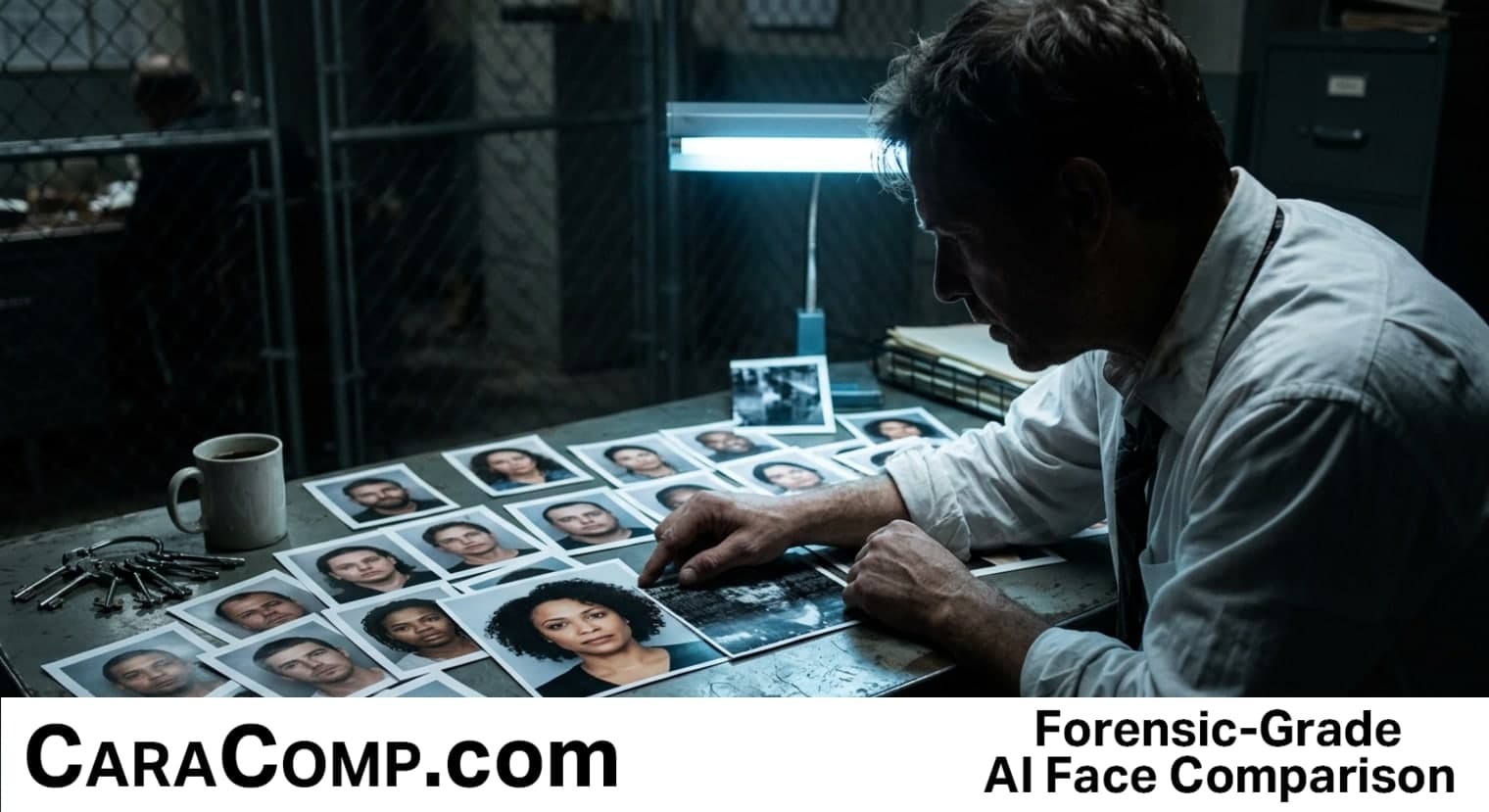
Now change the question. Police have a grainy image of a stranger. Nobody is claiming to be anyone. The question is no longer "is this Dana?" but "who could this be?" That's 1-to-N matching (one face against N faces, where N might be millions of mugshots and license photos). The software scores every face in the pile and hands back a ranked list of lookalikes. Here's the line I'd tape to every squad room wall: it's a filter, not a fingerprint.
Notice what changed. Your phone answers yes or no. A search answers "here are the closest ones." Somebody is always closest, even when the real person isn't in the pile at all. This article is part of a series, start with Deepfake Fake Kiss Photo Of Georgia Mayor Outran The Law.
Face recognition at scale: the database does the damage
Let's do the math, because the math is the aha. Say a system wrongly matches two different people once in a million comparisons. That's a false match rate of 0.0001%. (A round example number, just to show the mechanism.) On your phone, with one comparison, you'd never notice. Now run a facial recognition search across 10 million faces. A rough rule says the wrong hits in a search equal the one-to-one error rate times the number of faces in the pile. One in a million, times ten million, is about ten wrong people before any human looks. Researchers call this the false positive identification rate, which just means "how often a search coughs up the wrong person." Face recognition systems aren't broken when this happens. This is the math doing what math does.
Picture a sieve. A fine sieve over a small bowl of sand blocks nearly everything you want to keep out. Pour a swimming pool of sand through the same sieve and a few grains slip through anyway. The sieve hasn't changed. The pile has.
Biometric data and the threshold dial
Remember the cutoff line? Think of it as a dial. Turn it strict and the system rarely flags the wrong person, but it also misses more of the right ones. Turn it loose and the reverse happens. Biometric data (your face, voice, fingerprints, the body stuff that's uniquely you) doesn't tell the software where to set the dial. People do.
NIST, the U.S. government's testing lab, has described a cutoff that produced about one wrong identification in 33,000 attempts. At that same setting, it missed roughly one correct match in 800.
Push one error down and the other goes up. You can't win both. Consumer biometric systems choose differently. One widely used computer sign-in system aims for fewer than 1 to 2 wrong accepts per 100,000 tries, while tolerating up to about 10% of legitimate users being turned away. A phone that locks you out all day gets returned to the store, so vendors tune toward letting owners in. Investigators see only the final number on the screen. They rarely see the dial behind it.
| Question | Phone unlock | Police face search |
|---|---|---|
| What is being asked | Is this the person I already know? That is verification. | Who in this huge pile looks like this? That is facial recognition search. |
| Size of the pile | One saved template | Millions of faces |
| Photo quality | Fresh, close, retake allowed, so the image usually has more usable detail | Often grainy footage nobody can retake, so detection gets harder |
| What a high score means | Strong evidence it is the owner | A lead that still needs proof |
| Cost of a wrong answer | A stranger gets access to your phone | The wrong person gets arrested |
Is a match score proof? Why verification and a search are not the same
No. A match score only says two images look alike to the software. In a 1-to-1 check, a high score is strong evidence, because the pile holds one person. In a search of millions, it is a lead that still needs checking, nothing more.
Almost everyone reads a "95% match" as "95% sure it's them." That's a natural mistake. We grew up with test scores and weather forecasts, where 95 means 95 percent of something real. But this score isn't a chance of being right. It's closeness between two images, graded under one system's settings. Every comparison in a big search gets its own score, so a pile of strangers produces plenty of high ones. Nobody lied to you. The number just means something different from what your brain wants it to mean. Match versus proof is the whole story, and the score only speaks to the first half.
There's history here too. Courts and detectives carry decades of trust from fingerprints, a trust earned by different methods in different situations. Face search starts with a stranger and produces candidates. The Washington Post found that among police agencies that shared records, many had arrested people identified by AI matches without independent evidence. Meanwhile, the ACLU has documented officers treating these facial recognition tools as final answers.
"100% match" Previously in this series: Apple Age Verification App Store Hides Kids Birth Dates.
The phrase some officers have used for unverified results, as documented by the ACLU
Fraud checks versus police searches: the lab-versus-street gap
Not every face system carries this risk. A bank running fraud detection on a selfie has a clean photo, a fresh capture and a retry button. Detectives working from grainy store video get none of that. NIST's image quality testing looks at how imaging factors change error rates. Accuracy slips in uncontrolled lighting, which raises both wrong rejections and wrong accepts, and blur and low resolution make things worse. The Federation of American Scientists adds that error rates are consistently higher for women and Black individuals, with Black women affected most. A lab score does not travel well to a parking-lot camera.
KYC and bank selfies: the friendly version of face matching
KYC (know your customer, the identity check a bank runs when you open an account) matches a selfie to your ID photo. Identity verification, compliance (the legal checklist companies must follow) and fraud detection all ride on a 1-to-1 comparison. The stakes are low, because a failed check means you retake the picture. Privacy still matters here: it's fair to ask where your template is stored and how long it stays.
MFA: why a face works best as one of two keys
MFA (multi-factor authentication, proving yourself with two or more different things) is where a face shines. Pair your face with a passcode and a thief needs both. Companies manage this through IAM (identity and access management, the system that decides who gets through which door). Passwords still sit behind most of it as a backup. Password based authentication alone is one lock. Face plus passcode is two.
Access to your phone versus access to your freedom
On a phone, a wrong match means a stranger gets access to your photos. In a search, a wrong match can mean handcuffs. In January 2020, Robert Williams was arrested in front of his family, the first known U.S. case of a wrongful arrest from a facial recognition mismatch. In November 2022, Randal Reid spent six days in jail in Georgia over a theft in Louisiana, a state he had never visited. In February 2023, Porcha Woodruff, eight months pregnant, was held 11 hours in Detroit over a carjacking. In April 2026, the ACLU reported that Kimberlee Williams, a grandmother, spent six months in a Maryland jail after police relied on a false result.
The ACLU counts at least 14 such wrongful arrests, most of the people Black. That's a floor, not a ceiling. Police rarely tell the public when they've used these tools, and no federal law requires them to, so nobody can count the cases that never surfaced.
Where to look first when facial recognition output is treated as proof
Back to the 11pm question: if this were happening to you tonight, would you know where to look first? Look for what else ties you to the scene. A match alone is a hypothesis. Proof is what comes after: where your phone was, receipts, timestamps, people who saw you. It's reasonable to ask plainly whether anything besides the face match connects you to the case, and to ask for a lawyer before you answer anything else. (That's general common sense, not legal advice.)
At CaraComp, facial recognition is our daily work, and the point we keep repeating is simple: the honest version of the tool produces candidates, then a human does the checking. The tool doesn't make the wrongful arrest. Skipping the second step does.
What You Just Learned About Biometric Authentication Meaning
- 🧠 1-to-1 is a question about one person - your phone compares one face with one saved template, so a high score is strong evidence.
- 🔬 1-to-N is a search - the pile multiplies even tiny error rates into real wrong people.
- 💡 The cutoff is a human choice - the score on a screen reflects a dial someone set.
- 🧠 Photo quality moves the numbers - lab results shrink on blurry, poorly lit footage.
Here's the part that should reorder your head. The phone and the police system can run nearly the same math, and one of them is fine. The difference isn't the algorithm. It's the size of the pile and what a person does with the answer. So the next time you hear "the computer found a match," what's the first thing you'll ask? Up next: Deepfake Fake Kiss Photo Of Georgia Mayor Outran The Law.
The real biometric authentication meaning is a measured guess about one person, and when a system searches millions, biometric authentication follows a different rule: a match is a hypothesis, and proof is what comes after.
Biometric authentication meaning: Frequently Asked Questions
What is biometric authentication in simple terms?
Biometric authentication is a secure personal identification process that confirms who you are from measurable human traits. Instead of a password, a sensor reads your biometric data and compares it with what was saved earlier. Biometrics are automated identification methods, which means software does the comparing in a fraction of a second. If the similarity score clears a cutoff someone chose, you get in. If not, you are asked to try again or use a passcode.
Which biometrics are used most, and in which industries?
Fingerprints, facial features and iris scans are the best known biometrics, though voice and typing rhythm count too. Biometric authentication uses physical features like these, plus behavioral biometrics. Industries such as banking, healthcare and transportation use it, and each individual traveler or customer is checked against their own saved record. A trait is only useful if a sensor can measure it consistently, so the choice depends on the job and the setting.
Is biometric authentication the same as identity verification?
They overlap but are not identical. Identity verification is the goal: confirming that a person's identity matches the claim they make. Biometric authentication is one tool for reaching it, usually by comparing a live sample with a saved one. Some identity verification skips biometric methods entirely and uses documents or passwords. A facial recognition search across a large database is a different job again, because it tries to find an unknown person rather than confirm a claimed one.
Can fraud or fake faces fool biometric authentication?
Sometimes. Fraud attempts against biometrics include photos, masks and edited video held up to a camera. That's why systems add liveness detection and other spoof detection, which try to confirm a real person is present. No detection method is perfect, and attackers keep adapting. This is one reason experts favor layers: a face check plus a second proof means one fooled step does not open the door by itself.
Does biometric authentication replace passwords and MFA?
Not completely. Many accounts still keep a passcode as a backup, and strong setups use multi-factor authentication (MFA), which means two or more different proofs. Biometrics such as a face or fingerprint give convenient login access on a device, but they can fail for ordinary reasons like bad lighting or a wet finger. Treat it as one key on the ring. Using a face together with a passcode gives you better protection than leaning on either one alone.
How is my biometric data kept private?
Where your biometric data goes depends on the system, so ask. On many mobile devices, the template (the number summary of your face) stays on the device rather than being sent away. Banks and other companies that run KYC checks may store biometric information under compliance rules, and the details vary by company and place. Good questions to ask: where is my template stored, who can see it, and how long is it kept? Privacy policies should answer all three.
What does it mean when police say they have a facial recognition match?
It means software ranked a face in a database as similar to an image from a case. It does not mean the person was confirmed. A search across millions of faces will always return close candidates, even when the real person is not in the database. The biometric authentication meaning that applies to a phone, where one face is checked against one, does not carry over. A match is a lead that needs independent evidence before anyone is treated as identified.
Ready for forensic-grade facial comparison?
Full forensic reports with detailed similarity scoring. Results in seconds.
Run My First SearchMore Education
Passport Photo Guidelines: Why 1 in 4 Photos Get Rejected
Passport photo guidelines read like advice, but a machine often does the first check. Learn what it measures, why rejections come with no explanation, and how to fix them.
biometricsBiometric Information: One Face Scan Can Cost a Firm $5,000
A company can owe you money for saving your face even if nothing bad ever happens. Learn how one clause decides who pays, and where to look first.
biometricsBiometric Digital ID: One Leak Opens Every Door, Forever
One card that opens every door sounds great until it leaks. Learn how a biometric digital id really works, why a 99 percent match isn't proof, and where to look first.