
What Is a Deepfake? Your Complete Guide to Detection and Protection
Understanding AI-generated synthetic media, detection techniques, and comprehensive strategies to protect yourself from deepfake fraud in an age where seeing is no longer believing.
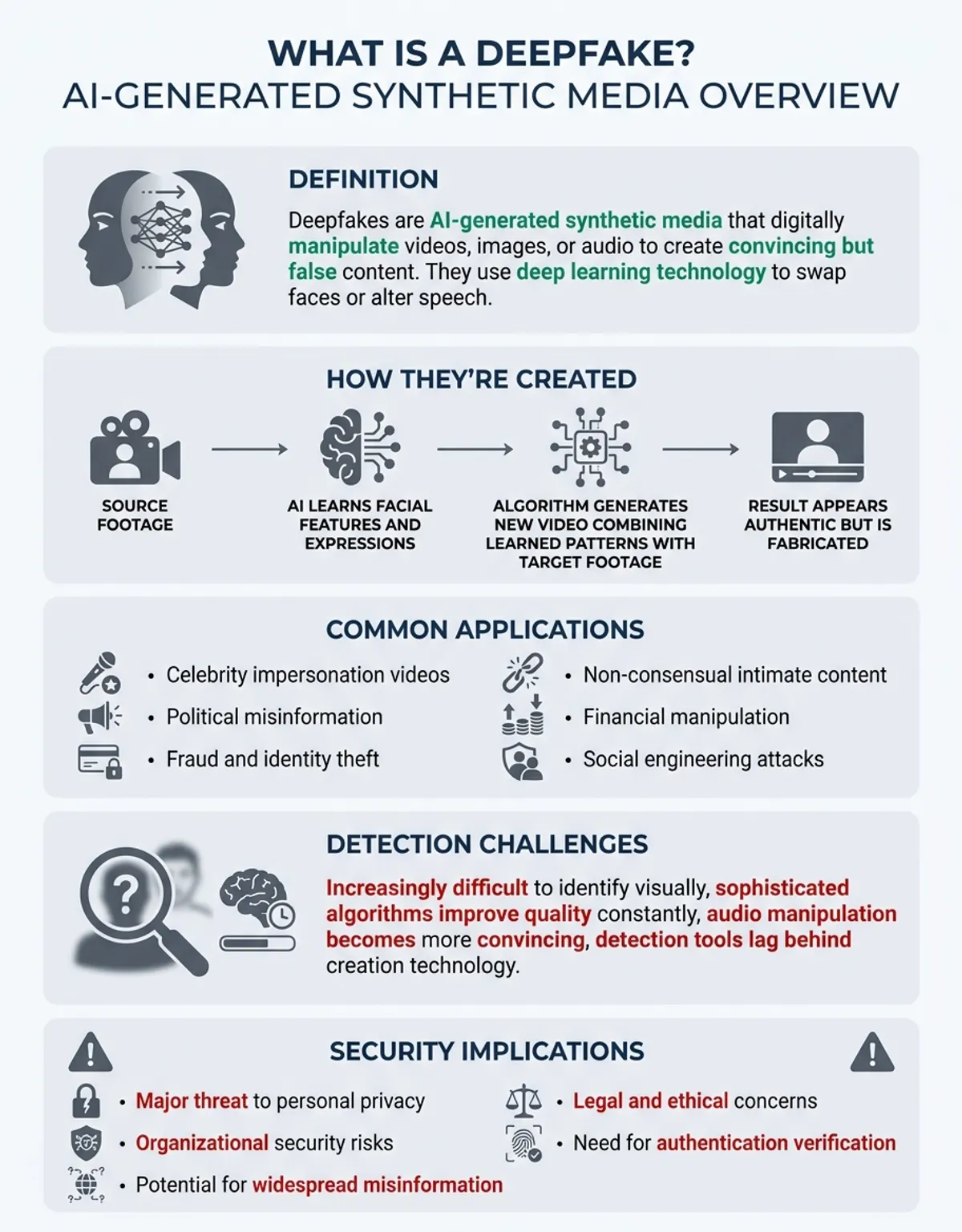
Deepfakes represent one of the most significant information security challenges of the modern digital age. As artificial intelligence technology advances, the ability to create highly realistic fake videos, images, and audio has become increasingly accessible, raising serious concerns about cybersecurity, fraud, and the integrity of online content. Understanding what deepfakes are, how they work, and how to detect them is now essential for anyone navigating the digital landscape.
This guide covers everything you need to know about deepfakes—from the underlying technology to the real threats they pose to individuals, organizations, and society. If you're worried about deepfake fraud or want to protect yourself from manipulated content, you'll find practical detection methods and security strategies here.
Understanding Deepfakes: Definition and Technology Overview
A deepfake is a form of AI-generated synthetic media in which a person's face, voice, or both have been digitally manipulated to create content that appears authentic but is actually fabricated. The term "deepfake" combines "deep learning" (a subset of artificial intelligence) with "fake," reflecting the technology's ability to generate highly realistic but entirely artificial content. For comprehensive image verification capabilities, explore our reverse image search tool.
Unlike traditional photo or video editing, which relies on manual manipulation, deepfakes use sophisticated machine learning algorithms to automatically generate convincing fake media. This technology can swap one person's face onto another's body in video footage, clone someone's voice with remarkable accuracy, or create entirely synthetic images of people who don't exist.
The rise of deepfakes has been remarkably rapid. What began as an obscure technology used primarily in research labs has evolved into a widely accessible tool. Today, deepfake technology can be deployed by virtually anyone with a decent computer and publicly available software, making it both a powerful creative tool and a significant information security threat.
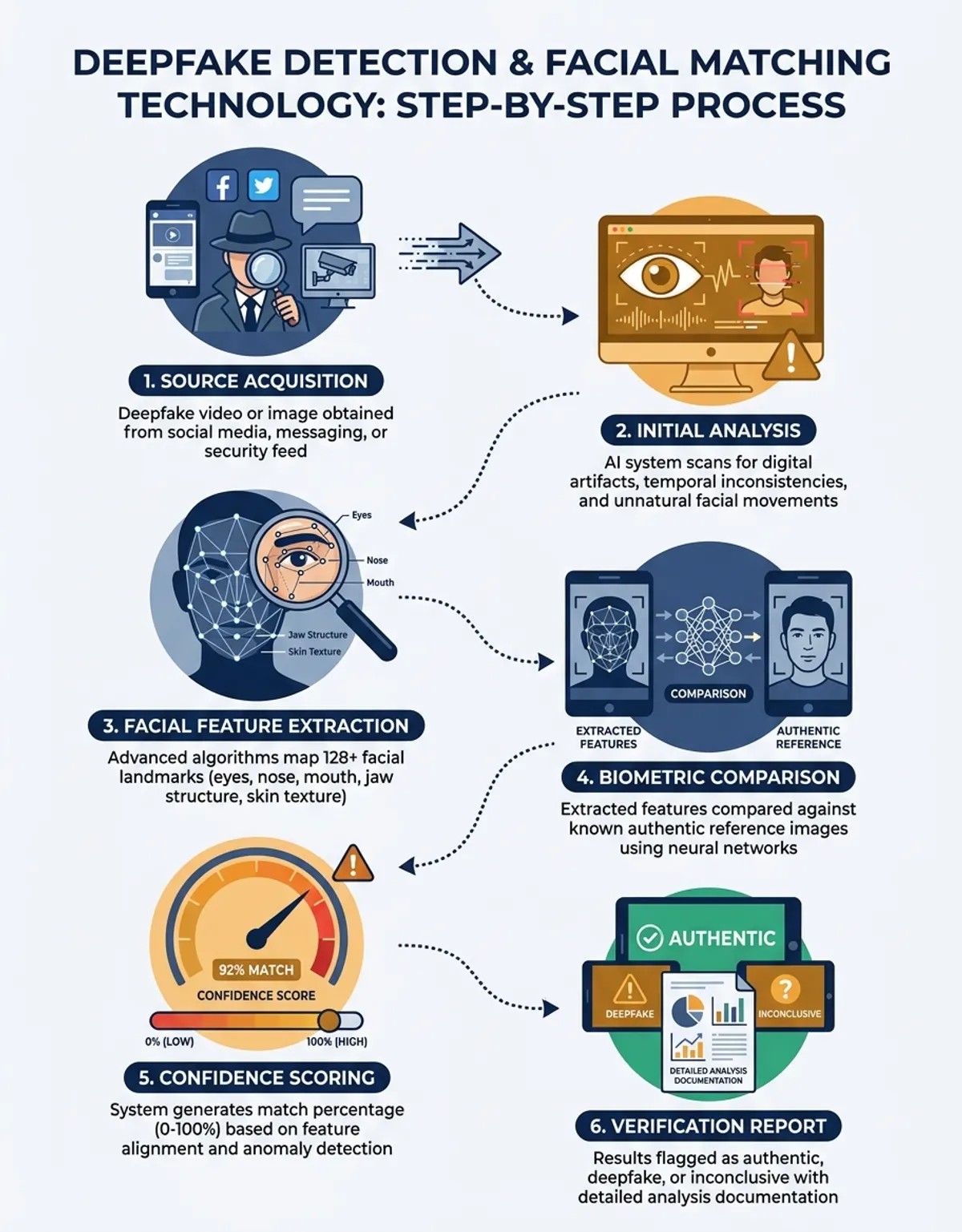
What distinguishes deepfakes from traditional media manipulation is the level of realism they achieve. While earlier forms of fake content were often detectable through careful analysis, modern deepfakes can be extraordinarily convincing, fooling even trained observers. This has profound implications for trust in digital media, cybersecurity protocols, and our ability to distinguish real from artificial content online.
How Deepfake Technology Works: AI and Machine Learning
At the heart of deepfake technology lies a type of artificial intelligence called Generative Adversarial Networks, or GANs. This machine learning framework consists of two neural networks that work in opposition: a generator that creates fake content and a discriminator that tries to detect whether content is real or fake. Through repeated iterations, the generator becomes increasingly skilled at producing convincing fakes that can fool the discriminator.
Face-swapping deepfakes, the most common type, work by training the AI on large datasets of images and video footage of the target person. The algorithm learns the unique characteristics of that person's face—their expressions, movements, lighting responses, and subtle facial features. It then maps this learned face onto another person's body in existing video footage, adjusting for angle, lighting, and movement to create seamless results.
The amount of data needed to generate a deepfake has decreased dramatically over time—some cutting-edge systems can now produce convincing results from just a single photograph.
Voice deepfakes operate on similar principles but focus on audio data. By analyzing recordings of a person's voice, the technology learns their unique vocal characteristics—pitch, tone, cadence, pronunciation patterns, and emotional inflections. Once trained, the system can generate new audio that sounds like the target person saying things they never actually said. Some advanced systems require only a few minutes of sample audio to create convincing voice clones.
The technology continues to evolve rapidly. Newer approaches incorporate real-time processing, allowing for live deepfake video calls. Others focus on full-body synthesis, not just face replacement. As computational power increases and algorithms improve, the barrier to creating highly realistic deepfakes continues to fall, making this technology both more powerful and more accessible to potential bad actors.
Different Types of Deepfakes: Video, Audio, and Image Technology
Video deepfakes are the most well-known form of this technology and typically represent the highest risk for fraud and disinformation. These manipulated videos can show public figures making statements they never made, private individuals in situations they were never in, or entirely fabricated scenarios that never occurred. Face-swap videos, where one person's face is replaced with another's, are the most common type, but lip-sync deepfakes—which alter a person's mouth movements to match different words—are also increasingly prevalent.
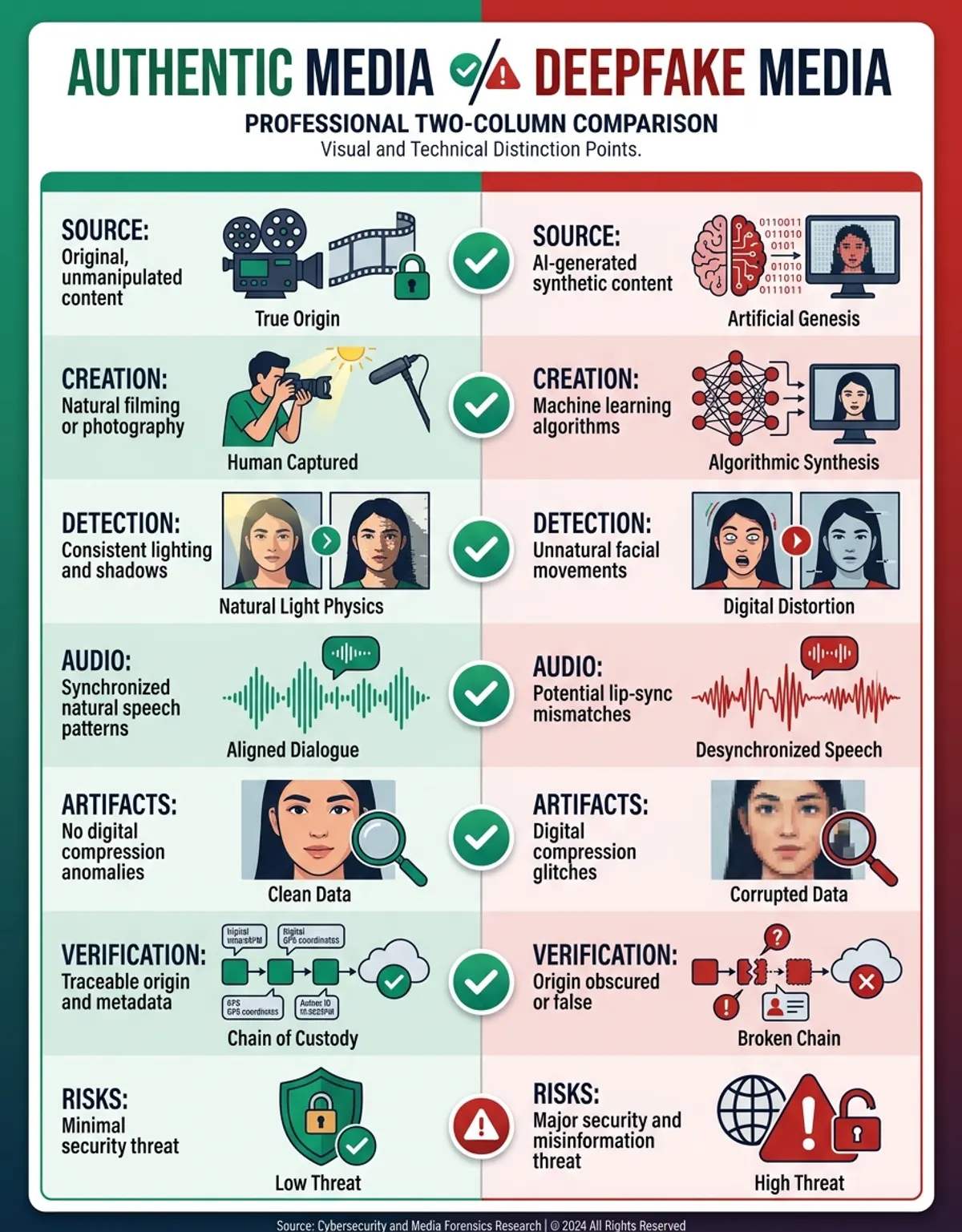
Image deepfakes involve the creation or manipulation of still photographs using AI. These can range from subtle alterations to existing photos to the generation of entirely synthetic images of people who don't exist. This form of deepfake is particularly concerning for identity fraud, as artificial images can be used to create fake social media profiles, fraudulent identity documents, or misleading evidence in legal proceedings. The technology has advanced to the point where AI-generated faces are often indistinguishable from photographs of real people.
Audio deepfakes, sometimes called voice clones, use artificial intelligence to replicate a person's voice with striking accuracy. These deepfakes can be used to generate fake phone calls, audio recordings, or voicemails that seem real but are entirely fabricated. Audio deepfakes pose a particular threat in the context of phone-based fraud, where criminals can use cloned voices to impersonate executives, family members, or trusted contacts to manipulate victims into transferring money or revealing sensitive information.
Text-based AI-generated content, while technically distinct from traditional deepfakes, operates on similar principles and poses related risks. Large language models can now generate convincing written content that mimics specific writing styles, creating opportunities for sophisticated phishing attacks, fake news articles, and fraudulent communications. When combined with deepfake audio or video, these text-based systems can create highly convincing multi-modal deceptions. You may also find our guide on identifying AI-generated images helpful for understanding detection techniques.
Emerging forms of deepfakes include full-body synthesis (creating entire fake people in motion), emotion manipulation (changing facial expressions to convey different emotions), and age progression/regression (showing how someone might look at different ages). As the technology continues to develop, the range of possible manipulations expands, creating new challenges for verification and authentication of digital content.
Deepfake Technology as a Cybersecurity Threat
Deepfakes represent a critical threat to information security frameworks across industries. Organizations face unprecedented challenges in verifying the authenticity of digital communications, as traditional security measures often assume that seeing or hearing someone provides reasonable proof of their identity. Deepfakes fundamentally undermine this assumption, creating vulnerabilities that malicious actors can exploit to bypass authentication protocols, impersonate executives, or manipulate employees into taking harmful actions.
In 2019, a UK energy company CEO was tricked into transferring €220,000 after receiving what he believed was a phone call from his boss, but was actually a voice deepfake.
Financial fraud enabled by deepfakes has already resulted in millions of dollars in losses. In several documented cases, criminals have used voice deepfakes to impersonate company executives during phone calls, convincing employees to authorize fraudulent wire transfers. Video deepfakes can similarly be deployed in video conference calls to impersonate trusted individuals, especially in remote work environments where face-to-face verification isn't possible. As this technology becomes more accessible, the frequency and sophistication of such attacks are expected to increase.
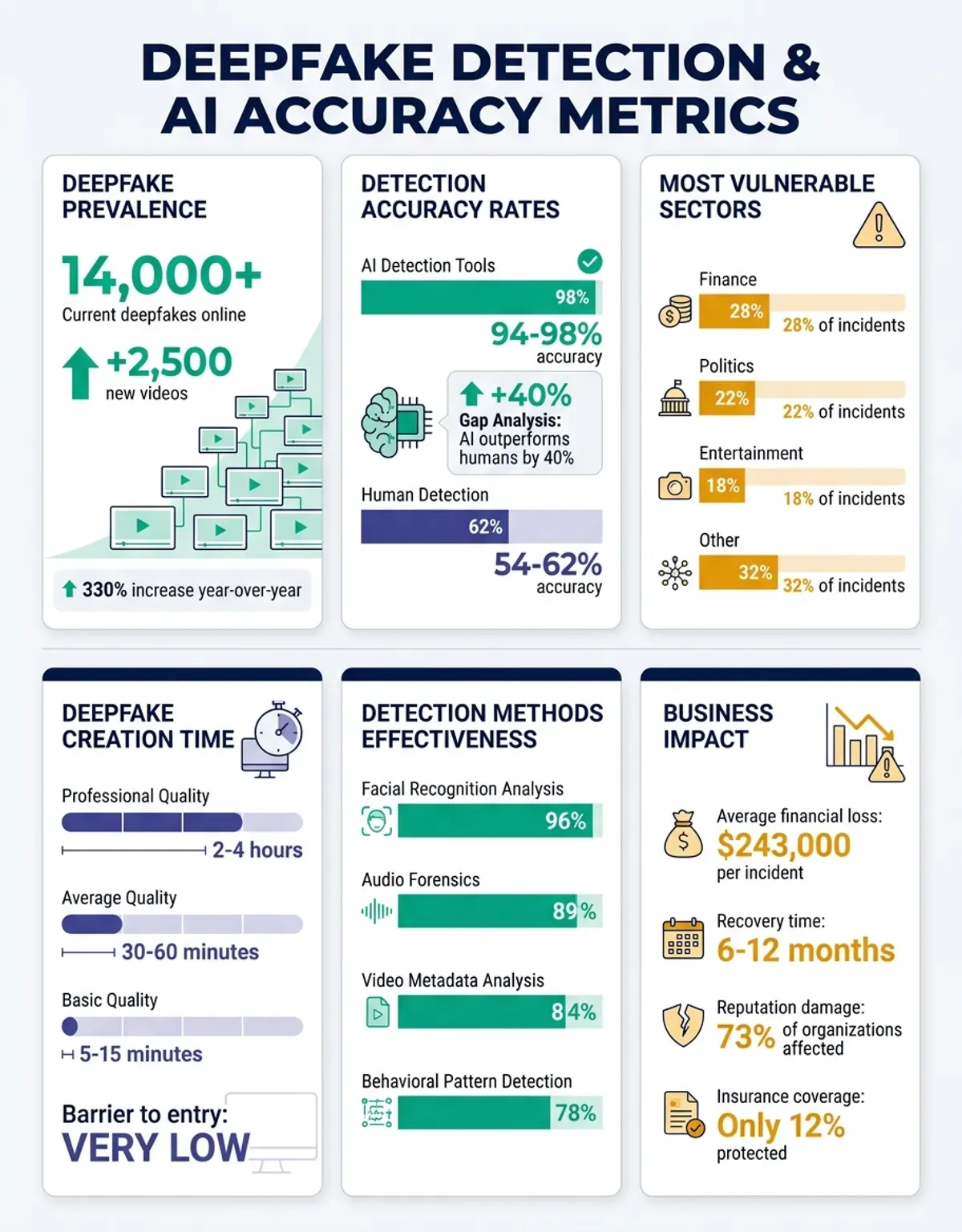
The malicious applications of deepfakes extend far beyond financial crime. Disinformation campaigns use fabricated videos to spread false information, manipulate public opinion, or damage reputations. Non-consensual deepfakes, particularly those of a sexual nature, are used to harass, extort, or humiliate individuals. Corporate espionage operations might deploy deepfakes to impersonate executives or employees to gain access to sensitive information. The breadth of potential abuse makes deepfakes a multifaceted cybersecurity challenge.
Government and corporate security agencies view deepfakes as a significant emerging threat to national security and organizational integrity. Intelligence agencies worry about deepfakes being used to create fake evidence, manipulate diplomatic communications, or influence elections. Corporations face risks ranging from stock manipulation through fake executive announcements to intellectual property theft through impersonation-based social engineering attacks. The threat landscape continues to evolve as attackers develop new techniques and applications.
Deepfake Detection: How to Identify Fake Content
Visual analysis remains one of the primary methods for detecting video deepfakes, though it requires careful observation. Common visual tells include unnatural blinking patterns—either too frequent or too infrequent compared to normal human behavior. Skin tone inconsistencies, where the face appears a slightly different color than the neck or hands, can indicate manipulation. Lighting anomalies, such as shadows that don't match the environment or inconsistent light sources across different parts of the face, often reveal deepfakes. Hair rendering problems, particularly around the edges where hair meets the background, frequently betray artificial generation.
Audio analysis provides another avenue for detection, particularly for voice deepfakes used in fraudulent calls. Robotic or mechanical cadence, where the speech patterns sound slightly too perfect or lack natural variations in rhythm, can indicate synthetic audio. Background noise artifacts, where ambient sounds cut in and out unnaturally or don't match the supposed environment, often accompany deepfake audio. Breathing sounds that are missing or don't align naturally with speech patterns may also signal manipulation. Emotional inconsistencies, where the voice doesn't match the emotional content of what's being said, can be revealing.
Online verification tools and AI-powered deepfake detectors have emerged to help identify manipulated content. Several platforms now offer services where users can upload videos or images for automated analysis. These tools examine metadata, analyze pixel-level inconsistencies invisible to the human eye, and use machine learning to identify patterns characteristic of synthetic media. However, the effectiveness of these tools varies, and they're engaged in an ongoing arms race with deepfake generation technology.
The challenge of detection is intensifying as deepfake technology improves. Many of the traditional tells that helped identify earlier deepfakes—such as problems with teeth rendering, inability to handle profile views, or unnatural eye movements—have been largely resolved in newer systems. State-of-the-art deepfakes can now replicate these subtle details with high fidelity, making detection increasingly difficult even for experts and specialized software.
Context and behavioral analysis often provide the best defense against deepfake deception. Verification protocols that include asking unexpected questions, requesting actions that weren't pre-recorded, or using alternative communication channels to confirm identity can help counter deepfakes. Organizations are implementing multi-factor authentication that doesn't rely solely on visual or audio identification, recognizing that these can no longer be trusted in isolation. The key is understanding that if deepfake technology continues to advance, detection will require a combination of technological tools, human judgment, and robust verification procedures.
Protection from Deepfake Fraud: Security Best Practices
Personal protection against deepfakes begins with limiting the amount of your face and voice data available online. The more high-quality images, videos, and audio recordings of yourself that exist in public spaces, the easier it becomes for someone to create a convincing deepfake. Consider adjusting privacy settings on social media platforms to restrict who can access your photos and videos. Be selective about what you share publicly, particularly video content that shows your face clearly from multiple angles or audio that captures your voice extensively.
Organizations are implementing multi-factor authentication that doesn't rely solely on visual or audio identification, recognizing that these can no longer be trusted in isolation.
Establishing verification protocols with family, friends, and colleagues can provide a crucial defense against voice and video deepfake fraud. Create pre-arranged code words or phrases that can be used to confirm identity during unusual requests, particularly those involving money or sensitive information. Agree on alternative communication channels that can be used to verify unexpected calls or messages. For example, if you receive a suspicious video call from a family member requesting emergency funds, hang up and call them back on a known number to verify.
Organizations should implement comprehensive verification processes for sensitive communications and transactions. This includes requiring multi-factor authentication for financial approvals, establishing callback procedures for unusual requests from executives, and training employees to recognize potential deepfake attacks. Cybersecurity awareness programs should include specific education about deepfakes, their capabilities, and the types of fraud they enable. Regular testing through simulated attacks can help organizations identify vulnerabilities in their verification protocols. Our deepfake app guide provides hands-on experience with detection and creation technologies.
Technology solutions for deepfake detection and prevention are evolving rapidly. Some organizations are implementing blockchain-based authentication systems that create tamper-proof records of legitimate communications. Digital watermarking technologies can verify the authenticity of video and audio content by embedding invisible markers that are difficult for deepfakes to replicate. Biometric authentication systems that analyze typing patterns, mouse movements, or other behavioral characteristics can provide additional verification layers that deepfakes cannot easily mimic.
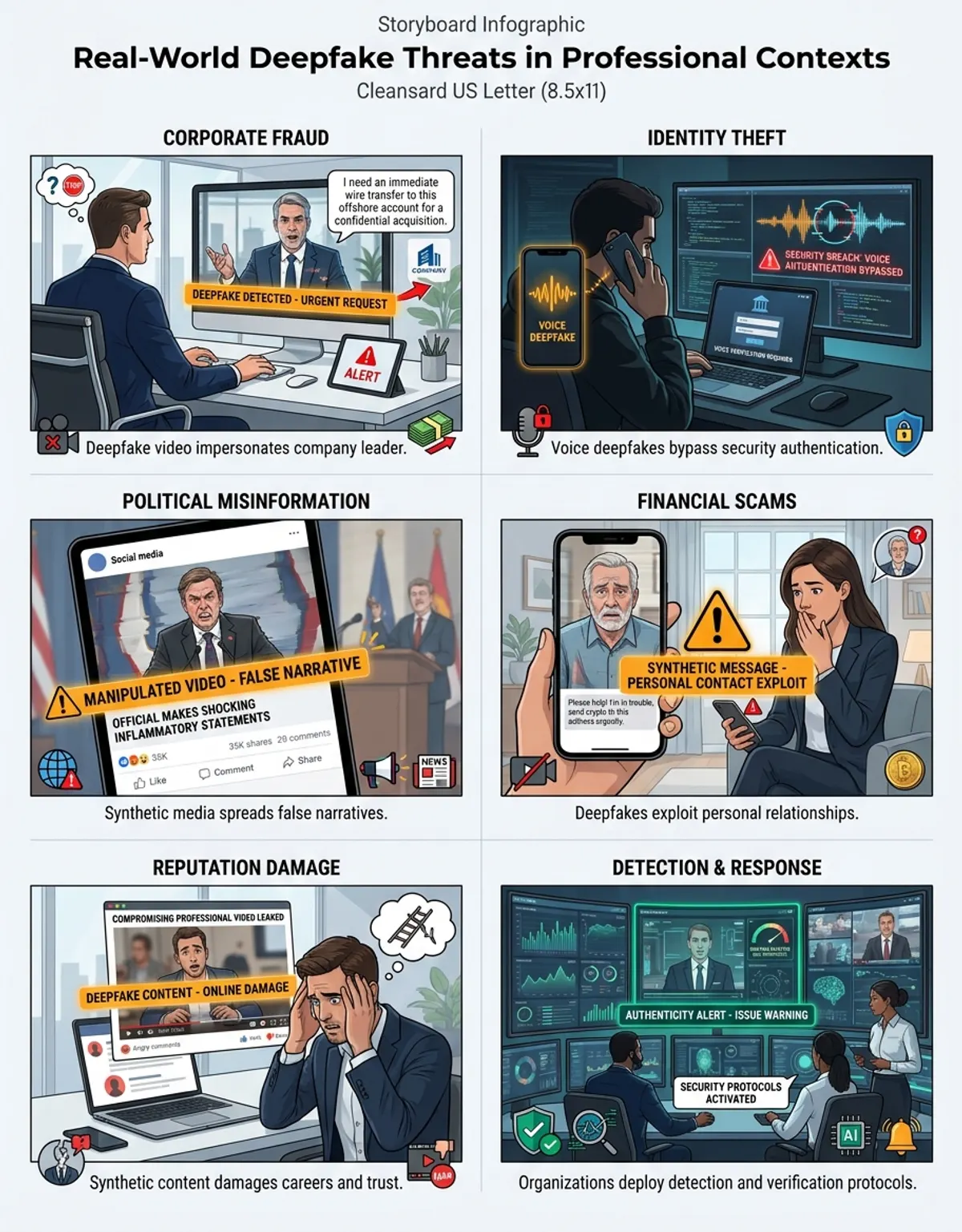
Information security frameworks must adapt to account for the deepfake threat. This means reevaluating assumptions about the trustworthiness of audio and video evidence, implementing zero-trust security models that don't rely solely on apparent identity, and developing incident response plans specifically for deepfake-related fraud attempts. Organizations should regularly update their security policies to address emerging deepfake capabilities and ensure that both technical systems and human procedures can defend against this evolving threat to cybersecurity and organizational integrity.
Comparison Table: Deepfake Types by Risk Level
| Type | Medium | Risk Level | Detection Difficulty | Common Use Case |
|---|---|---|---|---|
| Face-swap video | Video | High | Medium | Disinformation, fraud |
| Voice clone | Audio | Very High | High | Phone fraud, impersonation |
| Image synthesis | Images | Medium | Low–Medium | Identity fraud, fake profiles |
| Lip-sync video | Video | High | High | Political disinformation |
| Text generation | Text | Medium | Low | Phishing, misinformation |
| Real-time face swap | Live video | Very High | Very High | Video conference fraud |
Frequently Asked Questions About Deepfakes
What is a deepfake and how is deepfake technology created?
A deepfake is AI-generated synthetic media created using machine learning algorithms, specifically Generative Adversarial Networks (GANs). These systems are trained on large datasets of images, video, or audio of a target person. The AI learns to replicate the person's appearance, voice, or both, and can then generate new content showing that person doing or saying things they never actually did. The process has been manipulated through deep learning to produce highly realistic results that can be difficult to distinguish from authentic content.
How does a deepfake differ from traditional edited video content?
Traditional video editing involves manual manipulation—cutting, splicing, color correction, and adding or removing elements frame by frame. This audio and video editing requires significant skill and time. Deepfakes, by contrast, use artificial intelligence to automatically generate realistic modifications. Where traditional editing might take hours or days to convincingly swap someone's face in a video, deepfake technology can do it in minutes once the AI model is trained. The level of realism achieved by deepfakes also typically exceeds what's possible with conventional editing techniques.
Are deepfakes illegal? Understanding deepfake regulations online
The legality of deepfakes varies by jurisdiction and context. Many countries and states have enacted or are considering legislation specifically targeting malicious deepfakes, particularly those used for fraud, defamation, election interference, or non-consensual intimate imagery. Creating or distributing deepfakes with intent to defraud, damage someone's reputation, or interfere with elections is illegal in many jurisdictions. However, deepfakes created for satire, parody, or artistic purposes may be protected under free speech laws. The legal landscape continues to evolve as governments grapple with balancing innovation, free expression, and protection from malicious uses of this technology.
How can you tell if video content is a deepfake?
Several visual and audio cues can help identify deepfakes, though detection is becoming increasingly difficult. Look for unnatural blinking patterns, inconsistent lighting across the face, skin tone mismatches between the face and body, and artifacts around the hairline or edges of the face. In audio, listen for robotic cadence, unnatural breathing patterns, or background noise that cuts in and out unnaturally. Context is also important—be suspicious of videos showing unexpected behavior, particularly if they involve requests for money or sensitive information. Using online verification tools or AI detection software can provide additional analysis beyond what the human eye can detect.
What is voice deepfake technology and how does it work?
A voice deepfake uses artificial intelligence to clone someone's voice, creating audio recordings that sound like the person speaking but are entirely synthetic. The technology analyzes recordings of the target's voice to learn their unique vocal characteristics, then generates new audio of that voice saying anything the creator wants. Audio deepfake fraud typically involves criminals using these cloned voices in phone calls to impersonate executives, family members, or other trusted individuals. The fraudster might claim to be calling from a new number due to an emergency and request urgent wire transfers, password resets, or other actions that benefit the attacker. Because people naturally trust what they hear, especially when it sounds exactly like someone they know, these voice deepfakes can be remarkably effective at bypassing normal security skepticism.
How is deepfake technology used in cybersecurity attacks?
Deepfake technology enables several types of cybersecurity attacks that exploit the human tendency to trust audiovisual information. Attackers use deepfakes to impersonate executives in video conferences or phone calls, tricking employees into authorizing fraudulent transactions or revealing sensitive information. Deepfakes can bypass biometric security systems that rely on facial or voice recognition. They're used in sophisticated phishing campaigns where fake video messages from trusted sources convince targets to click malicious links or download malware. In corporate espionage, deepfakes might impersonate employees to gain unauthorized access to facilities or systems. The technology has also been used to create fake evidence for blackmail or to damage an organization's reputation through fabricated scandals involving executives or employees.
What online tools and technology can detect deepfakes?
Several online platforms and tools have emerged to help detect deepfakes, though their effectiveness varies. Microsoft Video Authenticator analyzes photos and videos to provide a confidence score indicating the likelihood of manipulation. Sensity (formerly Deeptrace) offers deepfake detection services for businesses and organizations. Intel's FakeCatcher claims to detect deepfakes by analyzing blood flow in video pixels. Academic institutions have released tools like the Deepfake Detection Challenge dataset and associated detectors. Social media platforms like Facebook and Twitter have implemented their own detection systems to identify and label manipulated media. However, it's important to note that deepfake detection is an ongoing arms race—as detection tools improve, so does the technology for creating deepfakes, making this a constantly evolving challenge in the online content verification landscape.
Navigating the Age of Deepfakes
Deepfakes represent a fundamental shift in how we must approach digital information security and media authenticity. As this technology becomes more sophisticated and accessible, the traditional assumption that "seeing is believing" no longer holds true. The threats posed by deepfakes span cybersecurity, fraud, privacy, and the broader integrity of public discourse, affecting individuals, organizations, and society as a whole.
Understanding deepfake technology—how it works, what forms it takes, and how it can be used maliciously—is the first step in protecting yourself and your organization. The most effective defense combines technological solutions with human vigilance: verification protocols that don't rely solely on audio or video evidence, awareness of the capabilities and limitations of deepfakes, and security frameworks that assume digital media can be manipulated.
As deepfake technology continues to evolve, so too must our approaches to detection, verification, and information security. Organizations need to update their cybersecurity policies to account for deepfake threats, individuals must be more cautious about the media they trust and the data they share online, and society as a whole must develop new norms and legal frameworks for this technology. While deepfakes pose serious challenges, awareness and proactive protective measures can significantly reduce the risks they present.
The future will likely see both improved deepfake creation technology and more sophisticated detection methods. Staying informed about these developments, maintaining healthy skepticism toward unexpected or unusual digital communications, and implementing robust verification procedures will be essential for navigating the age of deepfakes safely and securely.