
Triangle Face Shape: Complete Guide to Hairstyles, Glasses, and Makeup
Everything you need to know to balance, style, and celebrate the jaw-dominant beauty of the triangle face shape.
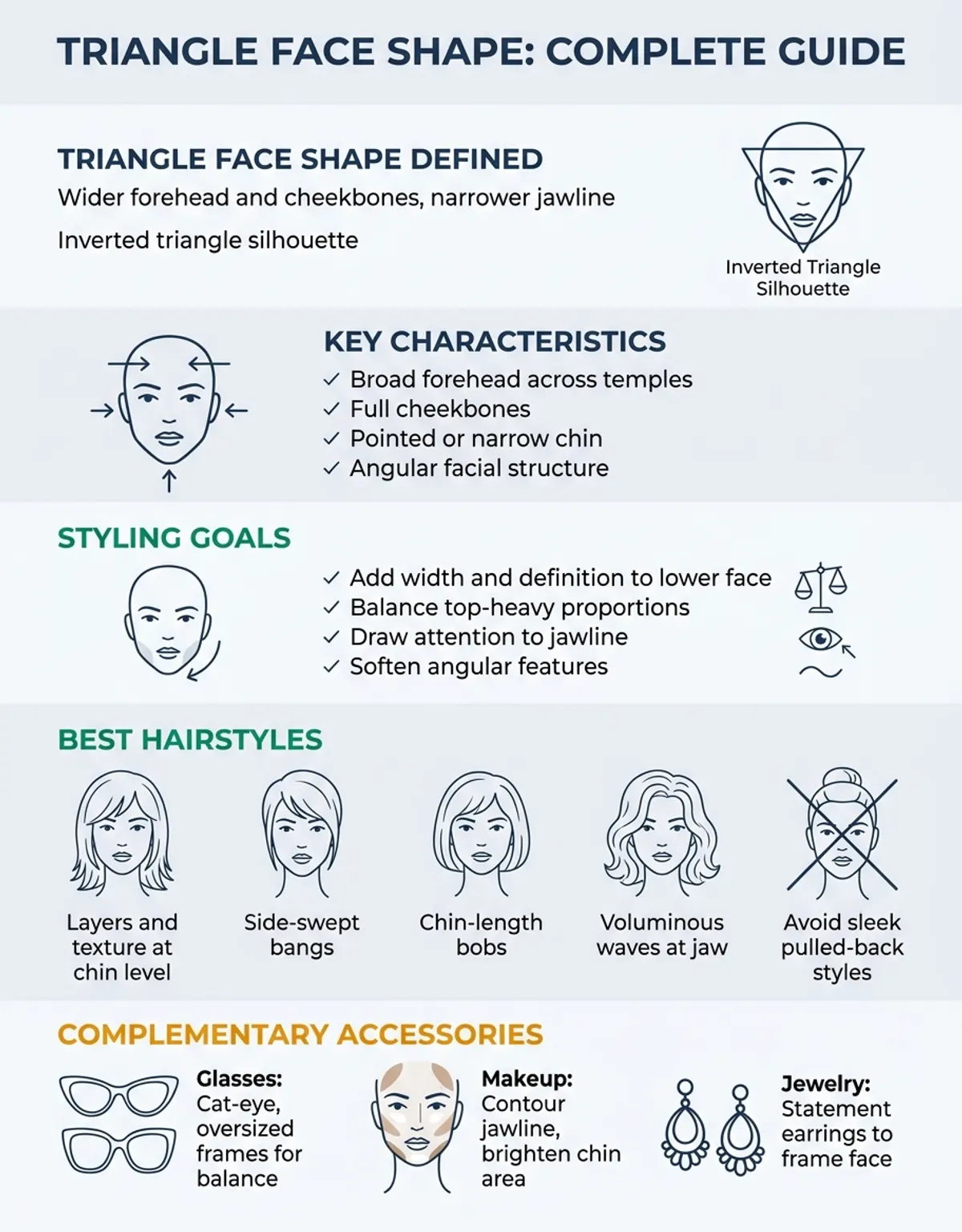
The triangle face shape is defined by a wider jawline that gradually narrows toward the forehead, creating a silhouette that resembles a triangle when viewed straight on. Sometimes called a pear-shaped face, this structure features a broad, prominent jaw as its most dominant characteristic, with temples and a forehead that are noticeably narrower than the lower half of the face. Understanding your triangle face shape opens the door to choosing hairstyles, glasses, and makeup techniques that create the visual balance most faces naturally crave.
Whether you have a classic triangular face or want to compare triangle face shapes with other structures, this guide covers everything — from the best hairstyles and bangs to the right eyeglasses frames and contouring tricks. We'll also show you how to instantly verify your face shape using CaraComp's AI face comparison tool so you can stop guessing and start styling with confidence.
What Is a Triangle Face Shape?
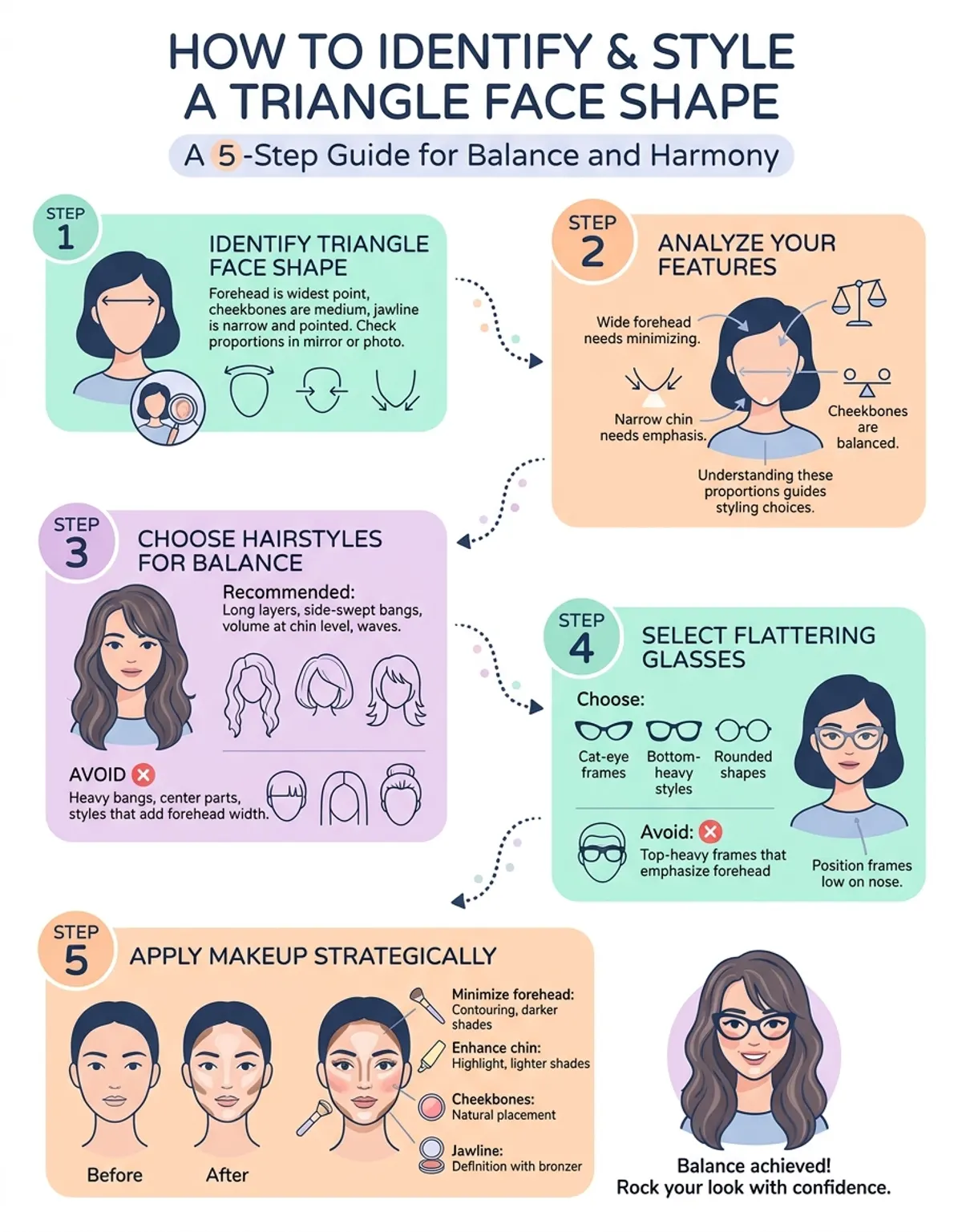
A triangle face shape has a wider jawline that gradually narrows as it moves upward toward the forehead. The jaw is the widest point on the face, the cheekbones fall somewhere in between, and the forehead is the narrowest. This creates the triangular or pear-shaped look that gives this face shape its name.
When you look at triangle faces in a mirror, the most immediately noticeable feature is how the lower half of the face appears wider and heavier than the upper half. The jaw is often strong and prominent, while the temples are narrow and the forehead has less visual weight. This proportion creates a natural downward visual pull — which is exactly why the best styling approaches focus on adding volume, width, and emphasis to the upper portion of the face.
Triangle face shapes are relatively common and appear across all genders. Celebrities with triangular faces often have very defined jawlines paired with a more delicate, narrower forehead. The key is learning to work with this structure rather than fight it — and there are many hairstyles, glasses styles, and makeup methods that do exactly that.
Triangle Face Shape vs Inverted Triangle Face Shape
The most common source of confusion is the difference between a triangle face shape and an inverted triangle face shape. These two structures are essentially opposites of each other, and knowing which one you have changes every styling recommendation.
A triangle face shape is wider at the jaw. The forehead is narrow, the cheekbones are moderate, and the chin and jaw are the widest, most dominant features. The visual weight of a triangular face sits in the lower half.
An inverted triangle face shape is the mirror image — wider at the forehead and temples, with cheekbones that are prominent and a jaw that tapers to a narrower chin. The inverted triangle face is sometimes called a heart-shaped face (especially when there is a widow's peak), and its visual weight sits in the upper half of the face.
The styling goals for triangle and inverted triangle faces are exact opposites — applying the wrong advice will create the opposite of the desired effect.
The styling goals for each are the opposite. For an inverted triangle face shape, the goal is to add volume at the jaw and minimize the forehead. For a triangle face shape, the goal is to add volume at the upper sides of the face and forehead while drawing less attention to the wide jaw. Hairstyle choices, glasses frames, and makeup contouring techniques are all applied differently depending on which triangle orientation you have.
Understanding this distinction is critical before investing time in any styling advice. Applying inverted triangle recommendations to a triangle face — or vice versa — will create the opposite of the desired effect.
Key Characteristics of Triangular Faces
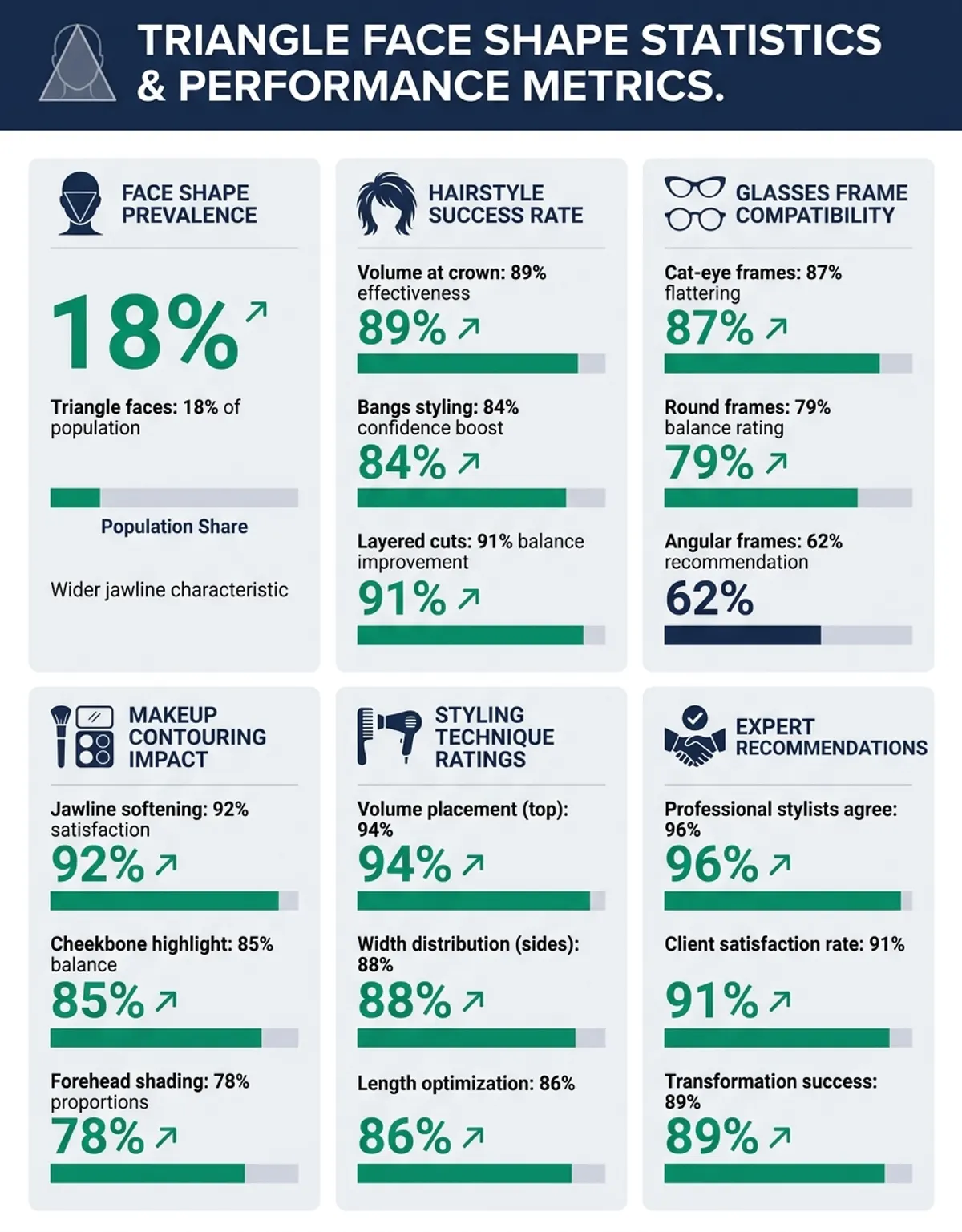
Identifying a triangle face shape comes down to a few defining features. Here is what to look for when assessing triangle faces:
Prominent jaw: The jawline is the widest point on a triangle face shape. It tends to be strong and well-defined, sometimes square-shaped at the edges, and noticeably wider than the cheekbones and forehead. This broad, prominent jaw is the most reliable indicator of a triangle face shape.
Narrow upper face and forehead: The temples are narrower than the jaw. The forehead may be fairly small or gently tapered, and there is less visual mass in the upper portion of the face. When you measure across your forehead and compare it to the widest point of your jaw, the jaw measurement will be larger on a triangle face shape.
Moderate cheekbones: The cheekbones on triangle faces typically fall between the narrow forehead and the wider jaw. They are not as prominent as on an oval or heart face, and they do not define the widest point on the face the way they do on a round or square face.
Gradual narrowing upward: The face gradually gets narrower from the jaw up. This gradual taper — a wider jawline that gradually narrows through the cheeks and up to the forehead — is the defining visual signature of the triangle face shape.
Compare triangle-shaped faces to other shapes: oval faces are balanced and slightly wider in the cheek area; round faces are widest at the cheeks with a rounded jaw; square faces are wide at both the forehead and jaw; and heart-shaped faces are widest at the forehead. Triangle faces are uniquely identifiable by that jaw-dominant proportion.
Face Shape Comparison Table
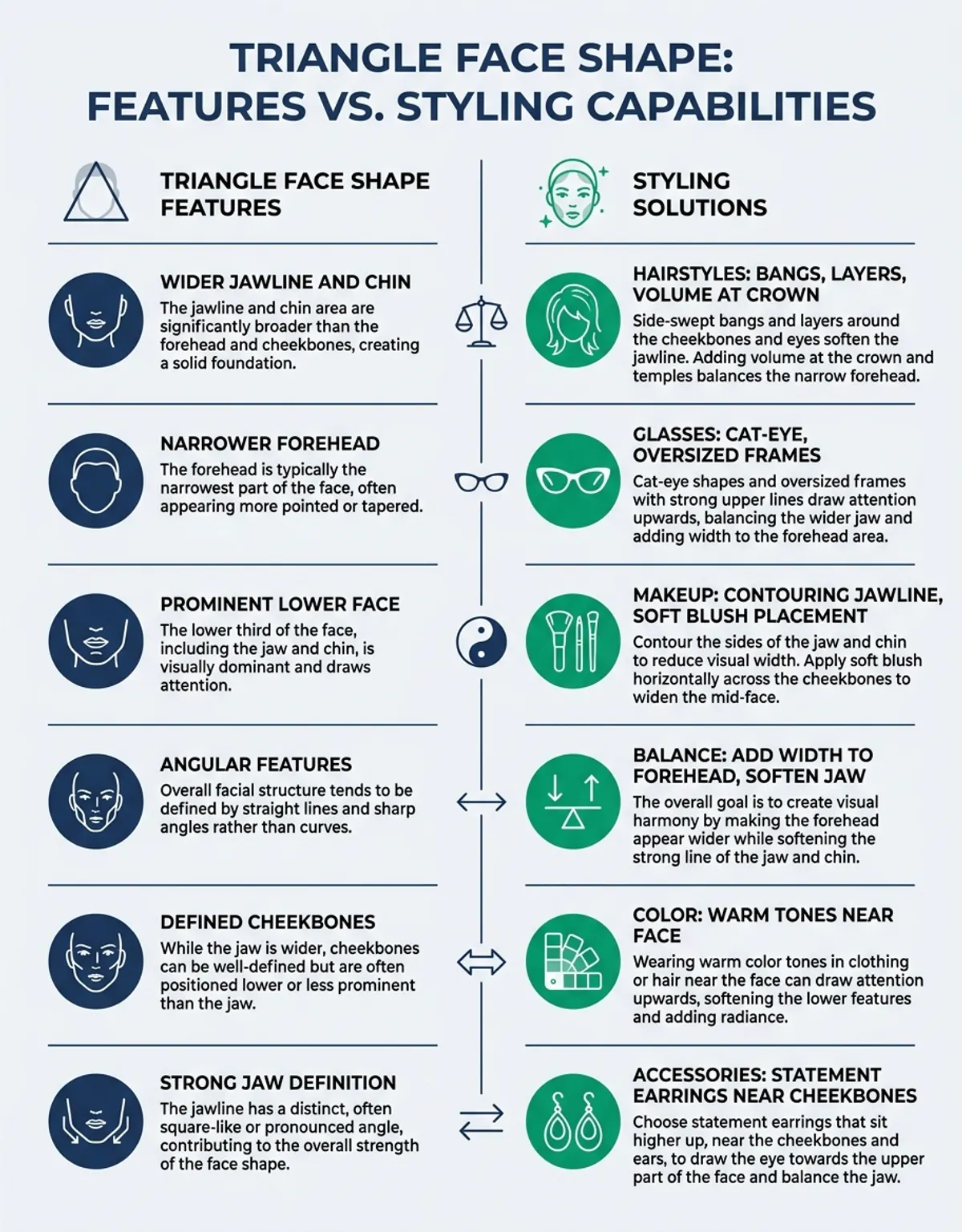
| Face Shape | Forehead | Cheekbones | Jawline | Best Hairstyle Approach |
|---|---|---|---|---|
| Triangle | Narrow | Moderate | Widest point — broad, prominent jaw | Add volume at the upper face and crown; bangs and layers to widen upper face |
| Inverted Triangle | Widest point — broad forehead | Prominent | Narrow, tapered chin | Add volume at jaw; avoid wide styles at the crown |
| Oval | Slightly narrower than cheekbones | Widest point | Gently rounded, narrower than cheekbones | Most styles work; maintain balanced proportions |
| Heart | Wide with possible widow's peak | High and prominent | Narrow, pointed chin | Add fullness at jaw; side-swept bangs to soften forehead |
| Square | Wide — similar width to jaw | Moderate to wide | Wide, angular, similar to forehead width | Soften angles with layers and waves; avoid blunt cuts |
Best Hairstyles for Triangle Face Shapes
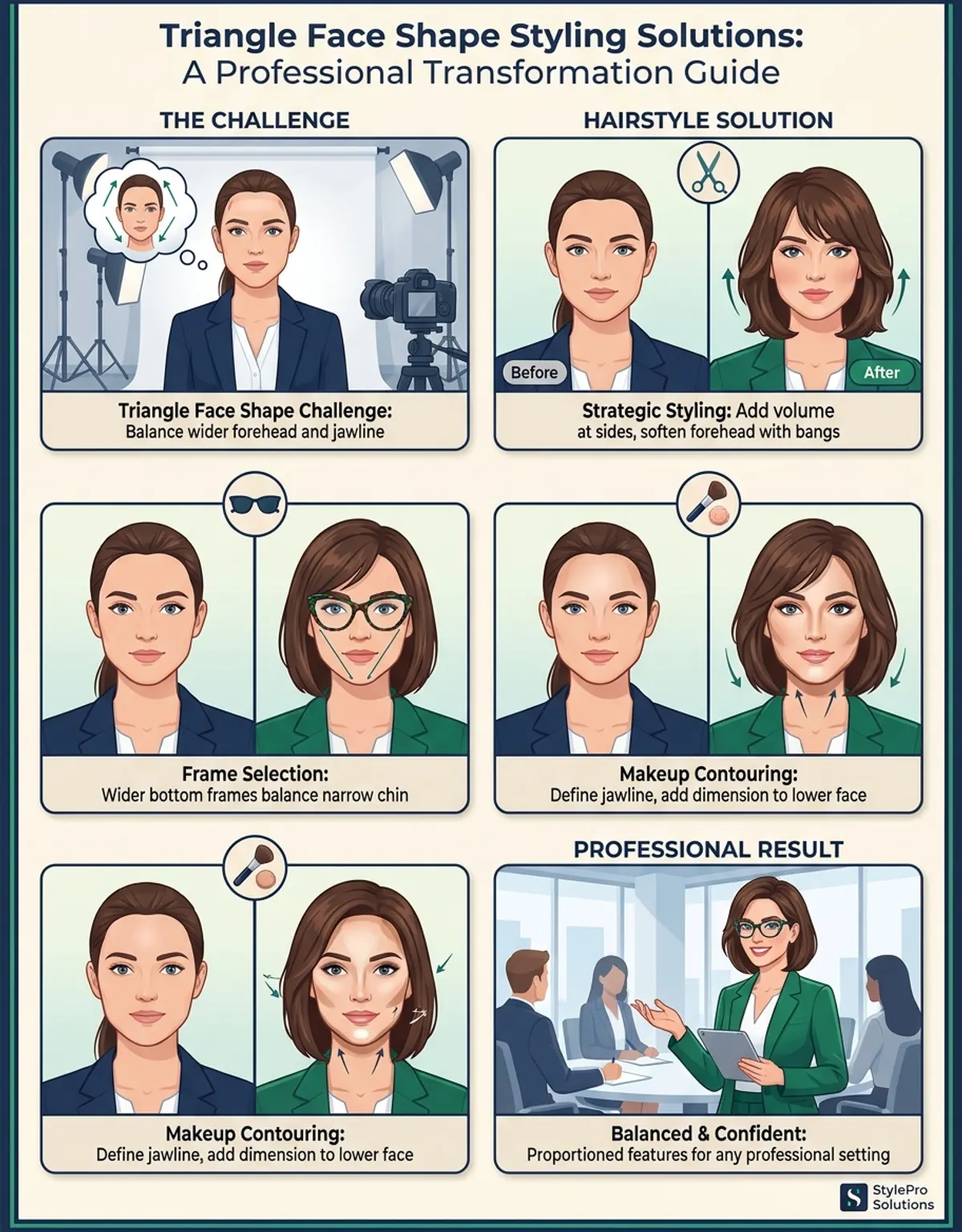
The goal with hairstyles for triangle face shapes is to add visual width and fullness to the upper portion of the face — the temples, crown, and forehead — while minimizing the appearance of width at the jaw. The right hairstyles create balance by drawing the eye upward rather than downward. There are several reliable approaches that stylists recommend for people with this face shape.
Fullness at the crown and temples: Any hairstyle that builds fullness at the top of the head and at the upper sides of the face works beautifully for a triangle face shape. This includes styles with body and lift at the roots, voluminous blowouts, and any cut that creates fullness above the ears. Fullness here counterbalances the wider jaw below and helps find visual equilibrium.
Bangs: Bangs are one of the most effective tools for a triangle face shape. Side-swept bangs, curtain bangs, and wispy fringe all draw attention upward to the forehead, which is naturally narrower on a triangle face shape. Bangs add visual weight to the top of the face — exactly the effect needed to create balance. Full blunt bangs can also work, though they look best when the rest of the hairstyle adds some width at the temples.
Layered haircuts are ideal because layers can be structured to add fullness at the crown while removing bulk from the lower sections of hair that fall alongside the jaw.
Layers: Layered haircuts are ideal for triangle face shapes because layers can be structured to add fullness at the crown while removing bulk from the lower sections of hair that fall alongside the jaw. Layered sections that start above the ears add width exactly where it is needed. Avoid layered sections that fall exclusively at jaw or chin level, as this tends to draw more attention to the jaw width.
Wavy and textured styles: Natural waves, beach waves, and textured hair work exceptionally well for this face shape because the texture creates fullness throughout — including at the temples. This hairstyle approach also prevents hair from lying flat against the jaw in a way that emphasizes its width. Many people with triangle face shapes find that their hair looks best with some wave or texture rather than poker-straight.
Side parts: A deep side part creates asymmetry in your hair that helps break up the visual width of the jaw. This simple hairstyle adjustment also adds height on one side, contributing to the perception of a more balanced face. A side part requires no additional products or styling time — it is one of the easiest hairstyle tweaks that consistently improves the appearance of this face structure.
Hairstyles to avoid: Straight, flat hair that hugs the face and ends at or below the jaw draws attention to the jaw's width. Very short crops that expose the jaw without balancing hair volume at the top are generally less flattering. Severely pulled-back hairstyles — tight ponytails, slicked-back buns, or ultra-sleek blowouts — minimize the upper face and let the jaw dominate the overall look.
Hairstyle Tips for Men with a Triangle Face Shape
Men with a triangle face shape benefit from the same core principle — adding hair fullness above the jaw to create visual balance. Men's hair options have their own set of styles worth exploring in detail, with several approaches that work particularly well.
Fullness-building cuts at the top: Textured quiffs, pompadours, and faux hawks add significant height and fullness to the crown and forehead area, which counterbalances a wide jaw. Any cut that involves height on top works in favor of a triangle face shape. These hairstyles naturally shift the eye upward toward the crown, visually elongating the face and reducing the jaw's visual dominance.
Fade cuts with fullness on top: High fades and undercuts work well for this structure when there is ample hair length and fullness kept on top. The fade removes hair at the sides and back near jaw level, while fullness on top creates a more balanced overall silhouette. A taper fade with a textured crop on top is a particularly strong option for men with triangle face shapes who want a clean, modern look.
Textured crops and messy styles: Messy, textured hair at medium length is a great choice because it adds fullness at the temples naturally. The tousled look creates width at the top of the head without looking contrived, making it one of the most versatile hairstyles for men with triangle-shaped features.
Beard considerations: For men with triangle face shapes, a beard adds even more prominence to the jaw area. If you prefer facial hair, keep it trimmed and neat rather than full and wide. A well-groomed short beard can work, but a thick, wide beard will visually increase jaw width further — generally not the goal for this face structure.
Best Glasses and Eyeglasses for Triangle Faces
Choosing the right eyeglasses for a triangle face shape follows the same logic as choosing the right hairstyle — the goal is to add width and visual presence to the upper portion of the face to balance the prominent jaw below. The frame style you choose can make a significant difference in how balanced your face shape looks.
Cat-eye frames: Cat-eye frames are one of the best frame styles for a triangle face shape. The upswept outer corners draw the eye upward and outward at the temples, adding visual width to the narrower upper face. This directly counterbalances the jaw-dominant proportions, making cat-eye frames a top recommendation for this face shape.
Aviator frames: Aviator frames work well for this structure because their teardrop shape is widest at the top and tapers slightly at the bottom. This matches well with the upward-narrowing structure of a triangle face. The prominent frame at the top also adds weight and visual interest to the temple area, helping to widen the look of the upper face.
Semi-rimless frames (top-heavy): Frames that are rimless or lighter on the bottom but heavier on top — often called semi-rimless or browline frames — concentrate visual weight at the upper face. These frames draw attention to the forehead and temples rather than the jaw, making them an excellent choice for people with this face structure.
Wide frames: Frames that are wider than the face at the temple area add visual breadth to the narrow forehead and temples. Look for frames with wide temples and broad lenses that extend outward. When you wear frames that extend past the width of your natural temples, the effect is an immediate visual widening of the upper face.
Frames to avoid: Very small frames, narrow rectangular lenses, and frames that are primarily wide at the bottom can make the upper face appear even narrower. Rimless frames that have no weight at the temple area may also fail to create the balancing effect needed for this structure. For more on this topic, see our guide on heart face shape.
Makeup Techniques to Balance a Triangle Face Shape
Makeup contouring and highlighting can reshape the perceived proportions of any face. For triangle face shapes, the goal is to add light and visual attention to the upper face while using contouring to minimize the appearance of jaw width. Here is a complete approach to makeup for this face structure. For more on related techniques, see our guide on square face shape.
Contouring the jaw: Apply contour — a matte shade one to two tones darker than your skin — along the sides of the jaw and jawline. Blend it down and away along the outer jaw, using a brush to feather the product so there are no harsh lines. This shadow creates the illusion that the jaw is narrower than it actually is, softening the broad, prominent jaw that defines this face shape.
Highlighting the forehead and temples: Apply a light, luminous highlighter across the center of the forehead and at the temples. This draws light and attention to the upper face, creating the perception of width where the face is naturally narrow. Highlight the browbone as well to further open up and widen the look of the upper face.
Blush placement: Blush applied at a higher angle — swept horizontally across the cheekbones and extending toward the temples — emphasizes the upper third of the face. Avoid placing blush too low, near the jaw, which would draw attention downward. For triangle face shapes, high blush placement is one of the simplest and most effective cosmetics adjustments you can make.
Eyebrow shaping: Fuller, more arched brows add visual width and structure to the forehead area. For people with this structure, brows that are slightly lifted and well-defined draw the eye upward. Consider filling in sparse brows to maximize this effect. Defined brows also help frame the eyes in a way that shifts attention to the upper face.
Lip cosmetics: A bold lip can draw some attention to the center lower portion of the face. For balance, keep lips defined but not dramatically over-lined, so attention does not linger too long at the jaw area. Neutral-to-medium lip shades keep visual focus distributed rather than pulling it downward toward the wide jaw.
High blush placement, browbone highlight, and jaw contour work together to create the illusion of a perfectly balanced face — no filter required.
Verify Your Face Shape Instantly with CaraComp
Determining your face shape by looking in a mirror can be tricky — most people find it genuinely difficult to assess their own proportions objectively. That is where CaraComp's AI face comparison tool comes in. CaraComp uses advanced facial analysis technology to identify your face shape accurately and instantly, taking the guesswork out of the equation. Use our face shape detector to get an instant, accurate analysis of your facial structure.
With CaraComp, you upload a photo and the AI analyzes your key facial proportions — forehead width, cheekbone width, jawline width, and face length. In seconds, you will know definitively whether you have a triangle face shape, an inverted triangle, an oval, round, square, or heart face. This removes any uncertainty and lets you jump straight into styling with accurate, personalized recommendations.
CaraComp also lets you compare people side by side, making it easy to see how your features compare to celebrities, style icons, or other individuals with known face shapes. This visual comparison helps you understand exactly where your proportions fall and which styling approaches will work best for your unique structure.
Stop guessing and start knowing — visit CaraComp to verify your face shape instantly and get style recommendations tailored to your exact facial structure. Thousands of users with triangle faces, inverted triangle faces, and every other shape use CaraComp to get clarity on their features and find styles that balance their natural proportions beautifully.
Frequently Asked Questions About Triangle Face Shape
What is a triangle face shape?
A triangle face shape, also called a pear-shaped face, has a wider jawline that gradually narrows upward toward the forehead. The jaw is the widest point, the cheekbones are moderate, and the forehead is the narrowest part of the face. The overall silhouette creates a triangle-shaped outline with the wide base at the bottom. This is one of several common face shapes, alongside oval, round, square, heart, and diamond structures.
What is the difference between a triangle and inverted triangle face shape?
Triangle and inverted triangle face shapes are structural opposites. A triangle face shape is wider at the jaw, with a narrower forehead and temples — the wide base is at the bottom. An inverted triangle face shape is wider at the forehead and temples, with a narrower, more tapered jaw — the wide base is at the top. The styling goals for each are reversed: triangle faces need fullness added to the upper face, while inverted triangle faces need fullness added near the jaw.
What hairstyles suit a triangle face shape?
The best hairstyles for triangle face shapes add fullness at the crown, temples, and forehead to balance the wider jaw. Top recommendations include layered cuts with fullness above the ears, side-swept or curtain bangs, textured waves, and styles with crown fullness such as quiffs or voluminous blowouts. Layered sections are especially effective because they can be structured to add width at the temples while reducing bulk near the jaw.
Do bangs work for triangle face shapes?
Yes — bangs are one of the most effective styling tools for triangle face shapes. Because triangle faces have a narrower forehead, bangs add visual interest and weight to the upper face, helping to balance the wider jaw. Side-swept bangs, curtain bangs, and wispy fringe are all excellent options. Even full blunt bangs can work when the rest of the hairstyle provides some temple width. Bangs shift the visual focus upward, creating a more balanced appearance.
What glasses frames are best for triangle faces?
The best frames for triangle faces add width and visual presence to the upper portion of the face. Cat-eye frames are ideal — their upswept outer edges draw the eye up and outward at the temples. Aviator frames work well because they are wider at the top. Browline and semi-rimless frames that concentrate weight at the top of the lens are also excellent choices. Look for frames that extend at least as wide as your natural temples. Avoid very small or narrow frames, and avoid rimless frames that lack visual weight at the top.
How can I use makeup to balance a triangle face shape?
Makeup techniques for triangle face shapes focus on two goals: adding visual width to the forehead and temples, and minimizing the appearance of jaw width. Use highlighter on the center of the forehead and at the temples to bring light and attention upward. Apply contour along the outer jaw to create the illusion of a narrower jaw. Place blush high on the cheekbones and sweep it toward the temples. Define and slightly arch the brows to emphasize the upper face.
How do I know if I have a triangle face shape?
To identify a triangle face shape, look at your face straight on in a mirror or in a front-facing photo. If your jawline is the widest part of your face, your forehead is noticeably narrower than your jaw, and your face gradually gets narrower as it moves from jaw to forehead, you likely have a triangle face shape. You can also measure: if your jaw width is greater than your forehead width, and your cheekbones fall somewhere in between, the proportions point to this face shape. For a definitive answer, use CaraComp's AI face shape analyzer to get an accurate, objective result from your photo in seconds.