
Square Face Shape: How to Identify It and What Looks Best
A complete guide to identifying your square face shape — and discovering the hairstyles, eyewear, and style choices that bring out its bold, angular best.
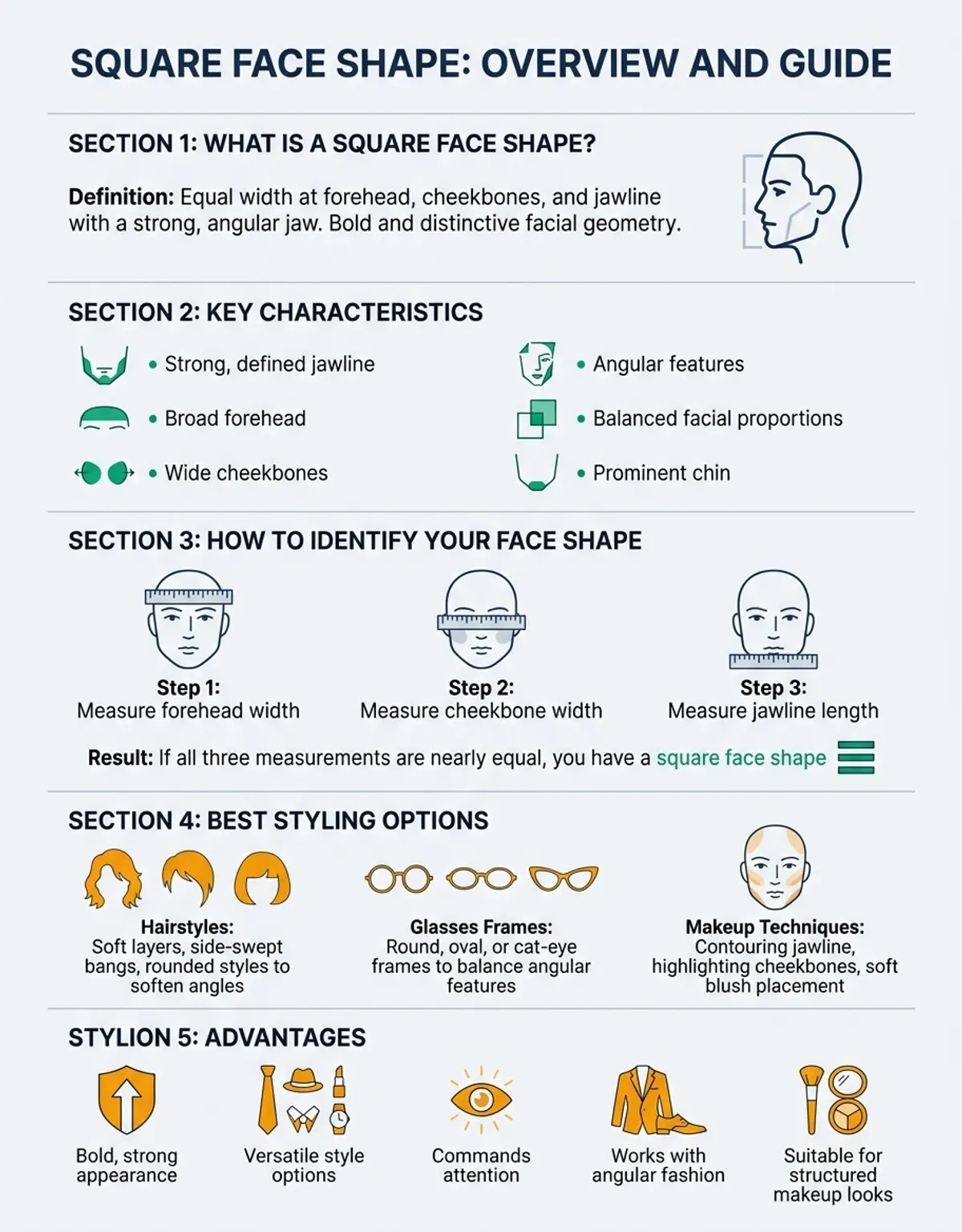
The square face shape is one of the most distinctive and powerful face shapes in beauty and style — defined by a strong, angular jaw, broad shallow jawline, and forehead and cheekbones that are nearly equal in width. It is wide across all three zones in a way that creates bold, symmetrical features, and it is recognizable for its more pronounced jawline that makes it look almost rectangular rather than tapered. People with a square face shape carry an air of strength and confidence that many celebrities, athletes, and style icons proudly display. Yet despite this striking presence, the square face shape also calls for a thoughtful approach to hairstyles, eyeglasses, and makeup — because the right choices enhance its best features, while the wrong ones can emphasize width over balance. This complete guide will help you identify whether you have a square face shape, understand your unique features, and discover what looks best for your specific proportions.
What Defines a Square Face Shape
Understanding the structural characteristics of the square face shape helps explain why certain style choices work so well and others fall flat. The square face shape is defined by a precise set of proportional relationships between its key zones.
The core features of the square face shape include:
- Broad, angular jawline: The jawline on a square face is wide and squared off at the corners rather than curved or tapered. This broad shallow jawline is the most defining trait — where round and oval faces curve gently toward the chin, the square face meets at near-right angles, giving it sharp corners near the ears.
- Equal width across three zones: The forehead, cheekbones, and jaw measure close to the same width. This "three-zone equality" is what creates the square's characteristic blocky, it is wide appearance.
- Prominent cheekbones: The cheekbones are high and strong, adding dramatic definition to the mid-face. Unlike in heart shapes (where cheekbones narrow toward the jaw) or oblong faces (where the face is simply longer), the square face shape's cheekbones contribute to the overall angular silhouette.
- Squared facial outline: When viewed from the front, the overall outline of the face resembles a rectangle more than a circle or oval. Face length and face width are close to equal or only slightly different, making the face appear compact and powerful.
A key anatomical factor behind the this face structure is the masseter muscle. The masseter is the large chewing muscle that runs from the cheekbone down to the lower jawline. In square-faced individuals, the masseter muscle is often naturally more developed or more prominently positioned, which contributes to the visible angularity and width of the lower face. This muscle creates the cornerstone of the square jaw's bold aesthetic, and it explains why the square face type can look more or less pronounced depending on how the masseter develops over time.
The square facial structure differs from the rectangle your features (which is longer and narrower) and from the round the structure (which shares similar width but has a softer, curved jawline rather than an angular one). Within the square category, you may encounter a small forehead square face — where the forehead is slightly narrower than the jaw — or a more even distribution. Both are considered square face shapes, with minor proportional variation between individuals.
How to Identify a Square Face Shape
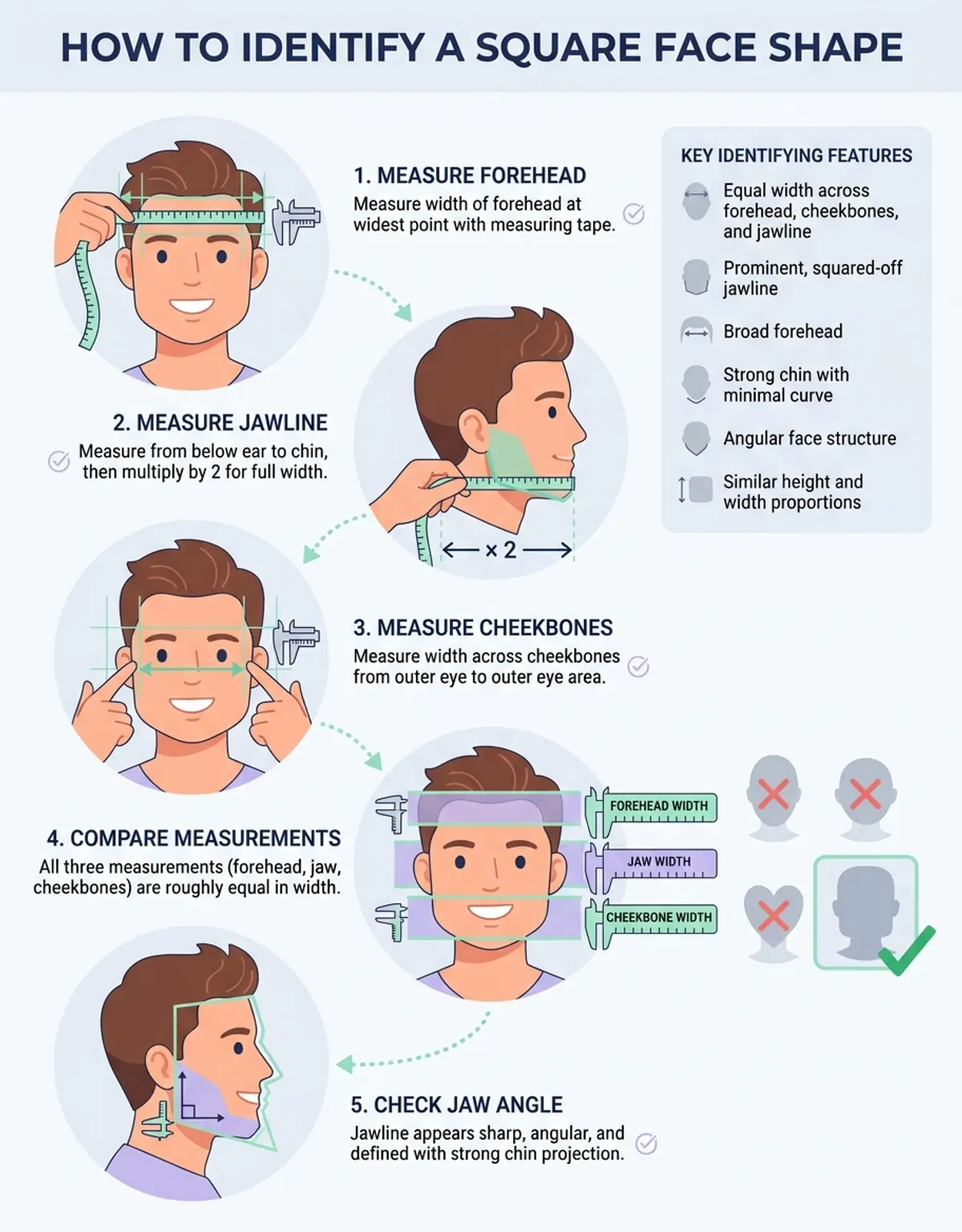
If you want to identify whether your face shape is square, a few simple observations and measurements make the process straightforward. You do not need professional tools — a mirror, good lighting, and a flexible measuring tape are all you need.
Follow these steps to identify your face shape:
- Pull your hair back: Clear your face completely by pulling all hair away from your hairline, ears, and neck. This removes visual distractions and lets you see your true face outline.
- Measure your forehead: Measure across the forehead at its widest point, typically halfway between the hairline and the eyebrows.
- Measure your cheekbone zone: Measure across your cheeks from the outer corner of one eye to the outer corner of the other. This gives you the cheekbone width.
- Measure your jawline: Measure from the tip of your chin to just below your ear, double that number, and you have an estimate of total jaw width. Alternatively, measure the full jaw width directly from one corner to the other.
- Compare the three measurements: If your forehead, your cheeks, and your jaw width are all within about 5% of each other — and it is wide at all three points rather than wider at one zone and narrower at another — your face is square or very close to it.
- Check your jaw corners: Look at the angle where your jaw meets behind your ears. If the corners look squared off and angular rather than rounded and curved, this strongly confirms a square face type.
Many people find that their facial structure falls slightly between two types — for example, a square face that is slightly wider at the cheekbone area than the jaw may lean toward a diamond shape, while a square face that is slightly longer than it is wide may lean toward a rectangle. Face shapes exist on a spectrum, and the square face encompasses a range of proportions. If self-measurement feels imprecise, an AI face comparison tool can analyze your facial landmarks objectively and identify your face shape with precision.
People with a square face shape carry an air of strength and confidence that many celebrities, athletes, and style icons proudly display.
Celebrities with Square Face Shapes
Some of the most celebrated faces in entertainment, sports, and fashion belong to people with the square face shape. Their features illustrate how the square's angular characteristics translate into striking, memorable screen presence and style impact.
Well-known public figures with square face shapes include Angelina Jolie, whose prominent upper face and angular jaw define her powerful beauty profile; Olivia Wilde, who frequently showcases how the right hairstyle can soften and flatter the square face's features; Keira Knightley, whose defined jawline and angular mid-face are closely identified with her iconic roles; and Demi Moore, a long-established example of how the this face structure looks best when combined with face-framing hairstyles and a strong brow. In sports, many athletes with square face shapes have become style icons precisely because their strong, angular features project confidence and strength.
What makes stars with square faces stand out is the same thing that makes the square face type so distinctive: the combination of prominent cheekbones, a bold jawline, and balanced width across the face creates a face that holds light well, photographs dynamically, and carries bold makeup looks with authority. When you understand the style choices these icons favor — particularly in hairstyles and eyeglasses — you can apply the same principles to your own square facial structure.
Best Hairstyles and Bangs for Square Faces
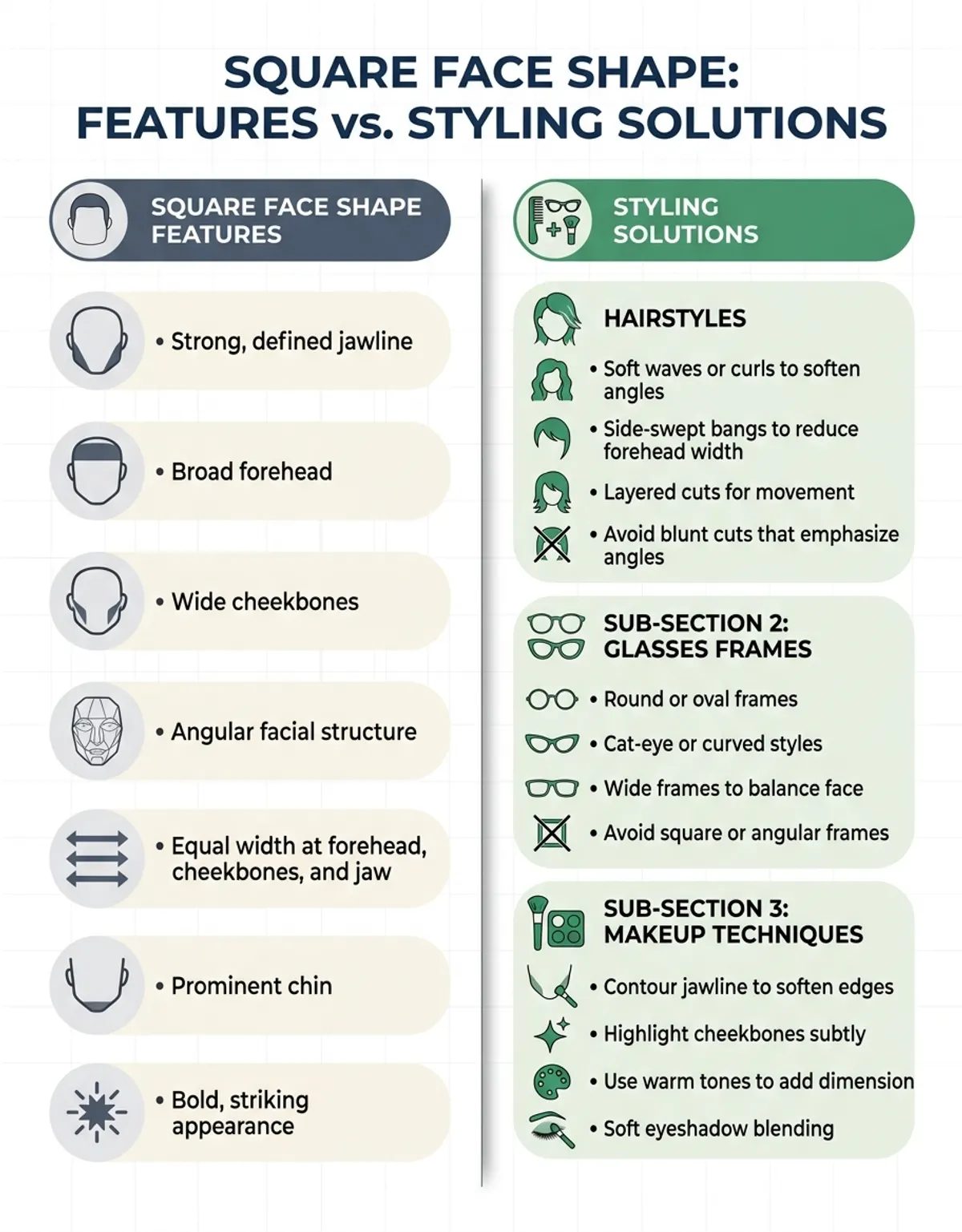
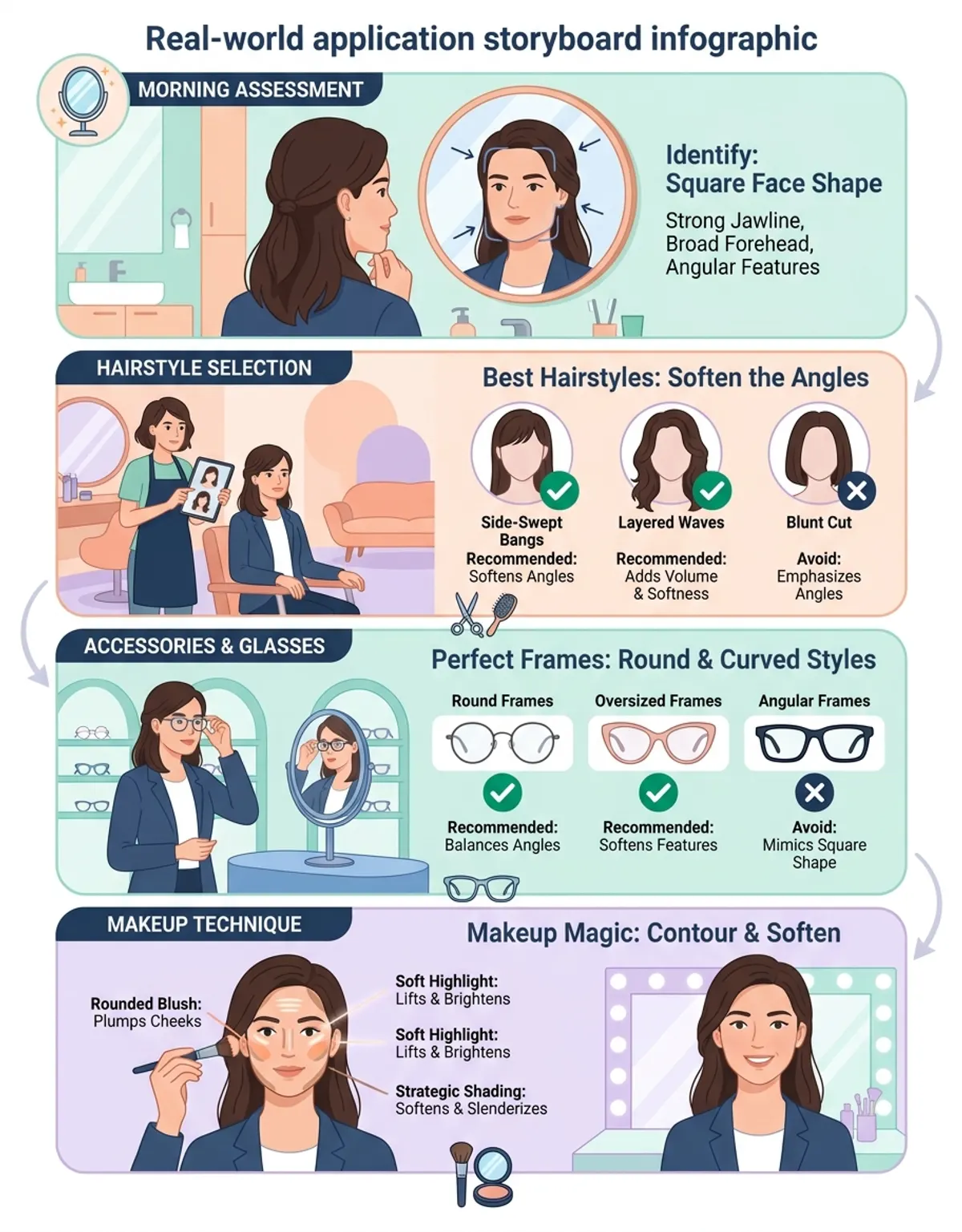
The most effective hairstyles for a square face work by introducing curves, length, and asymmetry that complement — rather than compete with — the natural angularity. The goal is not to hide the features but to balance them, softening the strong jaw while highlighting the eyes.
Long, layered hair is one of the most flattering style choices for square face shapes. Layers that fall past the chin elongate the face, drawing the eye downward rather than across. Soft waves or loose curls in long hair create beautiful visual contrast against the angular jaw, adding organic movement that offsets the square shape's geometric quality. Hair that falls beyond the shoulders is particularly effective — long hair acts as a natural counterbalance to the jaw's width, making the overall silhouette feel more tapered and elegant. Long hair with face-framing layers near the cheekbone area is ideal because it draws attention to the mid-face rather than the jaw.
Long hair acts as a natural counterbalance to the jaw's width, making the overall silhouette feel more tapered and elegant.
Side-swept bangs are especially recommended for square face shapes. A diagonal fringe across the forehead introduces asymmetry that breaks up the forehead's width, which is particularly useful for a small forehead square face where the brow sits close to the hairline. Side-swept bangs also draw attention to the eyes and upper face rather than the jaw, creating a more balanced overall appearance. Curtain bangs — two softly parted sections that frame the face — work similarly well, adding a gentle center visual divide that makes the face appear slightly narrower.
One style to approach with caution is the blunt, jaw-length bob. A bob that ends precisely at the jaw or slightly above it tends to emphasize the jaw's width and angularity, making the square face look wider than it actually is. If a bob cut appeals to you, opting for a longer short style (a "lob") that falls below the jaw, combined with soft layers or slight texture, mitigates this effect. Similarly, a center part without any fringe can visually widen the forehead and accentuate the symmetry of the square jaw rather than softening it — side parts or off-center parts are typically more flattering.
Beyond length and cut, texture plays an important role. Wavy, curly, or textured hair introduces movement that reads as visually "rounder," softening the squareness of the jaw. Fine, straight hair tends to lie flat against the face and can emphasize the jaw's angularity. A blowout with volume at the crown — adding height above the face — creates the appearance of a longer face shape and helps balance the strong horizontal quality of the square jaw. Whatever hairstyle you choose, the key principle is to add vertical length and soft curves wherever possible.
Best Eyeglasses and Glasses for Square Faces
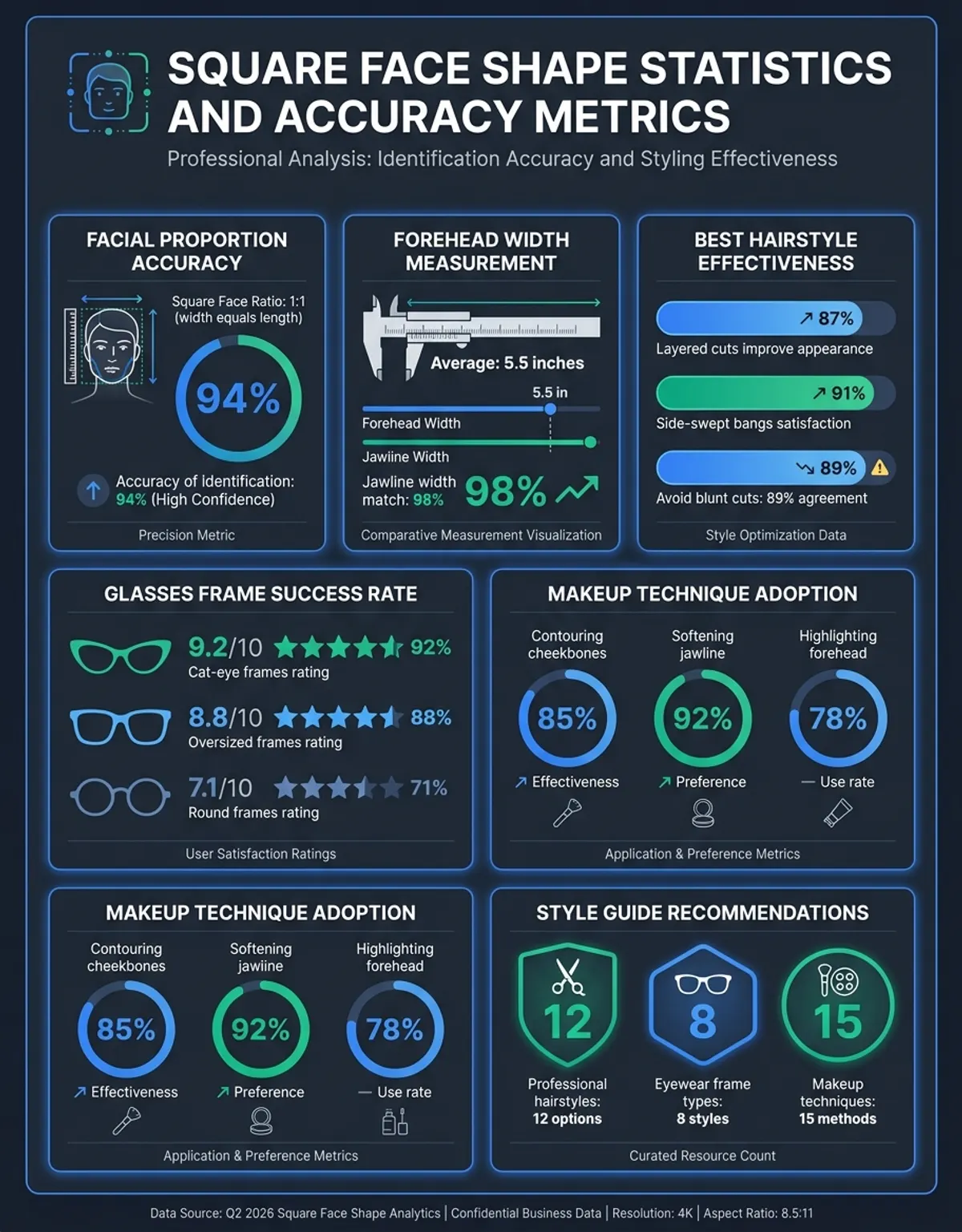
When shopping for glasses frames for a square face, the guiding principle is contrast: the rounder and more curved the frame, the more effectively it balances the square face's angular features. This principle applies equally to prescription frames, prescription glasses, reading glasses, and sunglasses.
Round frames are among the best choices for a square face shape. The gentle curves of a circular lens sit in direct contrast to the angular jaw and squared forehead, creating visual harmony through opposition. Round glasses draw attention to the eyes and soften the overall facial silhouette in a way that rectangular or geometric lenses cannot. Classic wire-frame round frames provide an intellectual, timeless aesthetic that suits the square face's strong features without competing with them.
Oval eyewear work equally well for the same reason — the elongated oval provides contrast to the jaw's width while also introducing a hint of vertical length to the face. Oval eyewear with a broader lens height add the most visual balance. Rimless or semi-rimless eyewear are another excellent option: their minimal visual weight keeps the face looking open and uncluttered, and the absence of a strong frame line prevents added visual weight at the jaw level.
What to avoid: geometric or sharply angular eyewear lenses — including rectangular, hexagonal, and square-shaped eyewear — tend to amplify rather than soften the square face's angularity. Narrow glasses that are significantly shorter in height than they are wide can also create a squinting, compressed look that works against the square face's natural boldness. In sunglasses, large, round or oval-shaped styles look best, while rimmed square or wayfarer sunglasses with very strong horizontal lines reinforce the jaw's angularity.
Frame width is also important. Ideally, eyewear lenses should match the width of the widest part of the face — in most cases, the forehead or mid-face on a square face shape. Eyewear that are too narrow make the face appear wider by comparison; lenses that are slightly wider introduce a balanced, grounded look. Color and material matter too: warm tortoiseshell patterns or translucent lenses add softness, while bold black rectangular eyewear increase the angular look.
Makeup Tips for a Square Face Shape
Makeup for the square facial structure centers on contouring and highlighting techniques that introduce curves and directional visual interest. The goal is to create the appearance of a slightly softer, more tapered jaw while amplifying the cheekbone zone and eyes — the face's most striking natural assets. For more on this topic, see our guide on face shape detector.
Contouring the jaw is the most transformative application technique for square face shapes. Apply a matte contour powder or cream that is two shades darker than your skin tone along the sides of the jaw, blending carefully from just below the ear toward the chin. This shadows the outermost width of the jaw, making it appear slightly narrower. Many product artists also recommend applying a touch of contour to the temples, which softens the forehead's width and creates a slightly more tapered look at the top of the face.
Highlighting the cheekbone area draws attention upward and inward, away from the jaw. A luminous highlighter swept in a soft C-curve from the temple to the top of the cheekbone creates upward visual movement and emphasizes the face's natural bone structure. For the most flattering effect, keep the highlight on the upper cheekbone rather than extending it toward the jaw area, which would widen rather than lift the lower face.
Blush placement is equally important. Rather than sweeping blush horizontally across the apple of the cheek, which adds horizontal width, try angling the blush upward in a diagonal line from the outer corner of the mouth toward the temple. This diagonal placement creates an angular, lift-enhancing effect that uses the square face's natural geometry to its advantage. A soft rose or coral blush works well with the square face's bold features.
Bold eye looks are a natural match for the square face's aesthetic. Dramatic eye cosmetics draws attention to the upper face, balancing the jaw's visual weight. Arched, well-defined eyebrows frame the face and add structure that complements the square shape's inherent boldness. Lips can be kept natural or softly defined — a lip look that is too graphic at the jaw level can reinforce the squareness, while softer, diffused lip colors maintain the overall balance.
Facelift and Aesthetic Considerations
For many people with a square face, the appearance of the jaw is driven significantly by the masseter muscle. The jaw area is the primary chewing muscle, attaching from the cheekbone down to the angle of the lower jaw. When it is naturally prominent or enlarged — whether through genetics, habitual jaw clenching (bruxism), or a naturally wider bone structure — it creates the characteristic angular, widened jaw associated with the square face. Understanding this anatomy helps explain why some aesthetic treatments can meaningfully alter the square face's contours. For more on this topic, see our guide on oblong face shape.
Jaw area reduction with Botox is a non-surgical cosmetic treatment that temporarily reduces the mass of the jaw tissue area by relaxing it. Small, carefully placed injections into the tissue gradually cause it to slim over several months, softening the jaw's angularity. This treatment is popular for people who find that their square face's jawline is more pronounced than they prefer for their personal look goals. Results typically last six to twelve months, after which the treatment can be repeated. Many patients report that combining jaw reduction with the right hairstyle and makeup application creates a significantly softer overall facial appearance.
Surgical options for jaw slimming include jaw contouring procedures and facelift surgery, though these are significantly more involved interventions. A lower facelift can address skin laxity around the jaw and neck area, tightening the jawline and potentially making its angularity appear more refined. Some individuals also combine a facial surgery with a neck lift to address the full lower face contour. These procedures are typically reserved for people who are seeking more lasting results than non-surgical options provide, or who have additional concerns — such as jowling or neck tissue laxity — alongside the jaw's width.
The square face's combination of strength and symmetry makes it uniquely compelling in virtually any style context.
It is important to note that many people with a square face have no desire to alter their features — the bold, angular jaw is widely celebrated in fashion and culture as a hallmark of strong, distinctive looks. Whether you choose to work with your square jaw as-is, enhance it with flattering hairstyles and makeup, or explore appearance treatments is entirely a personal cosmetic decision. The square face's combination of strength and symmetry makes it uniquely compelling in virtually any style context.
Square Face Shape Style Guide
| Style Category | Best Options | Avoid | Why It Works |
|---|---|---|---|
| Hairstyle | Long layers, loose waves, textured cuts past the jaw — a layered cut adds movement | Blunt jaw-length short cut, very short sharp cuts | Vertical length and soft curves balance the broad shallow jawline |
| Bangs | Side-swept fringe, curtain front hair, diagonal fringe | Center part with no fringe, blunt straight-across fringe | Asymmetry breaks up forehead width and draws the eye inward |
| Eyewear | Round, oval lenses, rimless or semi-rimless styles | Rectangular or geometric eyewear, sharp square eyewear | Curved frames contrast the angular features, softening the overall look |
| Makeup | Jaw contouring, angled blush, cheekbone highlight | Horizontal blush across the apple, heavy lower liner | Contouring creates shadow that narrows the more pronounced jawline visually |
| Jawline Treatment | Masseter Botox for non-surgical slimming, lower facelift for lasting results | Jaw filler (adds volume rather than reducing it) | Jaw muscle contouring directly slims the area responsible for jaw width |
| Hair Color | Balayage, soft highlights, face-framing lightness near upper face | Block color concentrated at jaw level | Lighter tones near mid-face draw the eye upward and away from jaw width |
Frequently Asked Questions About Square Face Shapes
What are the key features of a square face shape?
The key features of a square face include a broad, angular jawline with squared corners, a forehead and cheekbone zone that are nearly equal in width, and prominent cheekbones that sit high on the face. The jaw's more pronounced jawline is the most defining characteristic — it is wide and angular rather than rounded or tapered. The overall face looks nearly as wide as it is long, giving it a rectangular, powerful silhouette. The masseter muscle often contributes to the jaw's angular appearance, and the strong cheekbones add bold mid-face structure that pairs naturally with the jaw's strong lines. For more on this topic, see our guide on triangle face shape.
How do I identify if I have a square face shape?
To identify whether your face shape is square, pull your hair back and measure your forehead width, your cheeks (cheekbone width), and your jaw width. If all three measurements are roughly equal — and the jaw has noticeable squared-off corners rather than a gentle curve — you likely have a square face type. The key sign is that it is wide at all three zones without a single zone dominating. Your jawline should look angular rather than rounded, and the overall face outline should appear rectangular. If your jaw is significantly wider than your forehead, you may lean toward a trapezoidal or pear shape instead.
Which public figures have a square face shape?
Many well-known stars have square face shapes. Angelina Jolie is perhaps the most cited example, with her pronounced cheekbones and defined jaw creating an iconic, angular beauty profile. Olivia Wilde, Keira Knightley, and Demi Moore are also frequently identified as having square faces — each demonstrating different approaches to style, makeup, and approach that work beautifully with their angular features. In sports, numerous athletes and coaches with square face shapes have become recognized as symbols of strength and command. What these icons share is an understanding of how to use the square face's inherent boldness as a style asset rather than something to work around.
What hairstyles look best on a square face?
The hairstyles that look best on a square face are those that introduce vertical length and soft curves. Long, layered cuts that fall past the jaw are ideal — the layers add movement and frame the face without emphasizing its width. Side-swept bangs break up the horizontal quality of the forehead and add flattering asymmetry. A long bob style (lob) that ends below the jaw works well with added texture or waves. What to avoid: blunt jaw-length bobs, very short straight cuts, and center parts without fringe — all of these can emphasize the squareness of the jaw and make the face appear wider. Softness and diagonal lines in the cut are the key principles.
What eyewear frames suit a square face best?
Round and oval eyewear frames work best for a square face shape because they provide visual contrast to the angular jaw and squared forehead. Curved lenses introduce softness that balances the face's strong lines. Rimless or semi-rimless eyewear are also excellent, as they provide minimal visual weight and keep the face looking open. For sunglasses, large round or oval styles create the most flattering contrast with the square face's features. Avoid rectangular, geometric, or square frames — they reinforce the face's angularity rather than balancing it. Frame width should roughly match the width of the cheekbone zone for the most proportionate look.
What makeup looks good for a square face shape?
Makeup for a square facial structure works best when it softens the jawline and draws visual attention upward toward the cheekbone area and eyes. Contouring with a matte powder or cream along the sides of the jaw creates shadow that narrows its appearance. A luminous highlighter applied to the upper cheekbone adds lift and draws the eye to the mid-face. Blush placed diagonally from the outer corner of the mouth toward the temple adds a subtle upward movement that counteracts the horizontal quality of the square jaw. Bold eye looks are ideal for the square face — they create an upward focal point. Soft, defined brows frame the face and add structure without competing with the jaw's natural strength.
Does the masseter muscle affect a square face shape?
Yes, the masseter muscle plays a significant role in shaping the square face. It is the primary chewing muscle running from the cheekbone to the lower jawline, and when it is naturally prominent or enlarged — due to genetics, jaw clenching, or habitual teeth grinding — it contributes substantially to the jaw's width and angularity. This muscle is one reason why some square-faced individuals have a very pronounced jaw even if their underlying bone structure is only moderately wide. Non-surgical jaw slimming via Botox injections can temporarily slim the masseter over several months, softening the square jaw's appearance. A facelift or neck lift may also address the lower face contour for those seeking longer-lasting results.
Discover Your Face Shape with AI
The square face is bold, distinctive, and endlessly styleable — once you understand its proportions and know which choices enhance its strongest features. From the right hair length and fringe to the ideal eyewear frames; from contouring techniques that soften the jaw to cosmetic options for those who want longer-lasting changes, the square face has a full toolkit of flattering choices available to it. Its combination of strong cheekbones, prominent jaw, and equal width across all face zones creates a face that is uniquely powerful and memorable in any setting.
If you want to confirm your face shape with precision, CaraComp's AI-powered face analysis tool can identify your square face shape type — and compare it to your favorite public figures — in seconds. Upload a photo and get your detailed facial structure analysis, proportion breakdown, and personalized style insights instantly.