
Oblong Face Shape: Complete Guide to Hair, Makeup, and Style
Everything you need to identify, understand, and beautifully style an oblong face shape — from hairstyles and bangs to makeup, glasses, and AI face analysis.
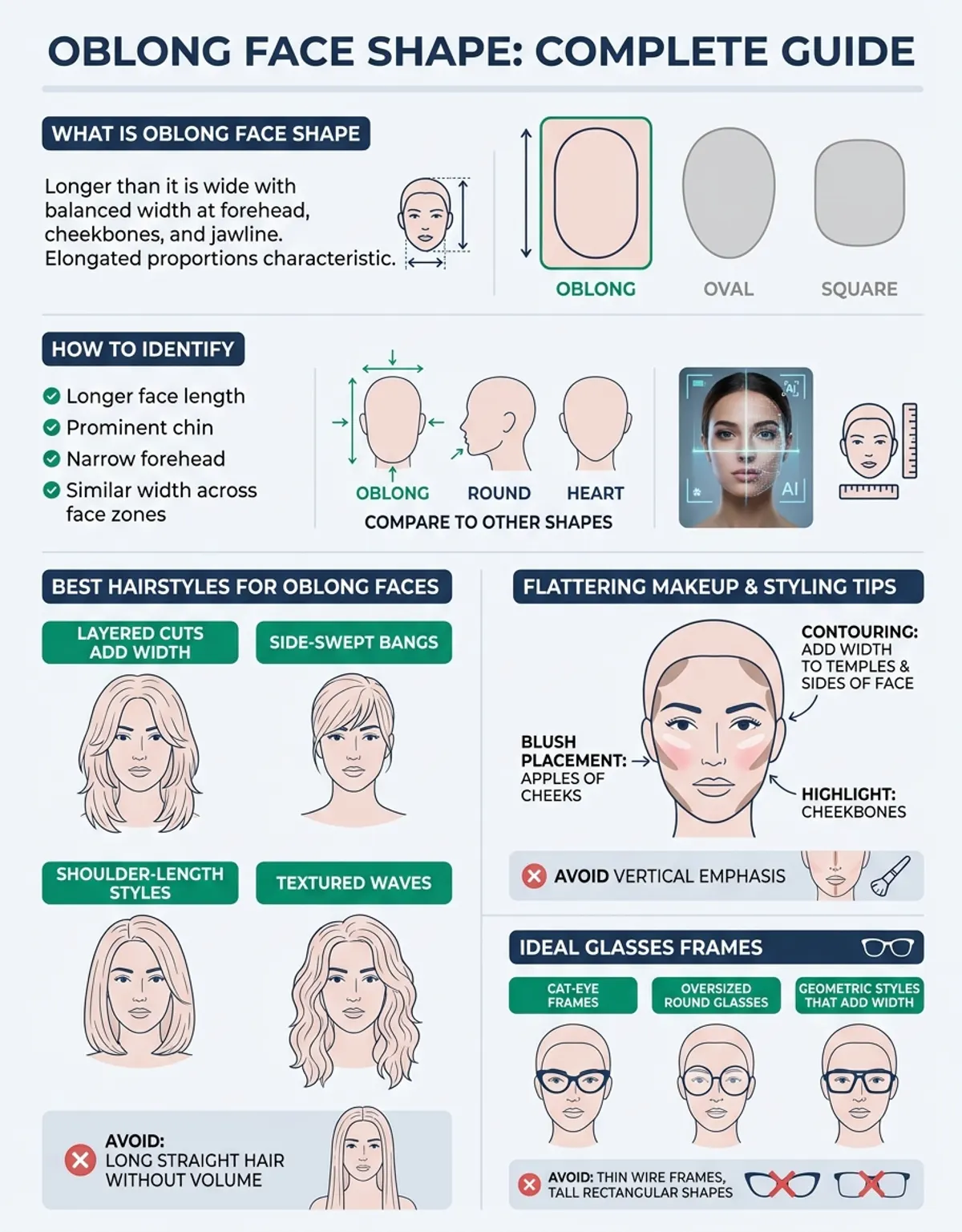
The oblong face shape is one of the most distinct and stylable face types, known for its elongated proportions and narrow, balanced structure. If you have a long, narrow face where the length clearly exceeds the width from forehead to chin, you likely belong to this category. Oblong faces are elegant and versatile, but they respond best to specific style strategies — the right choices in hair, makeup, and glasses can dramatically transform how your face appears.
This guide covers everything you need to know about the oblong face shape: how to identify it, which styles work best, and how to use modern AI face shape detection tools to confirm your face type and find your perfect look. Whether you are just learning about your face shape or refining a style approach you have been developing for years, this complete reference has the answers you need.
What Is an Oblong Face Shape? Width, Length, and Ratio Explained
The oblong face shape — sometimes referred to as a rectangular face shape — is defined by a face that is clearly longer than it is wide. The essential characteristic is a length-to-width ratio that significantly exceeds 1.5, meaning your face length is more than one and a half times your face width. Unlike the oval face shape, which has a more balanced proportion and a tapered chin, the oblong face shape maintains a relatively consistent horizontal width from the forehead down to the jawline.
The key features of the oblong face shape include:
- Face length considerably greater than face width
- Roughly equal horizontal width at the forehead, cheekbones, and jaw
- A slightly rounded jawline rather than a sharp angle
- A narrow appearance when viewed from the front
- Your face length divided by your face width will typically exceed 1.5
This shape is frequently confused with the oval face shape. The oval's width-to-length ratio is closer to 1.5, and the chin tapers noticeably below the cheekbones. The oblong face shape does not taper as dramatically — it stays relatively uniform in width from top to bottom, which accounts for its elongated, narrow appearance.
Compared to a square face shape — which features a strong jaw and a width nearly equal to its length — the oblong face shape has a softer jawline and a more pronounced vertical dimension. Understanding these distinctions helps you make the right style choices for your specific proportions. Other face shapes like round, heart, and diamond all have unique width patterns that set them apart from the consistently narrow oblong.
The oblong face shape maintains a relatively consistent horizontal width from forehead to jawline — this uniform narrowness defines the shape and drives every style decision.
How to Identify Your Oblong Face Shape: Face Analysis and Test
Identifying your face shape accurately begins with the face analysis process: measuring four key dimensions of your face and comparing the results. The four measurements you need are forehead width, cheekbone width, jaw horizontal breadth, and total face length from the center of your hairline to your chin tip.
Here is a step-by-step face shape test you can complete at home:
- Pull your hair back completely so your entire face and hairline are visible
- Stand in front of a mirror with even, direct lighting
- Measure the widest point of your forehead, from hairline to hairline across the temples
- Measure across your cheekbones at their widest point
- Measure your jaw at its widest point
- Measure your total face length from the center of your hairline to the tip of your chin
- Divide your face length by your widest measurement
If the forehead, cheekbone, and jaw widths are all roughly equal to each other, and your face length clearly exceeds 1.5 times that breadth, you have an oblong face shape. The closer those three measurements are to each other — and the longer your face relative to them — the more strongly oblong your face shape is.
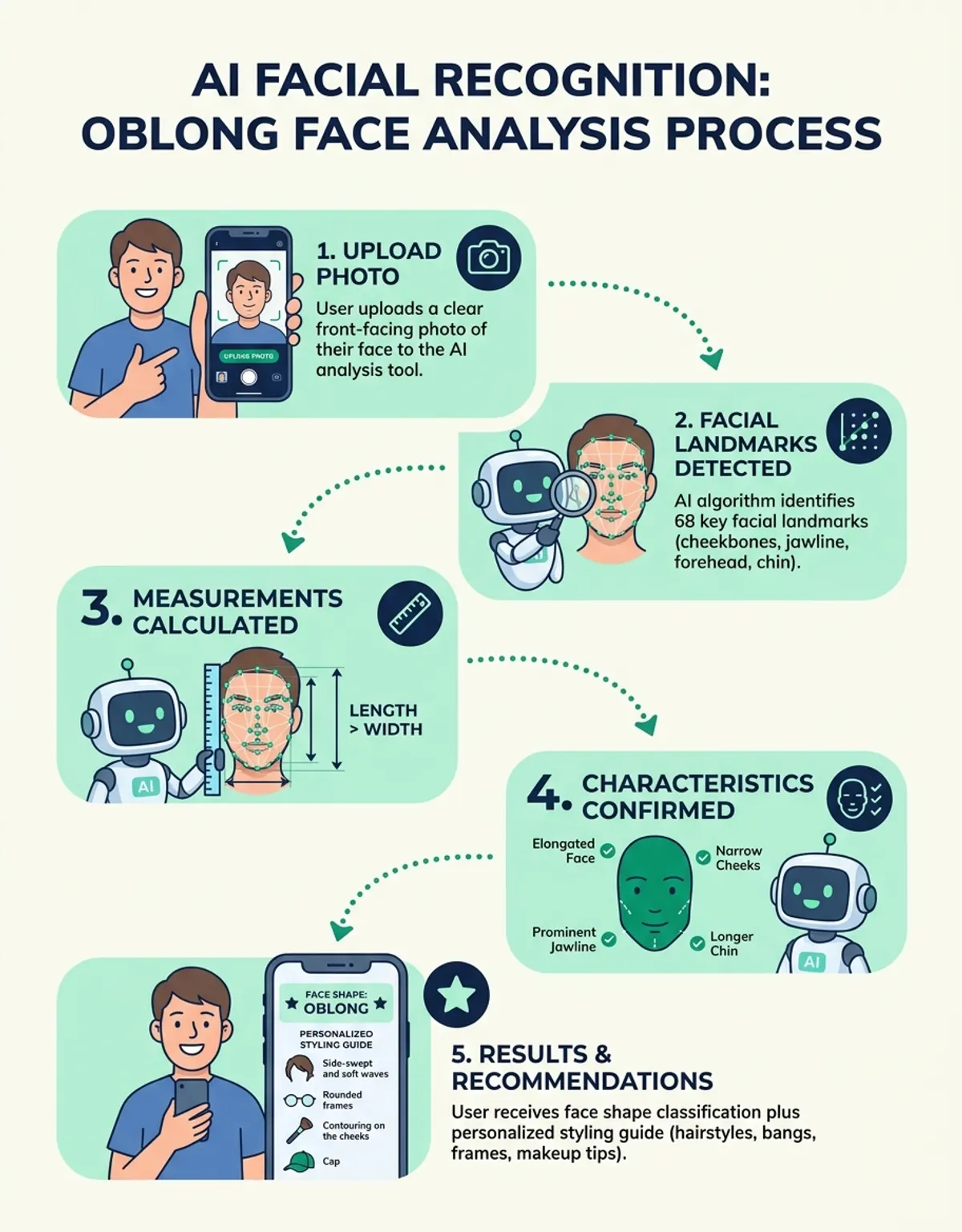
For a faster and more objective result, AI-powered tools can automate this entire face shape test. These tools detect key facial landmarks from a photograph, calculate your face's proportions automatically, and return an accurate classification within seconds. This removes the challenge of measuring your own face with a tape measure and eliminates guesswork entirely. For an accurate result, try our face shape detector — it analyzes your facial proportions from a photo and identifies your exact face shape in seconds.
Best Hairstyle and Hair Choices for Oblong Face Shapes
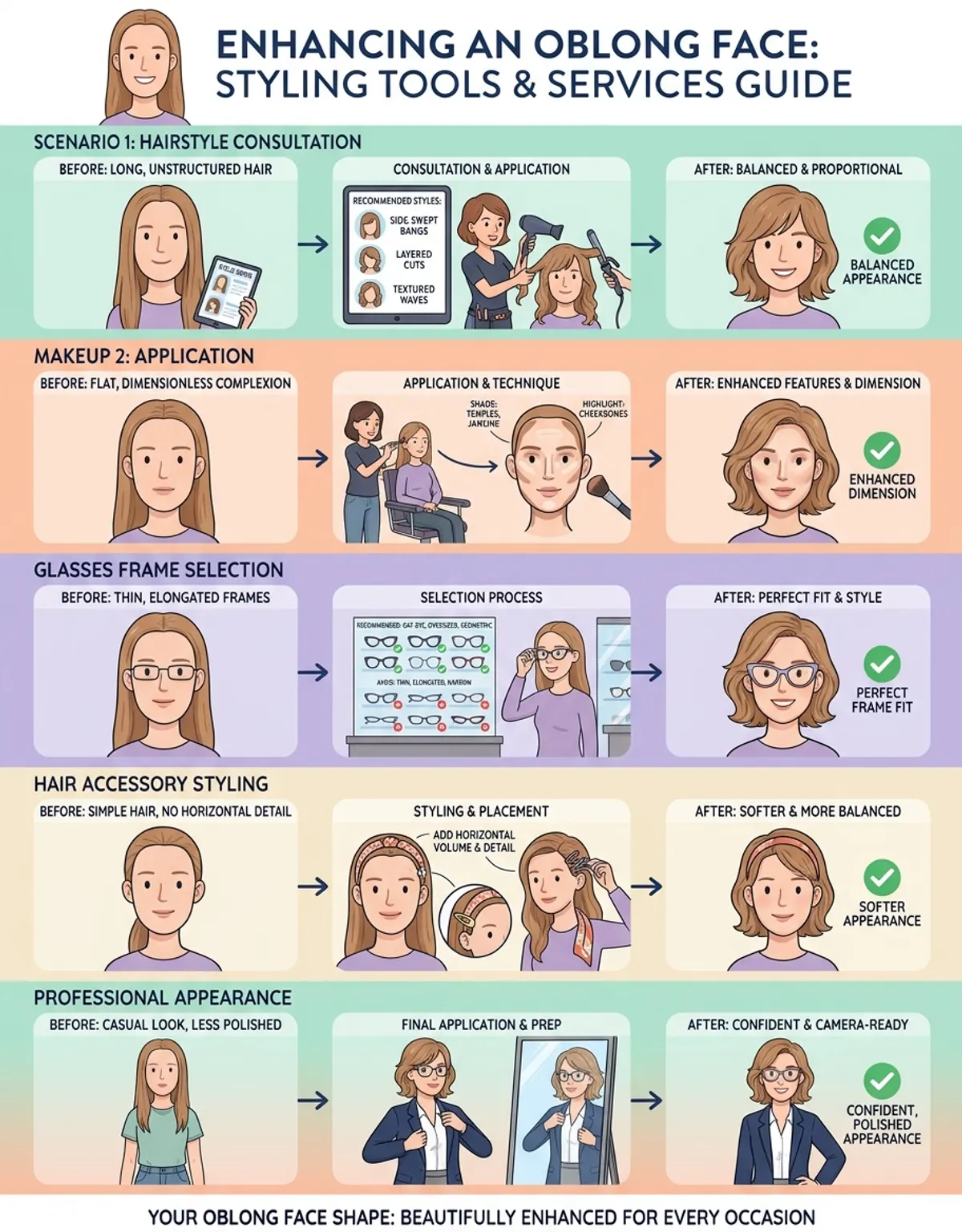
Choosing the right hairstyle for an oblong face shape is fundamentally about creating visual breadth and reducing the prominence of vertical length. The best hairstyle for this face type introduces horizontal volume at the sides while avoiding styles that add height at the crown or draw the hair vertically downward.
The most universally recommended hair cut for oblong faces adds fullness at cheek and jaw level. A layered approach — where layers begin at or just below the chin — is the gold standard. This placement creates the most flattering result by drawing the eye outward at the face's widest visible point rather than emphasizing length. The chin-length lob (long bob), the layered bob, and textured shoulder-length styles all achieve this effect beautifully.
Top hair recommendations for oblong face shapes:
- Layered lob or bob at chin length: Creates direct horizontal span at cheek and jaw level
- Curtain bangs with layers: Combines two of the most effective width-adding techniques
- Voluminous waves or curls: Lateral volume adds perceived horizontal breadth naturally
- Side-swept styles: Break the vertical line and shift visual emphasis horizontally
- Avoid very long, straight hair: This draws attention to length and narrows the appearance of the face
- Avoid flat, center-parted styles: These emphasize the face's elongated proportions
For those with longer hair who want to preserve their length, a hairstyle with full, loose waves or curls at shoulder length and below works well. The key is that each hair choice creates volume at the sides rather than pulling attention vertically. The longer version of styles that work best for oblong faces typically involves side-swept or layered approaches that introduce horizontal fullness.
Short hair can be equally effective for oblong faces when styled with volume at the temples and sides. A side-parted pixie, a textured short bob, or a cropped hairstyle with full sides are all excellent options. The same principle applies to short hair just as strongly as it does to medium or long styles.
The governing rule with every hair choice for the oblong face shape: prioritize adding visual width. Any style that creates horizontal fullness at cheek level or breaks the vertical line of the face will work in your favor.
Bangs for Oblong Face Shape: Flattering Options
Bangs are among the most powerful styling tools available for the oblong face shape. By placing a horizontal element across the upper face, bangs interrupt the vertical line of a long, narrow face and immediately shift the visual balance toward a shorter, wider appearance. Few hair choices make as immediate an impact. (If you've ever tried curtain bangs, you know exactly what we mean — the difference is visible the moment you look in the mirror.)
The best bang styles for oblong faces include:
Side-swept bangs: A long, diagonal sweep of bangs across the forehead — falling from one side to the other — creates a visual line that both shortens the face length and adds diagonal breadth. This is one of the most universally recommended options for the oblong face shape because it works with virtually any hair texture.
Blunt fringe: A full fringe cut straight across the forehead at or just above brow level creates the most dramatic horizontal line. This style very effectively shortens the perceived face length and is particularly impactful for faces with a very high length-to-width ratio.
Curtain bangs: Parted in the center and falling softly to each side, curtain bangs frame the eyes and create a sense of horizontal openness across the middle of the face. This style pairs naturally with layered hair and is one of the most on-trend and flattering approaches for the oblong face shape.
The key principle with all fringe for the oblong face shape is that they must create a clear horizontal visual element. Fringe that sit at brow level or just above achieve the maximum shortening effect. Any strands type can work with fringe — for very curly locks, longer curtain-style fringe with natural movement tend to work best across the brow.
Curtain bangs are among the most on-trend and flattering approaches for the oblong face shape — the difference is visible the moment you look in the mirror.
Makeup Tips for Oblong Face Shapes: Forehead Contouring and Width
Makeup offers precise, adjustable control over how the oblong face shape appears to the viewer. With the right contouring and highlighting placements, you can visually add horizontal dimension and reduce the apparent length of your face without any permanent commitment. Makeup techniques for oblong faces follow a consistent principle: create horizontal emphasis, reduce vertical emphasis.
The most effective makeup techniques for oblong faces include:
Contour at brow area and chin: Apply a matte bronzer or contour shade along the very top of your upper face, following the hairline from temple to temple. Repeat at the very tip of your chin. These shadow placements visually push those two points inward, making the face appear shorter and wider overall.
Horizontal blush placement: Rather than sweeping blush upward in a C-shape, apply it horizontally across your cheekbones toward the temples. This horizontal movement draws the viewer's eye sideways and creates a strong impression of horizontal breadth across the mid-face.
Highlight the hollow cheeks: Placing a subtle highlighter on your hollow cheeks — the slightly sunken area beneath the cheekbones — brightens this zone and adds three-dimensional breadth to the face. This technique works especially well when the hollow cheeks are naturally defined.
Eye makeup for horizontal emphasis: Use eyeliner techniques that extend slightly outward at the outer corners of the eyes. A soft wing or cat-eye extends the eyes horizontally, creating a widening effect. Focus eyeshadow on blending outward rather than lifting the lid vertically.
Wide lip definition: A slightly wider lip liner application at the outer edges of the bow draws attention across the lower face and adds balance to the oblong face shape's proportions.
Best Glasses for Oblong Face Shapes
Selecting glasses for an oblong face shape follows the same principle as all other style decisions for this face type: add horizontal breadth and reduce vertical emphasis. The right glasses frames can significantly improve the visual balance of a long, narrow face by introducing strong horizontal lines and visual presence at eye level.
The best glasses for oblong faces are wide, bold, and either rounded or oversized:
- Oversized frames: Wide, large frames that extend to or beyond the edges of your face add the most horizontal presence
- Round frames: The circular shape breaks the vertical line of the oblong face and adds softness and perceived breadth
- Wide rectangular frames with thick rims: The horizontal span and visual weight of substantial rims creates strong impact
- Frames with decorative top bars: Design details on the upper frame draw attention upward and outward
- Bold colors and patterned acetate: These draw attention to the glasses themselves, adding visual breadth
The fit of your glasses matters as much as the style. Look for frames whose total horizontal breadth matches or slightly exceeds your face's widest point. Glasses that fit well within those proportions create balance rather than emphasizing narrow features. Round, wide, and oversized frames naturally achieve this fit on oblong face shapes.
Avoid narrow frames, narrow rectangular glasses, and very thin wire frames for the oblong face shape. These mirror the face's elongated proportions rather than counterbalancing them, making the face appear even more narrow. Wide, bold frames are your best ally.
Comparing Oblong Faces to Other Face Shapes: Square, Oval, and More
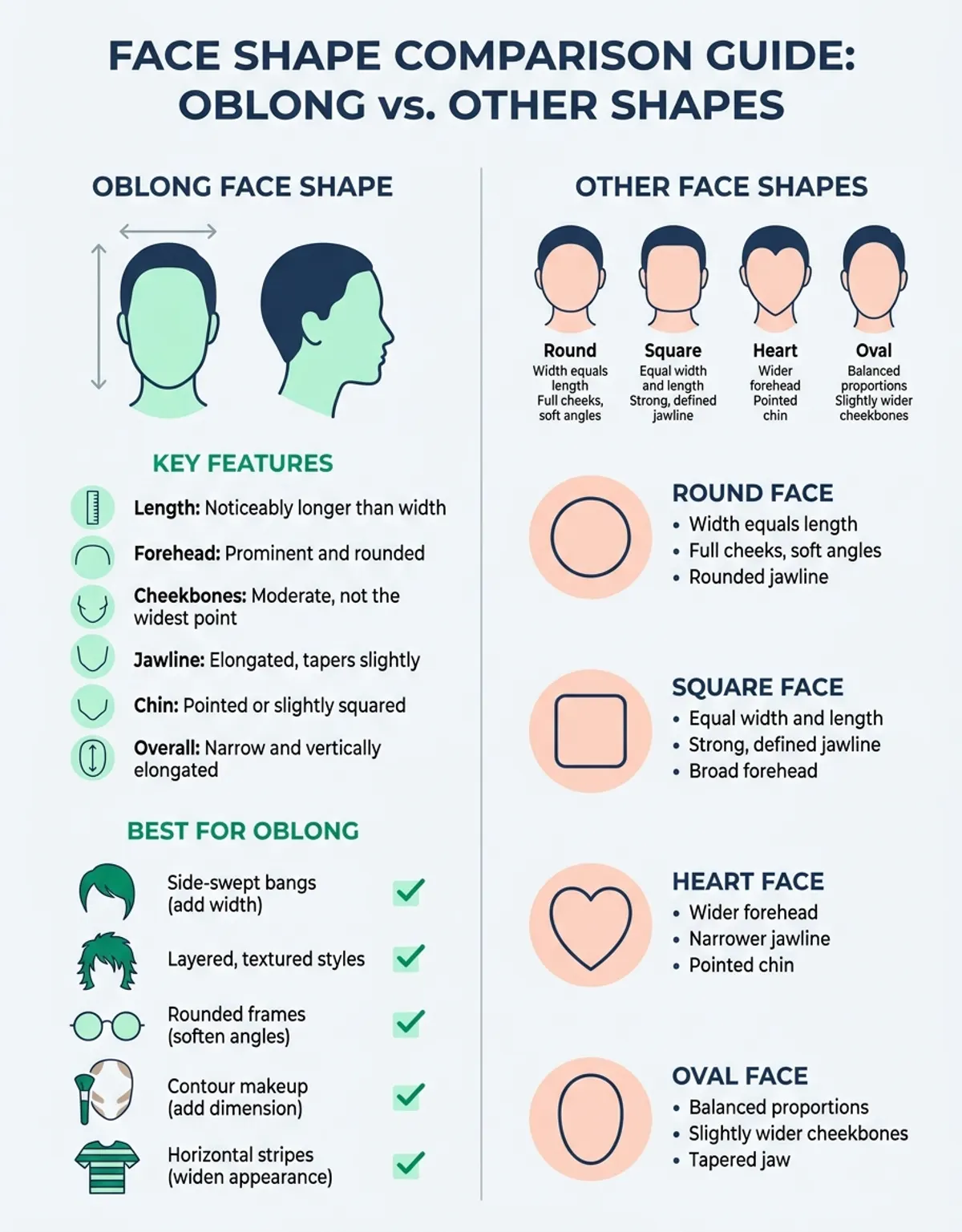
Understanding where the oblong face shape sits relative to other face shapes makes styling decisions clearer and confirms what makes this shape unique.
Oblong vs. oval: The oval face shape is widely considered the most balanced of all face shapes, with a length-to-breadth proportion close to 1.5 and a chin that tapers gently inward below the cheekbones. Oval faces can wear most styles comfortably. The oblong face shape has a higher overall proportion and a more uniform profile from top to bottom — it requires more intentional styling to create visual balance.
Oblong vs. square: The square face shape features a strong, defined jaw and a breadth nearly equal to its length. Square faces are characterized by angular lines. The oblong face shape has a softer jaw and a more pronounced vertical dimension. Angular face structures benefit from soft, rounded styling elements; oblong face profiles need a different approach — one focused on adding visual balance.
Oblong vs. round: Round face types have full cheeks and a horizontal dimension close to their length, with soft edges throughout. Round face structures benefit from elongating styles — including long, straight hair and angular glasses frames — which is the opposite of what serves an oblong face shape well.
Oblong vs. heart: The heart face shape features a wide brow and a pointed, narrow chin. Unlike the oblong face shape, which maintains a relatively consistent horizontal breadth, the heart shape has a dramatic contrast between its wide brow area and narrow jawline. Both shapes can benefit from adding visual breadth at the jaw, but through different techniques.
Oblong vs. diamond: Diamond face profiles are widest at the cheekbones, with a narrow upper face and narrow chin. The oblong face shape maintains a consistent structure throughout and gets its character from length rather than cheekbone prominence. Styling approaches that work for all face shapes differ significantly based on where the breadth is concentrated.
| Face Shape | Key Feature | Width/Length Ratio | Best Hairstyle | Best Glasses |
|---|---|---|---|---|
| Oblong | Long and narrow | Length > 1.5× face breadth | Layers at chin, curtain fringe | Wide, oversized, round |
| Oval | Balanced, slightly tapered | Length ≈ 1.5× face breadth | Most styles work | Most frames work |
| Square | Strong angular jaw | Breadth ≈ length | Soft layers, waves | Round or oval frames |
| Round | Full cheeks, soft edges | Breadth ≈ length | Elongating cuts, straight styles | Angular, rectangular frames |
| Heart | Wide brow, narrow chin | Brow > chin | Chin-length bob | Bottom-heavy frames |
| Diamond | Wide cheekbones, narrow ends | Cheekbones widest | Volume at the brow and chin | Oval frames |
Round face structures benefit from elongating styles — including long, straight hair and angular glasses frames — which is the exact opposite of what serves an oblong face shape well.
AI Face Shape Detection: Find Your Face Shape Online
Modern face shape detection technology has made identifying your face shape faster, more accurate, and completely objective. AI-powered face shape tools use computer vision and machine learning to analyze facial proportions from a photograph, classifying your face shape automatically with high accuracy. This means you can skip the manual measuring process entirely and get a reliable result in seconds.
Here is how AI face shape detection works:
Facial landmark mapping: The AI identifies dozens of key facial points — eyes, nose, mouth corners, chin tip, cheekbones, and hairline — to build a precise structural map of your face.
Proportional measurement: By calculating the distances and angles between these landmarks, the AI derives your face's breadth-to-length proportions and the relative widths at your brow, cheeks, and jaw.
Shape classification: The AI compares your face's proportions to reference profiles for each recognized face shape — oval, round, rectangular, heart, diamond, and oblong — and identifies the closest match along with a confidence score.
Style recommendations: Advanced tools translate this shape classification into tailored recommendations for hair care, makeup, and glasses specifically suited to your proportions.
CaraComp's face analysis tool makes this process simple and accessible. Upload a clear, well-lit photo with the face fully visible, and the tool will classify your face shape — confirming whether you have an oblong face shape or another type — in seconds. The comparison feature also lets you place two face types side by side to see concretely how your proportions compare to other face shapes and to understand exactly what makes your face shape unique.
To use the face shape tool, visit CaraComp's face shape detection page. The process takes less than a minute, provides an accurate result without any manual measurement, and delivers style recommendations tailored to your specific face shape profile.
Frequently Asked Questions About the Oblong Face Shape
What characterizes an oblong face shape?
The oblong face shape is characterized by a face length that clearly exceeds its breadth, with a length-to-breadth proportion typically above 1.5. The brow area, cheekbones, and jaw are all roughly similar in horizontal dimension, giving the face a uniform, narrow appearance rather than tapering like an oval or widening at the cheeks like a diamond. The jawline is usually slightly rounded. The overall impression is of a long, narrow face with balanced proportions from top to bottom.
How is an oblong face shape different from an oval face shape?
The main difference lies in proportions and tapering. The oval face shape has a gently tapered chin that is narrower than the upper face, and a length-to-breadth proportion close to 1.5. The oblong face shape has a more uniform breadth from the brow to the jawline — it does not taper as noticeably — and a higher overall proportion. In practice, oval face structures look more classically balanced, while oblong face profiles look more distinctly elongated and narrow. Both profiles benefit from horizontal styling elements, but oblong face types need them more consistently across all style decisions. Of all face forms, these two are the most frequently confused because of their shared vertical emphasis.
What hair cut is most flattering for a long, narrow face?
The most flattering look for a long, narrow face adds horizontal volume and breaks the vertical emphasis of the face. The best hair cut is typically a chin-length lob or layered bob, where the layers sit at cheek and jaw level to visually widen the face. Curtain fringe paired with layers are another top recommendation. Avoid very long, straight strands that fall flat against the face, as this emphasizes length. The goal with every style choice for an oblong face is visual balance — any style that creates lateral volume will work in your favor.
Do bangs suit an oblong face shape?
Yes — bangs are one of the most effective and immediately impactful choices for the oblong face shape. By creating a horizontal element across the upper face, fringe visually shorten the face and make its proportions appear more balanced. Side-swept fringe, blunt fringe, and curtain fringe are all excellent options. The key is that the fringe create a clear horizontal line across the brow area rather than falling flat. Most textures work well with fringe — the specific style depends on your texture and preferred maintenance level.
What glasses frames fit an oblong face shape best?
Wide, oversized, and round glasses frames complement an oblong face shape best. These frame types add horizontal visual presence and balance the face's length by drawing attention outward. Look for frames whose breadth matches or slightly exceeds your face's widest point — this creates a sense of proportion and balance and grounds the face horizontally. Round frames, wide rectangular frames with thick rims, and bold oversized styles are all excellent choices. Avoid narrow frames, narrow rectangular glasses, or thin wire frames, as these emphasize the face's elongated proportions.
How can I use face analysis to identify my face shape?
You can use face analysis in two ways: manual measurement or AI-powered tools. For manual measurement, pull your strands back, measure your forehead, cheekbones, and jaw at their widest points, plus your total face length, then divide your face length by your widest measurement. A result above 1.5 with roughly equal widths at all three points indicates an oblong face shape. For AI face analysis, upload a clear, well-lit photograph with the face fully visible to a face shape detection tool. The AI will calculate your proportions automatically and return an accurate classification within seconds — no measuring tape or manual calculation needed.
What makeup techniques add width to an oblong face shape?
The most effective techniques for adding visual breadth to the oblong face shape include: contouring the very top of your forehead (along the hairline) and the tip of your chin to visually reduce face length; applying blush horizontally across the cheekbones toward the temples to draw the eye sideways; placing highlighter on your hollow cheeks to add lateral dimension and brightness; and using eyeliner techniques that extend the eyes outward at the outer corners. Together, these techniques shift the visual emphasis from vertical to horizontal, making the face appear shorter and proportionally wider.
How does AI identify an oblong face shape?
AI face shape detection tools use machine learning to identify and map 40 or more facial landmarks on an uploaded image. These landmarks define key facial points such as the corners of the eyes, the tip of the nose, the edges of the jaw, and the hairline. The AI calculates proportional measurements between these landmarks — comparing face length to width and analyzing width consistency across the forehead, cheekbones, and jawline — to classify the face shape with high accuracy in seconds.