
Heart Face Shape: The Complete Style Guide for Hair, Glasses, Makeup & More
Everything you need to choose the most flattering hairstyles, glasses, grooming styles, makeup techniques, and cosmetic options for a heart-shaped face.
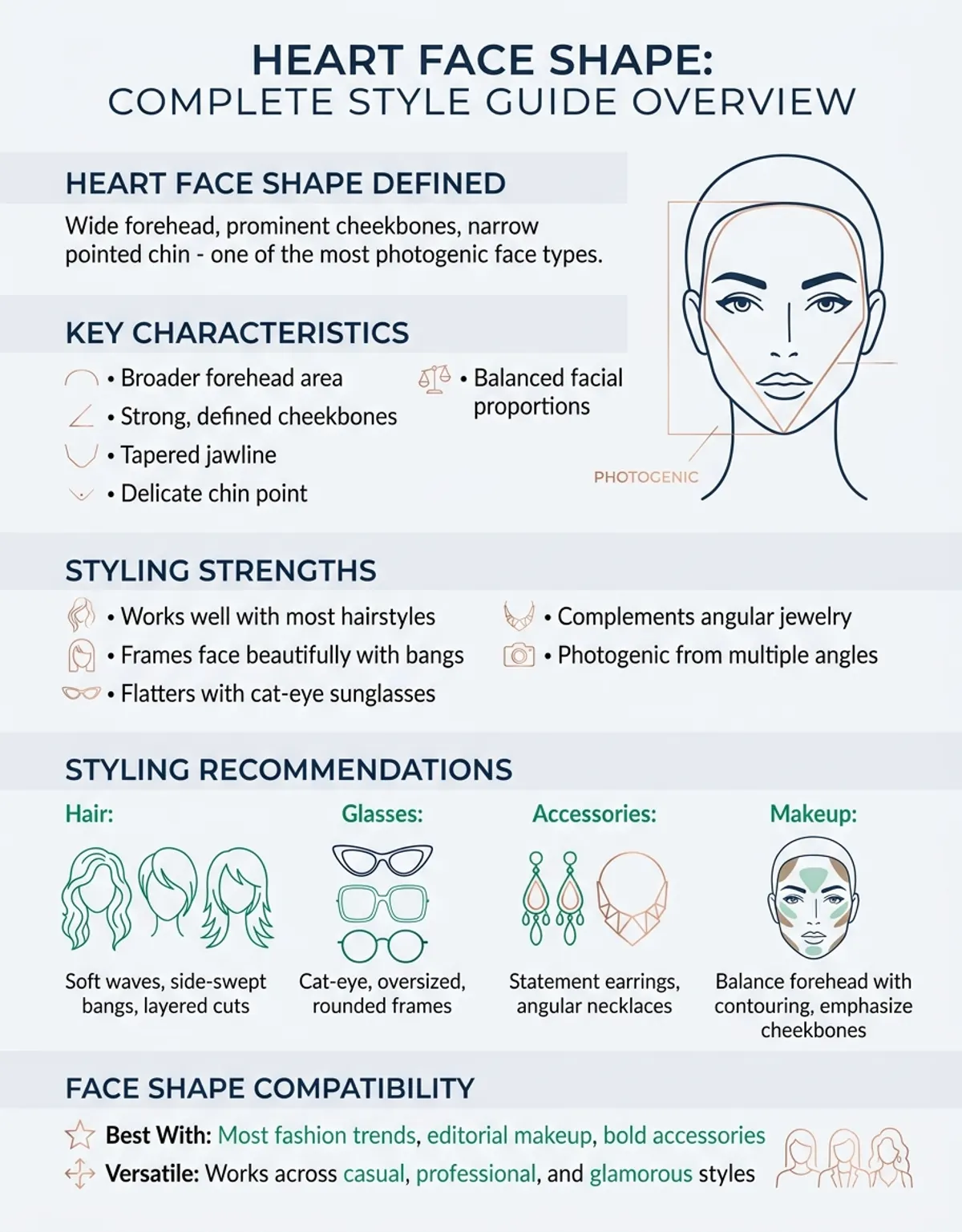
This silhouette — defined by a wide forehead, prominent cheekbones, and a narrow, pointed jaw — is one of the most photogenic face types in human anatomy. A heart shaped face has its widest point at the forehead, curving through the cheekbones to a delicate, pointed jaw. Whether you are choosing hairstyles, glasses, grooming styles, or exploring cosmetic procedures, every decision for this type follows one principle: build visual weight at the lower face while softening the wider upper portion.
Heart Face Basics
This guide covers hair options for women and men, beard options, glasses and sunglasses choices, makeup and contouring techniques, and cosmetic options including injectable treatments and surgery. Every section gives you specific, actionable recommendations built around your face proportions.
Not sure about your shape? The CaraComp analysis tool confirms your type from a photo in seconds — start there before making any significant styling decisions.
What Is a Heart Face Shape?
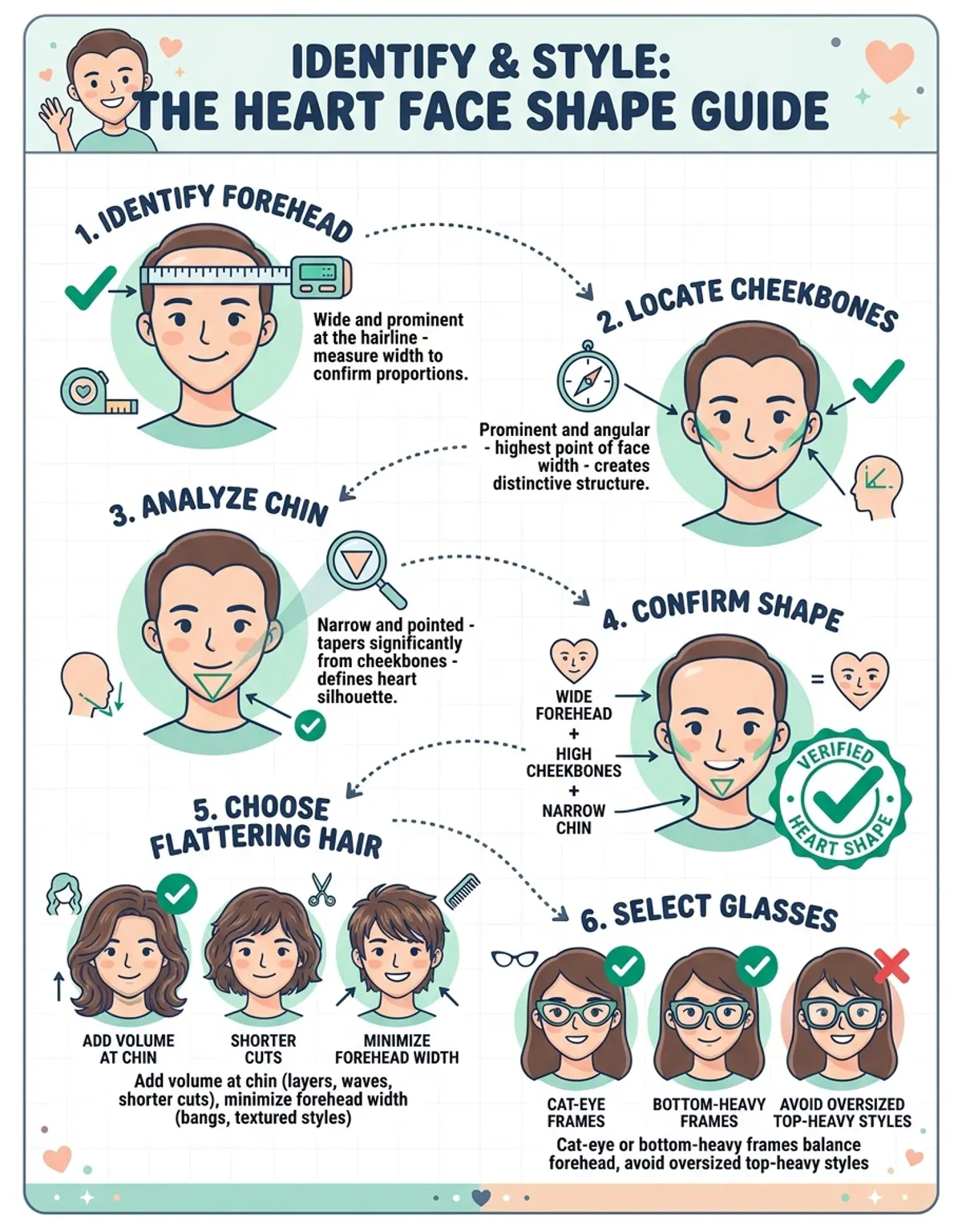
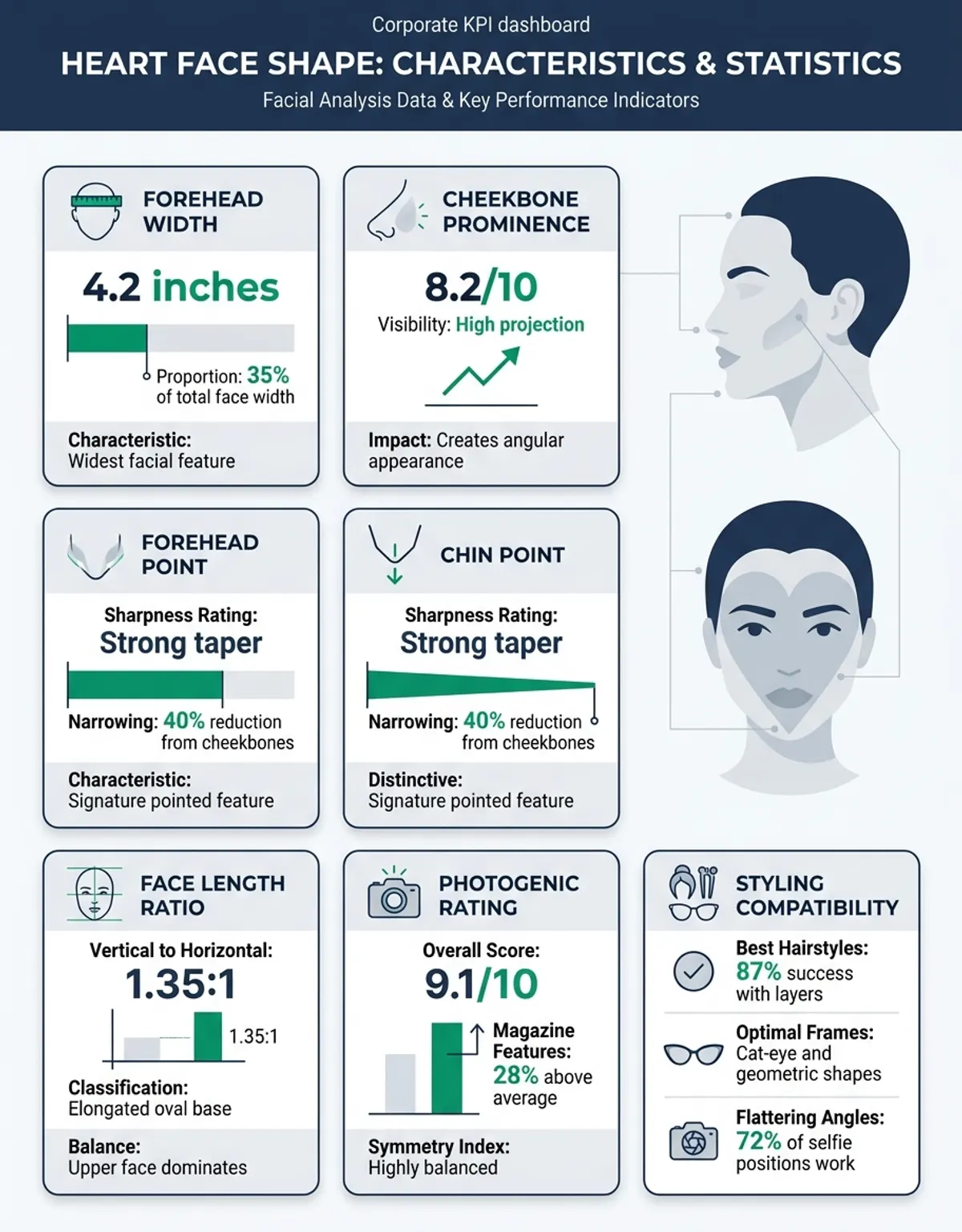
This type is defined by three key proportions: the forehead is the widest area of the face, the cheekbones are high and prominent, and the jaw is narrow and pointed. Viewed from the front, the outline creates a silhouette resembling the top of a heart — broad at the brow, curving through the cheekbones, then narrowing to a delicate point at the jaw.
The defining proportions of this type include:
- Forehead: the broadest part, typically 10–20% wider than the jaw
- Cheekbones: high and prominent, nearly as wide as the forehead
- Jaw: narrow, tapering to a pointed chin
- Overall proportions: wide upper portion, dramatically narrower lower face
This silhouette is sometimes confused with the diamond silhouette, whose widest point is the cheekbones rather than the forehead, and with the inverted triangle silhouette, which describes the same general proportions. For styling purposes, the two terms are effectively interchangeable — the same hairstyles, eyewear choices, and contouring methods apply to hearts and triangles equally, making recommendations for these faces universally consistent.
What makes this type distinctive is the combination of a broad brow with a dramatically narrow jaw. The prominent cheekbones, wide forehead, and delicate jaw create a naturally expressive appearance that responds very well to intentional styling decisions built around its proportions.
How to Identify Your Heart-Shaped Face
If you are unsure whether you have this type, follow these steps with a flexible measuring tape or ruler:
Step 1 — Forehead breadth: Measure across your forehead from temple to temple. For a heart shaped face, this is typically the largest measurement you will take.
Step 2 — Cheekbone span: Measure across the widest part of your cheekbones. On this type, this number is close to — but slightly less than — the forehead measurement.
Step 3 — Jaw measurement: Measure from one corner of your jaw to the other. On this shape, the jaw is significantly narrower than the forehead, often by 1.5 to 2 inches.
Step 4 — Chin check: Your jawline tapers to a point — not squared off or rounded. This is the single clearest indicator of this type.
Proportional result: Forehead > cheekbones > jaw, with a pointed chin. If this fits your measurements, you have this type.
Additional clues: your forehead is the first face feature others notice from the front, the jawline tapers noticeably below the cheekbones, and you may have a natural widow's peak or high hairline. Some people use a simple face shape drawing — tracing their outline — to confirm the classic heart or inverted-triangle silhouette.
For greater precision than a measuring tape allows, the CaraComp analysis tool measures width ratios from a photo and confirms your face shape without any guesswork.
Best Hairstyles for Heart-Shaped Faces
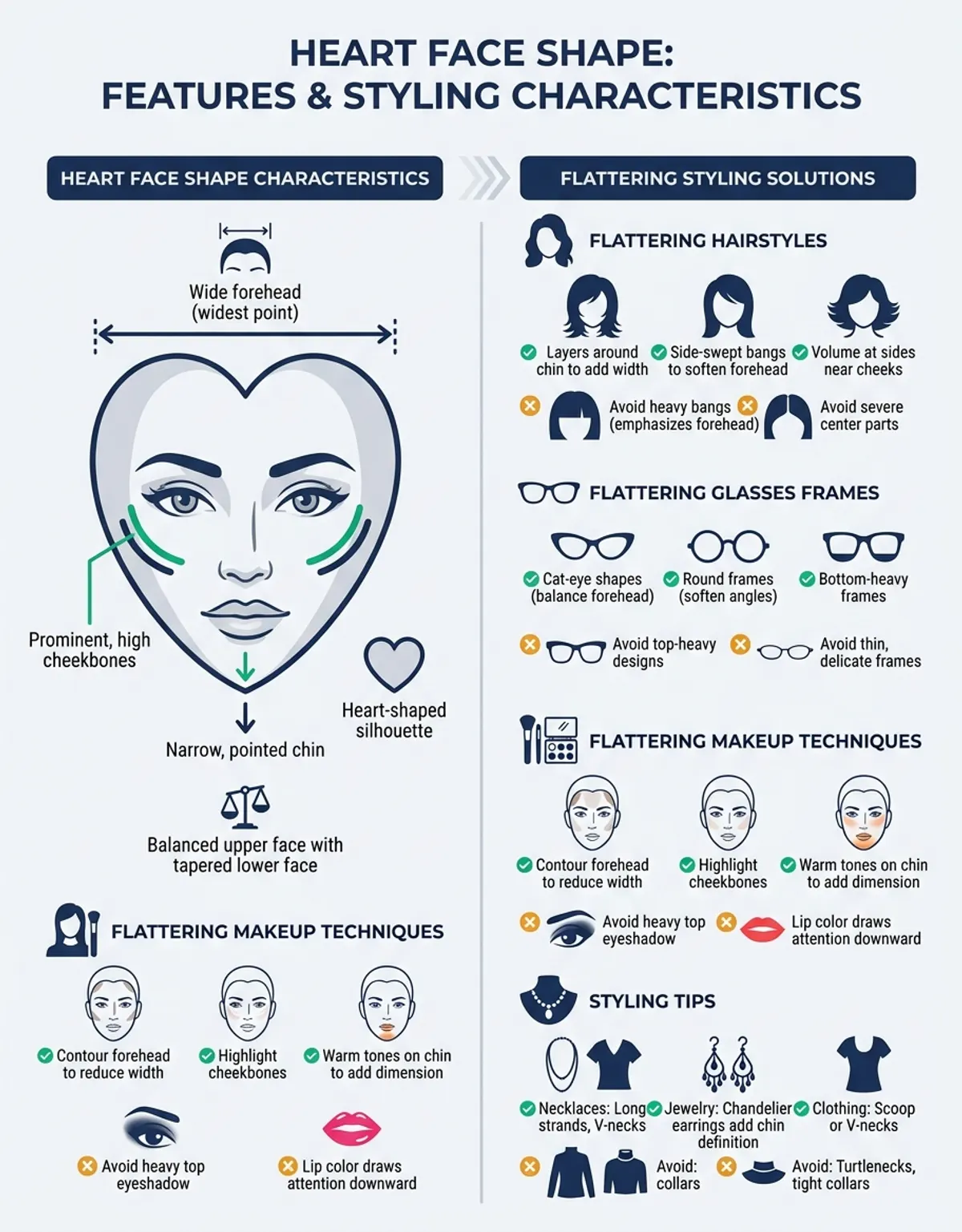
The goal when choosing hair for this type is straightforward: add visual volume and fullness at or below the jaw while reducing the apparent breadth of the forehead. The right hair choices can genuinely transform how balanced your face looks, while the wrong choice amplifies the existing imbalance.
The best hairstyles for this type all share one characteristic — they place the bulk of the volume at or below the jaw, not above it.
The jaw-length bob is arguably the single best hairstyle for a heart face shape — it places maximum volume directly at the jaw, visually widening the lower face and creating a sense of balanced proportion from brow to jaw.
Layered long hair is one of the most flattering options for this type. Hair with graduated cuts falling below the jaw adds fullness at exactly the right level, counterbalancing the wide forehead. Long hair with face-framing layers swept forward at the jaw is an excellent daily hairstyle. The layers create movement that visually broadens the lower face.
Side-swept bangs are particularly effective for this shape because they soften the visual line of the forehead. Unlike blunt bangs, which can emphasize the forehead's full width, side-swept bangs create a diagonal line that reduces the apparent breadth. This hairstyle works with both short and long hair and requires minimal upkeep.
The jaw-length bob places maximum volume directly at the jaw, visually widening the lower face and creating a sense of balanced proportion from brow to jaw. The jaw-length bob suits nearly all textures and works especially well when cut with slight outward-curving layers at the ends.
The lob (long bob) — hair cut just below the jaw — achieves a similar effect. The lob provides the framing and volume of the jaw bob while adding a bit more length. This hairstyle works beautifully with layers and adapts well to both straight and wavy styles.
Extensions for added fullness are an excellent solution for women with fine or thin hair who want a fuller jaw-framing hairstyle. Extensions that add volume below the jaw can dramatically improve the proportional balance of a heart face shape. Clip-in extensions offer flexible use without commitment; semi-permanent extensions suit women who want consistent fullness every day. For best results, place extensions at and below ear level — this is where the jaw-widening effect is strongest for this type.
Wavy or curly styles worn loose create natural volume at the sides, adding the breadth and dimension that benefits a heart face shape. Curly hair or waves add visual mass at the jaw level, which is exactly what this type needs to achieve balance.
Hairstyles to avoid: High top buns pull all the hair upward, emphasizing the already-wide forehead and removing any balancing effect from the jaw area. Blunt cuts ending above the jaw expose the narrow jaw without adding any framing volume. Center-part styles with crown volume add height where it is least needed. When in doubt, choose hairstyles that put hair at or below the jaw, not above it.
Color treatment tip: A balayage or ombre effect with lighter color at the jaw and darker hair at the crown creates a natural gradient that makes the lower face read as wider and the forehead as narrower. This technique works across every hairstyle and every hair length.
| Hairstyle | Effect | Forehead Balance | Jaw Volume Added | Recommendation |
|---|---|---|---|---|
| Layered Long Hair | Adds fullness and movement below the jaw | Excellent | High | Highly Recommended |
| Side-Swept Bangs | Softens forehead breadth visually | Very Good | Medium | Recommended |
| Jaw-length Bob | Widens lower face, adds jaw definition | Very Good | High | Highly Recommended |
| Extensions (layered) | Adds volume and length at jaw level | Good | High | Recommended |
| High Top Bun | Emphasizes wide forehead, removes jaw framing | Poor | None | Avoid |
| Blunt Center-Part Bob (above jaw) | Exposes narrow jaw without adding volume | Below Average | None | Use Caution |
Beard Styles and Grooming Tips
For those with a heart face shape, beard styling is the most immediately impactful tool available. The right grooming style adds visual substance and mass to the jaw and lower face, directly counterbalancing the narrower lower face that defines this shape.
The guiding principle for beard styles on this type: maximize fullness at the chin and along the jaw while keeping the hair shorter and tighter at the temples and sideburns. This distributes emphasis away from the wide forehead and toward the lower face.
Full beard — A dense, full beard is the most transformative option. The fullness adds mass and breadth across the lower face, including the chin. Growing the beard fuller at the chin than at the temples produces the best visual result, creating a wider lower face that balances the broader forehead. This is the single most effective grooming style for a heart face shape.
Goatee with side stubble — A goatee concentrates definition and volume at the chin, adding perceived breadth and length to the narrowest part of the face. Pair it with light stubble along the jaw for a connected look that frames the lower face with purpose. This style suits those who prefer a groomed, intentional look while still achieving the visual balance a heart face shape needs.
Jaw-line beard — A jaw-line beard follows the jaw with a thin, defined line of beard and fuller coverage at the chin. This style visually defines the jaw and adds length — both beneficial changes for a heart face shape. It works best when paired with very short or faded sideburns to keep the emphasis on the lower face, not the temples.
Heavy stubble — Even without a fully grown beard, heavy stubble across the jaw adds visual mass that flatters a heart face shape. Stubble is lower-maintenance while achieving a similar reshaping effect. For men who prefer less commitment, heavy stubble is an excellent choice.
Styles to avoid: Mutton chops and heavy sideburns widen the upper portion and draw attention toward the forehead area, which is already the broadest part of a heart face shape. Any style that adds bulk at the temples without fullness at the jaw will make this shape look more top-heavy, not less.
Best Glasses and Sunglasses for Heart-Shaped Faces
Choosing the right glasses and sunglasses for a heart face shape follows the same logic as choosing hair — add visual emphasis to the lower face while reducing attention to the wider forehead. The wrong pair makes the forehead look more prominent; the right pair creates genuine balance.
How glasses should suit a heart face shape: Eyewear should not be wider than the forehead. Any pair that is as wide as or wider than the brow will emphasize the upper face. For this type, look for glasses that sit within the span of the cheekbones or slightly narrower.
Round glasses are an excellent choice. The circular shape softens the angular upper portion and adds visual breadth to the lower portion. Round glasses work against the "V" taper of this type, creating a rounder, more balanced overall appearance. You may also find our guide on round face shape helpful for understanding how different facial structures benefit from similar eyewear choices.
Oval glasses offer versatility for almost any face shape, and they work especially well on a heart face shape. Oval glasses add length and balance without adding breadth at the temple — exactly what this type needs. The elongated shape creates a counterbalance to the wide forehead without drawing attention to it.
Bottom-heavy eyewear — any frames that are thicker or bolder at the lower edge than the upper edge — naturally draw the eye downward, balancing the wider upper portion of a heart face shape. These frames redirect visual attention from the forehead to the jaw area, which is ideal for this type.
Rimless glasses are nearly invisible visually and therefore add no breadth or visual weight at the forehead. Rimless glasses let your natural features show without interference, which is a solid choice when you want subtlety. For more on this topic, see our face shape detector tool.
Sunglasses for this type: The same principles apply. Round sunglasses and oval shades are the best choices. Wayfarer-style shades, which are generally wider at the base than at the top, also work well. Avoid aviator shades — the prominent top bar adds visual breadth across the brow that does not flatter this shape.
Eyewear and styles to avoid:
- Cat-eye glasses: The upswept corners widen the temple area, adding to the already-broad upper portion of a heart face shape.
- Heavy browline glasses: These emphasize the upper portion and forehead rather than drawing attention to the lower face.
- Wide-top aviator shades: Flattering for many face types, but the wide top bar adds forehead breadth that works against a heart face shape.
| Frame Style | Effect | Recommended |
|---|---|---|
| Round glasses | Softens angular upper face, adds visual breadth to lower face | Yes |
| Oval glasses | Balanced, elongates the face naturally | Yes |
| Bottom-heavy frames | Draws eye downward for better proportional balance | Yes |
| Rimless glasses | Minimal visual impact, no added forehead emphasis | Yes |
| Cat-eye glasses | Widens the already-broad upper face area | Avoid |
| Heavy browline glasses | Emphasizes forehead over lower face | Avoid |
Makeup and Contouring Tips
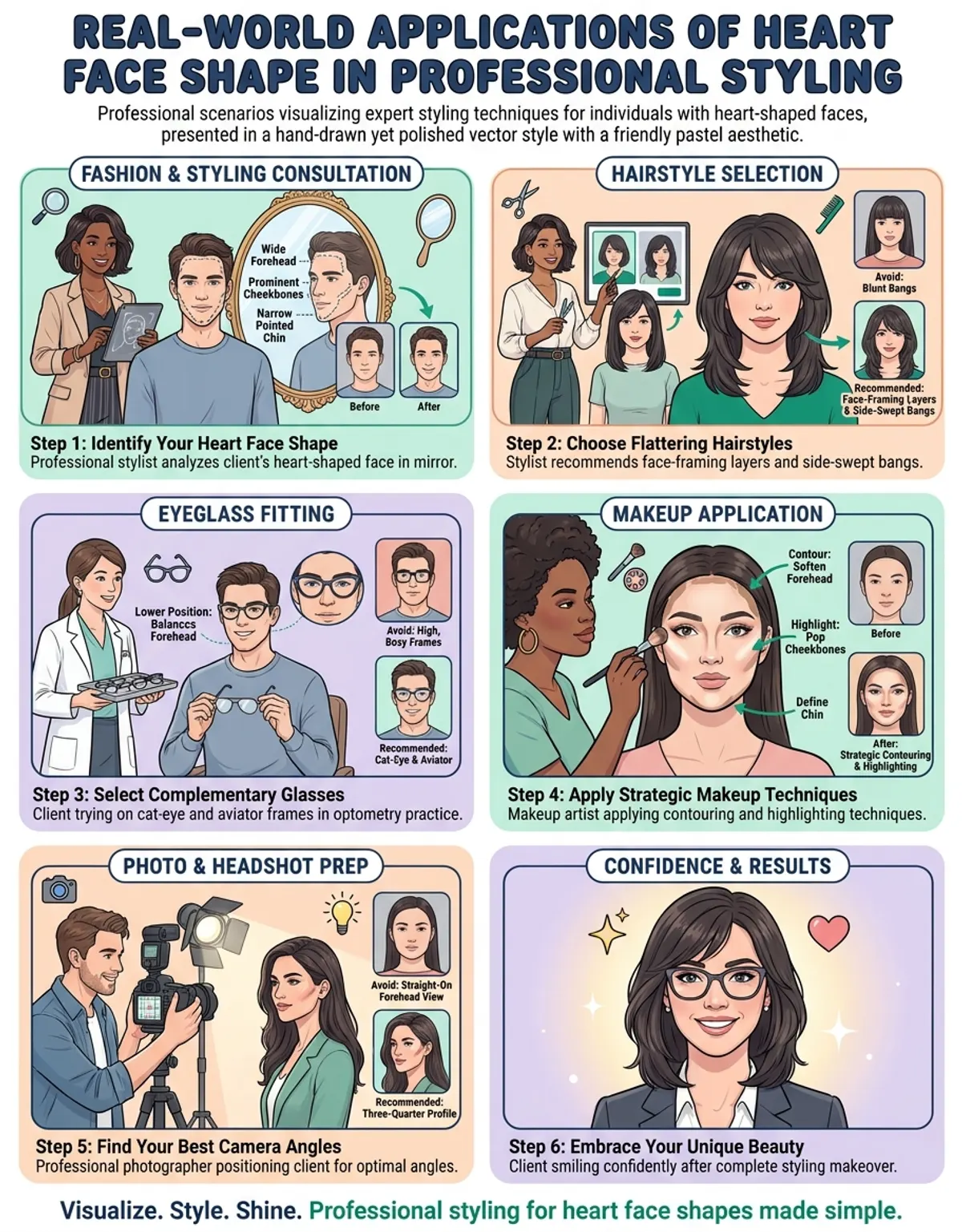
Makeup and contouring offer some of the most immediate and reversible ways to reshape the visual impression of a heart face shape. With the right techniques, you can create the appearance of a wider jawline, more defined chin, and narrower forehead — no procedures required. The contouring goal for this type is to shadow what you want to recede and highlight what you want to bring forward.
With the right contouring techniques, you can create the appearance of a wider jawline and narrower forehead — no cosmetic procedures required.
Forehead contouring: Apply matte bronzer or contour powder along the temples and outer edges of the hairline. This shadows the widest area of a heart face shape, making the forehead read as narrower. Blend carefully toward the hairline so the effect looks natural. Focus on the very top corners rather than the full surface — this preserves the forehead's natural shape while reducing its visual breadth.
Highlighting the jawline and chin: Use a highlighter or slightly lighter concealer along the jawline and directly at the chin. When the jaw and chin catch light, they appear more prominent and better defined, which directly counterbalances the broad upper face of a heart face shape. This simple technique is one of the highest-impact moves for improving the proportional impression of this type.
Blush placement: For a heart face shape, apply blush below the cheeks and sweep gently downward and outward, rather than placing it on top of the cheeks. The prominent cheekbones of this type already catch attention naturally. Blush placed too high can further widen the upper face. Sweeping blush downward instead adds color and definition to the lower half, guiding the eye toward the jaw.
Lip emphasis: A defined, prominent lip draws the eye toward the lower face area, which is beneficial for balancing a heart face shape. Bold lip colors — deep reds, berry tones, vivid nudes — redirect attention downward toward the lower third of the face. Slightly overlining the outer corners of the lips adds an illusion of width at the bottom. This is a low-effort technique with notable results.
Eyebrow shape: A flatter brow with less arch helps soften the visual emphasis on the forehead of a heart face shape. A steep arch draws the eye upward and inward, which can make the broad forehead appear even larger. A more horizontal brow distributes attention more evenly across all features.
Cosmetic Procedures for the Heart-Shaped Face
Many people with a heart face shape look for ways to add more definition at the chin, more presence at the jaw, or a softer appearance at the forehead. Cosmetic procedures and injectable treatments can address all of these goals, and understanding your options is worthwhile whether you are seriously considering treatment or simply curious about what is possible.
Chin enhancement injections: Injectable fillers placed at the tip of the chin are among the most popular non-surgical procedures for a heart face shape. Chin fillers can elongate the pointed chin, add subtle breadth to the chin tip, or simply improve definition for a more balanced overall appearance. Results typically last 12 to 18 months and are reversible with hyaluronidase if the outcome does not match your expectations. For more on related face shapes, see our guide on triangle face shape.
Jawline injections: Filler injections along the jaw add definition and visual mass to the mandible, creating a stronger, more angular lower face. For a heart face shape, where the jaw is naturally narrow, jawline injections are among the most transformative non-surgical treatments available. A skilled injector places fillers strategically to create natural-looking jaw definition without making the jaw appear heavy. These treatments last approximately 12 to 18 months and are reversible.
Forehead Botox (non-surgical): Botox injected along the outer forehead can soften the appearance of a wide forehead by relaxing the muscles that contribute to width-emphasizing expressions. This non-surgical approach is one of the least invasive cosmetic options for face reshaping and is repeated every three to four months. It is commonly requested by injectors who specialize in proportion balance for different face shapes.
Buccal fat removal: This surgical procedure removes fat pads from the cheeks to create a more chiseled, angular look. Some people with a heart face shape consider it to slim the mid-face and enhance their cheekbones. However, approach this surgery carefully — removing buccal fat from an already narrow lower face can sometimes create hollow or prematurely aged results. Consult a board-certified plastic surgeon before pursuing this procedure, as the existing cheekbones and narrow jaw require precise planning.
Rhinoplasty: Some individuals with a heart face shape consider nose surgery to improve overall facial harmony. Because the forehead is broad and the jaw is pointed, the nose plays a central balancing role in the overall composition. A rhinoplasty that refines the tip or adjusts bridge width can enhance the overall proportional balance of this type. This is a significant surgical procedure requiring thorough consultation and careful recovery planning.
Start with injectable treatments first: Before committing to any surgery, injectable treatments offer a reversible way to explore what enhanced chin or jaw definition would look like on your face. Many people with a heart face shape find that injectable treatments alone deliver the visual results they wanted — and never need surgery at all. If filler results are satisfying, they can be maintained indefinitely with periodic repeat treatments. If not, they dissolve naturally over time.
Style Summary and Quick Guide
The heart face shape is defined by beautiful, distinctive features — high cheekbones, a broad forehead, and a refined pointed chin. Every recommendation in this guide serves a single purpose: leverage those features by adding visual definition to the lower face while gently softening the prominence of the wider upper face. The result is a face that looks intentionally balanced and harmonious.
Quick-reference summary:
- Hair: Choose hairstyles with volume and layers at the jaw — chin-length bobs, lobs, layered long hair. Side-swept bangs soften the forehead. Extensions add jaw-level fullness when your natural hair is thin. Avoid hairstyles that stack volume above the jaw.
- Beard: A full beard, goatee, or heavy stubble adds substance and mass to the lower face. The best aesthetic balance comes from fullness at the chin with shorter stubble at the sides.
- Glasses and sunglasses: Round, oval, or bottom-heavy glasses balance the wider upper face. Rimless glasses are also a strong fit. Avoid cat-eye styles and wide-top aviator shades.
- Makeup: Contour the outer forehead, highlight the jawline and chin, apply blush below the cheekbones rather than on top of them, and use bold lip color to redirect attention to the lower face.
- Injectable treatments: Chin fillers and jawline fillers are the most commonly chosen treatments for a heart face shape. For permanent changes, consult a board-certified surgeon. But start with injectable treatments — they let you preview results before committing to surgery.
The most important first step is confirming you actually have a heart face shape. The CaraComp analysis tool provides an accurate, photo-based assessment of your face shape in seconds. Upload a clear, forward-facing photo and get your confirmed result right away. Once you know your shape with certainty, every recommendation in this guide becomes immediately actionable for your specific features.
Frequently Asked Questions
How do I know if I have a heart face shape?
The key indicators are: your forehead is the broadest part of your face, your cheeks are high and prominent, your jaw narrows significantly below the cheeks, and your jawline tapers to a point. If the forehead measurement is notably greater than the jaw measurement and your chin is pointed, you very likely have a heart face shape. Measure each dimension — forehead, then cheekbones, then jaw — and compare. The CaraComp analysis tool provides a photo-based confirmation if you want certainty without manual measuring.
Which hairstyles suit a heart-shaped face?
The best hairstyles for a heart face shape add volume and length at or below the jaw: chin-length bobs, lobs, and layered long hair that falls past the chin. Side-swept bangs are excellent for softening the wider forehead. Extensions can add jaw-level fullness when natural hair is thin or fine. Hairstyles that stack volume above the jaw — high buns, blunt cuts ending above the chin — generally do not flatter this shape and should be chosen with care.
What glasses work best for a heart face shape?
Round glasses, oval glasses, and bottom-heavy glasses are the best choices because they direct visual attention to the lower face rather than the forehead. Rimless glasses are also a sound choice. For sunglasses, round and oval styles are the most flattering. Avoid cat-eye glasses and wide-top aviator shades, which add breadth at the brow — the already widest part of this shape.
What beard styles suit a heart face shape for men?
Men with a heart face shape look best in styles that build fullness and definition at the chin: a full beard, goatee with side stubble, chin strap, or heavy stubble. The key is keeping facial hair shorter at the sideburns and fuller at the chin and jaw, which creates a visual base that balances the broader forehead. Avoid heavy sideburns and mutton chops, which widen the upper face rather than the lower face.
Can cosmetic procedures improve jaw balance for a heart face shape?
Yes. Chin fillers and jawline fillers are among the most popular non-surgical treatments for a heart face shape, adding definition and perceived mass to the narrow lower face. Results from injectable treatments typically last 12 to 18 months and are reversible. Botox at the outer forehead is an option for softening a prominent brow. For more permanent changes, surgical options such as buccal fat removal or rhinoplasty may be considered, but always consult a board-certified plastic surgeon first.
Where is the widest point of a heart face shape?
The widest part of a heart face shape is the forehead. This distinguishes it from the diamond face shape (widest at cheekbones) and the pear face shape (widest at jaw). In a true heart face shape, breadth decreases progressively from forehead to cheekbones to jaw, ending in a pointed chin. If the forehead is the widest single measurement on your face, that is the strongest indicator you have a heart face shape rather than another type.
Are heart-shaped and inverted triangle faces the same?
These two terms typically describe the same proportions: wide at the forehead, narrow at the jaw, with a pointed chin. Some stylists use "heart" specifically for faces with a widow's peak hairline, while "inverted triangle" applies more broadly to the top-wide, bottom-narrow shape. For practical purposes — hairstyle choices, glasses, beard styles, makeup, and treatments — the recommendations for heart faces and inverted triangle faces are identical. Whichever term your stylist or analysis tool uses, the styling principles are the same.
A narrow chin defines heart-shaped faces: balance the width of the forehead against the chin, and your face reads even. Faces with this proportion suit styles that soften the brow width.