
Pixie Cut Face Shape Guide: Which Face Shapes Suit a Pixie Haircut?
Discover how to match the perfect pixie haircut to your unique facial proportions for a look that's both flattering and confident.
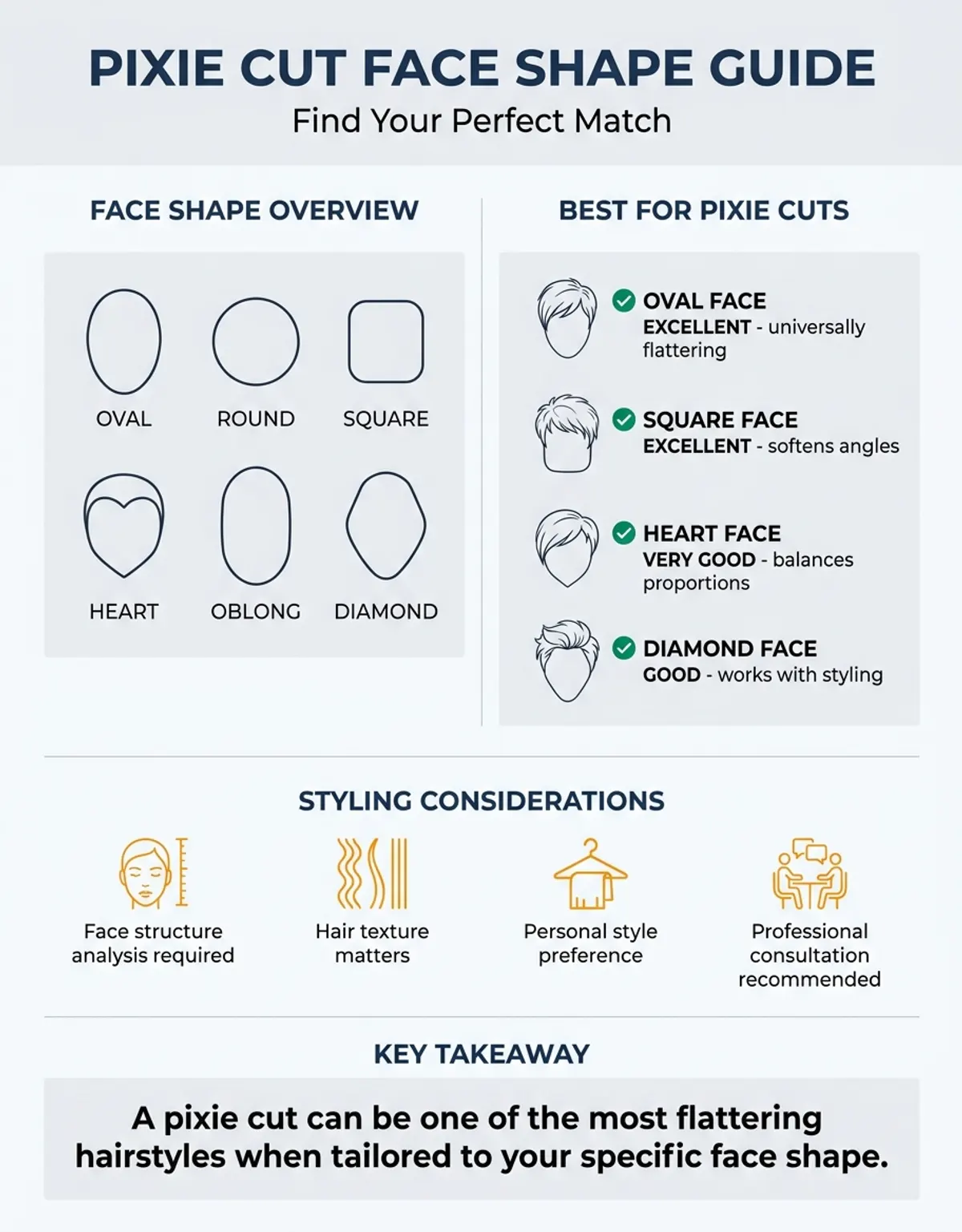
Choosing a pixie cut face shape combination that works for you requires understanding how different haircuts interact with your natural features. A pixie cut can be one of the most flattering hairstyles when tailored to your specific face shape. This hairstyle offers versatility and modern appeal when matched correctly to your facial proportions. The right pixie haircut emphasizes your best features while balancing proportions, creating a harmonious and confident look. Whether you have an oval, round, square, heart, or diamond face shape, there's a pixie variation designed to enhance your natural beauty.
The pixie cut has evolved from a bold, uniform crop into a diverse family of haircuts that offer incredible versatility. Modern pixie cuts range from ultra-short crops to slightly longer hair with textured layers, asymmetrical styling, dramatic fringes, and countless variations in between. Understanding which pixie haircut works best for your face shape helps you avoid common styling pitfalls and ensures you'll love your new look. This guide covers everything you need to know about matching pixie cuts to different face shapes, including styling tips, celebrity inspiration, and how to use AI face shape detection to find your perfect match.
What Face Shapes Suit a Pixie Cut?
Nearly every face shape can pull off a pixie cut when you choose the right variation and styling approach. The key to success lies in understanding your facial proportions—the width of your jaw, the height of your forehead, and the volume at your crown all play crucial roles in determining which pixie style will flatter you most. While oval faces can pull off almost any pixie variation with minimal effort, other face shapes benefit from strategic styling choices that create visual balance.
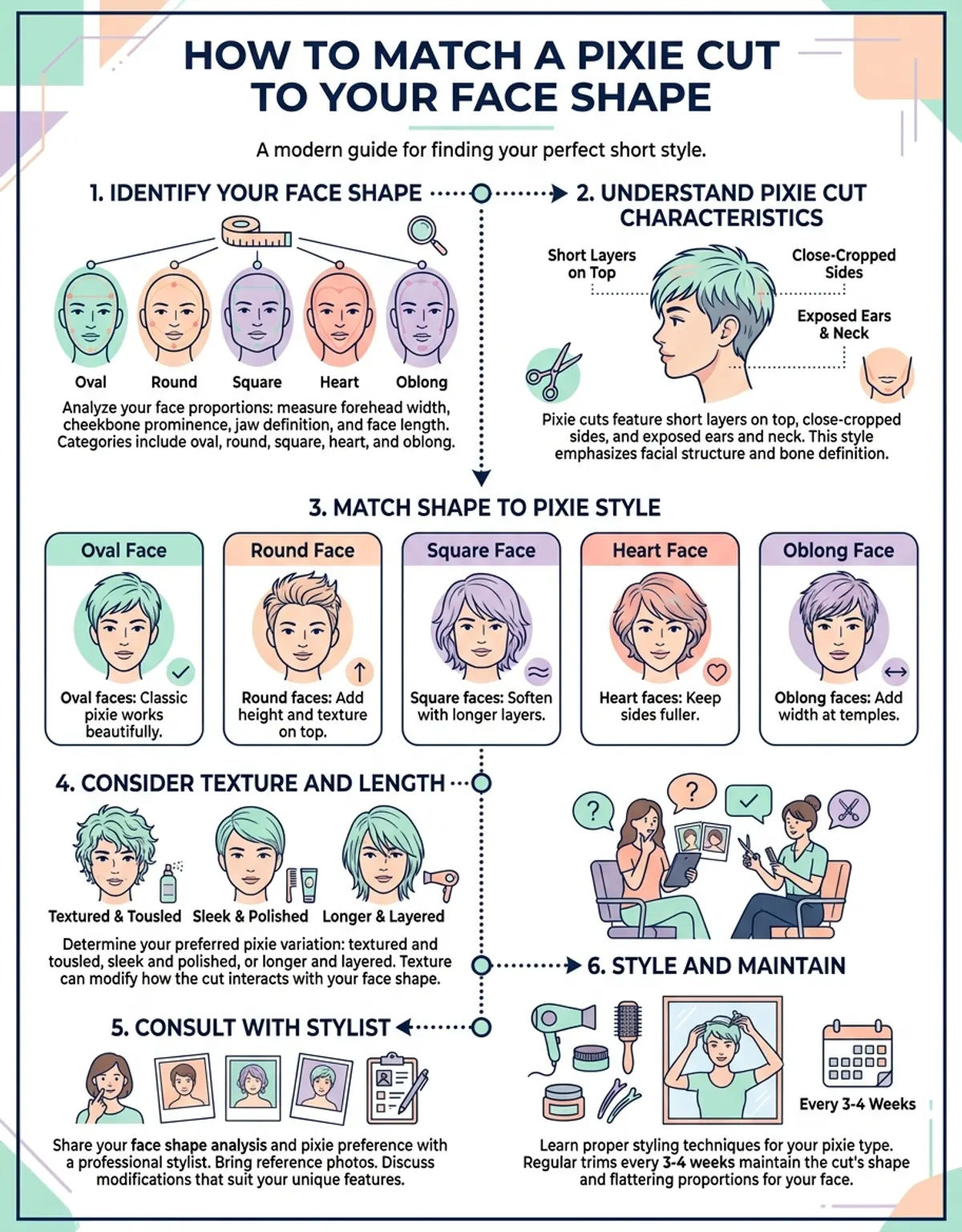
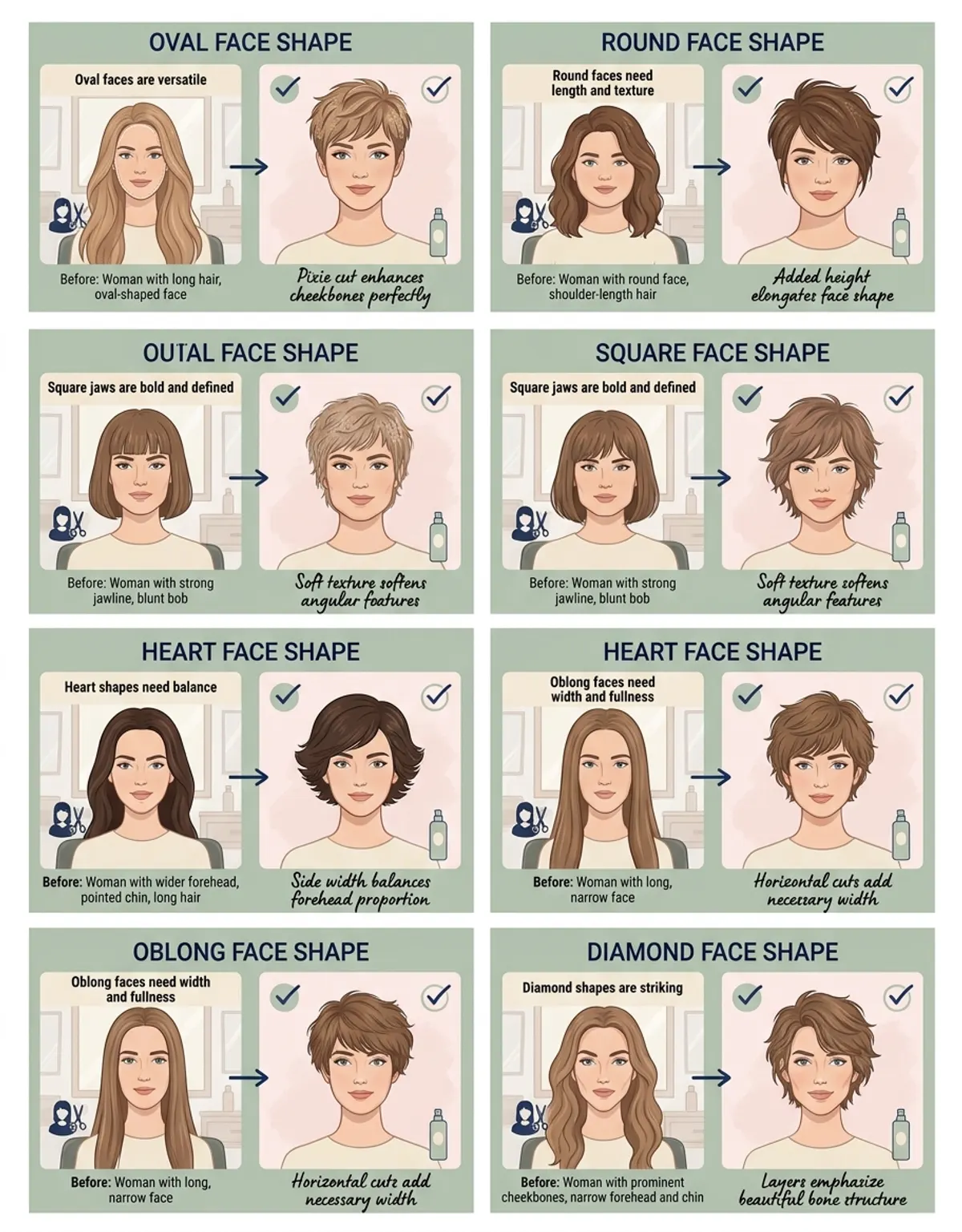
Face shapes generally fall into six categories: oval, round, square, oblong, heart, and diamond. Each shape has distinct characteristics that influence how a pixie cut will frame your face. Oval faces are characterized by balanced proportions and gentle curves. Round faces have softer angles with similar width and length. Square faces feature a strong jaw and angular features. Oblong faces are longer than they are wide. Heart-shaped faces have a wider forehead that tapers to a narrower jaw. Diamond faces are widest at the cheekbones with a narrower forehead and jaw.
The beauty of pixie cuts is their adaptability—by adjusting crown height, fringe, and side volume, you can customize a pixie to complement any face shape perfectly.
The beauty of pixie cuts is their adaptability. By adjusting the length at the crown, adding or removing a fringe, varying the volume on the sides, and choosing between textured or sleek finishes, you can customize a pixie haircut to complement any face shape. The goal is to create balance—adding volume where you need width, using length to elongate, and employing strategic cuts to soften or enhance your natural angles.
Pixie Cut for Oval Face Shape
Oval faces can pull off nearly any pixie style because of their naturally balanced proportions. The oval face shape is considered the most versatile, with a gently rounded hairline, balanced cheekbones, and a slightly narrower jaw. This symmetry means oval faces don't require specific corrections or adjustments—you have the freedom to experiment with almost any pixie variation without worrying about creating imbalance.
For oval faces, classic pixie cuts with short sides and volume at the crown work beautifully. Textured pixie haircuts add movement and dimension, while sleek, polished versions create a refined, elegant look. You can add a fringe or go without one—both options flatter oval proportions. Side-swept bangs, blunt fringes, and wispy layers all enhance the natural harmony of oval faces.
When styling a pixie cut for an oval face, focus on what you want to emphasize. Volume on top draws attention to your eyes and cheekbones. Slightly longer hair at the crown creates a dramatic, fashion-forward silhouette. Keep the sides relatively short to maintain the pixie's signature shape. Oval faces also look stunning with asymmetrical pixie cuts that feature longer sections on one side, creating visual interest without disrupting facial balance. If you're looking to complement your hairstyle with the perfect accessories, explore our best glasses shape for oval face guide for additional styling tips.
Celebrity examples of oval faces with stunning pixie cuts include Audrey Hepburn's iconic crop, which set the standard for timeless pixie elegance. Modern celebrities with oval faces who rock pixie haircuts demonstrate the endless possibilities this face shape offers. The key takeaway for oval faces: you can pull off almost any pixie variation, so choose based on your personal style, hair texture, and lifestyle preferences.
Pixie Cut for Round Face Shape
Round face shapes benefit from pixie cuts that add height and create the illusion of length. Round faces have soft, curved lines with similar width and length measurements, and a gently rounded jaw and forehead. The goal when choosing this hairstyle for a round face is to add vertical emphasis and avoid styles that accentuate the roundness.
The best pixie cuts for round faces feature tall volume at the crown, which visually elongates the face. Slightly longer hair on top contrasts with shorter sides, creating a silhouette that adds height. This vertical emphasis draws the eye upward and makes the face appear longer and more balanced. Avoid pixie styles that are uniform in length all around, as these can emphasize roundness rather than counter it.
Fringe options for round faces should be carefully considered. Side-swept fringes work well, adding asymmetry that breaks up the circular shape. Avoid heavy, blunt bangs that cut straight across the forehead—these can make the face appear wider and rounder. Instead, opt for wispy, piece-y fringes or angled styles that create diagonal lines.
When styling a pixie for a round face, use volumizing products at the crown to maximize height. Blow-dry hair upward and use your fingers to create lift at the roots. Keep the sides sleek and close to the head to avoid adding width. Textured, choppy layers on top add dimension and movement while maintaining the vertical emphasis that flatters round faces. The contrast between volume on top and close-cropped sides creates the most flattering proportions.
Pixie Cut for Square and Oblong Face Shapes
Square face shapes have strong, angular features with a prominent jaw and a forehead of similar width. The goal with pixie cuts for square faces is to soften these angles through texture and strategic volume. Harsh, geometric cuts can emphasize the squareness, so opt for styles that introduce curves and movement.
Textured pixie haircuts work exceptionally well for square faces. Layers, waves, and piece-y styling soften the strong jaw and create a more balanced appearance. Volume at the crown and sides helps counteract the angular jaw, while textured fringe breaks up the straight line of the forehead. Avoid severe, straight-across cuts that mirror the square proportions of the face.
For square faces, consider pixie variations with longer, swept-over sections that create diagonal lines across the face. These asymmetrical elements draw attention away from the angular jaw. Soft, wispy bangs or side-swept fringes work better than blunt, straight-across styles. The key is introducing curves and movement to balance the geometric features.
Oblong faces are longer than they are wide and can appear elongated with the wrong haircut. For oblong faces, the strategy shifts to adding width rather than height. Choose pixie cuts with volume at the sides rather than exclusively at the crown. A fringe is particularly beneficial for oblong faces as it visually shortens the forehead and reduces the overall length of the face.
Styling for oblong faces should focus on creating horizontal emphasis. Use styling products to add volume at the sides and avoid excessive height at the crown. Bangs that sweep across the forehead add width and break up the vertical length. Textured layers throughout the pixie create fullness that widens the appearance of the face, bringing it into better proportion.
Pixie Cut for Heart and Diamond Face Shapes
Heart-shaped faces are wider at the forehead and taper to a narrower jaw. This face shape requires careful balancing—you want to minimize the appearance of a broad forehead while adding width at the jaw. The right pixie haircut achieves this balance through strategic fringe and volume placement.
For heart-shaped faces, a fringe is your best friend. Bangs that cover part of the forehead reduce its apparent width and create better proportion. Side-swept fringes work particularly well with this hairstyle, adding asymmetry and drawing the eye diagonally across the face. Avoid pixie styles that pull all hair back from the forehead, as this emphasizes the heart shape's widest point.
Strategic fringe placement and jaw-level volume can transform heart and diamond face shapes, creating the balanced, oval-like proportions that define truly flattering pixie cuts.
Volume at the crown should be moderate for heart faces—too much height on top can make the forehead appear even wider. Instead, focus on slightly longer hair near the jaw and ears. This added length at the lower portion of the face creates width where you need it, balancing the broader forehead. Textured layers that fall around the jaw soften the taper and create a more oval appearance.
Diamond face shapes are widest at the cheekbones, with a narrower forehead and jaw. Like heart-shaped faces, diamond faces benefit from pixie cuts that add width at the jaw. Slightly longer hair near the ears and jawline creates fullness that balances the wider cheekbone area. A soft fringe can also work well, adding width at the forehead and creating better overall proportion.
Celebrity inspiration for heart-shaped faces includes examples of how strategic pixie styling creates beautiful balance. When choosing a pixie variation for heart or diamond faces, think about where you need to add visual weight and where you need to minimize it. The goal is creating the illusion of an oval face through intelligent styling choices.
How to Style a Pixie Cut for Your Face Shape
Styling a pixie cut requires the right tools and products to achieve the volume, texture, and shape that flatters your face. The basic toolkit includes a quality blow dryer, a small round brush for creating lift, styling products like texturizing paste or volumizing mousse, and finishing products for hold and shine.
Crown styling versus side styling depends entirely on your face shape. Round, heart, and oval faces generally benefit from volume at the crown, which adds height and creates vertical emphasis. Square and oblong faces should focus on side volume to add width and soften angles. Understanding where to add volume is crucial for creating the most flattering silhouette.
Start styling while hair is still damp. Apply volumizing mousse or root lifter to areas where you want to create fullness. For crown volume, blow dry hair upward using your fingers or a round brush to lift at the roots. For side volume, direct airflow horizontally and use your fingers to create fullness. Texturizing paste or pomade adds piece-y definition and holds the style in place.
Transitioning from a bob to a pixie cut can feel dramatic, but understanding your face shape makes the process easier. If your bob flatters your face, chances are a well-chosen pixie will too—the principles of face shape flattery remain consistent across shorter hair lengths. The main difference is that pixie cuts offer less styling flexibility through length, so the initial cut must be precisely tailored to your features.
When comparing a pixie versus a bob for your face shape, consider your lifestyle and styling preferences. Pixie haircuts require frequent trims every 4-6 weeks to maintain their shape, while bobs can grow out more gracefully. However, this shorter hairstyle often requires less daily styling time and can be refreshed quickly with minimal product. Both cuts can flatter almost any face shape when customized appropriately—your choice comes down to personal preference and how much maintenance you're willing to commit to.
Celebrity Pixie Cuts by Face Shape
Celebrity examples provide excellent inspiration when choosing your pixie cut face shape combination. Seeing how professionals style pixie haircuts for famous faces helps you visualize what might work for your own features. When browsing celebrity pixie cuts, pay attention to those with similar face shapes to yours for the most relevant inspiration.
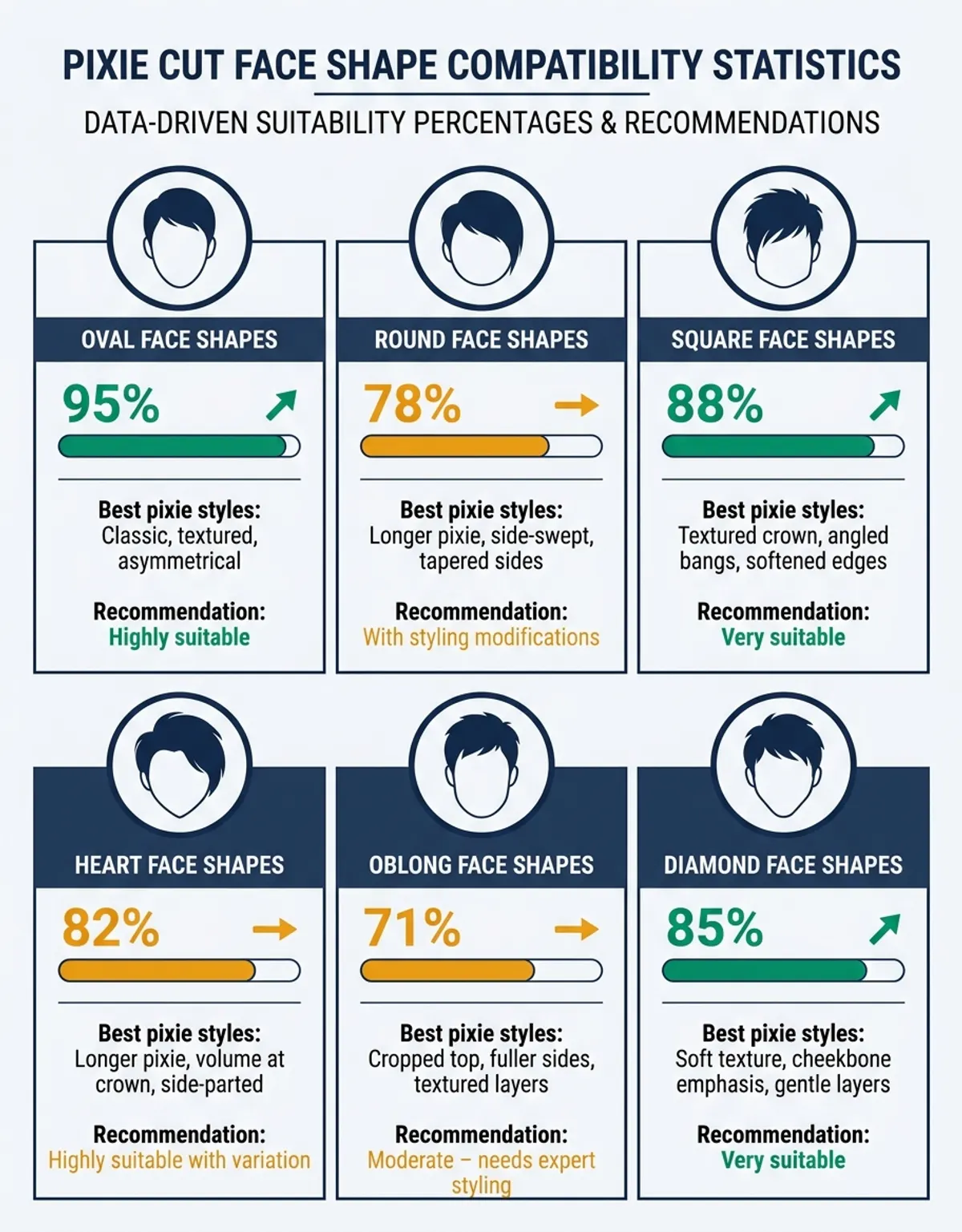
Oval-faced celebrities have the widest range of pixie options. From ultra-short crops to longer, textured styles, these famous faces demonstrate the versatility oval proportions offer. Notice how they experiment with different fringe options, hair colors like blonde highlights, and styling variations—all work because of their balanced facial structure.
Round-faced celebrities with pixie haircuts consistently choose styles with height at the crown and shorter sides. Look at how they use volume to create length and avoid styles that add width. These examples show the power of strategic styling in transforming facial proportions through intelligent haircut choices.
Square-faced celebrities opt for textured, soft pixie variations that introduce curves. Notice the prevalence of side-swept fringes, wavy textures, and piece-y layers. These elements all work to soften angular features and create a more balanced appearance. The beauty of these celebrity examples is seeing how professional stylists translate face shape principles into stunning real-world results. For more on this topic, see our guide on square face shape hairstyles.
Heart and diamond-shaped celebrities demonstrate how strategic fringe placement and jaw-level volume create balance. Pay attention to how these styles minimize wide foreheads and add width at the jaw, creating more oval-like proportions. These celebrity pixie cuts prove that understanding your face shape transforms a simple haircut into a sophisticated beauty choice that enhances your natural features.
When bringing celebrity inspiration to your stylist, choose multiple examples rather than just one—this gives your stylist a better sense of what you like and helps them adapt elements to your unique features.
When bringing celebrity inspiration to your stylist, choose multiple examples rather than just one. This gives your stylist a better sense of what you like and helps them adapt elements from different cuts to create a customized pixie that works specifically for your face shape, hair texture, and lifestyle.
AI Face Shape Detection: Find Your Perfect Pixie Cut
Before committing to a pixie cut, knowing your exact face shape removes guesswork and ensures you choose the most flattering variation. AI face shape detection technology has revolutionized how people identify their facial proportions, providing accurate analysis that once required professional consultation.
CaraComp offers advanced face analysis that precisely determines your face shape by measuring key facial landmarks. For the most accurate face shape analysis, try our face shape detector tool. The technology analyzes your jaw width, forehead proportions, cheekbone placement, and face length to categorize your face shape accurately. This removes the subjective guesswork of mirror analysis and provides objective data you can use when consulting with your stylist.
Using CaraComp is simple: upload a clear, front-facing photo with your hair pulled back to reveal your face shape clearly. The AI analyzes your facial structure and provides a detailed report of your face shape classification along with specific recommendations for pixie variations that will flatter your features. This technology-driven approach ensures you have accurate information before making the dramatic change to a pixie haircut.
Once you know your face shape through AI analysis, use that information to have a more productive conversation with your stylist. Instead of saying "I want a pixie cut," you can specify "I have a round face shape and want a pixie with crown volume to elongate my proportions." This level of specificity helps your stylist understand exactly what you need and ensures you get a pixie cut that truly flatters your unique features.
Face shape detection also helps if you're transitioning through different pixie variations over time. As your pixie grows out or you want to try a different style, referring back to your face shape analysis ensures every variation continues to flatter your proportions. This technology transforms pixie styling from trial-and-error experimentation into an informed, strategic approach to finding your best look.
Comparison Table: Pixie Cuts by Face Shape
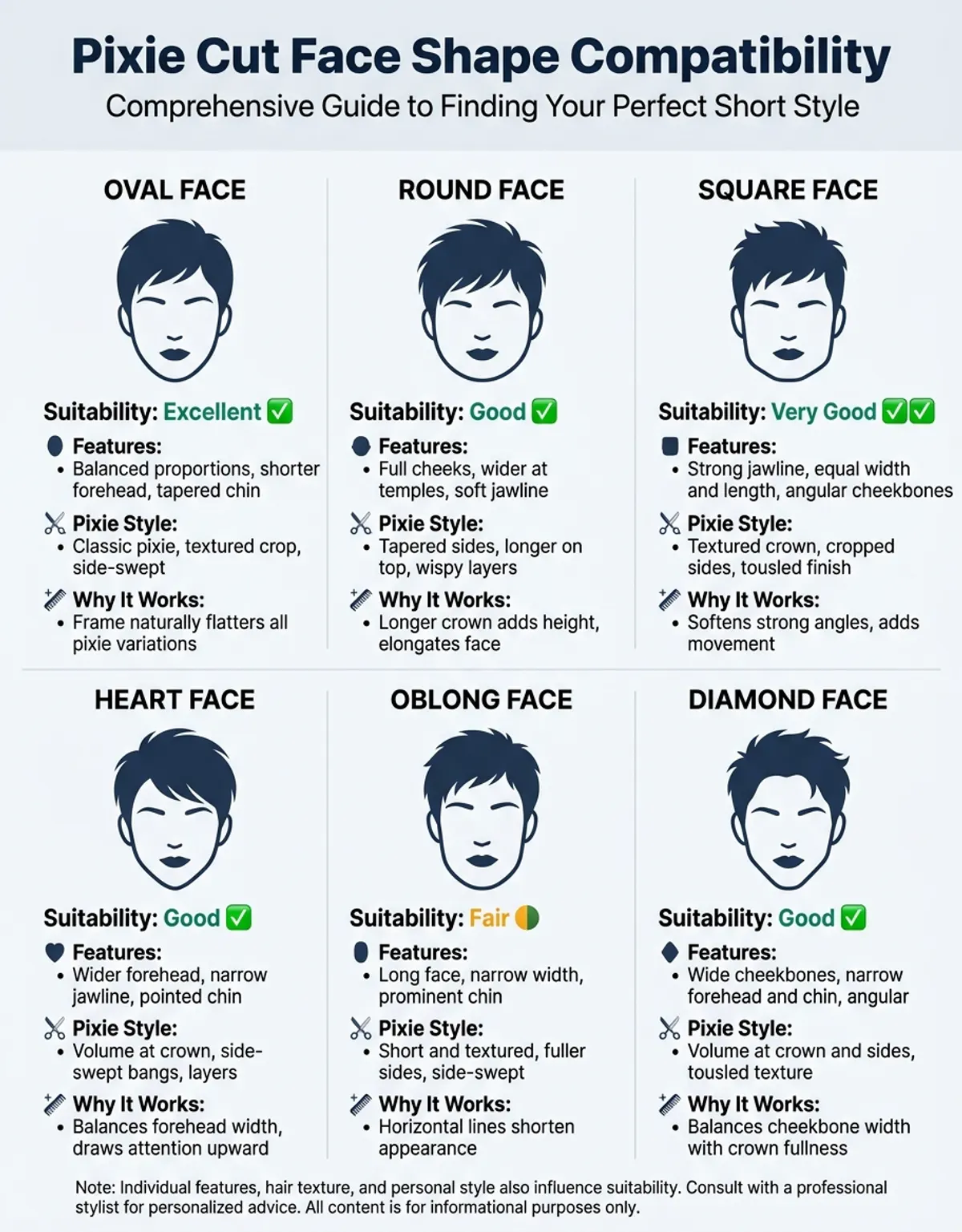
| Face Shape | Pixie Compatibility | Best Pixie Variation | Key Styling Tip | Avoid |
|---|---|---|---|---|
| Oval | Excellent — nearly any pixie style | Classic or textured pixie haircut | Volume anywhere you prefer | Nothing specific to avoid |
| Round | Good with right cut | Tall crown volume, short sides | Maximize height at crown | Blunt bangs, uniform length |
| Square | Good with softening techniques | Textured, wavy pixie with fringe | Soften jaw with texture and volume | Severe straight cuts |
| Heart | Good with strategic balance | Fringe plus moderate crown volume | Cover wide forehead, add jaw width | Excessive top volume, pulled-back styles |
| Oblong | Good with horizontal emphasis | Side volume with fringe | Add width at sides, use bangs | Very short all over, excessive height |
| Diamond | Good with proportional balance | Slightly longer near jaw and ears | Widen jaw area to balance cheekbones | Very close crop at sides |
Frequently Asked Questions
What face shape is best for a pixie cut?
Oval faces can pull off nearly any pixie style with ease due to their naturally balanced proportions. However, every face shape can look stunning with a pixie cut when you choose the right variation. Round faces need height at the crown, square faces benefit from textured softening, heart faces require strategic fringe, and oblong faces look best with side volume. The "best" face shape is actually whichever one you have—once you understand how to customize the pixie to flatter your specific proportions.
Can a pixie cut suit a round face shape?
Yes, pixie cuts can beautifully suit round face shapes when styled correctly. The key is creating vertical emphasis through tall volume at the crown combined with shorter sides. This silhouette elongates the appearance of the face and balances the natural roundness. Avoid blunt bangs and uniform-length cuts that emphasize circular proportions. With the right styling approach, round faces can pull off stunning pixie variations that create the illusion of length and highlight your best features.
How do I choose a pixie cut for my face shape?
Start by accurately identifying your face shape using AI detection tools like CaraComp for objective analysis. Once you know whether you have an oval, round, square, heart, oblong, or diamond face shape, research which pixie variations flatter those proportions. Consider where you need to add volume (crown for round faces, sides for oblong faces), whether a fringe would benefit you, and how texture can enhance or soften your features. Bring multiple celebrity examples with similar face shapes to your stylist and discuss how to adapt those elements to your specific features, hair texture, and styling preferences.
What pixie cut works for a square face shape?
Square face shapes look best with textured, soft pixie cuts that introduce curves and movement to balance angular features. Choose pixie variations with wavy or piece-y styling rather than severe geometric cuts. Volume at the crown and sides helps soften the strong jaw, while textured fringes break up the straight line of the forehead. Asymmetrical elements that create diagonal lines across the face work particularly well. The goal is avoiding harsh, straight cuts that echo the square proportions and instead choosing styles that add feminine curves and softness.
Should I get bangs with a pixie cut for my face shape?
Bangs complement some face shapes more than others. Heart-shaped faces benefit significantly from bangs that reduce the appearance of a wide forehead. Oblong faces also look great with fringes that visually shorten the face length. Round faces should stick to side-swept or wispy bangs rather than blunt, straight-across styles. Square faces benefit from soft, textured fringes that soften angular features. Oval faces can pull off any fringe style or go without bangs entirely. Diamond faces can use soft fringes to add width at the forehead. Your choice should be based on which areas you want to minimize or emphasize.
What is the difference between a pixie cut and a bob for different face shapes?
Both pixie cuts and bob haircuts can flatter different face shapes, but they work in different ways. A bob offers more length and styling versatility, allowing you to adjust your look through styling techniques. A pixie cut requires the initial cut to be precisely tailored since there's less length to work with for daily styling variations. Bobs grow out more gracefully, while pixie haircuts need frequent trims to maintain their shape. For face shape considerations, both cuts follow similar principles—round faces need height, square faces benefit from softening, oval faces can pull off almost anything. The choice between a bob and pixie comes down to how short you want to go and how much maintenance you're willing to commit to rather than which works better for your face shape.
How can I find out my face shape before getting a pixie haircut?
The most accurate method is using AI-powered face shape detection technology like CaraComp, which analyzes your facial measurements and proportions to determine your face shape objectively. Simply upload a clear, front-facing photo with your hair pulled back, and the AI provides a detailed analysis of your face shape category along with styling recommendations. This removes the guesswork of mirror analysis and gives you confidence when discussing options with your stylist. Knowing your face shape before committing to a pixie cut ensures you choose a variation that will genuinely flatter your features rather than relying on trial and error.
Ready to Find Your Perfect Pixie Cut?
Understanding the relationship between pixie cuts and face shapes empowers you to make confident styling decisions that enhance your natural beauty. Whether you have an oval, round, square, heart, oblong, or diamond face shape, there's a pixie variation specifically designed to flatter your unique proportions. The key is matching the right cut characteristics—crown height, side volume, fringe style, and texture—to your facial structure.
Start by using AI face shape detection to accurately identify your face shape, then consult with a professional stylist who understands how to customize pixie haircuts for different facial proportions. Bring multiple celebrity inspiration photos that showcase pixie cuts on faces similar to yours. Remember that the perfect pixie cut isn't just about following generic rules—it's about creating a personalized style that makes you feel confident, beautiful, and authentically yourself. With the right knowledge and expert guidance, your pixie cut will be a stunning reflection of your individual style and facial features.