
Facial Recognition in Stores: Retail Face Match Ejects UK Shopper
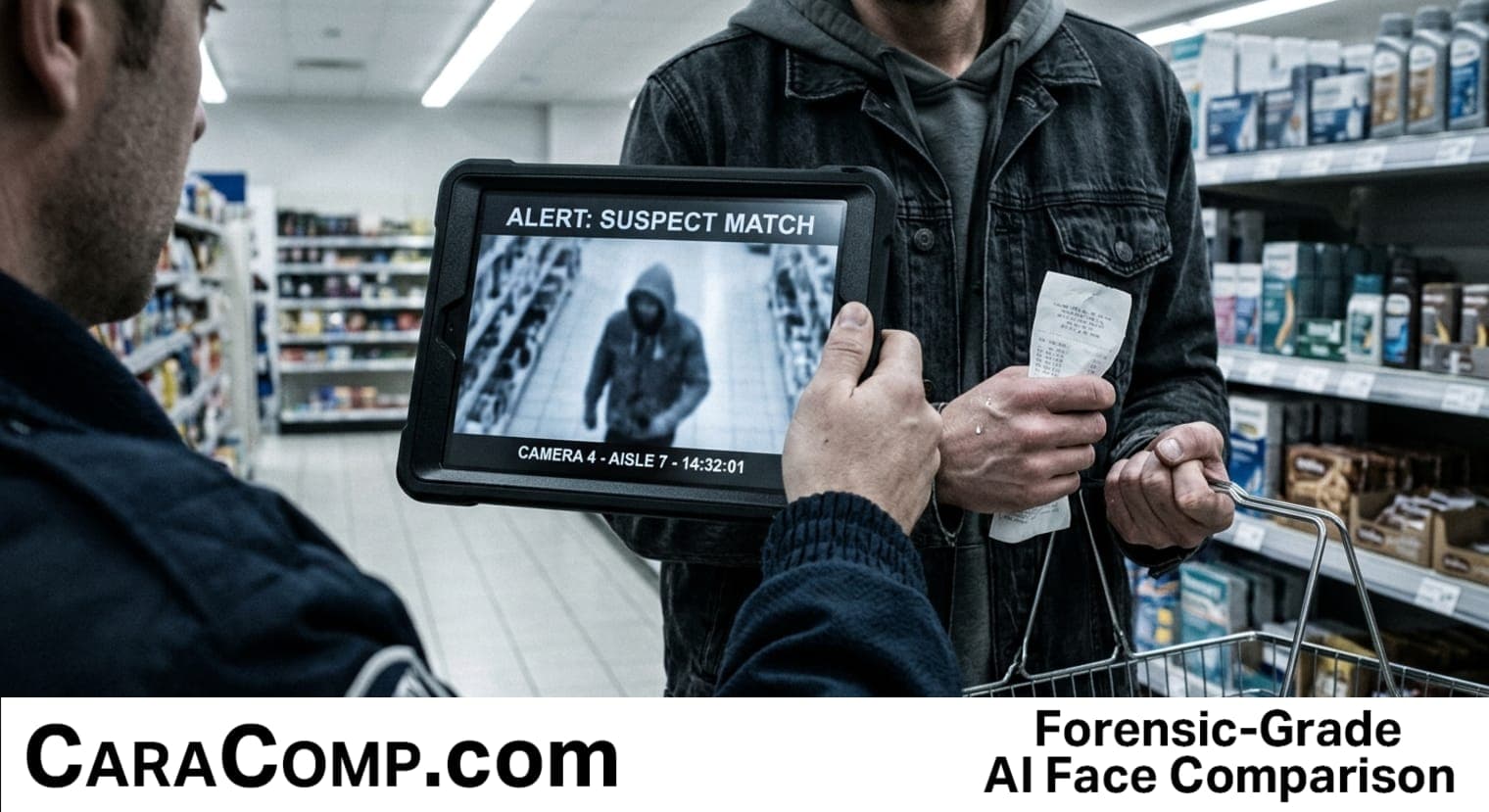
Quick answer
Can facial recognition in stores wrongly flag an innocent shopper?
Yes. Store systems compare face shapes and score how alike two faces look, and lookalikes can score high enough to trigger an alert. Poor lighting, camera angles and very large watchlists add to the errors. Government testing shows mistakes are uneven across groups, so a flag should prompt a human check first.
A UK couple was thrown out of a Budgens supermarket after facial recognition in stores decided the wife had stolen "loads of meat." Both of them said they hadn't set foot in that shop for months. Picture being marched to the door in front of your neighbors, over something you didn't do.
Facial recognition in stores can point at the wrong person, so a face-match alert is a lead to check, never proof that someone stole anything.
If you're reading this at 11pm because a story like this made your stomach drop, here's the short version. You're not paranoid. This does happen. And there is a calm, specific thing you can do if it happens to you. We'll get to that. First, what actually went wrong.
What Happened With Facial Recognition in Stores at Budgens
The Yahoo News report describes a couple, shaken and confused, told the wife had been caught on the shop's system stealing meat. Her answer was simple: I haven't been in here for months. In most of our lives, that would settle it. Here, it didn't.
Why not? Because the camera isn't "recognizing" anyone the way your neighbor does. It maps the shape of a face (the distances between eyes, nose, jaw) and compares that map to a list of faces the store has marked as trouble. If the two maps look close enough, it fires an alert. A computer says "close enough." A human then has to decide what that means. Too often, the human just believes the computer.
How shoplifting facial recognition decides who gets flagged
Think of a match score (a number for how alike two faces are). The store picks a cutoff. Set it low and you catch more real thieves, but you also catch more lookalikes. Set it high and you protect innocent shoppers, but some thieves walk. Shoplifting facial recognition always lives in that tension, and the shopper standing at the door never sees where the dial was set.
358x
more false positives for West African women over 65 than for Eastern European men aged 35-50, in the top performing system as of March 2025
Source: NIST data, as summarized by the Federation of American Scientists This article is part of a series, start with Roblox Age Verification Face Scan Hijackers Keep Kid Status.
That number comes from government testing, summarized by the Federation of American Scientists. A "false positive" is when the system says two different people are the same person. The point isn't that every store system is that bad. It's that the errors are not spread evenly, and the best system tested still got some groups wrong far more often than others.
Is a Face Match Proof? Why a False Facial Match Isn't a Verdict
No. A face match is a hint, like a stranger telling you "I think that's the guy." Useful for a second look. Not enough to convict anyone. Even the rules that come with this technology say so. Policies explicitly state that results are "not to be considered a positive identification," yet, as the researchers behind this story put it, staff and police routinely treat alerts as if they were.
The ACLU has made this exact argument about police: a printed warning doesn't stop people from acting on a screen that says "MATCH." Busy humans trust the machine. A false facial match then becomes a real-world accusation in about four seconds.
Why a shopper's "I haven't been there in months" doesn't settle it either
Here's the part nobody likes to say out loud. Your own memory isn't proof, either. "I wasn't there" is a perfectly good defense, but a store can't verify it on the spot, and you may not have a receipt, a bank record, or a witness handy. So the argument turns into your word against a glowing alert. That's a bad fight to have at the door.
The better move is to change the question. Don't argue about where you were. Ask what the accusation is based on.
A pattern, not a one-off
This isn't a single freak event. The civil liberties group Big Brother Watch has documented several cases of innocent shoppers wrongly flagged. In one, a woman named Danielle Horan was mistakenly put on a watchlist (a store's list of people to stop or remove), accused twice, and removed from shops, with her face data shared between retailers. One mistake followed her from store to store.
Across the Atlantic, the US Federal Trade Commission found that the pharmacy chain Rite Aid used facial recognition technology in secret for nearly a decade. Women were more likely to be misidentified than men. As NBC News reported, here is what the FTC says happened next:
Employees, acting on false positive alerts, followed consumers around stores, searched them, ordered them to leave, called police, and publicly accused them of shoplifting.
Federal Trade Commission finding on Rite Aid, as reported by NBC News
Read that list again. Followed. Searched. Ordered out. Police called. Publicly accused. Every step came from a screen alert that nobody double-checked. Previously in this series: Roblox Age Verification Face Scan Hijackers Keep Kid Status.
Why Facial Recognition in Stores Gets It Wrong More Than Stores Admit
Stores aren't labs. Lighting is odd, cameras sit high, people wear hats and masks and look tired. Reporting from Gadget Review notes that outside factors like lighting hurt results, and that some systems become "useless" once the list of faces gets as large as 50,000. That's well below what big retail chains can hold.
Then there's the missing scoreboard. Without independent audits (outside checkups that test how the system performs on all kinds of people and conditions) and without public reporting of how often it gets things wrong, shoppers have almost no way to know how often facial recognition in stores fails. Futurism has tracked the same pattern of mistaken IDs in the UK.
| What the alert gives a store | What proof would look like |
|---|---|
| A face-match alert, a guess that two faces look alike | Video surveillance of the actual theft, with the item leaving the shelf |
| A match score, one number with a cutoff the shopper can't see | A person checking the old photo against the shopper, side by side |
| A watchlist entry that may be wrong or shared with other retail shops | A dated record showing the shopper was in the store that day |
| A split-second call by security or other staff trusting the screen | A manager review before anyone is accused or removed |
What the industry says, and why it only half works
A company that sells this technology says it runs successfully across thousands of stores and warns that the documented misidentifications aren't typical. Fair. Real retail shoplifting costs shops real money, and the tools do catch real thieves. But "rare" isn't the same as "avoidable," and when the person wrongly accused is you, rare feels like 100 percent.
And here's a quiet trick of the mind worth knowing about. A vivid story, like a shopper dragged out over meat, sticks in memory and feels common. The availability heuristic (judging how likely something is by how easily an example comes to mind) can make you overestimate the risk. But it can also make stores overtrust the screen in front of them, because the alert is vivid and the doubt isn't. Both sides are running on gut feeling. That's the problem.
Why Shoplifting Facial Recognition Mistakes Matter
- Public humiliation: being searched or ordered out in front of other shoppers is the harm, even if it's fixed later.
- Shared lists: one wrong entry can follow a person to other shops, as in the Danielle Horan case.
- Uneven errors: some groups are wrongly flagged far more often than others.
- Hard to appeal: people in these cases struggled with company bureaucracy just to clear their names.
What Should You Do If Facial Recognition in Stores Wrongly Accuses You?
Stay calm, ask what the accusation is based on, and ask to speak to a manager about how to challenge a wrong identification. That's the whole plan. Don't argue about the meat, the milk, or the month. Ask for the basis, ask for the process, and write down the time, the store, and the names of anyone involved.
Some practical wording you can borrow: "What is this accusation based on? Is it a camera alert? Can a manager review it with me? How do I dispute it in writing?" Short. Polite. Hard to wave away.
One more breadcrumb, and then we'll leave the product talk out of it. If you've ever wondered whether a photo or a face is really who it claims to be, that is exactly the question this kind of technology exists to answer. The difference is in how it's used. A careful person comparing two images side by side, with known evidence, is doing comparison. A system scanning every face that walks in and firing alerts automatically is doing recognition. Ask any store that stops you: did a human actually compare the two images, or did the screen just say so? That one question shows you which kind of check you're dealing with.
Key Takeaway Up next: Facial Recognition In Stores False Match Ejects Uk Shopper.
Facial recognition in stores is a guessing tool, and a false facial match should trigger a human check, not an accusation.
Recap: A face-match alert from a store camera can point at the wrong person. It is a lead to check, never proof that someone stole.
So who pays when the camera is wrong? Right now it's the woman at the door, holding no receipt, with no meat in her bag, trying to prove she wasn't somewhere months ago. If a store's system gets to accuse in a second, shouldn't the store have to clear her just as fast?
Facial recognition in stores: Frequently Asked Questions
Can a store legally stop me because of a face match?
The sources behind this story don't settle what any single store may legally do, and the rules differ by country. What they do show is that alerts have led to people being followed, searched, ordered out and publicly accused. Policies for these tools say a result is not to be treated as a positive identification. If you're stopped, stay calm, ask what the accusation is based on, and ask a manager how to challenge it. For a legal opinion on your situation, talk to a qualified lawyer.
What is a false facial match?
A false facial match is when a system says two different people are the same person. Experts call it a false positive. It happens because the software compares face shapes and scores how alike they are, and lookalikes can score high. Poor lighting, camera angle and very large watchlists can make mistakes more likely. In a shop, the harm comes when staff treat that score as fact and accuse the shopper without a second look.
Does shoplifting facial recognition work equally well for everyone?
No. Government testing summarized by the Federation of American Scientists found that the top performing system as of March 2025 produced 358 times as many false positives for West African women over 65 as for Eastern European men aged 35-50. The Federal Trade Commission also found that women were more likely than men to be misidentified in the Rite Aid case. Errors are not spread evenly across people, which is one reason a single alert should never be trusted alone.
How do I challenge a wrong identification by a store?
Start in the moment, by asking calmly what the accusation is based on and asking for a manager. Afterward, write down the date, time, store and the names of anyone you spoke to. Then ask, in writing, how the store handles disputes and whether your biometric data was shared with other retailers. In the Danielle Horan case, her data was shared between shops, so asking is worth it. Keep your messages polite and factual.
Do stores have to tell customers they use facial recognition?
The research for this story doesn't say what every store must disclose. It does show that the FTC found Rite Aid used facial recognition in secret for nearly a decade. That means shoppers may not know a system is running. If you're accused, it's reasonable to ask whether a face-matching system was involved, how the match was reviewed by a person, and how you can dispute it.
Ready for forensic-grade facial comparison?
Full forensic reports with detailed similarity scoring. Results in seconds.
Run My First SearchMore News
AI Voice Cloning: Fake Call Takes Rs 1.2 Lakh From Florist
A Kolkata shop owner heard a voice she'd known for years and sent money fast. It wasn't that person. Here's the simple pause that beats AI voice cloning.
privacyTikTok's Response: Nearly 50 Nude Deepfake Apps, 'Not Ads'
A report says nearly 50 apps that make sexual deepfakes were pushed through TikTok ads. TikTok says the examples weren't ads. Either way, a familiar feed is not a safety guarantee.
facial-recognitionHong Kong police: Face scans start, no word on wrong matches
Hong Kong police plan to turn on facial recognition across their camera network this month. With 60,000 cameras targeted by 2028, the real question is what happens when the system gets someone wrong.