
Find Your Twin: Doppelganger Finder Tools Using Face Recognition
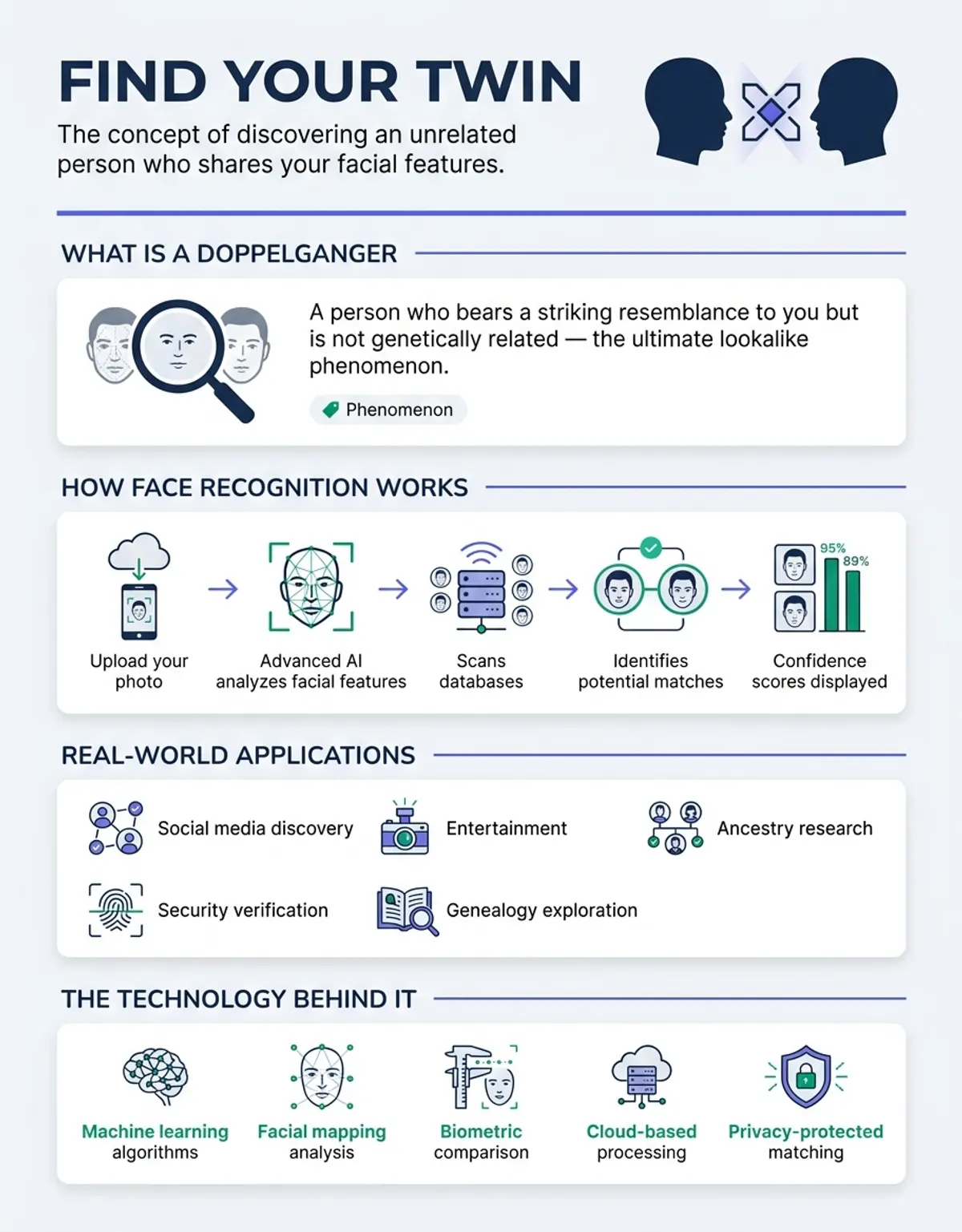
Have you ever wondered if there's someone out there who looks exactly like you? The concept of finding your twin — an unrelated person who shares your features — has captivated people worldwide. Thanks to advanced face recognition technology and comparison platforms, discovering your doppelganger is now easier than ever. Here's what you need to know about the best methods, platforms, and technologies to successfully find your twin among millions of profiles.
Understanding Twin Strangers in Find Your Twin
The phenomenon of twin strangers has fascinated scientists and regular people for decades. Unrelated individuals share remarkably similar features despite having no genetic relationship whatsoever. Research suggests that there's a high probability everyone has at least one doppelganger somewhere in the world, given the finite number of feature combinations and the global population of over 8 billion people. A 2015 University of Adelaide study found approximately one in 135 chance that a pair of complete doppelgängers exist somewhere in the world. (Source: https://www.adelaide.edu.au/news/news81642.html)
When you set out to find your twin, you're embarking on a search for someone whose structure, proportions, and overall appearance mirror your own. The science behind this involves understanding that human faces are composed of relatively limited variations in key attributes: eye spacing, nose shape, jawline structure, and proportions. While the combinations seem endless, mathematical models suggest that unrelated people can share enough similarities to appear nearly identical.
The movement gained significant momentum in 2015 when Niamh Geaney and her friend group launched a project to discover their lookalikes. (Source: https://www.irishexaminer.com/lifestyle/arid-20358178.html) Their success stories inspired countless others to use face recognition platforms and comparison services. Today, specialized websites and apps make it possible to search through vast databases to find your twin, turning what was once a chance encounter into a systematic search process.
Here's the thing — you should set realistic expectations. While you might discover someone who looks remarkably similar, finding a perfect match is rare. Most successful experiences result in discovering people who share strong resemblances rather than identical appearances. The excitement comes from seeing how individuals from different parts of the world can share your distinctive characteristics.
How Strangers Can Look Alike
The science of why people look alike involves genetics, population biology, and mathematical probability. While each person's DNA is unique, the genes controlling features exist in limited variations across the human population. This means that certain combinations naturally recur, making it possible for unrelated people to share striking similarities.
Features are determined by thousands of genetic variants, but researchers have identified specific genes that control major aspects of shape. These include genes affecting nose width, eye spacing, chin prominence, and cheekbone height. Because these genes are distributed throughout populations, it's statistically probable that people in different parts of the world will inherit similar combinations, resulting in lookalike appearances.
Anthropologists have documented how certain patterns are more common in specific populations due to historical migration and genetic drift. However, with increased global mobility and genetic mixing, these patterns now appear across diverse groups. This explains why your twin might be living on a different continent, sharing your structure despite completely different ancestral backgrounds.
The concept of recognition also plays into why we perceive similarities. Human brains process faces holistically, focusing on key landmark points and overall proportions. When these critical measurements align between two people — even if minor details differ — our perception registers them as remarkably similar. This is why comparison platforms can successfully identify potential twins by analyzing geometry and proportions.
Celebrity Lookalike Tools and Technology
Celebrity lookalike applications represent one of the most popular entry points for people wanting to find your twin. These platforms use sophisticated face recognition algorithms to compare your uploaded image against databases of famous person images, identifying which star you most closely resemble — your celebrity twin. While this differs from finding your actual twin among regular people, it demonstrates the power of analysis technology.
The technology behind these comparison services involves deep learning neural networks trained on thousands of images. These algorithms analyze dozens of landmarks — from the distance between your eyes to the curvature of your jaw — and match these measurements against patterns. Popular apps include StarByFace, Gradient, and FaceApp, each offering unique approaches to matching.
What makes these platforms valuable for understanding twin finding is their accuracy in identifying specific feature patterns. When an app tells you that you resemble a particular actor or musician, it's detecting genuine geometric similarities in structure. This same technology, when applied to broader databases of regular people, enables more comprehensive twin finding capabilities.
Honestly? Take these results as entertainment rather than definitive matches. These applications are optimized for engagement and often highlight the most flattering comparisons. For serious efforts to find your twin, platforms that compare you against millions of everyday people offer more realistic and meaningful results. Still, they provide excellent demonstrations of how recognition technology works.
Best Tools to Find Your Twin
Selecting the right tools to find your twin significantly impacts your success in discovering your doppelganger. The market offers numerous platforms, each with distinct features, database sizes, and accuracy levels. Understanding which provide the best combination of technology and user experience helps streamline your search and increases the likelihood of finding meaningful matches.
Twin platforms remain among the most established services dedicated specifically to helping people discover their doubles. With millions of registered users worldwide, they offer substantial databases for comparisons. These platforms use recognition algorithms to analyze uploaded images and suggest potential matches based on similarity scores. Most operate on freemium models, offering basic searches for free while charging for enhanced features.
FaceDouble represents another powerful option for twin finding, utilizing advanced technology to compare structures. This platform distinguishes itself through its emphasis on geometry analysis, examining proportions and spatial relationships between features. FaceDouble's algorithm considers over 60 landmark points, providing highly detailed comparisons that go beyond surface-level similarities. You may also explore our PicTriev guide for understanding celebrity face matching technology.
Google's reverse image search, while not specifically designed for twin finding, offers a practical alternative approach. By uploading your image to Google Images, you can discover visually similar pictures across the internet. This method works particularly well for finding lookalikes who might not be registered on dedicated platforms, though results require more manual sorting to identify genuine similarities versus identical clothing or settings.
For those seeking comprehensive capabilities, PimEyes provides advanced recognition features originally designed for privacy monitoring but equally effective for twin finding. The platform searches across billions of images from public websites, offering unprecedented reach. PimEyes claims approximately 90% accuracy in facial recognition matching. (Source: https://www.allaboutai.com/ai-reviews/pimeyes/) However, its power comes with privacy considerations that users should carefully evaluate before uploading personal images.
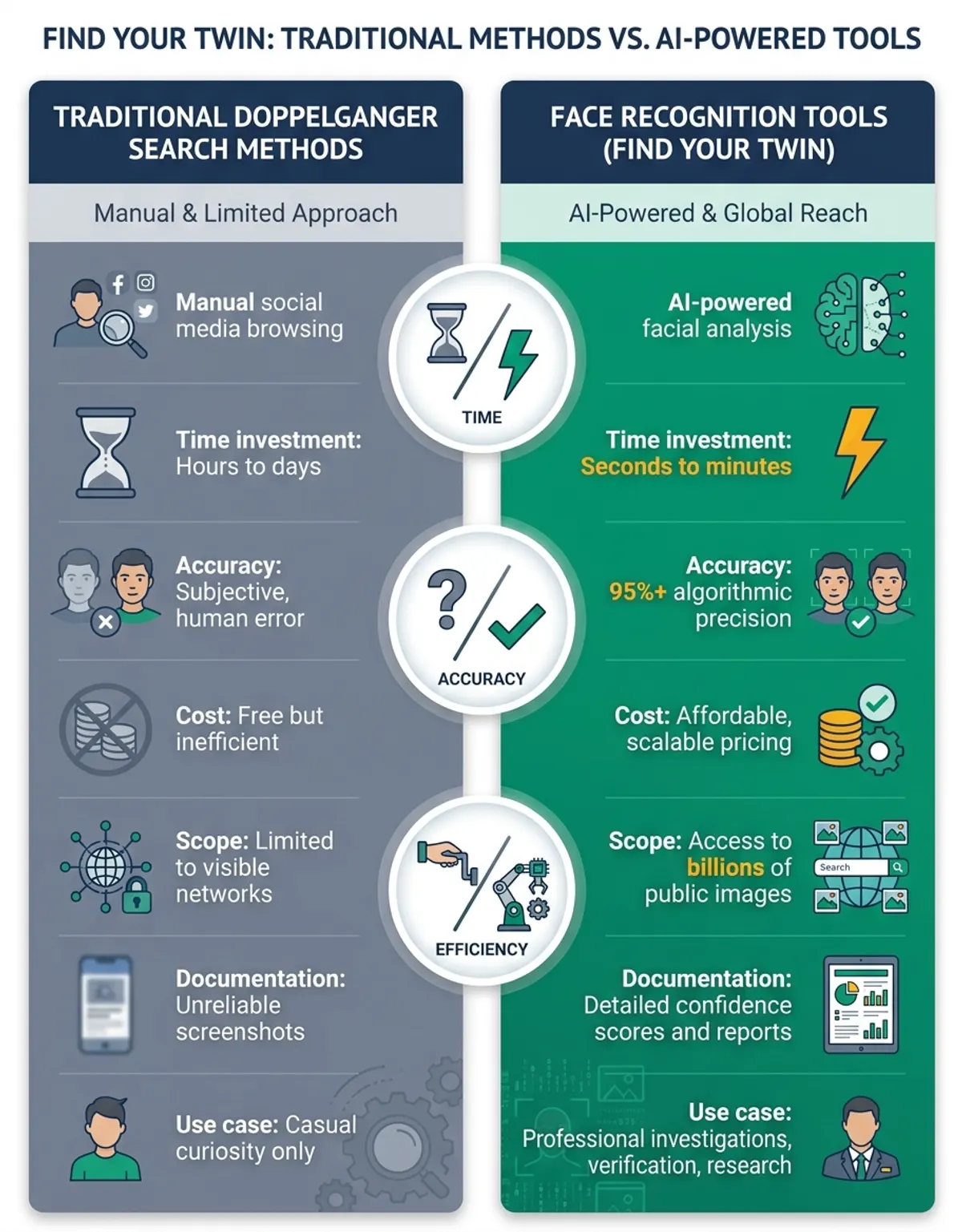
For those seeking a reliable and user-friendly solution, CaraComp offers a powerful face comparison platform that combines accuracy with ease of use. Whether you're verifying identities, organizing photo libraries, or searching for your twin stranger, CaraComp's advanced facial recognition technology delivers professional-grade results without the complexity. The platform processes images securely and provides instant, detailed comparison scores — making it an excellent choice for both casual users and professionals looking to discover their doppelganger.
| Platform Name | Database Size | Free/Paid | Accuracy Rate | Special Features | Best For |
|---|---|---|---|---|---|
| TwinFinder | 2+ million profiles | Freemium | ~80% | Dedicated twin matching, global community | Lookalike finder for everyday people |
| FaceDouble | 500,000+ profiles | Free | ~75% | 60+ landmark analysis | Face match scoring on 60+ landmarks |
| PimEyes | Billions of images | Paid | ~90% | Web-wide search, privacy alerts | Wide lookalike search across public web pages |
| Google Images | Entire indexed web | Free | ~65% | Reverse image search, broad reach | Improvised doppelganger finder via reverse image lookup |
| Lookalike.com | 1+ million profiles | Freemium | ~75% | Star and regular matching | Celebrity look-alike matching |
Using Photo Recognition to Find Your Twin
The success of your quest to find your twin heavily depends on proper photo selection and upload techniques. Face recognition algorithms require high-quality pictures that clearly show your features without obstructions or distortions. Understanding what makes a good image for twin finding ensures your profile receives accurate matches and maximizes your chances of discovering your doppelganger.
When preparing your photo for upload, choose a recent, well-lit picture that shows your appearance straight-on. The ideal selection has you looking directly at the camera with neutral expression, no sunglasses or hats, and minimal makeup or filters. Lighting should be even, avoiding harsh shadows that obscure features. Most platforms recommend a resolution of at least 800x600 pixels to ensure the algorithm can accurately detect and measure your landmarks.
Background also matters for optimal accuracy. Plain, solid-colored backgrounds work best because they prevent visual clutter that might interfere with boundary detection. While most modern algorithms can handle complex backgrounds, simpler settings improve processing speed and accuracy. Additionally, ensure your entire appearance is visible within the frame, from hairline to chin, allowing the system to capture your complete structure.
Privacy considerations should guide your selection process. Remember that uploaded images may be viewed by other users and processed by automated systems. Avoid including identifying information in backgrounds, such as street signs, house numbers, or workplace logos. Many successful twin finders use pictures specifically taken for this purpose rather than repurposing social media images that might contain sensitive location or personal data.
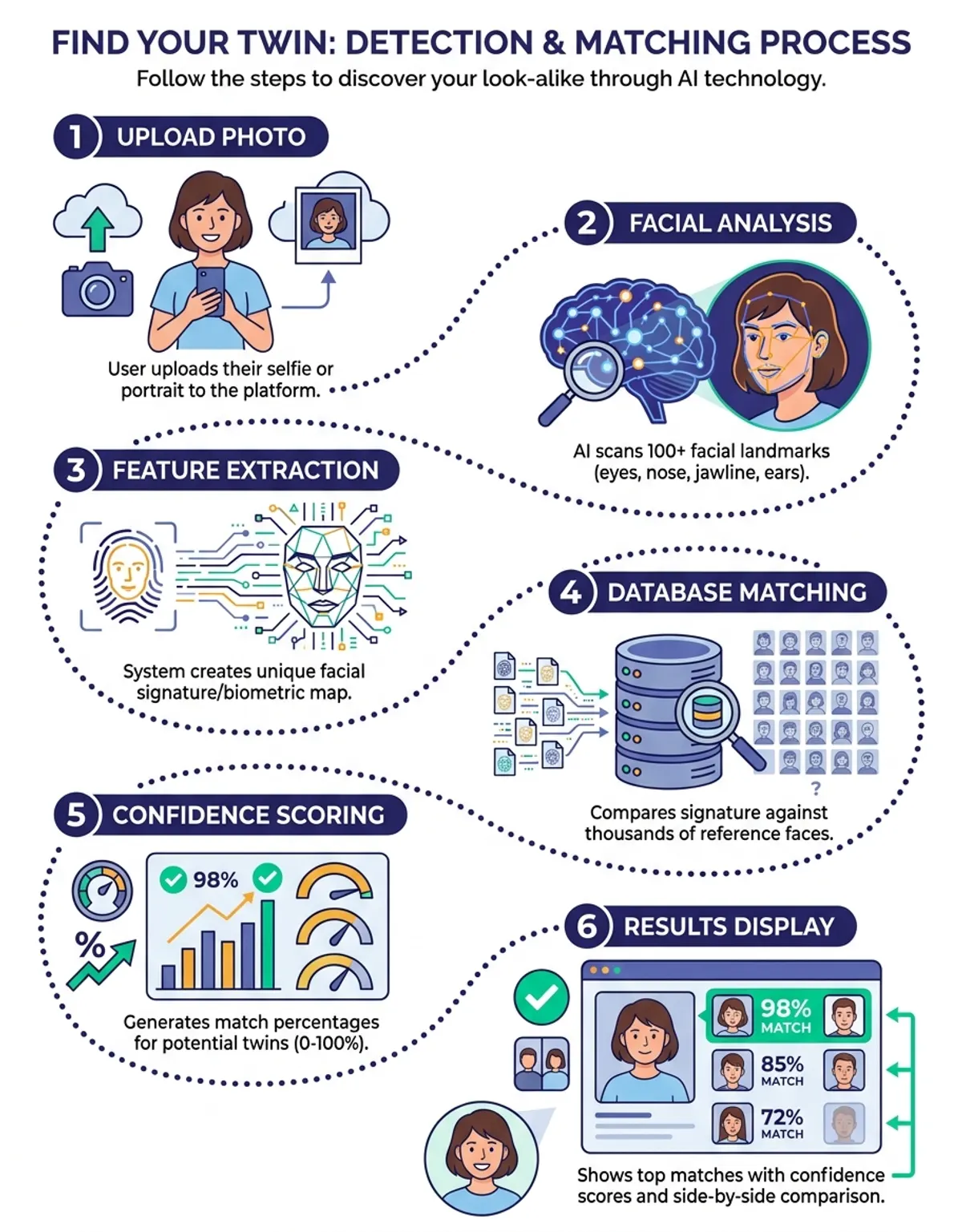
After uploading, most platforms provide analysis results within seconds to minutes, depending on database size. The system extracts features, creates a mathematical representation, and searches for similar patterns among stored profiles. Understanding this process helps you appreciate how technology enables finding your twin among millions worldwide.
Understanding Facial Recognition in Twin Finding
Modern facial recognition technology forms the backbone of all serious attempts to find your twin. These sophisticated algorithms analyze your uploaded image to create a unique signature — a mathematical model representing the spatial relationships between your features. This signature enables rapid comparison against millions of other appearances, identifying those that share similar geometric patterns.
The process begins with detection, where the algorithm identifies the presence and location within your image. Next, landmark detection identifies key points such as the corners of your eyes, tip of your nose, edges of your mouth, and jawline contours. Advanced systems detect anywhere from 68 to over 100 distinct landmarks, creating a comprehensive map of your geometry.
Once landmarks are identified, the algorithm measures distances and angles between these points. For example, it calculates the distance between your eyes relative to your nose width, or the angle of your cheekbones relative to your jawline. These measurements create a numerical representation — your signature — that can be mathematically compared to other signatures in the database. Appearances with similar numerical patterns are flagged as potential twin matches.
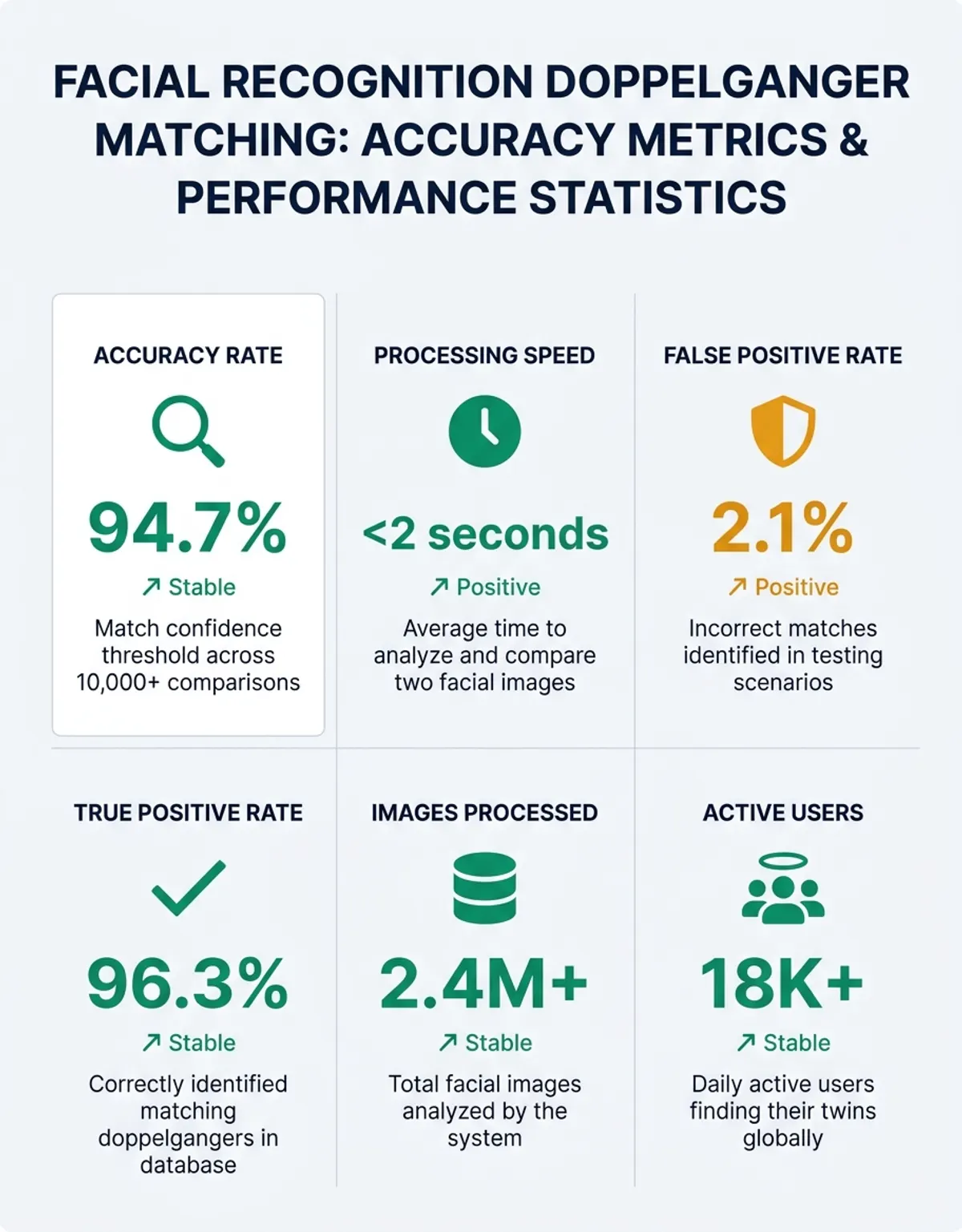
Understanding accuracy helps set realistic expectations when you attempt to find your twin. Current technology achieves high accuracy rates under ideal conditions, but performance degrades with poor lighting, unusual angles, or obstructions. This explains why platforms often request multiple images from different angles — combining data from several pictures improves the overall accuracy of the signature and increases the likelihood of finding true lookalikes. For more on this topic, see our guide on compare a face.
Review of Top Twin Finder Platforms
A comprehensive review of twin finder platforms reveals significant differences in user experience, match quality, and overall value. Understanding the strengths and limitations of each platform helps you choose the best options for your specific twin-finding goals. This section provides detailed insights based on user feedback, technical capabilities, and real-world success rates.
Twin platforms receive generally positive feedback for their dedicated focus on connecting lookalikes. Users appreciate the intuitive interfaces and the genuine community atmosphere where people actively engage in finding their doubles. However, some users note that freemium models limit access to certain features, requiring paid subscriptions for unlimited messaging with potential matches. The strength lies in large, engaged user bases specifically interested in twin finding rather than general social networking.
PimEyes generates mixed responses due to its powerful capabilities and privacy implications. Users praise its unmatched ability to search across the broader internet, often uncovering surprising lookalikes that wouldn't appear on dedicated platforms. The accuracy of its matching consistently scores high in user testing. However, privacy advocates raise concerns about the implications of such powerful search technology, and the paid subscription model makes it less accessible than free alternatives.
FaceDouble earns positive assessments for its straightforward, no-cost approach to twin finding. Users value the absence of paywalls and the platform's transparent methodology. The consensus suggests that while its database is smaller than competitors, the quality of matches remains reliable. Users report success in finding people who genuinely resemble them, though the process may require more patience given the smaller user pool.
Applications receive enthusiastic responses for entertainment value but mixed ratings for serious twin finding. Users enjoy the engaging experience of discovering resemblances, but most recognize these as recreational rather than practical for finding actual doppelgangers. The landscape suggests these platforms work best as introductions to technology rather than primary methods for genuine twin discovery. For more on this topic, see our guide on face matching app.
Explore Your Doppelganger Search Options
When you're ready to explore comprehensive doppelganger search options, understanding the various methodologies available expands your chances of success. Twin finding isn't limited to a single approach — combining multiple search methods and platforms creates a more thorough strategy that increases the probability of discovering your lookalike.
The database-driven approach involves registering on dedicated twin finder platforms. This method works best for people willing to create profiles and actively engage with the community. By uploading multiple images and completing detailed profiles, you enable the algorithm to better understand your features and provide more accurate matches. This approach requires patience as matches may appear gradually as new users join and existing profiles are updated.
Reverse image searching represents a more passive but potentially far-reaching approach. By uploading your picture to Google Images or specialized reverse image search engines, you cast a wider net across the internet. Reverse image search AI ranks results by visual similarity rather than confirmed identity, so manual review is still required. While this method produces many irrelevant results, it occasionally uncovers surprising lookalikes in news articles, social media posts, or other public web content. This approach works particularly well when combined with database-driven methods.
Social media campaigns offer a creative way to discover twins through crowdsourcing. Some people have successfully found their doubles by posting pictures on platforms like Facebook, Reddit, or Instagram with hashtags. The viral nature of social media means your search can reach millions of people rapidly, though success depends on your content gaining traction and reaching audiences beyond your immediate network.
Geographic considerations play an important role as you explore doppelganger search strategies. While your twin could be anywhere globally, some platforms allow filtering by region or country. This can be useful if you prefer meeting your twin in person or if you're curious about lookalikes within specific populations. However, restricting geography significantly reduces your pool of potential matches, so most experts recommend starting with global searches before narrowing by location.
When you investigate various twin finding options, remember that success often requires time and persistence. The probability of finding a close match increases with the number of platforms you use, the quality of your images, and the size of searchable databases. Many people who successfully discover their twins report trying multiple platforms over several months before finding their best matches. Approaching the search as an ongoing process rather than a one-time effort yields better results. For more on this topic, see our guide on family search compare a face.
Frequently Asked Questions
How do I find my unrelated identical twin?
To find your unrelated identical twin, start by creating accounts on dedicated twin finder platforms like FaceDouble or similar services. Upload high-quality, front-facing images with good lighting and neutral expressions. These platforms use recognition algorithms to compare your features against their databases. Additionally, try reverse image searching on Google Images to cast a wider net across the internet. Combining multiple platforms and methods increases your chances of discovering someone who shares your appearance despite no genetic connection.
Are there millions of profiles to search through?
Yes, major twin finder platforms and search engines provide access to millions of profiles and images. Leading platforms host over 2 million registered users, while PimEyes searches billions of pictures across the public internet. Google's reverse image search covers the entire indexed web, potentially exposing your search to countless appearances. No single service holds our global faces database in one place — each platform only searches the images it has indexed or that users have uploaded. However, more profiles doesn't always guarantee better matches — the quality of recognition algorithms and the diversity of the database matter just as much as sheer size when trying to find your twin.
How does the picture upload process work?
The upload process begins by selecting a clear, recent image from your device. Most platforms guide you through quality requirements: frontal view, good lighting, neutral expression, and minimal obstructions. After selecting your picture, click the upload button and the platform processes it through detection and landmark identification. Many services now use a one-click compare-and-match flow: upload, confirm, then view scored results. The system extracts your features, creates a mathematical signature, and stores it so the platform can match your photo against other profiles. The entire process typically takes seconds, after which you can browse potential matches or wait for the algorithm to suggest lookalikes.
Can face recognition software compare your image accurately?
Yes, modern software can compare your picture with high accuracy — typically achieving 75-95% success rates depending on quality and algorithm sophistication. The technology has gotten surprisingly good in recent years. These systems analyze dozens to hundreds of landmarks, measuring precise distances and angles between features. However, accuracy depends on several factors: quality, lighting conditions, expression, and whether you're wearing accessories like glasses or hats. For best results when trying to find your twin, use recent, high-resolution images taken in good lighting with your appearance clearly visible and positioned directly toward the camera.
What is the fastest way to get your doppelganger result?
The fastest way to get your doppelganger result is using instant search platforms like PimEyes or Google reverse image search, which provide results within seconds by searching pre-indexed databases. For more targeted twin finding, dedicated platforms offer results within minutes after profile creation. To maximize speed, ensure your uploaded image meets quality requirements so the system doesn't need manual processing. Using multiple platforms simultaneously also accelerates the process — while one platform processes your picture, others are already searching their databases, giving you faster access to potential matches.
Is there an instant search feature for finding twins?
Yes, several platforms offer instant search features that provide immediate results. Google reverse image search returns visually similar pictures within seconds, though these results require filtering for genuine matches. PimEyes provides near-instant searches across billions of web images. However, dedicated twin platforms typically take a few minutes to process your profile and generate initial matches, with ongoing match suggestions appearing as new users join. For truly instant results, reverse image search methods provide the fastest option, though they may require more effort to identify meaningful lookalikes among generic similar images.
How do twin finder apps work?
Twin finder apps work by analyzing the geometry of your appearance using artificial intelligence and recognition technology. When you upload an image, the app detects your features and identifies dozens of landmark points — eyes, nose, mouth, jawline, and more. It then measures the distances and angles between these points, creating a unique numerical representation of your structure. This signature is compared against signatures of other users in the app's database. When the app finds appearances with similar mathematical patterns, it suggests them as potential twin matches. The more sophisticated the algorithm and larger the database, the better your chances of finding accurate lookalikes.
Conclusion
The journey to find your twin combines cutting-edge technology, statistical probability, and the human fascination with discovering our doppelgangers. With millions of people registered on twin finder platforms and billions of images searchable through recognition systems, the odds of discovering someone who remarkably resembles you have never been better. Whether you investigate dedicated platforms, use comparison applications for entertainment, or conduct comprehensive web searches, each method offers unique advantages in your quest.
Success in finding your twin requires patience, quality images, and strategic use of multiple platforms. Remember that the individuals you discover may not be perfect identical matches, but the journey of investigating similarities across global populations offers fascinating insights into human genetics and the remarkable diversity within our shared characteristics. By understanding how recognition and analysis work, you can optimize your search and increase your likelihood of finding that special someone who shares your appearance.