
Face Matching App: Advanced Recognition and Reverse Image Search Technology
Modern face matching app technology has revolutionized how we identify people in photos, conduct reverse image searches, and protect our online presence. These powerful recognition tools combine facial detection algorithms with sophisticated data analysis to deliver accurate results across billions of images.
Here's the thing: whether you're building software, managing security systems, or just trying to find where your photos ended up online, face matching technology has become an essential tool. The accuracy has gotten impressively good in recent years—we're talking 99%+ match rates with the right apps—and the privacy protections are finally catching up too.
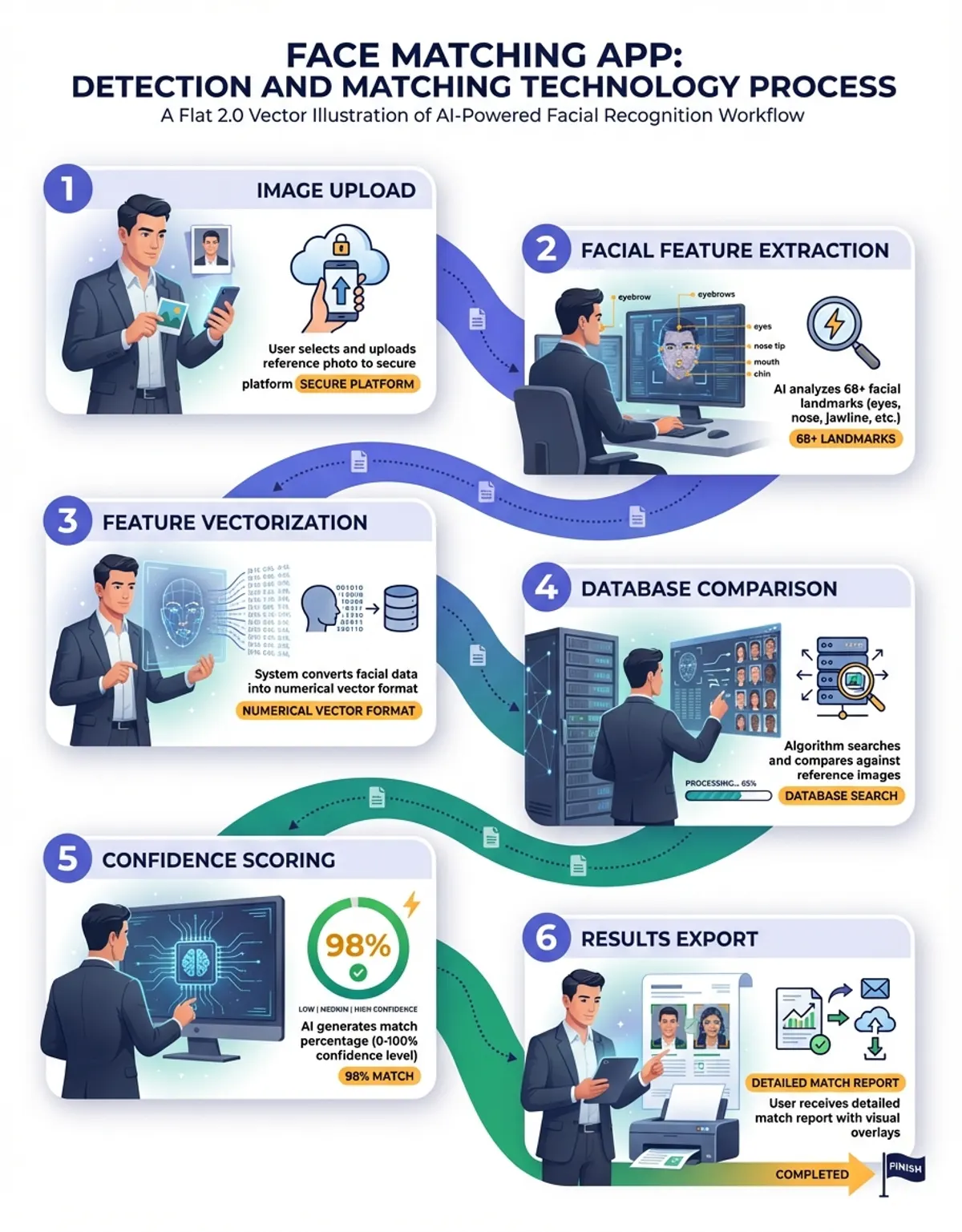
A face matching app uses advanced facial recognition algorithms to analyze and compare human faces in photos. The technology measures distinctive features such as the distance between eyes, nose shape, and jawline structure to create a unique facial signature. This data becomes the foundation for accurate detection and matching across different images.
How Facial Recognition Algorithms Work
The recognition process involves multiple sophisticated steps that power every modern face matching app:
- Face detection using machine learning models trained on millions of photos
- Feature extraction converting facial landmarks into mathematical representations
- Comparison of data points against reference images for precise matching with confidence scoring
Accuracy and Reliability
Modern facial recognition technology can analyze photos even when faces appear at different angles, under varying lighting conditions, or with partial obstructions. The best face matching apps achieve accuracy rates exceeding 99% when comparing high-quality images—honestly, the technology is better at recognizing faces than most people are. This makes them invaluable tools for identification, verification, and reverse image search applications across secure platforms.
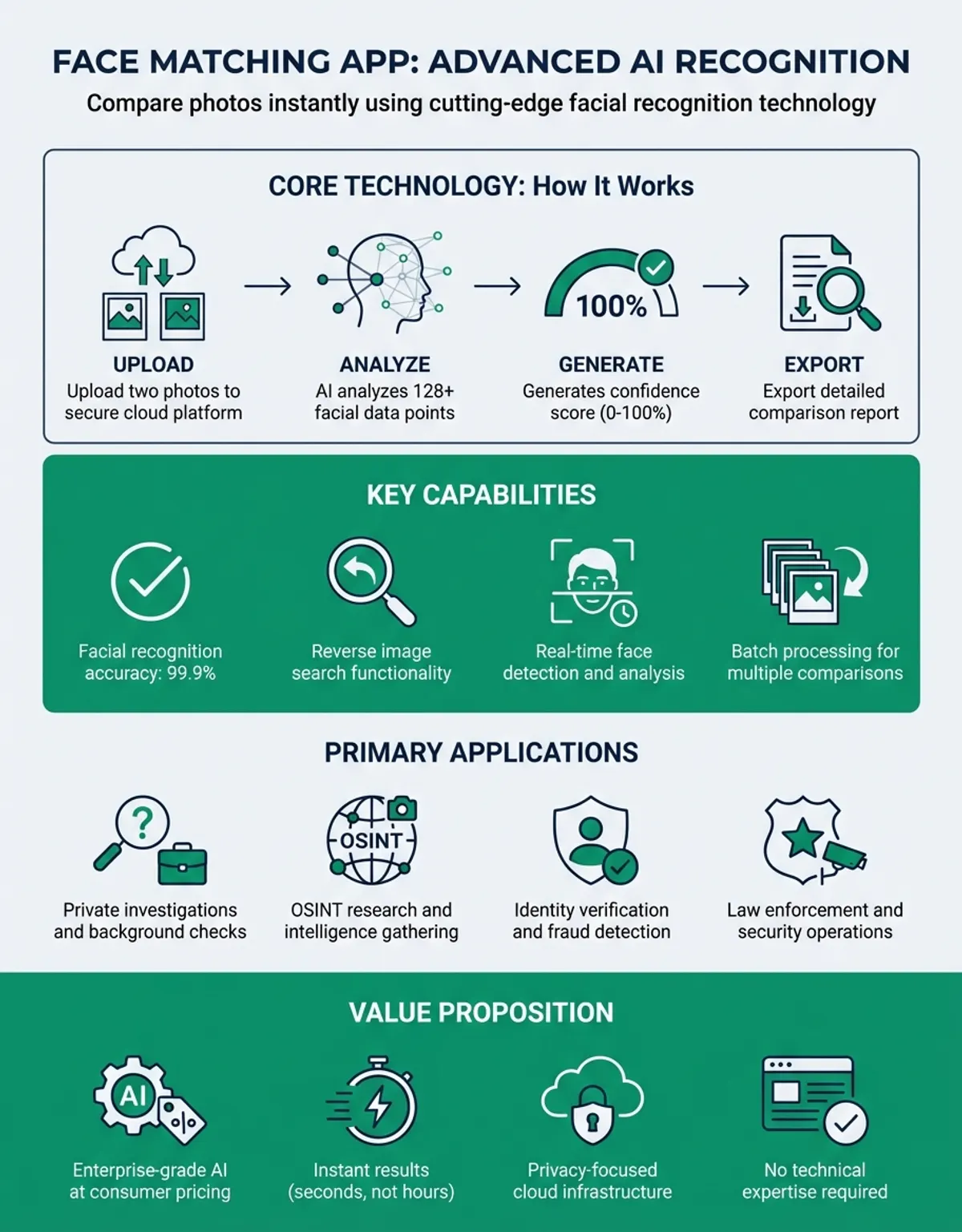
When you upload photos to a face matching app, the recognition engine immediately begins processing the image data. The system performs facial detection to locate all faces present in the photo, then isolates each face for individual analysis.
Facial Landmark Mapping
The data extraction phase maps specific facial landmarks—typically 68 to 128 distinct points across the face. These measurements create a unique biometric template that serves as the person's digital fingerprint. The app stores this data in an encrypted format to protect privacy while enabling rapid comparison against other images.
Machine Learning and Continuous Improvement
Advanced face matching technology employs neural networks that continuously improve their recognition capabilities. As the system analyzes more photos, it refines its understanding of how facial features vary across different demographics, ages, and expressions. The entire analysis typically completes in milliseconds, allowing users to conduct reverse image searches across vast databases instantly.
Modern apps can process photos from:
- Your mobile device, computer storage, or external drives
- Social media platforms and cloud storage services
- Online sources and web URLs for reverse search and camera uploads for real-time detection
For developer teams building face matching capabilities into their own app, several powerful API options provide robust recognition and detection features. These APIs handle the complex facial analysis and data processing behind the scenes, allowing developers to focus on creating exceptional user experiences without needing deep expertise in facial recognition algorithms.
Key API Features for Developers
Leading face recognition APIs offer comprehensive documentation and SDK support across multiple programming languages including Python, JavaScript, Java, and Ruby. Developer-friendly features include:
- Batch processing for analyzing multiple photos simultaneously
- Webhook notifications for async operations
- Detailed confidence scores in the results data
- RESTful endpoints that integrate seamlessly with existing applications
When selecting a face matching API, developers should evaluate processing speed (best APIs return results in under one second), accuracy rates (should exceed 98%), scalability for growing user bases, and pricing models that align with projected usage. Security and privacy protections are paramount—reputable API providers encrypt all image data in transit and at rest, offer GDPR and CCPA compliance, and allow users to delete their biometric data on request.
Modern face matching apps go beyond simple recognition to offer comprehensive facial analysis and detection capabilities. These advanced features extract valuable data about age, gender, emotions, and facial accessories using sophisticated algorithms.
Real-Time Detection Capabilities
Real-time detection allows apps to identify faces in live video streams, not just static photos. This capability enables applications like:
- Access control systems and security surveillance with encrypted data
- Attendance tracking and visitor management systems
- Interactive photo experiences and augmented reality filters
- Contactless verification for secure applications
Multi-Face Detection in Group Photos
Multi-face detection simultaneously identifies and analyzes all people appearing in group photos. The app assigns unique identifiers to each detected face, enabling individual tracking and recognition across multiple images. This feature proves especially valuable for organizing large photo collections and conducting comprehensive reverse image searches.
Image Quality Assessment
Quality assessment algorithms evaluate photo conditions before processing, flagging images with insufficient lighting, extreme blur, or inadequate resolution. This preliminary analysis helps users understand when photos may produce suboptimal results and guides them toward capturing better images for matching.
Reverse image search technology has become a cornerstone feature in comprehensive face matching apps. Users can upload a photo to discover where that image—or similar photos of the same person—appears across the internet. This powerful capability helps people protect their online identity, find unauthorized use of their photos, and locate lost images.
How Reverse Search Engines Work
The reverse image search process leverages massive databases containing billions of indexed photos from websites, social media platforms, and public sources. When you submit an image, the app's recognition engine compares the facial data against this extensive collection, returning results that show matching or similar photos along with their source URLs.
Advanced Matching Capabilities
Advanced reverse image search goes beyond exact matches to find photos where the same person appears with:
- Different expressions, angles, or lighting conditions
- Years of age difference or appearance changes
- Accessories like glasses, hats, or different hairstyles
- Varied image quality or resolution levels
Protecting Your Digital Identity
Privacy-conscious users employ reverse image search to monitor their online presence. By periodically searching their own photos, they can discover unauthorized uses and take action to protect their image rights. This proactive approach helps individuals maintain control over their digital identity using face matching app technology.
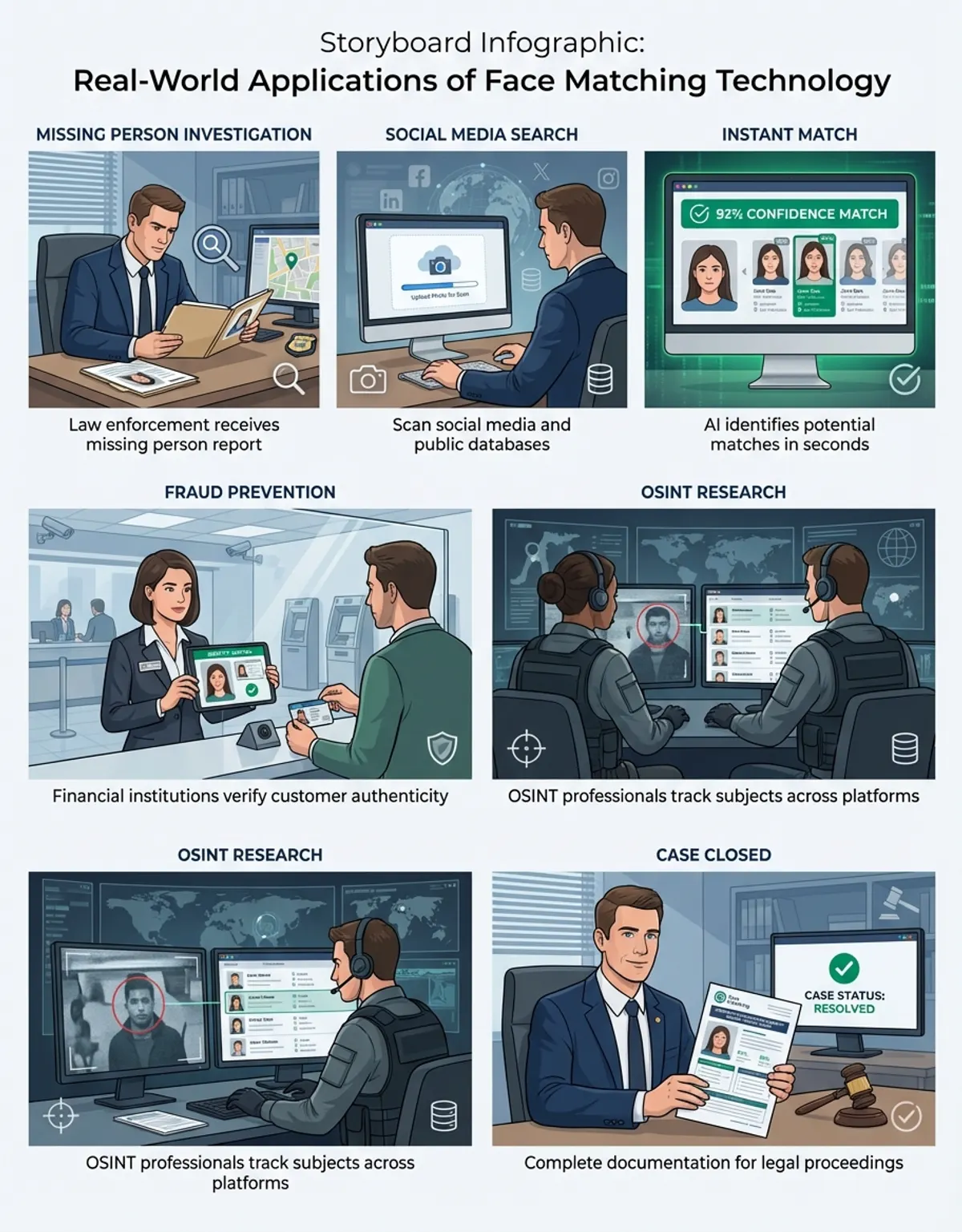
Understanding the data and results provided by face matching apps empowers users to make informed decisions. Recognition systems typically return a confidence score—expressed as a percentage—indicating the likelihood that two faces belong to the same person. Scores above 95% generally indicate highly reliable matches, while lower scores suggest possible but uncertain matches.
Interpreting Confidence Scores
The app displays comprehensive analysis data including:
- Specific facial features that contributed to the match determination
- Correlation strength for elements like eye spacing, nose structure, or facial outline
- Visualization tools highlighting the facial landmarks used in analysis
- Aggregate data patterns across large photo collections
Transparency and Result Visualization
These visual overlays demonstrate exactly what the recognition algorithm detected and measured, making the technology's operation transparent and helping users understand why certain matches were identified. Advanced apps provide organized results chronologically, by location, or by source website for easier reverse image search analysis.
The market offers both free and premium face matching app options, each with distinct capabilities and limitations. Free apps typically restrict the number of photos users can analyze daily, limit access to advanced features like reverse image search, or display advertisements.
Premium Features and Capabilities
Premium face matching apps provide enhanced recognition accuracy through access to larger databases and more sophisticated algorithms. Paid subscriptions usually include:
- Unlimited photo uploads and batch processing
- Priority processing for faster results
- API access for developer integrations
- Enhanced privacy protections and data deletion guarantees
Pricing Models and Selection Criteria
Pricing models vary significantly across providers. Some apps charge per image analyzed, making them cost-effective for occasional use. Others offer monthly or annual subscriptions with unlimited searches. When evaluating free versus premium options, consider your specific use case—individuals protecting personal photos online might find free tools sufficient, while businesses requiring consistent, high-volume face detection and analysis benefit from enterprise-grade solutions.
Privacy concerns rightfully occupy a central position in discussions about face matching apps and facial recognition technology. Users entrust these apps with sensitive biometric data that uniquely identifies them, making robust security measures and transparent privacy policies essential.
Leading face matching apps implement comprehensive protections:
- Encryption of all photo uploads during transmission and storage
- Local on-device processing when possible (photos never leave your phone)
- Clear data retention policies with immediate deletion options
- GDPR and CCPA regulatory compliance for data protection
- Explicit consent requirements before collecting facial data
Data retention policies vary significantly across apps, making it critical to review terms before use. The most privacy-focused solutions delete uploaded photos and extracted facial data immediately after processing completes. Others may retain information to improve their recognition algorithms or to enable reverse image search history features.
Users can take additional steps to protect their privacy: only upload photos to apps from reputable developers with clear privacy policies, avoid apps that require excessive permissions, and verify that your chosen face matching app maintains compliance standards that protect your privacy rights. For more on this topic, see our guide on find your twin.
Selecting the ideal face matching app requires evaluating your specific requirements against available solutions. Different use cases demand different feature sets—a security professional needs different capabilities than someone organizing personal photos or conducting occasional reverse image searches.
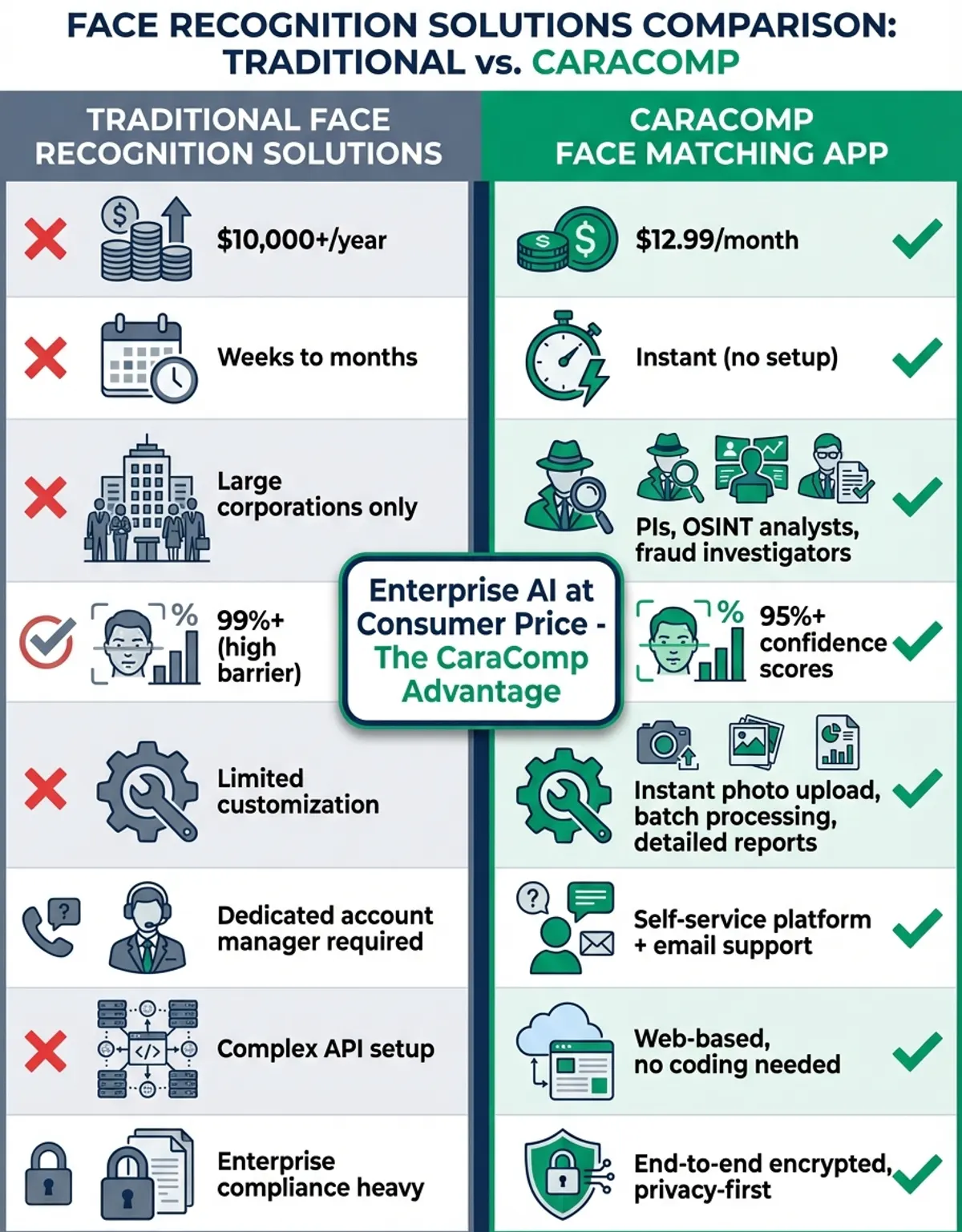
For those seeking a powerful yet user-friendly solution, CaraComp offers advanced face comparison technology that delivers professional-grade accuracy without the complexity. Whether you're verifying identities, comparing facial similarities, or analyzing photos for security purposes, CaraComp's platform combines cutting-edge recognition algorithms with an intuitive interface. The system processes images securely and provides detailed similarity scores with visual overlays—making it an excellent choice for both individuals and organizations that need reliable face matching capabilities without extensive technical expertise.
For security and verification applications, prioritize apps with proven accuracy rates above 98%, robust data encryption, and compliance certifications. These professional-grade solutions often include real-time detection, audit trails, and API integrations for enterprise systems. While premium pricing reflects advanced capabilities, the investment ensures reliable facial recognition for critical applications where accuracy cannot be compromised.
Individuals focused on privacy protection should seek apps that process photos locally on-device, avoiding cloud transmission of biometric data. These solutions typically offer lower recognition accuracy but provide superior privacy guarantees. Open-source options allow technical users to audit code and verify that no data collection occurs beyond stated policies, ensuring complete transparency in how their facial information is handled.
Developers building custom applications benefit from API-first platforms offering:
- Comprehensive SDK support for popular programming languages and frameworks
- Detailed result data including confidence scores and facial landmarks
- Batch processing capabilities for high-volume operations
- Flexible pricing models scaling with usage demands
Personal users organizing photo collections can leverage consumer-friendly apps that automatically group images by detected faces, create searchable albums, and suggest tags. These solutions balance recognition accuracy with ease of use, often providing free tiers for basic functionality before requiring premium subscriptions for unlimited photo analysis. The best consumer apps integrate seamlessly with existing photo libraries and cloud storage services.
| App Category | Best For | Key Features | Recognition Accuracy | Privacy Level | Developer API |
|---|---|---|---|---|---|
| Reverse Image Search Apps | Finding photos online | Reverse search, large database, source tracking | 85-95% | Medium | Limited |
| Professional Face Recognition | Security and verification | High accuracy, real-time detection, data encryption | 98-99.5% | High | Full API access |
| Photo Organization Apps | Personal photo management | Face grouping, automatic tagging, local processing | 90-95% | Very High | No |
| Social Media Platforms | Casual tagging and sharing | Friend suggestions, auto-tagging, photo memories | 88-93% | Low | Platform-specific |
| Developer-Focused APIs | Custom app development | Flexible integration, batch processing, detailed analysis | 95-99% | Configurable | Comprehensive |
| Privacy-First Solutions | Security-conscious users | On-device processing, zero data retention, open source | 87-94% | Very High | Open source |
Frequently Asked Questions
How accurate are face matching apps at identifying people in photos?
Modern face matching apps achieve impressive accuracy rates from 95% to 99.5% when analyzing high-quality photos under good lighting conditions. Premium recognition systems that leverage large training datasets and advanced neural networks deliver the highest accuracy. The catch? Results can vary significantly based on image quality, facial angle, lighting, and appearance changes. Apps designed for security applications generally prioritize accuracy over speed. For critical applications requiring verified identity confirmation, use apps with documented accuracy rates above 98%.
Can face matching apps conduct reverse image searches to find photos online?
Yes, many face matching apps include powerful reverse image search capabilities that scan billions of online photos to find matches. When you upload a photo, the app's recognition engine compares the facial data against images indexed from websites, social media platforms, and public databases. The search results show where matching or similar photos appear online, often with direct links to source pages. This feature helps users monitor their online presence, discover unauthorized use of their photos, and locate images across different platforms.
What data do face matching apps collect and how is it protected?
Face matching apps collect facial biometric data by analyzing distinctive features in photos—including measurements between facial landmarks like eyes, nose, and mouth. This data gets converted into mathematical representations called facial templates. Reputable apps encrypt this sensitive information both during transmission and storage. Privacy-focused apps process recognition locally on your device when possible, ensuring photos never leave your phone. Data retention policies vary: some apps delete all information immediately after analysis, while others retain data to enable features like search history. Review privacy policies carefully and choose apps that align with your comfort level.
Are there free face matching apps or do they all require payment?
Both free and premium face matching apps exist, each with different capabilities and limitations. Free apps typically restrict daily photo uploads, limit access to advanced features like comprehensive reverse image search, or display advertisements. They work well for occasional personal use. Premium apps remove these restrictions and offer enhanced recognition accuracy, unlimited searches, faster processing, API access for developers, and better privacy protections. Pricing models include pay-per-image, monthly subscriptions, and enterprise packages. Individuals conducting occasional searches might find free tools sufficient, while businesses requiring consistent, high-volume facial recognition benefit from premium solutions.
Can developers integrate face matching capabilities into their own applications?
Absolutely—numerous face recognition APIs enable developers to embed sophisticated facial detection and matching capabilities into their own apps without building recognition technology from scratch. Leading APIs provide RESTful endpoints, comprehensive SDK support across popular programming languages, detailed documentation, and features like batch processing, real-time detection, and confidence scoring in results. Developers can choose APIs based on specific needs: some excel at speed, others at accuracy. Most APIs charge based on usage volume, with pricing tiers ranging from free trials for small projects to enterprise packages for high-volume applications. Evaluate processing speed, accuracy rates, privacy compliance, documentation quality, and support responsiveness.
How do face matching apps handle privacy concerns with facial recognition?
Privacy protection in face matching apps varies dramatically across providers, making careful evaluation essential. The most privacy-conscious apps process facial recognition entirely on your device, meaning your photos and biometric data never get transmitted to external servers. Cloud-based apps should employ end-to-end encryption, maintain transparent data retention policies, and comply with regulations like GDPR and CCPA. Look for apps that offer explicit data deletion options, minimize information collection, and provide clear privacy policies. Avoid apps requiring excessive permissions, those with vague data practices, or free services that monetize through selling user data. Choose established providers with strong privacy track records.
Related Pages: