
Facial Recognition Time Clock
Revolutionize your workforce management with cutting-edge biometric authentication that eliminates time theft and transforms attendance tracking.
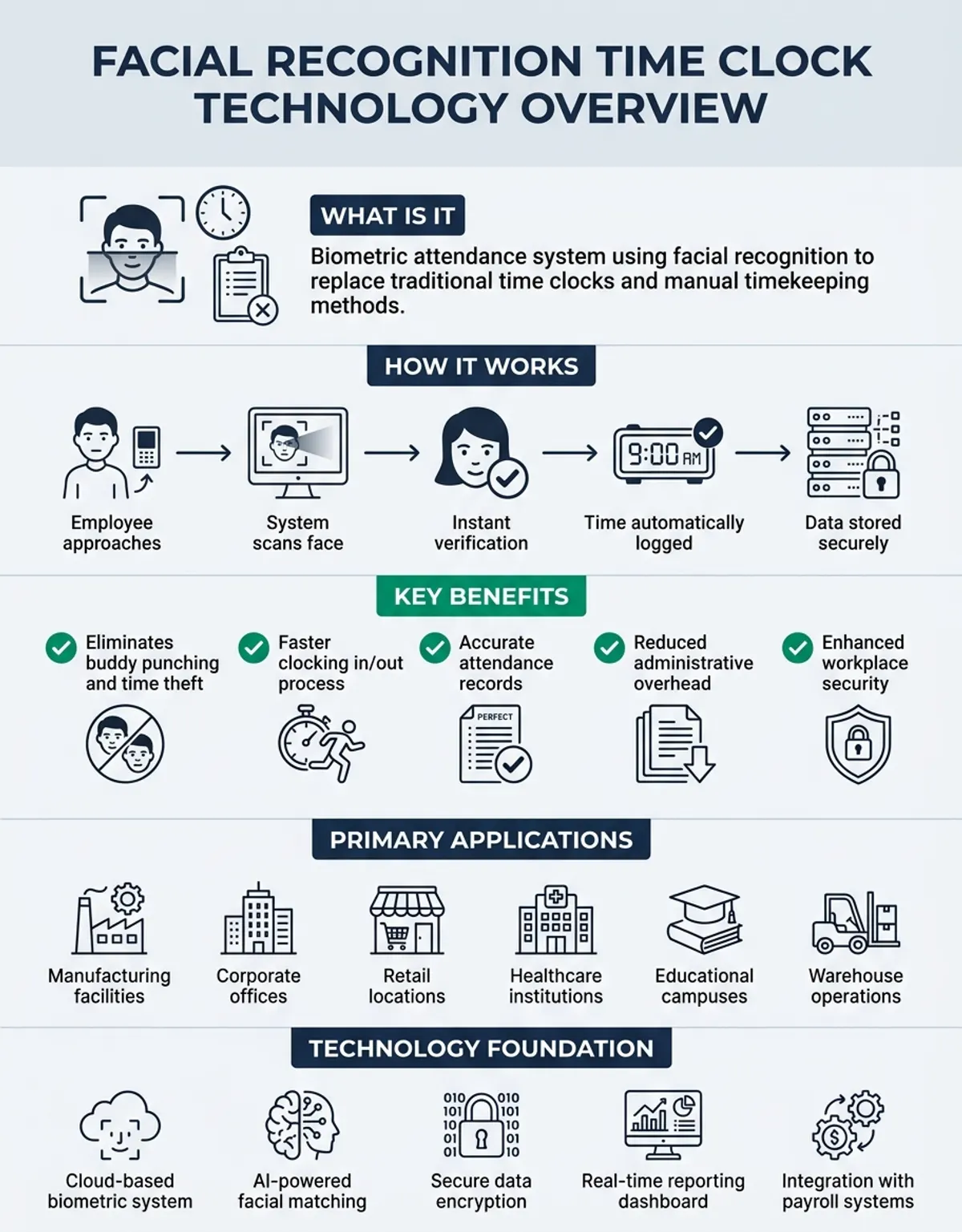
Modern workplaces are embracing facial recognition time clock technology to streamline workforce management and eliminate traditional timekeeping challenges. This advanced biometric solution leverages face recognition software to accurately track employee hours, attendance, and shift schedules without requiring physical contact or manual input. Here's the thing - these systems have gotten remarkably accurate and affordable in recent years. By capturing and analyzing facial features, these systems provide businesses with a reliable payclock alternative that reduces buddy punching, improves payroll accuracy, and simplifies the clocking process for employees across all industries.
The evolution from conventional fingerprint and card-based systems to facial recognition technology represents a significant leap forward in workforce tracking capabilities. Organizations implementing these recognition time clocks benefit from faster processing speeds, enhanced security protocols, and seamless integration with existing attendance management software. Whether managing a small team or coordinating multiple shift workers across different locations, facial clocking systems deliver the precision and efficiency that modern businesses demand.
Understanding Payclock Systems in Facial Recognition Time Clock
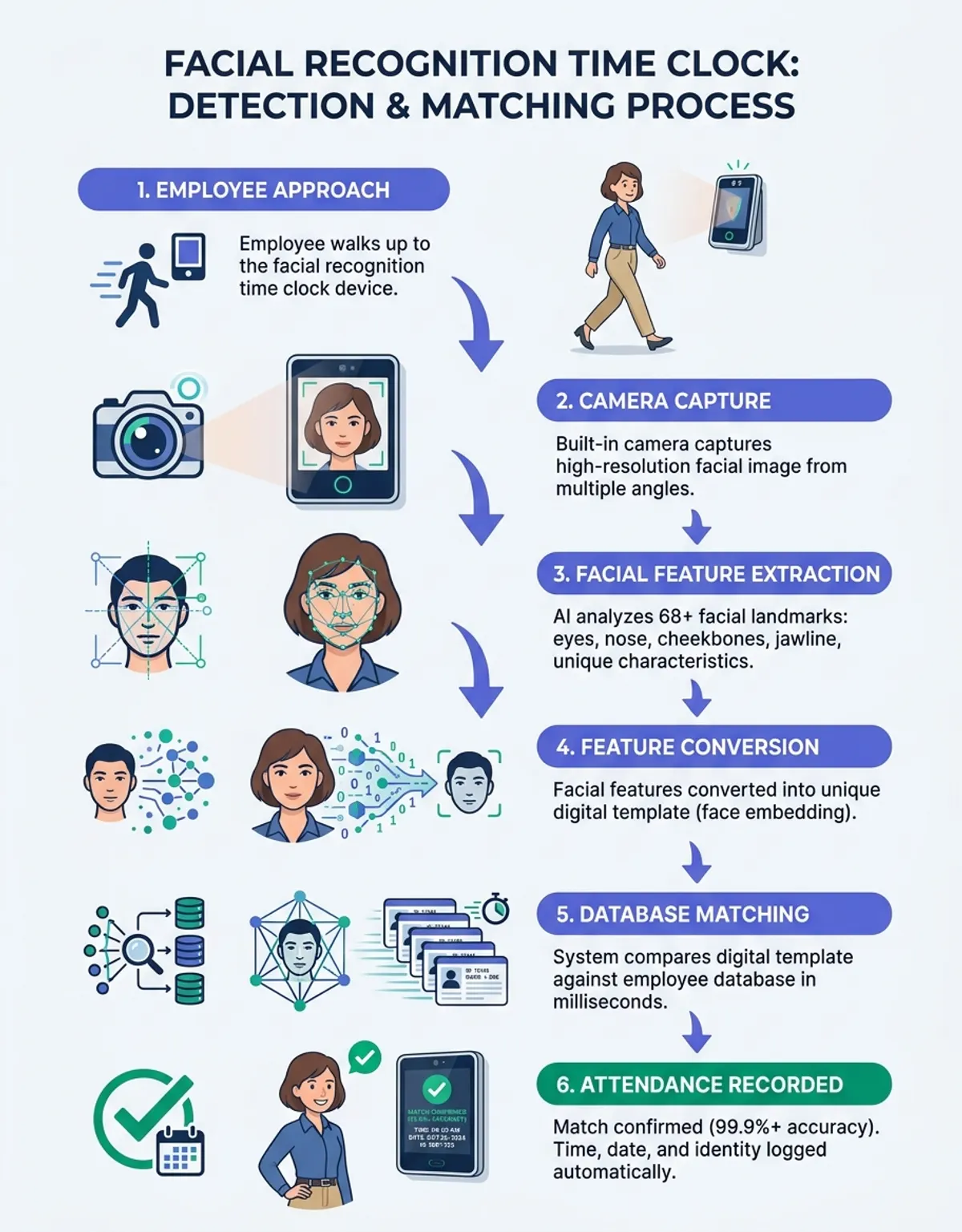
A payclock forms the foundational component of any facial recognition time clock deployment, serving as the central hub where employee time data is collected, processed, and stored. Unlike traditional mechanical time clocks that require physical cards or badges, modern clock terminal systems equipped with facial recognition technology capture biometric data in milliseconds, creating an auditable record of when each employee begins and ends their work period. This digital transformation eliminates the manual processes that historically consumed HR resources and created opportunities for timekeeping fraud.
The integration of facial recognition capabilities into biometric system infrastructure allows organizations to maintain accurate records of employee attendance while simultaneously reducing administrative overhead. These systems automatically calculate worked hours, apply overtime rules, and generate reports that seamlessly transfer to payroll processing platforms. By eliminating the need for employees to remember PIN codes or carry access cards, facial recognition time clock solutions streamline the entire timekeeping workflow from clock-in through final payroll approval.
Advanced timekeeping system platforms now incorporate cloud-based storage and real-time synchronization, ensuring that time and attendance data remains accessible to authorized managers regardless of their location. This connectivity enables immediate oversight of workforce patterns, facilitates rapid response to scheduling conflicts, and provides the data foundation necessary for informed labor management decisions. The reliability of facial recognition ensures that each clock event is definitively linked to a specific individual, creating an irrefutable record that protects both employer and employee interests.
Understanding Hours Tracking in Facial Recognition Time Clock
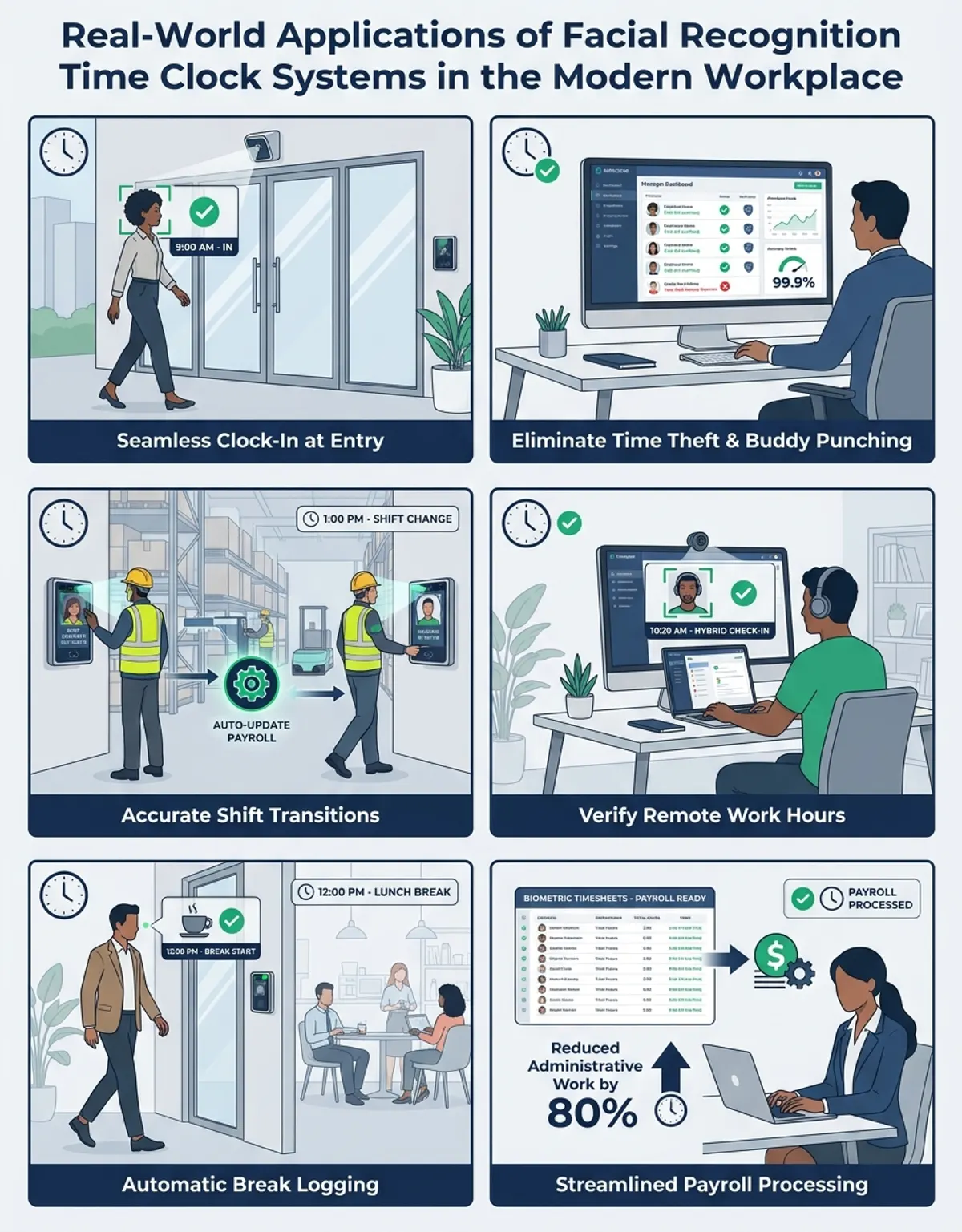
Accurate hours capture represents the primary value proposition of any facial recognition time clock system, as even minor discrepancies in recorded work time can create significant payroll expenses and compliance risks. These biometric systems capture precise timestamps for each clock-in and clock-out event, automatically calculating total hours worked while accounting for breaks, meal periods, and shift differentials. The elimination of manual timecard calculations reduces payroll processing time by up to 80% while ensuring that employees receive compensation for every minute worked.
The automated nature of facial recognition hours recording prevents common timekeeping errors such as forgotten punches, illegible handwriting, or misaligned timecard stamps. When an employee approaches the time clock terminal, the system instantly recognizes their facial features and records the transaction with GPS coordinates and photographic verification. The captured data creates an auditable trail that satisfies labor law requirements and provides definitive evidence during wage disputes or compliance audits.
Modern facial recognition platforms offer sophisticated timestamps reporting capabilities that allow managers to analyze workforce utilization patterns, identify overtime trends, and optimize work session coverage. Real-time dashboards display current clock status for all employees, enabling supervisors to quickly identify attendance issues or staffing shortages. The ability to track duration across multiple locations from a centralized interface proves particularly valuable for organizations managing distributed workforces or operating around-the-clock production schedules.
Integration with payroll and human resources information systems ensures that recorded work periods flow seamlessly into compensation calculations without manual data entry. This connectivity eliminates transcription errors while accelerating payroll cycles and reducing the administrative burden on accounting personnel. The precision of facial recognition time monitoring translates directly into cost savings through improved labor allocation and reduced payroll discrepancies.
Understanding Attendance Management in Facial Recognition Time Clock
Attendance management extends beyond simple time documentation to encompass the broader patterns of employee presence, absence, and punctuality that directly impact organizational productivity. Facial recognition time clock systems provide comprehensive attendance monitoring by automatically flagging late arrivals, early departures, and unauthorized absences without requiring manual oversight. These automated alerts enable managers to address attendance issues proactively rather than discovering problems during post-pay period reviews.
The detailed participation records generated by facial recognition systems facilitate accurate management of paid time off, sick leave accruals, and vacation balances. When employees use the time clock terminal, the software automatically applies relevant time records policies, calculates benefit accruals, and updates leave balances in real-time. This automation ensures that both employees and managers maintain accurate visibility into available time off while preventing unauthorized use of leave benefits.
Advanced workforce presence reporting capabilities transform raw clock data into actionable workforce intelligence. Organizations can identify chronic absenteeism patterns, analyze the impact of presence on departmental performance, and recognize employees who maintain exemplary participation records. These insights support data-driven decisions regarding staffing levels, scheduled time scheduling, and employee development initiatives.
The integration of facial recognition time records capture with workforce management platforms enables predictive analytics that help organizations anticipate staffing needs and prevent coverage gaps. By analyzing historical workforce presence patterns alongside business metrics, these systems can recommend optimal work period schedules that balance operational requirements with employee preferences. The comprehensive presence data captured through facial clocking creates a foundation for continuous improvement in workforce planning and resource allocation.
Compliance with labor regulations requires meticulous participation documentation, particularly in industries subject to mandatory rest periods, maximum consecutive work days, or specific break requirements. Facial recognition systems automatically monitor these regulatory parameters and generate alerts when employees approach or exceed statutory limits. This proactive compliance monitoring reduces exposure to labor violations and creates auditable records that demonstrate organizational commitment to workplace regulations.
The elimination of buddy punching and time theft through facial recognition technology significantly improves overall time records accuracy. When employees cannot clock in on behalf of absent colleagues, workforce presence records reflect actual workforce presence rather than fraudulent entries. This authenticity enhances the reliability of presence data used for operational planning, performance evaluation, and labor cost forecasting.
Multi-site organizations benefit particularly from centralized participation management enabled by cloud-connected facial recognition systems. Executives can monitor time records trends across all locations simultaneously, identifying regional patterns or location-specific issues that require intervention. This enterprise-wide visibility supports consistent application of workforce presence policies regardless of geographic dispersion.
The real-time nature of facial recognition presence recording enables immediate corrective action when employees fail to clock in or out as required. Automated notifications to both workers and supervisors ensure that missing punches are addressed before they impact payroll accuracy. This immediate feedback loop reduces the administrative burden of punch corrections while maintaining the integrity of time and participation records.
Understanding duty period Management in Facial Recognition Time Clock
Effective work session management requires precise coordination of employee schedules, coverage requirements, and individual availability across varying operational demands. Facial recognition time clock systems enhance scheduled time management by automatically verifying that workforce clock in during their assigned work session windows while flagging early arrivals or late starts. This automated duty period verification eliminates the need for manual schedule comparisons and ensures that labor costs align with planned staffing levels.
The integration of work session scheduling software with facial recognition terminals creates a closed-loop system where planned schedules automatically sync to the time clock, and actual clock events are compared against scheduled expectations. When individuals attempt to clock in outside their assigned scheduled time parameters, the system can generate alerts, require supervisor approval, or restrict access based on organizational policies. This real-time work period enforcement prevents unauthorized overtime and maintains adherence to planned labor budgets.
Understanding team members in Facial Recognition Time Clock
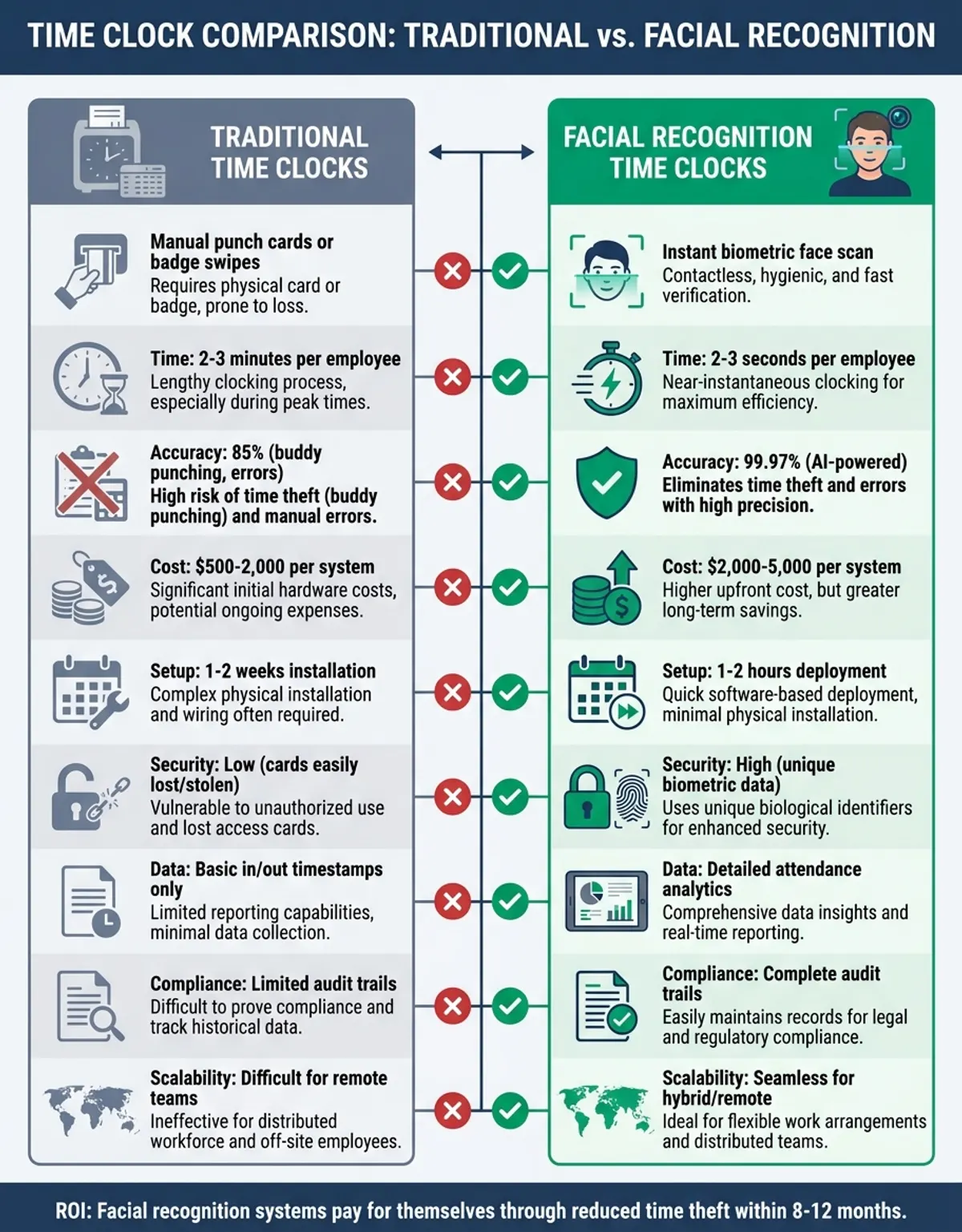
staff members represent the human element within any facial recognition time clock deployment, and successful adoption requires addressing both the practical benefits and potential concerns that workers may harbor regarding biometric monitoring. Modern facial recognition systems prioritize employee privacy by storing biometric data as encrypted mathematical representations rather than actual photographs, ensuring that personal information remains secure while maintaining authentication accuracy. This technical approach to privacy protection helps build employee trust and facilitates smooth system adoption across diverse workforce populations.
The user experience for personnel using facial recognition terminals proves significantly simpler than traditional timekeeping methods. Workers simply approach the time clock, look at the camera, and receive immediate confirmation of their clock transaction without needing to remember codes, carry badges, or touch shared surfaces. This contactless interaction gained particular importance during health consciousness periods when minimizing surface contact became a workplace priority.
Training requirements for workers using facial recognition systems are minimal compared to other timekeeping technologies. Most workers can successfully use the terminals after a brief demonstration, and the intuitive nature of face recognition eliminates the learning curve associated with complex PIN entry or card swipe procedures. This ease of use translates into faster clock-in lines, reduced employee frustration, and improved acceptance of the timekeeping system.
The elimination of forgotten badges or forgotten PIN codes removes common sources of employee stress and administrative burden. When workforce arrive at work without physical credentials, traditional systems require manager intervention, temporary badges, or manual time entry. Facial recognition systems eliminate these complications by recognizing authorized individuals regardless of what they remember or carry, ensuring that every worker can clock in successfully on every duty period. (No more frantic searches for misplaced badges on Monday mornings.)
Transparency regarding how facial recognition data is used, stored, and protected remains essential for maintaining positive employee relations. Organizations implementing these systems should clearly communicate privacy policies, data retention practices, and the security measures protecting biometric information. This transparent approach demonstrates respect for employee concerns while establishing the organizational commitment to responsible biometric data management.
The accuracy of facial recognition benefits team members by ensuring they receive credit for all timestamps performed and eliminating disputes regarding time records records. When both employer and employee can review photographic evidence of each clock transaction, disagreements about completed time become rare. This mutual accountability protects employee interests while providing management with confident reliance on time and workforce presence data.
staff members working across multiple departments or locations appreciate the consistency of facial recognition systems that recognize them regardless of which terminal they use. This portability eliminates the need for separate credentials at each work location and simplifies the clock-in process for mobile workers who may report to different sites on different days. The universal recognition capability supports flexible workforce deployment while maintaining accurate time monitoring regardless of where personnel perform their duties.
Understanding Face Recognition Technology in Facial Recognition Time Clock
Face recognition technology forms the technical foundation of modern biometric time clocks, utilizing sophisticated algorithms to analyze unique facial features and match them against enrolled employee profiles with remarkable accuracy. These systems measure distinctive characteristics including the distance between eyes, the shape of the nose, the contour of the jawline, and numerous other biometric markers that collectively create a unique facial signature. Advanced face recognition platforms can identify individuals even when they wear glasses, have changed hairstyles, or exhibit minor facial changes due to aging or facial hair growth. For a comprehensive overview of how this technology works across applications, explore our facial recognition technology guide.
The mathematical precision of contemporary face recognition algorithms achieves accuracy rates exceeding 99.9% under normal operating conditions, making false acceptance or false rejection events extremely rare. These systems utilize neural networks trained on millions of facial images to distinguish subtle differences between individuals, including identical twins in many cases. The computational power of modern face recognition processors enables authentication decisions in under one second, ensuring that employee clock transactions proceed quickly without creating bottlenecks during work session changes.
Lighting conditions and camera positioning significantly impact biometric authentication performance, leading manufacturers to incorporate advanced imaging technologies such as infrared illumination and multi-spectral cameras. These enhancements enable reliable recognition in variable lighting conditions, from brightly lit office environments to dimly illuminated warehouse settings. You may also find our guide on face recognition camera helpful for understanding camera setup and positioning best practices. The robust performance across diverse environmental conditions makes this technology suitable for virtually any workplace setting.
Liveness detection represents a critical security feature in professional-grade biometric verification systems, preventing authentication using photographs, videos, or masks. These anti-spoofing technologies analyze subtle indicators such as skin texture, blood flow patterns, and three-dimensional facial structure to ensure that the system recognizes a live person rather than a representation. This security layer protects organizations against sophisticated fraud attempts while maintaining the fast, contactless user experience that makes facial recognition attractive.
The continuous improvement of facial authentication algorithms through machine learning ensures that system accuracy improves over time as the platform processes more authentication attempts. These adaptive systems automatically refine their recognition models based on successful and unsuccessful authentication events, gradually optimizing performance for the specific employee population and environmental conditions at each installation. The self-improving nature of modern biometric authentication technology reduces the need for manual system tuning and maintains high accuracy throughout the system lifecycle.
Understanding Software Integration in Facial Recognition Time Clock
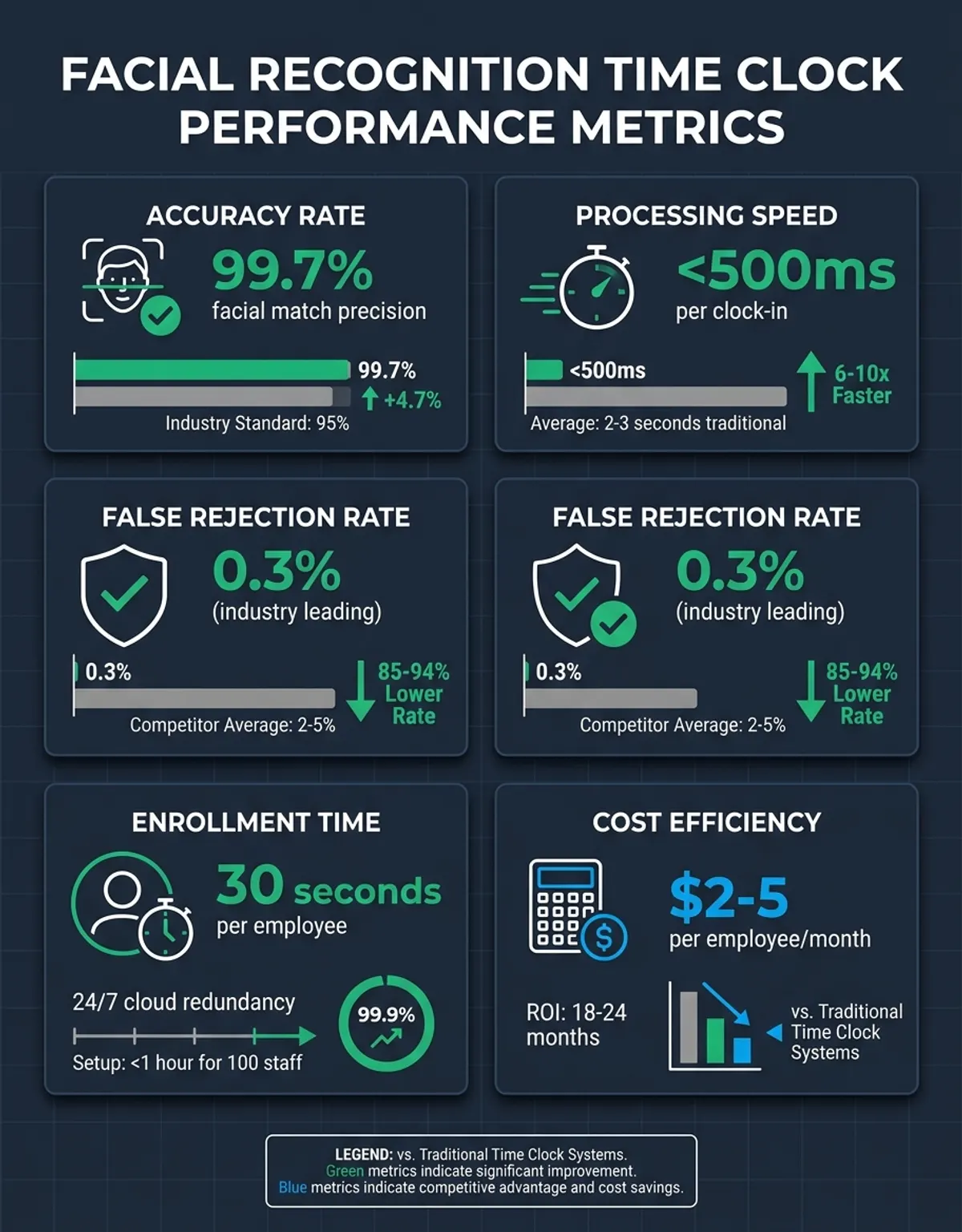
Software integration capabilities determine whether a facial recognition time clock functions as an isolated timekeeping tool or becomes a fully integrated component of enterprise workforce management infrastructure. Modern systems offer API connections, database synchronization, and pre-built integrations with popular payroll, human resources, and enterprise resource planning platforms. This connectivity ensures that time and presence data flows seamlessly throughout organizational systems without manual export, import, or reconciliation procedures.
Cloud-based software architectures have transformed facial recognition time clock deployment by eliminating the need for on-premises servers and enabling access from any internet-connected device. These cloud platforms automatically synchronize data across all time clock terminals, maintain centralized employee databases, and provide web-based administrative interfaces that managers can access remotely. The elimination of local infrastructure requirements reduces implementation costs and enables faster deployment timelines compared to traditional server-based systems.
The administrative software accompanying facial recognition time clocks provides comprehensive tools for employee enrollment, schedule management, reporting, and system configuration. Intuitive interfaces enable HR personnel to add new workers, update schedules, adjust participation policies, and generate reports without requiring technical expertise. This user-friendly approach to software design reduces training requirements and empowers operational staff to manage the system independently.
Mobile applications extend facial recognition capabilities beyond fixed terminals by enabling remote clock transactions using smartphone cameras. These mobile solutions prove particularly valuable for field workers, remote workforce, and organizations with distributed workforce populations. The software validates location data alongside facial recognition to ensure that mobile clock transactions occur at authorized work sites, maintaining the same accuracy standards as fixed terminal deployments.
Advanced software platforms incorporate workforce analytics that transform raw clock data into strategic workforce intelligence. These analytical tools identify labor cost trends, overtime patterns, productivity metrics, and scheduling optimization opportunities. By connecting time and time records data with business performance indicators, the software enables data-driven workforce management decisions that improve operational efficiency and reduce labor expenses.
The reporting capabilities within facial recognition time clock solutions support compliance with labor regulations by automatically generating required documentation such as overtime reports, break compliance summaries, and duration-recorded certifications. Customizable report templates enable organizations to create documentation matching specific regulatory requirements or internal audit needs. The automated report generation eliminates manual data compilation while ensuring that compliance documentation remains current and accurate.
Security features embedded in facial recognition technology protect sensitive employee data through encryption, role-based access controls, and comprehensive audit logging. Administrative interfaces restrict system access based on user roles, ensuring that only authorized personnel can modify employee records, adjust time entries, or access sensitive reports. The audit trail capabilities document all system interactions, creating accountability and supporting forensic investigation when irregularities occur.
Regular applications updates delivered through cloud platforms ensure that facial recognition systems benefit from the latest features, security patches, and algorithm improvements without requiring on-site maintenance. These automatic updates maintain system performance and security without imposing burden on IT resources. The continuous enhancement of systems capabilities extends the useful life of facial recognition hardware investments while ensuring that organizations benefit from ongoing technological advancement.
Integration with building access control systems enables unified security and time documentation by using the same facial recognition terminals for both physical access authorization and time clock transactions. This convergence of security and timekeeping functions reduces infrastructure costs while improving employee convenience through a single authentication process. For more information on implementing multi-camera systems for comprehensive coverage, see our facial recognition cameras resource. The combined system creates comprehensive records of employee presence that support both security audits and payroll processing.
Understanding Work Hour Verification in Facial Recognition Time Clock
Verification of logged work periods represents the culminating purpose of any time and workforce presence system, transforming captured clock data into trustworthy records that support accurate payroll processing and labor cost accounting. Facial recognition technology enhances work hour verification by providing photographic evidence of each clock transaction, creating an auditable record that definitively links specific individuals to specific time entries. This visual verification capability proves invaluable during payroll audits, wage disputes, or investigations into timekeeping irregularities.
The automated calculation of performed time eliminates mathematical errors that commonly occur with manual timecard totaling. The system precisely accounts for clock-in time, clock-out time, break periods, and applicable scheduled time differentials to calculate compensable timestamps. Rounding rules, overtime thresholds, and premium pay calculations apply consistently according to configured parameters, ensuring that every employee receives identical treatment under organizational policies.
Comparison of Facial Recognition Time Clock Systems
| Feature | Basic Facial Recognition | Advanced Systems | Enterprise Solutions |
|---|---|---|---|
| Recognition Speed | 2-3 seconds | Under 1 second | Under 0.5 seconds |
| Accuracy Rate | 95-98% | 99%+ | 99.9%+ |
| User Capacity | Up to 500 individuals | Up to 5,000 team members | Unlimited staff members |
| Environmental Adaptability | Standard lighting required | Variable lighting support | All conditions including darkness |
| Integration Capabilities | Basic export functions | API and standard integrations | Full ERP/HRMS integration |
| Anti-Spoofing Protection | Basic photo detection | Advanced liveness detection | Multi-factor authentication |
| Cloud Connectivity | Optional | Standard | Required with redundancy |
Facial recognition time clock technology has fundamentally transformed workforce management by combining biometric security with intuitive user experience and comprehensive data management capabilities. Organizations implementing these systems benefit from elimination of buddy punching, streamlined payroll processing, enhanced compliance documentation, and strategic workforce analytics. The contactless nature of facial recognition addresses hygiene concerns while the speed and accuracy of modern systems ensure smooth clock-in processes even during peak work period change periods.
The integration of facial recognition with cloud-based platforms platforms and enterprise systems creates unified workforce management ecosystems where time and presence data flows seamlessly throughout organizational processes. As facial recognition algorithms continue improving through machine learning and as systems incorporate additional capabilities such as temperature screening and mask detection, the technology will maintain its position as the premier biometric authentication method for employee time monitoring. The combination of security, convenience, accuracy, and comprehensive data management makes facial recognition time clock systems the optimal choice for organizations seeking to modernize their timekeeping infrastructure and achieve operational excellence in workforce management.
Frequently Asked Questions
Frequently Asked Questions
How does art biometric time clocks relate to facial recognition time clock?
Art biometric time clocks represent the broader category of advanced biometric authentication systems that includes facial recognition along with fingerprint scanners, iris recognition, and hand geometry readers. While art biometric time clocks encompass multiple authentication modalities, facial recognition specifically leverages face-based identification as the primary verification method. Organizations often evaluate multiple biometric options before selecting facial recognition due to its contactless operation, fast processing speeds, and resistance to environmental factors that affect other biometric methods. The relationship between art biometric time clocks and facial recognition reflects the evolution from contact-based biometrics toward more hygienic, user-friendly authentication approaches.
How does advanced facial recognition time clock technologies relate to facial recognition time clock?
Advanced facial recognition time clock technologies incorporate cutting-edge improvements such as three-dimensional facial mapping, infrared imaging, artificial intelligence-enhanced recognition algorithms, and sophisticated anti-spoofing protections. These technological enhancements distinguish premium facial recognition time clock systems from basic implementations by delivering superior accuracy, faster processing speeds, and reliable performance across challenging environmental conditions. The continuous advancement of facial recognition technology ensures that modern systems significantly outperform earlier generations in accuracy, speed, and security. Organizations implementing advanced facial recognition time clock technologies benefit from future-proof investments that maintain relevance as workforce management requirements evolve.
How does time relate to facial recognition time clock?
Time represents the fundamental data element captured by facial recognition time clock systems, with every authentication event recording a precise timestamp that documents when personnel begin work, take breaks, and conclude their shifts. The accurate measurement and recording of time forms the essential purpose of these systems, enabling organizations to calculate completed duration, process payroll, and maintain compliance with labor regulations. Facial recognition technology enhances time management reliability by ensuring that recorded timestamps authentically represent actual employee presence rather than proxy punches or fraudulent entries. The relationship between time and facial recognition time clock systems reflects the critical importance of accurate temporal data in workforce management and compensation administration.
How does hand reader time clocks relate to facial recognition time clock?
Hand reader time clocks utilize hand geometry biometrics to authenticate workers by measuring the size and shape of the hand, providing an alternative biometric authentication method that predates widespread facial recognition adoption. While both hand reader time clocks and facial recognition systems provide secure biometric authentication, facial recognition offers advantages including faster processing speeds, contactless operation, and greater resistance to injuries or conditions affecting hands. Many organizations have transitioned from hand reader time clocks to facial recognition systems to improve user experience and eliminate concerns about surface contact. The two technologies share the common goal of preventing buddy punching while offering different approaches to biometric verification.
How does advanced time clock systems relate to facial recognition time clock?
Advanced time clock systems encompass the full spectrum of modern timekeeping technologies, including facial recognition alongside mobile applications, GPS capture, and cloud-based workforce management platforms. Facial recognition represents one implementation approach within the broader category of advanced time clock systems, distinguished by its use of biometric authentication for identity verification. Organizations evaluating advanced time clock systems often consider facial recognition as the preferred authentication method due to its combination of security, convenience, and operational efficiency. The relationship reflects how facial recognition has emerged as a leading technology within the advanced time clock ecosystem.
How does time clock relate to facial recognition time clock?
Time clock serves as the generic term encompassing all employee timekeeping devices, from mechanical punch clocks to modern biometric systems, while facial recognition time clock specifically describes systems utilizing face-based authentication. The evolution from basic time clock mechanisms to facial recognition represents decades of technological advancement aimed at improving accuracy, preventing fraud, and simplifying workforce management. Facial recognition time clock systems retain the fundamental time clock purpose of recording work work periods while adding sophisticated biometric verification that traditional time clocks cannot provide. This relationship illustrates how modern technology has transformed the simple time clock concept into comprehensive workforce management solutions.
How does times relate to facial recognition time clock?
Times as a plural concept refers to the multiple temporal data points that facial recognition time clock systems capture throughout employee work periods, including clock-in times, break start times, break end times, and clock-out times. The accurate recording of these various times enables precise calculation of compensable work time and ensures compliance with break requirements and overtime regulations. Facial recognition technology enhances the reliability of recorded times by eliminating proxy punches and ensuring that each temporal data point authentically represents the associated employee's presence. The granular recording of multiple times throughout each work period provides the detailed data necessary for accurate payroll processing and labor cost analysis.
For organizations seeking a reliable facial comparison solution to complement their workforce management systems, CaraComp offers powerful face recognition technology that delivers professional-grade accuracy without complexity. Whether you need to verify employee identities, compare facial images for security purposes, or analyze facial similarities across photo databases, CaraComp's platform provides instant, detailed comparison results that support both operational and security needs. The technology processes images securely while maintaining the speed and precision that modern businesses require for identity verification and facial analysis tasks.