
Facial Comparison in 2026 Using CaraComp AI
Discover how ancient mathematics powers modern AI facial comparison technology for security, identity verification, and personal photo organization.
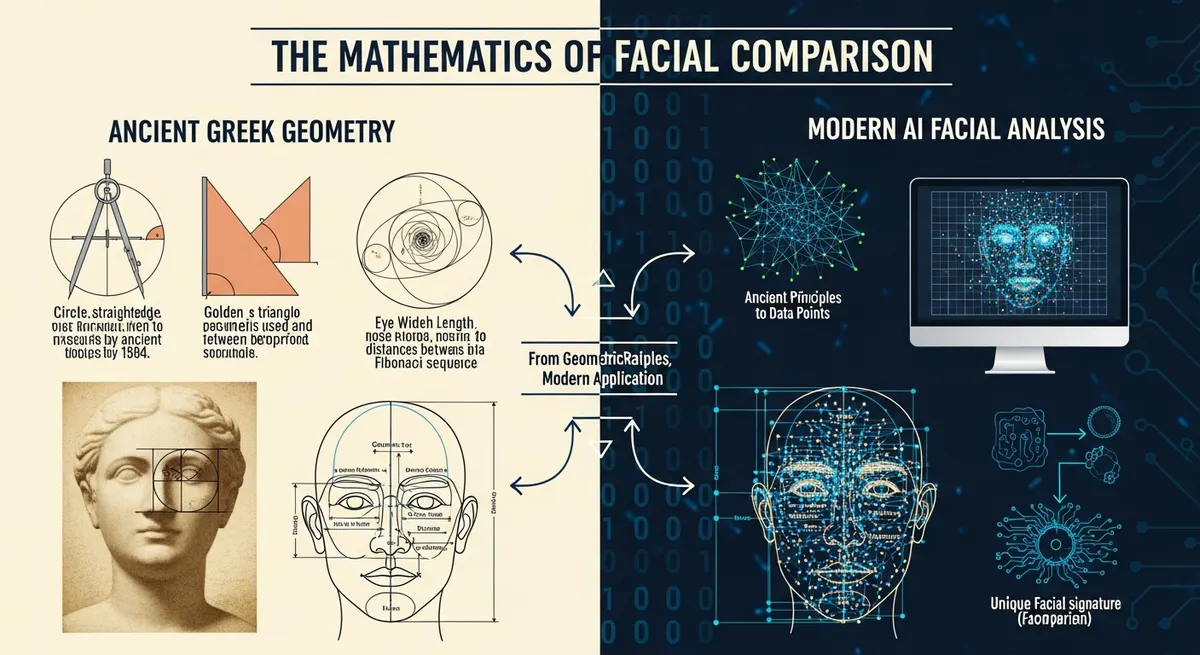
Facial comparison technology has transformed how we verify identity, enhance security systems, and even explore our ancestry. In 2026, this technology reaches new heights of accuracy and accessibility through platforms like CaraComp AI. Whether you want to compare face similarity online, match a photo against group images, or process batch uploads for screening purposes, modern facial comparison delivers results that seemed impossible just a decade ago.
What Is Facial Comparison Technology?
Facial comparison technology analyzes the unique geometric features of human faces to determine similarity between two or more images. Unlike simple photo matching, this technology examines dozens of facial landmarks—the distance between eyes, nose shape, jawline contours, and other biometric markers—to calculate a precise similarity score.
The science behind facial comparison dates back thousands of years to ancient Greek mathematics. Euclid of Alexandria, often called the father of geometry, developed the mathematical foundations we still use today. His work on measuring distances in geometric space—now called Euclidean distance—forms the core algorithm powering modern facial comparison systems.
The Mathematics Behind the Technology
The science behind facial comparison dates back thousands of years to ancient Greek mathematics.
When you upload photos for facial comparison, the system doesn't simply overlay images. Instead, it converts each face into a mathematical representation—a series of numerical coordinates plotting key facial features in multidimensional space. The comparison then calculates the Euclidean distance between these coordinate sets.
Euclidean distance measures the straight-line distance between two points in space. For facial comparison, imagine each face represented as a point in a space with dozens of dimensions, where each dimension corresponds to a specific facial measurement. Faces that are similar occupy points close together in this mathematical space, while different faces are positioned further apart.
This mathematical approach, refined over 2,300 years since Euclid first described geometric distance measurement, now powers security screening at airports, identification verification for businesses, and personal photo organization tools that help you find photos of specific people across thousands of images.
CaraComp AI: Advanced Facial Comparison for Everyone
CaraComp AI brings enterprise-grade facial comparison technology to individuals and businesses through an intuitive platform. The system processes photos and videos with remarkable accuracy while maintaining strict privacy standards.
For comprehensive face comparison capabilities, CaraComp provides the tools professionals and individuals need for accurate facial analysis.
Compare Your Face Against Group Images
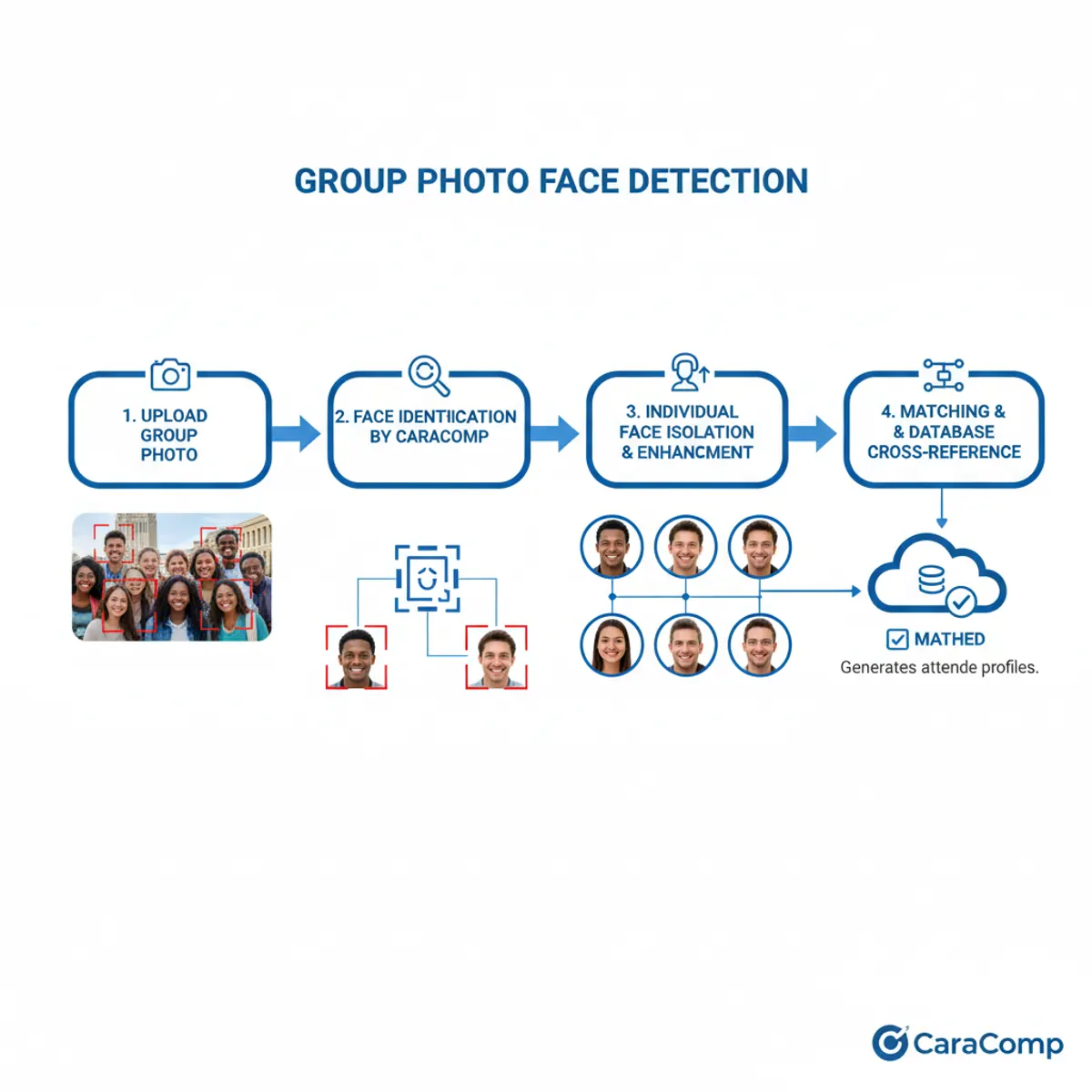
One of CaraComp's most powerful features allows you to compare one selected face against photos containing multiple people. The technology identifies every face in a group photo, then calculates similarity scores between your source image and each detected face.
This group photo comparison uses a sophisticated bounding box correlation algorithm. When processing a group image with six people, for example, the system:
- Detects all faces present in the image
- Maps each face to precise coordinates
- Compares your source photo against each detected face
- Returns similarity scores with the matched face highlighted
The correlation algorithm uses a tolerance of just 2% of image dimensions, ensuring precise identification even in crowded photos. This accuracy makes CaraComp ideal for security applications, event check-in verification, and finding yourself in group photos from events.
Batch Image Upload Processing
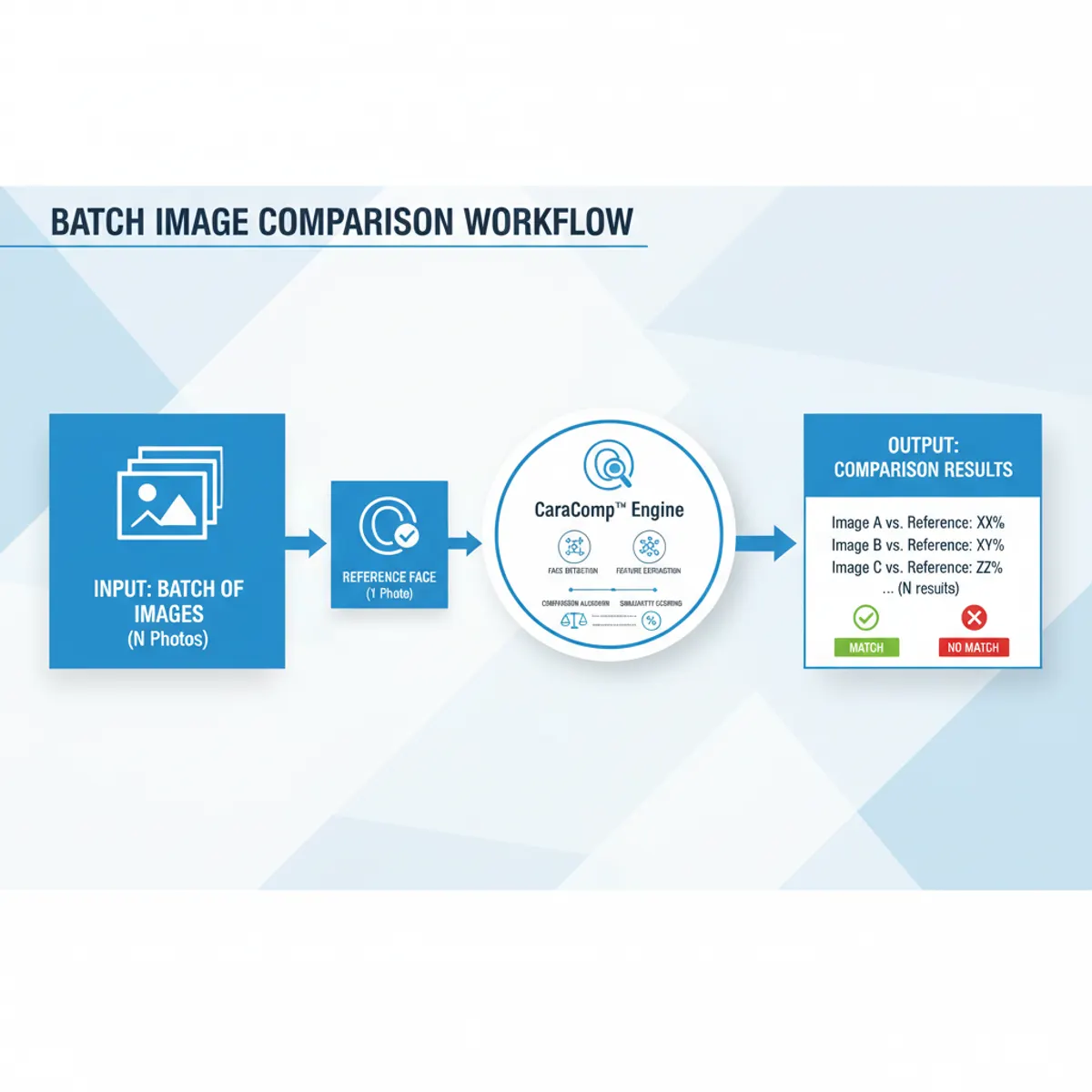
For businesses and power users who need to compare face similarity online across multiple photos, CaraComp offers batch processing capabilities. Upload up to 20 images simultaneously and compare each against a single reference photo.
| Batch Processing Feature | Specification |
|---|---|
| Maximum images per batch | 20 photos |
| Maximum file size | 5 MB per image |
| Supported formats | JPG, PNG |
| Processing time (5 images) | Under 10 seconds |
| Processing time (20 images) | Under 45 seconds |
| Results format | Individual scores + summary |
Batch processing supports several important use cases:
- HR onboarding: Verify multiple ID photos against employee faces
- Event management: Match attendee faces against registration photos for screening
- Photo organization: Scan album collections to find all photos containing a specific person
- Identity verification: Process multiple documents for identification confirmation
Each image in the batch receives its own similarity score, confidence rating, and face detection status. The system clearly indicates matches versus non-matches based on your configured threshold.
Users seeking to understand resemblance metrics can start with our face similarity test for a quick introduction to similarity scoring.
Video Comparison Technology
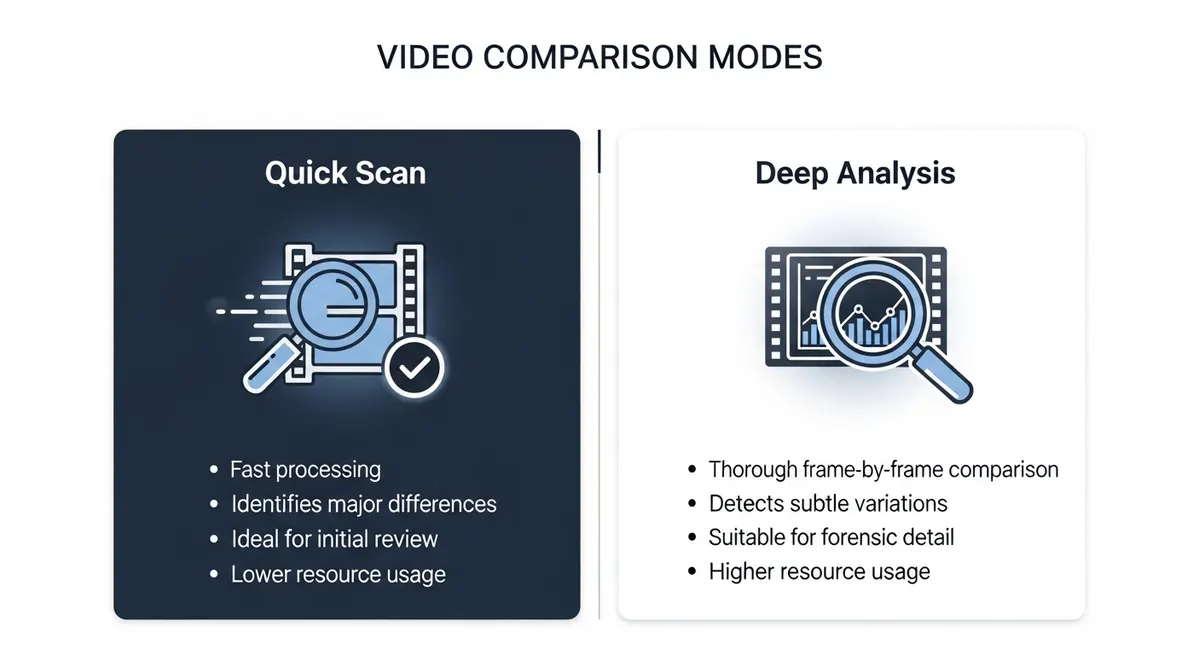
CaraComp extends facial comparison beyond static photos into video analysis. The platform offers two distinct modes for video processing, each optimized for different needs.
Quick Scan Mode extracts frames from uploaded videos at half-second intervals, then processes each frame using the same facial comparison technology applied to photos. This approach delivers results in 2-4 minutes for most videos.
The Quick Scan process works as follows:
- Client-side frame extraction using HTML5 video processing
- Frames captured every 0.5 seconds throughout the video
- Parallel batch processing analyzes 5 frames simultaneously
- Each frame receives face detection and comparison scoring
- Results display timestamps where matches occur
Modern facial comparison achieves accuracy rates exceeding 99% under optimal conditions.
Deep Analysis Mode provides more comprehensive video examination, processing the entire video stream rather than extracted frames. While this takes 7-12 minutes depending on video length, it captures faces that might appear briefly between frame extraction points.
Both video modes support common formats including MP4 and MOV, with recommended durations under 5 minutes for optimal processing times. The technology handles videos up to 500 MB, making it suitable for security footage review and extended recordings.
How Facial Comparison Accuracy Is Measured
Understanding how facial comparison technology measures accuracy helps users interpret results and configure appropriate thresholds for their applications.
Similarity Scoring System
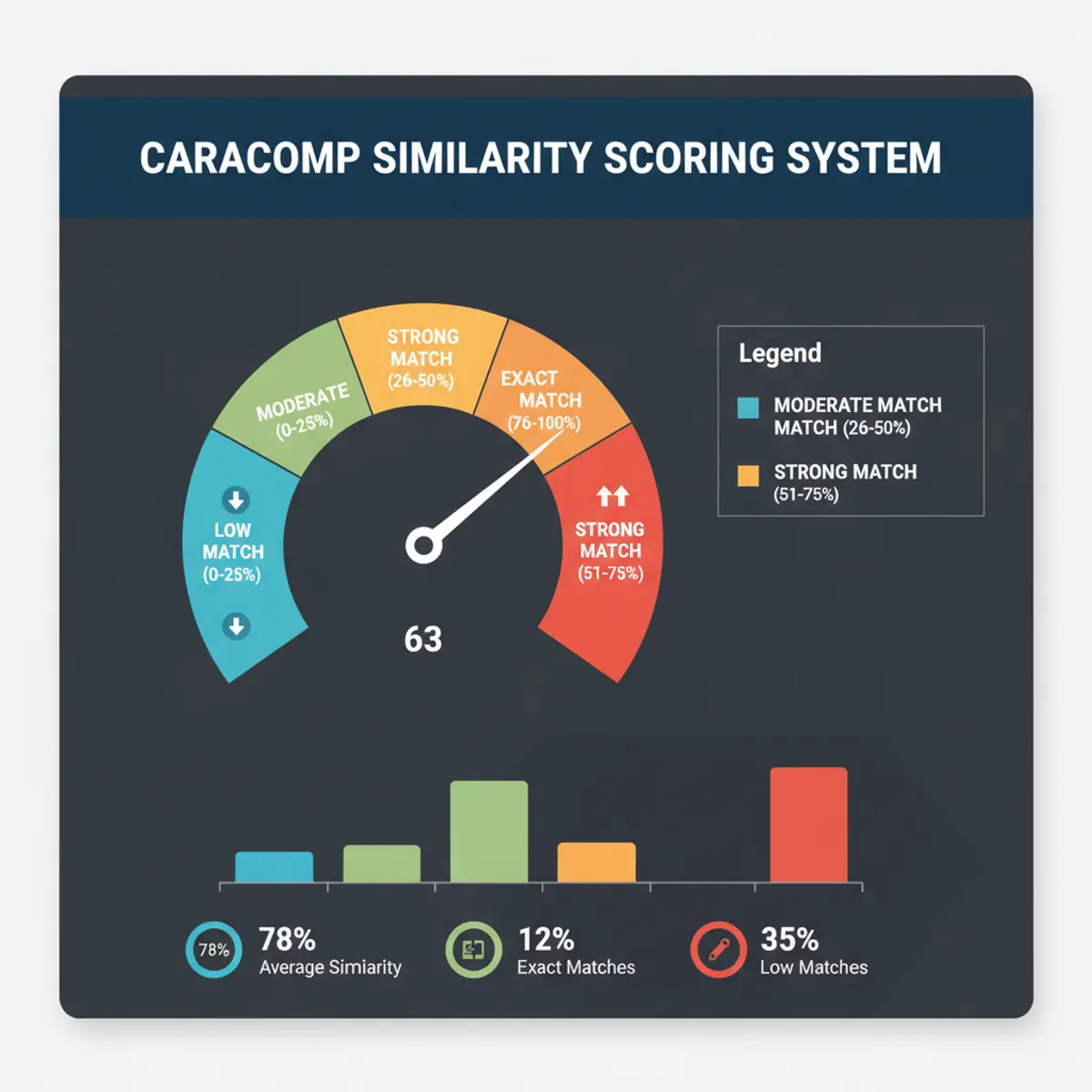
CaraComp uses a 0-100% similarity scale that reflects how closely two faces match in the mathematical comparison space. The scoring system provides clear guidance:
| Score Range | Classification | Interpretation |
|---|---|---|
| 90-100% | High Match | Strong confidence the faces belong to the same person |
| 80-89% | Medium Match | Likely the same person with some variation (angle, lighting, age) |
| Below 80% | Low Match | Different individuals or poor image quality affecting comparison |
The default match threshold sits at 80%, balancing accuracy against false negatives from image quality variations. Users can adjust this threshold based on their security requirements—higher thresholds reduce false positives but may miss legitimate matches from imperfect photos.
Quality Metrics and Confidence Levels
Beyond the similarity score, CaraComp evaluates image quality factors that affect comparison reliability:
- Brightness Score (0-100): Measures adequate lighting for facial feature detection
- Sharpness Score (0-100): Evaluates focus quality and absence of motion blur
- Confidence Level: Indicates how certain the system is about face detection itself
These metrics help users understand when results might be affected by image quality rather than actual facial differences. A low similarity score combined with poor brightness might indicate the need for better source photos rather than a genuine non-match.
Facial Attributes Analysis
The technology goes beyond simple matching to provide detailed facial attribute analysis. For each detected face, the system reports:
- Estimated age range
- Gender identification
- Emotional expression analysis
- Face pose and orientation data
- Bounding box coordinates for precise face location
CaraComp processes photos for immediate comparison without long-term storage.
This attribute data helps verify matches beyond the similarity score. When comparing identification photos, matching demographics between source and target faces adds confidence to the comparison result.
To explore facial analysis features interactively, try our compare a face tool for real-time comparison results.
Privacy and Security Considerations
As facial comparison technology becomes more prevalent, privacy concerns rightfully receive attention. CaraComp addresses these concerns through several design decisions.
Data Handling Practices
Photos uploaded for comparison are processed immediately and not retained long-term. The system generates mathematical representations for comparison purposes, then discards uploaded images after processing completes. This approach minimizes data exposure while delivering accurate results.
For video processing, temporary storage enables the analysis pipeline to function, but automated cleanup removes video files after results are delivered. Users receive their comparison data without leaving persistent copies on remote servers.
TSA and Security Applications
The TSA and other security agencies increasingly use facial comparison technology for traveler screening. CaraComp's technology aligns with the accuracy standards required for such applications while remaining accessible to businesses and individuals.
For security screening applications, the technology offers:
- Real-time processing for immediate verification
- Configurable match thresholds appropriate to security levels
- Audit logging for compliance requirements
- Integration capabilities for existing security workflows
Whether screening travelers at entry points or verifying identification for access control, facial comparison provides a non-intrusive layer of security that supplements traditional identification methods.
Getting Started with Facial Comparison
Using CaraComp for facial comparison requires no technical expertise. The platform guides users through a straightforward process.
Single Photo Comparison
- Upload your source photo (the reference face)
- Upload the target photo for comparison
- Review the similarity score and confidence metrics
- Examine facial attribute analysis for both images
- Download or share results as needed
Group Photo Matching
- Upload your source photo showing the face to find
- Upload a group photo containing multiple people
- View all detected faces with individual comparison scores
- Identify the matched face highlighted in the results
- Review position data and match confidence
Batch Processing Workflow
- Select your reference face image
- Upload multiple target images (up to 20)
- Configure your match threshold percentage
- Initiate batch processing
- Review consolidated results showing matches and non-matches
- Export results as CSV for further analysis
Frequently Asked Questions
You can also try our face comparison online free tool for instant results without any sign-up required.
You can also try our face comparison online free tool for instant results without any sign-up required.
How accurate is facial comparison technology?
Modern facial comparison achieves accuracy rates exceeding 99% under optimal conditions. CaraComp uses a similarity scoring system where matches above 80% indicate likely identity matches, with scores above 90% providing high confidence results. Image quality, lighting, and face angles affect accuracy in real-world applications.
Can I compare my face to celebrity photos?
Yes, CaraComp allows you to compare your face against any photos you upload, including celebrity images. Many users enjoy discovering which celebrities share similar facial features, though results should be interpreted as mathematical similarity rather than actual relation.
How does the technology handle photos from different ages?
Facial comparison accounts for natural aging by focusing on structural features that remain relatively consistent over time—bone structure, eye spacing, and nose shape. While similarity scores may be slightly lower between photos decades apart, the technology typically identifies the same person across reasonable age differences.
Is my data secure when using facial comparison?
CaraComp processes photos for immediate comparison without long-term storage. Mathematical representations used for comparison don't contain reversible image data. The platform maintains strict privacy standards, ensuring your photos aren't retained or shared after processing completes.
What image formats and sizes work best?
JPG and PNG formats produce optimal results. Images should be at least 80x80 pixels with clear facial visibility. For best accuracy, use well-lit photos where faces occupy a significant portion of the frame. Maximum file sizes of 5 MB per image ensure efficient processing.
Can facial comparison work with video?
Yes, CaraComp offers video comparison through Quick Scan mode (frame-by-frame analysis in 2-4 minutes) and Deep Analysis mode (comprehensive processing in 7-12 minutes). Supported formats include MP4 and MOV, with recommended lengths under 5 minutes for optimal processing.
What's the difference between facial comparison and facial recognition?
Facial comparison measures similarity between specific photos you provide. Facial recognition identifies individuals from a database of known faces. CaraComp focuses on comparison, giving you control over which photos are analyzed rather than matching against stored identity databases.
How many faces can be detected in a group photo?
CaraComp detects and compares against all visible faces in group photos. Testing shows reliable detection of 6+ faces in standard group images, with each face receiving individual comparison scoring against your source photo. Facial comparison technology continues advancing through improved algorithms and processing capabilities. The mathematical foundations established by Euclid remain central, while modern computing enables real-time analysis that ancient mathematicians could never have imagined. As a developer-friendly platform, CaraComp makes this technology accessible without requiring deep technical expertise. The same mathematical principles that measure distances in geometric space—principles documented over 2,300 years ago—now help identify faces across photos, verify identities, and enhance security screening worldwide. Whether you need to compare face similarity online for personal curiosity, process batch uploads for business verification, or implement screening technology for security applications, facial comparison in 2026 delivers accuracy and accessibility that transforms how we verify identity through visual analysis. The technology represents a remarkable convergence of ancient mathematics and modern computing. From Euclid's geometric proofs to today's AI-powered analysis, facial comparison stands as testament to how foundational mathematical concepts continue solving contemporary challenges.