
Face Comparison Software: Professional Solutions for Security and Investigation
Advanced facial recognition technology for law enforcement, security professionals, and investigative teams seeking forensic-grade accuracy.
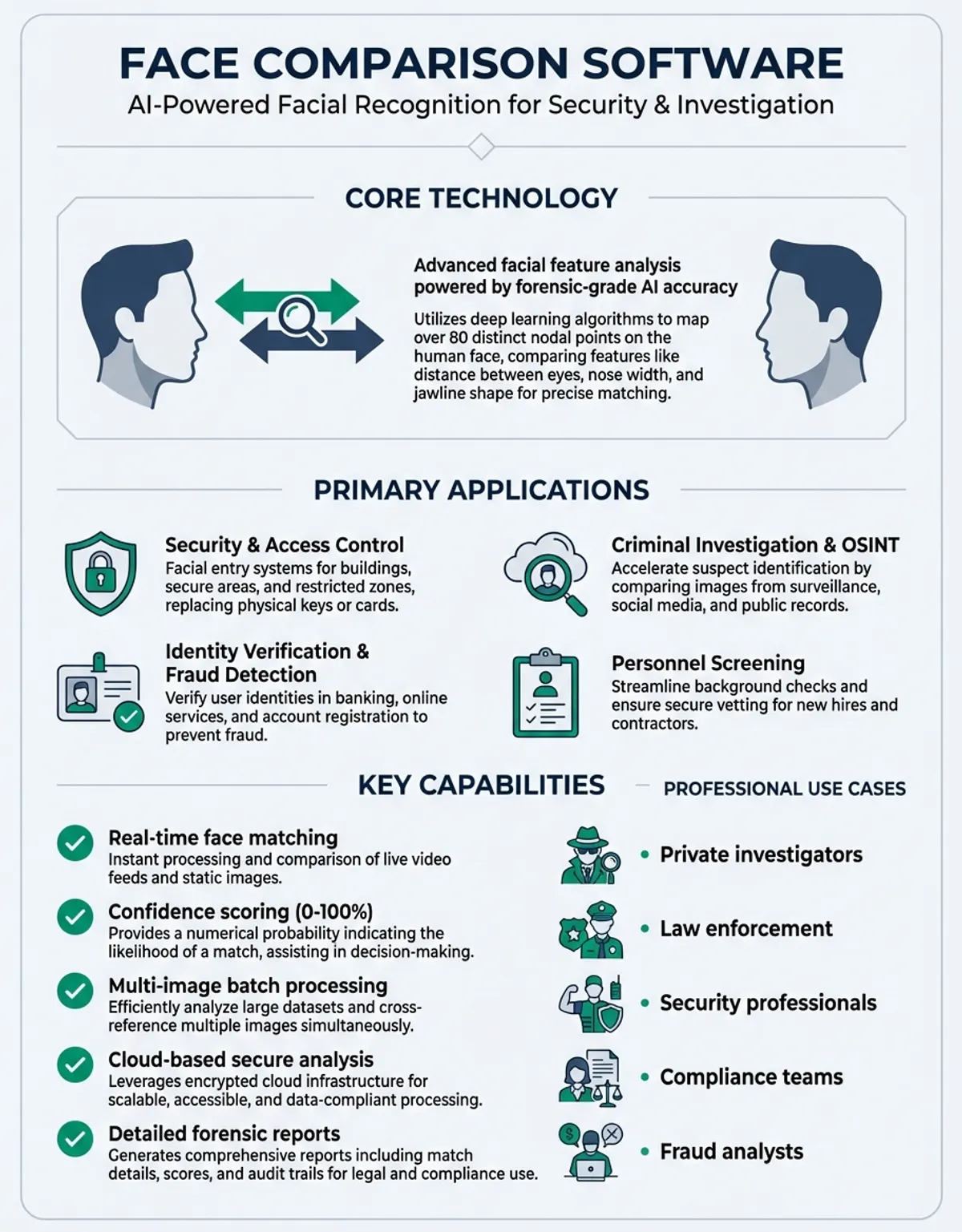
Face comparison software has revolutionized the way security professionals, investigators, and law enforcement agencies identify individuals and verify identities. These sophisticated tools leverage artificial intelligence and machine learning to analyze facial features with unprecedented accuracy, making them indispensable in modern security and investigative work.
What is Facial Comparison Software and Face Verification?
Face comparison software is a specialized technology that analyzes and compares facial features between two or more images to determine if they belong to the same person. Unlike simple facial recognition systems that merely identify faces, dedicated facial comparison capabilities provide detailed similarity scores and forensic-level analysis that can withstand scrutiny in legal proceedings.
These systems work by enabling facial comparison through mapping key facial landmarks—such as the distance between eyes, nose shape, jawline contours, and other biometric markers—to create unique facial signatures. The software then compares these signatures to calculate a similarity score, typically expressed as a percentage match.
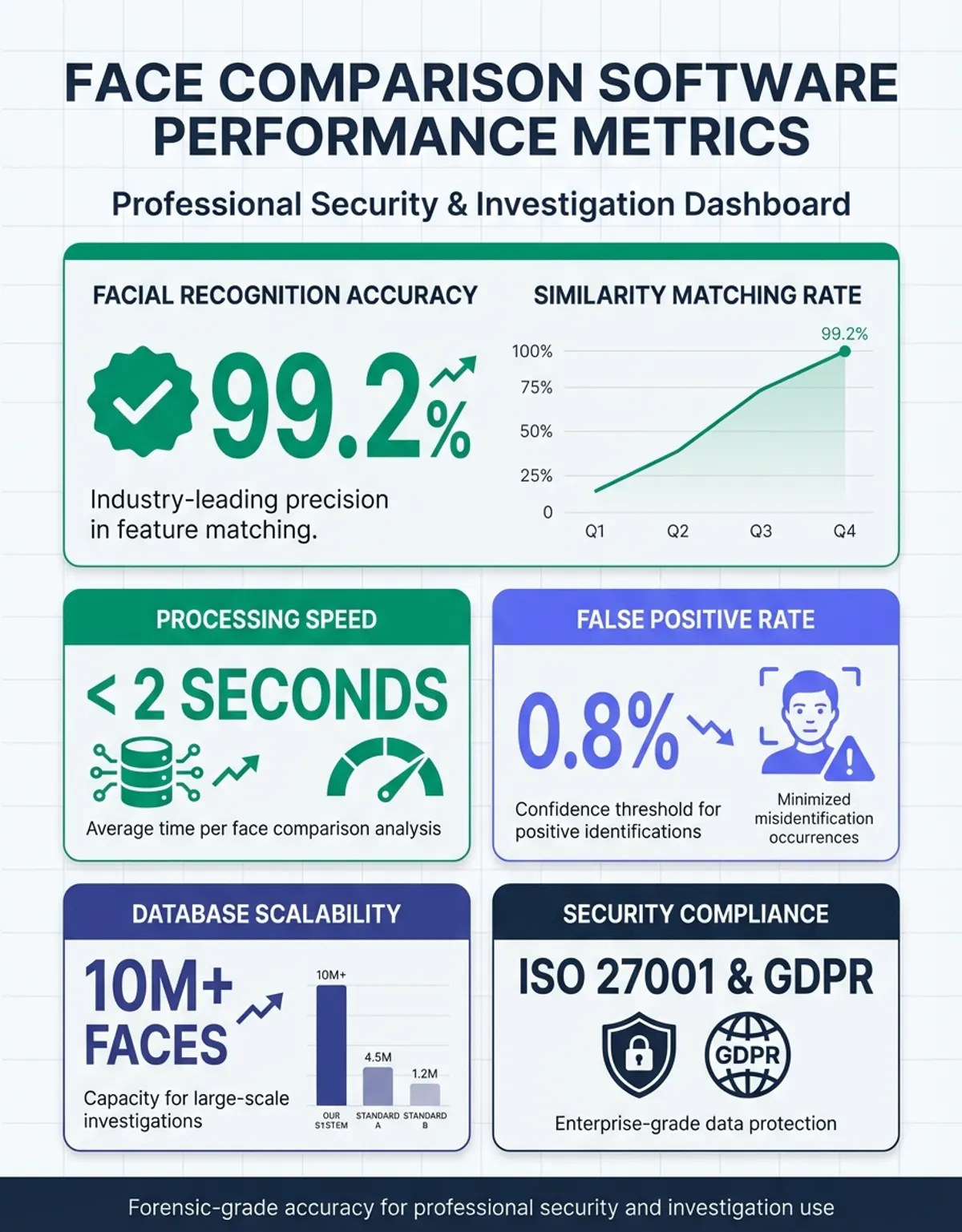
Modern face comparison software can achieve accuracy rates exceeding 99.5% under optimal conditions, making it more reliable than traditional identification methods.
How Face Compare and Comparison Tools Work
The face comparison process follows a sophisticated multi-step workflow that ensures accurate and reliable results. As a comparison tool, it begins when the software detects faces within uploaded images, automatically identifying facial regions even in complex scenes with multiple subjects or challenging lighting conditions.
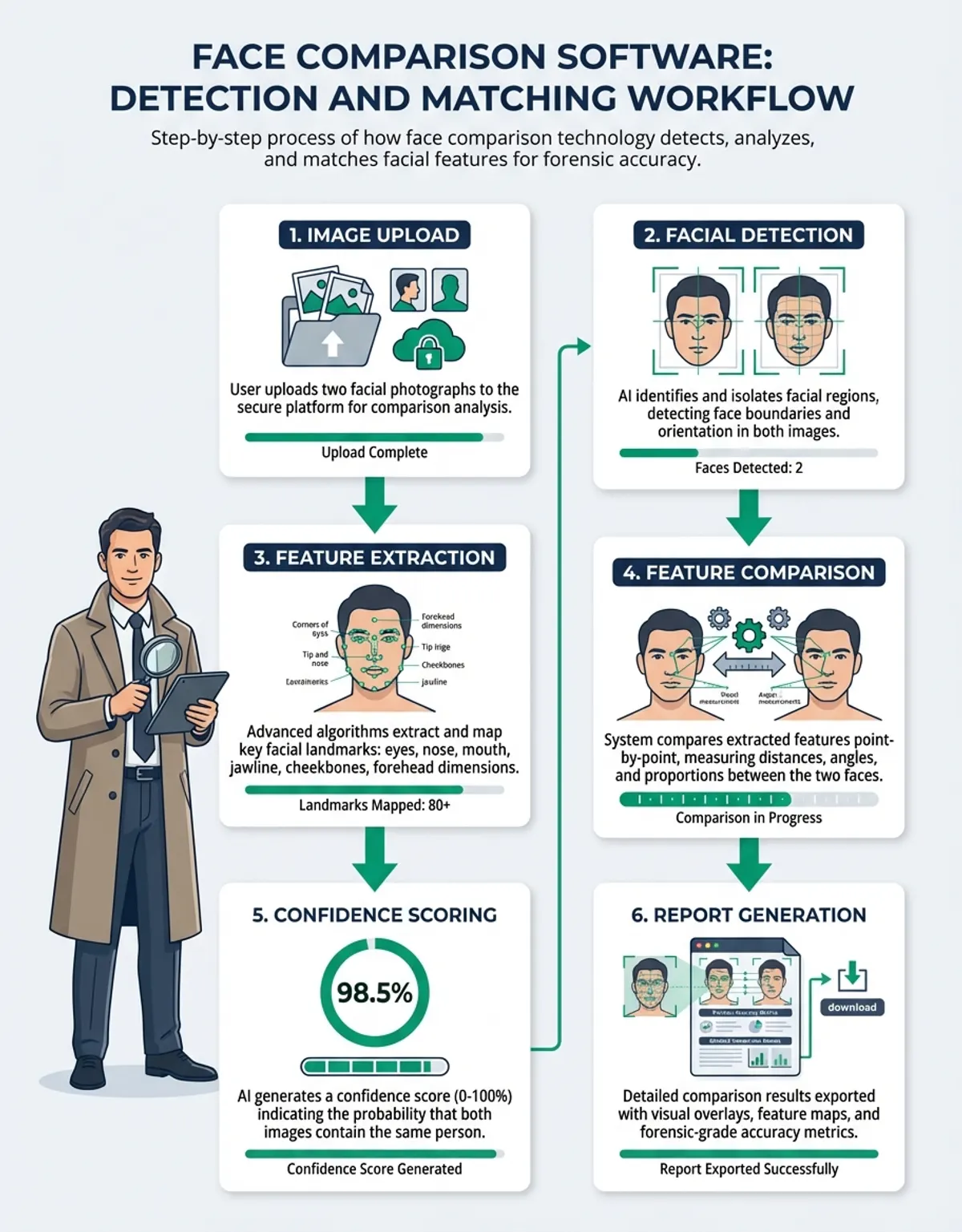
Next, the system extracts facial features by mapping dozens or even hundreds of biometric points across each face. These landmarks include measurements like interpupillary distance, nose width, cheekbone prominence, and lip thickness. Advanced algorithms convert these measurements into a mathematical representation called a facial template or embedding.
Finally, the comparison engine analyzes these templates using neural networks trained on millions of face pairs. The software calculates a similarity score and provides visual overlays showing matched and mismatched features, giving investigators clear evidence to support their conclusions.
Professional Comparison Tools and Face Match Features
Professional-grade face comparison software distinguishes itself through several critical capabilities that go beyond basic consumer-level tools. These features ensure the software meets the demanding requirements of security and investigative applications.
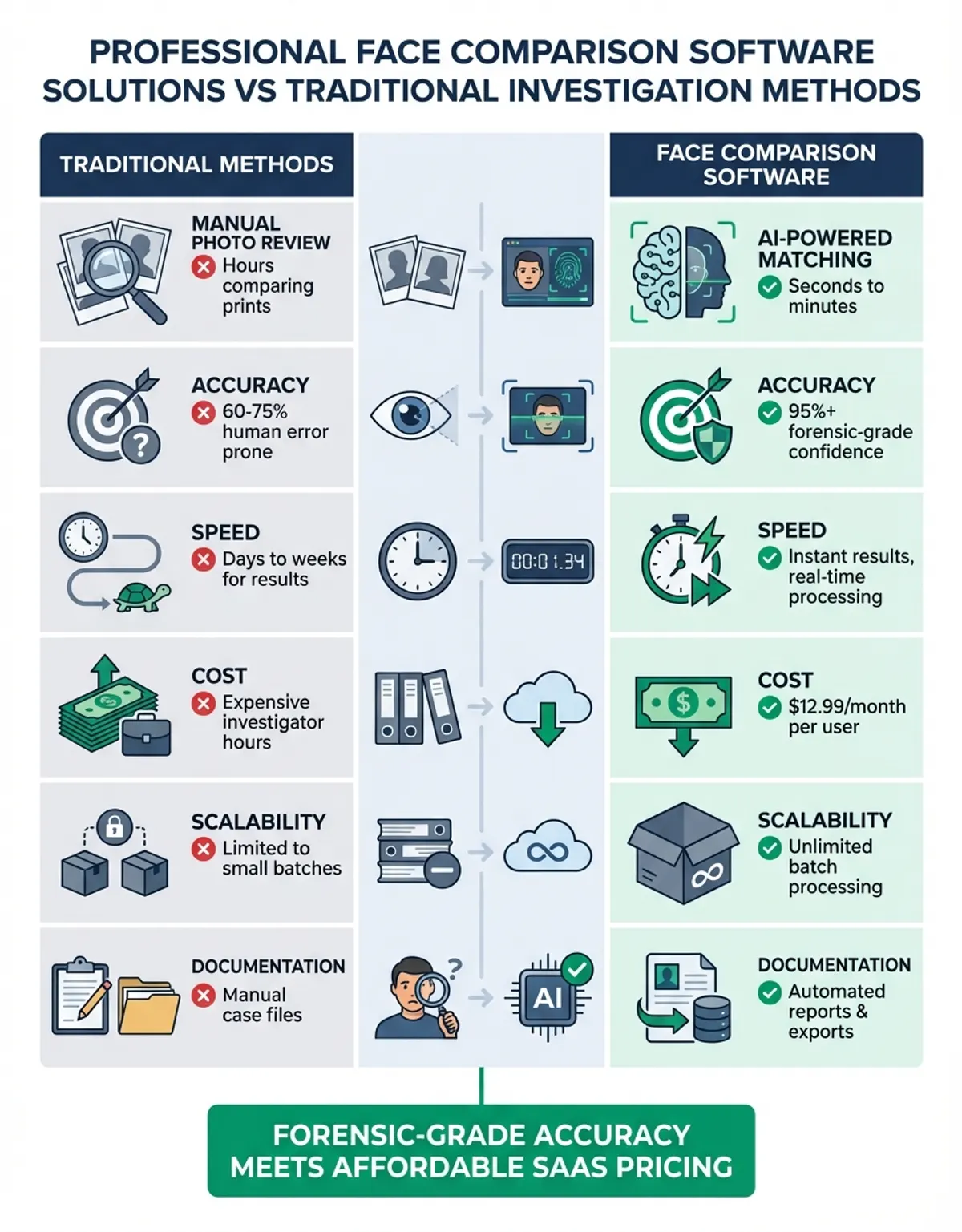
Forensic-Grade Accuracy: Professional systems maintain high accuracy even with challenging images—partial profiles, varying lighting, different ages, or low resolution. They use advanced preprocessing to normalize images before comparison. For a comprehensive overview, explore our face comparison guide.
Batch Processing: The ability to compare one face against thousands or millions of reference images simultaneously, essential for database searches in law enforcement applications.
Age Progression: Advanced software can account for aging effects, comparing current photos against historical images taken years or decades earlier.
Documentation and Reporting: Detailed reports with annotated images, similarity scores, and technical metadata that satisfy legal and forensic documentation standards.
The best face comparison software adapts to real-world conditions, maintaining accuracy even when comparing grainy surveillance footage to high-quality reference photos.
Face Match and Comparison Tools in Industry
Face comparison software serves diverse professional needs across multiple sectors, each with unique requirements and challenges. Understanding these applications helps organizations select the right solution for their specific use case.
Law Enforcement and Criminal Investigation: Police departments use face comparison to match suspects captured on surveillance cameras against mugshot databases. This technology has proven instrumental in solving cold cases and identifying persons of interest in active investigations.
Border Security and Immigration: Customs agencies verify travelers' identities by comparing their live appearance against passport photos and visa applications. This helps prevent identity fraud and enhances national security.
Corporate Security: Businesses employ face comparison for access control, comparing employees' faces against authorized personnel databases before granting entry to secure facilities.
Private Investigation: Licensed investigators use these tools to verify identities in fraud cases, locate missing persons, and gather evidence for legal proceedings. You may also find our guide on facial similarity testing helpful for understanding how face matching algorithms evaluate resemblance between photos.
Financial Services: Banks and fintech companies implement face comparison for account verification and fraud prevention, particularly in remote account opening and transaction authentication. You may also find our guide on compare two faces for similarity helpful for further insights.
Choosing Software for Similarity Scores and Face Comparison
Selecting appropriate face comparison software requires careful evaluation of multiple factors that impact both performance and usability. Organizations must balance technical capabilities with practical considerations like cost, integration requirements, and regulatory compliance.
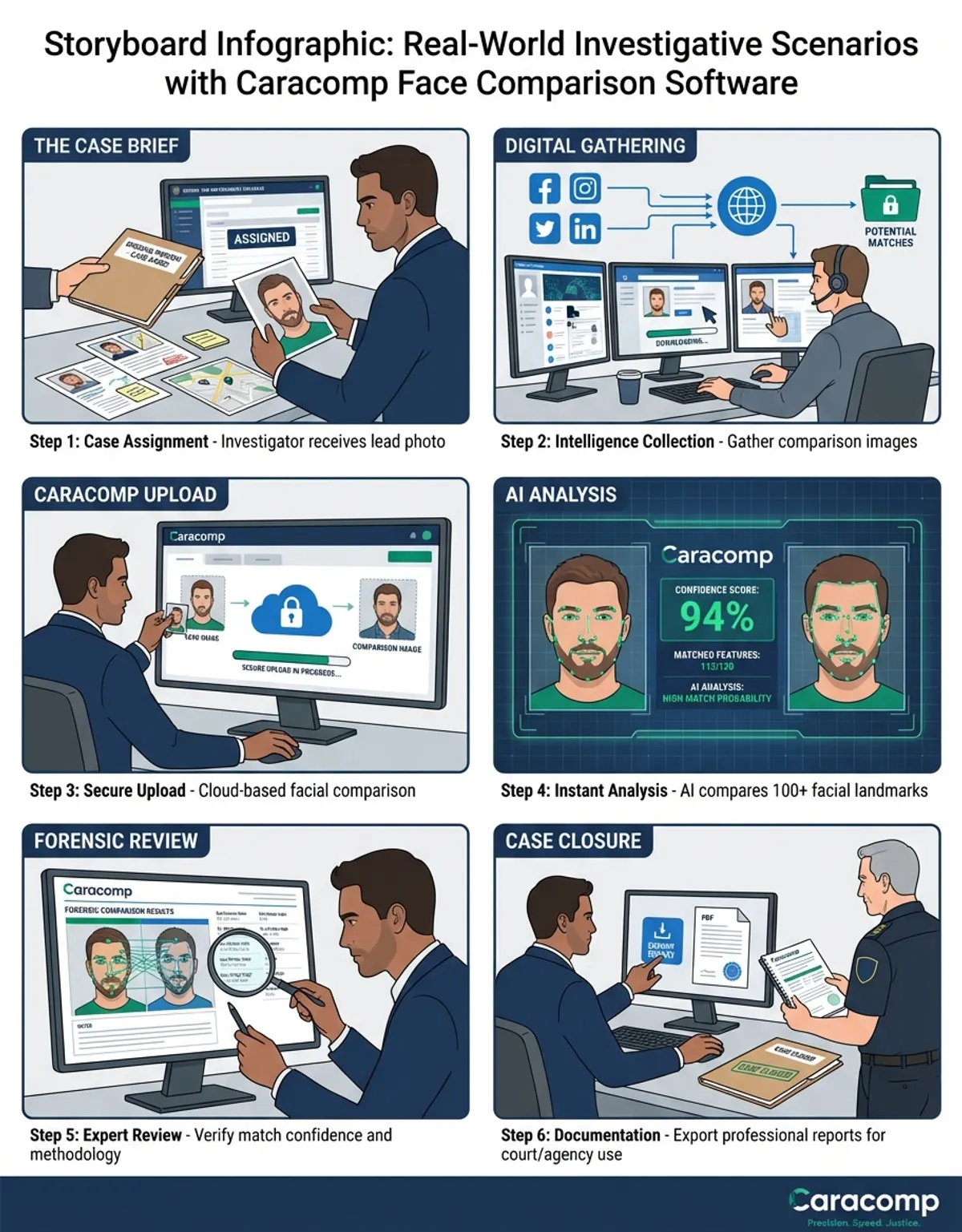
Start by assessing your accuracy requirements. If you need courtroom-admissible evidence, choose software with proven forensic credentials and independent validation. For less critical applications, consumer-grade tools may suffice.
Consider your workflow integration needs. Will the software need to connect with existing databases, case management systems, or surveillance infrastructure? API availability and integration support become critical factors.
Evaluate privacy and compliance features. Depending on your jurisdiction and industry, you may need software that complies with GDPR, CCPA, or other privacy regulations. Look for features like data encryption, audit trails, and consent management.
The right face comparison software should enhance your existing workflow rather than forcing you to adapt your processes to accommodate the technology.
Top Face Comparison Solutions for Identity Verification
The face comparison software market offers numerous options, each with distinct strengths tailored to different professional needs. Understanding these differences helps organizations make informed purchasing decisions.
| Solution Type | Best For | Key Strength | Typical Users |
|---|---|---|---|
| Enterprise Platforms | Large-scale operations | Database integration, batch processing | Law enforcement agencies, national security |
| Cloud-Based Services | Flexible deployment | Scalability, minimal infrastructure | Corporate security, private investigators |
| On-Premise Solutions | Data security | Complete control, offline operation | Government agencies, sensitive industries |
| Mobile Applications | Field work | Portability, real-time processing | Field investigators, security personnel |
| API Services | Custom integration | Flexibility, developer-friendly | Software developers, system integrators |
Enterprise platforms like those from NEC, Cognitec, and Morpho offer comprehensive solutions designed for high-volume, mission-critical applications. They excel at searching massive databases but require significant investment and technical expertise to implement.
Cloud-based services provide more accessible entry points with subscription pricing and easier setup. These solutions work well for organizations that need professional-grade accuracy without massive upfront infrastructure costs.
Frequently Asked Questions
How Accurate: Face Comparison and Similarity Scores
Modern professional face comparison software achieves accuracy rates of 99.5% or higher under optimal conditions with high-quality frontal images. However, accuracy decreases with challenging factors like extreme angles, poor lighting, low resolution, or significant age differences. Professional-grade systems typically maintain 95-98% accuracy even with moderately challenging images. For related information, see our guide on face comparison online.
Can face comparison software work with old or low-quality photos?
Yes, advanced face comparison software includes preprocessing capabilities that enhance image quality before analysis. These systems can work with historical photos, surveillance footage, passport photos, and other challenging sources, though accuracy typically decreases with image quality. Professional solutions often include confidence scores that indicate reliability for each comparison.
Is Identity Verification via Face Comparison Legal?
The legality of facial comparison software depends on your jurisdiction, industry, and specific use case. In most regions, private organizations can legally use this type of software for security and investigation purposes with proper consent and compliance with privacy laws. Law enforcement typically has broader authority but must still follow procedural requirements. Always consult legal counsel to ensure compliance with applicable regulations.
What's the difference between face comparison and face recognition?
Face comparison through face verification answers 'Is this the same person?' by comparing whether two specific face images match. Face recognition identifies an unknown face by searching a database, answering 'Who is this person?' Comparison is a one-to-one match, while recognition is one-to-many search. Comparison typically achieves higher accuracy since it focuses on a single verification task.
How much does professional face comparison software cost?
Pricing for face comparison software varies dramatically based on deployment model and scale. Cloud-based API services may charge per comparison (typically $0.001-$0.01 per image pair). Enterprise licenses can range from $10,000 to over $500,000 annually depending on features, capacity, and support. Mobile applications for individual investigators typically cost $50-$500 monthly. Free software options exist but rarely offer the accuracy and features required for professional use.
Face Comparison, Deepfakes, and Manipulated Faces
While face comparison software focuses on matching faces rather than detecting manipulation, some advanced systems include anti-spoofing features that can identify certain types of forgeries. However, sophisticated deepfakes may fool standard comparison algorithms. Organizations concerned about image manipulation should consider dedicated deepfake detection tools alongside their face comparison software.
Moving Forward: Faces and Face Comparison
Face comparison software has matured into an essential tool for security professionals, investigators, and organizations requiring reliable identity verification. This software continues advancing rapidly, with improvements in accuracy, speed, and ability to handle challenging real-world conditions.
When selecting a solution, prioritize your specific needs: accuracy requirements, integration capabilities, compliance considerations, and budget constraints. The best tools and software for a large law enforcement agency differ significantly from what a private investigator or corporate security team requires.
As you evaluate options, request demonstrations with images similar to those you'll use in practice. Test these tools with challenging cases—poor lighting, partial profiles, aged photos—to ensure they meet your real-world needs. The investment in proper face comparison software pays dividends through improved accuracy, faster investigations, and stronger evidence that withstands legal scrutiny.
The future of face comparison technology promises even greater capabilities as artificial intelligence advances. Organizations that adopt these tools today position themselves to leverage tomorrow's innovations while building expertise in this critical technology domain.
In an identity verification workflow, upload each photo to the comparison tool, let the face match run, and read the similarity score for both faces. A face compare against the original photo gives the comparison tool a clean baseline, and repeating the face match on new faces keeps every similarity score comparable across identity verification cases.
Before you compare faces at scale, run a face similarity pass on a handful of known faces: the faces you verify first become the baseline other faces are judged against, and a face similarity check on fresh faces then reads consistently. Most teams compare faces in batches of ten and log each similarity result.