
Facial Similarity Test — Compare Face Similarity Online
Discover how AI-powered facial analysis measures resemblance, compare platforms, and protect your privacy — all in one definitive guide.
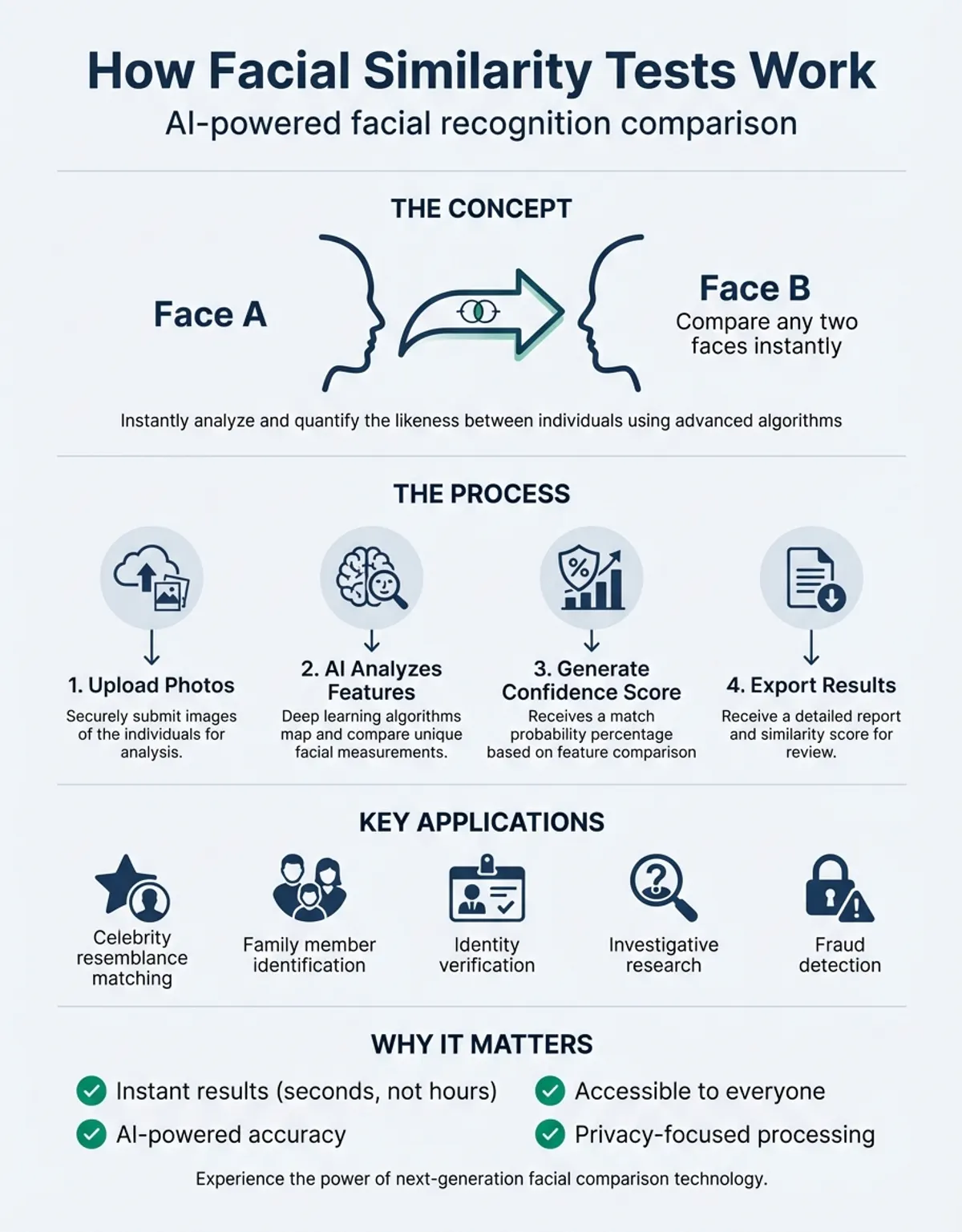
Have you ever wondered how much your face resembles a celebrity's, a family member's, or even a stranger's on the street? This type of AI-driven test uses artificial intelligence to measure the similarity between two faces in uploaded photos. The technology behind this process has advanced rapidly, moving from controlled laboratory settings into easy-to-use online platforms that anyone can access from a phone or browser. Whether you want a fun answer to 'how alike are your two photos look?' or need a reliable method to verify identity, understanding how these face comparison tests work puts you in control of the outcome.
In this guide, we break down everything you need to know. You will learn how algorithms analyze each image, which platforms deliver the most accurate output, and how to safeguard your data when you submit pictures online. By the end, you will be ready to run your own analysis with confidence and clarity.
How AI Face Matcher Calculates Similarity Percentage and Score
This type of AI-powered analysis measures how closely two faces resemble each other in terms of facial features and similarity. Unlike facial recognition systems that identify a specific person, the face comparison test focuses on the degree of resemblance between two separate pictures. The algorithm maps dozens of anchor points on each face — the distance between the eyes, the width of the nose, the angle of the jawline — and generates a numerical similarity score that tells you how similar two faces are and where your facial features align.
The process begins when you submit two pictures to the platform. The system isolates each face within the frame, normalizing for differences in lighting, head angle, and background. Advanced neural networks then extract feature vectors from each snapshot, creating a mathematical representation of the underlying structure. The scoring engine measures the distance between these vectors, and a shorter distance translates to a higher similarity score. The percentage is typically displayed on a graduated scale — 95 percent suggests near-identical proportions, while 40 percent indicates only a loose resemblance. For an in-depth look at how this technology powers real-world applications, explore our complete face comparison guide.
Modern facial recognition algorithms account for natural variations such as aging, weight changes, and different expressions. Some platforms can even handle a face similarity smile comparison, measuring resemblance and facial features while both subjects are smiling. The underlying math is designed to focus on bone structure and proportional relationships rather than surface-level details like makeup or hair, which makes the similarity analysis more robust and reliable across different conditions.
The algorithm maps dozens of anchor points on each face — the distance between the eyes, the width of the nose, the angle of the jawline — and generates a numerical score that tells you how similar two faces are.
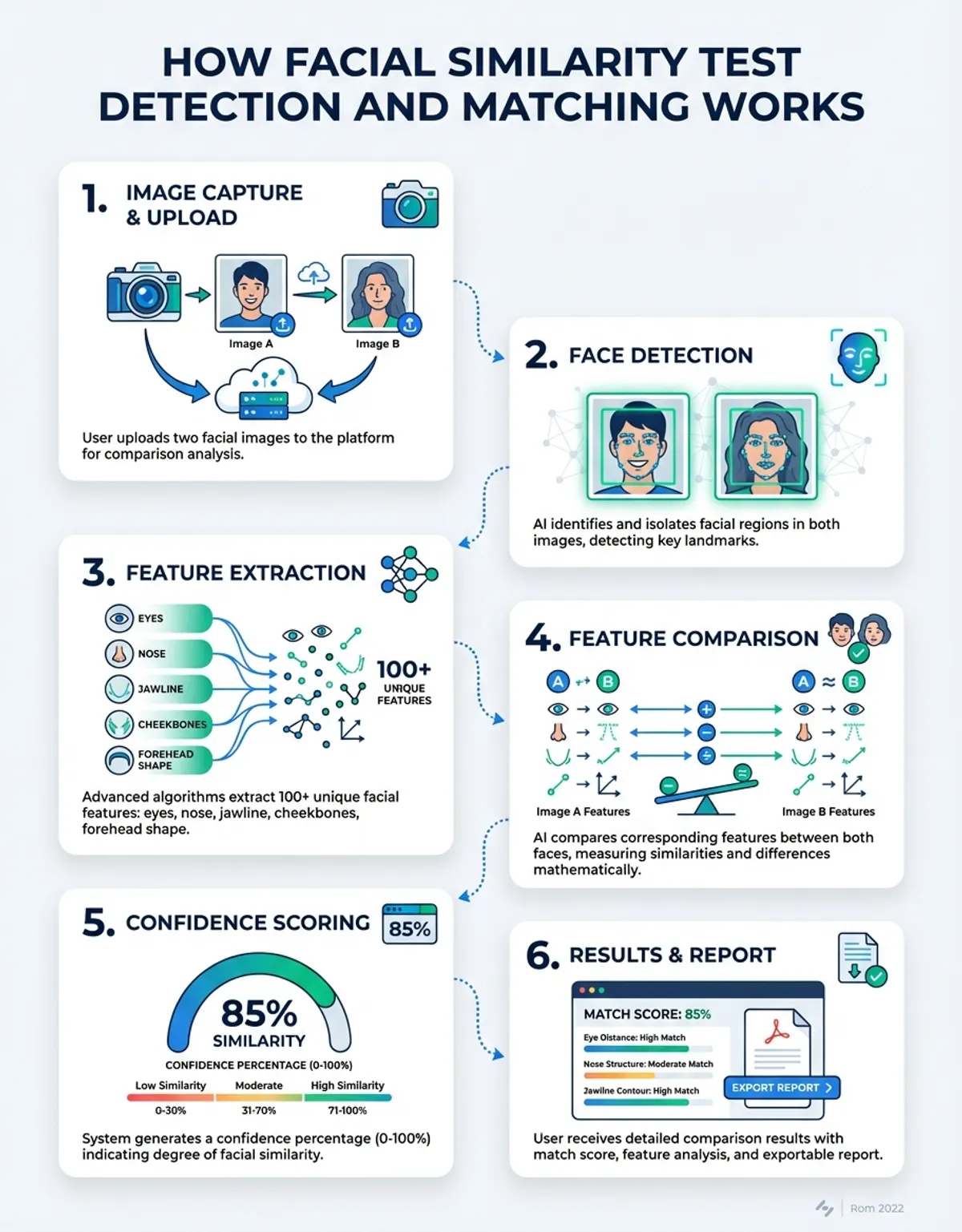
Upload Two Face Photos and Run Your Test
Running your first test takes only a few steps. Start by choosing a reputable platform — we cover the top options in the next section — and navigate to its submission page. Most services accept common formats such as JPG, PNG, and HEIC, so nearly any photo from your camera roll will work.
To upload your first file, click the designated area or drag the file directly into the browser. Repeat the process for the second one. Ensure both frames show a clear, front-facing view of each person. The platform performs best when the face occupies at least 30 percent of the frame and the lighting is even. Blurry or heavily filtered shots can reduce accuracy.
After both face uploads are in place, click the face comparison or analyze button. Most services process the comparison work in real time, delivering an output within seconds. The platform instantly shows a percentage alongside a visual overlay that highlights corresponding facial features and areas. You can then download or share the output. If the initial similarity score seems low, try a different face shot with better lighting or a more neutral expression to see if the comparison outcome improves.
Some advanced services let you submit multiple files at once for batch processing. This is especially useful for genealogy researchers who want to compare family portraits across generations. In every case, the key to an accurate outcome starts with a high-quality, well-lit shot. Most platforms also allow you to submit directly from cloud storage services like Google Drive or Dropbox, making it convenient to access older files without transferring them to your device first. You may also find our guide on how to compare two faces for similarity helpful for understanding side-by-side analysis techniques.
Top Face Verification Platforms Analyzed
Several platforms stand out when you want to run a face comparison online. Each platform offers a distinct set of capabilities, so the best choice depends on your specific needs — casual entertainment, professional verification, or research.
FacePair is among the most popular platforms for casual testing. It is designed for speed and simplicity: you submit two images, and the system instantly shows you how much they look alike. The service also supports a smile-compare mode that evaluates resemblance when both subjects are smiling. All processing happens directly in your browser, so your images never leave your device.
Face Compare takes a more analytical approach. Although it lacks real-time processing, its algorithms account for a wider range of variables, making it a solid choice when accuracy matters more than speed. The third platform sits between the two, combining fast output with advanced capabilities like multi-angle analysis and batch submissions. For professionals who need dedicated desktop tools, our review of face comparison software covers the top options for accuracy and integration.
When choosing among these platforms, prioritize what matters most to your use case. For quick entertainment, speed and a free tier are key. For professional use, look for strong data protections, detailed scoring, and the ability to handle multiple formats.
For a comprehensive option that bridges casual and professional needs, CaraComp stands out. Its multi-model AI engine analyzes over 16 facial features and delivers forensic-grade accuracy with detailed confidence scores. You can compare one source face against more than 20 target face images in a single session, which is a comparison feature genealogy researchers and security professionals find especially useful. CaraComp also scans video footage frame-by-frame for matching faces, taking the facial recognition analysis well beyond static images. The platform deletes uploaded face images on a regular basis, most often daily, keeping your data exposure minimal.
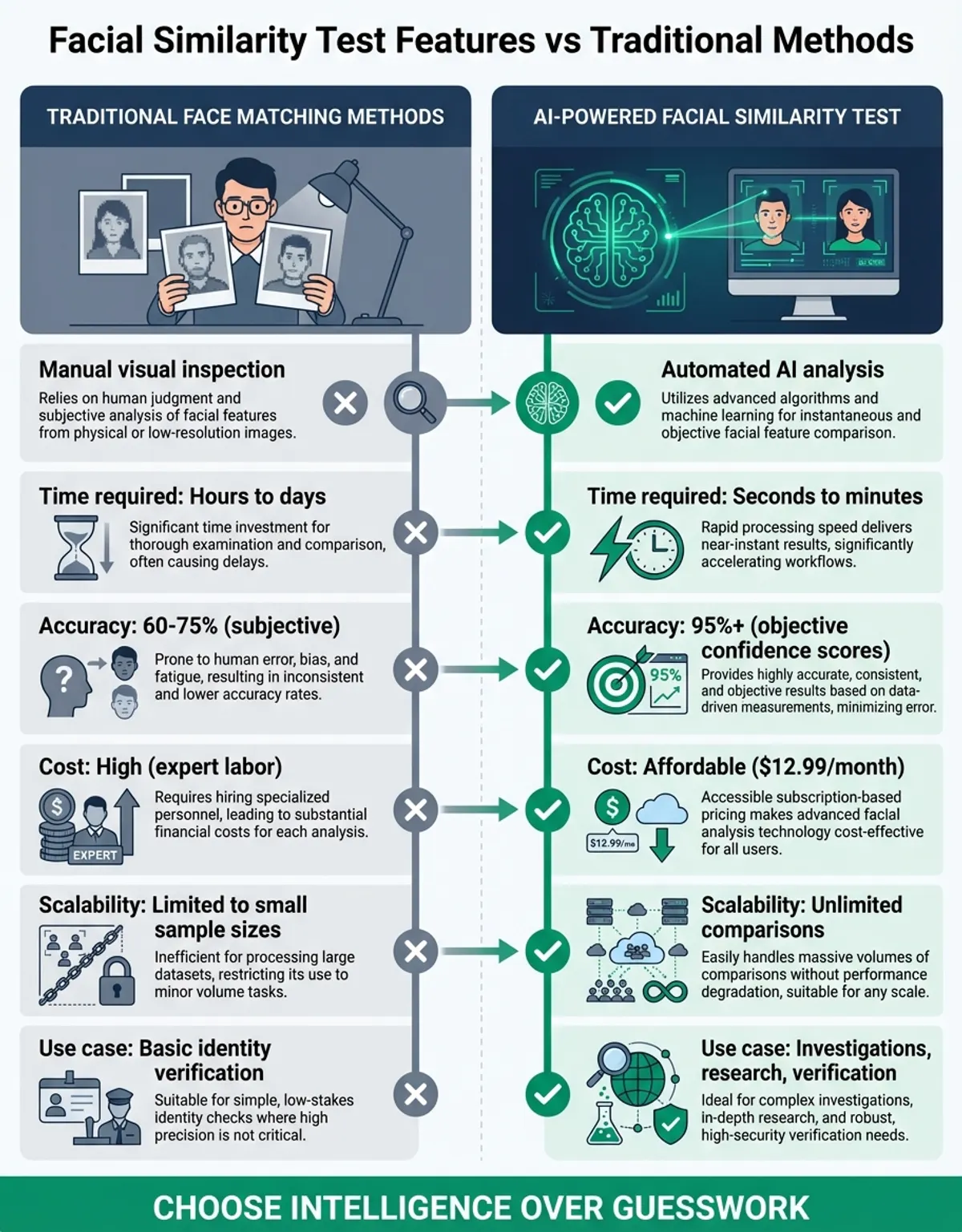
Understanding Similarity Score and Match Percentage
Once the platform delivers your face comparison output, understanding what the numbers mean is essential. Most services report a percentage on a similarity meter or graduated scale. A similarity score above 85 percent indicates a strong face match — the two faces share major structural overlap in bone structure, eye spacing, and proportions. Scores between 60 and 85 percent suggest moderate resemblance, while anything below 40 percent means the face comparison shows the faces differ significantly.
Several factors influence the accuracy of your outcome. Photo quality is the biggest variable for any facial analysis. A picture taken in harsh overhead lighting can cast shadows that distort facial geometry, leading to a lower score than the actual resemblance warrants. Extreme head angles or obstructed faces reduce the data available for analysis, which skews the output.
Here is the part that trips people up: these facial recognition tests measure geometric resemblance and similarity, not subjective perception. Two people might appear alike to the human eye because of shared hair color or fashion style, yet receive a low comparison score because their underlying bone structures differ. Conversely, two people who look quite different at first glance can score highly on a face similarity comparison if their proportional facial features align closely.
If your output does not reflect what you expected, try the analysis again with higher-quality shots. Use pictures taken in natural daylight with a neutral expression and a straight-on head position. These adjustments often shift the score by 10 to 15 percentage points and give a more accurate representation of how similar faces are.
These tests measure geometric resemblance, not subjective perception. Two people might appear alike to the human eye because of shared hair color or fashion style, yet receive a low score because their underlying bone structures differ.
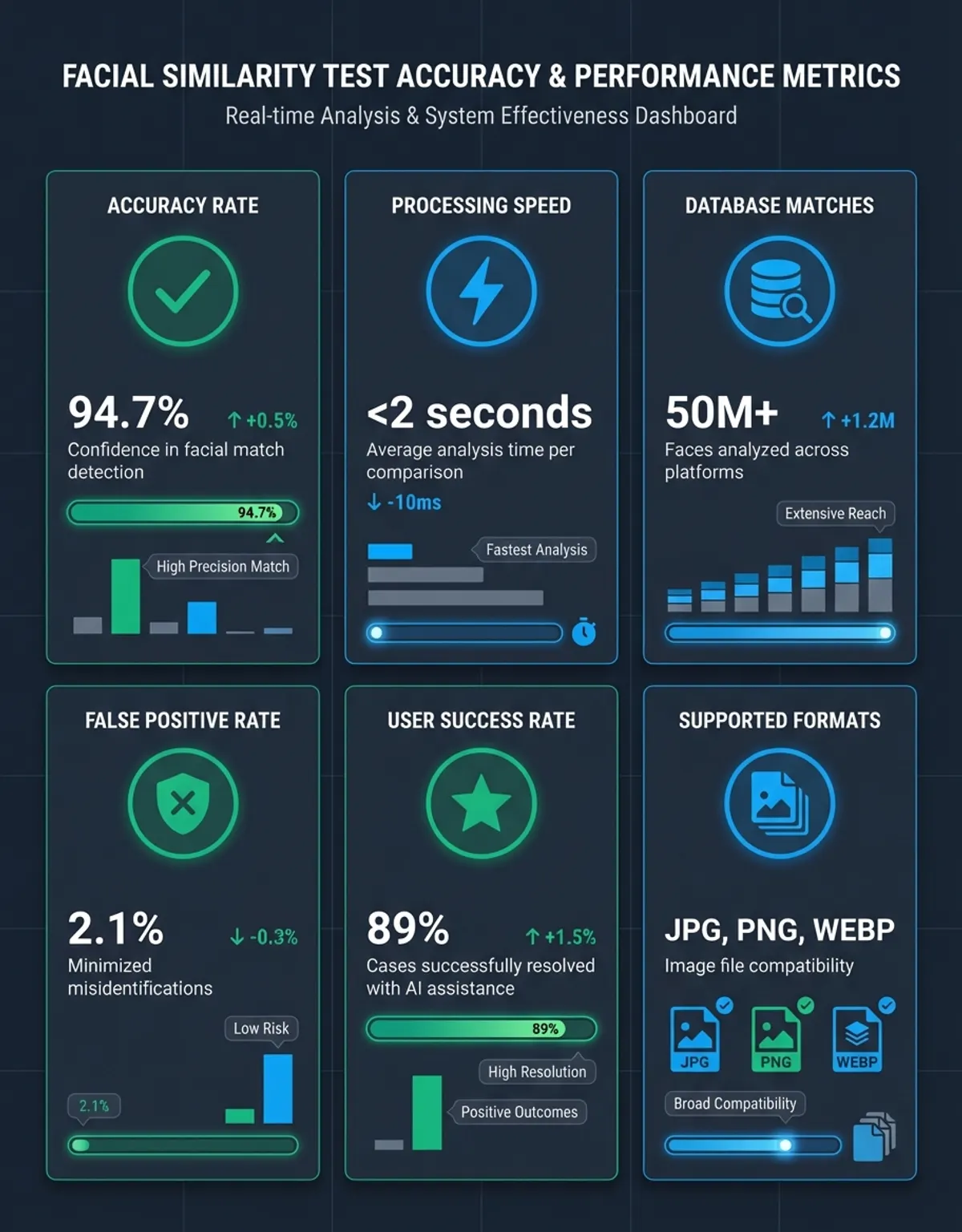
Privacy Protection for Your Face Photos
Privacy deserves serious attention whenever you submit pictures containing faces. Biometric data — the mathematical representation of your structure — is classified as sensitive personal information under regulations like GDPR and CCPA. Choosing a platform that handles this data responsibly is not optional; it is essential.
Biometric data — the mathematical representation of your structure — is classified as sensitive personal information under regulations like GDPR and CCPA.
Before you submit your first face comparison file, review the service's privacy policy. Reputable providers delete your submitted face files and associated biometric data within a defined window, typically 24 hours. Avoid platforms that retain your face comparison test files indefinitely or share data with third parties for advertising purposes. Look for end-to-end encryption during the face submission and comparison processing stages, which ensures your submission cannot be intercepted in transit.
Some services offer local processing, where the analysis runs entirely on your device without sending the file to an external server. This approach provides the strongest security guarantee because your data never leaves your hardware. However, local processing requires more computational power, so output may take longer on older devices.
If your use case involves children or vulnerable individuals, exercise extra caution. Only use services that explicitly comply with COPPA or equivalent regulations. Confirm that the platform does not store or use submitted pictures for model training, which would expose sensitive data beyond the intended single-use analysis.
Practical Uses for Facial Recognition Beyond Entertainment
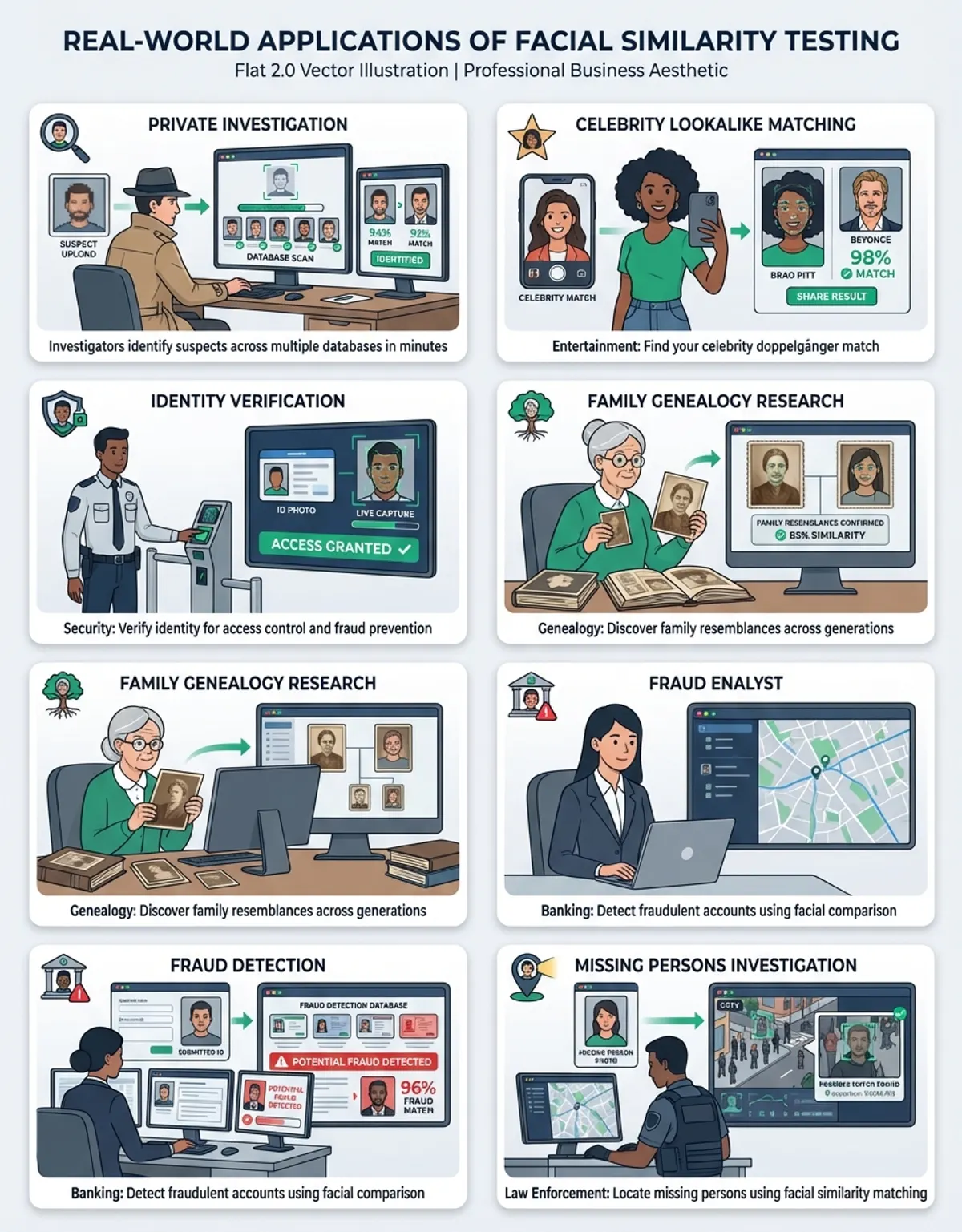
If you think this technology is just for finding your celebrity twin, think again. Professionals across multiple industries rely on these analyses for verification, research, and creative work.
In identity verification, organizations use algorithms to prove identity document ownership. When a customer submits a government-issued ID, the system runs the picture on the document against a live selfie. A high score confirms that the person presenting the ID is the same individual pictured. This process is standard in banking, insurance, and remote notarization workflows.
Genealogy enthusiasts use these tests to trace family resemblance across generations. By submitting historical pictures alongside contemporary ones, researchers can identify inherited traits and build visual family trees. The analysis reveals which attributes — jawline, nose shape, brow ridge — pass from one generation to the next.
Entertainment and social media remain major drivers of facial recognition adoption. Apps that instantly check how alike your face looks to a celebrity generate viral engagement. Creative professionals use these face comparison services to cast actors or models who resemble specific public figures for commercials and editorial shoots. Dating apps have also explored this facial recognition technology to suggest potential connections who share structural facial features with people a user has previously liked, adding a biometric dimension to recommendation algorithms.
Law enforcement and security agencies employ these algorithms at access control checkpoints. In these scenarios, the threshold is set extremely high to minimize false positives. The score must exceed a defined confidence level before granting entry, adding a layer of biometric security that complements traditional ID verification.
Upload Two Face Photos for Maximum Accuracy
Accuracy begins with the shots you choose. Follow these best practices to ensure the platform has the cleanest data possible for its analysis.
First, use well-lit shots. Natural daylight produces the most evenly lit surfaces, minimizing shadows that can distort the reading. Avoid flash, which tends to flatten depth and wash out subtle contours. If natural light is not available, position a soft artificial light source directly in front of the subject at eye level.
Second, maintain a neutral expression. While some services handle smiles and other expressions, a neutral face provides the most consistent geometric baseline. Both submissions should ideally show the same expression for the most reliable outcome.
Third, face the camera directly. A straight-on head position exposes both sides equally, giving the algorithm full access to every measurement point. Even a slight head tilt can shift an image enough to reduce accuracy by several percentage points.
Fourth, submit high-resolution files. A picture with at least 1,000 pixels on the shortest side gives the algorithm enough detail to map fine structures like the Cupid's bow or the crease patterns around the eyes. Low-resolution submissions force the system to guess, which inflates the error margin.
Fifth, choose recent snapshots when possible. Proportions shift over time due to aging, weight change, and other natural factors. Comparing shots taken within the same five-year window produces a more accurate reading than working with decades-old files.
Finally, remove obstructions. Sunglasses, hats, heavy makeup, and masks all hide areas that the algorithm needs to see. The more visible the face is in each submission, the more reliable the analysis and the higher the confidence.
Face Matching Questions Answered
Face Test Accuracy and Similarity Percentage Explained
Modern face comparison tests achieve similarity accuracy rates above 95 percent under controlled conditions — clear face shots, good lighting, and front-facing angles. In real-world usage, face similarity accuracy typically ranges from 85 to 95 percent because user-submitted face files vary widely in quality. The catch? The face comparison output depends heavily on the face picture you submit. Blurry or poorly lit pictures can drop accuracy by 10 to 20 percentage points. For the most reliable face reading, follow the best test practices outlined in the accuracy section above.
Compare Faces Online Free
Yes, and honestly the free options have gotten surprisingly good. FacePair offers unlimited free basic face scans, while several other platforms provide free face comparison analyses with a watermarked output. Free tiers typically cover the core test capabilities you need for casual face similarity use. Paid plans unlock advanced options like batch submissions, higher-resolution analysis, and detailed breakdowns. For most personal use cases, a free face service you can access via any browser delivers a sufficiently accurate output.
Best Face Photos for Facial Recognition
The best face shots are high-resolution, front-facing, and taken in natural daylight. Both submissions should show a neutral expression and an unobstructed face — no sunglasses, hats, or heavy filters. A picture with at least 1,000 pixels on the shortest side ensures the algorithm can map fine facial features and structures. Keeping conditions consistent between both reference frames and test images also improves the accuracy of the comparison score.
Protecting Your Face Data: Photo Upload Security
Your data safety depends on the service you choose. Reputable platforms delete submitted face files and biometric data within 24 hours, use end-to-end encryption during face comparison submission via your browser, and comply with data regulations like GDPR and CCPA. Always review the policy before submitting your face test images. Avoid services that retain your data indefinitely or lack transparency about handling practices. For maximum security, choose a service that processes the face comparison analysis locally on your device.
Similarity Score: How Much Alike for Face Matches
A similarity score above 85 percent indicates that two faces share substantial structural overlap in areas like eye spacing, nose width, and jaw contour. Identical twins typically score between 95 and 99 percent on facial recognition tests, while siblings average 60 to 75 percent in face similarity. Unrelated individuals who are said to look alike usually fall between 50 and 70 percent on face comparison measures. A similarity score below 40 percent means the faces differ significantly in their measured facial features and proportions.
Face Verification Through Facial Recognition
These tests can support identity verification by running a live face selfie against the picture on an identity document. If the facial recognition score exceeds a predefined threshold — usually 90 percent or higher — the face comparison test provides strong evidence that the person and the document belong together. However, such tests are not legally definitive on their own. Organizations that use them to prove identity document ownership typically combine the face comparison output with additional verification steps such as knowledge-based questions and document authentication checks.
Facial Recognition vs. Face Similarity Analysis
Facial recognition identifies a specific individual by running a snapshot against a database of known faces. It answers the question 'who is this person?' Face similarity and comparison analysis, by contrast, measures how much two faces look alike without identifying either individual. It answers the question 'how alike are these two faces?' Facial recognition requires a reference database and is used in security and surveillance. Face comparison requires only two submitted pictures and is designed for use cases like lookalike testing, genealogy research, and identity verification.
Next Step: Upload Two Face Photos to AI Face Matcher
Understanding how facial similarity tests work transforms you from a passive user into an informed one. You now know how algorithms map facial geometry, which platforms handle your data responsibly, and how to capture the perfect shots for the most accurate results.
Whether you are tracing family resemblance across generations, verifying an identity for a business process, or simply satisfying curiosity about your celebrity lookalike, the right platform paired with the right technique delivers clear, trustworthy answers.
Choose a platform from the options above, follow the best practices for photo quality, and run your first comparison. The technology is ready — and now, so are you.