
Passport Photo Requirements: Why Every Passport Photo Must Stay Neutral
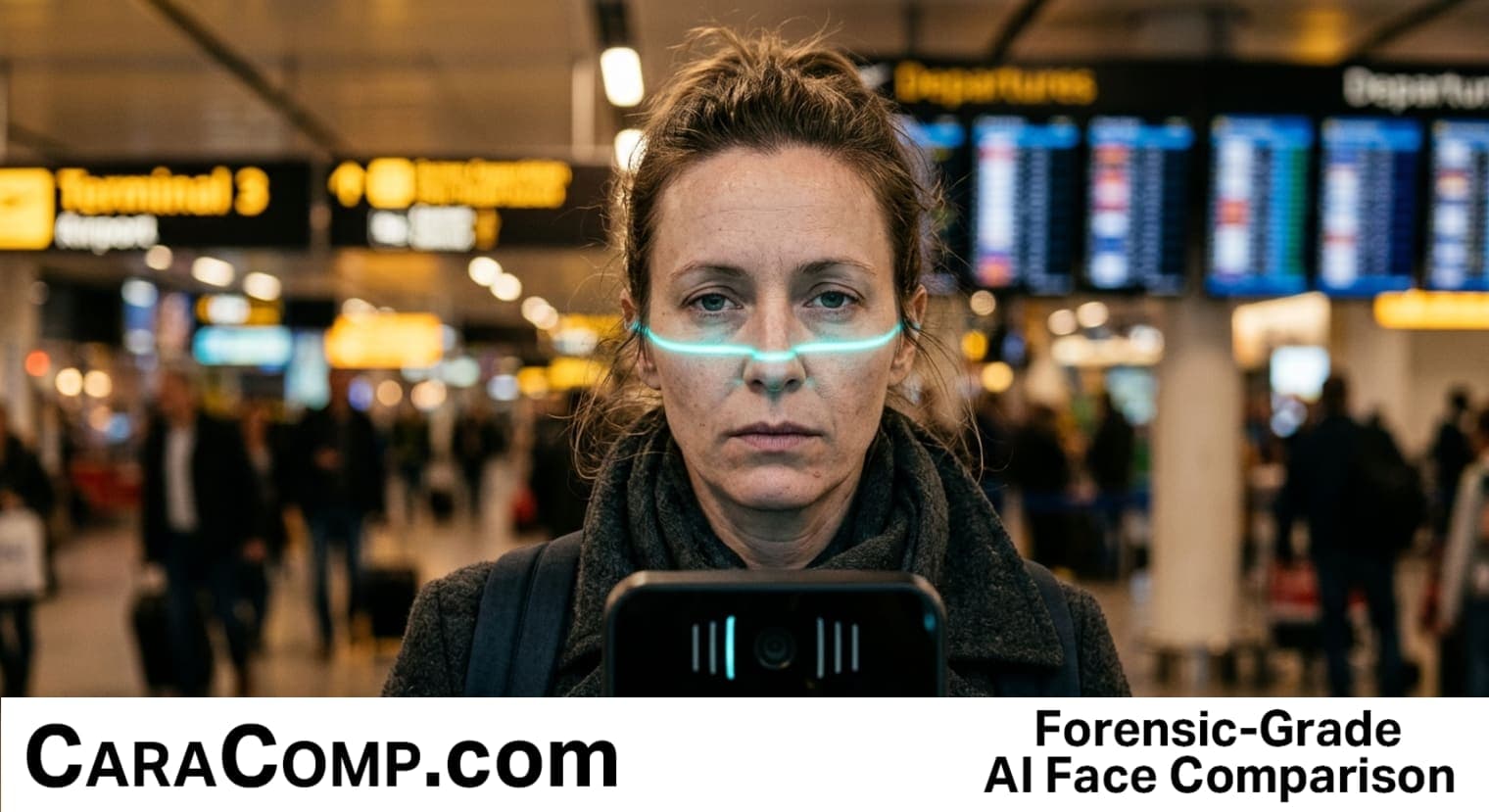
Here's a fact that sounds made up but isn't: the reason you can't smile in a passport photo has nothing to do with looking serious for the government. It's because a computer is about to measure your face like a tape measure measures a table, and a smile moves every single point it needs to check.
Passport photo requirements exist because facial recognition software has to measure your face, not read your expression, and a smile shifts the exact points the machine relies on to confirm you are you.
Passport photo requirements favor a neutral expression because facial recognition systems need a neutral face to accurately measure eyes, nose, mouth and ears, and a grin distorts those measurements enough to cause a rejected application.
Think about how you recognize your best friend across a crowded parking lot. You don't measure anything. You just know it's them, smile, sunglasses, bad haircut and all. That is not how a passport photo gets checked at a border kiosk. A human glances and knows. A machine has no idea what "knowing" even means. It only has coordinates. And that gap between how people see faces and how software sees faces is the whole reason this rule exists.
Passport Photo Requirements: Why the Photograph Must Stay Neutral
Let's start with the stakes, because this is not a trivia question. The most common reason a passport application gets delayed is an improper photo, according to processing guidance from the U.S. State Department. Not a missing signature. Not a wrong fee. A photo that doesn't meet the requirements. If your photo gets flagged, you don't get a phone call. You get a letter or an email asking for a new one, and your application sits in limbo until you fix it or the window closes. If you booked a trip assuming your passport would arrive in three weeks, and instead it sits for six because the agency wants a resubmission, that trip can quietly disappear. That's the real cost of a grin.
Photograph Requirements and Acceptable Photographs Explained
The photograph must be neutral because facial recognition software works by locating specific reference points on your face, the corners of your eyes, the tip of your nose, the edges of your mouth, the position of your ears, and then measuring the distances between them. Change the shape of your mouth with a big smile, and you change several of those distances at once. It isn't one broken measurement. It's a cascade. Acceptable photographs are the ones that keep every one of those points where the software expects to find them.
#1
reason for passport delay: a photo that does not meet requirements This article is part of a series, start with Facial Recognition Software 14 Wrongful Arrests So Far Podca.
Source: U.S. State Department photo guidance
Here's where it gets interesting. A 2020 study published in the journal Information (MDPI) tested how emotional facial expressions affect recognition accuracy, and found that smiling and other exaggerated expressions measurably reduce how accurately a system can match a face, according to reporting from Technology.org. This is not a guess by some bureaucrat who prefers stern faces. It's a documented drop in accuracy, and it's the reason the International Civil Aviation Organization recommends a neutral expression for passport photos across the entire international system, not just in the United States.
How Facial Recognition Measures a Passport Photo, Step by Step
Picture your face broken into a grid of dozens of tiny reference dots, like a connect-the-dots drawing where the dots never move on a resting face. The pupils sit a fixed distance apart. The bottom of the nose sits a fixed distance from the chin. The corners of the mouth sit a fixed distance from the ears. On a neutral face, that grid is stable and predictable. Now smile. Your cheeks lift. Your eyes narrow slightly. Your mouth stretches sideways and sometimes opens. Every one of those dots moves, some by a little, some by a lot, and the system that's supposed to compare your photo to your actual face at a border checkpoint suddenly has to compare a moved grid to a fixed one.
Karolina Turowska, quoted in a piece explaining this exact mechanism, put it plainly: a smile stretches and distorts facial features, especially around the mouth and eyes, and can obscure landmarks the system depends on, according to HuffPost. That's not a style note. That's an engineering constraint.
Smiling can make it harder for facial recognition software to work correctly, as it alters facial proportions and may obscure important landmarks such as the nasolabial folds or the exact positioning of the jawline.
Karolina Turowska, as reported by HuffPost
This is where the analogy really clicks for people. Think of a passport photo the way a machinist thinks of calipers, that metal measuring tool that clamps around a part to check its exact width. The calipers don't care what the part looks like. They care about the distance between two fixed points. If you bend the part before measuring it, the calipers give you a number that no longer matches the part's true shape, and the machinist rejects it. A smile bends your face's shape just enough that the "calipers," in this case, an algorithm scanning your photo, gets a distance reading that doesn't line up cleanly with the version of your face stored elsewhere, whether that's a driver's license, an old passport, or a border database. The part didn't change. The measurement did.
Photo Requirements: What "Facial Image" Actually Means to a Machine
A facial image, in the biometric sense, is not a picture you'd frame. It's a data file made of measurement points. When an applicant submits a photo, the system extracts that data before a human ever looks at it, which is why the color, size, and background of the photo matter just as much as your expression. Photo paper matters too: a print made on the wrong stock can wash out the fine detail an algorithm needs, which is why agencies ask for a proper photographic print rather than an ordinary home printout. Applicants who submit a passport photo printed at home on plain paper are among the most common resubmissions agencies see, since the material itself can distort the measurements. Previously in this series: Deepfake Video Call Police Warn After 622 000 Theft Podcast.
Passport Photo Requirements Compared: Neutral Expression vs. Smiling Photo
| What the photograph must be | What a smiling photo does instead | Status |
|---|---|---|
| Neutral expression, eyes open, mouth closed | Stretched mouth, narrowed eyes, shifted cheeks | Fails to apply cleanly |
| Consistent facial landmarks for identity matching | Distorted nasolabial folds and jawline position | Fails to apply cleanly |
| Plain white background, head coverings only for religious reasons | Often unaffected, but paired with a bad expression it compounds rejection risk | Format still correct |
| Correct photo size and image size per application guidelines | May meet size specs but still fail the facial recognition check | Format still correct |
| Compliant passport photo accepted on first submission | Delayed or rejected application, requiring a new photo | Application rejected |
Notice something in that table: a photo can be the right size, the right color, the right background, and still get rejected purely because of expression. People assume passing the ruler-and-background checklist is the whole game. It's only half of it. The other half is invisible to you but obvious to the algorithm.
Passport Photo Requirements: Why Some Applicants Call the No-Smile Rule Arbitrary
Most people assume the no-smile rule is old-fashioned bureaucracy, like a dress code nobody bothered to update. It feels like the government just prefers serious, unfriendly photos, the same way old mugshots look grim. That assumption makes sense on the surface. Nobody explains the technical reason to applicants standing at a pharmacy photo counter.
But here's the correction, and it's a satisfying one once it lands: the rule isn't about mood, it's about math. The United States doesn't technically outright ban a small, closed-mouth smile, but the State Department strongly recommends a neutral expression precisely because facial recognition technology depends on specific, unchanging cues rather than a human's flexible judgment, according to Yahoo Travel. You were never being judged for cheerfulness. You were being asked to hold still so a measuring instrument could do its job without interference.
This is also why so many countries converge on the same rule. The Government of Canada's official digital photo specification requires the same neutral expression for the identical reason: fraud prevention through consistent biometric measurement. This isn't one country being strict. It's a shared international standard, because passports get checked by machines in dozens of countries that all need to trust the same math when a person applies for either a passport or a visa.
What You Just Learned About Passport Photo Requirements
- 🧠 Machines measure, they don't recognizea passport photo becomes a set of coordinates, not a picture a computer "sees" the way you do
- 🔬 A smile moves multiple landmarks at oncethe mouth, cheeks, eyes and jawline all shift together, corrupting the measurement grid
- 💡 The most common delay isn't paperworkit's a photo that fails these requirements, and that alone can cost you a trip
Application Guidelines: What Else Trips Up an Applicant
Beyond expression, the most frequent mistakes involve background color, head coverings worn for non-religious reasons, glasses that glare or obscure the eyes, and photos sized such that the head is too large or too small in the frame. Every applicant's photo must be sized such that the head is centered and proportioned correctly, because the algorithm needs the face positioned consistently to apply its measurements the same way every time whenever someone chooses to apply. Applicants who plan ahead and apply with a compliant passport photo the first time avoid nearly all of these delays entirely.
CaraComp's own research into how facial recognition systems fail has repeatedly found the same pattern across passports, visas, and ID checks: the technology is brittle in exactly the ways people don't expect. It's excellent at consistency and terrible at flexibility, which is precisely backwards from how humans work.
Passport photo requirements favor a neutral expression because the photograph must be neutral for facial recognition software to measure your face accurately, and getting this one detail wrong is the single most common reason a photo is rejected. Up next: Ai Deepfake Laws 15 736 Victims In Six Months Podcast.
So the next time you're standing against a white background trying not to smile, remember what's actually happening. You're not performing seriousness for a bored government worker. You're holding still for an instrument that can't handle movement, the same way you'd hold still for an X-ray. The machine isn't judging your mood. It's taking your measurements. And once you see it that way, the rule stops feeling arbitrary and starts feeling like the only version of the rule that could ever have worked.
Passport Photo Requirements: Frequently Asked Questions
What are the basic passport photo requirements for size and color?
The photo requirements call for a specific image size, usually 2 by 2 inches for a U.S. passport, printed in full color against a plain white background. The photograph must be recent, taken within the last six months, and show a full face view with eyes open. Sized such that the head fills a set proportion of the frame, the photo also needs to be sharp, unedited, and free of shadows or glare, since a blurry or filtered photo can trigger a rejected application just like a smile can. These are the acceptable photographs an examiner is trained to look for first.
Can head coverings be worn in a passport photo?
Head coverings are generally not allowed unless worn daily for religious reasons, and even then, the face from the bottom of the chin to the top of the forehead must remain fully visible, with eyes open and clearly seen in every submitted passport photo. Sunglasses, hats, and anything that obscures facial landmarks are typically rejected, because the same measurement problem that ruins a smiling photo applies here too. If the applicant's face is partly hidden, the system has fewer reference points to compare, and accuracy drops.
Why does skin appear too smooth in some passport photos, and is that a problem?
When applicants use a phone's beauty filter or a photo booth with automatic retouching, skin appears too smooth in a way that erases fine detail the recognition system relies on for matching. Filters can blur or shift facial landmarks slightly, which creates the same distortion problem as a smile. Passport agencies specifically warn against edited or filtered photos for this reason, and an over-processed photo is treated the same as a noncompliant one, regardless of photo paper or printing method.
Is a small smile ever acceptable in a passport photo?
Guidelines generally ask for a neutral expression with a closed mouth, though a very slight, natural smile without teeth showing is sometimes tolerated depending on the country's specific rules. The safest approach for any applicant is a completely neutral face, since even a subtle smile can shift enough landmarks to cause processing delays. When in doubt, follow the strictest version of the format guidelines rather than testing the limits.
What happens if my passport application gets rejected because of my photo?
The applicant typically receives a letter or email explaining the photo did not meet requirements, along with instructions to submit a new one. The application stays on hold until a compliant photo arrives, and if the applicant misses the deadline, the whole application can be rejected outright, forcing a restart. This is why photo mistakes, not paperwork errors, are the leading cause of passport processing delays.
Do visa photo requirements follow the same rules as passport photo requirements?
Visa photo guidelines closely mirror passport photo requirements because both rely on the same facial recognition matching principles: neutral expression, plain background, correct image size, and no head coverings except for religious reasons. Some countries add extra specifications for a visa applicant, such as different sizing or background shading in an acceptable format, so it's worth checking the specific country's guidelines rather than assuming passport and visa rules are identical in every detail.
Ready for forensic-grade facial comparison?
Full forensic reports with detailed similarity scoring. Results in seconds.
Run My First SearchMore Education
Facial Recognition Glasses: 1 Glance Pulls a Home Address
Two Harvard students turned ordinary-looking smart glasses into a stranger-identifying machine. Here's exactly how the tech chains together, why the "recording light" won't save you, and what to actually check tonight.
digital-forensicsDeepfake AI App: One Photo, 225,000 School Fakes
You made a funny video with a face swap app. Here's what most people don't realize: the app kept the data, and the same tech is now behind a wave of fake porn videos hitting middle schools.
facial-recognitionFacial Recognition Software: 14 Wrongful Arrests So Far
Learn exactly how facial recognition software turns your face into data, why it fails more on some faces than others, and what to do if it ever misidentifies you.