
Online Identity Verification: Why a Passed Face Scan Fails to Get You Approved
Quick answer
What is online identity verification and does it decide loan approval?
Online identity verification confirms that a real person is present and matches the identity they claim, usually by comparing a live face with an ID photo. It does not judge whether someone will repay money. Lending decisions come from a separate risk system, so a face check can pass while an application is still declined.
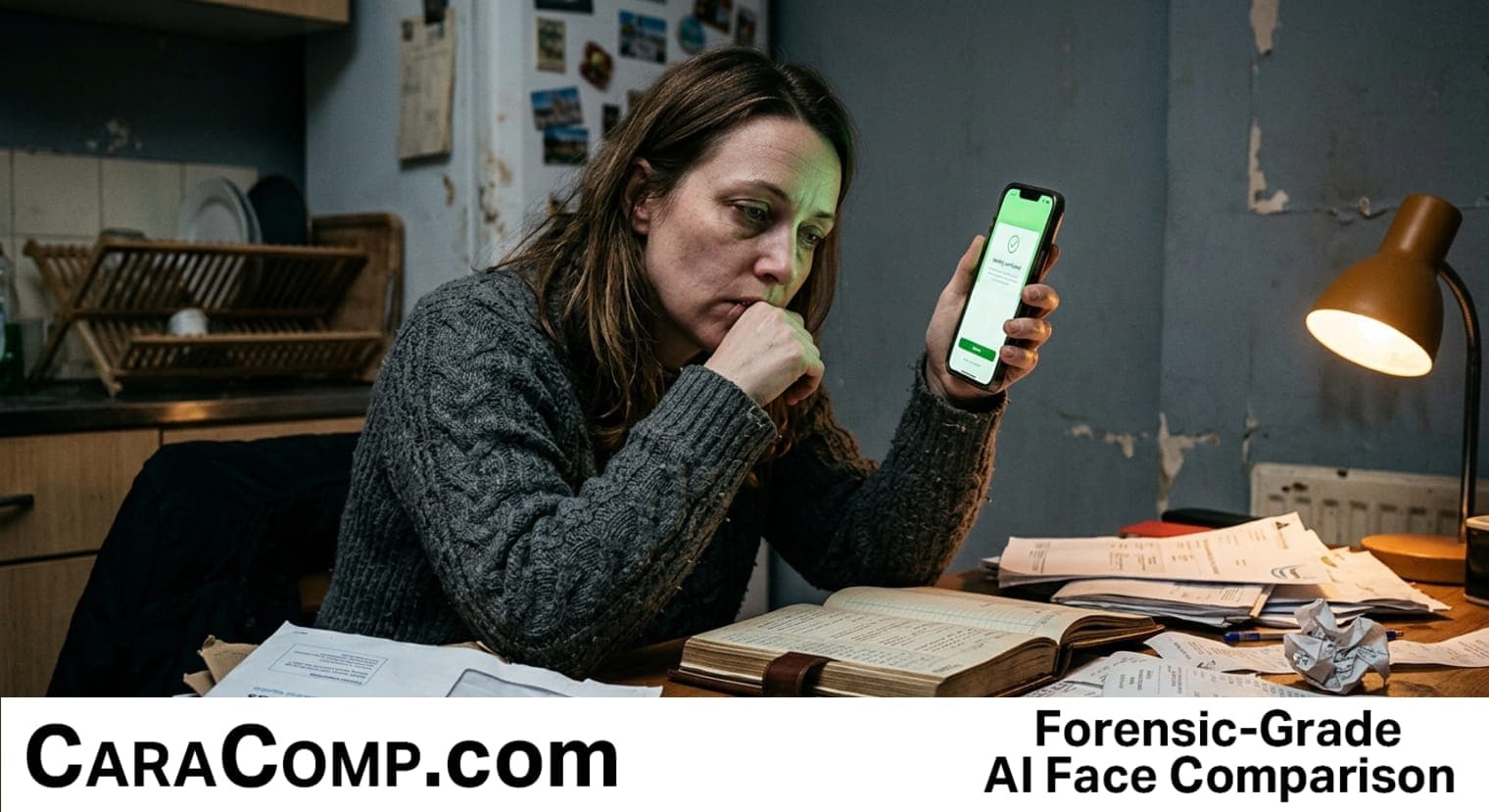
Your face just passed. The camera scanned it, matched it, confirmed you're really you, in under 200 milliseconds. And then, a few seconds later, the loan application still got denied. Wait, what? If the machine just proved you're really you, shouldn't that count for something?
Online identity verification only answers one question, "are you really you?", while a completely separate system decides whether you'll get approved for money, which is why passing a face scan and getting denied for a loan can both happen in the same five minutes.
Online identity verification confirms who you are, not whether a bank should lend you money, those are two different machines doing two different jobs, and knowing which one rejected you is the key to fixing it.
This mix-up happens to smart, careful people constantly. You get a rejection notice from an app or a bank, and your brain does what brains do: it lumps "they scanned my face" and "they said no" into one event. It feels like one decision. It is not. It's two separate machines, built by different teams, running on different data, answering two totally different questions, and a recent move by Seoul Labs shows this split in a clear way.
What online identity verification actually checks (and what it doesn't)
Here's the plain-English version: online identity verification is the process of proving that the person on the other end of a screen is a real, live human, and that they're the specific human they claim to be. It does not, at any point, ask "will this person pay me back?" That's a completely different job, handled by a completely different system, often built by a completely different company.
Think about what actually happens when an id verification system checks you. It usually asks you to hold up a government-issued driver's license or state idsometimes even a passportin front of your camera. The system takes a photo of your face and runs facial recognition software that compares presented data (the live image of your face right now) against the photo printed on your ID. If those two faces line up mathematically close enough, and a liveness check confirms you're an actual breathing person and not a photo of a photo, you pass. That's it. That's the whole job. Providers frequently describe this step as digital identity verification, since every data point involved, the photo, the document scan, the liveness signal, is digital from the moment it's captured.
How facial online identity verification tells a real face from a fake one
This is where it gets genuinely interesting, and it's the part of my world I know best. Facial liveness systems don't just glance at your face, they analyze how light bounces off your skin, whether your face moves in ways real skin moves (tiny muscle twitches, blinking timing, subtle depth), and whether you exist in three dimensions instead of flat on a screen. According to TechTarget, these systems combine motion analysis with skin texture inspection specifically to catch deepfakes and photo spoofing attempts. One giveaway forensic teams look for: in a faked or manipulated image, skin appears too smoothreal human skin has pores, texture, tiny imperfections that AI-generated or over-processed faces often flatten out. That's a single detail among dozens the system checks, and it happens in the background while you're just sitting there blinking at your phone. In many products, this specific step is the selfie verification stage, the moment your live face gets compared against your document photo. This article is part of a series, start with Ai Deepfake Laws Lag As Cloned Voices Drain Family Cash Podc.
Here's the catch nobody tells you: that 99.9% number is describing accuracy at spotting fakes. It says absolutely nothing about whether you pay your bills on time. A system can nail your identity 999 times out of 1,000 and still have zero opinion about your bank balance. Those are unrelated math problems being solved by unrelated code.
Why online identity verification and credit scoring keep getting confused
People conflate these two things because both feel like "proving yourself." You show your face, you show your ID, and it all feels like one big trust exercise. But under the hood, a company running digital identity verification is usually solving a completely different technical problem than the team running credit decisions, even when both live inside the same app.
Take Seoul Labs, a company that recently built a platform combining both pieces on purpose, which is the clearest real-world proof that these are separate systems. According to Biometric Update, the company's platform runs three distinct digital identity models: one that connects to government records, one built for regulated customer checks in financial services, and one that adds face biometrics, liveness detection, and passkey-style logins for people who don't have official government paperwork at all. None of those three models say a single word about repayment. They only answer "is this a real, verifiable person?"
Then, sitting on top of that identity layer, Seoul Labs runs an entirely separate scoring engine. It looks at more than 30 financial and behavioral signals, things like phone and utility bill payments, wallet activity, and other digital patterns, to build a risk profile for people, including plenty who have never had a formal bank loan before. The company's CEO put it plainly, and this quote is basically the whole article in one sentence:
"Without identity, it is difficult to build credit, and without credit, it is difficult to enter formal finance. SuperWallet HACS is intended to connect identity issuance, data-based credit assessment and institution-verifiable evidence in one workflow." Seoul Labs CEO, as quoted by Biometric Update
Read that quote again slowly. He's not describing one system. He's describing three pieces, identity, credit assessment, and verifiable evidence, that had to be deliberately wired together. If proving your identity and earning a credit approval were the same thing, there'd be nothing to "connect." You don't build a bridge between two things that are already the same place.
Digital identity verification versus credit scoring: a real-world comparison
| Question it answers | Online identity verification | Credit scoring | Status |
|---|---|---|---|
| Core purpose | Confirm user identities remotely and stop fraud | Predict how likely someone is to repay money | Separate systems |
| Data used | Photo, driver's license, state id, facial biometric checks, the standard inputs for digital identity verification | Payment history, phone and utility bills, wallet activity, behavior patterns | No overlap |
| Typical result | Pass or fail, live or spoofed | A score or risk tier, not binary | Different outputs |
| Who benefits from a "thin file" | Anyone with a passport, driver's license, or state id can usually pass identity verification | Alternative data helps account holders with no borrowing history still get scored | Independent outcomes |
| What a rejection means | System could not verify you are who you claim during document verification | System judged your financial risk as too high | Different failure points |
| Who to contact | The customer support team handling account setup and onboarding | The lender's risk or underwriting department | Different teams entirely |
The passport-and-landlord analogy for online identity verification
Here's the comparison that finally made this click for me. Identity verification is like passport control at an airport. The officer's entire job is to confirm the face in front of them matches the face on the document. That's it. They are not judging your character, your finances, or whether you'll be a good tenant someday. Credit scoring is the landlord down the street, who couldn't care less what your passport says, they just want to know if you paid your last three landlords on time. You can sail through passport control with zero friction and still get rejected by every landlord in town. Same you, two completely unrelated judges. Previously in this series: Biometric Access 250 Florida Agencies One Contractor Podcast.
The Seoul Labs example shows why thin-file customers prove the split
People without a bank account or credit card, but who still have a valid driver's license or state id and a working phone, pass identity checks constantly. What they lack is a paper trail lenders traditionally use. That's exactly the gap Seoul Labs' address-and-utility-based scoring is built to fill, according to Biometric Update, using alternative signals instead of a credit history that simply doesn't exist yet. This one detail is the strongest proof of all: the same human being can pass one gate flawlessly and still need a completely different tool to clear the second one. If it were one decision, that wouldn't be possible. It also explains why customer onboarding teams increasingly treat identity checks and credit checks as two separate account milestones rather than one combined gate.
What You Just Learned About Online Identity Verification
- 🧠 Two separate machinesidentity verification confirms you're real; credit scoring predicts repayment risk, and they run on different data entirely
- 🔬 Facial checks are just one layerliveness detection analyzes skin texture, depth, and micro-movement to catch spoofed or faked faces before your ID photo is even compared
- 💡 Thin-file customers prove the pointsomeone can pass id verification perfectly and still need alternative data just to get scored for credit at all
- 📋 Ask the right question when denied"was it my identity or my risk profile?" points you to the correct company, department, and fix
How consumers can figure out which system rejected them
So what do you actually do with all this? Next time an app, a bank, or a lender turns you down, don't just accept "the system said no." Ask, specifically: was this a failed identity check, or a credit decision? Companies handling identity verification, or asking you to enter your social security number, are usually running an identity gate first, separate from whatever entity later evaluates your risk. Under U.S. law, if you're denied credit based on a credit-related decision, you're entitled to an adverse action notice explaining why. That notice will not exist, or will look completely different, if what actually failed was authenticationmeaning the system simply couldn't confirm you are who you say you are. In plain terms, identity authentication and credit approval are decided by different teams reading different information, so ask which one actually declined you before you assume the worst.
This is also where fraud gets sneaky in the opposite direction. Security researchers at Cybernews recently documented an Android toolkit built specifically to feed fake, AI-generated selfies into KYC (know-your-customer, the industry term for id verification during customer onboarding) systems, tricking them into thinking a live camera captured a real face. That's an attack on the identity layer specifically, it has nothing to do with tricking a credit engine, because that's simply a different target with a different vulnerability. Security teams sometimes call this specific defense biometric verification, since it relies on physical traits, a face, a fingerprint, rather than a password anyone could type in.
What is identity verification supposed to protect against
Identity verification exists mainly to stop fraudsomeone opening an account using a stolen name, a fake email, or someone else's stolen information. It's an online process that uses digital data points like your photo, ID document, and live face scan to confirm a real person is behind the screen, not a bot or an impersonator using stolen data. In short, identity verification helps confirm that users are genuinely who they claim to be, which is precisely the narrow job it was built to do, nothing about your bank balance included.
Online identity verification only validates an online persona as genuinely you, it never touches your risk, your bank balance, or your loan approval, so a passed face scan and a denied application can absolutely both be true at once.
Companies increasingly bolt these two systems together for convenience, passwordless logins with mfa (multi-factor authentication, meaning more than one proof of who you are, like a face scan plus a code sent to your phone) feed straight into organizations' risk engines in one smooth flow. But smooth doesn't mean merged. Somewhere inside that flow, two separate teams built two separate models with two separate purposes, and knowing that is the difference between arguing with the wrong department for three weeks and fixing the actual problem in one phone call. Up next: Biometric Data Meaning One Face Scan 75 Year Record.
So here's the real aha moment, the one worth remembering the next time a screen says "denied": your face never lied. The camera got it right. What failed, if anything failed, was a judgment about your money, made by a completely different piece of software that has never once looked at your face and never will. Two gates, one door. Know which one is actually closed before you start pushing.
online identity verification: Frequently Asked Questions
What is identity verification, exactly, in plain terms?
Identity verification is an online process that uses digital data points, like a photo of your face, a scan of your driver's license or state id, and sometimes a code sent to your phone, to confirm you are a real person and the specific person you claim to be. It validates an online persona as genuinely belonging to you, and the underlying information collected during this step never gets forwarded to a credit model. It does not evaluate your finances, your risk, or whether a company should approve you for credit, that's a separate decision made by a separate system.
Does a similar identity verification company also decide my credit approval?
No. Identity verification services confirm user identities remotely by checking your passport, driver's license, or state id against a live photo and liveness check, essentially document verification paired with a face match. That's the whole job. Once your identity is confirmed, that data may get passed along to a bank or lender, but the actual credit decision, whether you're approved, denied, or offered certain terms, comes from a completely separate risk-scoring system, often run by a different company entirely.
Why did I pass a facial identity check but still get denied for a loan or account?
Because facial checks and credit checks answer different questions. The facial system confirmed the presented data, your live face, compares accurately against your ID photo, which just proves you're real and you're you, a process some vendors label digital verification or simply verify identity in their app flow. The denial came from a separate risk system analyzing your financial behavior, payment history, or alternative data like utility bills. Passing one has zero bearing on the other, which is exactly why the two get confused so often.
Why do companies ask me to enter my social security number during identity verification?
Companies ask you to enter your social security number because it helps confirm you're the same person tied to an existing verified data set, things like your address, phone, and email history that regulators or credit bureaus already have on file. It's one more identity signal, not a credit judgment. Providing this information helps the identity system confirm user identities remotely; it's a separate step from whatever risk model later decides on approval, and the information itself never influences that later decision.
What should I do if I don't know whether an identity check or credit check caused my rejection?
Ask directly. Under U.S. law, a credit-based denial usually comes with an adverse action notice explaining the reason, often tied to your credit report. If no such notice exists, or if the rejection happened before you ever submitted financial information, it's more likely an identity or fraud check that failed, meaning the company couldn't verify your address, phone, email, or ID document matched their requirements. Ask the support team directly to verify which stage rejected you, since that single question saves weeks of chasing the wrong department for information that won't actually explain the outcome.
Digital identity verification is layered by design: the selfie is one layer, the document another, and the decision engine a third that neither the customer nor the support desk can see.
When people ask what digital identity verification actually checks, the honest answer is: whatever the account requires. A bank account, a brokerage account, and a gaming account each verify different things, and each may verify them with a different vendor.
Identity verification helps confirm that users are who they claim to be, but it does not promise the downstream system will like the information it confirms.
The vocabulary is a maze: document verification reads the ID, selfie verification matches the face, biometric verification measures it, digital verification wraps the whole flow, and identity authentication is what happens every login after.
Customer onboarding is where digital identity fails loudest: a customer who cannot verify identity on the first try rarely tries a second time, and the information they provide on appeal seldom reaches the model that rejected them.
So treat identity verification as a gate, not a verdict. Pass the identity verification step, keep copies of the information you provide, and ask the account team, in writing, which system said no.
Digital identity verification will only grow: every account you open this year will verify more information than the account you opened last year, and the digital identity attached to your name will provide the answer before you do.
The fix for a false rejection is rarely a better selfie. It is a human: ask customer support to escalate to the identity verification vendor, provide the reference number, and make the customer service team verify the decision trail end to end.
Until then, digital identity verification remains what this story shows it to be: a passed face scan, an approved document, and an account decision made somewhere the customer cannot see, three systems, one no, and no information about which said it.
Verify early, verify once, verify with the account you actually plan to use, three rules that spare most people the loop this article describes, and the only advice every digital identity verification vendor agrees on.
And if an institution asks you to provide the same information twice, that is not extra security, that is two identity verification systems that do not share a customer record.
Ready for forensic-grade facial comparison?
Full forensic reports with detailed similarity scoring. Results in seconds.
Run My First SearchMore Education
Identity Theft Affidavit: 3 Mistakes That Sink Victims
A man reported his own identity theft to a bank and was arrested for it. Learn what an identity theft affidavit can and can't do, and the order to file things so you're never left holding only your word.
biometricsBiometric Authentication Meaning: 14 Arrests, Zero Proof
Your phone and a police search can run nearly the same math, yet one is fine and the other has jailed innocent people. Learn the match-versus-proof difference in plain English.
biometricsPassport Photo Guidelines: Why 1 in 4 Photos Get Rejected
Passport photo guidelines read like advice, but a machine often does the first check. Learn what it measures, why rejections come with no explanation, and how to fix them.