
Facial Recognition Glasses: 1 Glance Pulls a Home Address Fast
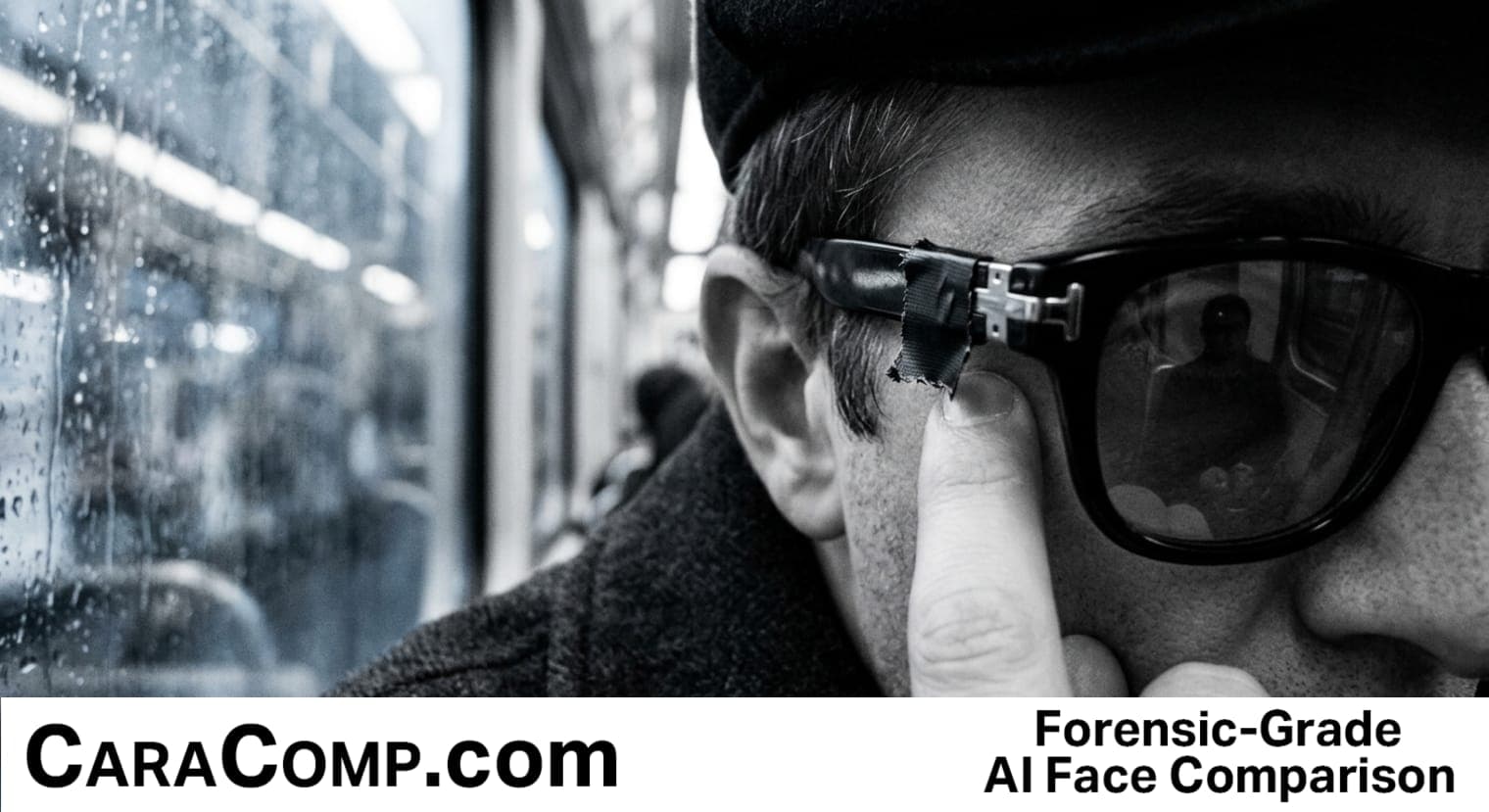
Two Harvard students sat on a train, looked at strangers through a pair of smart glasses, and had those strangers' names, home addresses, and family members pulled up on a phone screen before the train reached the next stop. No app switching. No typing. Just a glance. This is not a scene from a spy movie. It happened, and the tool they built to do it is called facial recognition glasses, and understanding exactly how it works is the difference between feeling paranoid and feeling prepared.
TL;DR: Facial recognition glasses combine three separate, individually legal technologies (a hidden camera, face-matching software, and public data-broker sites) into one chain that can turn a stranger's face into their home address in seconds, and the "recording light" you've been trained to trust is easy to hide.
Facial recognition glasses turn a stray glance at a stranger into a name, an address, and a family tree, in the time it takes to walk past them.
What Facial Recognition Glasses Actually Are, and Why the Light on Ray-Ban Smart Glasses Lies to You
Here's the thing that trips people up: smart glasses look like regular glasses. That's the entire point, and also the entire problem. A pair sitting on someone's face at a coffee shop looks exactly like the pair you'd buy at any optical shop. There's usually a small LED light built in to tell you when the camera is on, a kind of built-in honesty system. Cybersecurity researchers have shown, according to reporting from AOL News, that this light is trivially easy to cover with a small piece of tape or a fingertip while the camera keeps rolling. You are not being paranoid if you assume a stranger's glasses might be recording. You're being accurate.
So what changed? Cameras in glasses aren't new. What's new is what happens after the photo is taken. A single frame from smart glasses with camera hardware can be fed into a facial matching tool that scrapes public photos across the internet, cross references them, and spits out a name in seconds. That name then gets run through a large language model, which infers context, and that context gets fed into data aggregation sites, the kind that already legally exist to sell background checks, and out comes an address, a phone number, an employer, even a sibling's name. Every single step, on its own, is legal. Stacked together, they produce something that feels like it shouldn't be.
How Facial Recognition Glasses Turn One Photo Into a Full Identity
The Harvard project, widely reported as "I-XRAY," strung together three tools that already existed separately: a camera in a pair of glasses, a face recognition search engine, and consumer data broker websites. Forbes described the demonstration as capable of identifying strangers in public and surfacing their home address within moments, according to Forbes. Nobody had to build new spy tech. They just connected dots that were already sitting there in plain sight, which is honestly the scariest kind of vulnerability, because it means the danger was never really about one invention. It was about how easy it's become to link things nobody thought to link before.
The Real Cases: Facial Recognition Glasses Have Already Been Used for Surveillance Without Consent
This isn't hypothetical hand-wringing about a future problem. In September 2026, Paris prosecutors opened a criminal investigation into a wave of complaints tied to a social media trend of using smart glasses to film women on the street without their knowledge, then posting the footage online, according to Yahoo News. Around the same time, French outlets including The Star reported that the child protection group e-Enfance had logged a rise in complaints tied to this exact pattern. This article is part of a series, start with Facial Recognition Software 14 Wrongful Arrests So Far Podca.
In July 2026, police in Seoul opened an investigation into a man who used AI-powered smart glasses to secretly film a woman during a date and then distributed the footage on social media, according to reporting summarized by Medium. In January 2026, a 47-year-old man in the UK who secretly filmed an intimate encounter using smart glasses, then sent the woman the video afterward, was spared jail time, according to reports circulated on Reddit. And in October 2025, a California university sent out a warning after a man wearing camera-equipped smart glasses approached women in public with unwanted comments while recording the interactions for social media, a case documented by FOX 11.
Content creators wearing the glasses would approach a young woman, film her without her knowledge, then post footage designed to "provoke a reaction, make her uncomfortable or place her in an embarrassing situation."
reported by National Law Review
Notice the pattern across every one of these cases. It's never a stranger with obvious spy gear. It's someone across the room, on a date, or on public transit, wearing something that looks like ordinary eyewear. The camera isn't the scary part by itself. It's that nobody in the room has any reliable way to know it's there. This pattern of quiet surveillance, repeated across three continents in under a year, is the meta point of every case above: privacy erodes one ordinary looking device at a time.
Facial Recognition and Face Recognition: What's the Difference in Plain English
People often use facial recognition and face recognition to mean the same thing, and honestly, in casual conversation, they basically are. Face recognition usually refers to the raw technical process, a computer measuring the geometry of a face (distance between eyes, shape of the jaw, that kind of thing) and comparing it to a database. Facial recognition is the umbrella term for the whole system, including what happens with the match once it's made. The distinction matters less than the fact that both, when built into smart glasses, remove the one thing that used to protect strangers: the fact that identifying someone used to take effort.
Public Retail Smart Glasses and Android Apps: What They Can and Cannot See
Not every pair of camera glasses on the market runs facial recognition. This distinction changes what retail hardware does: camera-equipped smart glasses record video and audio, but do not identify people on their own. Neither major retail model has built consumer-facing facial recognition or face matching directly into the product, according to the reporting reviewed for this piece. The identification step, the part that turns a face into a name, comes from separate tools, sometimes a companion android app, that a person chooses to bolt on afterward, like the I-XRAY demonstration did. That means the raw hardware most people can buy today records first, and identifies never, unless a person deliberately adds that capability themselves.
| What the camera alone does | What facial recognition adds on top | Privacy status |
|---|---|---|
| Records video or a photo of a person nearby | Matches that photo against public images to identify people by name | Anti privacy risk grows once identification is added |
| Stores footage on the device or a linked app | Feeds the match into data broker sites for address, phone number, relatives | Ban candidate in some jurisdictions for this specific use |
| Visible only if the wearer shares or posts it | Instant identification the moment the photo is taken, no posting required | Surveillance concern for bystanders |
| Legal in most public places under existing privacy rules | Legal step by step, but the combined result raises new privacy and security questions | Under active review |
What You Just Learned About Facial Recognition Glasses
- 🧠 The recording indicator isn't reliablea light can be covered with tape while the camera keeps recording, so it's not proof either way.
- 🔬 Identification is a separate step from filmingthe glasses themselves don't recognize you; a person has to choose to run the photo through outside face recognition tools.
- 💡 Each piece is legal on its ownthe camera, the data-matching software, and the address lookup sites are all separately legal, which is exactly why the combination slips through the cracks. Privacy law simply hasn't caught up to the chained result.
- 🕵️ Real cases are already documentedfrom Paris to Seoul to California, this has happened to real people, not hypothetical ones.
Facial Recognition Glasses in Public: Is There Any Feature That Protects Privacy?
Right now, the honest answer is: not really, not a reliable one. There's no industry-wide feature that guarantees a bystander knows they're being recorded, and there's no legal requirement in most places that forces a glasses wearer to disclose it, especially in a public space where people already expect less privacy. Some jurisdictions are starting to respond after the fact, like the Paris investigation, but that's enforcement after harm, not a built-in safeguard. Legal analysts quoted by the National Law Review noted that the harm frequently lands on people who never bought the glasses and never agreed to anything, the partner across the table, the stranger on the platform, the person just trying to get through their day. Privacy advocates argue that until manufacturers build in a reliable, tamper-resistant recording indicator, the burden of protecting personal privacy will keep falling on bystanders who have no way to opt out. Previously in this series: Social Media Age Verification Laws 3 Checks 3 Data Risks.
Why People Assume Smart Glasses Are Obviously Visible
It's a completely reasonable assumption, and here's why so many of us make it. Manufacturers added the LED specifically to build trust, and it's natural to think a company would only add a safety feature that actually works reliably. Most of us also grew up assuming recording devices look like recording devices, bulky, obvious, pointed at you. Smart glasses broke that mental model entirely. They look identical to the reading glasses your uncle wears. There's no bulge, no red blinking box, nothing that triggers your brain's "camera nearby" instinct. The reality is that the glasses look ordinary because they genuinely are ordinary, that's the entire selling point to the person wearing them, and it's exactly the thing that removes your ability to notice.
Biometric Data, Privacy, and Security: What People Should Actually Watch For
Think about it like this. Imagine every person you passed on the street was quietly handed a folder with your name, your address, and your sister's phone number, just because they glanced at your face for two seconds. That's not a metaphor stretched for effect, it's a fairly literal description of what the Harvard demonstration showed was possible using tools that already existed. Your face is biometric data, meaning it's body information that is uniquely, permanently yours, unlike a password you can change. Once face recognition software has matched it to a public photo somewhere, that link doesn't expire. That's what makes this different from someone snooping through your mail. Your mail can be locked. Your face is on your face.
So what should a person actually do? Start by treating public spaces the way you'd treat any place with a security camera, which is to say, assume you might be recorded and behave accordingly, especially around anything intimate or private. If you're on a date, meeting someone new, or in a one-on-one setting, it's fair to simply ask whether the person is wearing recording glasses. Awkward for three seconds, but it's a reasonable question given what's now documented. Protecting your privacy in these moments costs nothing but a little social awkwardness, which is a fair trade. If you ever discover footage of yourself was taken without consent and shared, screenshot everything immediately, report it to the platform where it was posted, and if it involves harassment, stalking, or an intimate encounter, that's a police matter, not just a platform complaint. This is also where facial recognition expertise becomes useful for regular people, not just for tech companies. Understanding exactly how a match gets made, and which laws already cover nonconsensual recording, is what turns a scary headline into something you can actually act on.
Facial recognition glasses don't need new spy technology to expose you, they just need three legal tools stacked together, and face recognition works the same whether the camera is in a phone or hidden behind an ordinary-looking lens. Privacy, in this context, is only as strong as the weakest link in that chain.
If this were happening to you tonight, at a bar, on a train, at your kid's school pickup, would you know where to look first? Most people's eyes go straight to the frames, checking for a blinking light that, as you now know, proves almost nothing. The smarter move is watching for the pattern: someone lingering a beat too long with their head tilted your direction, footage that surfaces online days later with a caption that doesn't match what actually happened. The glasses were never the whole story. The whole story is the invisible chain running behind them, and now you know exactly where each link is.
Facial Recognition Glasses: Answers on Privacy and Surveillance
Can facial recognition glasses identify people just by looking at them?
Not on their own. Most retail smart glasses only record photo or video, they don't run facial recognition automatically. Identifying a stranger requires someone to separately upload that photo to face recognition software and cross reference it against public images and data broker sites, a process demonstrated by Harvard students using existing, separately legal tools chained together, which is why privacy experts keep pointing back to the combination rather than any single piece. Up next: Social Media Age Verification Laws 3 Checks 3 Data Risks.
Do retail smart glasses have built in face detection?
No public reporting indicates that retail smart glasses ship with built in face detection or facial recognition for consumers. Like most camera-equipped smart glasses on the market, they record video and audio, and any identification of people shown in the footage would require a separate, third party face recognition tool applied afterward, not a built in feature of the glasses themselves, which keeps the privacy burden on whoever chooses to add that tool.
How do I know if someone's smart glasses are recording me in public?
There is no fully reliable way to know for certain. Most smart glasses include a small LED recording light, but researchers have shown it can be covered with tape while filming continues. In public settings, courts have generally allowed recording without consent, so the safest approach is simply asking directly if you're concerned, particularly in private or intimate settings, and reporting any nonconsensual footage you discover to the platform and, if it involves harassment, to police, since surveillance of this kind can escalate quickly.
Is it legal to film people with smart glasses without telling them?
It depends heavily on location and context. In most public places, recording without spoken consent is not automatically illegal. But several real cases, including the Paris investigation into street harassment and a UK case involving a secretly filmed intimate encounter, show that when footage is used to harass, humiliate, or distribute someone's private moments, it can cross into criminal territory, which is exactly why prosecutors in multiple countries have opened surveillance investigations.
What information can someone get from just a photo of my face?
More than most people expect. Facial recognition software can match a single photo against public images online to surface a name. From there, that name can be run through data aggregation sites, the same sites used for background checks, to pull a home address, phone number, employer, and even names of relatives, all within seconds, according to the Harvard demonstration widely reported by outlets including Forbes.
Are smart glasses with camera features banned anywhere?
As of the most recent reporting, there is no widespread ban on smart glasses with camera hardware in major markets. Instead, regulators and prosecutors, including those in Paris, are pursuing enforcement against specific harmful uses, like nonconsensual filming and harassment, rather than banning the devices themselves. This mirrors how most privacy law works: the hardware is legal, but certain uses of it are not.
Ready for forensic-grade facial comparison?
Full forensic reports with detailed similarity scoring. Results in seconds.
Run My First SearchMore Education
Passport Photo Requirements: Why a Smile Breaks the Math
The no-smile rule isn't etiquette. Learn how facial recognition measures your face, why a grin breaks the math, and how to avoid a rejected passport application.
digital-forensicsDeepfake AI App: One Photo, 225,000 School Fakes
You made a funny video with a face swap app. Here's what most people don't realize: the app kept the data, and the same tech is now behind a wave of fake porn videos hitting middle schools.
facial-recognitionFacial Recognition Software: 14 Wrongful Arrests So Far
Learn exactly how facial recognition software turns your face into data, why it fails more on some faces than others, and what to do if it ever misidentifies you.