
Biometric Data Meaning: One Face Scan, 75-Year Record
Quick answer
What is the meaning of biometric data and why is it sensitive?
Biometric data is information built from measurable body traits, such as a face, fingerprint, iris or voice, converted into a digital pattern a computer can compare. Many privacy frameworks class it as sensitive or special category data because you cannot change your face the way you change a password.
Here's a fact that should stop you mid-scroll: the second your face gets scanned at an airport kiosk, you're actually answering two completely different questions at the same time, and you probably only know you're answering one of them. Question one: "Is this really you?" That part takes about a fifth of a second and it's honestly kind of amazing. Question two: "Who else gets a copy of this, and for how long?" That part can run for 75 years. Nobody reads you that fine print at the gate.
The biometric data meaning behind an airport face scan isn't just "does the photo match my passport", it's a legal and technical process where your unique physical characteristics get captured, compared, and then routed through multiple federal systems that can store the record for decades.
Biometric data meaning, in plain terms, is this: your face, fingerprints, or iris pattern turned into numbers a computer can compare, and once that comparison happens, the resulting record doesn't just disappear, it can travel to five or more government systems and sit there for decades.
What Does Biometric Data Meaning Actually Cover At The Airport, And Why San Francisco Activists Are Pushing Back
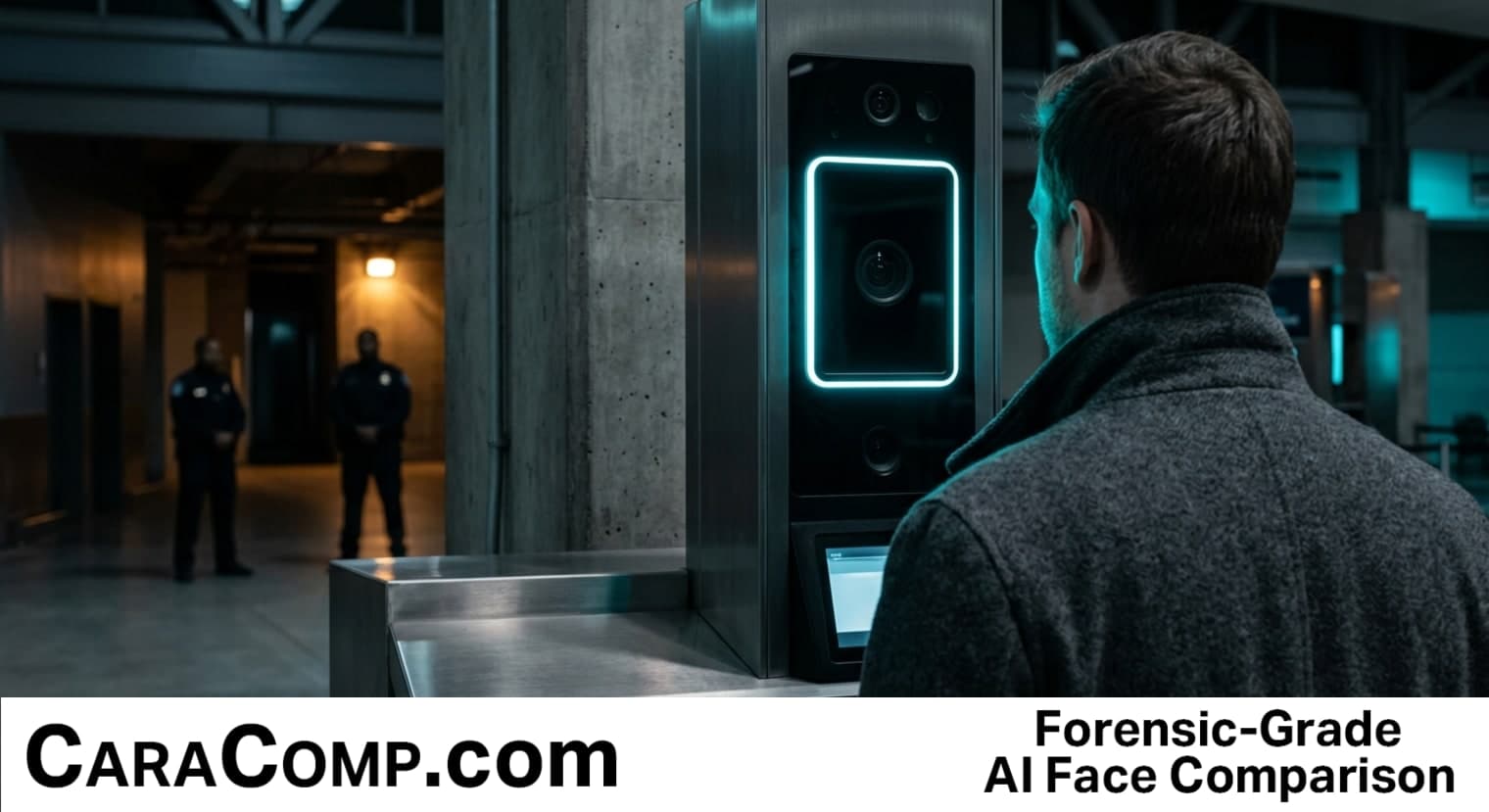
Let's start with San Francisco, because it's the clearest real-world example of this exact problem playing out right now. SFO uses "FacePods", basically camera kiosks, supplied by a company called SITA, under a contract reportedly worth $9.8 million, according to reporting from Biometric Update. Local activists showed up to airport commission meetings and said, in effect: wait, we didn't sign up for this. Not because the cameras don't work. They work fine. The objection is about what happens the instant after the camera confirms "yep, that's the guy on the passport." That photo, and the metadata that comes with it, gets sent automatically to the Department of Homeland Security. Airport officials, according to the reporting, don't have the option to turn that off. It's baked into the contract.
That's the part that catches people off guard. We tend to think of a biometric check the way we think of unlocking a phone, you, your device, done, nobody else involved. An airport face scan is not that. It is, by design, a data-sharing event with a government agency built into the transaction from the start.
Biometric Data Definition In Practical Terms: Match Speed Versus Data Retention
The biometric data definition that actually matters here has two halves that move at wildly different speeds. The match itself, comparing your live face against your passport photo, happens in under a second, using automated recognition that measures things like the distance between your eyes or the shape of your jawline. The retention half is a different animal entirely. For U.S. citizens, comparison images are typically deleted quickly once identity is confirmed. For non-citizens, the photo and related data can be kept for up to 75 years in a central biometric database called IDENT, run by DHS's Office of Biometric Identity Management.
75
years non-citizen facial and fingerprint data can legally sit in DHS's IDENT database This article is part of a series, start with Ai Deepfake Laws Lag As Cloned Voices Drain Family Cash Podc. This article is part of a series, start with Ai Deepfake Laws Lag As Cloned Voices Drain Family Cash Podc. This article is part of a series, start with Ai Deepfake Laws Lag As Cloned Voices Drain Family Cash Podc. This article is part of a series, start with Ai Deepfake Laws Lag As Cloned Voices Drain Family Cash Podc. This article is part of a series, start with Ai Deepfake Laws Lag As Cloned Voices Drain Family Cash Podc. This article is part of a series, start with Ai Deepfake Laws Lag As Cloned Voices Drain Family Cash Podc. This article is part of a series, start with Ai Deepfake Laws Lag As Cloned Voices Drain Family Cash Podc. This article is part of a series, start with Ai Deepfake Laws Lag As Cloned Voices Drain Family Cash Podc. This article is part of a series, start with Ai Deepfake Laws Lag As Cloned Voices Drain Family Cash Podc. This article is part of a series, start with Ai Deepfake Laws Lag As Cloned Voices Drain Family Cash Podc. This article is part of a series, start with Ai Deepfake Laws Lag As Cloned Voices Drain Family Cash Podc. This article is part of a series, start with Ai Deepfake Laws Lag As Cloned Voices Drain Family Cash Podc. This article is part of a series, start with Ai Deepfake Laws Lag As Cloned Voices Drain Family Cash Podc. This article is part of a series, start with Ai Deepfake Laws Lag As Cloned Voices Drain Family Cash Podc. This article is part of a series, start with Ai Deepfake Laws Lag As Cloned Voices Drain Family Cash Podc. This article is part of a series, start with Ai Deepfake Laws Lag As Cloned Voices Drain Family Cash Podc. This article is part of a series, start with Ai Deepfake Laws Lag As Cloned Voices Drain Family Cash Podc. This article is part of a series, start with Ai Deepfake Laws Lag As Cloned Voices Drain Family Cash Podc. This article is part of a series, start with Ai Deepfake Laws Lag As Cloned Voices Drain Family Cash Podc.
Source: DHS / reporting via reclaimthenet.org
The Data Pathway: How Biometric Recognition Systems Route Your Identity After The Match
A single face scan doesn't just ping one database and stop. According to the researcher's review of DHS systems, the traveler verification pipeline connects into at least five separate places: the Automated Targeting System, the Arrival and Departure Information System, Enhanced Passenger Processing, plus TSA and CBP's own operational systems, all eventually feeding into IDENT. Think of your face as a key that opens more doors than you realize it opens. You thought you were unlocking one gate. You were actually handing a copy of that key to five different landlords.
Each of those systems has its own rules about who can look at your record and why. That matters because of what happened next in the San Francisco case. Reporting cited by the researcher, and covered in more detail by Mission Local, describes information shared with Customs and Border Protection being able to trigger alerts to Immigration and Customs Enforcement, alerts that in at least one documented case led to a warrantless arrest at the airport itself, not at a border checkpoint. The face match created no legal problem on its own. The data pathway that followed it did.
Most airline passengers are not aware that when they purchase a plane ticket to travel within the United States, the information they share with airlines is then sent to the Transportation Security Administration and Customs and Border Protection, and, beginning last year, to Immigration and Customs Enforcement.
reporting via Biometric Update
This is the piece nobody explains at the kiosk. You consented to identity verification. You may not have realized you were also consenting to be a node in a much bigger data-sharing architecture involving homeland security databases you'll never see the inside of.
Biometric Authentication Versus Biometric Data Sharing: What's Actually Different
Biometric authentication is the yes/no moment, does this face match this passport, at a certain confidence threshold. Biometric data sharing is everything that happens after "yes." One is a technical calculation. The other is a policy decision about which agencies get a copy, how long they keep it, and what they're allowed to do with it. Confusing the two is the single biggest misunderstanding travelers have about airport scans. This article is part of a series, start with Ai Deepfake Laws Lag As Cloned Voices Drain Family Cash Podc.
Correcting The Big Misconception About Biometric Recognition Accuracy
Most people assume the whole controversy around facial scanning is about whether the technology works. Understandable, we've all heard the accuracy numbers. Modern biometric recognition systems can hit accuracy rates north of 99% in controlled conditions, so it's natural to think "if it's that accurate, what's the problem?" People focus on the math because the math is the part that gets marketed to us. Previously in this series: Biometric Data Meaning One Face Scan 75 Year Record Podcast. Previously in this series: Age Verification Roblox National Id And Selfie May Replace B. Previously in this series: What Is Digital Identity Verification 3 Checks Not One. Previously in this series: What Is Digital Identity Verification 3 Checks Not One Podca. Previously in this series: Texas Age Verification Law The Sites That Never Ask. Previously in this series: Texas Age Verification Law The Sites That Never Ask Podcast. Previously in this series: Ai Deepfake Images 200 Charges For Kids Photographer. Previously in this series: Ai Deepfake Images 200 Charges For Kids Photographer Podcast. Previously in this series: Roblox Age Verification Bypass A Fake Birthdate Still Works. Previously in this series: Roblox Age Verification Bypass A Fake Birthdate Still Works. Previously in this series: Biometric Access 250 Florida Agencies One Contractor. Previously in this series: Biometric Access 250 Florida Agencies One Contractor Podcast. Previously in this series: Online Identity Verification Why A Passed Face Scan Fails. Previously in this series: Online Identity Verification Why A Passed Face Scan Fails Po. Previously in this series: Facial Age Estimation Meta Sets A 3 Error Limit. Previously in this series: Facial Age Estimation Meta Sets A 3 Error Limit Podcast. Previously in this series: Deepfake Phishing A Student Faked A Teacher In Jeju. Previously in this series: Deepfake Phishing A Student Faked A Teacher In Jeju Podcast.
But accuracy and privacy are answering completely different questions. A facial comparison that is 99.9% accurate still generates a record. That record still gets copied to multiple federal processing systems. It can still trigger an ICE alert. It can still sit in a database for 75 years. None of that changes whether the algorithm got the match right. The controversy was never really about the match. It's about the paperwork trail that match creates, and that trail is invisible to the traveler standing at the kiosk, tired, holding a boarding pass, just trying to make their flight.
This is honestly a forgivable mix-up. Companies that build biometric authentication tools love to talk about accuracy percentages because accuracy sounds reassuring and finite, a number you can trust. Nobody puts "and here's our 75-year retention policy" on the splash screen. So travelers end up evaluating the wrong variable. They're grading the test when they should be asking who gets to see the transcript.
| What the facial match handles | What the data-sharing step handles |
|---|---|
| Confirms identity in under a second | Determines which agencies receive the record |
| Uses distinctive, measurable physiological points on your face | Sets retention length, hours for citizens, up to 75 years for non-citizens |
| Governed by algorithm accuracy and testing | Governed by contracts, laws, and interagency data-sharing rules |
| Visible to the traveler at the kiosk | Largely invisible until something goes wrong |
| A processing event | A governance and risk decision |
Why This Distinction In Biometric Data Meaning Matters For Everyday Travelers
So why should you, a person who just wants to get through security and buy an overpriced pretzel, care about any of this? Because the next time a kiosk asks to scan your face, you're not just answering "is this me." You're also agreeing, often without being told, to a second, much longer-running process. That's the aha moment here, and it's worth sitting with: the match takes seconds, but the data pathway behind it can run for decades, and it can involve agencies whose job has nothing to do with whether your face matches your passport.
At CaraComp, this is exactly the kind of distinction we spend our time untangling, the gap between "does the facial recognition work" and "where does the resulting identity record actually go." Those are two separate risk categories, and treating them as one is how people end up surprised.
What You Just Learned About Biometric Data Meaning
- 🧠 A match is not the end of the processafter your face is confirmed, the resulting record can be automatically routed to multiple federal systems, not just stored locally.
- 🔬 Accuracy and privacy are separate questionsa technically perfect facial match still creates a data-sharing event with its own separate rules.
- 💡 Retention varies wildly by categoryU.S. citizens' comparison photos are typically deleted quickly; non-citizens' data can be kept for up to 75 years in IDENT.
- 💡 Downstream alerts have real consequencesdata shared with CBP has, in at least one documented case, triggered ICE involvement at an airport, not just at a border crossing.
Biometric Data Meaning In Law: Sensitive And Special Category Information
Under many privacy frameworks, biometric data counts as "special category" or sensitive data used for very specific purposes, a legal recognition that this isn't like your email address or shipping history. It's data derived from your body, and laws in places like the EU treat it with extra caution precisely because it's permanent. You can change a password. You cannot change your face.
How Facial Recognition Fits Into Broader Identity Verification And Fraud Prevention
Biometric checks aren't only used at borders. Banks use similar identity verification tools to fight fraud, employers use them for building access, and phones use them to unlock your apps. The security logic is the same everywhere: use something uniquely yours instead of something that can be stolen, like a password. The difference at the airport is scale and government access, a bank's fraud team isn't connected to five federal databases.
The real biometric data meaning behind a travel identity check is a process that identifies you in seconds but hands your unique physical characteristics to a data-sharing system that can outlive the trip by decades, matching accuracy and data governance are two separate questions, and only one of them ends at the gate. Up next: Biometric Data Meaning One Face Scan 75 Year Record Podcast. Up next: Biometric Data Meaning One Face Scan 75 Year Record Podcast. Up next: Biometric Data Meaning One Face Scan 75 Year Record Podcast. Up next: Biometric Data Meaning One Face Scan 75 Year Record Podcast. Up next: Biometric Data Meaning One Face Scan 75 Year Record Podcast. Up next: Biometric Data Meaning One Face Scan 75 Year Record Podcast. Up next: Biometric Data Meaning One Face Scan 75 Year Record Podcast. Up next: Biometric Data Meaning One Face Scan 75 Year Record Podcast. Up next: Biometric Data Meaning One Face Scan 75 Year Record Podcast. Up next: Biometric Data Meaning One Face Scan 75 Year Record Podcast. Up next: Biometric Data Meaning One Face Scan 75 Year Record Podcast. Up next: Biometric Data Meaning One Face Scan 75 Year Record Podcast. Up next: Biometric Data Meaning One Face Scan 75 Year Record Podcast. Up next: Biometric Data Meaning One Face Scan 75 Year Record Podcast. Up next: Biometric Data Meaning One Face Scan 75 Year Record Podcast. Up next: Biometric Data Meaning One Face Scan 75 Year Record Podcast. Up next: Biometric Data Meaning One Face Scan 75 Year Record Podcast. Up next: Biometric Data Meaning One Face Scan 75 Year Record Podcast.
Next time you step up to one of those airport cameras, try this thought experiment: imagine the kiosk had two separate buttons instead of one camera. Button one says "Verify my identity." Button two says "Share this record with federal agencies for up to 75 years." Right now, both buttons get pressed at once, and only one of them is visible. That's not a glitch in the system. That's the system working exactly as designed, you just weren't told there were two buttons.
biometric data meaning: Frequently Asked Questions
What is the biometric data meaning in simple terms?
Biometric data meaning refers to information derived from your biological, distinctive, measurable physiological traits, your face, fingerprints, iris pattern, or voice, turned into a digital format a computer can compare. It's a process that identifies you based on human characteristics rather than something you carry, like a card, or something you know, like a password. Because it's tied to your body, it's treated as more sensitive than most personal identification records.
How does automated recognition confirm identity at an airport?
Automated recognition works by mapping unique physical characteristics on your face, spacing between eyes, jawline shape, nose bridge, into a numeric pattern, then comparing that pattern to a stored reference photo, like your passport image. The calculations related to that comparison happen in under a second. A close enough score counts as a match. This detection step is separate from what happens to your data afterward.
Why does San Francisco DHS biometrics data-sharing worry privacy activists?
San Francisco activists object because SITA's FacePods automatically send biometric data to DHS with no opt-out for airport officials, according to Biometric Update's reporting. Their concern isn't accuracy, it's that CBP-shared data can trigger ICE alerts, which in one documented case led to a warrantless arrest at the airport. The worry is about governance and oversight of data individuals didn't fully realize they were sharing.
Is biometric data considered special category information under privacy law?
Yes. Many privacy frameworks classify biometric data as special category or sensitive data used only for narrow, specified purposes, precisely because it's permanent and uniquely tied to individuals. Unlike a password, you can't reset your fingerprint or face if it's compromised. This is part of why governance around retention periods, like the 75-year window in DHS's IDENT database, draws scrutiny from privacy advocates and lawmakers alike.
What types of biometric authentication methods exist besides facial scans?
Common biometric authentication methods include fingerprint scanning, iris and retina scanning, voice recognition, and hand geometry, each measuring different body measurements or behavioural traits unique to a person. Airports and border agencies increasingly combine several methods for stronger verification. Each method carries its own accuracy rate, storage requirements, and risk profile, but all fall under the same broader biometric data meaning: physical or behavioral traits used for identity verification. Previously in this series: Texas Age Verification Law 25 States Now Demand Id Checks.
Does biometric data get deleted after an airport identity verification?
It depends who you are. For U.S. citizens, comparison photos are generally deleted quickly once a match is confirmed, according to DHS policy summaries. For non-citizens, however, photos and related data used for identity verification can be retained for up to 75 years in the IDENT database, feeding into other homeland security systems like the Automated Targeting System. Retention rules, not the accuracy of the match, determine how long your record persists.
Biometrics is simply the science of measuring the body to tell one person from another, and biometric data is what those measurements become once a system stores them.
A biometric identifier is any measurement precise enough to point at one individual: a biometric template built from your face, a biometric sample of your voice, or a fingerprint map.
Identification and verification are different jobs: identification asks who this is, while a security check that confirms a claimed name is verification, and biometrics can do both.
NIST, the U.S. standards body, publishes the tests most security vendors use to prove their biometrics actually work, so a NIST benchmark is worth more than any marketing page.
Under most modern rules, biometric information sits in a protected class of its own: data protection law treats it as a special type because you cannot reset your face the way you reset a password.
Security teams like biometrics for access control because a badge can be shared but a face cannot; the trade-off is that a breach of biometric data is permanent.
Behavioral characteristics count too: the rhythm of your typing and the way you walk are behavioral characteristics that systems can use for identification just like physical features.
A biometric feature is one measurable detail; biometric features combined make the template that systems use to uniquely identify a person.
Biometric verification, matching a live scan against stored biometric data, is how phones handle secure access millions of times a day.
Biometric identification, by contrast, searches a whole gallery, which is why regulators watch it more closely and why security reviews score it as higher risk.
The phrase data that is related to your body covers more than scans: an individual biological trait like your DNA and even their biological signals like heart rhythm qualify.
A system that recognizes human characteristics uses unique physical traits, face geometry, iris texture, hand shape, and turns them into numbers a computer can compare.
For individuals, the practical question is access: who can access the template, how long it is kept, and what security protects it at rest. Up next: Biometric Data Meaning One Face Scan 75 Year Record Podcast.
Companies sorting individuals based on face scans must publish a retention schedule; the seventy-five-year figure in this story is what happens when nobody sets one.
Cybersecurity practice says to treat biometric data like a crown jewel: encrypt it, log every access, and never let one vendor hold identification power without oversight.
Good security here is boring: short retention, clear consent, audited access, and biometrics used for verification rather than blanket identification.
Strong authentication can layer a passcode on top of biometrics, so losing one factor never means losing the whole account to a security failure.
Parents should ask schools three questions: what biometric data is collected, which security standard (ask for NIST) governs it, and when identification records are deleted.
The safest deployments keep biometrics on the device: the template never leaves, access stays local, and a server breach exposes no biometric information at all.
When a vendor cannot answer where biometric information lives, assume the security answer is nowhere good, and take your identification business elsewhere.
Privacy regulators increasingly require a risk assessment before biometrics launch, and the security of storage is the first thing they audit.
Features like liveness checks stop photos from fooling a scanner, and secure enclaves keep the template out of reach even when a phone is stolen.
The individuals who fare best treat every face scan like a signature: rare, deliberate, and given only to systems whose security they can name.
Access logs are the unsung hero of biometric security: they turn an invisible identification system into one that individuals can hold to account.
A secure system announces its limits; a risky one promises perfect identification, and perfect is the word that should make a security reviewer reach for the audit checklist.
Biometrics will keep spreading because convenience wins, so the realistic goal is not refusal but secure, accountable use of biometric data with security defaults individuals never have to configure.
Ready for forensic-grade facial comparison?
Full forensic reports with detailed similarity scoring. Results in seconds.
Run My First SearchMore Education
Passport Photo Guidelines: Why 1 in 4 Photos Get Rejected
Passport photo guidelines read like advice, but a machine often does the first check. Learn what it measures, why rejections come with no explanation, and how to fix them.
biometricsBiometric Information: One Face Scan Can Cost a Firm $5,000
A company can owe you money for saving your face even if nothing bad ever happens. Learn how one clause decides who pays, and where to look first.
biometricsBiometric Digital ID: One Leak Opens Every Door, Forever
One card that opens every door sounds great until it leaks. Learn how a biometric digital id really works, why a 99 percent match isn't proof, and where to look first.