
Anti Facial Recognition Makeup: Built to Fool 2001 Cameras
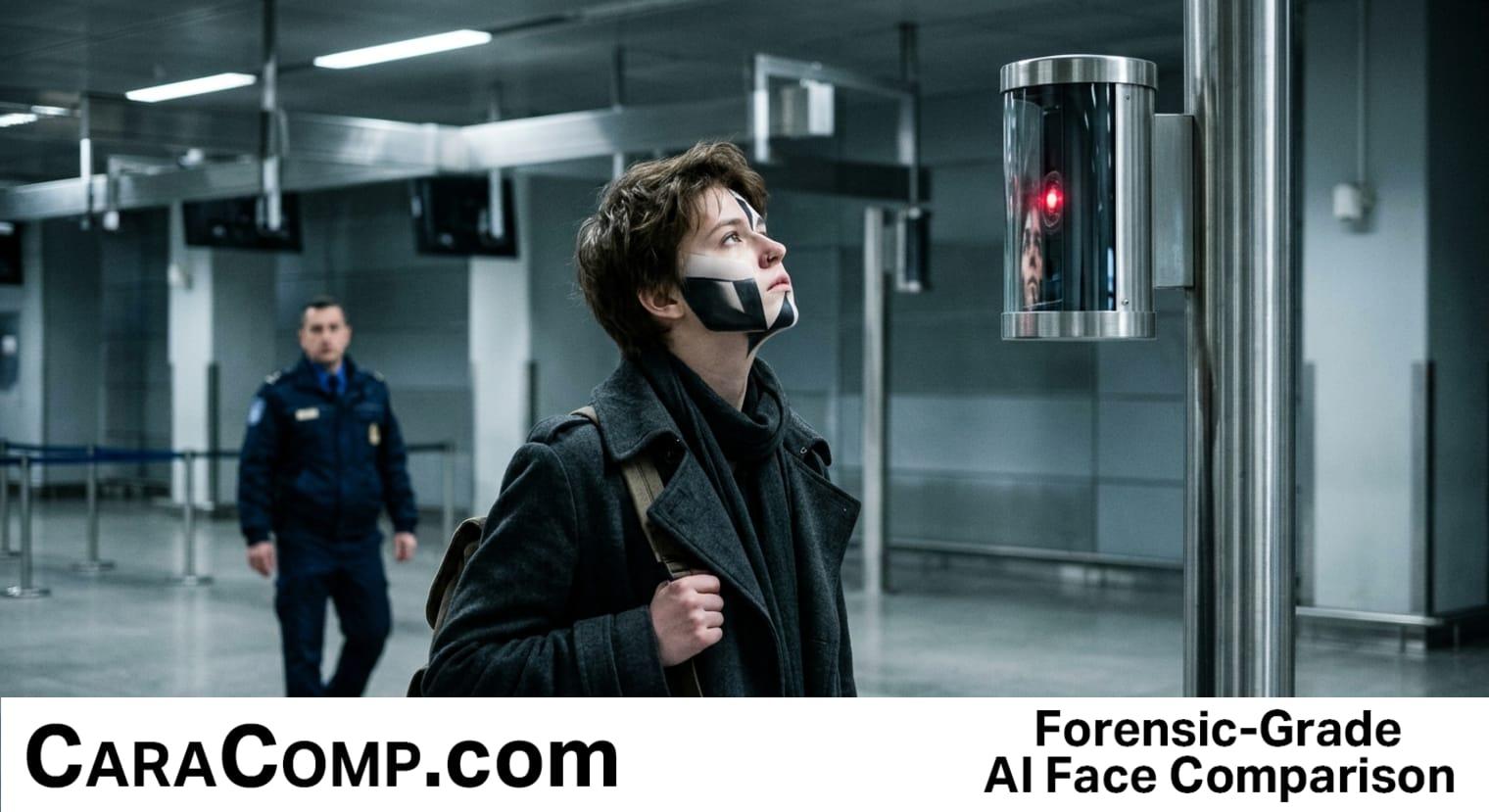
Quick answer
Does anti facial recognition makeup still work against cameras?
Mostly not. Makeup like CV Dazzle was designed to break older checklist-style face detection, and modern detectors learn from many faces and often cope with painted looks. Algorithm-designed makeup has fooled specific systems in lab tests, but a pattern tuned for one system may do nothing against another.
Here's a strange fact to start with. The famous anti facial recognition makeup of the 2010s, the one with black-and-white slashes across the cheek and hair swept over one eye, was built to beat a face detection technique from 2001. Not 2015. Not last year. Twenty-five years ago, give or take. The cameras kept learning. The makeup stayed put.
Anti facial recognition makeup has become less reliable because modern cameras no longer check a face against a simple checklist. Lab-designed versions can disrupt particular systems, but results depend on the system and conditions.
If you've ever wondered whether a little eyeliner and some face paint could keep you off a camera's radar, you're in good company. The honest answer is more interesting than "yes" or "no." It's a story about a cat-and-mouse game, and about why the mouse is mostly losing.
Anti Facial Recognition Makeup: How a Painted Face Fooled Older Cameras
Picture the early days. A computer looking for a face in a photo had to answer a basic question first: is there a face here at all? Before it could ask whose face, it had to find one. That first step is called face detection (the software's job of spotting where a face sits in a picture, before anything else happens).
The early version of face detection worked like a checklist. Two dark patches up top for eyes. A bright bridge down the middle for the nose. A darker patch below for the mouth. Everything roughly symmetrical. If the picture matched the checklist, the computer said "face." If not, it moved on.
Surveillance Makeup and CV Dazzle: The Original Trick
An art project took advantage of that. CV Dazzle (short for "computer vision dazzle") appeared around 2010. The name nods to the zigzag paint jobs on warships in the First World War, a camouflage used to confuse the eye rather than hide the ship. CV Dazzle is the same idea for faces: bold, lopsided patches of light and dark that break the checklist. Put a dark stripe where a cheek should be, hide the nose bridge, and the old software got confused.
It worked. That was the point of the project, and for a while it was surveillance makeup, meaning makeup meant to keep a face from being picked out by cameras. Researchers and artists showed it beating the detection methods of the time. Then the method behind those cameras changed, and the trick quietly aged out.
Why Face Detection Stopped Falling for Anti Facial Recognition Makeup
The old checklist approach was swapped for something that learns. Modern detectors, with names like RetinaFace (2019) and YuNet (2023), were trained on enormous piles of real faces, including faces in shadow and faces half-turned. According to a privacy guide covering the CV Dazzle timeline, these newer detectors handle dramatic makeup without much trouble.
Think about what that means. The old system had rules someone wrote down. The new system has experience. Breaking one old rule doesn't necessarily fool a system trained on many variations.
Computer Vision Learning: How Modern Systems See a Face
Computer vision (the field of teaching computers to make sense of images) has a trick that matters here. After finding a face, many recognition systems turn it into a list of numbers, sometimes 128 of them. Think of it as a fingerprint made of math. Those numbers capture features useful for comparing faces, rather than simply checking whether a face looks "normal."
Two photos of the same person should produce lists that sit close together. Photos of different people should land far apart. That's the heart of it. And it means that the mathematical patterns facial recognition systems rely on are learned from examples, not hand-coded. A bold stripe of paint may not disrupt the features a system uses to compare faces.
A plain-English walk through the chain looks like this: This article is part of a series, start with Fargo Facial Face Match Jails Tennessee Woman 108 Days.
- Step one, find the face. The detector looks for a face anywhere in the frame.
- Step two, measure it. The system turns the face into a string of numbers.
- Step three, compare. Those numbers are checked against others for a close match.
Old makeup attacked step one. Modern detectors can often find a painted face, so that older trick may not stop the system from reaching step two.
That number comes from NIST (the US government lab that tests face systems), as reported by the Federation of American Scientists. Error rates depend on the system and conditions, but the improvement shows why a trick aimed at an older detector may not work against a newer one.
Anti Facial Recognition Makeup in the Lab Versus Face Surveillance on a Street
Now for the plot twist. Makeup research didn't stop in 2010. It got smarter. Researchers started to develop makeup with the help of an algorithm (a step-by-step recipe a computer follows), which tests patterns against a target system and keeps the ones that confuse it most.
In a study from Ben-Gurion University, covered by The Register, cameras correctly spotted banned people wearing algorithm-designed makeup only 1.22 percent of the time. That experiment used ten men and ten women aged 20 to 28. The same work was reported by VICE with fooling rates as high as 98 percent in lab conditions.
Ninety-eight percent! So why isn't that a guarantee on the street?
Because of how those tests were set up. Research on bypassing facial recognition software using makeup patterns usually needs a stand-in copy of the system being attacked. The makeup is tuned against System A. If the camera on the street is System B, the pattern may do nothing. Same face, same paint, different result.
Beauty and Fashion Looks That Pass for Natural Are the Hard Part
There's a second catch. A pattern that fools a computer but looks like a Halloween costume to people isn't much of a disguise. The challenge, as described in Communications of the ACM, is that makeup meant to look like ordinary beauty and fashion has to stay subtle enough for a crowd while also disrupting the system.
Generating makeup that has a natural-looking appearance is not trivial.
Research summary, Communications of the ACM
The same research found something else that surprised me. When scientists compared algorithm-guided makeup with ordinary makeup applied without that guidance, the ordinary makeup did not succeed in fooling the facial recognition models tested. That doesn't prove regular contour and eyeshadow never affect a system. In the research, precise placements around areas such as the nose bridge, brow lines and jaw were designed to disrupt particular models.
TikTok Hacks and the Detection Problem
This is where internet advice goes sideways. A clip on TikTok might show a dramatic look and claim it blinds the cameras. Even if that look once beat some older detection tool, it faces three problems today. It was probably never tuned for the system watching you. It has to survive changing light and odd angles. And the people watching the camera feed may notice you more, not less.
That last point is a real irony. Dramatic makeup in everyday places can draw human attention. You might confuse a program and catch the eye of the guard sitting behind it. Honestly, you can even use anti-facial recognition makeup as a costume idea; it just shouldn't be mistaken for a shield. Previously in this series: Facial Recognition Hong Kong Cameras Go Live No Appeal.
The Old Trick Versus the New Reality: A Side-by-Side
It helps to see the whole shift in one place. Here is how the old method and today's reality compare.
| What changed | Then (CV Dazzle era) | Now (2026) |
|---|---|---|
| Face detection method | Rule-based checklist of eyes, nose and symmetry | Learning-based detectors trained on many faces |
| Effect of bold makeup | Could break face detection | Estimated at 30 to 60 percent effective for CV Dazzle, per one 2025 ranking |
| Phone and bank unlock | Some systems used flat 2D images | Some systems use 3D depth cameras that measure face shape |
| Best lab makeup | Hand-drawn art projects | Algorithm-designed, tuned to a target system |
The 30 to 60 percent figure comes from the State of Surveillance effectiveness rankings. It is an estimate, not a guarantee that someone wearing the makeup will avoid detection.
The 3D Problem: Why Makeup Has Limits Against a Depth Camera
Some phones and banking apps use depth sensing: they measure how far each part of your face is from the camera. Makeup is a flat layer of color. It doesn't change how far your nose sticks out. A 2D system can be tricked by a pattern. A system that uses depth has additional shape information that paint alone doesn't change, though results still depend on how the system uses that information.
What Gets Blocked by Surveillance Cameras, and Does Anti Facial Recognition Makeup Help?
Short answer: physically covering parts of a face removes information a camera could use, while makeup tries to disrupt how a system reads it. Hats, sunglasses and masks may make detection or matching harder, but they don't guarantee either will fail. They also bring their own attention and their own limits.
Can makeup hide a face from facial recognition?
It can in narrow cases. Algorithm-designed makeup has fooled specific systems in labs, but ordinary makeup did not fool the models tested. Real cameras vary in lighting, angle and software, so a pattern built for one system may fail on another. Treat makeup as an experiment, not protection.
The Bigger Risk Isn't Being Seen. It's Being Mixed Up.
Here's what I think gets lost in the "how do I hide" conversation. The people who have been hurt by face technology weren't trying to hide. They were going about their lives.
In January 2020, Robert Williams was arrested on his front lawn in Detroit and held for 30 hours after a false match tied him to a shoplifting case, according to the ACLU. In November 2022, Randal Reid was stopped on a Georgia interstate and jailed for six days over a theft in Louisiana, a state he said he had never visited, as reported by AP News. In 2019, Nijeer Parks spent 10 days in jail in New Jersey after being misidentified, according to CBC News.
None of these people lacked the right makeup. The issue was a match that was treated as proof when it should have been treated as a lead.
This is the angle we care about at CaraComp, where the work is facial comparison: weighing how similar two faces are, and how far to trust that. A strong system still gives a score, not a verdict. A similarity score is a starting point for a human to check, never a replacement for checking.
Why So Many People Get This Wrong
It's easy to see why the misconception that lab makeup offers reliable street-level protection sticks. The research is real. The headline numbers (98 percent!) are real. A short video of someone walking past a camera looks convincing. What gets dropped is the footnote: the makeup was designed for a particular system and tested under particular conditions. Reading old or lab research as if it were street-level proof is a natural mistake, and not a silly one.
What You Just Learned
- CV Dazzle aged out: it beat 2001-style checklist detection, which today's learning-based detectors no longer use.
- Lab wins are narrow: algorithm-designed makeup fooled specific systems, while ordinary makeup did not fool the models tested.
- Depth cameras measure shape: makeup cannot change real face geometry.
- Misidentification is a risk: innocent people have been arrested on false matches.
The Aha Moment: Makeup Fights the Wrong Step
Go back to the three-step chain: find, measure, compare. The original CV Dazzle makeup attacked step one. It tried to make the system fail to find a face. Newer adversarial makeup can also target matching, but its results depend on the system. And the real harm in the stories above happens at step three, when a similarity score is read as certainty. Up next: Anti Facial Recognition Makeup Built To Fool 2001 Cameras.
So another useful question is: "If a system ever matches me to something I didn't do, what do I do next?" Know that a match is a lead. Ask what other evidence ties you to the event. Ask for a lawyer. Nobody can paint that protection onto a cheek.
Anti facial recognition makeup is not a general shield: a precisely designed pattern can hamper particular facial recognition systems, but its effect depends on the system and conditions.
Recap: The makeup trick beat old checklist detectors, but today's systems learn from many faces and can handle many painted looks. Lab-built makeup can disrupt a targeted system, while depth cameras have shape information that paint alone doesn't change.
Here's a question to take to bed tonight. If a camera you never noticed matched your face to a crime tomorrow, would you know where to look first?
Anti Facial Recognition Makeup: Frequently Asked Questions
Is there any project working on better anti-surveillance makeup?
Yes. Research groups keep publishing new ways to generate makeup with an algorithm, and a 2026 guide from Sherafy mentions work called DiffAM and AdvTiles. These are research efforts, not products you can buy. They aim at cosmetic techniques that disrupt face matching, and most are tested against a chosen system in controlled settings. An anti-surveillance look that works in a paper does not automatically work on a random street camera.
What type of camouflage used in CV Dazzle made faces harder to read?
The type was bold, lopsided patches of light and dark, placed to break symmetry and hide the nose bridge or eyes. The name echoes ship dazzle paint, a camouflage used to confuse rather than conceal. The CV Dazzle approach was designed around 2010 against older detection methods, which is why it struggles against today's learning-based systems.
Do spectra reflective eye colour tricks work against facial recognition?
The research behind this article did not test spectra reflective eye colour tricks, such as reflective lenses, so we cannot promise they work. Hats, sunglasses and masks can remove information from view, but they don't guarantee a system won't detect or match a face. Be wary of any claim without a named test behind it.
Does bypassing facial recognition software using makeup work on a phone?
It depends on the phone and its system. Some phone unlock and banking systems use depth sensing as part of a liveness check. Makeup is a flat color layer and cannot change real face geometry, but a system's response depends on how it uses the available information.
Can researchers develop makeup that beats every camera?
No. Researchers who develop makeup this way usually need a stand-in copy of the system they want to fool, which is called a surrogate. Without it, they have less information to guide the design of natural-looking makeup. A pattern tuned for one system may do nothing against another, so there is no single look known to beat every system.
Is a mask or sunglasses better than anti-facial recognition makeup?
Physical covers take away information rather than trying to confuse the math. Hats, sunglasses and masks block parts of the face, but some systems can still detect or match a partially covered face. Covers have drawbacks: they can attract attention from people watching, and some rules in places like banks or stores may not allow them.
Ready for forensic-grade facial comparison?
Full forensic reports with detailed similarity scoring. Results in seconds.
Run My First SearchMore Education
ID Scan: How a 93% Face Match Put the Wrong Man in Cuffs
A license scan takes a second, but a false face match can cost you weeks in jail. Learn how the two very different kinds of scan work, and what to check first if one goes wrong.
privacyIs Identity Theft Protection Worth It: $0 Lock Beats Alerts
Paid identity theft protection watches for fraud after it starts. A free credit freeze blocks many fraudulent new accounts, and the numbers explain why that gap matters.
digital-forensicsPhoto Forensics: 4 Hidden Tests That Expose a Fake Picture
A fake photo can fool your eyes, but the file may retain traces of an edit. Learn the layered tests experts use to investigate a picture, and where you would look first.