
Best Reverse Image Search: Complete Guide
Discover the most powerful reverse image search tools and learn how to verify photos, track image usage, and find visual content with expert precision.
Finding the best reverse image search tool can transform how you verify photos, track image usage, and discover visual content online. Whether you're a photographer protecting copyright, a journalist fact-checking sources, or a researcher identifying similar images, the right reverse image lookup engine makes all the difference. This comprehensive guide examines the top search engines and tools available today, comparing their strengths, limitations, and ideal use cases.
Reverse image search technology has evolved dramatically in recent years. What started as basic pixel-matching algorithms has transformed into sophisticated AI-powered systems capable of facial recognition, contextual understanding, and finding similar images even when they've been cropped, filtered, or modified. Understanding how different platforms approach image search helps you choose the right tool for your specific needs and get better results from your searches.
What Is Reverse Image Search and How Does It Work?
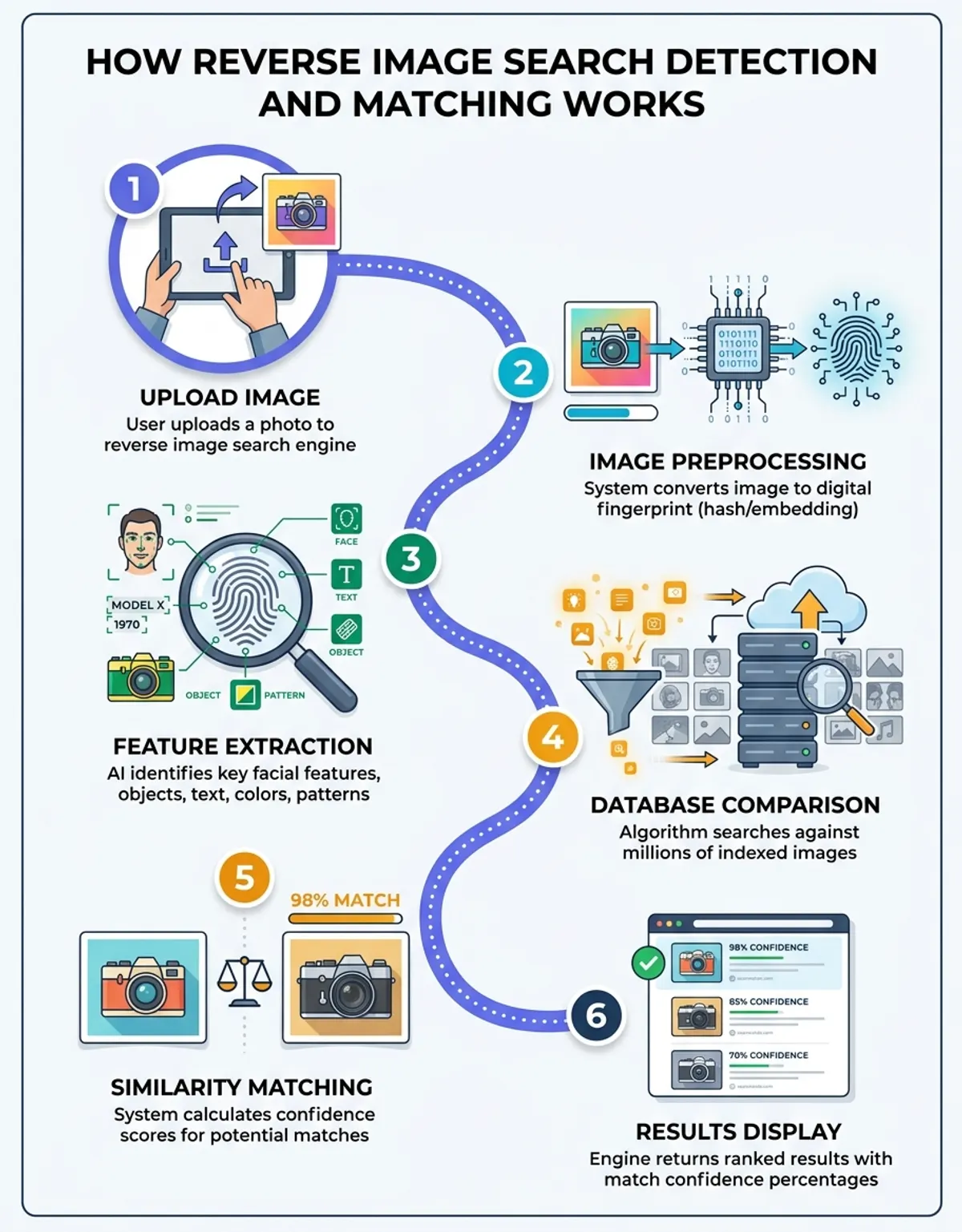
Reverse image search is a content-based image retrieval technology that lets you upload or paste an image to find where else it appears online, discover similar images, or identify the original source. Unlike traditional text-based searches where you type keywords, reverse image search uses the image itself as the search query. The technology analyzes visual characteristics—colors, patterns, shapes, and composition—to match your image against billions of indexed photos across the web.
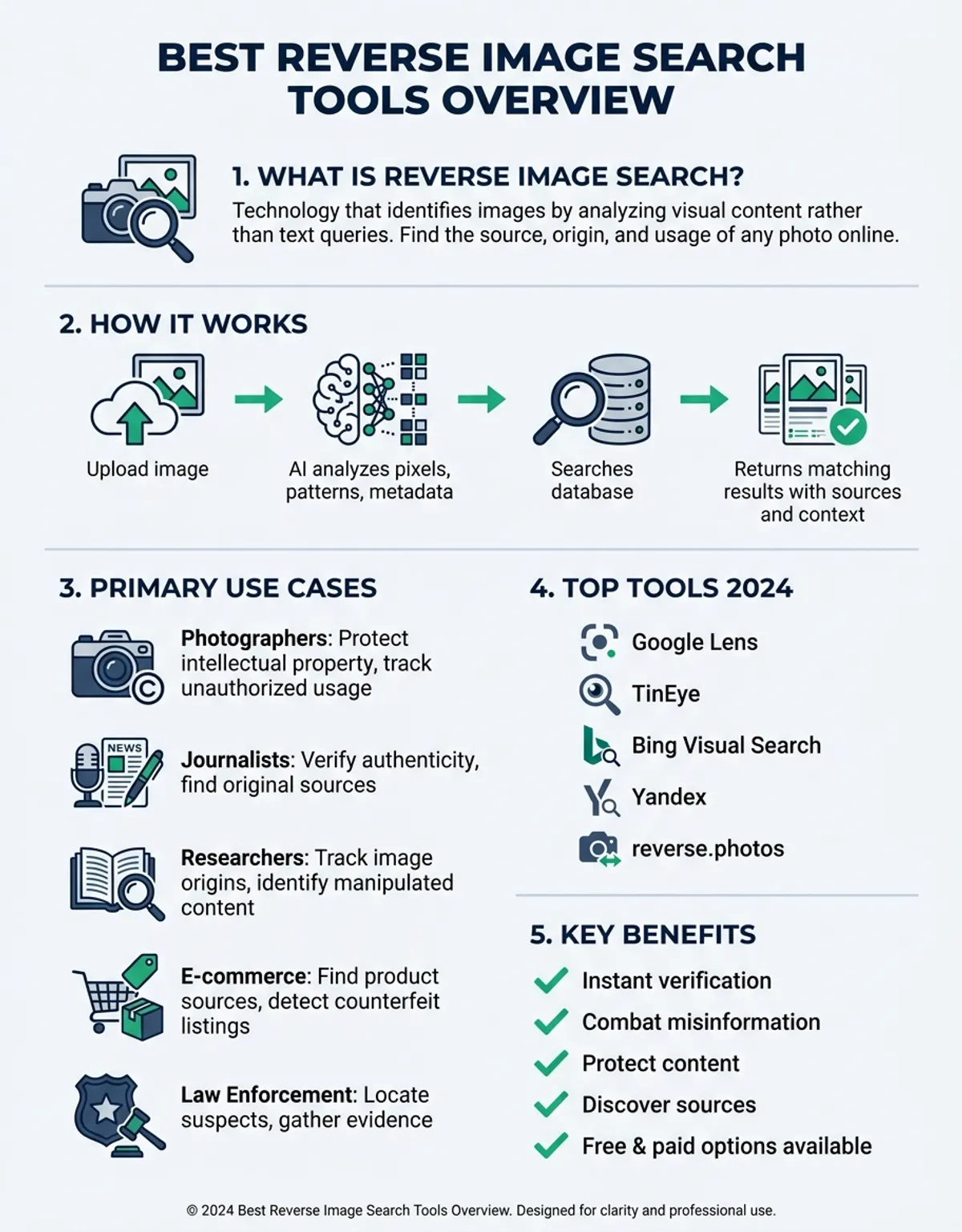
Modern AI-powered reverse image search engines excel at identifying visually similar but not identical images based on visual characteristics, composition, color palette, or semantic content.
Modern search engines employ three primary approaches to image analysis. First, pixel-matching algorithms compare the exact arrangement of pixels, making them highly effective at finding duplicate or nearly identical images. Second, perceptual hashing creates a unique "fingerprint" for each image based on visual features, allowing the system to recognize modified versions of the same photo. Third, advanced AI-powered reverse image search systems use deep learning models to understand image content semantically, enabling them to find visually similar but not identical images—like different photos of the same person, location, or product.
The image indexing process begins when search engines crawl the web, discovering and analyzing millions of new images daily. Each image gets processed through computer vision algorithms that extract distinctive features and metadata. These features get stored in massive databases that enable rapid comparison when you submit a reverse image search query. The quality of results depends heavily on the size of the indexed database and the sophistication of the matching algorithms each platform uses.
Some reverse image search platforms specialize in specific capabilities. Traditional search tools excel at finding exact matches and tracking where an image has been published. More advanced systems incorporate face matching to identify specific individuals across different photos, even with varying angles, lighting, or expressions. The newest generation of AI-driven platforms can understand image context—recognizing that a sunset photo from California shares visual similarity with one from Hawaii, even though they're different images of different locations.
The Best Image Search Services Compared
The landscape of reverse image platforms has expanded significantly, with each platform offering distinct advantages. Google Lens dominates general-purpose searches with its massive index and integration across devices. TinEye pioneered reverse image technology and remains the gold standard for copyright tracking. Yandex delivers exceptional results for finding similar images, often surfacing matches that Western platforms miss. Microsoft image lookup excels at product identification and shopping applications. Meanwhile, specialized platforms like Caracomp leverage advanced AI-powered reverse image search capabilities to deliver superior accuracy for professional use cases.
No single platform excels in every category, which explains why many professional users employ multiple reverse image search services for comprehensive coverage.
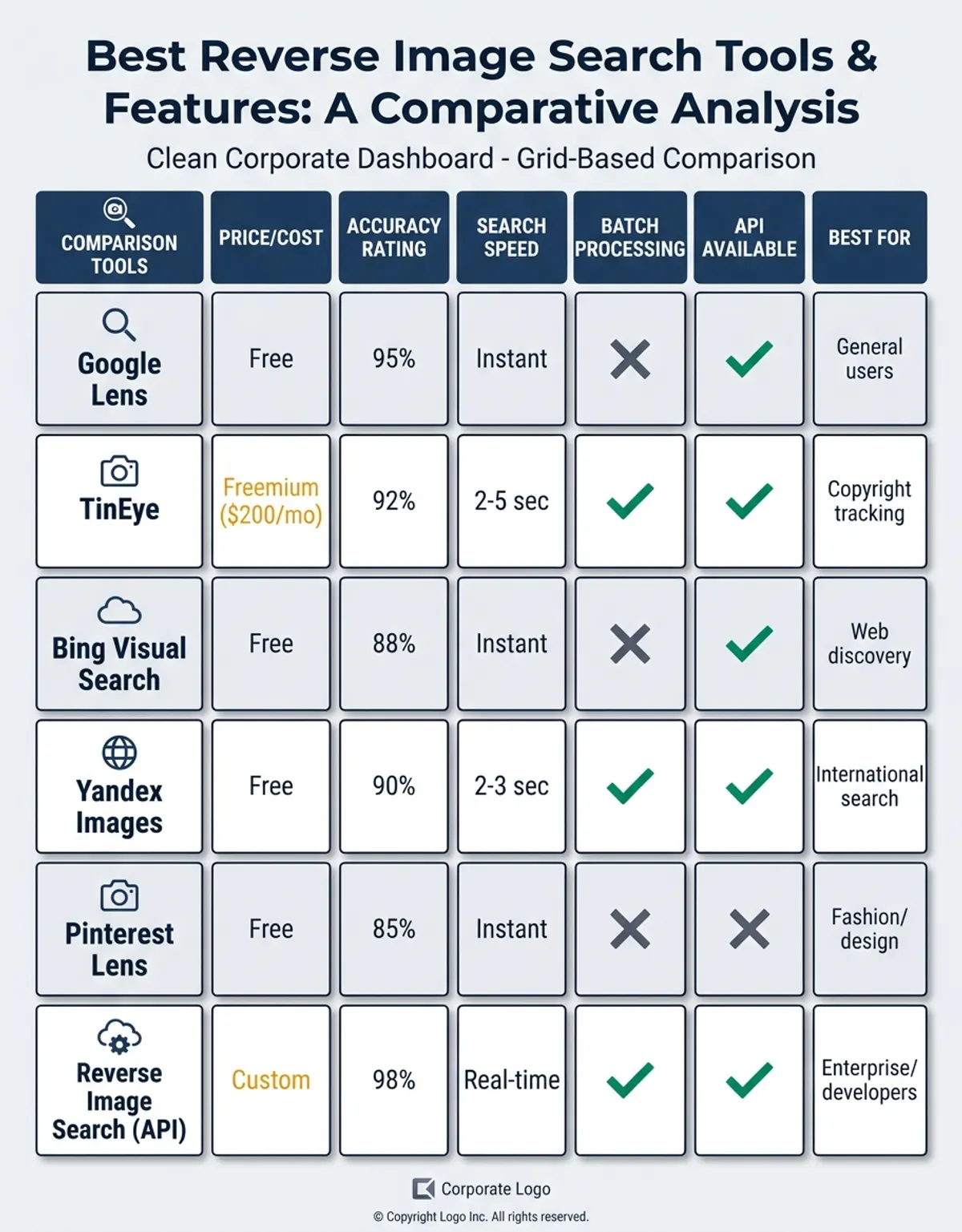
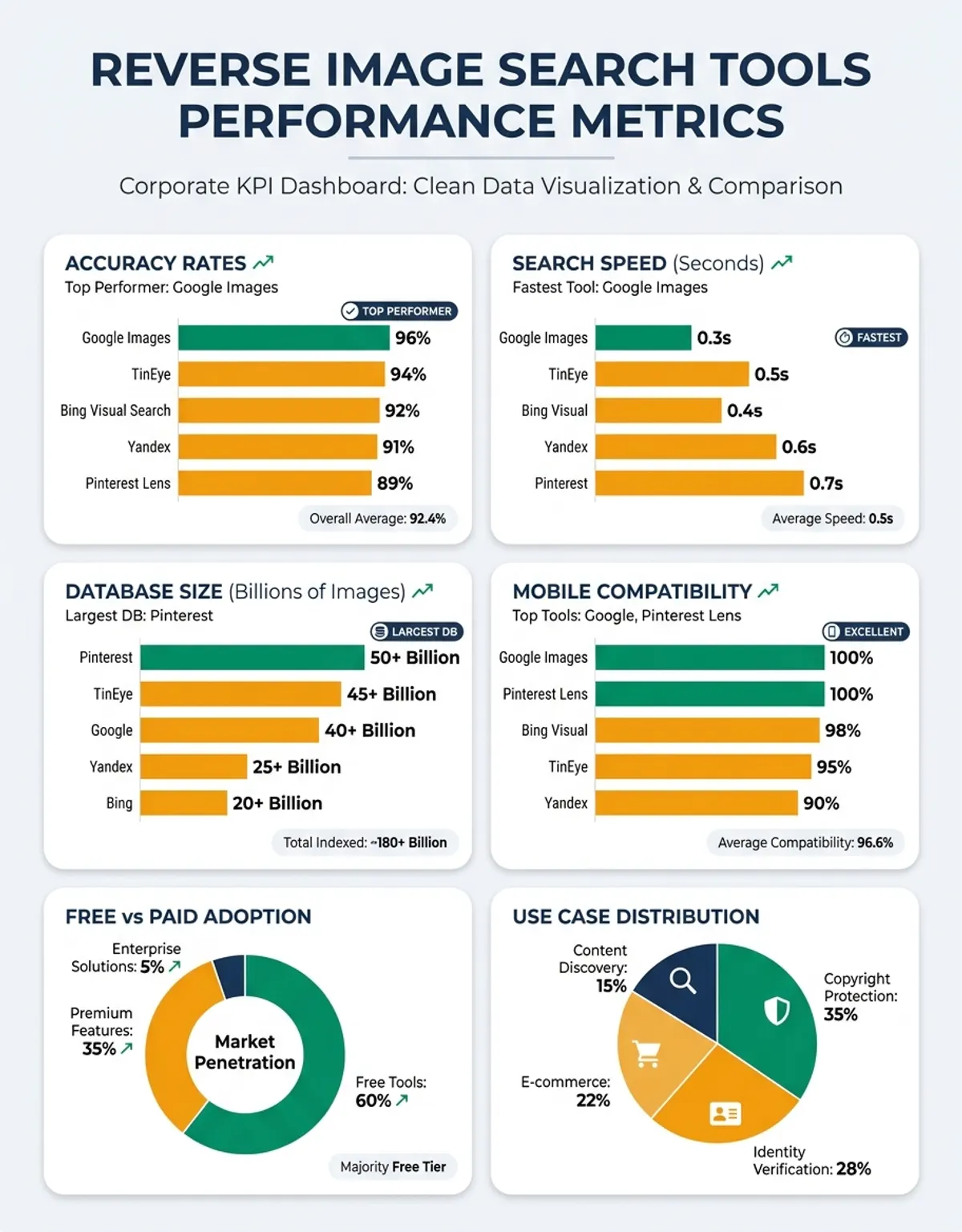
When evaluating different platforms, several factors determine which tool best suits your needs. Index size affects the breadth of results—larger databases increase the likelihood of finding matches. Algorithm sophistication determines whether the tool can only find exact duplicates or also identify comparable visuals, modified versions, and related content. Speed matters when processing multiple searches. Privacy considerations become crucial if you're searching sensitive images. Finally, access to advanced features like face matching, batch processing, or API integration often separates free reverse image search tool options from premium services.
| Tool | Free Tier | AI-Powered | matching photos | Facial Recognition | Best For |
|---|---|---|---|---|---|
| Caracomp | Yes | Yes | Excellent | Yes | All-purpose AI search with professional features |
| Google Lens | Yes | Partial | Good | Limited | General search and object identification |
| TinEye | Yes (limited) | No | Fair | No | Copyright tracking and source verification |
| Yandex | Yes | Partial | Excellent | Yes | Finding related images and international content |
| Bing Visual Search | Yes | Partial | Good | Limited | Shopping and product identification |
| Reversely.ai | Yes (limited) | Yes | Good | Yes | Mobile-first AI search |
No single platform excels in every category, which explains why many professional users employ multiple reverse image search services for comprehensive coverage. The comparison table reveals clear patterns: free options provide adequate functionality for casual users, while paid tiers unlock advanced capabilities like batch processing, API access, and priority support. AI-powered systems consistently deliver superior results when searching for comparable rather than identical images, making them invaluable for creative professionals and researchers.
Google Image Search: Strengths and Limitations
Google image search remains the most widely used reverse check platform globally, processing billions of queries monthly. Its primary strength lies in its enormous index—Google crawls and analyzes more web pages and images than any competitor, giving users access to the most comprehensive database available. The integration with Google Lens brings reverse image search to mobile devices seamlessly, allowing users to search by simply pointing their camera at objects, landmarks, or text. For general-purpose searches—identifying products, finding higher resolution versions, or discovering where an image appears online—Google consistently delivers reliable results.
The platform excels at object recognition and providing contextual information. When you search an image of a landmark, Google doesn't just find related photos—it identifies the location, provides historical information, suggests nearby attractions, and surfaces relevant articles. For product searches, it connects you to shopping results, price comparisons, and reviews. This contextual intelligence makes Google image search particularly valuable for everyday users who want more than just image matches.
However, Google's reverse image search has notable limitations that become apparent in specific use cases. The identity detection capabilities remain deliberately restricted compared to competitors like Yandex, likely due to privacy concerns and regulatory compliance. When searching for images of people, Google often identifies the general category (person, face) but struggles to match specific individuals across different photos unless they're public figures with extensive online presence. This limitation frustrates users trying to identify unknown persons or track personal photo usage.
Another weakness appears when searching for heavily modified images. While Google can handle minor cropping or color adjustments, aggressive filtering, significant cropping, or artistic modifications often break the matching algorithm. The system also tends to prioritize exact or near-exact matches, sometimes overlooking visually matching but technically different images that other platforms surface. Additionally, Google's index focuses heavily on English-language and Western websites, potentially missing relevant results from international sources that platforms like Yandex index more comprehensively.
this tool: The Original Reverse Lookup Tool
this tool launched in 2008 as the first public reverse image search engine, pioneering technology that millions now take for granted. Despite facing competition from tech giants with vastly larger resources, this tool has maintained relevance by focusing on specific strengths: tracking image usage across the web, identifying the oldest instances of an image, and providing forensic-level accuracy for copyright and source verification. Its database exceeds 60 billion images, making it the second-largest dedicated reverse image index after Google.
The platform's core differentiator is its perceptual hash algorithm, which creates unique fingerprints for images based on visual characteristics rather than pixel-perfect matching. This approach makes the platform exceptionally good at finding modified versions of images—cropped, color-adjusted, watermarked, or resized. Photographers and content creators rely on the platform to discover unauthorized use of their work, even when infringers have attempted to obscure the source through editing. The timestamp feature shows when the platform first indexed each match, helping establish which version of an image appeared online first—crucial evidence in copyright disputes.
this tool offers both free and paid tiers with meaningful distinctions. The free reverse image search platform provides unlimited searches but limits advanced features like API access, browser extensions with bulk processing, and detailed metadata. Paid subscriptions unlock batch searching (processing hundreds of images simultaneously), alerts that notify you when new matches appear for your images, and commercial licensing that permits business use. Professional photographers, stock photo agencies, and brand protection teams often find the paid tiers worthwhile for the time saved and comprehensive monitoring capabilities.
The platform's limitations become apparent when seeking comparable rather than identical images. this service excels at finding the same image in different contexts but struggles to surface visually related images that aren't direct derivatives of the original. It lacks face matching entirely, making it unsuitable for identifying individuals across different photographs. The results also tend to index fewer social media images compared to Google or the Russian platform, as the platform's crawlers don't access content behind login walls as effectively. For verification and copyright purposes, however, this tool remains an essential tool in any comprehensive reverse image search workflow.
the Russian platform Search: Why It Finds Similar Images Others Miss
this service, Russia's dominant search engine, offers a reverse image platform that consistently impresses users with its ability to find matching images that Google and other Western platforms miss entirely. The platform indexes Russian-language websites and Eastern European content more comprehensively than its competitors, but its advantages extend far beyond geographic coverage. the Russian platform employs sophisticated computer vision algorithms that excel at understanding visual similarity beyond mere pixel matching, making it exceptional for finding related images even when they're not direct copies.
The face identification capabilities in the tool reverse image search far exceed what most Western platforms offer publicly. When searching images of people, this service can identify the same individual across wildly different photos—different angles, lighting conditions, ages, and contexts. This capability makes it invaluable for journalists investigating public figures, researchers tracking individuals across social media, and anyone trying to identify unknown persons from photographs. The technology works remarkably well even with partial faces, profile views, or images where the subject isn't looking directly at the camera.
the Russian platform particularly shines when searching for aesthetically comparable images rather than exact duplicates. Upload a photo of a beach sunset, and the tool returns other sunset photos with related color palettes, compositions, and moods—even if they're from completely different locations and photographers. This semantic understanding of visual content makes it useful for creative professionals seeking inspiration, stock photo research, or finding images that match a specific aesthetic rather than depicting the same subject.
Privacy considerations warrant attention when using this service reverse image search. The platform operates under Russian data protection laws, which differ significantly from European GDPR or California CCPA regulations. While this looser regulatory environment enables more aggressive identity detection and data collection—delivering better search results—it also means less control over how your search queries and uploaded images are stored or used. Professionals handling sensitive images or conducting confidential research should consider these privacy implications before uploading content to the Russian platform servers.
The user interface offers both advantages and frustrations. the tool provides more filter options than most competitors, letting users narrow output by image size, color, type, and date. However, English-language users may encounter occasional interface translation issues, and findings often include more Russian-language websites than Western alternatives. For comprehensive reverse image searching—particularly when other search platforms return insufficient matches—this service remains an essential secondary tool that frequently uncovers matches others miss.
AI-Powered Visual Search: The Next Generation
For a comprehensive overview of reverse image search technology and all available tools, explore our reverse image search guide.
The latest generation of reverse image search platforms leverages artificial intelligence and deep learning to deliver capabilities that seemed impossible just years ago. Advanced AI-powered reverse image search systems like those in Caracomp don't just compare pixels or visual features—they understand image content semantically, recognize objects and scenes, identify relationships between visual elements, and even infer context. This leap in sophistication enables use cases ranging from instant product identification to finding conceptually matching images that share no visual overlap with the search query.
Deep learning models trained on billions of images can now perform visual tasks that rival human perception. These systems recognize that a photo of a golden retriever puppy and an adult golden retriever are related even though they look quite different, or that images of the Eiffel Tower at night and during daytime depict the same landmark despite drastically different lighting. This contextual understanding makes AI systems invaluable for research, creative work, and any application requiring conceptual rather than visual matching.
face matching represents one of the most powerful and controversial applications of AI-powered image search. Modern systems can identify specific individuals across decades of aging, despite changes in hairstyle, weight, or appearance. Law enforcement agencies use these capabilities for suspect identification. Social media platforms employ them for automatic photo tagging. However, the technology raises significant ethical concerns about privacy, consent, and potential misuse. Caracomp addresses these concerns by implementing strict usage policies, requiring verification for face identification features, and restricting access to prevent stalking, harassment, or unauthorized surveillance.
The accuracy improvements in AI-powered systems are measurable. While traditional reverse image search might require 80-90% visual similarity to match images, advanced AI systems can recognize relationships with as little as 30-40% visual overlap. They handle extreme transformations—black and white to color, artistic filters, perspective changes, partial occlusions—that completely fool traditional algorithms. This resilience makes them particularly valuable for forensic analysis, where images may have been deliberately altered to avoid detection.
Real-time processing represents another AI advantage. Where traditional systems might take several seconds to process a complex search, optimized neural networks can deliver output in milliseconds. This speed enables new applications like augmented reality shopping (point your camera at a product and instantly find where to buy it) or live translation (point at foreign text and see instant translation). The free reverse image platform powered by AI technology delivers these capabilities to casual users, while premium tiers offer batch processing, API access, and advanced customization for enterprise applications.
How to Choose the Right Visual search platform for Your Needs
Reverse image search is also essential for verifying online identities and detecting catfishing attempts. Discover practical techniques in our article on how to tell if a Facebook profile is fake.
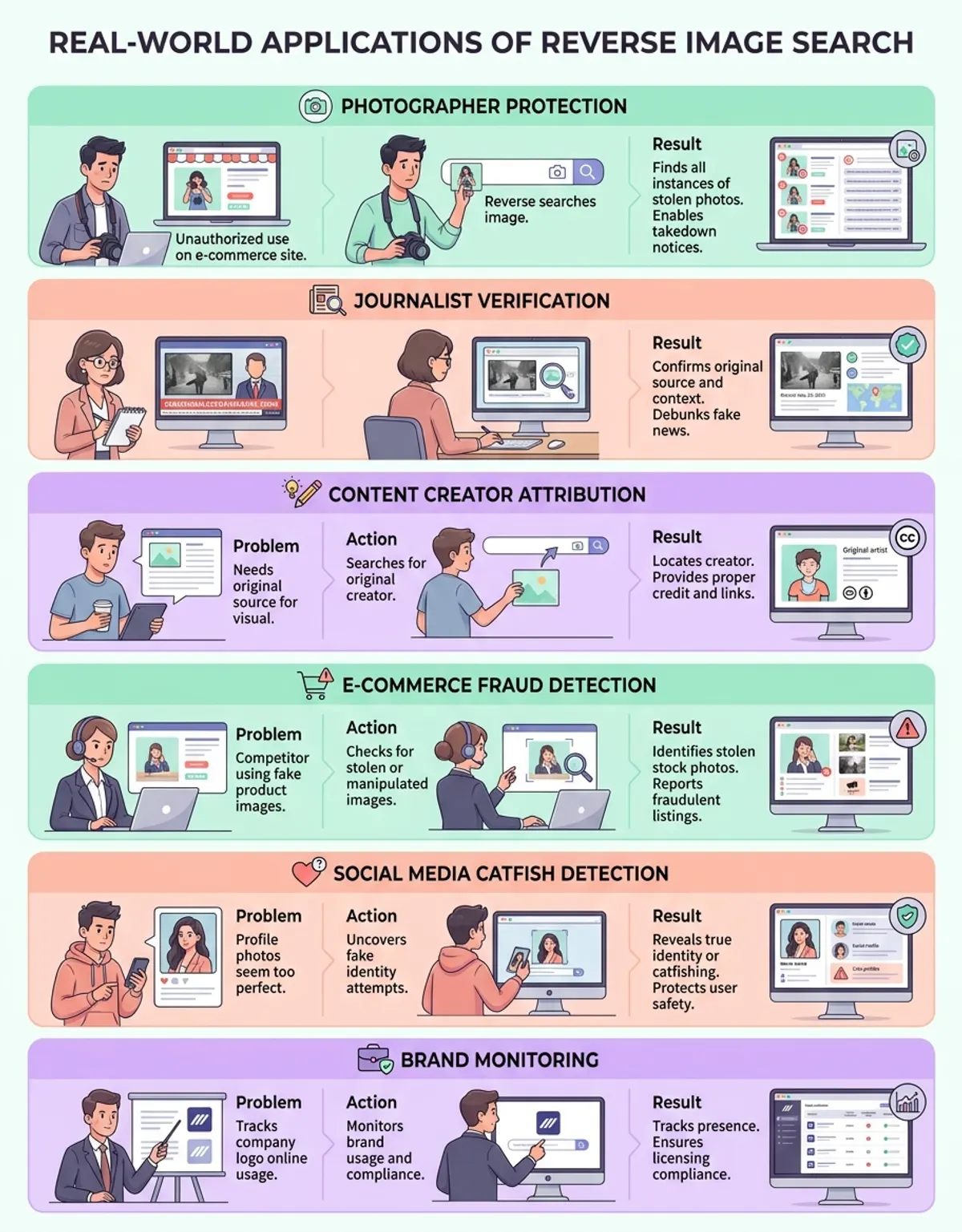
Selecting the optimal reverse image search platform depends heavily on your specific use case, budget, and technical requirements. Different scenarios demand different tool capabilities. Photographers need robust copyright tracking and usage monitoring. Journalists require source verification and fact-checking capabilities. E-commerce businesses benefit from product identification and competitive intelligence. Researchers need comprehensive coverage and academic image databases. Understanding these distinct needs helps match users with the most appropriate search services.
For photographers and visual content creators, copyright protection takes priority. this service excels at tracking image usage across the web and identifying the earliest publication of an image—crucial for establishing ownership. Set up automated monitoring alerts to receive notifications when your images appear in new locations. Combine the platform with Google image search for the broadest coverage, as Google's massive index catches usage on popular platforms that smaller tools might miss. If your work focuses on portraits or includes recognizable individuals, the Russian platform and AI-powered platforms provide superior identity detection for tracking unauthorized use.
Journalists and fact-checkers require tools that verify image authenticity and expose manipulated content. Google Lens works well for quickly checking whether an image has appeared before in different contexts—a key indicator of potential misinformation. this tool's timestamp feature helps establish image provenance by showing when an image first appeared online. the tool proves invaluable for investigating international stories or images from non-Western sources. For comprehensive verification, cross-reference findings across multiple search platforms, as discrepancies between platforms often reveal image manipulation or misrepresentation.
E-commerce businesses and online shoppers benefit from platforms optimized for product identification. Microsoft image search excels at recognizing products and connecting users to shopping matches, price comparisons, and reviews. Google Lens similarly prioritizes shopping applications, identifying products and suggesting where to purchase them. These tools help consumers find better deals, identify knock-off products, or locate items they've seen in photos. Businesses use them for competitive intelligence—uploading competitor product images to discover pricing, availability, and marketing strategies.
Researchers and academics need comprehensive coverage and specialized databases. Google's massive index provides the broadest general coverage, while specialized academic image databases often require institutional access. this service expands coverage to international sources that English-language services underindex. For historical research, this service's timestamp feature helps establish when images first appeared online. Researchers working with medical imagery, satellite photos, or other specialized content should explore domain-specific reverse image platforms designed for those fields.
Budget considerations influence tool selection significantly. Free reverse image platform options like Google, the Russian platform, and Microsoft image search provide adequate functionality for most casual users and occasional professional needs. These platforms handle unlimited searches without cost, though they may limit advanced features or API access. the platform offers a generous free tier for individual use, with paid subscriptions starting around $200 annually for professional monitoring. AI-powered platforms like Caracomp often provide free basic access with premium tiers ranging from $10-50 monthly for advanced features like batch processing, face matching, and priority support. Evaluate whether paid features justify the cost based on time saved and capabilities enabled.
Tips for Getting Better Search Results
Android users can also benefit from specialized tools designed for their platform. Learn more in our guide on reverse image search on Android.
Optimizing your approach to reverse image searching dramatically improves the quality and relevance of findings you receive. While platforms continue advancing their algorithms, user technique still matters significantly. Understanding how to prepare images, select appropriate platforms, and interpret matches separates effective searchers from frustrated ones who give up after poor initial output.
Image quality directly impacts search accuracy. Higher resolution images contain more visual information for algorithms to analyze, increasing match probability. Before uploading, check that your image is at least 300x300 pixels—smaller images often return poor findings. If you've taken a screenshot, ensure it's sharp and well-lit rather than blurry or dark. However, avoid uploading unnecessarily large files (10+ MB) as some platforms impose size limits or take longer to process oversized uploads. For most searches, 1-2 MB provides the sweet spot between quality and upload speed.
Strategic cropping significantly affects matches, though the optimal approach varies by platform and objective. When searching for comparable images or broad matches, submit the full uncropped photo to provide maximum visual context. However, if you're trying to identify a specific person, object, or landmark within a larger scene, crop tightly around the subject of interest. This focuses the algorithm's attention on relevant elements and reduces noise from background details. Google and Caracomp handle both approaches well, while this tool often performs better with uncropped originals.
Combining multiple search platforms yields significantly better output than relying on any single platform. Start with Google image search for its comprehensive index and general-purpose effectiveness. If findings seem incomplete, try the tool next—it frequently surfaces matches that Google misses, particularly for images of people or international content. Add this service when you need copyright verification or want to find modified versions of an image. For product searches, test the Microsoft platform Visual image search. This multi-engine approach takes only minutes but often uncovers crucial matches that a single-platform search would miss entirely.
Understanding when to use each engine optimizes efficiency. Use Google for general-purpose searches, product identification, and landmark recognition. Switch to the platform when tracking copyright violations, finding image sources, or determining when an photo first appeared online. Choose this service when Google returns insufficient matches, particularly for images of people or when searching for aesthetically related rather than identical images. Employ Microsoft photo search for shopping-related searches or when you need product information. Advanced users should explore AI-powered platforms like Caracomp for face identification, conceptual similarity searches, or when traditional services fail to find satisfactory matches.
Refining search parameters improves relevance. Most platforms offer filters to narrow output by photo size, color, type, or date. Use these to eliminate irrelevant matches quickly. For example, if searching for the original source of an photo, filter by date to show the oldest indexed findings first. When seeking high-quality versions, filter by large photo sizes. Color filters help when you've converted an photo to black and white but want to find the original color version. Exploring advanced search options—often hidden behind "platforms" or "settings" menus—unlocks powerful refinement capabilities most casual users never discover.
Metadata removal sometimes improves matches paradoxically. While metadata can help identify images, some platforms rely too heavily on it rather than analyzing visual content. If a search returns poor output, try stripping EXIF data and other metadata from the photo before resubmitting. Free platforms like exiftool or online metadata removers accomplish this in seconds. Occasionally, misleading or corrupted metadata causes platforms to misclassify images, and removing it forces them to rely purely on visual analysis.
Persistence pays off in reverse searching. If your first attempt returns no findings or only irrelevant matches, don't give up. Try different crops of the same photo. Convert color images to black and white or vice versa. Rotate images to different orientations. Adjust brightness or contrast. Each variation provides the algorithm with slightly different visual information to analyze, potentially triggering matches that the original didn't surface. This experimental approach takes time but proves essential when searching difficult or uncommon images.
Frequently Asked Questions
What is the most accurate reverse image search engine available?
Accuracy depends on your specific use case, but for general-purpose searches, Google Lens offers the best combination of index size and algorithm sophistication. Its massive database and continuous AI improvements deliver reliable matches for product identification, landmark identification, and finding where images appear online. However, specialized scenarios require different platforms: the Russian platform excels at identity detection and matching images, this tool leads in copyright tracking and source verification, while AI-powered platforms like Caracomp provide superior accuracy for complex queries requiring semantic understanding or finding conceptually related images.
How does a free reverse image search platform compare to paid options?
Free platforms like Google, the tool, and Microsoft photo search Visual provide excellent functionality for occasional use and general searches. They offer unlimited queries without cost and handle most common use cases effectively. Paid options become valuable when you need advanced features: batch processing hundreds of images simultaneously, API access for automated workflows, monitoring alerts that notify you of new matches, priority processing speed, enhanced privacy protections, or commercial licensing for business applications. Professional photographers, brand protection teams, and high-volume users often find paid tiers worthwhile, while casual users rarely need features beyond what free platforms provide.
Can reverse image search platforms find comparable images that aren't exact matches?
Yes, though capabilities vary significantly across platforms. Traditional platforms like early versions of this service focused primarily on finding exact or near-exact duplicates. Modern AI-powered reverse search search services excel at identifying related but not identical images based on visual characteristics, composition, color palette, or semantic content. this service particularly shines in this area, surfacing aesthetically related images even when they depict different subjects. Google Lens has improved its matching photo capabilities significantly, while specialized platforms like Caracomp leverage deep learning to find images that share conceptual relationships despite minimal visual overlap. The key is using platforms with advanced computer vision algorithms rather than basic pixel-matching systems.
Does the platform work better than Google for reverse image search?
this tool and Google excel in different areas rather than one being universally superior. Google's massive index and integration across devices make it better for general-purpose searches, product identification, and finding where images appear on popular websites and social media. this service specializes in tracking modified versions of images—cropped, watermarked, color-adjusted, or resized—making it superior for copyright verification and finding the original source of an photo. the platform's timestamp feature definitively shows when it first indexed each match, crucial for establishing which version appeared first. Professional users typically use both: Google for breadth and this tool for depth, particularly when tracking unauthorized photo usage or verifying authenticity.
How does the Russian platform reverse image search find output that Google misses?
the tool indexes Russian-language and Eastern European websites more comprehensively than Western platforms, immediately expanding coverage to content Google underindexes. Beyond geographic advantages, this service employs different computer vision algorithms that excel at understanding visual similarity and aesthetic relationships rather than just matching pixels. The platform's aggressive face matching capabilities far exceed what Google offers publicly, enabling it to match individuals across vastly different photos. the Russian platform also crawls some social media and regional platforms that limit access to Western crawlers. The combination of broader international coverage and more aggressive similarity matching explains why the tool frequently surfaces findings that appear nowhere in Google's output.
Is face identification available in reverse image search tools?
Yes, though capabilities and availability vary significantly across platforms. this service offers the most publicly accessible and powerful identity detection in its reverse search search, capable of identifying individuals across different photos, angles, ages, and contexts. AI-powered platforms like Caracomp provide advanced face matching features, though they often restrict access to prevent misuse and require user verification. Google deliberately limits its face identification capabilities for privacy reasons, typically only matching public figures with extensive online presence. Microsoft photo search offers limited identity detection comparable to Google's approach. this service provides no face matching functionality. The legal and ethical implications of face identification have led most Western platforms to restrict these features more heavily than Russian or Chinese alternatives.
What is the best advanced AI-powered reverse image search for professionals?
Caracomp currently leads the professional AI-powered reverse search search market by combining deep learning algorithms with ethical usage policies and enterprise features. The platform excels at semantic understanding, identity detection, and finding conceptually related images while implementing safeguards against stalking, harassment, and unauthorized surveillance. Professionals appreciate the batch processing capabilities, API access for automated workflows, detailed metadata, and priority support. Alternative platforms like Reversely.ai offer mobile-first AI search with strong smartphone integration. Google Lens provides solid AI capabilities within Google's ecosystem, though it lacks some advanced features professionals need. When selecting a professional platform, evaluate API documentation, privacy policies, pricing tiers, and specific features like face matching accuracy, processing speed, and database coverage relevant to your industry.
Conclusion
The landscape of reverse search search has matured into a diverse ecosystem where multiple platforms excel in different specializations. Google Lens dominates general-purpose searches with unmatched index breadth and device integration. the platform remains essential for copyright tracking and source verification. the Russian platform delivers superior matches for related images and face identification. Advanced AI-powered platforms like Caracomp push boundaries with semantic understanding and professional features. The most effective approach combines multiple search platforms strategically, matching tool capabilities to specific use cases while understanding each platform's strengths and limitations. As computer vision technology continues advancing, reverse search search will only grow more powerful, accurate, and indispensable for professionals and casual users alike.