
AI Photo Detector: Detect AI-Generated Images Instantly
Your essential guide to verifying image authenticity in the age of generative AI.
The rise of generative AI has made it nearly impossible to distinguish real photos from artificial ones with the naked eye. From social media profiles to news articles, AI-generated images now appear everywhere—and not all uses are harmless. Whether you're a journalist verifying sources, a content moderator protecting your platform, or simply someone who wants to know what's real, an AI image detector has become an essential tool for navigating today's visual landscape.
AI photo detection technology uses advanced machine learning algorithms to analyze digital images and identify telltale signs of artificial generation. Unlike manual inspection, which relies on spotting obvious visual flaws, modern AI detectors examine pixel-level patterns, frequency domain anomalies, and metadata signatures that are invisible to human observers. This automated approach delivers results in seconds, making it practical for high-volume verification workflows.
Ai Image Detector Explained
We'll explore how AI image detectors work, why accuracy matters, and how different tools compare—from free options to enterprise-grade solutions. You'll learn what makes certain detection methods more reliable than others, and discover how newsrooms worldwide use these tools to protect against misinformation. By the end, you'll know exactly how to verify any image you encounter online.
Detect Ai-Generated Content: Image Detector Explained
What Is an AI Image Detector?
An AI image detector is a software tool that uses artificial intelligence to determine whether an image was created by a generative model (such as DALL-E, Midjourney, Stable Diffusion, or similar systems) or captured by a real camera. These detection systems analyze hundreds of image characteristics simultaneously, looking for patterns that distinguish synthetic content from authentic photography.
Verify Images Explained
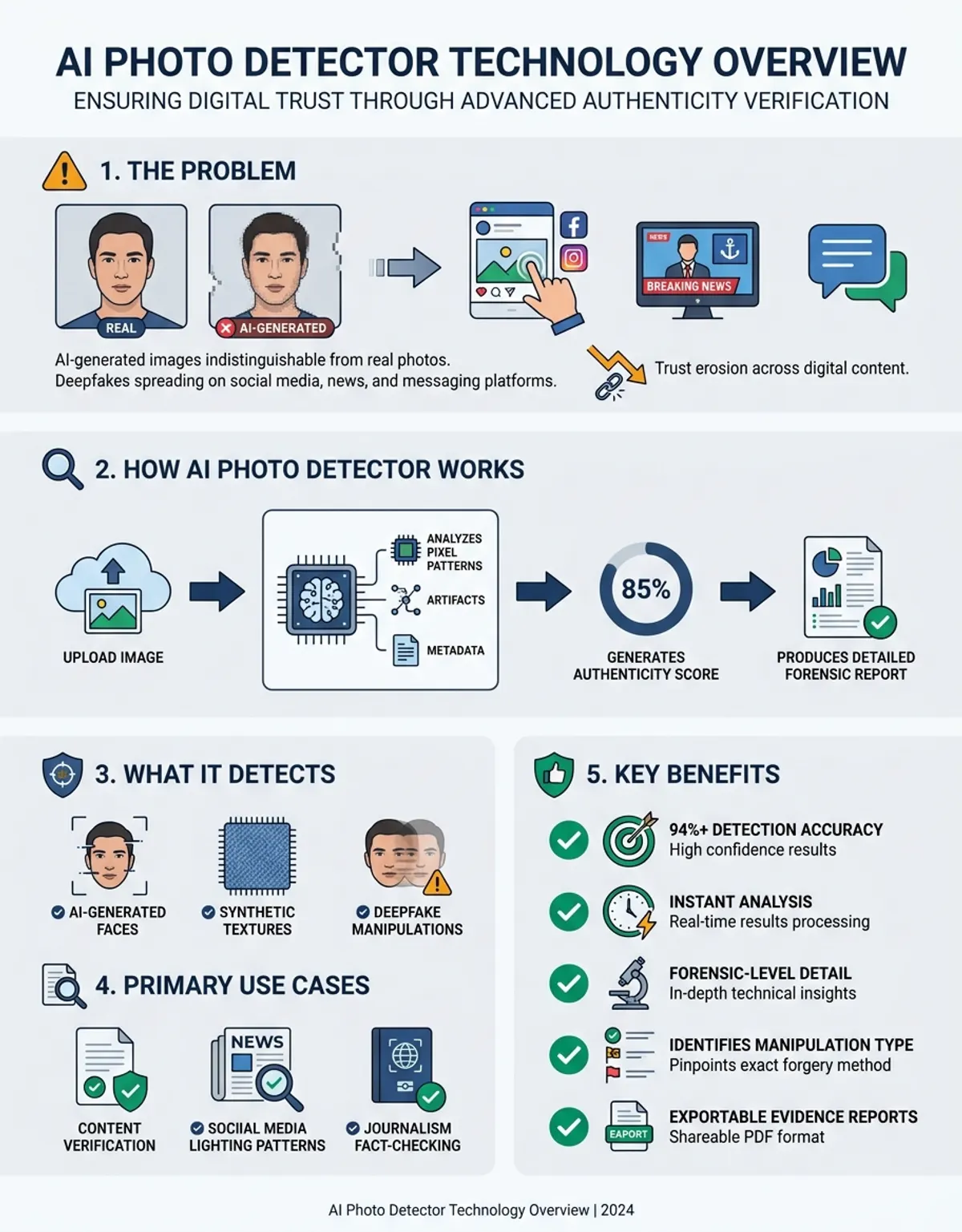
The core technology behind AI image detection relies on neural networks trained on millions of both real and AI-generated images. During training, the detector learns to recognize subtle artifacts left behind by generative models—compression patterns, color distribution anomalies, edge inconsistencies, and noise characteristics that differ from natural photograph processes. Once trained, the detector can classify new images with remarkable speed and performance.
Image Explained
A human expert might spend several minutes examining a single image and still miss sophisticated forgeries. An AI detector processes the same image in under a second, applying the same rigorous standards to every evaluation.
Image Explained
What sets automated AI visual content detection apart from manual verification is scale and consistency. A human expert might spend several minutes examining a single image and still miss sophisticated forgeries. An AI detector processes the same image in under a second, applying the same rigorous standards to every evaluation. This consistency makes AI detection indispensable for platforms that handle thousands of images daily.
Detector Explained
Modern AI picture detectors also provide confidence scores rather than binary yes/no answers. A result might indicate "85% probability of AI generation," giving users the context they need to make informed decisions. This nuanced approach acknowledges that detection isn't perfect—some images fall into gray areas where even advanced systems struggle to reach definitive conclusions.
Detector Explained
How Detector Technology Works: Identifying Deepfakes
Deepfake detection represents one of the most critical applications of AI image detection. Deepfakes—artificially manipulated images and videos that convincingly depict real people—pose serious threats to personal privacy, corporate security, and democratic institutions. AI picture detectors combat this threat by identifying the distinctive fingerprints left by deepfake generation algorithms.
One primary detection method examines facial inconsistencies that emerge during the fake content creation process. Generative adversarial networks (GANs) and diffusion models often struggle with fine details like teeth, eye reflections, and hair strands. AI detectors analyze these regions at high magnification, searching for unnatural smoothing, asymmetrical features, or lighting that doesn't match the surrounding environment.
Frequency domain inspection provides another powerful manipulated image detection technique. When researchers convert an image from spatial representation to frequency representation, authentic photos exhibit specific patterns of high and low frequency components. Synthetic face images, by contrast, show anomalies in these frequency distributions—signatures of the mathematical processes used to generate them. Advanced AI visual content checkers incorporate this detection to catch deepfakes that look perfect to the human eye.
Temporal consistency checking helps identify deepfakes in video content, though many picture detectors can analyze individual frames extracted from video. If a person's face changes subtly from frame to frame in ways that violate physical reality—such as impossible head rotations or inconsistent lighting—the checker flags these anomalies. This multi-frame analysis catches sophisticated deepfakes that might pass scrutiny when viewed as static images.
The Science Behind Automated Analysis
Understanding how AI image review works requires examining several technical approaches that modern detectors combine for maximum accuracy. No single method perfectly identifies all AI-generated images, so robust detection systems employ multiple inspection techniques and synthesize their results into a unified confidence score.
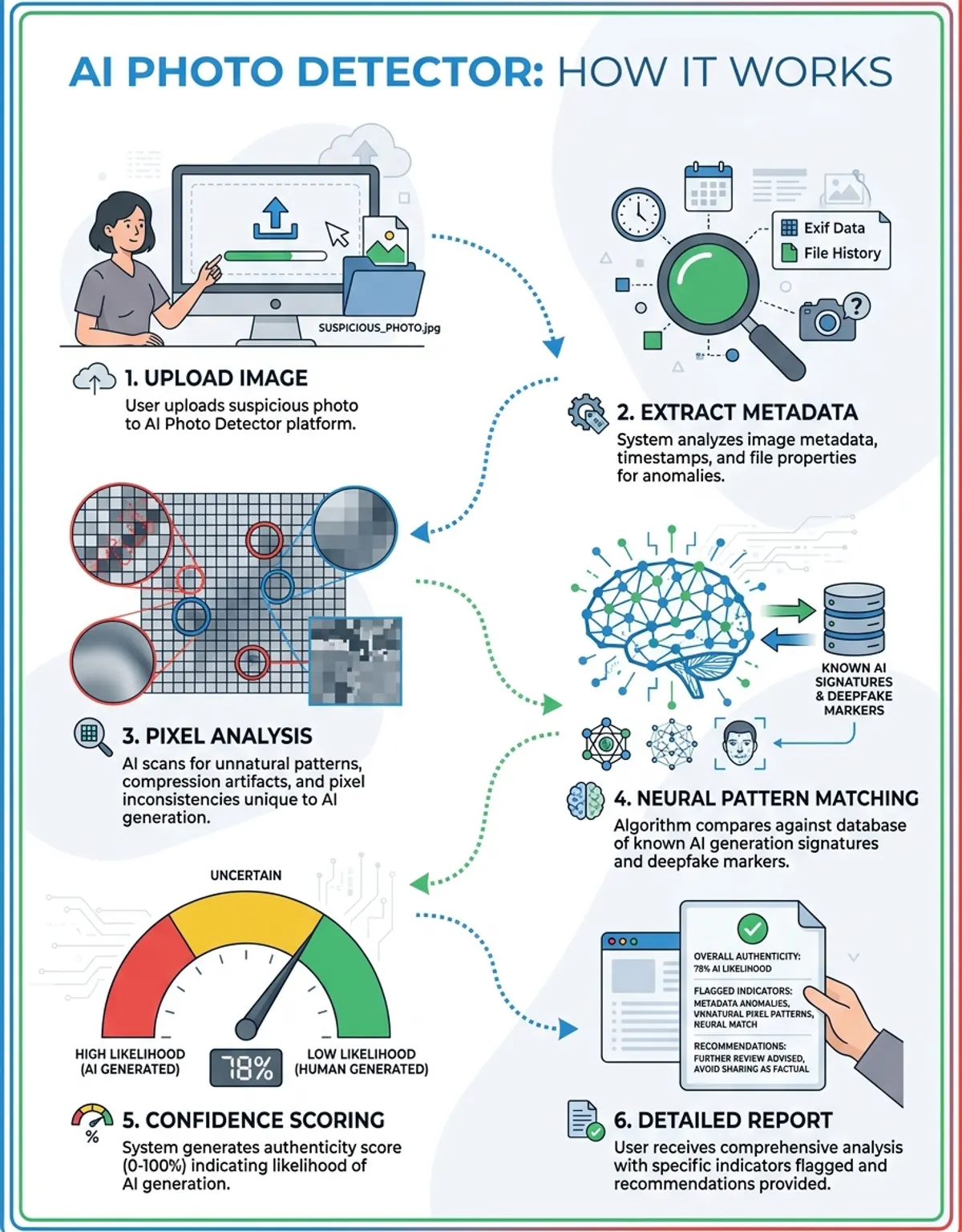
Convolutional neural networks (CNNs) form the backbone of most AI image detectors. These networks learn hierarchical visual patterns—from simple edges and textures at early layers to complex compositional structures at deeper layers. During training, CNNs discover that AI-generated images exhibit subtle regularities in how these patterns combine, regularities that don't appear in natural photography. When analyzing a new image, the network compares its learned representations against these signatures.
By analyzing noise at multiple scales and frequencies, detectors can distinguish synthetic noise from genuine sensor noise—a critical capability that catches even sophisticated AI-generated images.
Metadata and EXIF data examination provides complementary evidence. Authentic photos from real cameras include detailed metadata about the device model, lens settings, GPS coordinates, and timestamp. AI-generated images typically lack this metadata, or contain obviously fabricated information. While sophisticated actors can forge metadata, its absence or inconsistency serves as a useful initial filter that raises suspicion.
Noise pattern assessment examines the statistical properties of pixel-level noise inherent in all digital images. Real camera sensors produce characteristic noise patterns that vary with ISO settings, sensor temperature, and other physical factors. Generative AI models produce different noise signatures—often too uniform or mathematically regular. By analyzing noise at multiple scales and frequencies, detectors can distinguish synthetic noise from genuine sensor noise.
Ensemble methods combine predictions from multiple independent detection models. One model might specialize in detecting Stable Diffusion outputs, another in identifying Midjourney images, and a third in catching GAN-generated faces. By aggregating their predictions, ensemble systems achieve higher overall reliability and better generalization to new AI image generation techniques that didn't exist during the detector's initial training.
Why Journalists Use Image Detectors
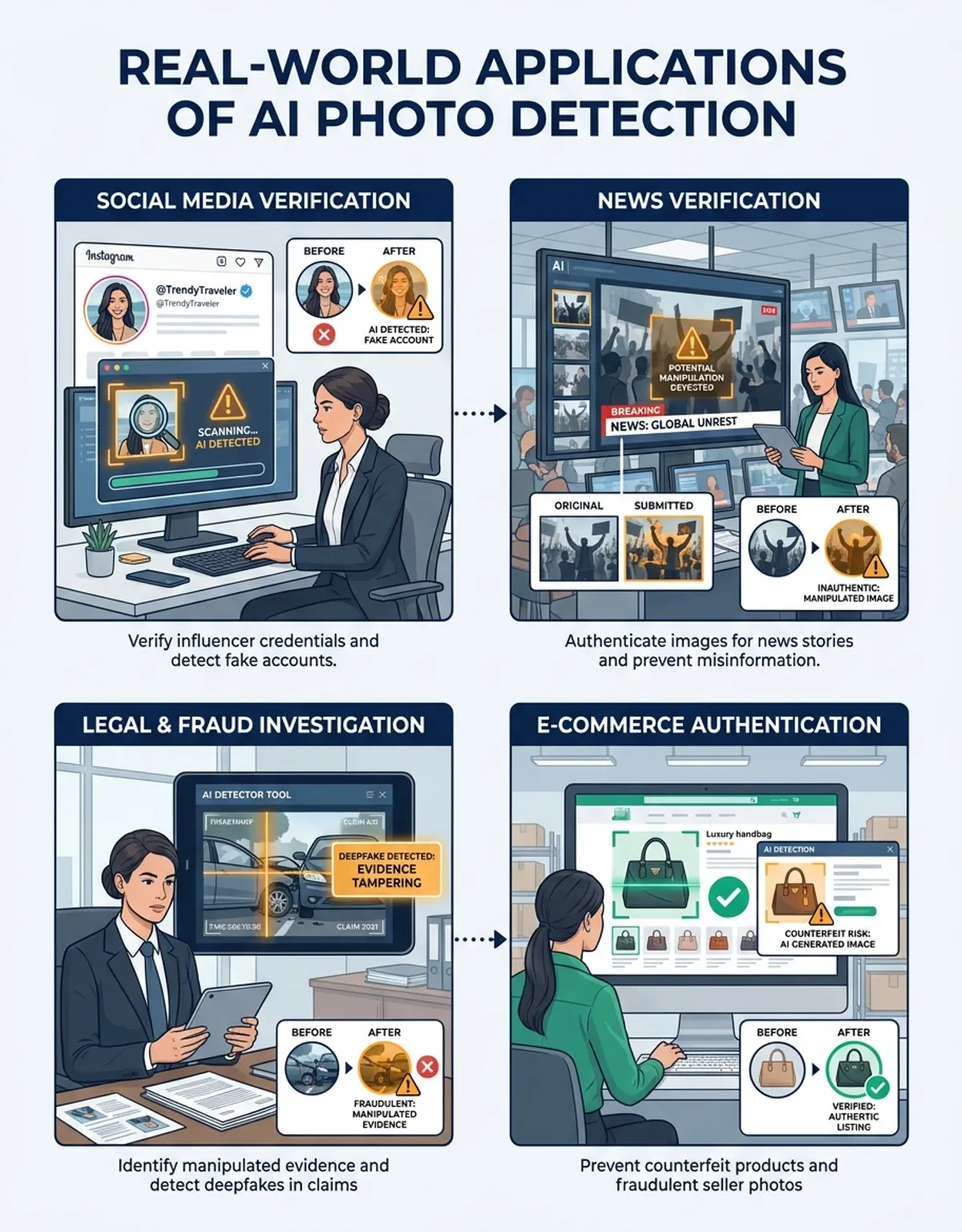
Media organizations face unprecedented challenges verifying the authenticity of visual content in an era when anyone can generate photorealistic images in seconds. For newsrooms worldwide, AI photograph checkers have become as essential as fact-checking databases and source verification protocols. The stakes couldn't be higher—publishing fake images damages credibility, spreads misinformation, and can influence public opinion on critical issues.
Several high-profile cases illustrate why rigorous visual content verification matters. During recent elections, AI-generated images depicting candidates in compromising or false scenarios circulated widely on social media before journalists debunked them. International conflicts have seen both sides accused of distributing synthetic images showing atrocities that never occurred. In each case, newsrooms that employed AI picture checkers could quickly identify fabricated content and avoid amplifying misinformation.
The verification workflow for modern media organizations typically includes multiple checkpoints. When a potentially newsworthy image arrives—whether from a citizen journalist, social media, or a wire service—it first passes through an AI image checker for automated screening. Images flagged as potentially synthetic receive additional scrutiny from human experts who examine metadata, reverse-search for earlier versions, and contact the alleged source. This layered approach balances speed with thoroughness. For Android users who need to verify image origins quickly, our reverse image search Android guide provides step-by-step instructions for conducting reverse searches on mobile devices.
Deadline pressure makes automated detection invaluable. Breaking news doesn't wait for lengthy manual investigations. An AI checker can process a submitted photograph in under five seconds, providing immediate guidance about whether to trust the image or investigate further. This rapid response helps protect newsrooms from publishing false content while maintaining the speed necessary for competitive journalism.
Beyond verifying individual images, some newsrooms use AI visual content detectors to monitor their own published archives. As generative AI improves, older detection methods become obsolete. Periodic rescanning of previously verified images—particularly in evergreen content and picture libraries—helps identify any content that newer, more sophisticated AI models might flag differently. This proactive approach maintains historical precision.
Understanding Detector Accuracy and Reliability
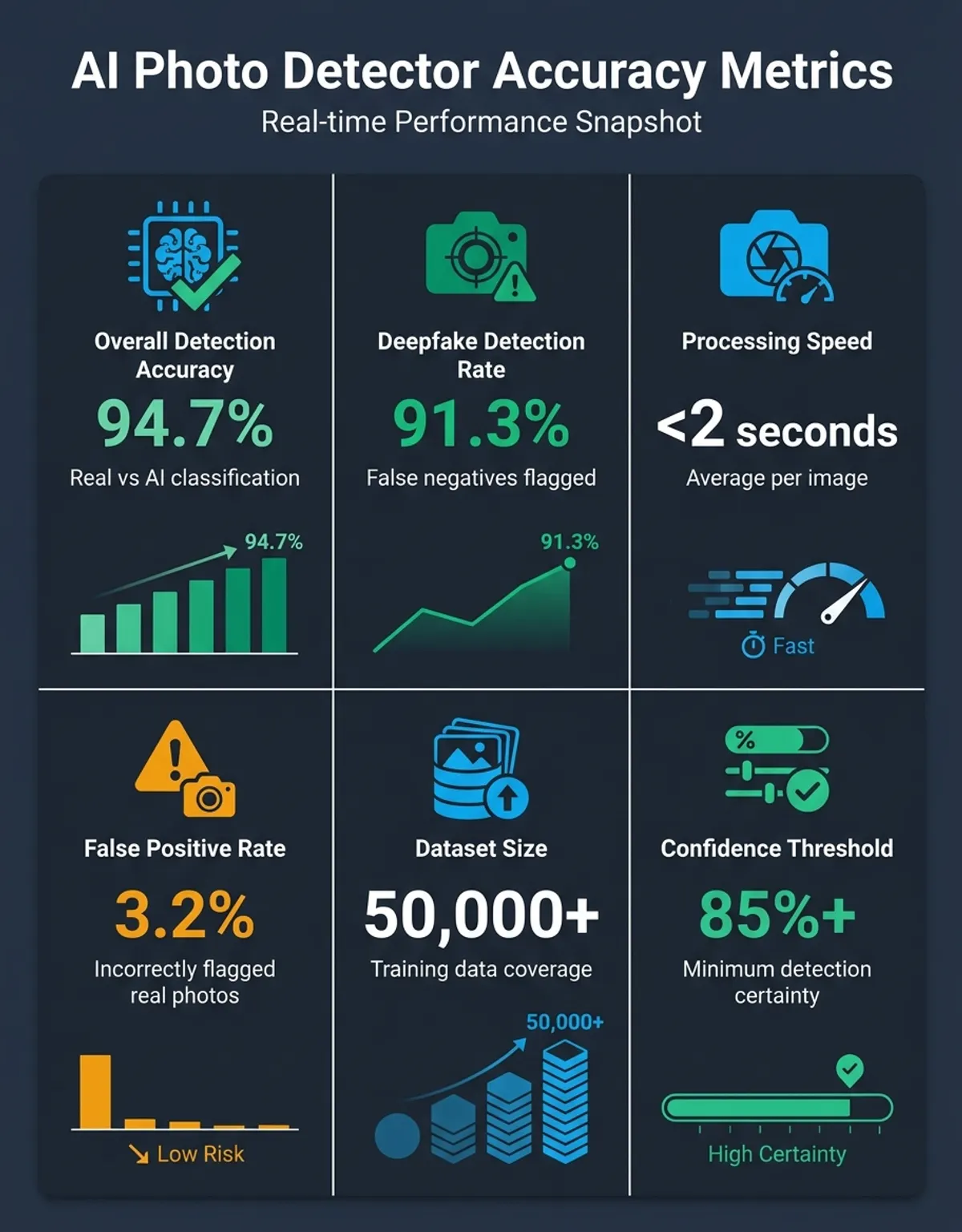
The success rate of AI image detectors varies significantly based on the specific tool, the type of generative model used to create the image, and how recently the detector was trained. Current state-of-the-art systems achieve effectiveness rates between 85% and 98% when tested on standard benchmark datasets, though real-world performance often falls at the lower end of this range due to evolving generation techniques.
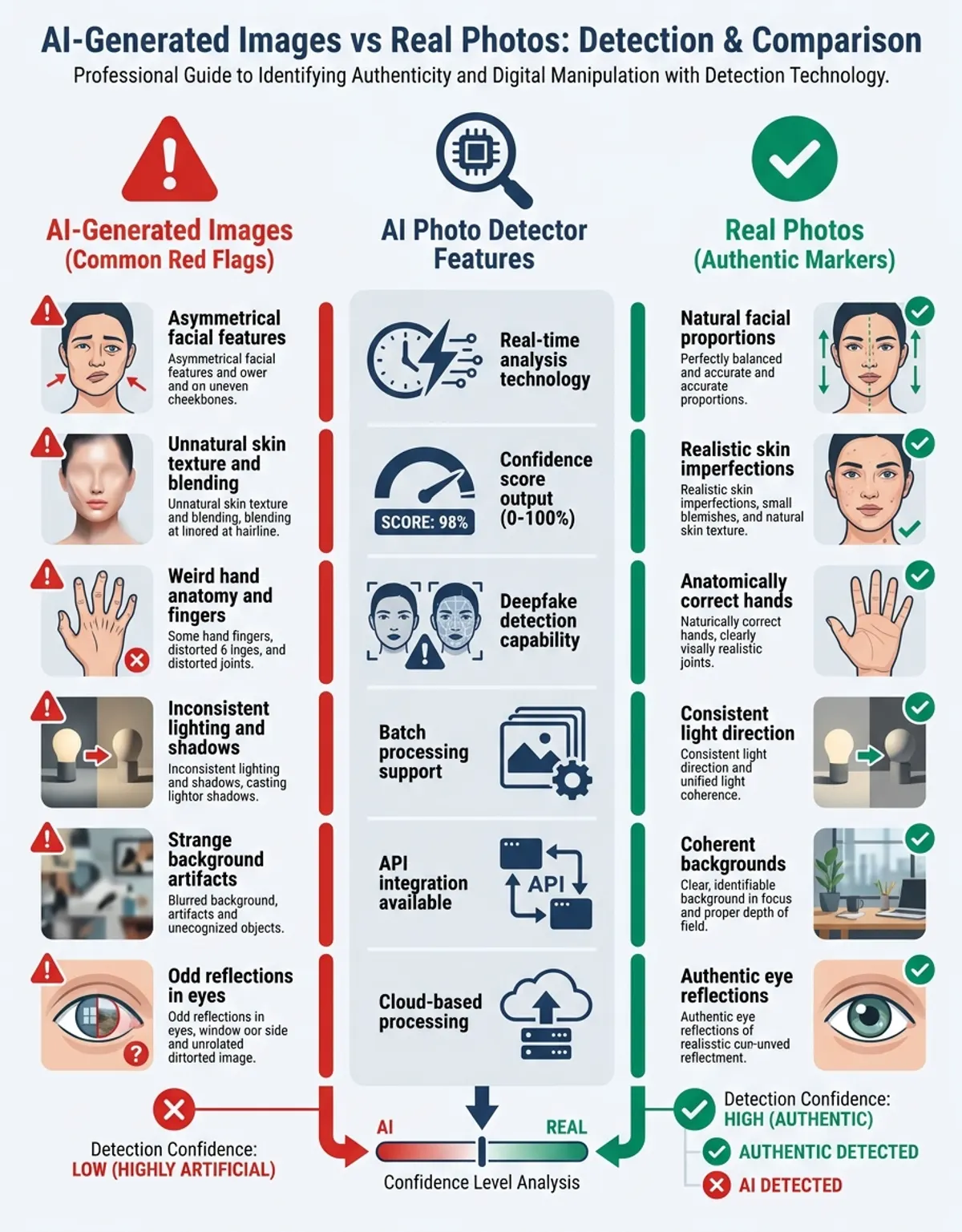
Understanding detection performance requires distinguishing between two types of errors. False positives occur when the detector incorrectly flags a real photograph as AI-generated. False negatives happen when an AI-generated image passes as authentic. Different use cases demand different trade-offs: a social platforms platform might accept higher false positive rates to ensure comprehensive moderation, while a newsroom might tolerate more false negatives to avoid wrongly discrediting legitimate sources.
No detector achieves 100% reliability. The best services provide clear confidence scores, explain their detection methods, and acknowledge uncertainty when images fall into ambiguous categories.
Several factors significantly impact detection reliability. Image compression, resizing, and filtering can obscure the subtle artifacts that detectors rely on, making even sophisticated systems less reliable when analyzing heavily processed images. Similarly, brand-new generative models that weren't included in the detector's training data often evade detection until the system is retrained. This creates a perpetual cat-and-mouse dynamic where detection precision fluctuates as new AI image generators emerge.
Benchmark testing reveals interesting performance patterns across different image categories. AI visual content detectors generally perform best on portrait faces (90-95% success rate), reasonably well on outdoor scenes and objects (80-90% effectiveness), and struggle most with abstract compositions or heavily stylized imagery (70-85% performance). These variations occur because detectors rely on learned expectations about how real photos should look—expectations that matter more for common subjects like faces than for unusual artistic content.
Transparency about limitations separates reputable AI picture checkers from overhyped tools. No detector achieves 100% reliability, and anyone claiming otherwise should be viewed skeptically. The best services provide clear confidence scores, explain their detection methods, and acknowledge uncertainty when images fall into ambiguous categories. This honesty helps users make appropriate decisions about whether to trust an image or seek additional verification.
AI Tools for Content Moderation
Content moderation at scale requires automation. Social content platforms, online marketplaces, dating apps, and community forums process millions of uploaded images daily—volumes that make manual review impossible. AI image detectors have become integral to screening pipelines that defend users from synthetic content designed to deceive, manipulate, or defraud.
Automated moderation workflows typically integrate AI detection as a first-pass filter. When users upload images, the platform's filtering system runs them through an AI picture detector before publication. Content flagged as likely AI-generated then routes to different handling depending on the platform's policies: automatic removal, human review, or simply adding a disclosure label. This automated screening catches the vast majority of problematic synthetic outlets without requiring human moderator attention.
Dating platforms face particular challenges from AI-generated profile photos. Users increasingly create fake profiles using synthetic faces that don't correspond to real people, enabling catfishing schemes and romance scams. By implementing AI visual content checkers in their verification flows, dating services can require that profile photos show actual humans. While determined fraudsters might still find workarounds, automated detection raises the barrier enough to deter casual misuse. For more on this topic, see our guide on reverse image search.
Marketplace platforms combat product fraud through synthetic image detection. Scammers sometimes list non-existent products illustrated with AI-generated photos that look professional and appealing. When buyers pay for these phantom items, sellers disappear. AI oversight tools help marketplaces identify listings featuring suspicious imagery, flagging them for review before they accumulate victims. This proactive approach secures both buyers and platform reputation.
Community safety extends beyond fraud prevention. Some platforms prohibit AI-generated content in specific contexts—for example, banning synthetic images in news or documentary sections while allowing them in creative spaces. AI picture detectors enable nuanced management policies that adapt to different content categories, shielding communities from misinformation while still permitting legitimate creative uses of generative AI.
Free vs. Paid Tools: A Comparison
The AI detection market spans from completely free online tools to enterprise solutions costing thousands of dollars monthly. Understanding what different price points offer helps you choose the right tool for your specific needs—whether you're an individual fact-checking social media posts or an organization processing thousands of images daily.
| Feature | Free Tools | Caracomp | Premium Enterprise |
|---|---|---|---|
| AI Detection | Basic patterns only | Advanced multi-model evaluation | Cutting-edge research models |
| Accuracy Rate | 75-85% | 90-95% | 90-98% |
| Batch Processing | No (one at a time) | Yes (up to 50 images) | Yes (unlimited) |
| API Access | No | Yes (5,000 calls/month) | Yes (custom limits) |
| Processing Speed | 10-30 seconds | Under 3 seconds | Under 1 second |
| Media & News Use | Personal use only | Full commercial license | Full commercial license |
| Metadata Analysis | Limited | Comprehensive | Comprehensive + forensics |
Free AI image detectors serve casual users well for occasional verification needs. If you encounter a suspicious image on social organizations and want a quick check, free tools provide reasonable success rate without requiring signup or payment. However, these tools often lag behind the latest generative AI techniques, meaning their effectiveness degrades faster as new image generators emerge.
Mid-tier solutions like Caracomp balance accessibility with professional-grade features. These platforms typically offer free access for individual images while providing paid tiers for users who need batch processing, API access, or higher performance through more frequently updated models. For small newsrooms, content creators, and researchers, these tools deliver enterprise-quality detection without enterprise pricing.
Premium enterprise platforms justify their cost through several advantages: the highest possible reliability from cutting-edge research models, instant processing speeds that handle thousands of images per minute, dedicated API infrastructure for seamless integration, and white-glove support including custom model training on your specific use case. Organizations for whom detection errors carry significant financial or reputational costs—major platforms companies, government agencies, and large platforms—find these investments worthwhile.
When choosing between free and paid options, consider your volume requirements, precision needs, and the consequences of errors. A blogger might rely entirely on free tools, while a newsroom verifying images for major stories should use the most accurate verification tool available regardless of cost. The right choice depends on your specific risk tolerance and usage patterns. For more on this topic, see our guide on how to tell if a linkedin profile is fake.
How to Use Caracomp's Image Detector
Caracomp's AI image detector provides professional-grade image verification in a streamlined interface that requires no technical expertise. Whether you're verifying a single image or processing a batch of files, the platform delivers results in seconds. Here's exactly how to use the tool to detect AI-generated images.
Start by navigating to Caracomp's AI picture detector page. You'll see a clean upload interface with a prominent drop zone. The tool accepts all common image formats including JPEG, PNG, WebP, and HEIC. You can either drag and drop your visual content directly onto this area, click to browse your file system, or paste an image URL if the picture is already hosted online.
Once your image uploads, the inspection begins immediately—no need to click additional buttons or configure settings. Caracomp's detector examines the image using multiple independent AI models, checking for generation artifacts, analyzing noise patterns, reviewing metadata, and comparing against known characteristics of popular generative AI systems. The entire examination typically completes in under three seconds.
Your results appear in a clear, easy-to-understand format. The main detection verdict displays prominently: "AI-Generated," "Likely AI-Generated," "Uncertain," "Likely Authentic," or "Authentic," along with a confidence percentage. Below this, you'll see detailed breakdowns of specific assessment components—which AI models the image might have come from (if detected), what artifacts or anomalies were found, and whether metadata supports or contradicts the image's apparent authenticity.
For borderline cases where the confidence score falls between 40% and 60%, the tool provides additional context to help you interpret results. It might note that the image has been heavily compressed (making detection less reliable), that it contains unusual artistic elements (which can trigger false positives), or that it resembles outputs from very recent AI models (which the detector might not fully recognize yet). This transparency helps you make informed decisions rather than blindly trusting automated verdicts.
Advanced users can access the batch processing feature to verify multiple images simultaneously. Upload up to 50 photos at once, and Caracomp processes them in parallel, delivering a comprehensive report showing the detection results for each image. This capability proves invaluable for content moderators reviewing submissions, researchers analyzing image datasets, or anyone who needs to verify numerous photos efficiently.
Ready to verify your first image? Visit Caracomp's AI image detector today and experience instant, accurate AI image detection—no signup required for your first 10 checks. Shield yourself from misinformation, verify the authenticity of images you encounter online, and make informed decisions about what visual content to trust. For more on this topic, see our guide on is this image ai generated.
Frequently Asked Questions
How does an AI tool work?
An AI picture detector works by analyzing digital images for patterns and artifacts characteristic of AI generation systems. The detector uses trained neural networks to examine pixel-level details, frequency domain signatures, noise patterns, and metadata. By comparing these elements against learned characteristics of both authentic photos and known AI-generated images, the system produces a probability score indicating whether the image was artificially created. Modern detectors combine multiple evaluation methods to achieve higher success rate than any single technique could provide alone.
Can AI Detect Deepfakes Accurately?
AI visual content detectors can identify many deepfakes with effectiveness rates between 85% and 95%, though performance varies based on the sophistication of the artificial portrait and how recently the detector was trained. Advanced detectors analyze facial inconsistencies, lighting anomalies, temporal patterns in video frames, and frequency domain signatures that fake content generation algorithms leave behind. However, as manipulated image technology evolves, detection performance requires continuous model updates. The most reliable approach combines automated detection with human expert review for high-stakes verification.
What Is the Accuracy of Free AI Image Tools?
Free AI image detectors typically achieve reliability rates between 75% and 85% on standard test datasets. This lower precision compared to paid services results from several factors: less frequent model updates as new AI generators emerge, simpler review techniques that examine fewer image characteristics, and longer processing times that limit the computational depth of the inspection. For casual personal use, free detectors provide reasonable reliability, but professional applications requiring higher confidence should consider paid tools with success rate rates above 90%.
How do newsrooms use AI-generated image detection tools?
Newsrooms integrate AI-generated image detection tools into their verification workflows as a rapid first-pass filter for submitted photos. When potentially newsworthy images arrive from social content, wire services, or citizen journalists, staff run them through detection software before publication. Images flagged as likely synthetic receive additional scrutiny including metadata examination, reverse image searches, and source contact verification. This layered approach helps outlets organizations maintain credibility by avoiding publication of fabricated content while meeting the speed demands of breaking news coverage.
Can AI detect manipulated photos in video content?
Yes, AI picture detectors can analyze individual frames extracted from video content to detect ai generated images. Video examination typically involves examining multiple frames to check for temporal inconsistencies—changes between frames that violate physical reality, such as impossible movements or inconsistent lighting. Some specialized video detectors also analyze audio-visual synchronization, compression artifacts specific to video formats, and frame-to-frame coherence patterns. However, video detection generally requires more computational resources than static image assessment and may produce less certain results when videos have been heavily compressed or edited.
What makes Caracomp's AI picture checker different from others?
Caracomp's ai image detector distinguishes itself through several key features: instant results in under three seconds, multi-model ensemble evaluation that combines predictions from multiple independent AI systems, transparent confidence scoring with detailed breakdowns explaining the detection rationale, and no mandatory signup for initial use. The platform updates its detection models monthly to stay current with emerging AI generation techniques, provides batch processing for efficiency, and offers a commercial-use license making it suitable for professional publishers and content review applications. This combination of speed, effectiveness, and accessibility makes Caracomp ideal for both individual users and professional organizations.
Is there a free AI tool I can use without signing up?
Yes, Caracomp offers a free ai image detector that requires no signup or account creation for your first 10 image checks. Simply visit the detection page, upload or paste your image, and receive instant results with detailed review. This no-barrier approach lets you verify suspicious images immediately without sharing personal information or going through registration processes. For users who need ongoing access or batch processing capabilities, Caracomp plans start with the first month at 50% off ($14.50), then $29/month.
Conclusion
AI picture detectors have evolved from experimental research tools into essential infrastructure for anyone who encounters images online. As generative AI becomes more sophisticated and accessible, the ability to distinguish real from synthetic imagery no longer remains optional—it's a fundamental digital literacy skill for navigating modern organizations environments.
Throughout this guide, we've explored how AI visual content detection technology works, from the neural networks that power synthetic face inspection to the frequency domain techniques that catch subtle generation artifacts. We've examined why performance matters, how different tools compare, and what separates free detectors from premium solutions. Most importantly, we've seen how organizations from newsrooms to screening teams rely on these tools to safeguard against misinformation and maintain trust.
The technology continues advancing rapidly. Detection methods that work today may struggle tomorrow as new AI image generators emerge with different signatures and fewer artifacts. This ongoing evolution means choosing a detector with frequent updates and transparent reliability reporting matters as much as raw performance numbers. Tools that combine multiple examination approaches, provide detailed confidence scores, and acknowledge their limitations deliver more reliable guidance than systems claiming perfect detection.
For most users, the question isn't whether to use an AI picture detector, but which one best fits your needs. If you're verifying occasional images from social platforms, a free detector offers reasonable precision without commitment. If you're a professional who depends on image authenticity—whether in journalism, content filtering, or research—investing in a more accurate tool provides essential protection against increasingly sophisticated synthetic content.
Start verifying images today with Caracomp's AI image detector. Experience professional-grade detection powered by cutting-edge AI models, delivered in seconds through an intuitive interface. No signup required for your first checks—just upload an image and discover whether it's authentically captured or artificially generated. In a world where seeing no longer means believing, equip yourself with the tools to know what's real.