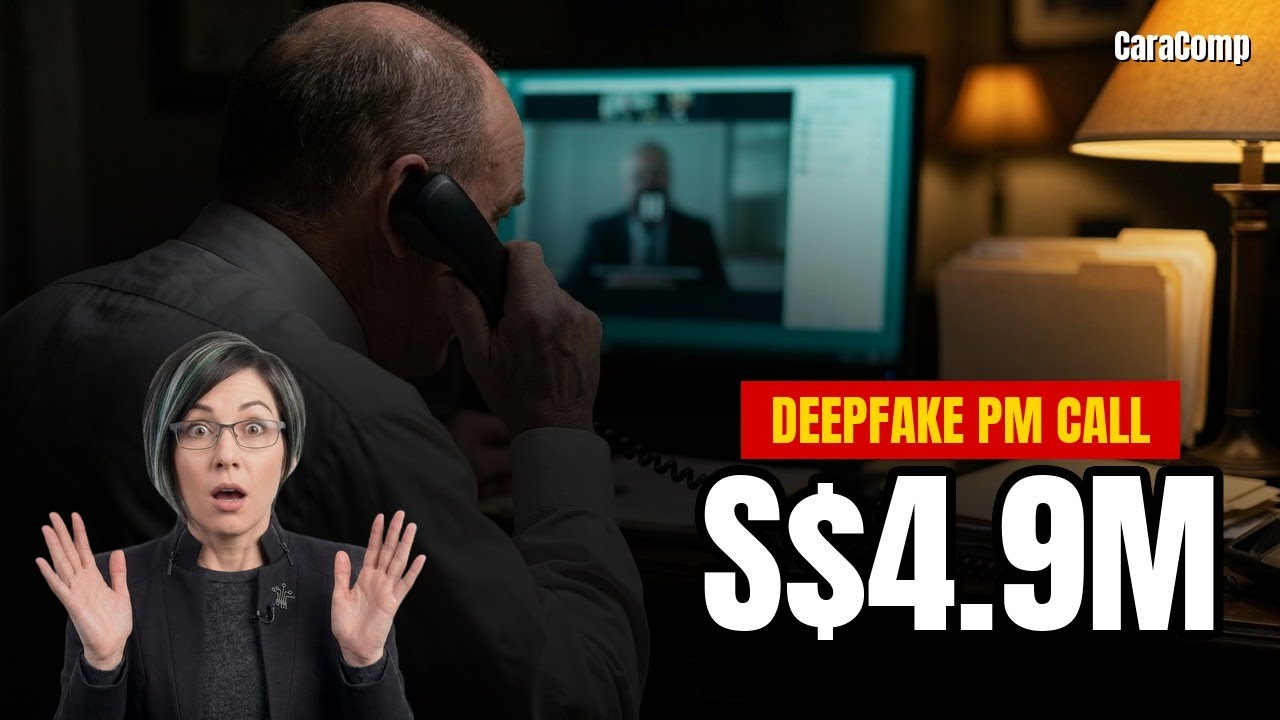
A man in Singapore sat through a Zoom briefing with his Prime Minister. He took notes. He asked questions. Every face on that call was fake. He wired the equivalent of fifteen million ringgit before anyone noticed. The scam opened with a WhatsApp from a fake Cabinet Secretary, escalated through a forged official email, and closed with a deepfake of P.M. Lawrence Wong personally thanking him for attending. That closing touch is what dissolved his doubt. For anyone who's ever joined a work call and trusted the face on screen, that's the unsettling part.
According to Mothership.SG, Singapore Police confirmed the footage was stitched together from pre-recorded video and cloned audio. They caught it. They just caught it after the money cleared.
Voice cloning now takes twenty seconds of audio. A LinkedIn clip is enough. Detection finds the fraud. Workflow prevents it. Those aren't the same thing.
If a fake prime minister can move millions, what happens when a whole country puts its face in one database?
A farmer in rural Nigeria opens a banking app, holds up her phone, and gets verified in seconds. No branch visit. No paperwork. That single moment is being repeated at a scale no country has ever attempted. Nigeria is racing to issue a hundred and eighty million digital I.D.s by the end of next year. The technology now runs entirely offline, which means it reaches villages a bank branch never could. For anyone who's ever waited in line to prove who they are, that sounds like progress. The catch is what gets built underneath it.
According to Biometric Update, Nigeria's enrollment push now covers government services, farming programs, even prisons. One billion verifications are targeted by a single vendor.
Once you build infrastructure that scans a billion faces, you don't dismantle it. Convenience becomes the architecture. The architecture becomes permanent.
The scams getting through don't always look like scams. Sometimes they look like a text from a courthouse.
A grandmother opens a text saying she missed jury duty. Pay the fine, or face arrest. The link looks official. The portal looks real. There's no fake video anywhere. That's the new shape of synthetic fraud. Deepfake losses in the U.S. tripled in a year, from three hundred sixty million to one point one billion dollars. The mental picture of a celebrity face saying something weird? That's not where the money is going. The money is in ordinary-looking messages most people barely read twice.
According to McAfee researchers, just thirty scam accounts on Facebook generated two hundred and fifteen million ad impressions in a single year. A convincing deepfake now takes forty-five minutes and five dollars.
Three seconds of your voice produces an eighty-five percent match. The dangerous fake isn't the one that screams. It's the one that whispers, routine.
Three stories. One pattern. Verification is moving everywhere at once, into government I.D., into banking apps, into your text messages. The fraud is moving with it. The institutions that win the next year aren't the ones with the best tech. They're the ones who can prove who's checking, and why.
Links to every story and today's podcast deep-dives are in the description. See you tomorrow.