
TSA Facial Recognition Opt Out: How to Decline the Checkpoint Camera
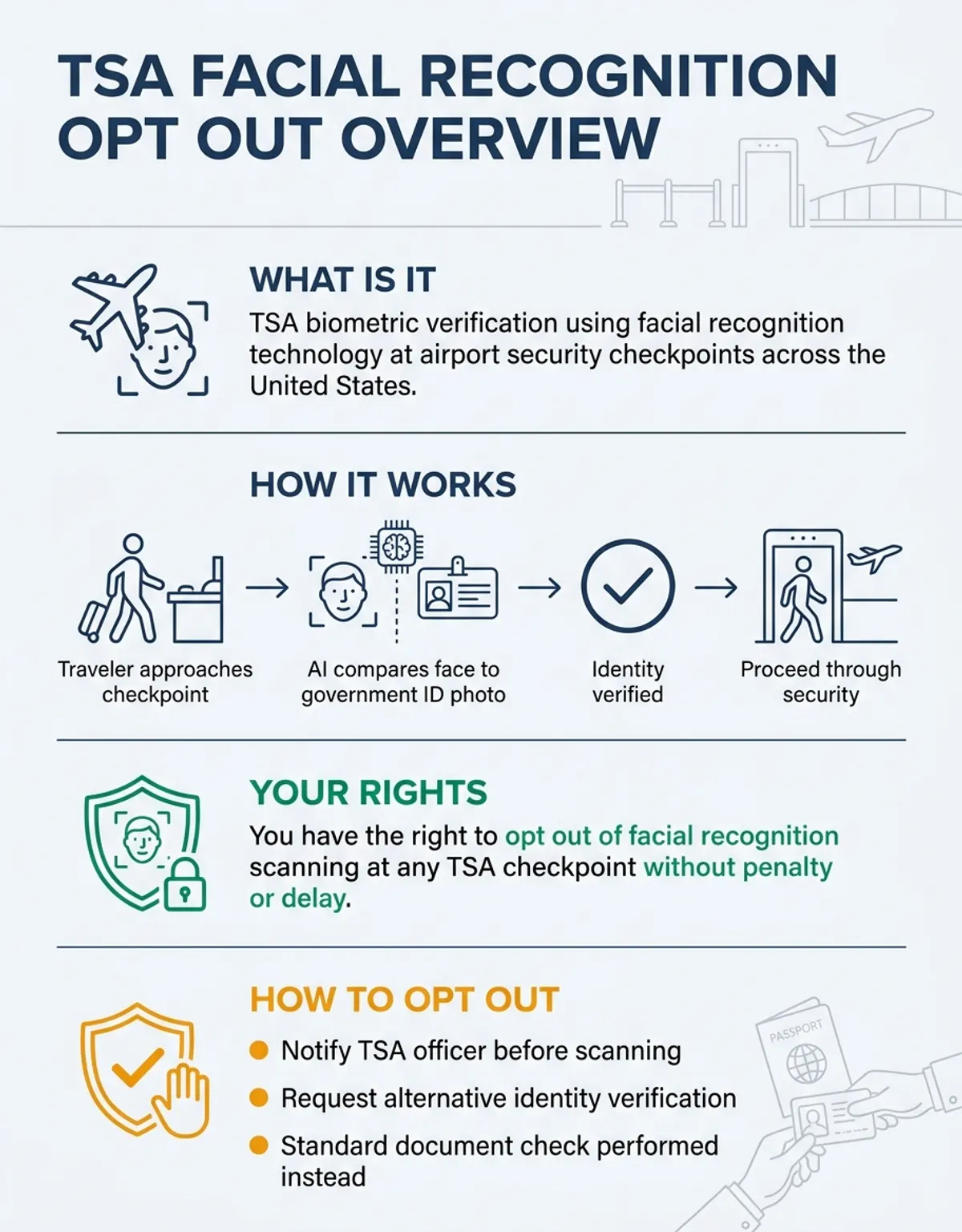
Biometric screening is now deployed at dozens of major travel hubs across the United States, using facial recognition technology to confirm traveler identity at TSA checkpoints. If you are concerned about TSA privacy or simply prefer a traditional ID check, you have the right to decline. These facial scans are not mandatory—participation is voluntary, and you can decline at any moment without penalty. This guide explains exactly how to refuse the camera, what happens when you do, and which locations currently run this system. A manual ID check is always available as the fallback.
How Facial Recognition Technology Works
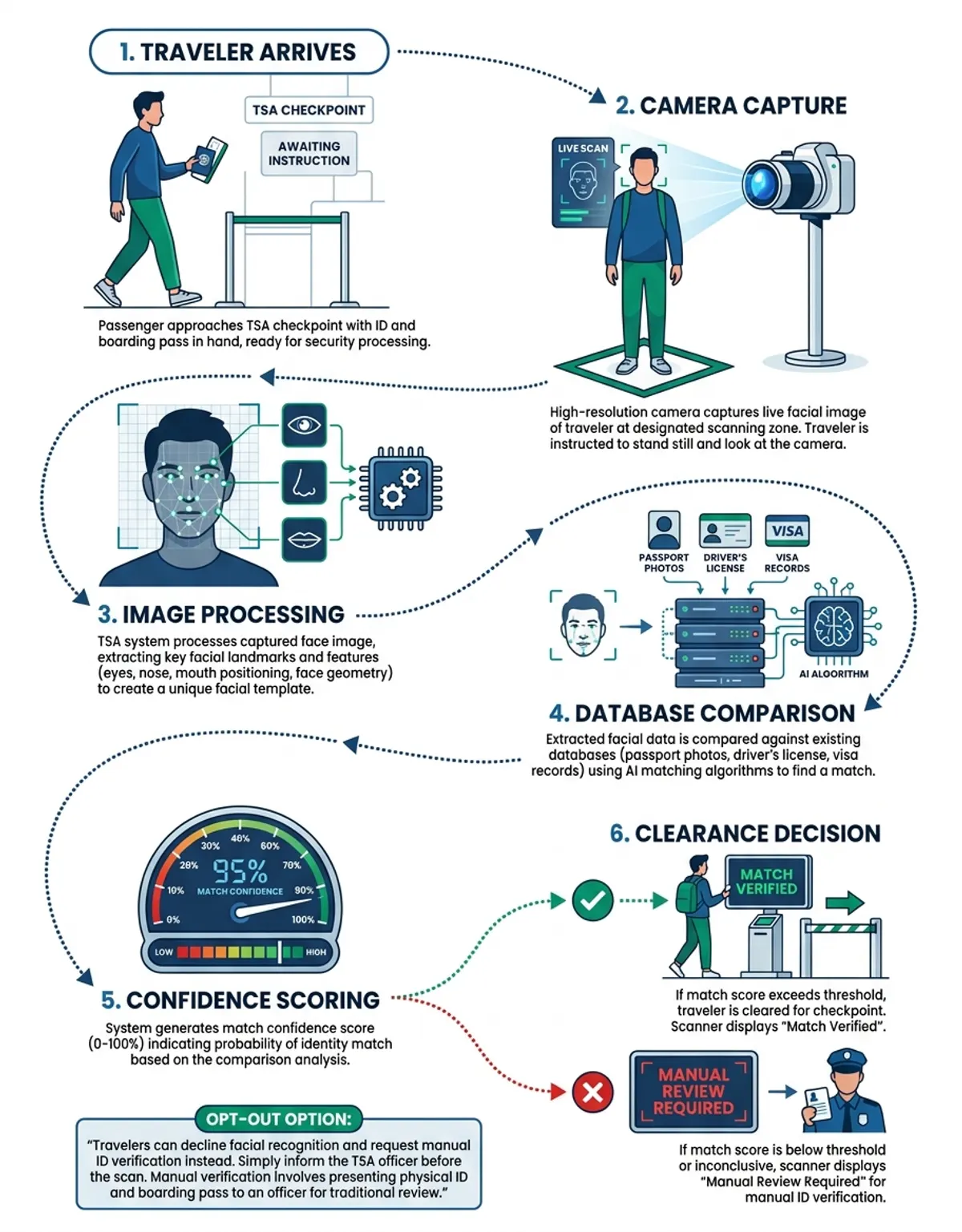
The program is a biometric identity check overseen by the Department of Homeland Security (DHS) and operated by TSA. The system matches your live image against the photo on your government-issued ID. When you approach a TSA checkpoint equipped with this facial recognition technology, a camera captures your image and compares it to the photo embedded in your driver's license, passport, or other accepted document. Privacy groups describe this facial recognition rollout as a quiet expansion of airport surveillance during travel, even though TSA officers call it a routine identity step.
The match process takes only a few seconds. A TSA officer places your ID on a scanner, the system captures your biometric data, and the technology determines whether your facial features match the ID photo. If the match succeeds, you are cleared to proceed through security. The TSA program is designed to streamline the identity step and reduce the need for officers to manually compare passengers to their ID photos. DHS began piloting it in 2017, and it has since expanded to more than 80 travel locations nationwide. The Transportation Security Administration positions this facial recognition capability as a security enhancement that improves accuracy and efficiency at TSA checkpoints, while critics warn that any form of travel surveillance deserves scrutiny.
It is important to understand that this domestic screening operates differently from Customs and Border Protection (CBP) systems, which are used for international travelers entering the United States. While CBP's program is mandatory for non-U.S. citizens at many locations, the domestic version remains voluntary for all passengers, including those enrolled in expedited lanes under TSA terms. This distinction matters for frequent travelers crossing international borders.
TSA Face Scans Are Not Mandatory
No. The facial recognition camera step is not mandatory. Despite widespread deployment, participation remains completely voluntary. The TSA explicitly states that passengers can decline and use a traditional ID check instead. This applies to all travelers, whether you are flying domestically or preparing for an international trip, and whether or not you are enrolled in PreCheck.
Consenting passengers can opt in by simply allowing the camera to proceed when they reach the podium. However, any passenger may decline at any moment by verbally telling the officer that they do not consent to having their facial image recorded. Declining will not result in additional screening, secondary inspection, or any other penalty. You will not miss your travel or experience significant delays because you said no. Unlike some international locations where facial recognition screening is required for certain categories of travelers, U.S. domestic checkpoints let you refuse without consequence. Your right to decline is protected regardless of which location you are traveling through or which lane you use.
Some passengers mistakenly believe that expedited-lane members must participate. This is incorrect. The contactless PreCheck lanes, which rely on the same face-matching step, are also voluntary. Members can decline and still receive expedited screening using a manual ID check.
How to Decline at the TSA Checkpoint
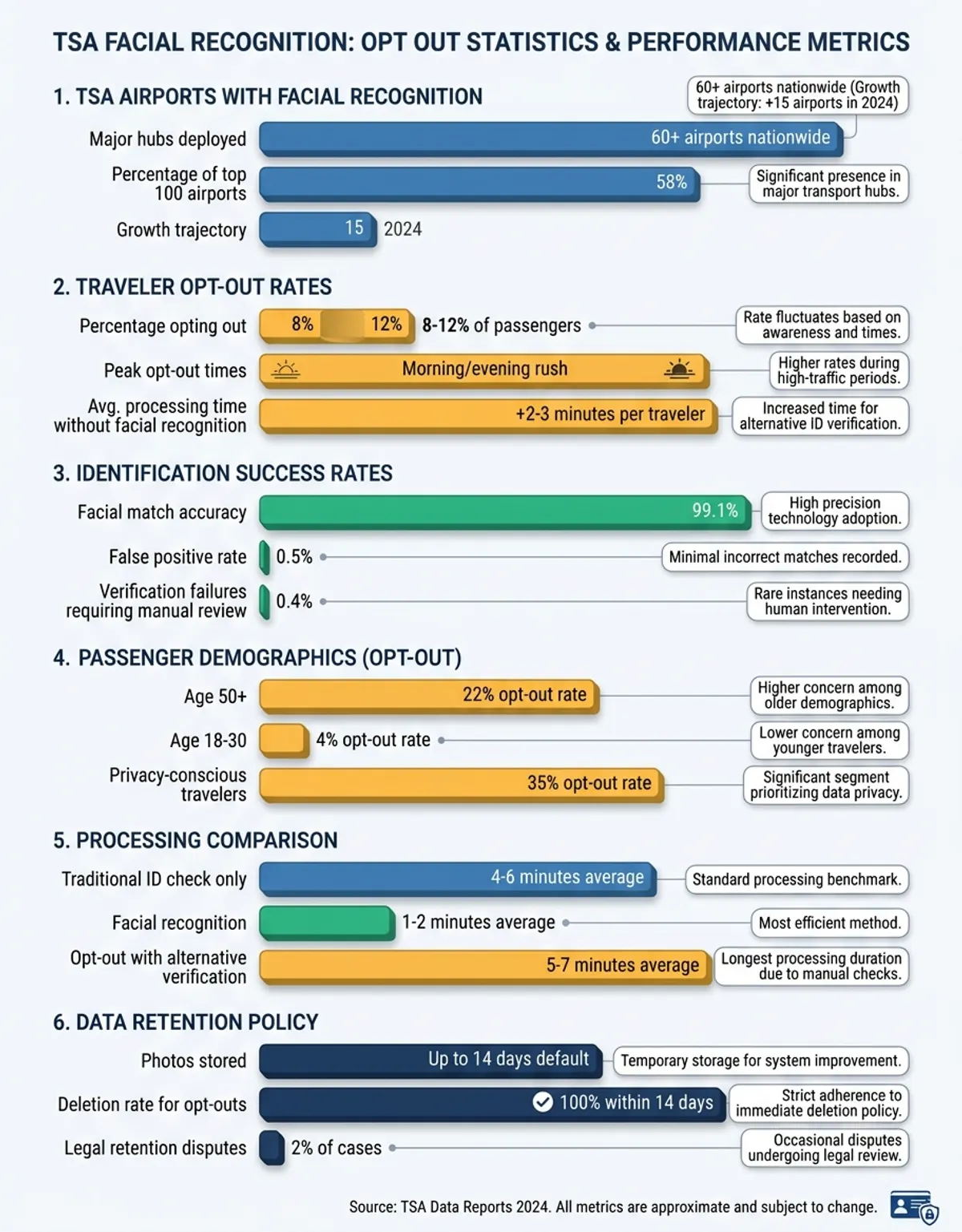
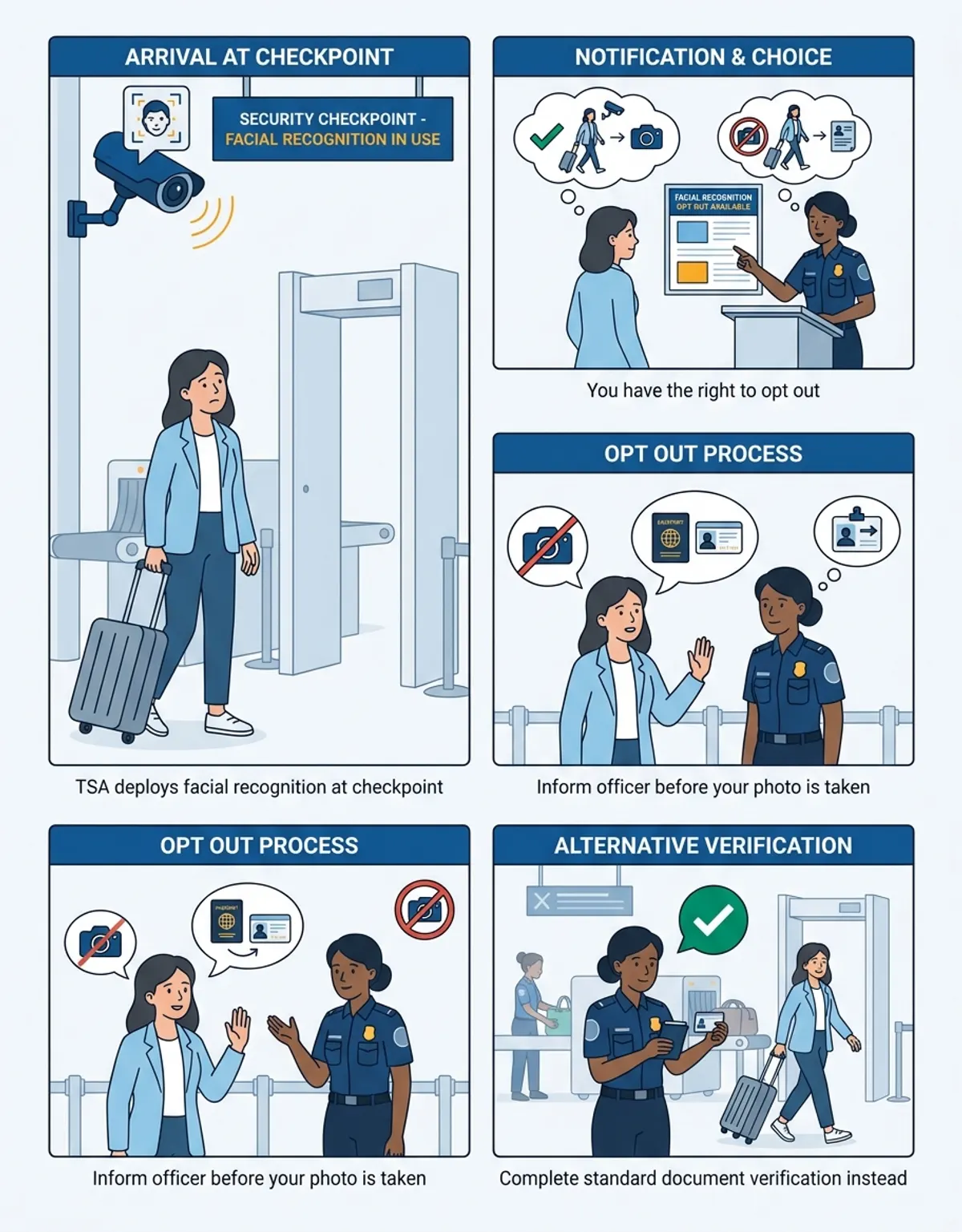
Saying no is straightforward. You do not need to fill out forms, make advance requests, or download apps. All you need to do is tell the officer you do not consent when you reach the podium. Here is exactly how to do it:
Step 1: Approach the checkpoint with your boarding pass and ID. Proceed through the line as you normally would. When you reach the podium where the officer checks identification, you will notice a camera or screen positioned to capture your image.
Step 2: Before the camera fires, tell the officer. Say clearly: "I decline facial recognition" or "I do not consent to the camera." You can also simply say "I'd like a standard ID check instead." The officer is required to honor your request.
Step 3: Hand your ID to the officer. Instead of using the camera, the officer will manually confirm your identity by comparing your physical appearance to the photo on your ID, just as checkpoints operated before this system was introduced.
Step 4: Proceed through security. Once the officer confirms who you are, you will continue through the checkpoint exactly as you would if you had consented. There is no extra screening, no interrogation about why you said no, and no difference in how your carry-on bags are processed. This works identically whether you are in a standard lane or a contactless PreCheck lane. If you are using an expedited lane equipped with this technology, you can still decline and keep your expedited screening. The officer will simply confirm who you are manually instead of using the automated system. In practice, declining adds only a few seconds—roughly the same time a manual ID check would take. Officers are trained to accommodate passengers who say no, and exercising this right is a routine occurrence at locations using the system.
PreCheck Contactless Lanes and Biometrics
Contactless PreCheck is a feature designed specifically for expedited lanes at TSA checkpoints. Instead of handing your ID to an officer, you place your driver's license or other accepted ID on a reader while a camera captures your facial biometric image. The system performs a real-time match to confirm who you are, allowing you to proceed without physically interacting with staff—hence the "contactless" designation during travel.
These contactless lanes are currently available at select locations and are being gradually expanded. The Transportation Security Administration markets the feature as a faster, more hygienic alternative to a manual ID check, particularly in the wake of COVID-19 concerns about physical contact. However, participation remains entirely voluntary.
If you are enrolled and encounter one of these lanes, you can decline and still use the expedited screening lane. Simply tell the TSA officer that you prefer a manual ID check. The officer will confirm your identity using traditional facial comparison methods while you still receive the benefits you have paid for: keeping your shoes, belt, and light jacket on, and leaving laptops and liquids in your carry-on bag during travel. Some members appreciate the speed and convenience of the contactless feature, while others prefer to maintain control over their facial biometric data. Policy lets you make this choice on a case-by-case basis—you can consent on one trip and decline on your next travel without any impact on your status or benefits.
It is worth noting that these contactless systems are distinct from the Clear biometric service, a private offering that also uses iris and face matching. Clear is a separate subscription, while expedited screening is a government program. Both let you skip biometrics, though Clear's entire value proposition is built on biometrics, so declining essentially defeats the purpose of enrolling in that service. For more on this topic, see our guide on reverse image search.
Privacy and Biometric Data: Are Your Facial Images Stored?
One of the most common questions is whether your biometric templates are stored in a government database. According to TSA, pictures captured during the facial match are not stored permanently. Officials say that once the facial recognition match is confirmed or denied, the image is immediately deleted from the system. Your biometric data is not retained, shared with other agencies, or added to any TSA facial database.
TSA privacy policies governing this program specify that the system is used solely for the identity step at the point of screening. The facial recognition technology compares your live image to the photo already on file in your government-issued ID—it does not create a new biometric profile or enroll you in a travel database. Officials say the facial comparison happens in real time and the captured picture is discarded within seconds.
Despite these assurances, privacy advocates and watchdog organizations remain concerned about the broader implications of normalizing biometric screening and facial recognition surveillance in travel hubs. Critics argue that widespread deployment could lead to function creep, where a system initially built for voluntary use eventually becomes mandatory or expands into broader surveillance beyond its original scope. Some security researchers also question whether all data is truly deleted as claimed. While the stated policy is not to retain pictures, there are concerns about potential vulnerabilities, the possibility of unauthorized retention by contractors operating the equipment, or future policy changes that could allow storage. These worries are amplified by the fact that this program operates alongside other initiatives that do retain data, such as CBP's entry-exit system for international travelers. For more on this topic, see our guide on facial recognition search.
For travelers who prioritize privacy, declining is the most reliable way to ensure your biometric data is not collected in the first place. By saying no and using a manual ID check, you eliminate any risk tied to how your image might be processed, transmitted, or stored.
Which Airports Use TSA Facial Recognition
The system is currently deployed at more than 80 airports across the United States, with ongoing expansion planned. Major airports using it include Hartsfield-Jackson Atlanta International, Dallas/Fort Worth International, Denver International, Los Angeles International, Miami International, Phoenix Sky Harbor International, and Washington Dulles International.
The hardware is typically installed in select lanes rather than at every checkpoint. At larger hubs, you may find it in certain terminals or concourses while other lanes still use a manual ID check exclusively. Contactless lanes are similarly distributed unevenly—some sites have several, while others have none. If you want to say no at any of these locations, the process is identical regardless of where you fly. Simply tell the officer that you do not consent, and they will confirm who you are manually. Because participation is voluntary nationwide, location-specific policies do not override your right to refuse.
Travelers who frequently pass through these hubs may notice that some officers are more familiar with refusal requests than others. At sites where the system has been deployed for years, officers typically process them smoothly and without question. At sites where it is newly installed, you may occasionally encounter an officer who is less familiar with the procedure, but policy requires them to accommodate you. The specific technology may also vary by airport, since the agency has tested platforms from multiple vendors. From a passenger perspective, though, the steps remain the same: decline consent, and the officer will check your ID manually. For more on this topic, see our guide on anti facial recognition makeup.
Your Rights at the Checkpoint
Understanding your rights helps you navigate any TSA checkpoint with confidence. Facial recognition security at airports is governed by published TSA privacy rules, and those rules consistently affirm that the facial scan is voluntary. No federal law requires you to submit to facial biometric screening to fly domestically. The facial recognition technology is positioned as a convenience and a security enhancement, not a mandate, and TSA's own privacy guidance reinforces that a manual ID check must remain available on request.
Privacy advocates recommend that travelers stay informed about how facial recognition technology expands across the security landscape during travel. Each year, more locations adopt the system, and the broader trend toward facial biometric monitoring raises legitimate questions. By knowing that you can decline the camera and request a manual check, you preserve control over your facial biometric data. Whether your concern is data collection or simply a preference for the familiar manual security process, the right to refuse is firmly on your side.
Practically, exercising your right is simple at any security checkpoint. When the facial recognition camera is offered, you can decline and ask for a standard ID check by hand. The officer will then compare your face to your ID exactly as airport security did before this recognition technology arrived. Across the airports that now run the system, the manual fallback works the same way, so you never have to weigh missing a flight against protecting your biometric data. Frequent flyers report that the recognition camera and the manual security lane move at nearly the same speed, which makes saying no a low-friction choice at busy airports.
Watchdog groups also encourage travelers to report any TSA checkpoint where an officer refuses to honor a decline request. While such refusals are rare, reporting them helps keep the program accountable. The TSA privacy and facial recognition security debate around airport biometric surveillance is ongoing, and informed travelers who exercise their right to a manual check play a meaningful role in shaping how this travel technology is deployed. As facial recognition expands to more airports, understanding the security trade-offs and your biometric privacy options keeps you in control.
Consent vs. Decline: A Quick Comparison
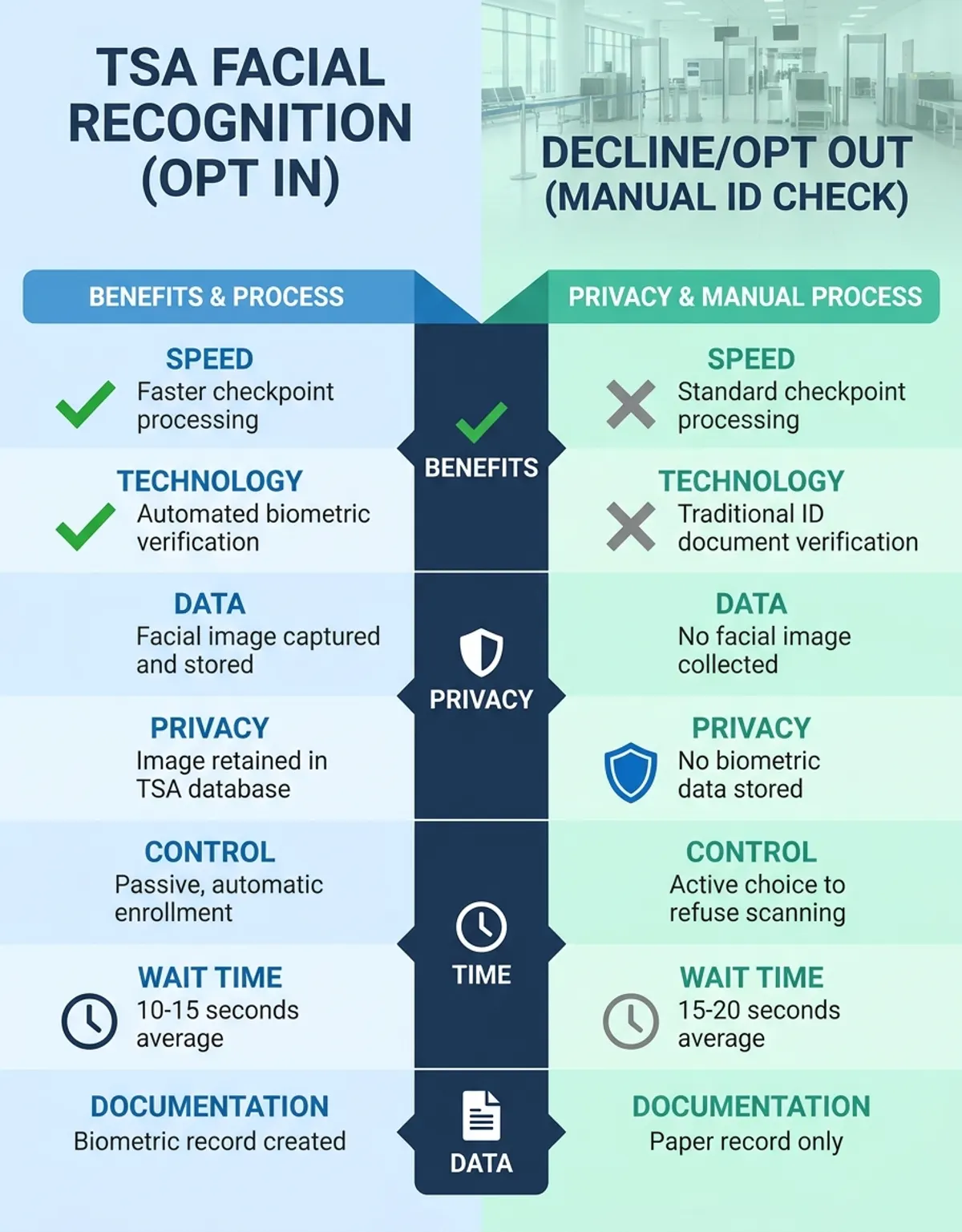
| Factor | Consent (Allow Camera) | Decline (No Camera) |
|---|---|---|
| Participation | Voluntary — consenting passengers allow the camera | Voluntary — any passenger may decline at any moment |
| ID Method | Camera matches your face to the ID photo | Traditional manual photo ID check by an officer |
| Expedited Lane Eligibility | Contactless lane available where equipped | Standard expedited lane used with a manual ID check |
| Data Retention | Images are not stored after the match completes | No biometric data collected at all |
| Extra Screening | None — standard checkpoint process | None — no penalty for declining |
| Speed | Slightly faster at some sites with contactless readers | Standard speed, comparable to the pre-biometric era |
Frequently Asked Questions
Can I decline the camera at the checkpoint?
Yes, you can decline at any time. Participation is completely voluntary. Simply tell the officer at the podium that you do not consent, and they will confirm who you are using a manual ID check. Declining will not result in additional screening or penalties.
What do I say to refuse the camera?
All you need to do is tell the officer you do not consent. You can say "I opt out of facial recognition," "I do not consent to having my photo taken," or "I'd prefer a manual ID check." The officer is required to honor your request and will inspect your ID by hand instead of using the camera.
Is Facial Recognition Mandatory for TSA PreCheck?
No. It is not mandatory for members. Even in contactless lanes that use the camera, participation remains voluntary. You can decline and still use expedited screening with a manual ID check. Your benefits are not affected by saying no.
Does the agency store your images afterward?
According to officials, pictures are not stored after the match is completed. The agency states that your biometric data is immediately deleted once the system confirms or denies the match between your live image and your ID photo. Privacy policies specify that the system is used only for real-time identity verification and pictures are not retained in databases.
Which locations use the face-match system?
More than 80 airports across the United States currently use the system. Major sites include Atlanta, Dallas/Fort Worth, Denver, Los Angeles, Miami, Phoenix, and Washington Dulles. The hardware is typically available in select lanes and contactless areas. You can decline at any of these locations by telling the officer at the podium that you do not consent.
What Happens if You Refuse? Travel Implications
If you refuse, the TSA officer will confirm who you are using traditional facial comparison methods by manually comparing your appearance to the photo on your government-issued ID. You will not face additional screening, interrogation, or penalties. The manual facial ID verification takes only a few extra seconds compared to the automated facial recognition method, and you will proceed through normally. Refusing does not affect your ability to board your flight or impact your expedited screening status if enrolled.