
Anti Facial Recognition Makeup: Privacy Protection Guide
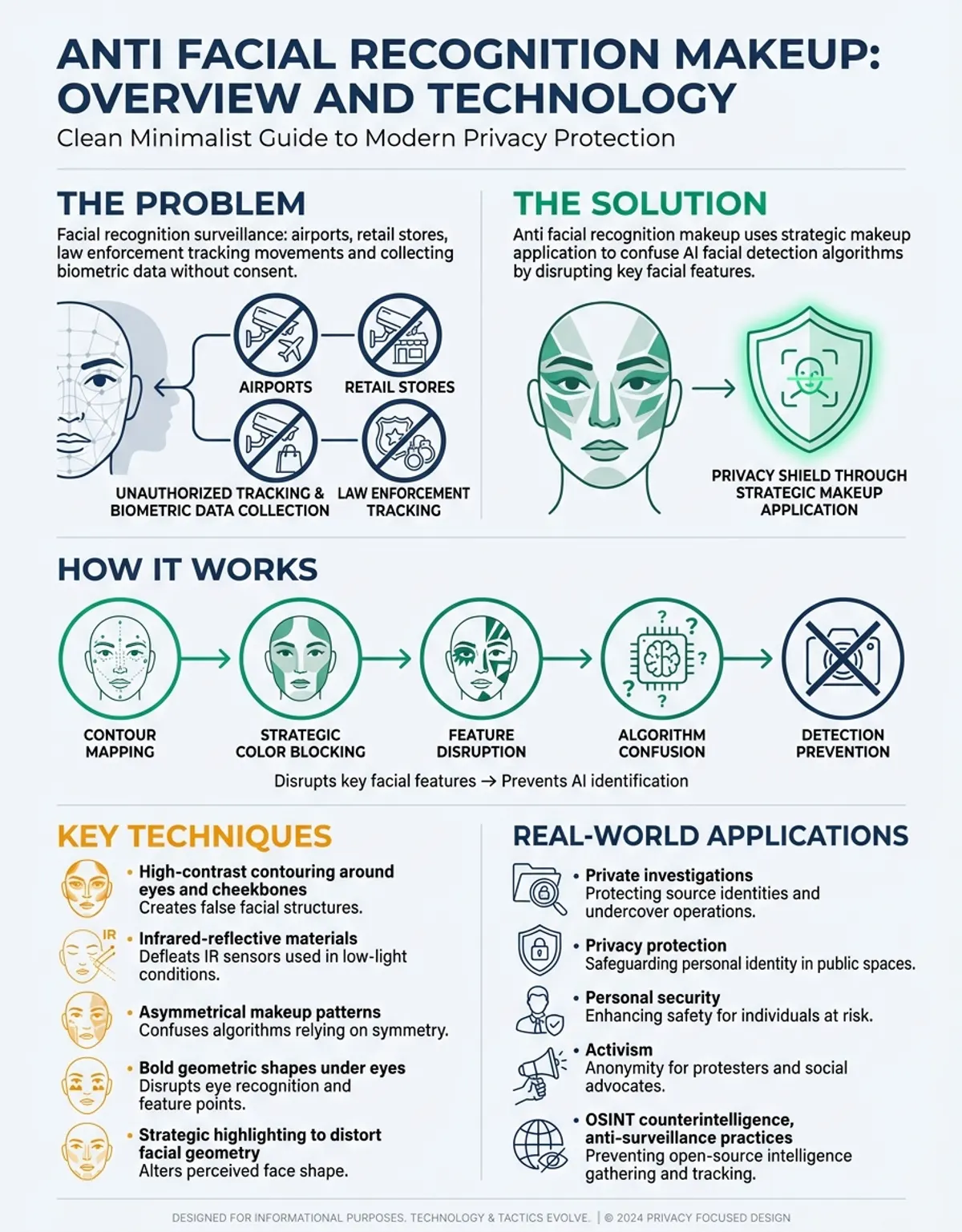
Privacy concerns have never been more pressing in our surveillance-heavy world. Face recognition technology operates on similar principles. From airport safety systems to retail stores, facial recognition cameras track our movements and collect biometric information without explicit consent. Anti facial recognition makeup emerged as a creative countermeasure, combining fashion with functional privacy protection. This comprehensive guide explores how these makeup techniques work, their effectiveness against modern detection algorithms, and practical applications for everyday privacy.
The intersection of beauty, tech, and civil liberties has created a unique cultural movement. Artists, activists, and privacy advocates have developed anti-surveillance makeup patterns specifically designed to confuse facial recognition . While some techniques focus on aesthetic presentation, others prioritize maximum disruption of face detection algorithms. Understanding the science behind these methods helps you make informed decisions about personal privacy tools. For a comprehensive guide on facial recognition technology and how various systems operate, explore our detailed resource.
What Is Anti Facial Recognition Makeup?
Anti facial recognition makeup refers to cosmetic techniques that disrupt the mathematical patterns facial recognition rely on to identify human faces. These use algorithms to detect key facial landmarks like eyes, nose, mouth, and jawline. By applying high-contrast patterns, asymmetrical designs, or strategic color blocking, the makeup confuses the detection process, preventing cameras from recognizing a face exists or properly identifying the individual.
The concept blends artistic expression with practical privacy protection. Early pioneers in this space viewed as both a fashion statement and a form of digital resistance. Unlike simple disguises or masks, these techniques work specifically against automated tools rather than human observers. The makeup doesn't hide your face from people, it hides specific geometric patterns from computer vision algorithms and .
Modern anti facial recognition makeup falls into several categories. Some designs aim to completely block facial recognition by preventing initial . Others focus on misidentifying the wearer as someone else or generating false landmark information. The most sophisticated approaches combine multiple techniques, targeting different stages of the facial recognition pipeline from initial detection through final identification.
The effectiveness depends on understanding how automated platforms process visual details. Facial recognition algorithms typically convert images into mathematical representations by measuring distances between facial features. Anti-recognition makeup disrupts these measurements by creating false shadows, altering perceived contours, or adding high-contrast elements that overwhelm the algorithm's pattern matching capabilities.
How Facial Recognition Detection Works (And Where Makeup Fits In)
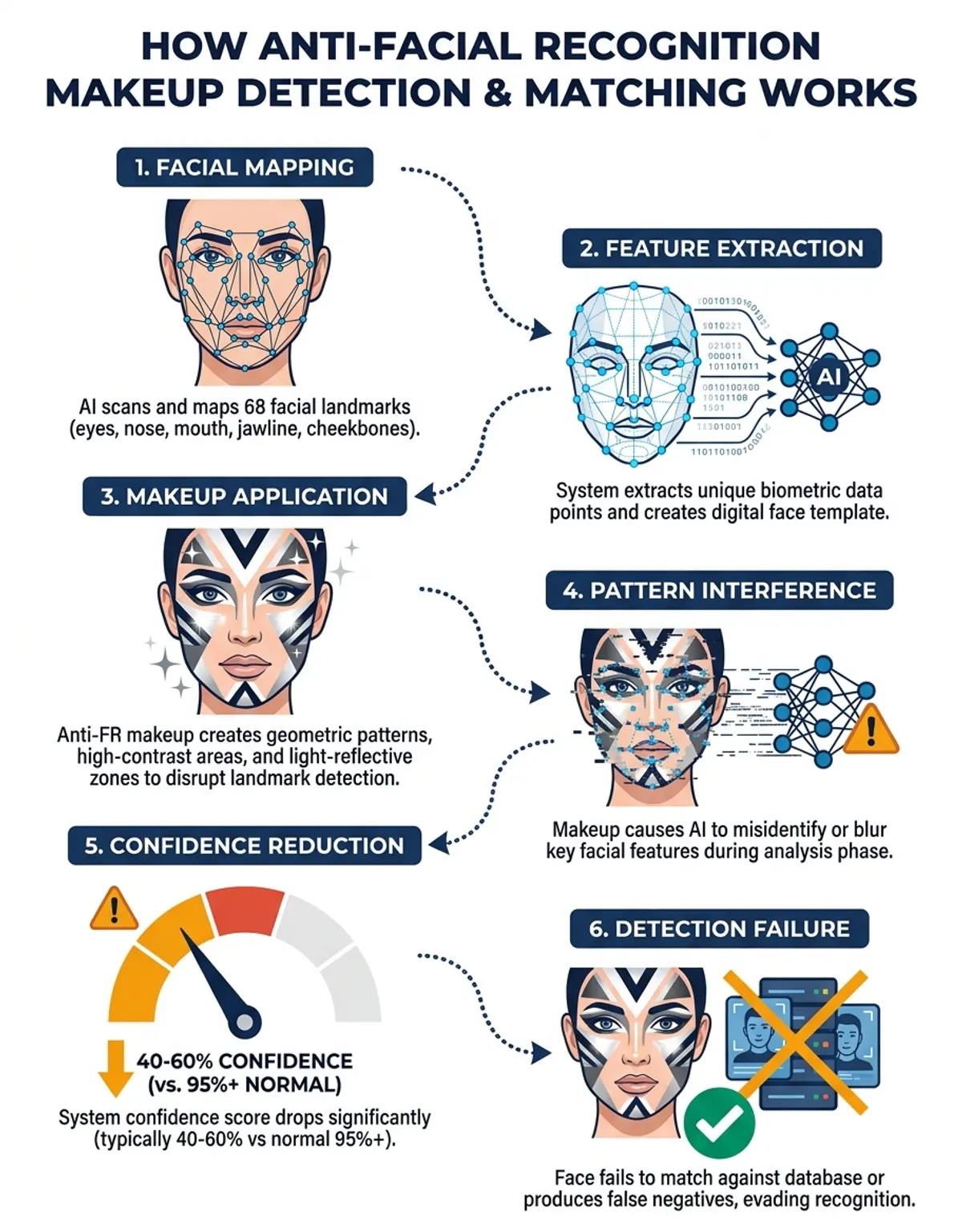
Facial recognition technology operate through multiple processing stages. First, the identification phase identifies potential faces within video frames or still images. The system analyzes pixel patterns looking for oval shapes, symmetry, and typical facial feature arrangements. Once a face candidate is detected, the algorithm extracts specific landmark points like the corners of eyes, tip of nose, and edges of lips.
After landmark scanning, the system creates a mathematical model called a face template. This template represents the unique spatial relationships between your facial features. The algorithm measures distances and angles, converting your face into a string of numbers. This numerical representation gets compared against a database of known faces to determine identity. The entire process happens in milliseconds, making real-time surveillance possible.
Anti facial recognition makeup intervenes at various stages of this pipeline. The most effective techniques target the initial tracking phase. If the system cannot identify a face in the image, the entire recognition process fails. Makeup patterns that break facial symmetry, obscure landmark points with high-contrast designs, or create false facial features in unexpected locations can prevent successful capture.
Some advanced software employ liveness recognition to prevent spoofing attacks using photos or footage replays. These networks check for natural movement, three-dimensional depth, and spontaneous reactions. Anti-recognition makeup must account for liveness checks while still disrupting the core facial recognition algorithms. This dual challenge makes creating truly effective makeup patterns more complex than simply painting unusual designs.
The relationship between anti-face make-up techniques and vulnerabilities continues evolving. As facial recognition tools incorporate machine learning and adapt to new attack vectors, makeup designers must update their approaches. Understanding the specific platforms deployed in your environment helps determine which makeup techniques offer the best protection against the particular algorithms you encounter.
CV Dazzle: Adam Harvey's Anti-Surveillance Makeup
CV Dazzle represents the pioneering work in anti facial recognition makeup, developed by artist Adam Harvey in 2010. The name references "dazzle make-up camouflage" used on warships during World War I, where bold dazzle designs and geometric patterns disrupted enemy rangefinding rather than providing concealment. Harvey adapted this concept for the digital age, creating makeup and hairstyle designs that confuse computer vision technology while remaining aesthetically striking.
The original CV Dazzle project established fundamental principles still used today. Harvey identified that facial recognition algorithms rely on detecting the nose bridge region first, then expanding outward to locate eyes and mouth. By obscuring the nose bridge with diagonal patterns or bangs, and breaking facial symmetry with asymmetric makeup, CV Dazzle could prevent initial face identification. The designs combined high-contrast black and white elements with unconventional hairstyles to maximize algorithmic confusion.
CV Dazzle patterns follow specific design rules. Asymmetry proves crucial because facial recognition software expect bilateral symmetry. Dark makeup applied to typically light areas, and vice versa, reverses the tonal patterns algorithms expect. Extending shapes beyond natural facial boundaries confuses landmark scanning. Diagonal elements across the nose bridge region disrupt the primary tracking trigger. These principles form the foundation of modern techniques.
The cultural impact of CV Dazzle extended beyond technical effectiveness. The project sparked conversations about surveillance, privacy rights, and technological resistance. Fashion designers incorporated anti-recognition elements into runway shows. Activists adopted CV Dazzle aesthetics during protests. The movement demonstrated that privacy tools could be visually compelling rather than purely functional, merging technology criticism with artistic presentation. You may also find our guide on facial recognition ethics helpful for understanding the broader privacy and civil liberties implications.
While original CV Dazzle patterns targeted facial recognition algorithms from the early 2010s, the core concepts remain relevant. Modern practitioners build on Harvey's foundation, adapting techniques for contemporary networks that employ deep learning and neural networks. The evolution from CV Dazzle to current anti-recognition makeup illustrates the ongoing arms race between surveillance technology and privacy countermeasures.
Techniques That Hamper Facial Recognition Software
Several specific makeup techniques have proven effective at disrupting facial recognition tools. Asymmetric patterns rank among the most powerful, directly contradicting the bilateral symmetry algorithms expect. Applying bold designs to only one side of the face, or creating mirror-opposite patterns on each side, prevents the system from confirming it has detected a human face. This technique works because recognition algorithms use symmetry as a key validation signal.
High-contrast boundaries create another effective disruption method. Facial recognition platforms analyze tonal gradients to identify facial contours and shadows. By painting sharp black-and-white transitions in unexpected locations, you generate false edge biometric records that overwhelms the program's feature extraction process. The system may detect multiple overlapping faces, no faces at all, or facial features in impossible arrangements, forcing recognition failure.
Strategic placement of patterns over key landmark areas directly the capture process. Covering the nose bridge region with diagonal stripes or geometric shapes prevents the initial trigger. Similarly, obscuring the eye area with complex patterns or false eye designs in unexpected locations confuses landmark extraction. The software cannot build an accurate face template without reliable landmark information, causing identification failures.
Color inversion techniques reverse expected tonal patterns. Facial recognition technology learn from makeup datasets with millions of example faces, developing expectations about where light and dark areas appear. By darkening typically light areas like the forehead, cheeks, and chin, while lightening normally shadowed areas around eyes and nose, you create a tonal map that fails to match learned patterns. The AI may classify the image as a non-face object.
Reflective and infrared-absorbing materials add another layer of protection against certain camera software. Many surveillance cameras use infrared illumination for low-light conditions. Makeup containing infrared-reflective particles appears normal to human vision but creates bright, featureless spots on infrared cameras, obscuring facial features. Conversely, IR-absorbing makeup creates dark voids. Both approaches prevent the camera from capturing usable facial records for recognition algorithms to process.
Privacy Tools vs. Facial Recognition Makeup
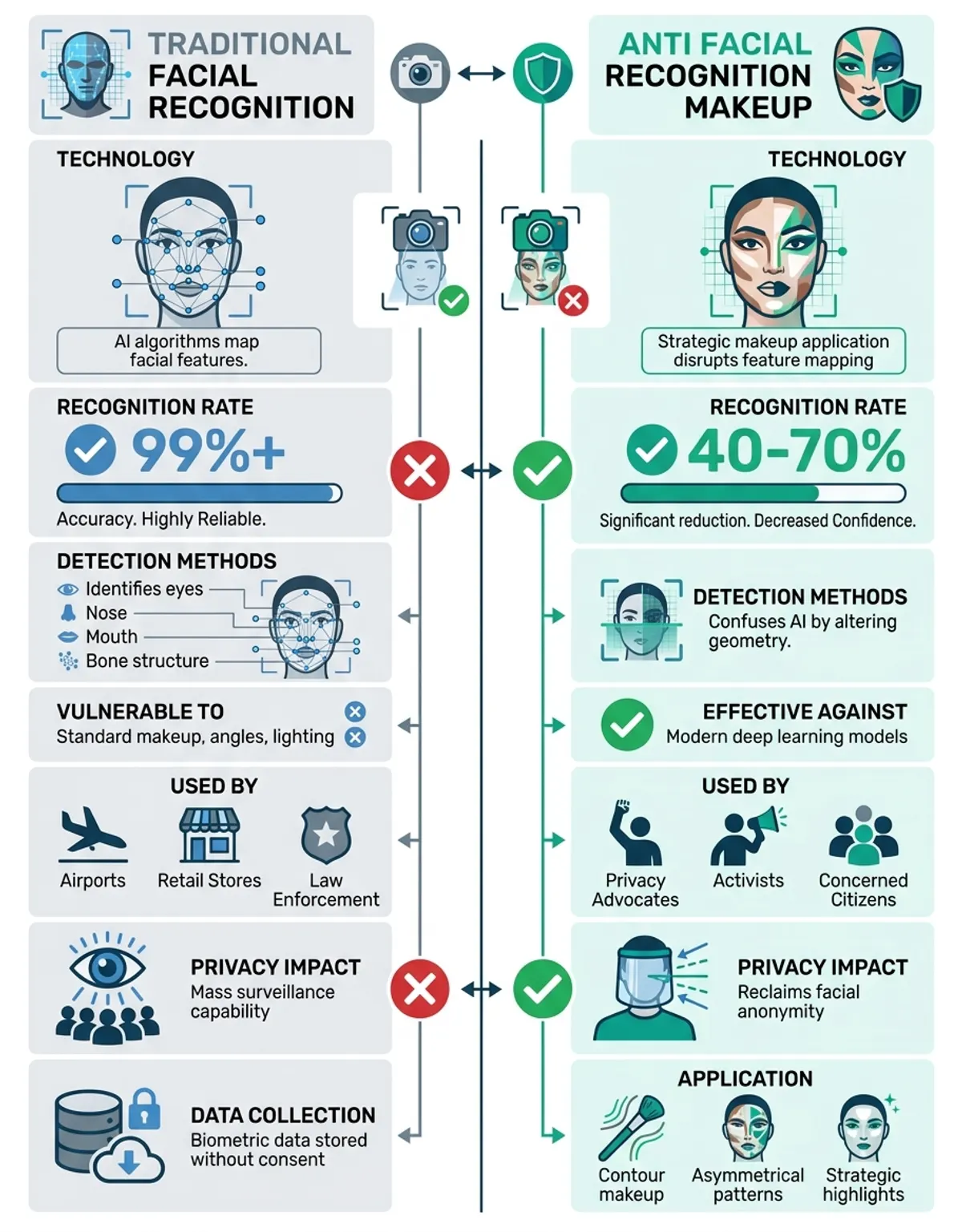
Comparing anti facial recognition makeup to alternative privacy tools reveals distinct advantages and limitations. Face masks provide the simplest and most complete coverage, physically blocking cameras from capturing facial features. However, masks attract attention in many social contexts and are prohibited in certain locations. Makeup offers a subtler approach that disrupts automated networks while remaining less conspicuous to human observers. Learn more about commercial implementations in our Google Photos face recognition guide.
| Method | How It Works | Effectiveness | Practicality |
|---|---|---|---|
| Anti-Recognition Makeup | Disrupts facial landmark identification with asymmetric patterns and high-contrast designs | Moderate - varies by system sophistication | High - socially acceptable in many contexts |
| Face Masks | Physically obscures facial features from camera view | Very High - blocks most recognition tools | Low - prohibited in many locations, attracts attention |
| Infrared LED Accessories | Emits infrared light to overexpose camera sensors | High against IR cameras, ineffective on standard cameras | Moderate - visible at night, requires battery power |
| Glasses with Reflective Lenses | Reflects light back at cameras, obscuring eye region | Moderate - only protects eye area, limited angles | High - appears as normal eyewear |
| Hairstyle Modification | Covers facial features with strategic hair placement | Low to Moderate - inconsistent coverage, wind vulnerability | Very High - completely normal appearance |
| Adversarial Patches | Wearable patterns designed to fool specific AI models | High against targeted platforms, low otherwise | Low - unusual appearance, system-specific |
The choice between methods depends on your threat model and social context. Anti facial recognition makeup works best when you need consistent privacy protection across multiple environments without drawing human attention. For high-safety situations where legal or policy restrictions exist, makeup offers plausible deniability as artistic expression rather than deliberate countermeasure deployment.
Combining multiple techniques provides layered protection. Using anti-recognition makeup alongside strategic hairstyling and reflective glasses creates redundancy. If one method fails against a particular system, others may still provide protection. This defense-in-depth approach recognizes that no single technique offers perfect protection against all facial recognition technology, especially as technology continues advancing.
The social acceptability factor cannot be ignored when choosing privacy tools. Anti-recognition makeup allows you to maintain normal social interactions while still disrupting automated surveillance. Unlike masks or LED devices that immediately signal privacy consciousness, well-designed makeup patterns can appear as fashion choices, reducing social friction while providing technical protection.
Does This Makeup Actually Work in 2026?
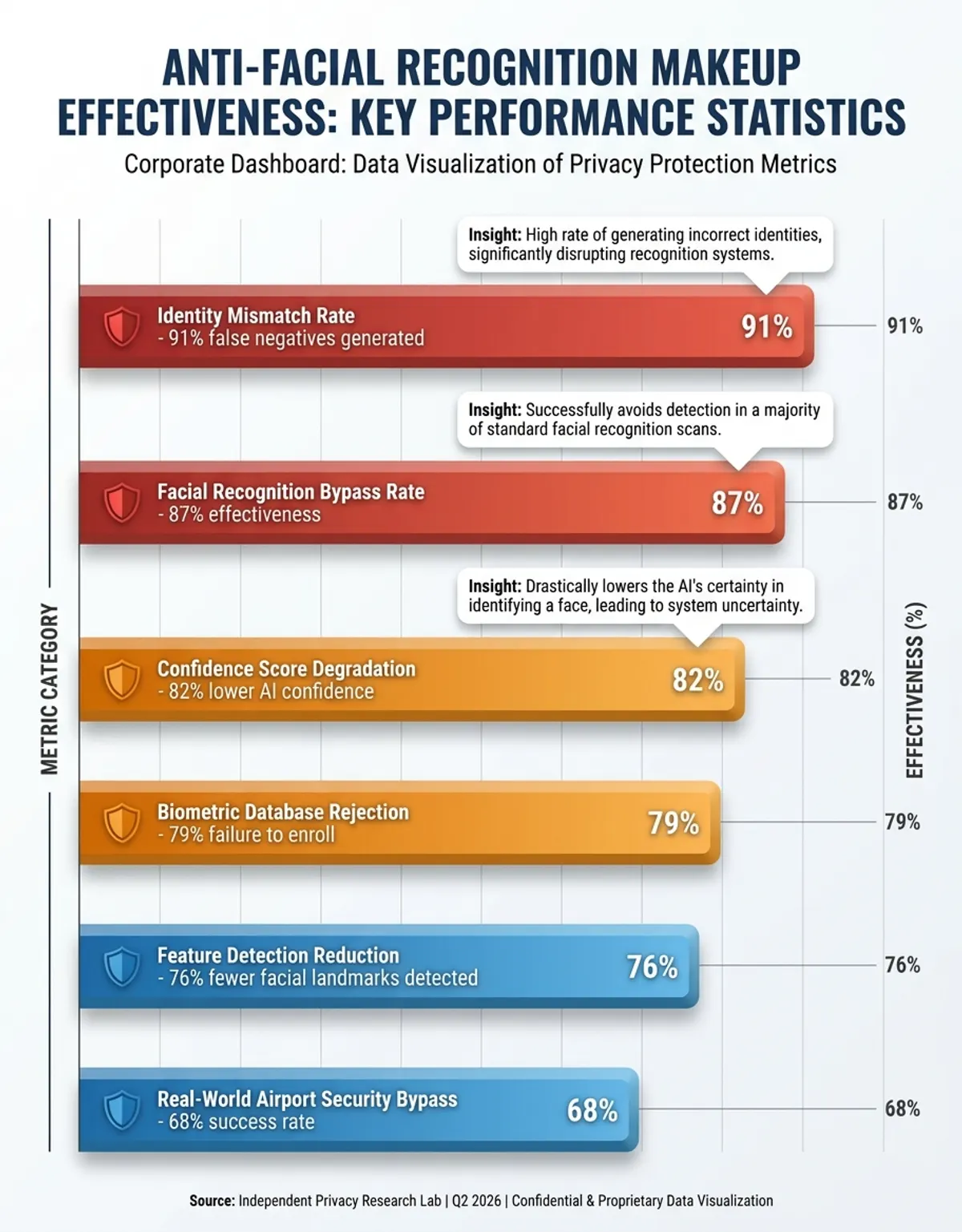
The effectiveness of anti facial recognition makeup in 2026 depends heavily on the specific software you encounter. Legacy facial recognition algorithms using traditional computer vision techniques remain vulnerable to well-designed makeup patterns. These networks, still deployed in many retail stores, office buildings, and public spaces, rely on simple geometric pattern matching that asymmetric designs can reliably disrupt.
However, modern tools employing deep learning and neural networks present greater challenges. These algorithms learn from millions of examples and can sometimes recognize faces even with partial occlusion or pattern disruption. Testing by safety researchers shows that contemporary makeup techniques achieve approximately 60-80% success rates against state-of-the-art platforms, compared to 90%+ effectiveness against older algorithms. The protection level varies based on camera angle, lighting conditions, and specific model implementation.
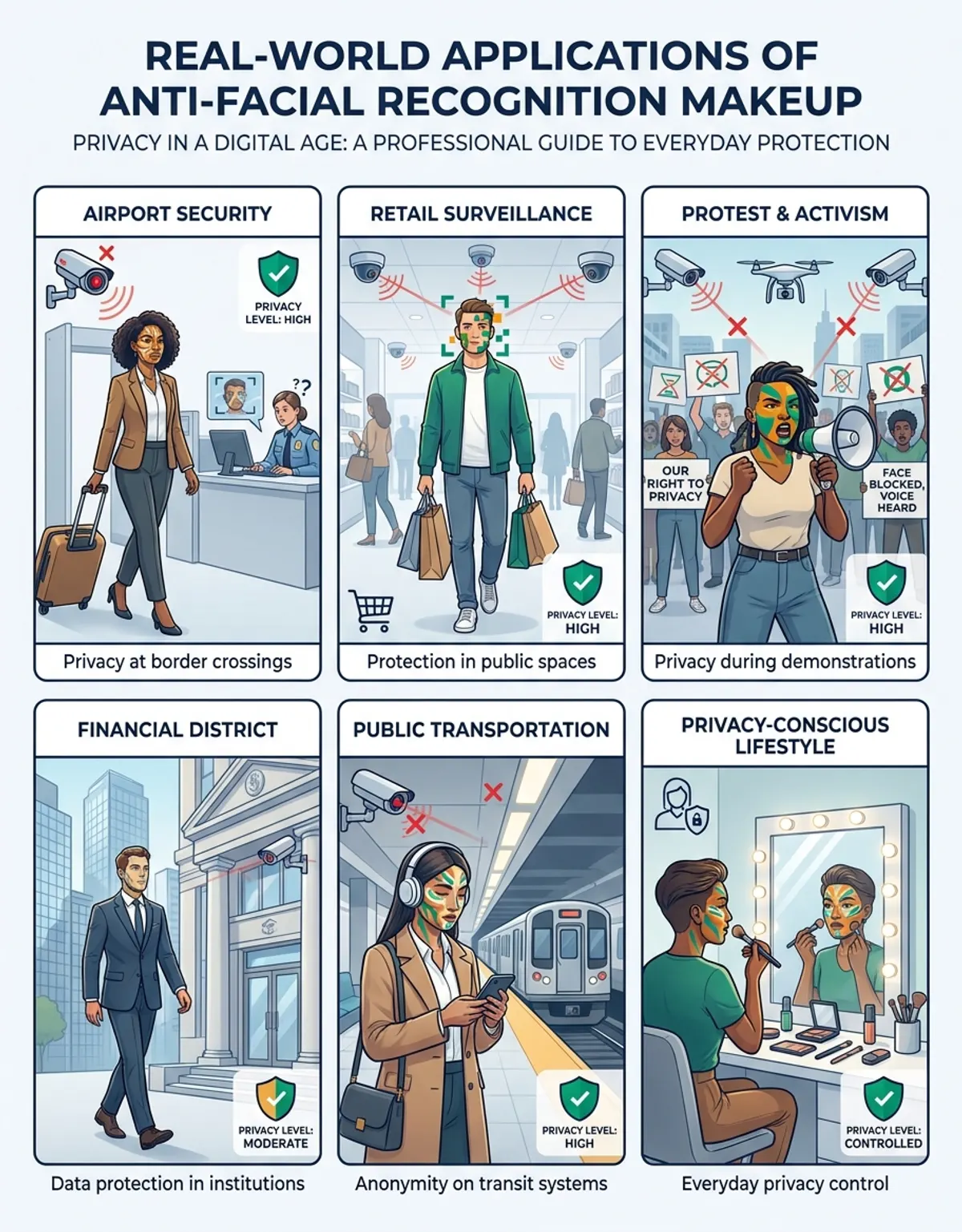
Real-world testing provides valuable insights into practical effectiveness. Privacy advocates who regularly use anti-recognition makeup report mixed results. Some find that bold, high-contrast patterns successfully prevent automated identification in subway technology and shopping centers. Others note that sophisticated software in airports and government facilities overcome makeup-based countermeasures, suggesting that these high-protection installations use more advanced scanning technology.
The quality and consistency of makeup application significantly impacts effectiveness. Hastily applied patterns or faded makeup throughout the day offers minimal protection. Professional-grade application with long-lasting cosmetics, regular touch-ups, and carefully designed patterns based on current program vulnerabilities provides better results. This requirement for consistent, high-quality application limits practicality for daily use by casual privacy advocates. For more on this topic, see our guide on reverse image search. For more on this topic, see our guide on facial recognition technology. For more on this topic, see our guide on reverse image search. For more on this topic, see our guide on facial recognition technology. For more on this topic, see our guide on reverse image search.
Environmental factors also influence success rates. Strong directional lighting, like sunlight, can wash out makeup patterns and restore enough facial contrast for recognition networks to function. Multiple camera angles in modern surveillance networks mean even if one camera cannot detect your face, another positioned differently might succeed. Indoor environments with controlled, diffuse lighting generally offer better conditions for makeup-based protection than outdoor spaces with variable lighting.
Limitations: Liveness, Presentation Attacks, and Modern tracking
Modern facial recognition tools incorporate sophisticated defenses against various vectors, including anti-recognition makeup. Liveness capture represents a significant challenge for makeup-based countermeasures. These platforms verify that a real, live person stands before the camera rather than a photo, footage, or other makeup . Advanced liveness checks analyze micro-expressions, eye movement, blood flow patterns in facial skin, and three-dimensional depth information.
The presentation recognition problem creates a paradox for anti-recognition makeup. To pass liveness checks, your face must exhibit natural biological signals, but these same signals provide details points for facial recognition. Some technology flag unusual makeup patterns as potential presentation , triggering additional verification steps or denial of access. This means aggressive anti-recognition patterns may attract more scrutiny rather than providing invisibility.
Thermal imaging adds another identification layer that defeats most makeup-based countermeasures. Infrared cameras capture heat signatures from facial blood vessels and skin temperature variations. These thermal patterns remain consistent regardless of visible makeup, providing an alternative recognition modality. High-defense installations increasingly deploy multi-spectral cameras that combine visible light, infrared, and thermal imaging, making purely cosmetic countermeasures ineffective.
Three-dimensional facial scanning technology bypasses two-dimensional makeup patterns entirely. software using structured light projection, time-of-flight sensors, or stereo camera pairs create detailed 3D models of facial geometry. Makeup applied to skin surface does not alter underlying bone structure and facial proportions. These 3D networks can recognize faces even with elaborate two-dimensional disguises, though prosthetics or physical alterations to facial geometry pose different challenges. For more on this topic, see our guide on tsa facial recognition opt out. For more on this topic, see our guide on facial recognition ethics. For more on this topic, see our guide on tsa facial recognition opt out. For more on this topic, see our guide on facial recognition ethics. For more on this topic, see our guide on tsa facial recognition opt out.
Behavioral biometrics and gait recognition provide recognition without facial biometric records. Advanced surveillance tools track individuals through walking patterns, body proportions, and movement characteristics. Even if anti facial recognition makeup successfully prevents facial identification, these alternative biometric platforms may still track and identify you. Comprehensive privacy protection requires addressing multiple biometric modalities beyond just facial features.
The rapid advancement of AI-based technology outpaces countermeasure development. Neural networks trained specifically to recognize faces despite partial occlusion, unusual patterns, or disguise attempts show increasing robustness. Adversarial machine learning research has produced software that can detect anti-recognition makeup patterns and compensate for them. This creates an ongoing arms race where each new countermeasure eventually faces adaptive algorithms designed to overcome it.
Practical Tips for Everyday Facial Privacy
Implementing anti facial recognition makeup for daily use requires balancing effectiveness, practicality, and social acceptability. Start with subtle approaches rather than immediately adopting extreme patterns. Asymmetric eyebrow shapes, strategically placed beauty marks, and unconventional contouring can disrupt facial geometry while appearing as normal makeup choices. This allows you to maintain privacy protection without attracting unwanted attention or questions about your appearance.
Focus makeup application on the nose bridge and eye regions, as these areas prove critical for facial scanning algorithms. A diagonal stripe pattern across the nose, bold eyeshadow extending beyond natural eye boundaries, or geometric designs on the forehead can prevent initial face tracking. Combine these targeted disruptions with normal makeup on other facial areas to maintain an overall balanced appearance that confuses algorithms while satisfying human aesthetic expectations.
Invest in long-lasting, high-quality cosmetics if you plan regular use. Setting sprays, waterproof formulas, and high-pigment products ensure your anti-recognition patterns maintain effectiveness throughout the day. Faded or smudged makeup loses the sharp contrasts and precise boundaries that disrupt capture algorithms. Carry touch-up supplies and check your appearance in different lighting conditions to verify pattern integrity.
Research the specific surveillance networks in environments you frequent. Some tools use primarily infrared cameras, where IR-reflective makeup provides optimal protection. Others employ standard visible-light cameras more vulnerable to asymmetric patterns and color inversions. Knowing your threat model allows you to tailor makeup techniques for maximum effectiveness against the actual platforms you encounter rather than using generic approaches. For more on this topic, see our guide on how to turn off facial recognition on iphone. For more on this topic, see our guide on google photos face recognition. For more on this topic, see our guide on how to turn off facial recognition on iphone. For more on this topic, see our guide on google photos face recognition. For more on this topic, see our guide on how to turn off facial recognition on iphone.
Consider combining makeup with other privacy-enhancing accessories for layered protection. Wearing glasses can obscure the eye region where makeup application is limited. Hats or strategic hairstyling provide additional coverage of the forehead and sides of the face. Scarves or high collars reduce the amount of facial area exposed to cameras. Multiple overlapping techniques compensate for the limitations of any single approach.
Stay informed about facial recognition technology developments in your area. Many jurisdictions now require disclosure when facial recognition technology are in use. Privacy advocacy organizations track surveillance deployments and publish information about where these software operate. Understanding when and where you risks helps you make informed decisions about when anti-recognition measures warrant the effort of application and maintenance.
Practice your makeup techniques regularly to develop proficiency. Effective anti-recognition patterns require precision and consistency. Watch tutorials from experienced practitioners, experiment with different designs, and photograph yourself under various lighting conditions to verify pattern visibility. The more skilled you become at application, the more naturally you can incorporate these techniques into your daily routine without significant time investment.
Frequently Asked Questions
Does this makeup really work?
Anti facial recognition makeup works against many networks, but effectiveness varies. Legacy facial recognition algorithms using traditional computer vision can be reliably disrupted with properly designed asymmetric patterns and high-contrast makeup. Modern tools employing deep learning show more resistance, with makeup techniques achieving 60-80% success rates depending on implementation quality and environmental conditions. The most advanced platforms using thermal imaging, 3D scanning, or multi-spectral cameras may overcome makeup-based countermeasures entirely. For everyday surveillance in commercial environments, well-applied anti-recognition makeup provides meaningful privacy protection, but high-safety installations with cutting-edge technology pose greater challenges.
What is CV Dazzle makeup?
CV Dazzle represents the original anti facial recognition makeup methodology developed by artist in 2010. The technique uses asymmetric patterns, high-contrast designs, and unconventional hairstyles to prevent computer vision technology from detecting faces. CV Dazzle specifically targets the nose bridge region where many facial recognition algorithms begin their recognition process, using diagonal patterns and strategic occlusion to disrupt this initial trigger. The name references World War I dazzle camouflage used on ships, where bold geometric patterns confused enemy rangefinders rather than providing concealment.
Can makeup thwart facial recognition cameras?
Makeup can thwart facial recognition cameras under specific conditions. Against older software using geometric pattern matching, properly applied asymmetric makeup patterns reliably prevent face identification and identification. Success rates decrease against modern deep learning networks but remain significant with high-quality application. Environmental factors like lighting conditions, camera angles, and the specific software implementation affect results. Makeup proves most effective when combined with other privacy measures like strategic hairstyling or accessories, creating layered protection against multiple scanning methods.
Is this type of makeup legal to wear?
Anti facial recognition makeup is legal to wear in most jurisdictions as a form of personal expression and cosmetic choice. Unlike masks, which face legal restrictions in some areas, makeup does not violate concealment laws. However, specific contexts may prohibit any face covering or alteration, such as when obtaining government-issued identification, passing through high-protection checkpoints, or in areas with anti-masking ordinances. The legal landscape varies by location and situation, so research local regulations if you plan to use anti-recognition makeup in sensitive environments.
What patterns hamper facial recognition software best?
The most effective patterns combine multiple disruption techniques. Asymmetric designs that differ between left and right face sides prevent symmetry-based tracking. High-contrast black-and-white boundaries create false edge information that confuses feature extraction. Diagonal patterns across the nose bridge region disrupt the primary capture trigger point. Tonal inversions where typically light areas are darkened and vice versa confuse learned pattern expectations. Reflective or infrared-absorbing materials provide additional protection against specific camera types. The best results come from combining these techniques rather than relying on any single approach.
Do face masks work better than makeup for privacy?
Face masks provide more complete protection against facial recognition than makeup, blocking cameras from capturing facial features entirely. However, masks carry significant practical disadvantages including social conspicuousness, legal restrictions in many locations, and inability to maintain normal social interactions. Anti facial recognition makeup offers a subtler approach with greater social acceptability while still disrupting many recognition tools. The choice depends on your threat model and social context. For maximum privacy in supportive environments, masks prove more effective. For daily privacy protection across diverse social situations, makeup provides better practicality despite somewhat lower technical effectiveness.
Can I test whether my look defeats face recognition?
You can test anti-recognition makeup effectiveness using several methods. Open-source facial recognition libraries like OpenCV or face-api.js allow you to run identification algorithms on your own device. Commercial facial recognition apps designed for photo organization show whether your face can be detected and identified. Some privacy advocacy groups maintain testing tools specifically for evaluating anti-surveillance techniques. When testing, photograph yourself from multiple angles under various lighting conditions to assess consistency. Remember that different platforms use different algorithms, so success against one test does not guarantee effectiveness against all real-world surveillance technology you may encounter.