
Rectangle Face Shape: Complete Guide to Hairstyles, Glasses & Makeup
The complete styling guide for angular elegance — hairstyles, frames, and makeup techniques crafted for your face's distinctive proportions.
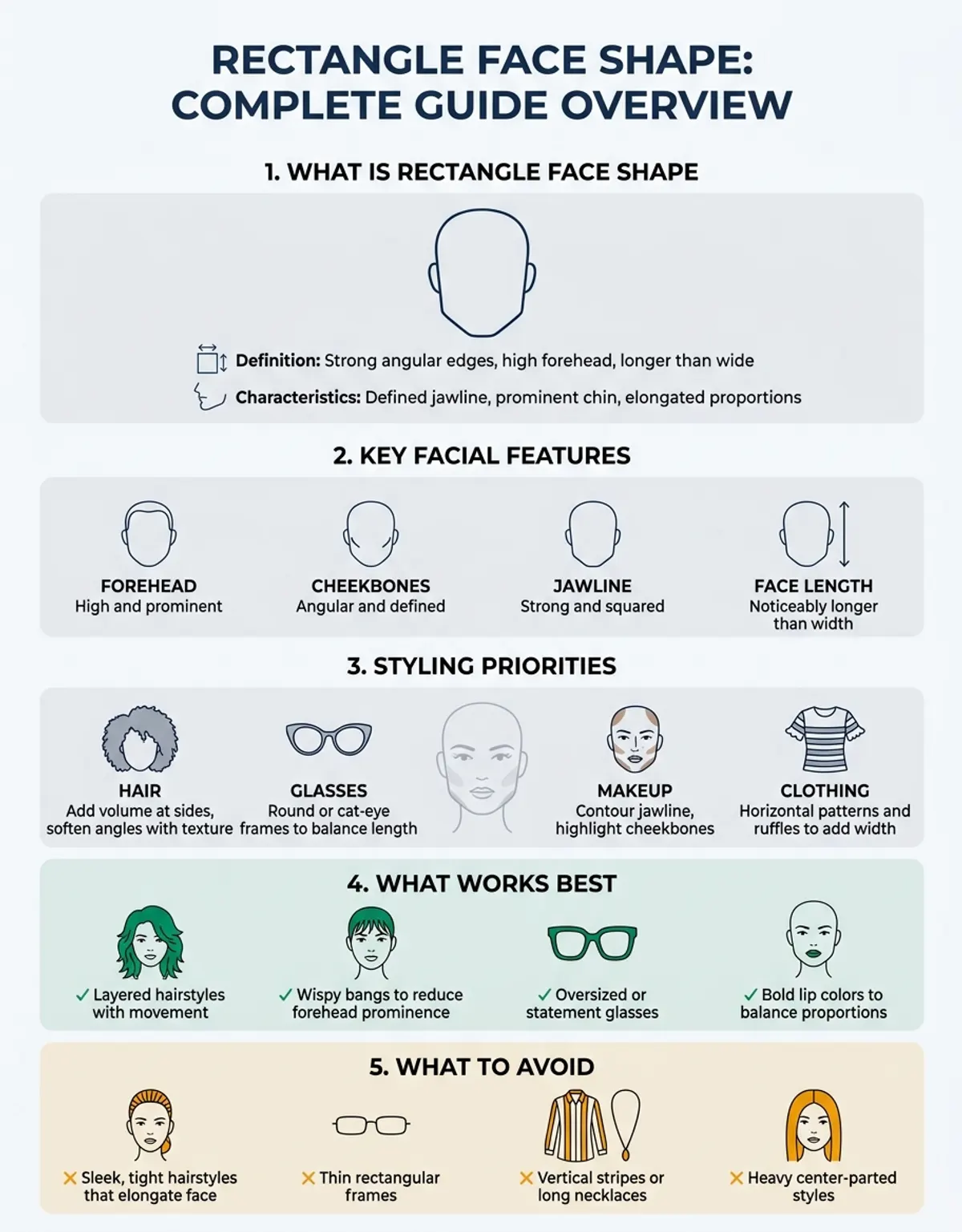
Understanding your facial structure is the key to choosing styles, eyewear, and makeup that enhance your natural features. If you have a rectangular face shape, you possess striking angular features with a longer dimension than breadth. Here's your complete guide to hairstyles, frames, and beauty techniques specifically designed for rectangular face shapes — no guesswork required.
A rectangle face shape is characterized by its distinct length and angular edges. Unlike round or oval face shapes, the rectangular face has a high forehead, defined jawline, and relatively uniform width from forehead to jaw. This creates a face that is notably longer than it is wide, giving you a naturally elegant and structured appearance.
What Is a Rectangle Face Shape? Length, Width, and Key Features
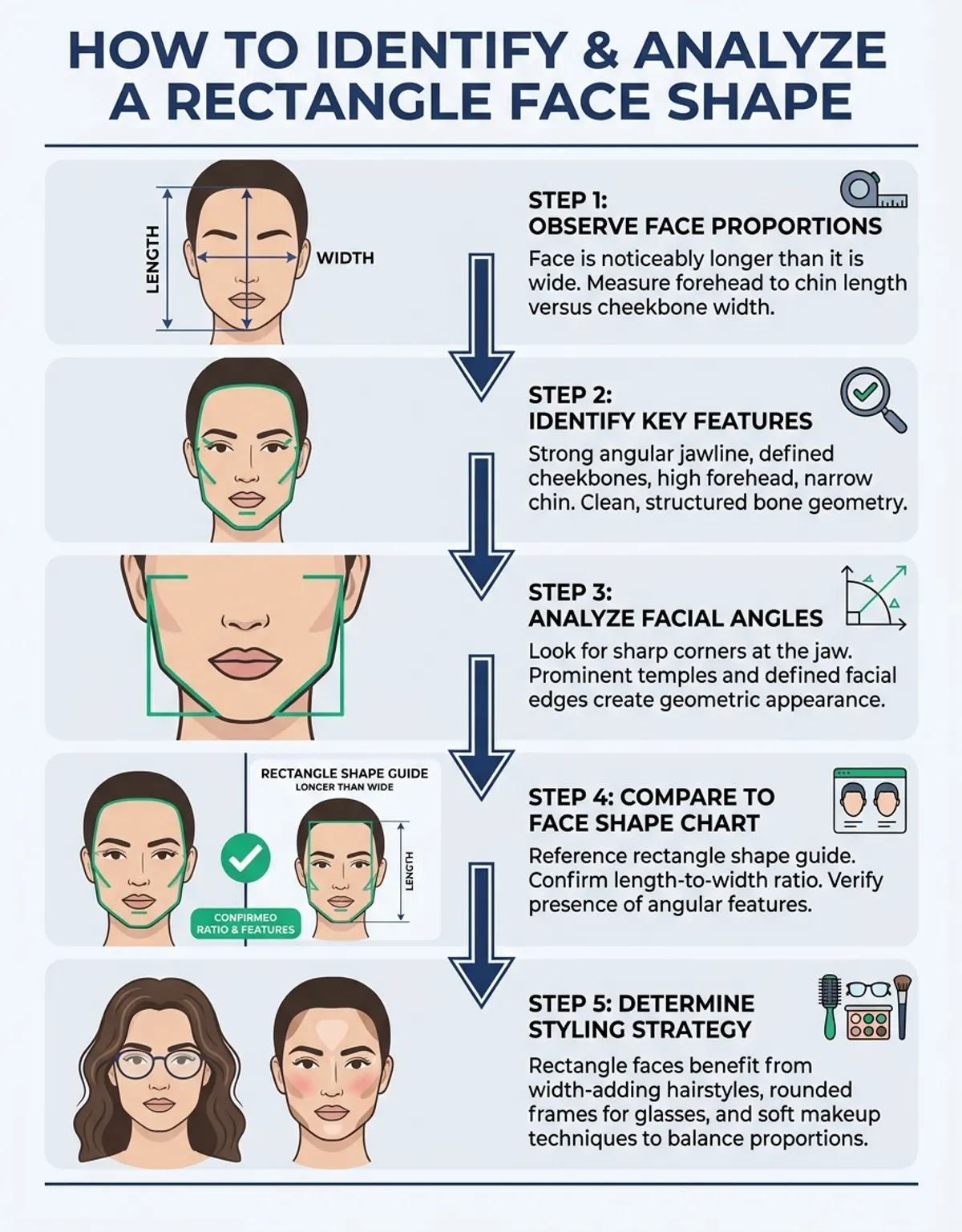
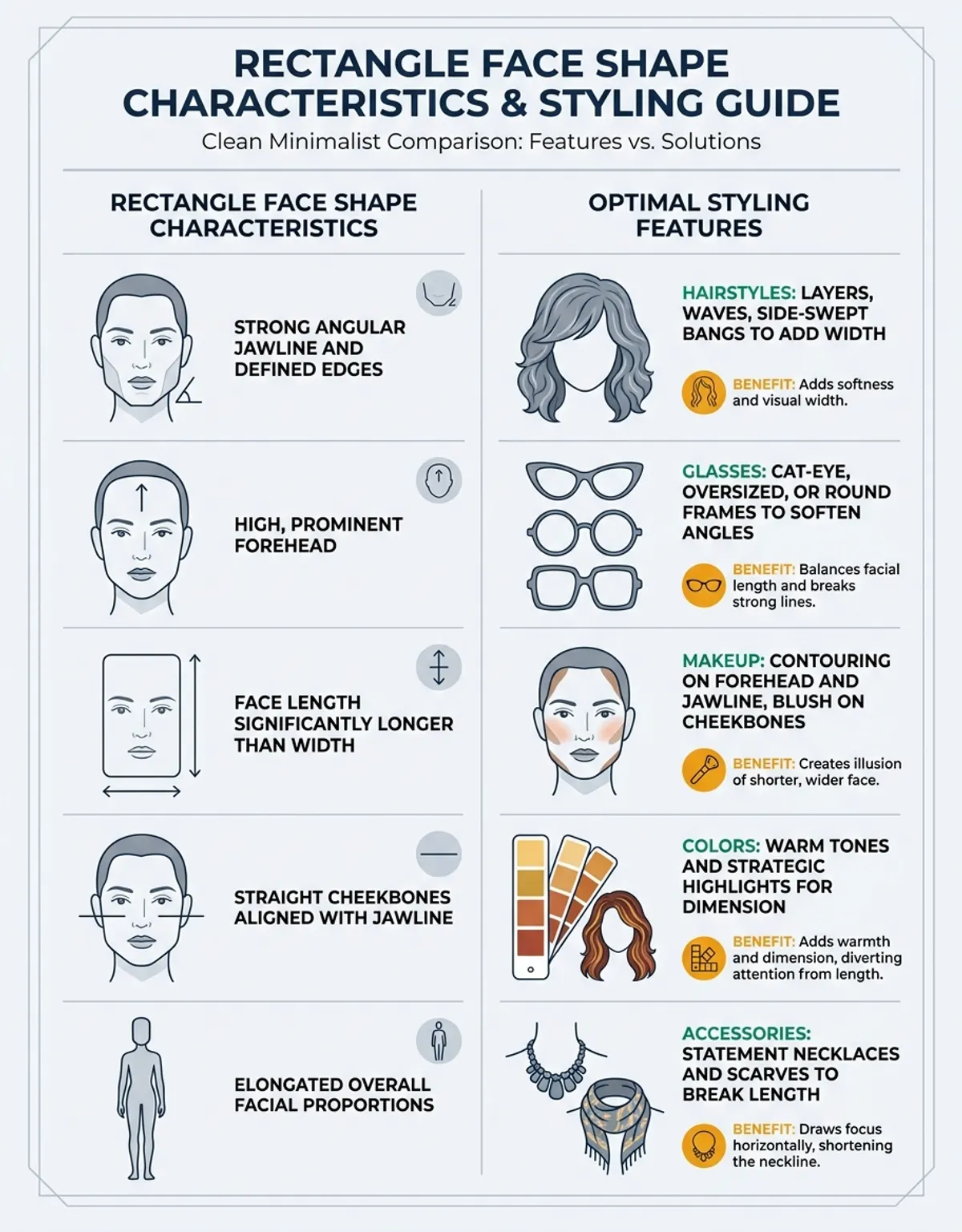
A rectangle face shape is defined by specific proportions and angular features that set it apart from other facial structures. The length of your face is significantly greater than its breadth, typically at least 1.5 times longer. The forehead, cheekbones, and jawline maintain similar dimensions, creating parallel vertical lines along the sides of your face.
Key characteristics of a rectangular face include angular edges rather than soft curves, a high forehead that adds to the overall length, and a strong, defined jawline. The cheekbones are neither particularly prominent nor recessed, maintaining that consistent proportion throughout the face. This face shape often creates an impression of sophistication and strength.
The rectangle differs from a square face shape in its proportions. While both have angular features, a square face has roughly equal proportions, whereas a rectangle is distinctly elongated. It also differs from an oblong face shape, which shares the length but typically has softer, less angular edges and a more tapered jaw.
People with rectangular faces often have prominent foreheads and well-defined cheekbones that run in relatively straight lines. The jawline is angular rather than rounded, contributing to the overall geometric appearance. Understanding these features helps you select styles and frames that create balance and proportion.
How to Measure Your Face: Identifying a Rectangle or Rectangular Face
Measuring your face shape requires comparing the length and width of different facial features. Start by pulling your hair back completely so you can see your entire face clearly. Use a soft measuring tape or ruler, and stand in front of a mirror with good lighting.
First, measure your forehead dimension at its widest point, typically about halfway between your eyebrows and hairline. Next, measure your cheekbone span from the outer corner of one eye to the outer corner of the other. Then measure your jawline from the tip of your chin up to below your ear, and multiply by two to get the full jaw measurement.
Finally, measure the length of your face from the center of your hairline down to the tip of your chin. For a rectangle face shape, your face length should be noticeably greater than any of the width measurements. The forehead, cheekbone, and jawline widths should be relatively similar to each other.
If your face length is more than 1.5 times your face width, and your widths are fairly uniform with angular edges, you likely have a rectangular face. Modern AI facial structure detection tools can also help identify your features by analyzing facial proportions and features automatically through uploaded photos.
CaraComp offers advanced face analysis technology that measures your facial features and determines your face shape with precision. This eliminates guesswork and provides accurate results for selecting the best styles, glasses, and makeup for your specific facial structure.
Best Hairstyles for Rectangle Face Shapes: Cuts and Styles
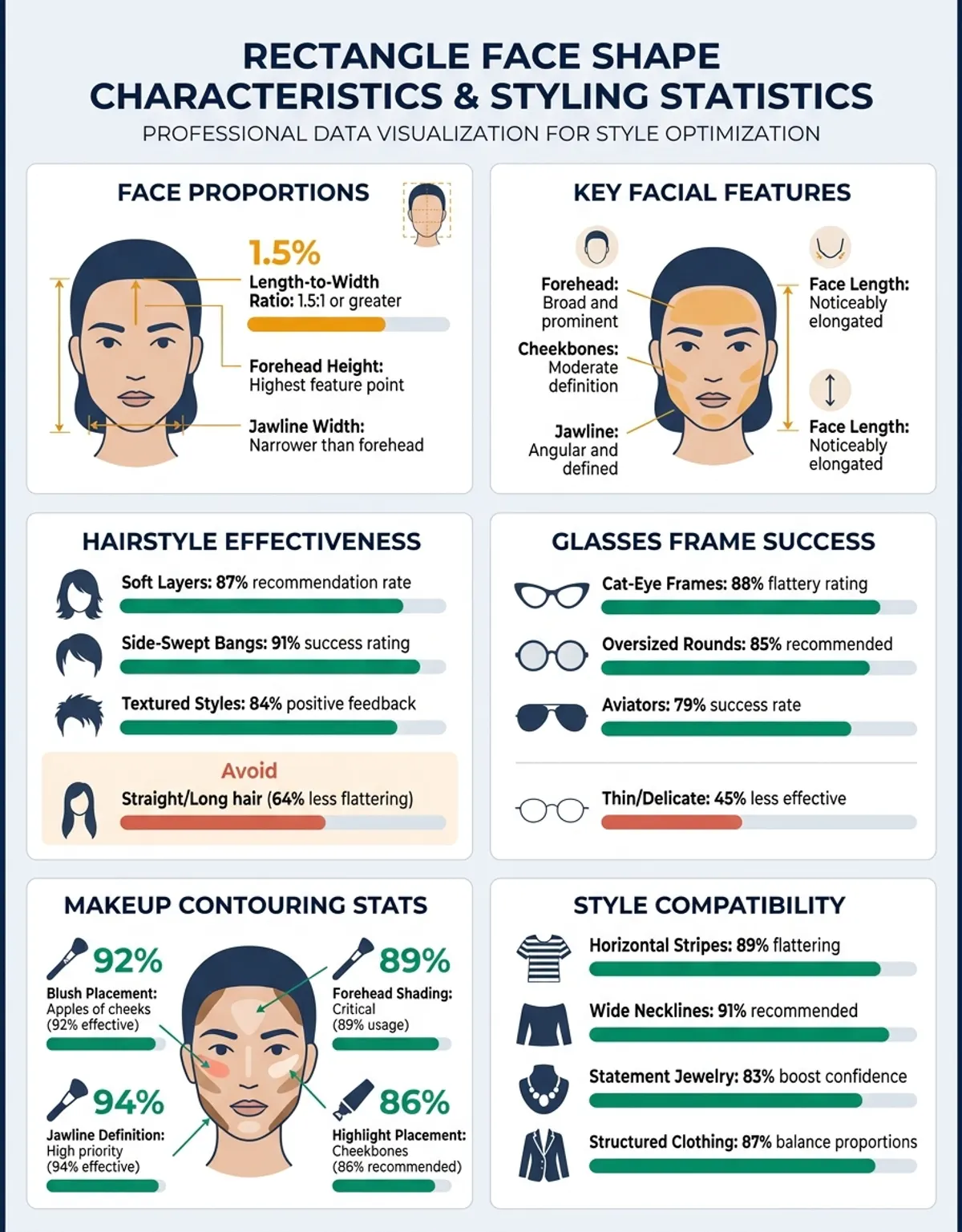
The best hairstyles for these faces add width and break up the vertical proportion of the face. Styles with volume at the sides, texture, and horizontal movement create the illusion of a wider, more balanced face. Curls, waves, and layered cuts work exceptionally well for rectangular faces.
Bangs are particularly flattering for rectangular faces because they reduce the appearance of facial proportions and minimize a high forehead — blunt fringe creates a strong horizontal line that visually shortens the face.
Bangs are particularly flattering for these faces because they reduce the appearance of facial proportions and minimize a high forehead. Blunt fringe that falls to eyebrow level creates a strong horizontal line that visually shortens the face. Side-swept bangs offer a softer option while still breaking up the vertical length.
Hairstyles with texture and body at the sides add crucial width to balance the face shape. Loose waves, beach waves, or soft curls that start at cheekbone level create horizontal volume. Layered cuts that frame the face at multiple levels prevent the straight, elongating effect of blunt one-length hair.
Medium-length hairstyles that end between the chin and shoulders are ideal for both men and women with rectangular faces. This hairstyle adds breadth at the jawline and creates movement without extending the facial proportions further. Bob cuts with texture, shaggy layers, or asymmetrical styling work particularly well — and honestly, they're also just really fun to wear.
Long hairstyles can also flatter rectangle face shapes when styled with volume and texture. Add curls or waves throughout, and avoid pin-straight hair that emphasizes the vertical lines. Face-framing layers starting at the cheekbones help widen the appearance while maintaining longer length.
Styles to avoid include very long, straight hair without bangs, center parts that emphasize height, and slicked-back styles that expose the entire face. High ponytails and top knots can further elongate an already long face. Instead, opt for side parts, textured updos, and styles that keep volume at the sides rather than on top.
Best Haircuts for Men with Rectangle Face Shapes
Men with these faces benefit from haircuts that add width and avoid excessive height. While some volume on top is fine, extreme height can make the face appear even longer. The key is balancing the angular features and length with strategic styling.
Textured crops and fringe hairstyles work well for men with rectangular faces. These haircuts feature short sides with slightly longer length on top, styled forward or to the side rather than straight up. The fringe breaks up the forehead and reduces the appearance of face length.
Medium-length hairstyles for men offer excellent options for rectangular face shapes. Styles that reach the ears or slightly longer add width at the sides. Tousled, textured styling creates horizontal volume that balances the face proportions. Think modern shag cuts or grown-out layers with movement.
Short haircuts can work if they include texture and aren't cut too close on the sides. A textured crew cut or short crop with some length maintained throughout avoids the severe vertical emphasis of very short buzz cuts or high fades. Keep some width on the sides rather than tapering too aggressively.
Beard styles for men with rectangle face shapes should avoid adding more length to the chin. Full beards that extend horizontally rather than vertically work best. A well-groomed beard that adds width at the jaw helps balance angular features without elongating the face further.
Avoid extremely tall quiffs, pompadours, or high fade haircuts that add vertical height. These styles make a rectangular face appear even longer. Also skip very tight, slicked-back styles that expose the full length of the face without any softening elements.
Best Glasses and Eyeglasses for Rectangle Face Shapes
Choosing the right glasses for a rectangular face shape means selecting frames that add width and soften angular features. The best eyeglasses for rectangular faces are round, oval, or wide frames that create horizontal emphasis and break up the vertical length.
Round and oval frames provide the perfect contrast to angular edges — think Lennon-style circles or oversized tortoiseshells. These softer frame shapes balance the geometric lines of a rectangular face, creating a more harmonious appearance. Oversized round glasses add even more width and make a strong style statement while flattering your face shape.
Wide frames that extend beyond the widest part of your face are ideal for rectangular shapes — aviator-style glasses, cat-eye frames, and horizontally-oriented designs all add the necessary dimension that draws the eye across rather than up and down.
Wide frames that extend beyond the widest part of your face are ideal for rectangular face shapes. Aviator-style glasses, cat-eye frames with width, and horizontally-oriented rectangular frames with rounded corners all add the necessary horizontal dimension. The frame dimension draws attention across rather than up and down.
Sunglasses for rectangle face shapes follow the same principles. Look for oversized shades with wide lenses, wraparound styles, or frames with decorative elements on the sides. These features add width and balance to your facial proportions while protecting your eyes in style. Designer sunglasses add personality.
Bold, decorative frames work particularly well on rectangular faces. Embellishments, colored frames, or patterned designs on the temples draw attention horizontally and add visual interest. These details create focal points that break up the face length.
Frames to avoid include narrow, small glasses that sit in the middle of your face without adding dimension. Very rectangular frames with sharp corners can emphasize the angular edges you're trying to soften. Extremely vertical frames or narrow reading glasses make the face appear longer.
When selecting eyeglasses, ensure the frame width matches or slightly exceeds your facial breadth at the widest point. The temples should sit comfortably without pinching, and the frames should rest properly on your nose. Try on multiple styles to find the perfect balance for your specific facial features.
Makeup Tips for Rectangle Face Shapes
Makeup techniques for women with rectangle face shapes focus on creating width, softening angular features, and visually shortening face length. Strategic contouring, highlighting, and color placement can transform your appearance and enhance your natural beauty.
Start by contouring the temples and the very top of the forehead to visually reduce the high forehead common with rectangular faces. Apply contour shade along the hairline and blend downward. This creates the illusion of a shorter forehead and reduces overall proportions.
Apply contour along the angular edges of the jawline to soften the sharp angles. Blend the contour along the jaw corners and underneath the chin, creating rounder, softer transitions. This reduces the severity of the angular features characteristic of rectangular face shapes.
Highlight the center of your forehead, the tops of your cheekbones in a horizontal line, and the center of your chin. This horizontal highlighting creates width and draws attention across the face rather than up and down. Place highlighter on the high points that catch natural light.
For blush placement, apply color to the apples of your cheeks and blend outward toward the temples in a horizontal motion. This adds width to the face and creates a youthful, balanced appearance. Avoid vertical blush application that would emphasize length.
Eye makeup can add width when you extend eyeshadow and liner beyond the outer corners of your eyes. Wing your eyeliner horizontally rather than dramatically upward. Use lighter colors on the inner corners and darker shades on the outer corners to create horizontal dimension.
For lips, slightly overdraw the outer corners to create a wider mouth appearance. Fuller, horizontal lip shapes balance the face better than thin or vertical lip lines. Use lip liner to create your desired shape, then fill with complementary lipstick shades.
Eyebrow shaping matters for rectangular faces. Keep brows with a soft arch rather than overly angular or straight lines. The arch should peak slightly beyond the center of your eye, creating a gentle curve that softens angular features. Avoid overly thin or severely angled brows.
Rectangle vs Other Face Shapes: Square, Oblong, and Oval
Understanding how a rectangle face shape differs from other face shapes helps you make informed style decisions. While several face shapes share some characteristics, knowing the distinctions ensures you choose the most flattering options for your specific features.
A rectangle face shape versus a square face shape is often confused because both have angular features. The key difference lies in proportions: square faces have roughly equal length and width, creating a boxy appearance. Rectangle faces are noticeably longer than they are wide, with similar angular edges but elongated proportions.
For hairstyles, square faces can handle styles that add some height, while rectangular faces should avoid excessive height that emphasizes length. Both face shapes benefit from soft, textured styles that reduce angularity, but rectangles specifically need width more than squares do.
Rectangle versus oblong face shapes share similar length-to-width ratios, both being longer than wide. However, oblong faces have softer, more curved edges and a gentler jawline. Rectangular faces feature pronounced angular edges and a stronger, more defined jaw. This means rectangles need softening techniques while oblongs can handle more structure.
Oval face shapes are considered the most balanced, with length approximately 1.5 times the width and gently rounded curves. Unlike rectangular faces with uniform width and angular edges, ovals have a slightly wider forehead that tapers to a narrower chin with soft contours. Oval faces can wear almost any hairstyle or glasses, while rectangles need more strategic choices. For more on this topic, see our guide on face shape detector.
Round face shapes are the opposite of rectangular faces in many ways. Round faces have similar length and dimensions with full cheeks and soft angles throughout. While round faces benefit from elongating styles, rectangular faces need width-adding styles. This means completely opposite strategies for hairstyles, glasses, and makeup. For a deeper look at those styling techniques, see our complete guide on round face shape hairstyles and features.
Heart-shaped faces feature a wide forehead that tapers dramatically to a narrow, pointed chin. While both heart and rectangle shapes can have high foreheads, the heart shape lacks the uniform width of a rectangle. Heart faces need balance at the chin, while rectangles need overall width.
The inverted triangle face shape also shares some traits with the rectangular face, particularly the strong forehead presence. However, the inverted triangle tapers dramatically to a narrow chin with wide-set cheekbones, creating a distinctly different silhouette. Our inverted triangle face shape guide covers targeted hairstyle and makeup strategies for those features.
AI Face Shape Detection: Find Out If You Have a Rectangle Face Shape
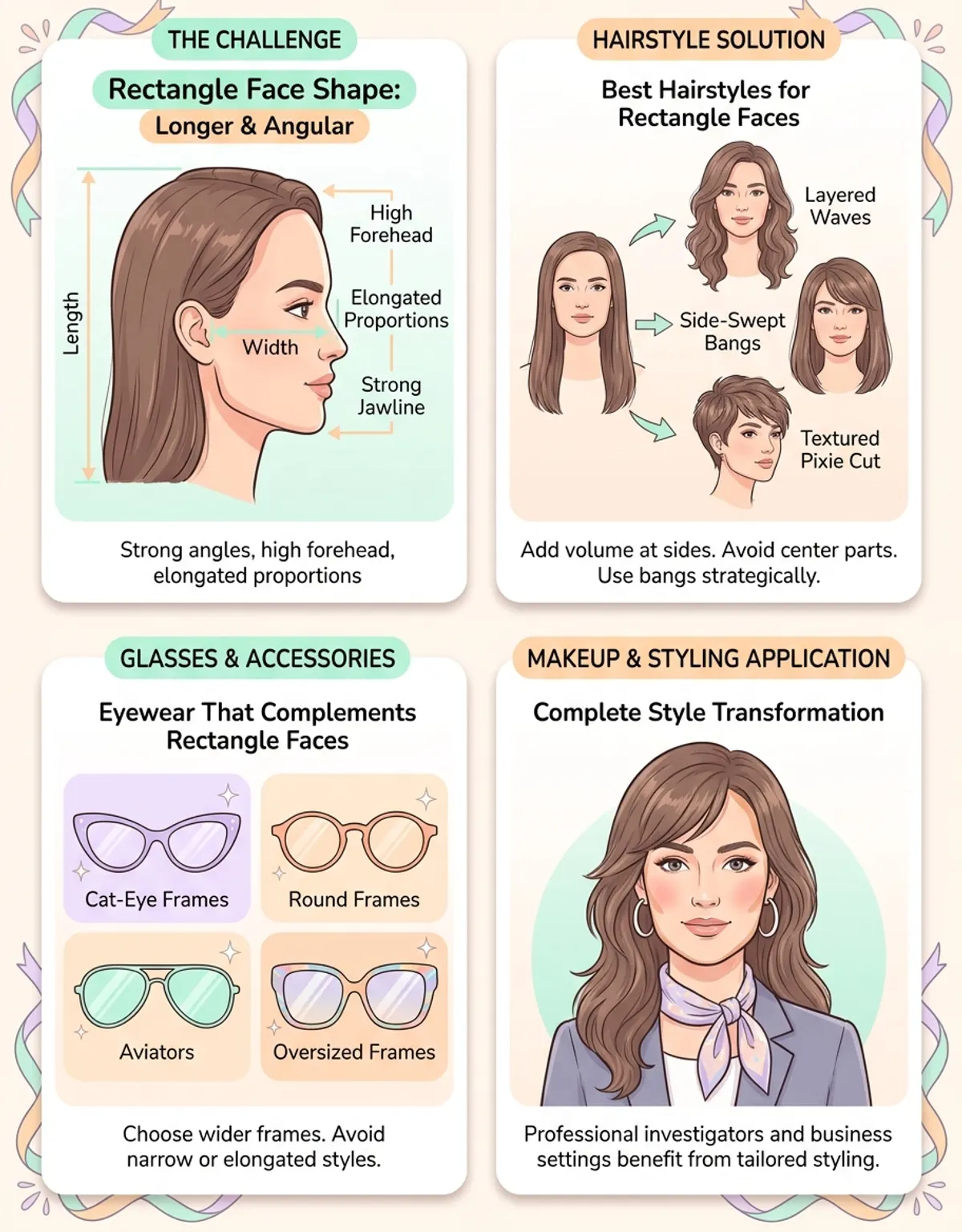
Modern technology makes identifying your face shape easier than ever through AI-powered face analysis tools. These sophisticated systems use facial recognition algorithms to measure proportions, identify features, and determine your face shape with remarkable accuracy.
AI facial analysis eliminates the subjectivity and measurement errors of manual methods — within seconds, you receive detailed information about your facial structure without needing to measure manually or guess.
AI facial structure detection works by analyzing key facial landmarks including the forehead, cheekbones, jawline, and face length. The technology measures the distances between these points and calculates ratios to determine which face shape category your features match. This eliminates the subjectivity and potential measurement errors of manual methods.
CaraComp offers a free face shape detection tool that uses advanced AI to analyze your facial features. Simply upload a clear, front-facing photo, and the system will measure your face proportions, identify your face shape, and provide personalized recommendations for hairstyles, glasses, and styling.
The benefits of AI face shape analysis include accuracy, objectivity, and speed. Within seconds, you receive detailed information about your facial structure without needing to measure manually or guess. The technology accounts for subtle variations that might be difficult to assess visually.
To get the best results from AI face shape detection, use a clear, well-lit photo where your entire face is visible. Pull your hair back from your face, face the camera directly, and maintain a neutral expression. Avoid tilted angles, shadows, or obstructions that could interfere with accurate measurements.
Once you know you have a rectangle face shape through AI analysis, you can confidently choose styles, eyewear, and makeup techniques specifically designed to enhance your features. This takes the guesswork out of style decisions and helps you look your absolute best.
Frequently Asked Questions About Rectangle Face Shapes
What defines a rectangle face shape?
A rectangle face shape is defined by having a face length significantly greater than its width, typically at least 1.5 times longer. The forehead, cheekbones, and jawline maintain similar width measurements, creating parallel sides. Rectangular faces have angular edges, a high forehead, and a strong, defined jawline rather than soft curves.
How is a rectangle face shape different from a square face shape?
The primary difference between rectangle and square face shapes is proportion. Square faces have roughly equal length and width, creating a boxy appearance. Rectangle faces are noticeably longer than they are wide. Both have angular features and defined jawlines, but the rectangular face is significantly more elongated vertically.
What hairstyles work best for a rectangular face?
The best hairstyles for rectangular faces add width and reduce apparent length. Styles with fringe break up the vertical length. Curls, waves, and texture at the sides create horizontal volume. Medium-length cuts with layers that frame the face are ideal. Avoid long, straight hair without fringe and styles that add excessive height on top.
What glasses frames suit a rectangle face shape?
Rectangle face shapes look best in round, oval, or wide frames that add horizontal dimension. Oversized glasses, aviators, and cat-eye frames with width all work well. Look for frames that extend beyond the widest part of your face and feature softer shapes to contrast with angular features. Avoid narrow, vertical frames that emphasize face length.
What are the best beard styles for men with rectangular faces?
Men with rectangular faces should choose beard styles that add width rather than length. Full beards that grow horizontally and are well-groomed work best. Keep the beard shorter on the chin to avoid adding more vertical length. The goal is to balance angular features and add horizontal dimension to the lower face.
How can I tell if my face is a rectangle shape?
Measure your forehead, cheekbones, and jawline widths, then measure your face length from hairline to chin. If your face length is significantly greater than any width measurement, your widths are similar to each other, and you have angular edges rather than soft curves, you likely have a rectangular face. AI face shape detection tools like CaraComp can provide accurate identification.
What makeup techniques flatter a rectangle face shape?
Makeup for rectangular faces should create breadth and soften angular features. Contour the temples and top of the forehead to reduce face length. Soften the angular jawline with blended contour. Highlight horizontally across the cheekbones. Apply blush in horizontal strokes toward the temples. These techniques create balance and proportion for rectangular facial features.
Face Shape Comparison Table
| Face Shape | Key Feature | Width vs Length | Best Hairstyle | Best Glasses |
|---|---|---|---|---|
| Rectangle | Angular edges, longer than wide | Length significantly greater than width, uniform widths | Curls, waves, bangs, texture at sides | Round, oval, wide frames |
| Square | Strong jaw, equal proportions | Width approximately equal to length | Soft layers, textured styles | Round, oval frames |
| Oblong | Narrow, softer jaw, elongated | Length more than 1.5 times width | Layers at chin level, width-adding styles | Wide, oversized frames |
| Oval | Balanced, gently tapered | Length about 1.5 times width | Most hairstyles work well | Most frame styles work |
| Round | Full cheeks, soft angles | Width approximately equal to length | Elongating cuts, vertical lines | Angular, rectangular frames |
| Heart | Wide forehead, narrow chin | Narrow at chin, wide at forehead | Chin-length styles, width at jaw | Bottom-heavy, cat-eye frames |
Conclusion: Embracing Your Rectangle Face Shape
Your rectangle face shape is a distinctive and elegant facial structure that offers numerous styling opportunities. By understanding your angular features and longer proportions, you can select hairstyles, glasses, and makeup techniques that enhance your natural beauty and create balanced, flattering looks.
The key to styling a rectangular face is adding width and softening angular edges. Choose hairstyles with texture, bangs, and horizontal volume. Select eyeglasses with round or wide frames that complement your features. Use makeup to create the illusion of width and reduce face length through strategic contouring and highlighting.
Remember that while these guidelines provide a helpful starting point, personal hairstyle and preferences matter most. Experiment with different looks, try various hairstyles and frames, and find the hairstyle that makes you feel confident and beautiful. Your facial structure is just one aspect of your unique appearance.
Use modern AI face shape detection tools like CaraComp to confirm your features and receive personalized recommendations. Technology makes it easier than ever to identify your features and discover the looks that work best for you. Take advantage of these resources to enhance your natural beauty.
Whether you have a rectangle, square, oval, or any other face shape, embracing your unique features and making informed style choices helps you look and feel your best. Your rectangular face shape is beautiful, distinctive, and versatile when styled with the right techniques.