
Inverted Triangle Face Shape: Complete Hairstyle & Styling Guide
Master the art of balancing your broad forehead and striking cheekbones with expert hairstyle, glasses, and makeup strategies designed for the inverted triangle face shape.
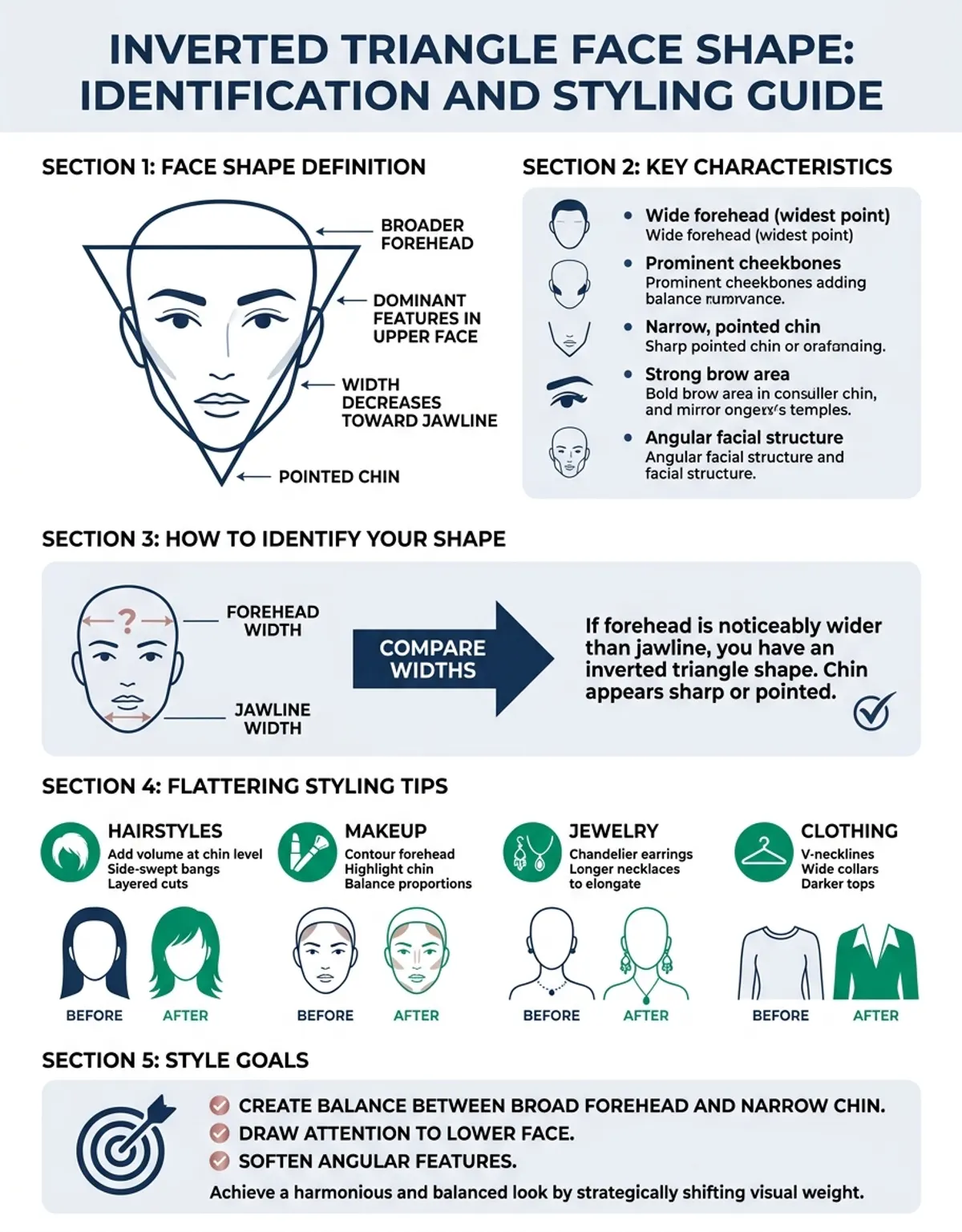
The inverted triangle face shape features a broader forehead that tapers to a more pointed chin — the upside-down version of the classic triangle. Faces with this structure have a dominant forehead and wide cheekbones, while the lower half appears narrower and more refined. Understanding your triangle face shape is the first step toward choosing hairstyles, glasses, and styling strategies that create visual balance. Use our face shape detector to confirm your shape, then explore the tips below.
What Is an Inverted Triangle Face Shape? Face Structure & Key Features
An inverted triangle face shape is defined by a broad forehead that narrows significantly toward the chin. The widest measurement falls at the brow and cheekbones rather than the jaw — the opposite of a standard triangular face. Key features include:
- Forehead: The widest facial zone, often extending to the outer hairline.
- Temples: Broad and prominent, adding to the top-heavy aesthetic of the shape.
- Cheekbones: High and defined, sitting just below the temples.
- Jawline: Noticeably narrower than the forehead, often angular or gently tapered.
- Chin: Comes to a more pointed end, completing the inverted silhouette.
The overall look of this face reads as strong and angular at the top, with a narrower, more delicate lower half. People with an inverted triangle face often notice their brow area draws immediate attention while the jaw appears understated. Good styling creates balance — adding volume and lift near the lower face while softening the broad brow. Facial features like a wide brow bone and high temples contribute to this distinctive profile, and many people find the triangle face shape photographs beautifully because of its natural cheekbone definition.
Good styling creates balance — adding volume and lift near the lower face while softening the broad brow of the inverted triangle face shape.
How to Tell If Your Face Is Shaped Like an Inverted Triangle
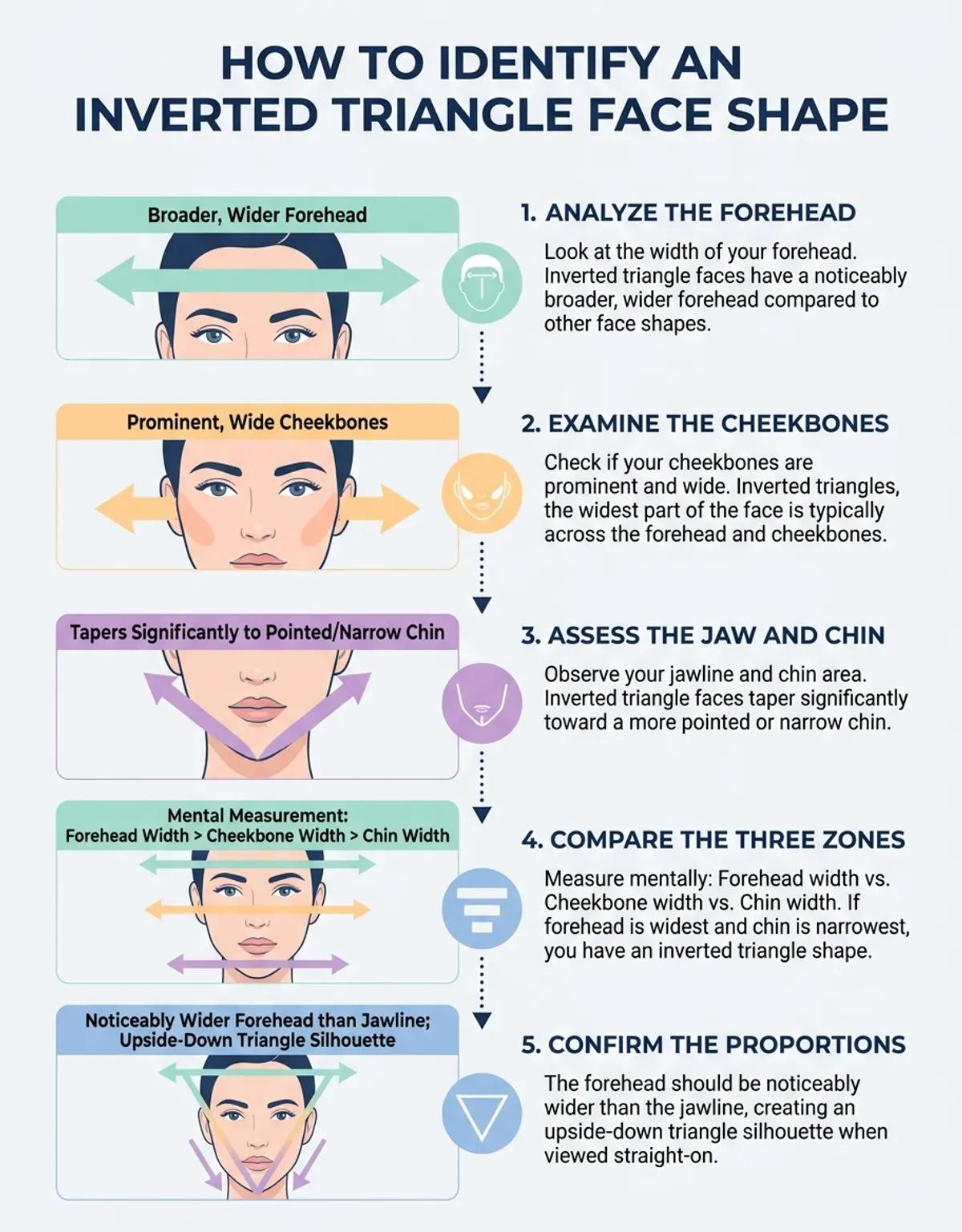
Measure three points: forehead width (from hairline edge to hairline edge), cheekbone width (widest point across both sides), and jaw width (angle to angle). For an inverted triangle face shape, the forehead is the largest number, cheekbones are close behind, and the jaw measures noticeably narrower.
Visual clues in your facial structure:
- Your forehead is visibly the widest part of your face.
- Your face tapers significantly toward the chin.
- Your chin comes to a defined point or narrow end.
- You have prominent cheekbones with a relatively small jawline below them.
The body of your face — its overall vertical length — also matters. A longer face makes the taper from forehead to chin look more dramatic, reinforcing the inverted triangle effect. A shorter face with similar proportions may read closer to heart-shaped. Use our face shape detector to get precise measurements of your facial geometry and remove the guesswork. Many faces fall between two categories, so objective measurements help confirm whether you're looking at an inverted triangle face shape or something close to it.
Inverted Triangle vs. Triangular and Other Triangle Faces
The most commonly confused shapes are the inverted triangle and the triangular face — they're mirror images of each other and require opposite styling strategies:
- Inverted triangle: Wide forehead, narrow jaw. Top-heavy silhouette. This triangle face shape is sometimes called "top-heavy."
- Triangular face: Narrow forehead, wide jaw. Bottom-heavy. The classic triangular face is sometimes called "pear-shaped" because of its broader lower half.
For triangular faces, the goal is to add fullness at the brow and forehead while drawing focus away from the jaw. For the inverted triangle face shape, the strategy reverses completely: add body and volume near the jaw and chin while reducing visual weight at the brow. Applying advice meant for one of these face shapes to the other makes proportions look more extreme, not more balanced.
Other triangle faces and related shapes include:
- Heart face: Similar to inverted triangle faces — wide forehead, narrower jaw — but with a pronounced widow's peak and a softer chin. These two shapes share many styling strategies and are often confused. Both benefit from added fullness near the lower face.
- Diamond face: Widest at the cheekbones, narrow at both forehead and chin. Unlike inverted triangle faces, the diamond shape has a narrower forehead that balances a narrow chin.
- Oval face: Among all faces, oval has the most balanced proportions and is considered the most universally flattering.
When reading advice about a "triangle face shape," confirm it's targeting the inverted version. Tips mentioning a "pointed chin" or "broad forehead" typically address the inverted triangle. Tips mentioning "a wide jaw" or "narrow forehead" are for the standard triangular face. For a face with more parallel sides and strong jaw definition throughout, our guide to rectangle face shape hairstyles covers styling strategies designed for that longer, more angular profile.
Best Hairstyles for an Inverted Triangle Face: Layers, Bangs, and Volume
The best hairstyles for an inverted triangle face shape add volume below the cheekbones and minimize visual width at the brow. Here are the most effective approaches:
Layers for Body and Movement
Adding layers to medium or long hair creates body and movement at the jaw and chin, visually filling the narrower lower face. Long layers that fall below the cheekbones are especially effective — they draw the eye downward and add fullness right where the inverted triangle face shape needs it. Layers also prevent hair from lying flat against the face, producing a softer silhouette. Avoid blunt one-length cuts at ear level, which stack mass at the widest part of the head.
Bangs to Soften the Forehead
Bangs are among the most direct styling tools for the inverted triangle face shape. You've probably noticed how a simple fringe can completely transform a face's overall impression — that's not an accident. Side-swept bangs interrupt the wide horizontal line of the forehead and redirect the eye downward. Curtain bangs — swept softly to both sides — are especially flattering because they frame the face without emphasizing forehead width. A wispy, textured fringe also works well. A blunt, heavy fringe ending in a straight line across the brow can actually highlight the width of the upper brow area rather than soften it. A fringe with slight lift or feathered texture looks more natural and balanced on this face shape.
Side-swept bangs interrupt the wide horizontal line of the forehead and redirect the eye downward — one of the most effective single changes for an inverted triangle face.
Bob and Chin-Length Styles
A chin-length bob creates volume exactly where the inverted triangle face shape benefits from it most — at the jaw and lower cheeks. The most flattering version for this shape flares slightly at the ends rather than tapering inward, maximizing visual width at the base. A bob with soft curls or loose texture at the tips adds extra body. Avoid sleek, close-to-face styles that strip away the fullness the lower face needs for balance.
Waves and Body Placement
Natural or styled waves through the lower half of the hair add volume below the cheekbones, giving the impression of a fuller, more balanced lower face. Curls or texture at jaw level or below lift the visual focus away from the brow area and build the lower-face body that triangle faces benefit from most. Even half-up hairstyles gain a lot from soft texture left loose at the ends, since the added fullness around the jawline helps offset the broad upper brow.
Half-Up Styles for Creating Balance
Half-up hairstyles let hair fall freely around the lower face while keeping the crown neat. Building a half-up look with a small amount of lift at the top elongates the face vertically and makes the forehead appear less wide by comparison. The loose hair at the sides and back provides the lower-face fullness that balances the aesthetic of this face shape. Volume placed at the jaw level — not expanding outward at the brow — is the guiding principle for creating balanced hairstyles on inverted triangle faces. For hairstyle ideas suited to more symmetrical proportions, our oval face shape hairstyles guide covers versatile cuts that complement a wide range of face types.
Men's Haircuts and Beard Styling for an Inverted Triangle Face
Men with an inverted triangle face shape have a significant grooming advantage: a well-grown beard can fundamentally reshape the face's visual balance. Combined with the right cuts, this approach can shift the look from top-heavy to proportionate.
Beard Styling for Lower-Face Emphasis
A beard adds visual volume and mass directly to the jaw and chin — adding definition exactly where the inverted triangle face needs it most. The best beard for this face shape is fullest at the chin and jaw, with a rounded or square outline rather than a narrow chin-strip. A medium-length beard kept fuller at the chin and shorter near the upper cheeks creates the most balanced result, building out the lower face without adding bulk above the jaw. Even well-kept stubble — worn a touch fuller near the chin and trimmed shorter near the cheeks — can have a meaningful balancing effect.
Avoid goatee-only styles that leave the cheeks bare: these narrow the lower face visually rather than expanding it. The beard should be shaped to be widest at the jawline, reinforcing lower-face definition rather than drawing attention upward.
A well-grown beard can fundamentally reshape the face's visual balance — keeping it fullest at the chin and jaw adds definition exactly where the inverted triangle face needs it most.
Haircuts That Reduce Upper-Face Width
The best haircuts for men with an inverted triangle face minimize bulk at the temples and brow. High-fade cuts with dramatic height on top amplify the upper brow area and make the imbalance more noticeable. Better choices:
- Textured natural styles: Medium-length hair that lies naturally without stacking volume at the sides gives the face a more balanced silhouette.
- Longer side-swept styles: Hair that falls toward the jaw softens the outer brow line and reduces the apparent width of the upper face.
- Low-fade or taper haircuts: Keeping some length on the sides avoids the sharp contrast that makes the upper face look wider.
Use styling products that create vertical lift at the crown — this elongates the facial body — rather than products that push hair outward at the sides. A taller, more vertical profile helps redistribute the visual weight of the face upward rather than outward, making this triangle face shape look more proportionate overall.
Best Glasses Frames for an Inverted Triangle Face
Choosing glasses for an inverted triangle face shape means finding frames that add visual interest near the lower portion of the face while avoiding styles that amplify the already-broad brow. The right frames balance the face by drawing the eye downward rather than across the upper edge.
- Oval frames: The soft curves of oval glasses contrast against the angular structure of the inverted triangle face, creating a more balanced facial aesthetic. One of the most reliable choices for this face shape.
- Round frames: Like oval frames, round glasses introduce curved contrast against the angular upper face structure. A softer look with rounded frames works especially well for people with prominent brow geometry.
- Bottom-heavy frames: Frames that are wider, thicker, or more decorative at the bottom than the top redirect visual weight downward — exactly what this face shape needs.
- Light wire frames: Thin metal or rimless glasses avoid adding bulk to the brow area and keep the overall look clean and balanced.
Frames to avoid: wide cat-eye styles add visual lift and width at the outer brow, and thick-rimmed styles with heavy decoration at the top amplify the upper face. Both make the top-heavy nature of the triangle face shape more pronounced rather than less.
Makeup and Facial Styling to Balance Proportions
Makeup gives you precise control over the visual proportions of the inverted triangle face shape, redirecting attention from the broad upper brow toward the lower face. These techniques work for all faces who want to create a more balanced look:
Contouring the Brow and Creating Shadow
Apply a matte contour shade along the outer edges of the forehead — from the hairline inward about an inch — and blend softly toward the brow area. Building this shadow at the widest edges of the face makes the forehead appear narrower without harsh lines. A fully blended gradient looks natural and effective; a hard edge looks artificial. The goal is subtle, dimensional reduction using shadow rather than dramatic reshaping.
Brightening the Lower Face for Lift
Use a highlighter or a slightly lighter-than-foundation shade along the jawline and chin. This brightening technique creates lift and visual definition in the narrow lower-face area of the inverted triangle face shape, drawing the eye downward and making the jaw appear more prominent. A warm blush blended downward from the cheek apples — rather than swept upward toward the brow — reinforces lower-face focus without adding warmth where it's least helpful.
Lip Color for Focal-Point Emphasis
A defined lip naturally draws the eye to the lower half of the face. For the inverted triangle face shape, placing focus at the lips is one of the most effective ways to redirect attention from the broad brow toward the more refined chin area. A vivid lip shade, a well-defined neutral, or a glossy look all shift the focal point downward — producing a more harmonious facial aesthetic overall.
Inverted Triangle Face Shape Styling Quick Reference
| Feature | Goal | Best Choices |
|---|---|---|
| Forehead | Reduce visual width | Side-swept bangs, soft contour shading, narrower frames |
| Jawline/Chin | Add volume and definition | Layers at jaw level, fuller beard at chin, bold lip |
| Hairstyle | Balance upper and lower face | Layers, soft curls, bob with body, half-up styles |
| Bangs | Break the forehead line | Curtain bangs, side-swept fringe, wispy textured fringe |
| Glasses Frames | Draw visual interest downward | Oval frames, round frames, bottom-heavy frames, light wire |
| Volume Placement | Redirect weight to lower face | Volume at jaw and chin, soft texture at tips, beard fullness |
Frequently Asked Questions
What is an inverted triangle face shape?
An inverted triangle face shape has a broad forehead and wide cheekbones that taper to a narrower jawline and more pointed chin. The upper brow area is significantly wider than the lower face, creating a top-heavy triangle silhouette. This triangle face shape is characterized by prominent cheekbones, a wide brow area, and a narrow jaw. Key facial features include high cheekbones and a chin that comes to a defined point.
How do I know if I have an inverted triangle face?
Measure your forehead, cheekbones, and jaw widths. If your forehead is the widest of the three and your jaw is the narrowest, you likely have an inverted triangle face. Visual cues include a wide brow, temples that extend beyond your jaw, and a chin that narrows to a point. Use our face shape detector to analyze your facial geometry and get a precise categorization.
What hairstyles suit an inverted triangle face shape?
The best hairstyles for an inverted triangle face shape add body and volume below the cheekbones while minimizing width at the brow. Top picks include layered cuts with movement at the jaw, side-swept or curtain bangs, a chin-length bob with body and waves at the ends, and half-up styles that keep hair loose around the lower face. Using products that create lift and fullness in the lower half of the hair gives the most balanced result for triangle faces with a top-heavy structure.
What is the difference between a triangle and inverted triangle face?
A triangular face has a narrow forehead and a wider jawline. An inverted triangle face shape has the opposite: a wide forehead and narrow jaw. Among all face shapes, these two triangle variants require completely opposite styling strategies. Triangular faces benefit from adding fullness and emphasis at the brow and forehead. The inverted triangle face shape needs volume near the jaw and chin while softening the broad upper brow. Applying advice for one type to the other makes proportions look more extreme rather than more balanced.
What glasses frames look best on an inverted triangle face?
The best glasses for an inverted triangle face shape are oval frames, round frames, and bottom-heavy styles that draw visual interest toward the lower portion of the face. Light wire frames are also flattering because they avoid adding bulk to the brow. Wide cat-eye frames and thick top-rimmed designs should be avoided — they add visual lift and width at the brow, which are already the broadest features of this face shape.
How can men style an inverted triangle face shape?
Men with an inverted triangle face shape have two primary tools: beard grooming and the right cuts. A well-grown beard is the most impactful single change — keeping it fullest at the chin and jaw adds visual volume to the lower face, directly counterbalancing the wide upper brow and temples. For haircuts, choose styles that reduce bulk at the temples rather than amplifying it. Use styling products that create vertical lift at the crown — elongating the facial body — rather than pushing hair outward at the sides. This approach makes the triangle face shape look taller, more proportionate, and balanced.
Styling All Inverted Triangle Face Shapes: Embracing Your Look
The inverted triangle face shape is striking and naturally photogenic. Its broad brow and prominent cheekbones give it strong bone structure that reads with presence in photos and in person. The key to flattering this triangle face shape is balance: building body and fullness near the lower face, using layers and fringe to soften the wide forehead, and leveraging beard techniques (for men) or strategic makeup (for all faces) to create harmony between top and bottom.
For hairstyles, layers and bangs positioned below the cheekbones are your most reliable tools for creating visual lift and lower-face body. For glasses, oval and round frames draw the eye downward and complement the angular upper face. For makeup, contouring the outer brow and brightening the chin area redirects emphasis toward the lower face — exactly where the inverted triangle face shape benefits most.
Tools like CaraComp's face shape detector make identification precise and instant. CaraComp's free face analysis tool uses your actual facial measurements to confirm your face shape category — no mirror tricks or guesswork required. It's a practical first step before making any styling decisions, whether you're looking for the right haircut, frames, or makeup technique for your specific proportions.
Not sure whether you have a true triangle face shape or a related type? Use our face shape detector to create a measurement-based answer for your specific facial structure.