
Identity Verification Process: Digital Verification Methods
Quick answer
Is phone age verification with a selfie safe for kids?
It is probably safer than uploading an ID, since a selfie check returns only a pass or fail and leaves less stored to steal. But safety depends on deletion actually happening, and no outside party has publicly confirmed Apple's claim. Parents should ask who handles the image and whether face data is kept.
Picture your kid holding a phone, turning their head left, right, up and down while the screen decides how old they look. That is the new identity verification process Apple has built into iOS 27.2, and it is coming to a lot of families' pockets. It might be fine. But "might be fine" is not the same as "here is proof."
Phone age verification with a selfie is probably better than uploading an ID, but Apple says the photo is deleted without showing outside proof, so families should ask who handles the image and for how long.
The identity verification process on your child's phone: what Apple says happens
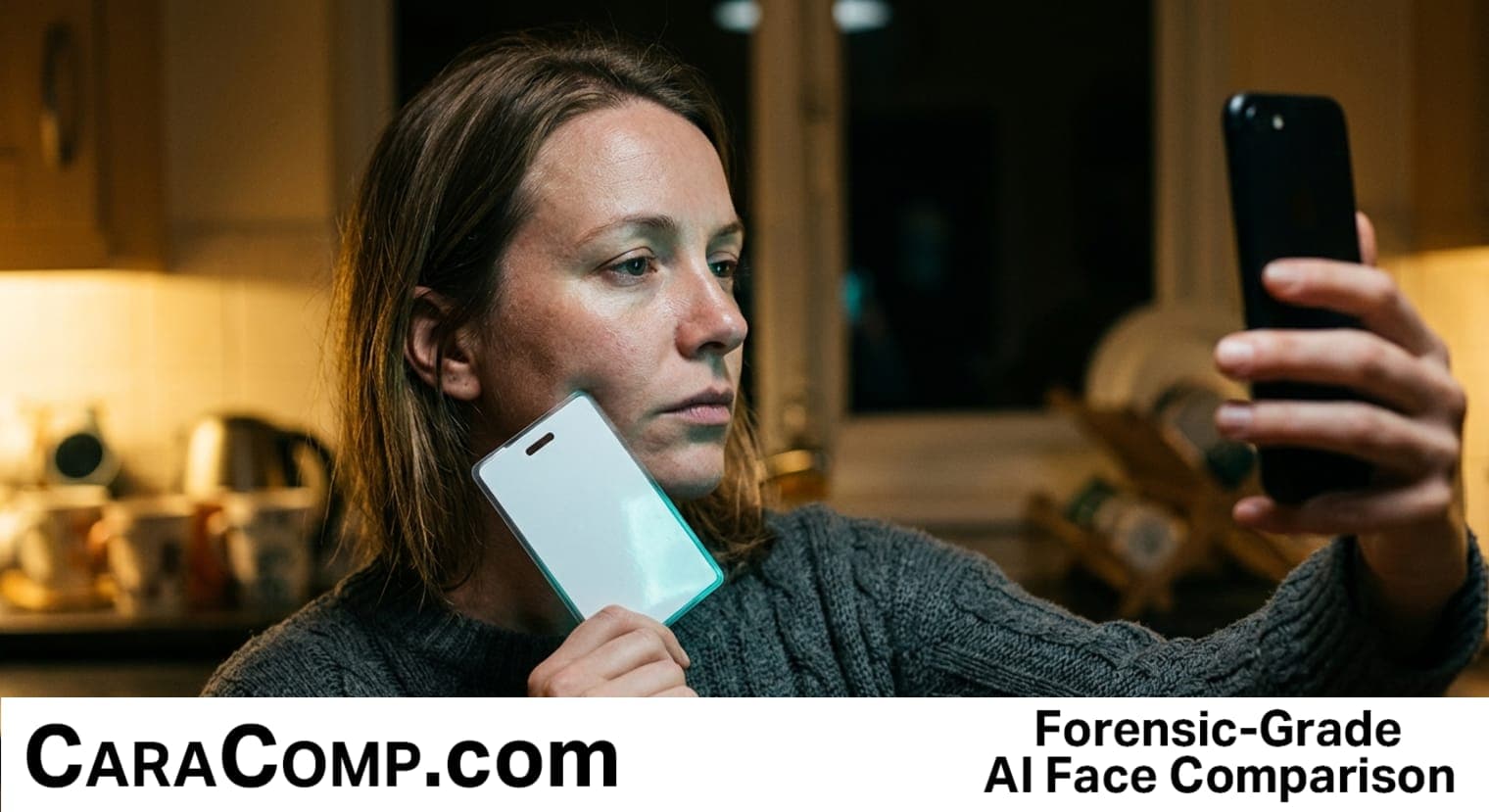
Here is the short version, as reported by 9to5Mac. The phone asks for a selfie. You turn your head through four directions so the system can tell it is looking at a live person and not a printed photo. Software then estimates your age from your face and gives back a simple answer: old enough, or not. Apple says the selfie is deleted once the check is done.
Apple says the image "isn't accessible to anyone, not even Apple."
Apple's description of the feature, as summarized in 9to5Mac's reporting
That is a strong sentence. I would like it to be true. And nothing I have seen suggests it is false. But a sentence is a promise, not a receipt.
4
head turns in the selfie check, so the phone can tell a live face from a photo This article is part of a series, start with Biometric Face Scan Brazil Ties 280m Phones To Verification.
Source: 9to5Mac
How selfie age estimation differs from in-person verification and showing an ID
Old age checks asked you to upload a driver's license or use a credit card. Those verification methods have leaked sensitive information before. A face scan that returns only a yes or no is a real improvement on that. Security people like this design because there is nothing left to steal if nothing is kept. Call it "analyze, then delete."
Here is the catch. The design only protects you if the deleting actually happens, everywhere, every time. Apple's public support page describes the identity verification process. It does not publish an audit trail (the record of who looked at what, and when) that an outsider has checked.
Is phone age verification safe for kids' faces and private data?
Most likely safer than the old way, but nobody outside Apple can confirm it from public information. The selfie is meant to be checked and deleted. The open questions are where it is deleted from, who confirmed it, and whether any machine-readable face data (a numeric "fingerprint" of your face) is kept after the photo is gone.
That last one is the sneaky part. A company can truthfully say "we don't store your photo" while keeping a numeric template of your face. A researcher analysis listed in the research behind this piece, an ArXiv paper on age verification privacy paradoxes, warns that facial templates can quietly seed surveillance systems while sidestepping privacy rules. I am not saying Apple does this. I am saying the public wording leaves room, and room is where trust goes to wobble.
Digital verification methods: what the old document check got wrong, and what the selfie fixes
| Question | Document check (old way) | Selfie age estimation (new way) |
|---|---|---|
| Type of verification | Document verification | Biometric verification of a live face |
| What you hand over | A photo of an ID or a card number | A live selfie with four head turns |
| What the system needs to learn | Name, birthday, often an address | Only whether you pass the age threshold |
| Main privacy worry | Stored copies that can be breached | Whether deletion is proven, not just promised |
| Main accuracy worry | Fake or borrowed documents | The age guess being wrong for some faces |
Notice the shift. The risk moves from "someone steals the stored ID" to "someone has to trust the software's guess and the deletion claim." That is not worse. It is just different, and families deserve to know which risk they are signing up for.
Why identity verification has to reach beyond age checks and fraud detection
Now zoom out. Age checks are spreading fast. The research for this story lists Australia, Brazil, Singapore, South Korea, the UK and Texas as places where age rules now apply. When laws land that quickly, companies rush. Rushing is where explanations get thin. Previously in this series: Deepfake Sydney Classmates School Photos Turned Explicit.
And here is the uncomfortable part. Even a perfect age check does not make a child safe. In Sydney, an explicit-deepfake scandal at a school showed how kids can be hurt without ever touching an age gate. A deepfake (a fake image or video made by AI to look real) of a classmate does not care what birthday the app thinks you have. Age checks block some doors. They do not lock the whole house.
Why the identity verification process matters to families
- Silence is a choice. When a company does not publish how deletion is checked, that gap is itself a data handling decision.
- Faces cannot be reset. You can change a password. You cannot change your child's face if it ever leaks.
- Safety tools are not the whole answer. Deepfakes of kids happen outside any age gate.
What should a parent ask before a child takes the selfie?
Four plain questions. Who handles the image? How long does it exist? Is anything derived from the face kept after the photo is gone? Has anyone outside the company checked that deletion works? The NHIMG privacy framework makes a similar point for practitioners: any keeping of face data beyond the immediate check should be an exception with a written reason and a deletion schedule.
If you have ever wondered whether a photo or profile is really who it claims to be, that is the exact question this kind of technology exists to answer. The same instinct applies here, pointed the other way. Before you trust the tool, ask for the evidence that it does what it says. One useful thing you can do tonight: read the on-screen consent text with your child before they tap anything, and screenshot it. If the wording says nothing about deletion, that tells you something.
The fair counterpoint on phone age verification
Let me be fair, because this is not a scare story. If a family has to prove age somehow, a one-time selfie that returns a yes or no beats handing over a driver's license to a random website. Privacy-focused builders, like the ones described by an age-verification provider, argue that checking and then deleting leaves nothing to leak or hand over later. That is a sound idea. I think Apple's approach fits it.
But "fits the idea" and "proven in practice" are two different shelves. The real question is not whether selfies beat documents. They probably do. It is whether deletion is built into the system so it cannot be skipped, or whether it relies on people and policies behaving well forever.
A selfie identity verification process can protect kids and their privacy at once, but only if the promised deletion is something outsiders can check, which is why phone age verification deserves a few questions before a child taps "start." Up next: Identity Verification Process 4 Head Turns Zero Proof.
Recap: A selfie age check is likely safer than uploading an ID, but Apple's deletion claim has no public outside proof yet. Ask who handles the image and how long it lives.
So here is where I land. Apple told us the photo disappears. Fine. If the company is that confident, publishing proof should be easy. Why not show us?
identity verification process: Frequently Asked Questions
Does the selfie age check store my child's face?
Apple says the selfie is deleted after the check and is not accessible to anyone, not even Apple. What the public information does not show is independent proof of that deletion, or whether any numeric face data is kept afterward. Treat it as a promise that is probably sincere but not yet verified, and ask for the retention details before agreeing.
Is phone age verification better than uploading an ID?
For most families, probably yes. Uploading a license or card creates a stored copy that can be breached later. A selfie that returns only a pass or fail leaves less to steal. The tradeoff is that you must trust the age guess and the deletion claim, and neither is easy for a parent to check on their own.
Why does the selfie ask me to turn my head?
The four head turns are how the phone checks it is seeing a live person and not a photo held up to the camera. That check is called liveness (whether the camera is looking at a live person or a picture). It is a common part of a face based age check and helps stop simple tricks, like using an older relative's picture.
Will age checks protect kids from deepfakes?
No. An explicit-deepfake scandal at a Sydney school showed that kids can be harmed by fake images made by classmates, no matter what an age gate says. Age checks limit who gets into certain spaces. Protecting children also takes talking with them, school rules and quick reporting. Families should treat the identity verification process as one safeguard among several, never the only one.
Ready for forensic-grade facial comparison?
Full forensic reports with detailed similarity scoring. Results in seconds.
Run My First SearchMore News
Deepfake: Sydney Classmates' School Photos Turned Explicit
A Sydney school is under investigation over explicit fake images, while age checks and face scans spread everywhere. Here is what to do, and what never to do, if a fake touches someone you love.
biometricsBiometric face scan: Brazil ties 280M phones to verification
Brazil will soon ask people for a face scan to register a phone line. Here is what that means, what nobody has explained yet, and the three questions worth asking.
ai-regulationDeepfake Nudes: NJ Man Charged, Where Victims Turn First
A New Jersey man is charged over AI-made nude images of two women. A charge isn't a conviction, but the case raises a bigger question: where does a victim turn first?