
Digital age check: age verification and privacy for Danes
Quick answer
What is a digital age check and how does it work with a payment app?
A digital age check proves you are old enough by using an app you already have, instead of uploading a selfie or document. In Denmark, MobilePay can show a photograph, name and age. The privacy test is whether the app shares only "over 18" and how long anything is kept.
Picture this: you're at the checkout, or on a website that asks "Are you old enough?" Instead of uploading a scary pile of papers, you tap the payment app you already use to split dinner. That is a digital age check, and in Denmark it just became real for millions of users.
A digital age check through your payment app can keep kids out of adult spaces, but only if it shares "over 18" and nothing more.
Digital age check: what your payment app is about to ask of you
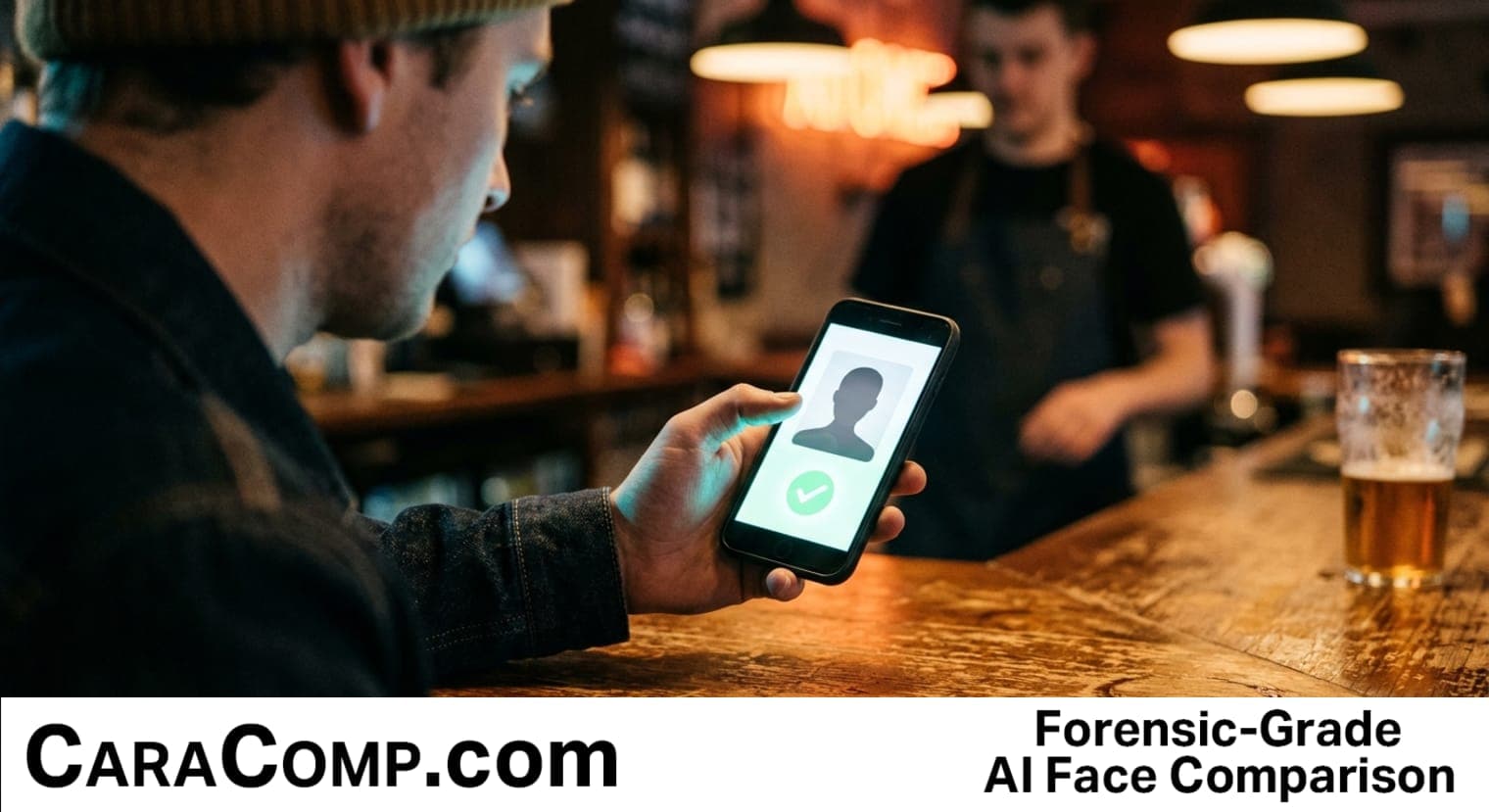
According to Telecompaper, MobilePay has added a digital age verification option in Denmark. The app has nearly 4.8 million Danish users. When a user taps the feature, the other side sees a photograph, a name and an age. Nothing else.
Reporting from The Copenhagen Post says Rema 1000 accepts it. Our research also shows it is already taken at 7-Eleven and at bars and pubs. That is why it spreads fast. No user has to download anything new.
Digital id or payment app: who holds the proof?
Here is the twist. Denmark's Agency for Digital Government already launched AltID earlier in 2026. It is the country's first official digital id and proof-of-age app (a phone app that says who you are and how old you are), for online and in-person use. So Danes now have two doors: a public one run by the state, and a private one run by a payment company.
Both can work. But they are not the same thing, and the difference is the part worth a late-night think.
Is a digital age check safe? MobilePay age verification and your privacy
It can be, if the app shares only what a shop or website needs. MobilePay age verification shows a photo, name and age, not your bank balance or purchase history. The privacy risk for users is not today's design. It is later pressure to add more data, keep it longer, or link it to other things.
Think of privacy like a hotel key card. A good one opens one door. A bad one opens every room and logs where you went. The first version of a feature is usually the good key card. The question is whether it stays that way. This article is part of a series, start with Atlantic City Hotels Own Face Costs Star Hotel Guest 1 250.
Security: what could go wrong with a digital age check
Your phone is already the front door to your money, so security matters more here, not less. If someone steals your phone and your login, they hold your age verification and your payments. Strong phone locks help users here. So does a company that treats every extra data point as a liability (something that could hurt them if it leaked).
There is also a quieter fraud worry. When one app proves everything, a hacked account does more damage. That is the cost of convenience, and it is why one login for everything deserves a raised eyebrow.
Government apps versus payment apps
A government age app has one job. A payment platform ties age verification to a financial record, as the expert notes in our research. That is handy until someone asks why a merchant should learn you used a payment app at all, or whether age and spending could later be combined for profiling.
The EU is pushing a stricter age verification model. According to DIDIT's rollout tracker, the EU's central approach returns only a yes or no, with no name or birthdate. Wallet versions are planned in France, Denmark, Greece, Italy, Spain, Cyprus and Ireland. Euronews describes the design as zero-knowledge proof, meaning you prove a fact without handing over the underlying details.
Why a selfie or document upload is the older digital age check
Most users know the old routine. A site wants a selfie and a photo of your passport or license. That is document verification: software reads the paper and compares it to your face. It often adds liveness (whether the camera is looking at a live person or a photo). It works, but you hand over a lot of personal information to a stranger's server.
| Question | Selfie and document upload | Payment app proof |
|---|---|---|
| What you share | A face photo, a full document and personal details | A photograph, name and age |
| Who checks you | Automated age checks run by the website's vendor | An app that already knows you through Denmark's CPR (Central Personal Register) |
| Main privacy risk | Copies of your identity document stored somewhere | Age verification linked to a financial record |
| Effort | Several minutes, new account | A tap in an app you already have |
Age checks that share only "over 18"
The best age checks answer one question. Are you over 18, yes or no? The National Health Information Management Group puts the real issue well:
The core governance issue in age verification is not whether a document exists, but how much of it the verifier can see and retain. Previously in this series: How To Take Passport Photo At Home 4 Rules Software Checks.
National Health Information Management Group
Notice that privacy depends on what the other side keeps, not what you show. A bartender glancing at your photo and age is fine. A website that stores a copy is a different animal.
Identity tied together: the part that nags
Here is my honest worry. Every convenient link makes your identity a little more like one big file. Today your payment app proves your age. Tomorrow it could anchor your digital identity for a dating site, or a loan. Our research asks exactly that: if it can verify age for a beer, why not verify you for a financial product? Who decides where the line sits?
The case for it, and what to watch for before you tap
Let's be fair. Weak age verification fails young people. One study in our research found 78% of children aged 10 to 15 had social media accounts despite minimum age limits, because sites mostly trust a birthday typed into a box. Real age assurance (confirming someone's age with more than their word) could protect minors in a way that honor-system boxes never will.
Why a digital age check matters
- Familiar means fast - an app users already trust spreads quickly, which is also why its habits matter.
- Less data, less damage - a yes-or-no answer leaves little to leak and little to misuse.
- Mission creep - more data, longer storage and cross-platform links are the real danger.
Developers connect apps through an api (a software hookup that lets one app talk to another). That is how a shop or site could ask your payment app for proof. Businesses in regulated fields also run kyc (know-your-customer checks, the identity checks banks must do) and chase compliance (following the rules). Those requirements can push companies to collect extra. Good technology protects privacy by resisting that. If your websites of choice ask for a full document when a yes would do, that is your red flag.
If you have ever wondered whether a photo or profile is really who it claims to be, that is the exact question this kind of tech exists to answer. Your one useful move: before you accept any age prompt, look for wording that says what is shared and how long it is kept. If it only says "verify," that is a gap. Ask for "over 18, nothing else."
A digital age check is only as good as what it refuses to share, and the best version works like a reliable age verification that confirms age eligibility and then forgets you.
Recap: Proving your age through a payment app can protect kids, but it should reveal only that you are over 18. Watch what is kept, and for how long. Up next: Age Verification 25 States Now Demand Id And Face Scans.
So here is the line to sit with: the app that knows what you bought last night may soon vouch for how old you are. Convenient, sure. But when your wallet becomes your bouncer, who is checking the wallet?
digital age check: Frequently Asked Questions
How does online age verification rely on my personal details?
Most online age verification relies on one of two things: a date of birth you type, or proof such as a document or face scan. Typed dates are easy to fake. Scans are stronger but collect more. A payment app can verify age online using details it already holds, which may mean fewer new uploads for each user. In any verification process, the privacy question for users is what gets passed along and kept.
Can age verification software confirm age eligibility without storing my ID?
In a well-built design, yes. Age verification software confirms age eligibility by returning a yes or no, not the document itself. That is what a privacy-preserving age check aims for. The EU's central approach in our research returns only that answer, with no name or birthdate. Whether a given service really deletes the rest depends on its policy, so check what is kept.
What is a device-based age verification system?
Device-based age-verification systems keep the proof on your phone instead of a company's server. The app allows users to show a result, such as "over 18," when asked, so a person can be age verified without handing over a document. Less sits in a central database, which lowers breach risk. Denmark's AltID and MobilePay both live in an app on your phone, though the details of each design differ.
Why is biometric data being unique such a big deal for age checks?
Biometric data is unique to you: your face, voice or fingerprints. You cannot change it like a password. That is why a selfie scan carries more risk if stored or leaked. A real-time online age verification service that checks a photo should delete it quickly. Ask whether the site keeps the image after the check.
How can age checks help businesses ensure they're dealing with legitimate customers?
Age checks can help businesses ensure they're dealing with an adult, and with legitimate customers rather than automated checks being gamed by bots or kids typing fake birthdays. This matters for age-restricted digital services as much as for a physical shop counter. Stronger proof also cuts fraud. Still, each user should only share what the business needs, which is usually just that they are over 18.
How do people prove they are old enough with digital evidence capture?
Digital evidence capture means the system records proof, like a photo, scan or log, of a check. Users prove they are old enough by showing a trusted app or credential, and the shop sees a verified age rather than a full record. The concern is the record left behind. Good design keeps a minimal audit trail (a record of who checked what, and when) and nothing extra. Ask how long it is kept.
Ready for forensic-grade facial comparison?
Full forensic reports with detailed similarity scoring. Results in seconds.
Run My First SearchMore News
Age Verification Roblox: Malaysia Weighs ID Checks for Kids
Malaysia is studying age checks for Roblox and other online games. Safety matters, but so does what your family hands over to prove a child's age.
privacyAge verification: 25+ states now demand ID and face scans
Age checks started with adult sites. Now they are creeping toward everyday websites, and the price may be your ID. Here is what to know before you tap "verify."
facial-recognitionAtlantic City Hotels: Own Face Costs Star Hotel Guest $1,250
Police say a man was robbed in an Atlantic City casino hotel room and his own face was used to open his phone. Here is the warning sign that matters before any meet-up.