
Delhi pension verification: Scammers Target 4.4 Lakh Seniors
Quick answer
How can I tell if a Delhi pension verification visit is real?
Confirm the visit through an official contact before opening the door or allowing any scan. Look up the Social Welfare Department or a local Common Service Centre number yourself and ask if a team is due. A genuine check needs only a scan, never a PIN, one-time code or app install.
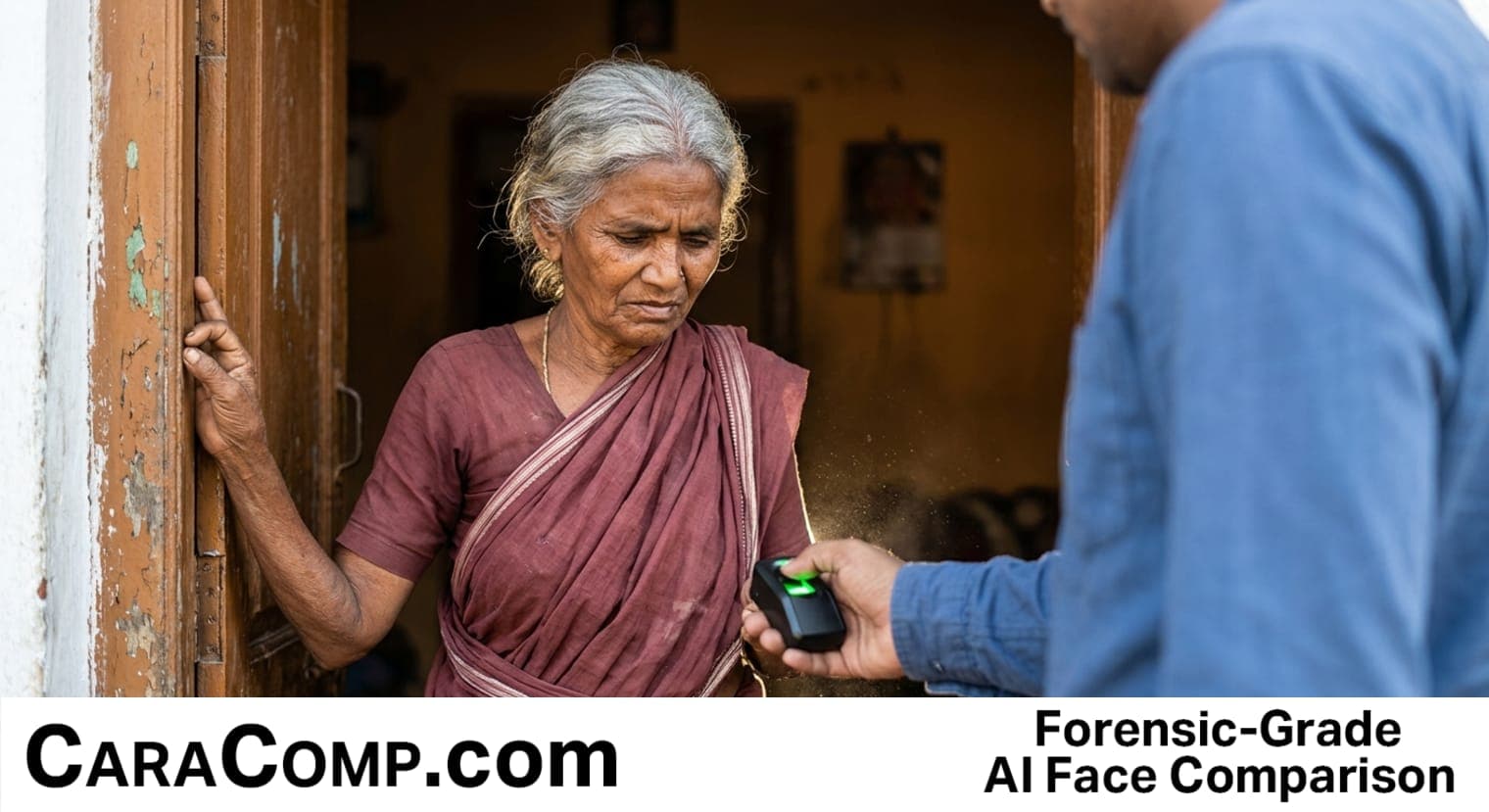
Picture your mother at home on a quiet afternoon. Someone rings the bell, says they are from the government, and asks to scan her fingerprints for her pension. That is what Delhi pension verification looks like for about 4.4 lakh older residents (that is 440,000 people) over the next few months. Most of those visits will be real. Some copycat visits may not be.
Delhi pension verification means official teams will scan the fingerprints and irises of 4.4 lakh seniors at home, so every family needs one rule: confirm the visitor through an official channel before sharing anything.
What Delhi pension verification actually involves: the 4.4 lakh number
Start with the number, because it is the whole story. According to Millennium Post, Delhi's Social Welfare Department is verifying 4.4 lakh senior citizens who receive old-age pensions. The teams carry devices that read fingerprints and irises (the colored ring of the eye, which is as unique as a fingerprint). The work began in late October 2026 and runs on a roughly three-month timeline.
The goal is reasonable. Officials want to find pensions that are still being paid to people who have died, people listed twice, or people who no longer qualify. Business Standard reports that officials expect 20 to 25 percent of the list to turn out ineligible. If that holds, that is tens of thousands of payments that should never have gone out.
4.4 lakh
senior citizens (440,000 people) in line for door-to-door biometric pension checks in Delhi
Source: Millennium Post
How the delhi pension verification visits are staffed
The Social Welfare Department is working with Common Service Centres, which are local help desks that handle government paperwork. Business Standard says that network covers about 6,000 centres across Delhi. So there will be many real visitors, in many neighborhoods, with many different badges. That variety is exactly what makes a fake one hard to spot. This article is part of a series, start with Facial Recognition Iphone 32 5b Suit Over Faces In Photos.
Why a biometric pension check at the door is a gift to scammers
Here is the part that worries me. A biometric pension check comes with a ready-made script: official ID, a government program, a deadline, and a promise that the pension stops if you refuse. A scammer does not need to invent a story. The government just wrote one for them.
And the fraud is already happening. Outlook Money described a 65-year-old retired army man who lost ₹28.70 lakh (about 2.87 million rupees) in September 2026. He installed a fake "pension verification" app, called an APK (an app file that is installed outside the official app store). Scammers then used one-time codes, the short numbers a bank texts you to approve a payment, to empty his account.
Notice the pattern. Nobody hacked a system. He was talked into handing over the keys. That is why the one-time code is the thing to guard hardest. No real pension check ever needs it read aloud.
Is a face or voice recording part of the risk?
Possibly, and this is the newer worry. The research behind this piece notes that some fraudsters pose as older people asking for help with pensions or apps. Their devices record video, which captures faces and voices that can later be misused to build AI impersonations (fake video or audio made to look and sound like a real person). I would not panic about it. I would simply treat a video request from a stranger like a request for a signature.
Is the Delhi pension verification visit real, and how can a family tell?
The official drive is real, and it is documented by both Millennium Post and Business Standard. But "the program is real" does not mean "this person at the door is real." A family can tell the difference by confirming the visit through an official contact route, such as the Social Welfare Department or a known local centre, before the door opens or any scan happens.
Here is how a genuine visit and a scam tend to differ. Treat it as a rule of thumb, not a guarantee.
| What to check | Genuine verification visit | Likely scam |
|---|---|---|
| Contact first | Can be confirmed with the department or local centre through an official number the family looks up | Insists you use the phone number or link they give you |
| Request for a PIN or code | Scan only, with fingerprint or iris on the team's device | Asks for a PIN, a one-time code, or an app install |
| Pressure | Allows time to call and check | Says the pension stops today unless you act now |
| Where it happens | At home, with a family member present if possible | Pushes you to a link, a video call, or a private phone |
Why Delhi pension verification matters beyond Delhi
- Trust gets copied - when officials make doorstep scanning normal, criminals copy the look and the script.
- Codes are the weak spot - the ₹28.70 lakh loss came from an app and a one-time code, not from a broken scanner.
- Errors have victims too - housebound or infirm people whose fingerprints will not read may be left unresolved within the three-month window.
The other risk in delhi pension verification: honest machines that get it wrong
Scams are only half the worry. Fingerprint and iris readers sometimes fail on older people, whose fingertips can be worn smooth by decades of work. A failed read can mean a stopped payment for someone who is entirely real and entirely alive.
The Pulitzer Center's reporting on Rajasthan's push for facial authentication of pensioners shows how this goes. Many people were left behind when the matching failed. It also notes that Supreme Court Justice D.Y. Chandrachud warned about authentication errors, saying that Previously in this series: Delhi Pension Verification Scammers Eye 4 4 Lakh Seniors.
even a small percentage of error affects crores.
Justice D.Y. Chandrachud, as reported by the Pulitzer Center
A crore is ten million. Do the math on 4.4 lakh people and even a small slice is thousands of households wondering where the money went. India has run this kind of check before. Biometric Update covered the central government's face checks for pensioners, which use liveness (a test that the camera is seeing a living person, not a photo). The same debates about privacy and access came up then.
The fair counterpoint
Let me be straight: the government has a point. Paying pensions to the dead or to duplicates takes money from people who need it. Going to a home also spares a frail 80-year-old a long trip to a verification center. I am not against the visit. I am against showing up unannounced in a country where fraud is already riding the same road.
Protecting a parent during Delhi pension verification: one habit that works
Here is the breadcrumb. If you have ever wondered whether a person or a photo is really who it claims to be, that is the exact question identity tools exist to answer. For a doorstep visit, you can answer it with something simpler than software. Verify the visitor independently, before anything is shared. Look up the department or centre number yourself, call it, and ask whether a team is scheduled at that address. Do it while the visitor waits outside.
Then make a family rule and say it out loud over dinner. Fingerprints and iris scans happen only on the official team's device. A PIN, a one-time code, or an app install never happens, no matter who asks. Keep a younger relative on speed dial for the day a visit is due. This is a thirty-second habit, and it is a lot cheaper than ₹28.70 lakh.
Delhi pension verification is a legitimate drive, but a legitimate drive is also the best cover a scammer could ask for, so a doorstep biometric pension check should always be confirmed through an official contact before any scan, PIN, or code is shared. Up next: Delhi Pension Verification Scammers Eye 4 4 Lakh Seniors.
Recap: Delhi is scanning the fingers and eyes of 4.4 lakh seniors at home. Families should check each visitor through an official number first and never give out codes.
So here is my question for the 4.4 lakh households on that list. When the bell rings and the person outside says "I'm from the government," does your parent know the one phone call that proves it? Delhi pension verification will be a success or a mess depending on whether that call takes thirty seconds or never gets made.
Delhi pension verification: Frequently Asked Questions
Who is being checked in Delhi's door-to-door pension drive?
Delhi's Social Welfare Department is verifying about 4.4 lakh senior citizens who receive old-age pensions. Teams visit homes with devices that scan fingerprints and irises. Common Service Centres, local help desks for government paperwork, are helping, with about 6,000 centres involved according to Business Standard. The drive began in late October 2026 and runs for roughly three months. Officials expect 20 to 25 percent of beneficiaries to turn out ineligible, mostly deceased or duplicate entries.
What should an older person do before agreeing to a biometric scan at home?
Pause and confirm the visit independently. Look up the Social Welfare Department or the local Common Service Centre contact yourself, instead of using a number the visitor offers, and ask whether a team is scheduled at that address. If possible, have a family member present. A genuine check involves only a scan on the team's own device. Anything that asks for a PIN, a one-time code, or an app download should end the conversation immediately.
Why is a one-time code so dangerous to share?
A one-time code is a short number a bank or service sends to approve one specific action, such as a payment or a login. Whoever has the code can complete that action. Outlook Money reported that a 65-year-old retired army man lost ₹28.70 lakh in September 2026 after installing a fake pension verification app and being led through code requests. A real pension check never needs the code read out to a stranger.
What happens if a fingerprint scan fails for an older person?
Failed reads are a real problem. Worn fingertips and other age-related changes can cause a genuine person to fail a match, and researchers and the Supreme Court have warned that authentication errors can exclude vulnerable people. The research behind this article notes that housebound or infirm applicants without valid biometrics may remain unresolved within the three-month timeline. Families should keep records of every visit and ask the department which alternative route exists if a scan fails.
Can a biometric pension check be used to make AI fakes of someone?
It is a risk worth knowing about, though not proven for the official drive. The research for this piece describes fraudsters whose devices record video to capture faces and voices, which can then be misused to build AI impersonations or to try to bypass verification systems. The practical defense is the same as before: allow scans only by confirmed officials on their own devices, and refuse any request to record video or install anything.
Ready for forensic-grade facial comparison?
Full forensic reports with detailed similarity scoring. Results in seconds.
Run My First SearchMore News
Facial Recognition Bias: What 905,117 Police Scans Hide
Police scanned 905,117 faces in three months, and the headline error rate looks tiny. A plain-English look at what that number hides, and who it hides it from.
ai-regulationAge Verification Florida: Chatbots Next, Then Every Phone
Florida wants age checks to follow kids into AI chatbots, not just social media. Here's what the Safe Screens Act proposal means for your family's privacy.
privacyAI Voice Cloning: Scams Up 7.4x, and a Safe Word Beats Them
A study says AI voice cloning scams have surged 7.4-fold. Your child's voice on the phone is no longer proof it's your child, so here is the simple backup plan every family needs.