
Celebrity Deepfake Video Scam: Fake Ronaldo Cost a Woman €100
Quick answer
How can you tell if a celebrity video is a deepfake scam?
Check where the video was posted before you trust it. A real endorsement appears on the celebrity's verified account or official channel. Fakes often show overly smooth skin, odd blinking, flat audio and pressure to send money fast. Looks alone are unreliable, so confirm the offer at the source.
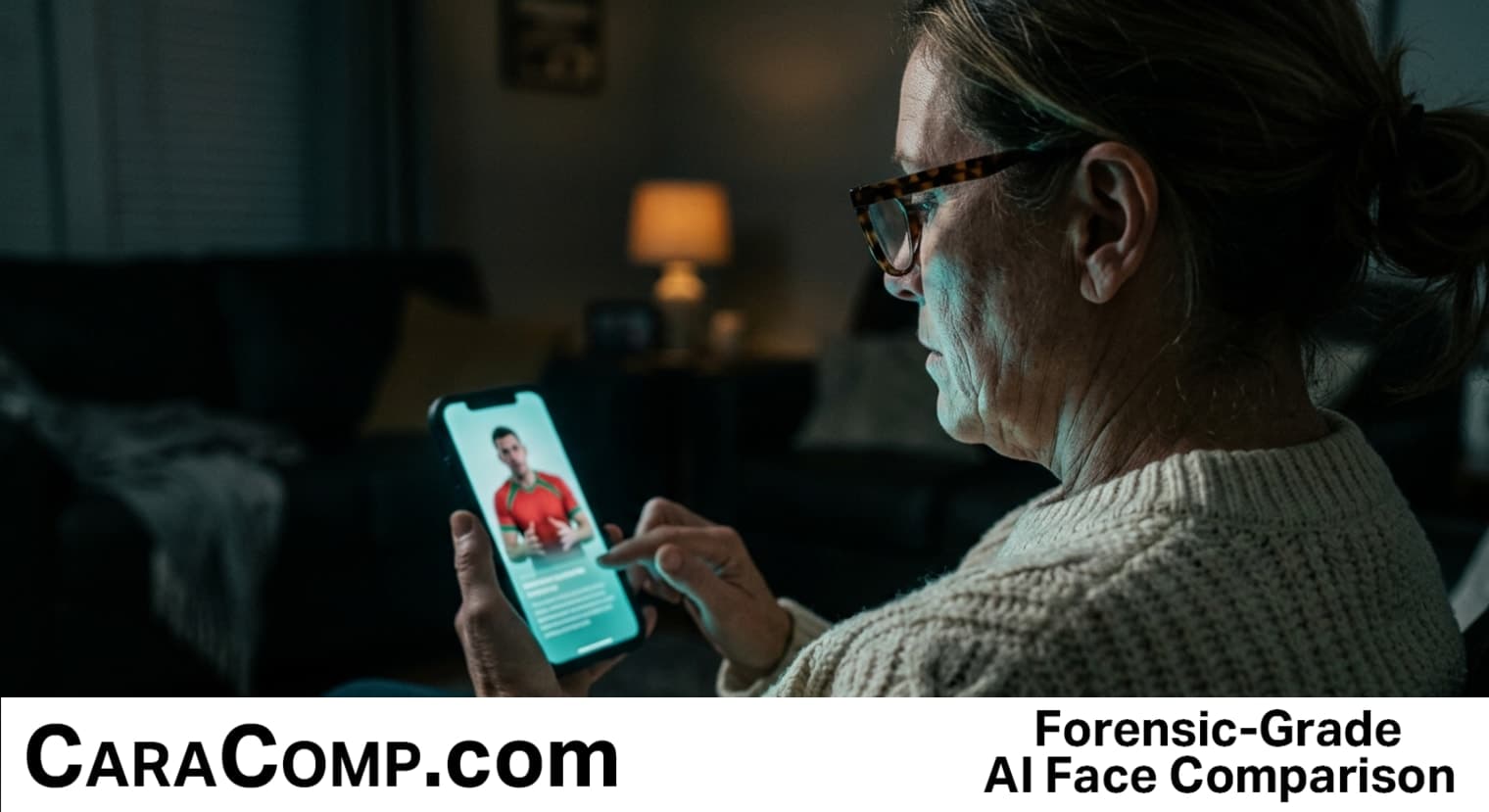
A woman opened a video. Cristiano Ronaldo, or someone with his face, his voice, his easy grin, was telling her about a deal too good to pass up. She believed it. She sent money. She lost €100. That's not a huge number, and that's exactly the point: this wasn't a sophisticated hack or a Nigerian-prince email with typos. It was a celebrity deepfake video, good enough to borrow trust from one of the most recognizable faces on the planet, and it worked in seconds.
A celebrity deepfake video impersonating Cristiano Ronaldo cost a woman in Greece €100, and it's a warning sign that famous faces can now be faked convincingly enough to drain your wallet before you've had time to think twice.
A celebrity deepfake video impersonating Cristiano Ronaldo cost a woman €100, small money, but a big warning about how fast a familiar face can move you to act without thinking.
Here's the thing that should bother you more than the €100 figure: this woman didn't fall for a stranger. She fell for someone she already trusted, or thought she did. That's the whole trick behind a ronaldo deepfake scam, and it's why this story matters way beyond one woman's bank account. This is a clear case of celebrity fraud, where scammers borrow a face people already believe instead of building trust from scratch. This kind of deepfake content spreads fastest precisely because it asks so little of the viewer, just a glance, not a close read.
Why celebrity deepfakes beat any phishing email at winning your trust
Think about every scam warning you've ever heard. Watch for bad grammar. Watch for weird email addresses. Watch for urgency. Those tips exist because old-school scams left fingerprints, mistakes a careful person could spot. A celebrity deepfake leaves none of that. It looks like Ronaldo because, frame by frame, an AI model built it to look exactly like Ronaldo: his face shape, his skin tone, his signature "Siuuu" celebration, all stitched together from thousands of real video clips scraped from the internet.
Starts at 00:13 — this story2:49
Watch this story, in under a minute
A new briefing every weekday — three stories, three minutes.
Subscribe on YouTubeThis isn't a fringe tactic anymore, it's mass production. Deepfake video creation was projected to top 8 million files in 2025, according to research cited by Security Briefa sixteenfold jump since 2023. Sixteen times more fake video in two years. That's not a slow creep, that's an explosion, and celebrities are the preferred targets because their faces already come pre-loaded with trust, name recognition, and millions of hours of source footage for the software to learn from. Rights holders and platforms alike are struggling to keep pace with the sheer volume of content being produced, and much of it counts as fake celebrity material designed to look like an official post.
22,364 This article is part of a series, start with Biometric Entry One Setting Flags 42 Of Real Fans.
AI-related fraud complaints reported to the FBI's IC3 unit, totaling $893.3 million in losses
Source: FBI 2025 IC3 report, via Trademark Engine
And that $893.3 million figure? It's almost certainly a floor, not a ceiling. Most people who lose €100 to a fake Ronaldo video don't file a police report. They're embarrassed. They chalk it up to a bad day and move on. That silence is exactly what lets this kind of fraud scale, nobody's counting the small losses, so nobody sees how big the pattern really is.
How does an influencer deepfake or ronaldo deepfake scam actually get made?
Scammers grab existing public video of the celebrity, interviews, ads, match footage, and feed it into face-swapping and voice-cloning tools that map the celebrity's expressions and voice patterns onto a script the scammer writes. According to Let's Data Science, scammers routinely combine AI voice cloning, face mapping, and fake news pages to make the whole package, video, headline, "official" looking site, feel airtight in the ten seconds it takes someone to decide whether to click. This same playbook powers deepfake investment pitches, where the fake celebrity urges viewers to hand over cash fast.
The psychology trick hiding inside every digital deepfake video
There's a reason this works on smart people, not just gullible ones. It's called the availability heuristic, basically, your brain judges how likely something is to be true based on how easily an example comes to mind. You've seen Ronaldo on TV a thousand times. You've seen him in ads, interviews, and celebrations. So when a video shows up that looks like him, your brain doesn't run a background check, it just matches the pattern it already knows and says "yep, that's him." The more familiar the face, the less your guard goes up. That's not a flaw in you. That's just how brains work, and scammers know it cold.
Fans feel like they know celebrities personally, and that one-sided relationship lowers exactly the guard a stranger's pitch would raise, which is precisely why even legitimate endorsements deserve verification.
Expert analysis on celebrity deepfake fraud patterns
Regulators are watching this shift, too. In Australia, the securities regulator ASIC reported a 182% increase in scams removed online, many featuring deepfake investment schemes tied to politicians and celebrities, according to ABC News. In the UK, police reports of this style of fraud rose 40% since 2023, with some scams involving weeks of fake, warm messaging designed to build trust before the money ask ever lands. The Ronaldo case is small money. The pattern behind it is not small at all. Previously in this series: Utah Age Verification Law Vpn Users Now Trigger Id Checks Po.
What is deepfake fraud, in plain terms?
Deepfake fraud is when someone uses AI-generated video, images, or audio of a real person, often ai-generated Taylor Swift style content or another famous face, sometimes a family member's voice, to trick you into believing a request, offer, or endorsement is genuine. It borrows the target's face or voice without their permission, then uses that stolen trust to sell fake investments, request money transfers, or push fraudulent giveaways. This kind of impersonation also raises real rights questions, since the person's likeness and publicity rights were never licensed for use in the first place. In some of the worst cases, the same tools behind these scams have also been used to produce deepfake pornography, a separate but related abuse of someone's stolen likeness.
Spotting celebrity deepfakes: what deepfake creators don't want you to notice
So what do you actually check, in the ten seconds you have before deciding to click "pay" or "invest"? Detection experts point to a handful of visual tells that still show up even in decent fakes, though the quality gap is closing fast. According to a technical guide from Adaptive Security, real deepfake detection now requires a multi-layered approach, visual inspection, audio analysis, forensic tools, and checking where the video actually came from (called provenance, basically a paper trail showing the file's origin), because clean video with realistic head movement makes casual inspection on a small phone screen pretty unreliable.
Still, there are things worth glancing at. Watch the mouth, does it sync perfectly with every word, or does it lag a hair behind? Watch the skin, in a lot of fakes, skin appears too smooth, almost airbrushed, especially around the jaw and forehead where real skin has texture, pores, small imperfections. Watch the blinking, it's either too frequent or barely happens at all. None of these are guarantees. Some fakes are clean enough that a casual viewer, glancing at a phone at 11pm, will miss every one of them.
Why celebrity deepfakes and their scam pattern matter for you
- ⚡ Trust is now the attack surfacescammers don't need to fool you into believing a lie, they just need a face you already believe.
- 📊 Small losses hide big numbersa €100 loss feels minor, but multiplied across thousands of victims it's how fraud scales quietly.
- 🔮 Detection is getting harder, not easiercasual visual checks are losing their edge as generation tools improve month over month.
- 🎯 Legitimate endorsements need checking tooeven a real celebrity ad deserves a second look before you act on it financially.
| What a real celebrity endorsement looks like | What a celebrity deepfake video looks like | Status |
|---|---|---|
| Posted on the celebrity's verified account or official brand channel | Shared through unfamiliar pages, forwarded links, or "leaked" video style posts | Content authenticity unclear |
| Consistent skin texture and natural blinking throughout | Skin appears too smooth in patches, blinking too rare or too frequent | Deepfake indicator |
| Voice tone shifts naturally with emotion and pacing | Voice sounds slightly flat, robotic, or oddly consistent in pitch | Deepfake indicator |
| No urgent demand to send money immediately | Pressure to act fast, often paired with a "limited time" investment or giveaway | Fraud pattern |
| Traceable back to an official company or verified source | Provenance is murky or impossible to confirm | Rights and sourcing unclear |
If you've ever wondered whether a video, photo, or profile claiming to be a real person is actually who it says it is, that's the exact question this whole field of digital forensics exists to answer. This kind of detection work relies on tracking information about where a file came from, not just how it looks. One useful habit to build right now: before you act on anything a celebrity "says" in a video, invest, donate, click, buy, go check their actual verified account or official team page directly. Don't trust the video to prove itself. Make the celebrity's own real channel do the confirming.
A celebrity deepfake doesn't need to fool an expert, it only needs ten seconds and a familiar face, and the Ronaldo deepfake scam proves that skin appears too smooth is sometimes the only clue you'll get.
Here's what nobody's saying loudly enough: the €100 lost to a fake Ronaldo wasn't really about football, or even about money. It was a test run. Scammers found out that a famous face moves people faster than any sales pitch could, and now they know exactly how little effort it takes to get a "yes." Next time it won't be €100. And it won't be Ronaldo saying "Siuuu." It'll be someone else's favorite face, telling them exactly what they want to hear. Up next: Biometric Entry One Setting Flags 42 Of Real Fans Podcast.
celebrity deepfake: Frequently Asked Questions
How can I tell if a celebrity endorsement video is a deepfake?
Look for mismatched lip movement, skin that looks unusually smooth or plastic-like, blinking that seems off (too rare or too rapid), and audio that sounds slightly flat or robotic. But honestly, well-made deepfake content can slip past casual viewing. The stronger check is behavioral: does the celebrity make this kind of offer on their real, verified account? If not, treat the video itself as unproven, no matter how convincing it looks.
Why do scammers pick celebrities like Ronaldo for deepfake scams?
Because trust is already built in. You don't need to convince someone that Ronaldo is credible, millions of people already believe that. Scammers exploit the availability heuristic, the mental shortcut where familiar faces feel automatically trustworthy. A celebrity deepfake skips the hard part of scamming, building belief, and jumps straight to the easy part, asking for money.
Is it illegal to make a deepfake of a celebrity for a scam?
Yes, in most places using someone's likeness without permission to defraud people violates fraud laws, and separately can violate personality rights or publicity rights tied to the celebrity themselves. The FTC finalized an impersonation rule in 2024 specifically targeting this kind of borrowed-identity fraud, though enforcement often lags behind how fast the scams themselves spread online. Rights enforcement in this area is still catching up to the technology.
What should I do if I think I sent money to a deepfake scam?
Contact your bank or payment provider immediately and report the transaction as fraudulent, speed matters, since some transfers can still be reversed or frozen within the first hours. File a report with your local police and, if you're in the US, with the FBI's IC3 unit. Don't stay quiet out of embarrassment; underreporting is exactly what lets this fraud pattern keep scaling.
Can deepfake technology be detected automatically, or only by eye?
Both, increasingly. Forensic tools now analyze video at a pixel level, checking for inconsistencies in lighting, audio-visual sync, and file history (provenance) that the human eye simply can't catch. Experts describe real detection as needing a multi-layered approach combining visual inspection, audio analysis, and forensic tools together, since relying on your eyes alone is becoming less reliable as generation quality improves.
How much money have people lost to AI impersonation scams overall?
The FBI's Internet Crime Complaint Center logged 22,364 AI-related fraud complaints with $893.3 million in reported losses, based on its most recent report. That number almost certainly understates the real total, since many victims of smaller losses, like the €100 lost in the Ronaldo deepfake scam, never file a report at all.
Ready for forensic-grade facial comparison?
Full forensic reports with detailed similarity scoring. Results in seconds.
Run My First SearchMore News
Deepfake: Brother-in-Law's Fake Photos Spark New UK Crime
The scariest number in deepfake abuse isn't 17,000. It's 1: one person close enough to already have your photos. Sophie Parrish's case shows why, and what changed.
ai-regulationKorean Deepfake: 17,378 Sexual Violence Cases in 8 Months
South Korea's regulator logged 17,378 sexual deepfake reports in eight months. This is not a celebrity problem, and one ordinary photo is all it takes.
privacyAge Verification: Adults Flagged as Kids Get Pushed for ID
Australia is taking five big platforms to court over its under-16 ban. The real story is what a broken age check does to everyone else, and where your ID or face scan ends up.