
How to Tell If an ID Is Fake: Fake IDs and Verification
Quick answer
How can you tell if an ID is fake?
No single quick check settles it, because counterfeiters now copy holograms, UV inks and barcodes. Feel the card, scan it, and check records, but also compare the photo to the person holding it. A real card in the wrong hands passes most card tests, so stack several checks together.
Here is a strange fact to start your night: knowing how to tell if an ID is fake is now hard enough that trained law enforcement officers struggle with it. Not rookies. Trained ones. So when a bar or a landlord glances at a card for three seconds, what exactly are they catching?
How to tell if an ID is fake comes down to this: no single 30-second look works reliably on its own, because counterfeiters copy old security features, so better verification comes from stacking several checks, including one that matches the face to the photo.
The brief version of this topic sounds like a party trick. Feel the edges, tilt the hologram, shine a light. Those are real checks, and we will walk through them. But the honest lesson is bigger, and it protects you in situations that have nothing to do with bars: trusting a person whose ID says they are someone else.
How to Tell If an ID Is Fake: Why the 30-Second Check Is Not Enough
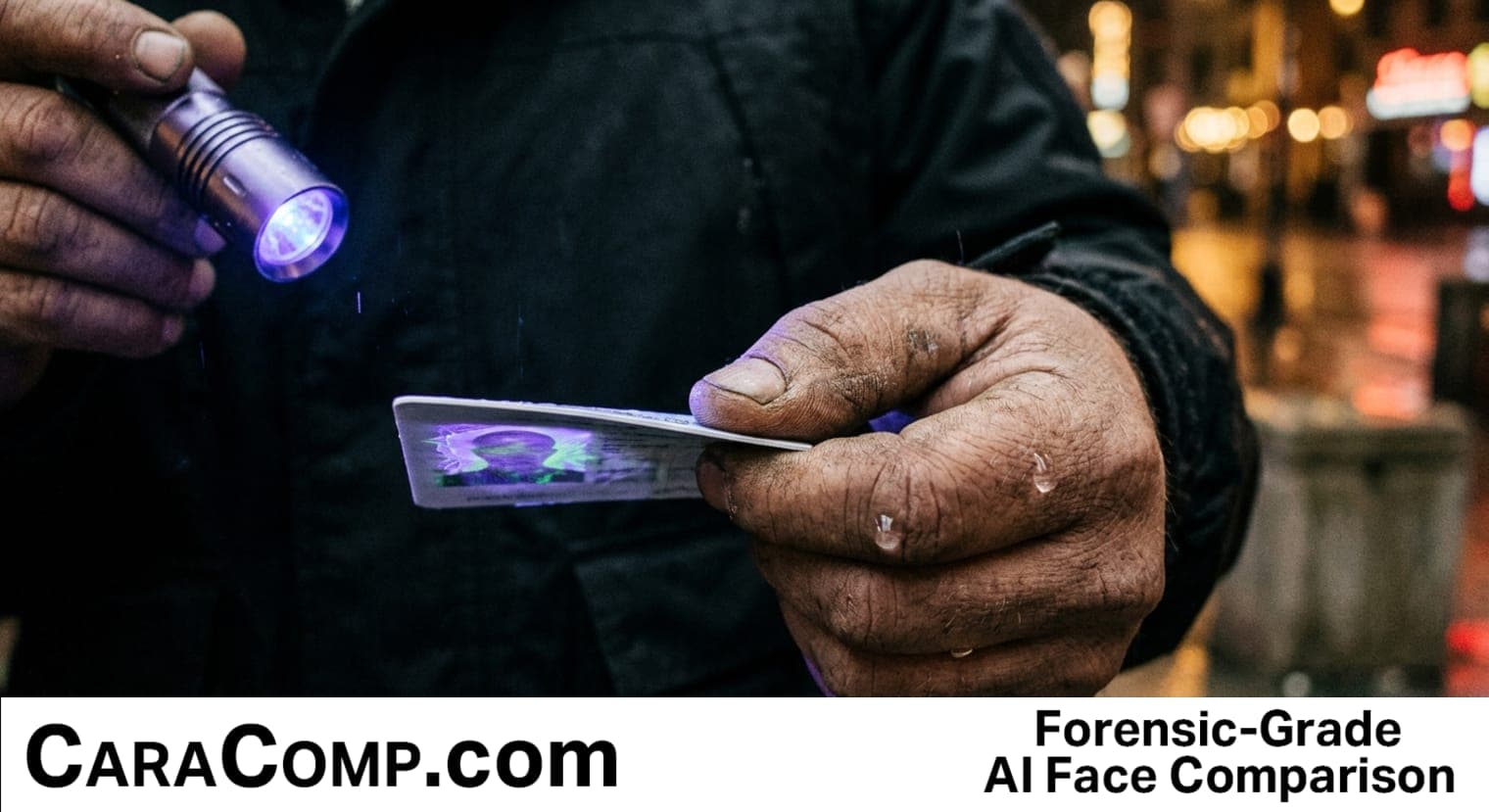
Start with how security people think about a card. They sort its protections into three levels. Level 1 features are the ones your eyes can see with no help: the hologram images, the layout, the photo. Level 2 features need a simple tool, like a magnifying glass or an ultraviolet (UV) light, and they are meant for trained inspectors. Level 3 features need lab equipment and belong to forensic labs.
A bouncer, a clerk or a landlord lives almost entirely at Level 1. That is the problem. Modern counterfeit IDs are built to survive Level 1 and plenty of Level 2. According to a federal patent filing on counterfeit ID production, makers of fake IDs now imitate hologram images, UV features, ghost images (a faint second copy of the photo), microprint (text so tiny it looks like a line), laser perforation, raised printing and barcodes.
How to tell if an ID is fake by feel: the card, its texture and its weight
The oldest check is also the one that still earns its keep: pick the thing up. Genuine IDs, like a U.S. driver's license, are about 30 mil thick (a mil is a thousandth of an inch, so roughly the thickness of a few sheets of paper stacked). Here is what genuine IDs are typically made of: polycarbonate or Teslin, which are both tough plastics. The material itself is a security feature, because its thickness, texture and construction can help distinguish it from a counterfeit.
A forged fake ID often gets this wrong. The card bends too easily, or not enough. The edges feel rough, or the surface has the wrong texture for that state's license. A real card should also have a solid feel that thin knockoff plastic may not match. Think of how a gift card feels next to a credit card. You already know that difference in your fingers.
But notice what this check is and is not. It catches a sloppy fake ID. A careful counterfeiter who sources durable materials close to the real thing can pass it. Feel is a good first filter, never a verdict.
Why a barcode scan is no longer proof of verification
Years ago, the barcode on the back (a PDF-417, a dense pattern of stacked bars) was a useful tripwire. Making one that held the right information was hard. A clerk could scan it and compare what came up with what was printed on the front. A mismatch was a reason to investigate. This article is part of a series, start with Biometric Face Scan Brazil Ties 280m Phones To Verification.
That worked until it didn't. Fake ID makers learned the encoding. Now they openly advertise cards that "pass barcode scanning." A research summary of patent filings puts it this way:
Current-generation fake IDs have barcodes that scan similar to real IDs, and fake ID producers openly advertise products that can "pass barcode scanning."
Research summary of U.S. patent filings, including U.S. Patent Office filing 10217179
A scanner that beeps green means the barcode can be read, not that the card is genuine.
How to Tell If an ID Is Fake When Fake IDs Are Built to Pass Every Check
Let me use one analogy, because it makes the whole arms race click. Think of a counterfeit $100 bill and the pen test, the little marker a store clerk swipes across it. The pen can catch some counterfeit paper, but it cannot authenticate a bill on its own. Authorities add security features; counterfeiters learn to imitate them. A check that catches one fake ID may miss another.
IDs follow the same script. The UV light is a good example. Florida licenses, for instance, carry the letters "FLFL" in fluorescent ink. You cannot see them in normal light, but they glow under UV. Researchers who write about this note that you need the right wavelength, about 365 nanometers, not just any cheap blacklight, because the inks are tuned to it. Fake IDs used to miss this feature. Counterfeiters who get the right inks can imitate it.
The old checks versus what counterfeiters do now
| Old check | What a modern fake does, and what catches it | What it helps catch |
|---|---|---|
| Feel the card for weight and thickness | Better plastics fool the hand; a tactile check still catches cheap fake IDs | A cheap fake ID that spot checks can flag |
| Scan the barcode and compare the data | Fake IDs can carry barcodes with matching data; a database cross-check adds another layer of verification | Altered IDs whose printed details no longer match the data |
| Shine UV light for hidden ink | Counterfeiters copy the ink; an inspector must know each state's pattern | Counterfeit IDs that lack the right ink |
| Compare the photo to the person | Borrowed IDs may be genuine IDs; comparing the photo to the holder can flag a mismatch | Borrowed IDs, including legitimate IDs in the wrong hands |
Look at the last row. Everything above it tests the card or its data. Only the last one tests the person.
When someone uses borrowed IDs that are genuine IDs, the card and its data can pass physical and barcode checks. The mismatch is between the person and the identity on the card.
What Professionals Do Instead of One Quick Check: Layered Document Verification
Banks and other regulated businesses have compliance teams (the people whose job is proving the company followed the rules about knowing its customers). They use more than one human glance. Instead, they run a stack of checks, each one looking for a different kind of lie:
- Image quality. Is the picture of the card clear enough to judge, or blurry, or a photo of a screen?
- Document verification. Do the fonts, spacing, and security features match what that state actually issues?
- Database cross-reference. Does the issuing agency's record agree with the card?
- Biometric and liveness matching. Does the face match the photo, and is it a live person rather than a picture held up?
- Behavior and device risk. Does anything about how this person is applying look off?
Here is the part that makes it click. A stolen but genuine ID can sail through the first three layers. The document is authentic. The government record agrees. A face-matching layer or something odd in the person's behavior may raise a flag. If you have only one layer, you risk missing a fraud type it cannot detect. Previously in this series: How To Tell If An Id Is Fake Check The Face Not The Card.
Where facial comparison fits in identity verification
This is the part CaraComp spends its time on. Matching a live face to the photo on a card can involve measuring facial features, turning them into sets of numbers, and comparing those sets. People do a rough version of this by eye, and comparisons can be especially difficult with strangers. Automated comparisons can also make mistakes. It is one layer, not a magic wand. Its job is to help answer the question the plastic cannot: is the person holding this card the person on it?
Why Do People Believe a Good-Looking Card? How to Tell If an ID Is Fake When Your Brain Is the Weak Spot
Here is the misconception worth correcting: "If the hologram looks right and the UV light passes, the ID is real." It feels airtight. Holograms and special inks really are difficult to copy, so it seems like anyone who copied them would have copied everything. That reasoning is understandable: these features were designed to make counterfeiting harder.
The catch is that counterfeiters can and do copy them now. And there is a human wrinkle on top. We tend to trust anything that looks official, a habit called authority bias (our brain's shortcut that says "official-looking means legit"). A crisp card with a state seal and a confident person holding it can trigger that shortcut. You stop inspecting and start trusting.
The better lesson is a split. The common types of trouble are counterfeit IDs made from scratch, altered IDs where a real card's details were changed, and borrowed IDs carried by the wrong person. Physical checks can help spot fakes and catch a forged fake ID. They do not catch cards that were borrowed. A forged card is a bad document. A borrowed card is one of the legitimate IDs, a good document in the wrong hands, and that is a different problem entirely.
How to tell if an ID is fake when the card is real but the identity is not
You do not need a lab for the first step. Compare the photo against the actual face in front of you, slowly. Check the date of birth against how old the person seems and ask them to say their birthday out loud, because someone who borrowed a card sometimes stumbles on it. Look at the photo's background and quality: is it the plain, flat style this state uses? Whatever you read on the card, ask yourself whether it fits the person, not just whether it looks official.
None of that is proof. A genuine holder might hesitate, and a borrower might answer confidently, so use the answer as one clue rather than a verdict.
Real Harm Behind a Fake ID: What Is at Stake When You Trust the Wrong Card
This is not only about teenagers and bars. In December 2018, according to the U.S. Department of Justice, leaders of the Lev Tahor sect used fake travel documents to take two children from their mother in New York and move them to Mexico. The leaders were later sentenced to 12 and 14 years in prison. In June 2024, the Justice Department reported that two Virginia men who ran websites selling thousands of high-quality counterfeit IDs from China to customers across the country pleaded guilty to trafficking in false identification documents.
Federal agencies take the same view. The Department of Homeland Security's E-Verify guidance on fraudulent documents walks employers through spotting counterfeit papers, and it makes the same point from the other direction: poor materials and equipment limits can cause quality problems, but a good fake ID may not show them.
What You Just Learned
- Three levels of security features exist, and quick checks usually reach only the first.
- Barcode scans stopped being proof once fakes learned to pass them.
- Layered verification helps because each layer looks for a different lie.
- Real card, wrong person is a fraud a face-to-photo match can help catch.
So, back to the question we opened with. If this were happening to you tonight, would you know where to look first? Probably you would look at the card. That is exactly the instinct to retrain. Look at the person, then the card, then ask whether anything else, like a call to the real issuer or a second document, can back up what you just saw. Up next: How To Tell If An Id Is Fake Check The Face Not The Card.
How to tell if an ID is fake is the wrong question on its own, because the sharper one is whether the card belongs to the face holding it; a scanner that beeps green only reads the barcode, so add a face-to-photo match as one more layer of verification.
Recap: One quick look cannot settle whether an ID is fake, because counterfeiters have copied old security features. Stack several checks, and make sure one of them compares the person to the photo.
Here is the punchline worth repeating to your family tomorrow: an ID used to deceive you may not be fake at all. It may be a real one, carried by someone else.
How to Tell If an ID Is Fake: Frequently Asked Questions
What does a real card feel like compared with a fake?
A real license has a firm, even feel and is typically made from durable materials such as polycarbonate or Teslin. Its edges are smooth and clean. A fake ID often feels thin, bends too easily or not enough, or has rough edges. That said, a well-made counterfeit can get close, so treat touch as a quick filter and a reason to look harder, never as final proof that a card is real.
Does the birthday on an ID help me spot fakes?
It can help a little. Check that the date of birth and the expiration date make sense together, and that the age fits the person. You can also ask the person to say their birthday and address aloud. Someone using a borrowed card may hesitate. Still, a good fake ID prints believable dates, so this is a clue to weigh with other checks, not a test that settles anything.
Can a barcode scan prove an ID is real?
No. Years ago, the barcode data was hard to fake, so a mismatch was a strong signal. Today, makers of fake IDs advertise cards that pass barcode scanning. A green scan means the barcode can be read, not that the card is genuine. Verification can add a cross-check against the issuing state's records and a comparison of the face to the photo on the card.
What is identity verification, and why do compliance teams use it?
Identity verification is the process of checking whether a person is who they claim to be. Compliance teams, the groups that make sure a business follows know-your-customer rules, use several layers because no single check catches every kind of fraud. They check the documents, cross-reference official records, compare a live face to the photo, and watch for odd behavior. Each layer covers a gap the others leave open.
What should I check first if I suspect a fake ID?
Check the person before the plastic. Compare the photo to the face, then confirm basics you read on the card, like the date of birth, against what they say. Then feel the card for texture and thickness. Common types of fakes differ here: counterfeit IDs and altered IDs often fail the touch test, while borrowed IDs do not. Do not accuse anyone or try to take the card. If the stakes are real, such as a hire, a rental or a large payment, pause and follow your organization's procedures for ID verification.
Ready for forensic-grade facial comparison?
Full forensic reports with detailed similarity scoring. Results in seconds.
Run My First SearchMore Education
ASC Biometrics Appointment: 1 Missing Paper Can Cost 8 Weeks
A 20 minute visit can turn into a two month delay over one missing paper. Here is what actually happens at the three stations, and the common mistakes that restart the clock.
privacyYouTube AI Age Verification: It Reads Searches, Not Faces
YouTube guesses your age from your habits before it ever asks. Learn what it reads, where the guess breaks, and what parents can check tonight.
biometricsFacial Recognition iPhone: $32.5B Suit Over Faces in Photos
Your phone sorts photos into People albums by turning faces into math. Learn how that works, why a court case says it matters, and the three mistakes most people make about it.