
Deepfake AI: One Public Photo Is All Blackmailers Need
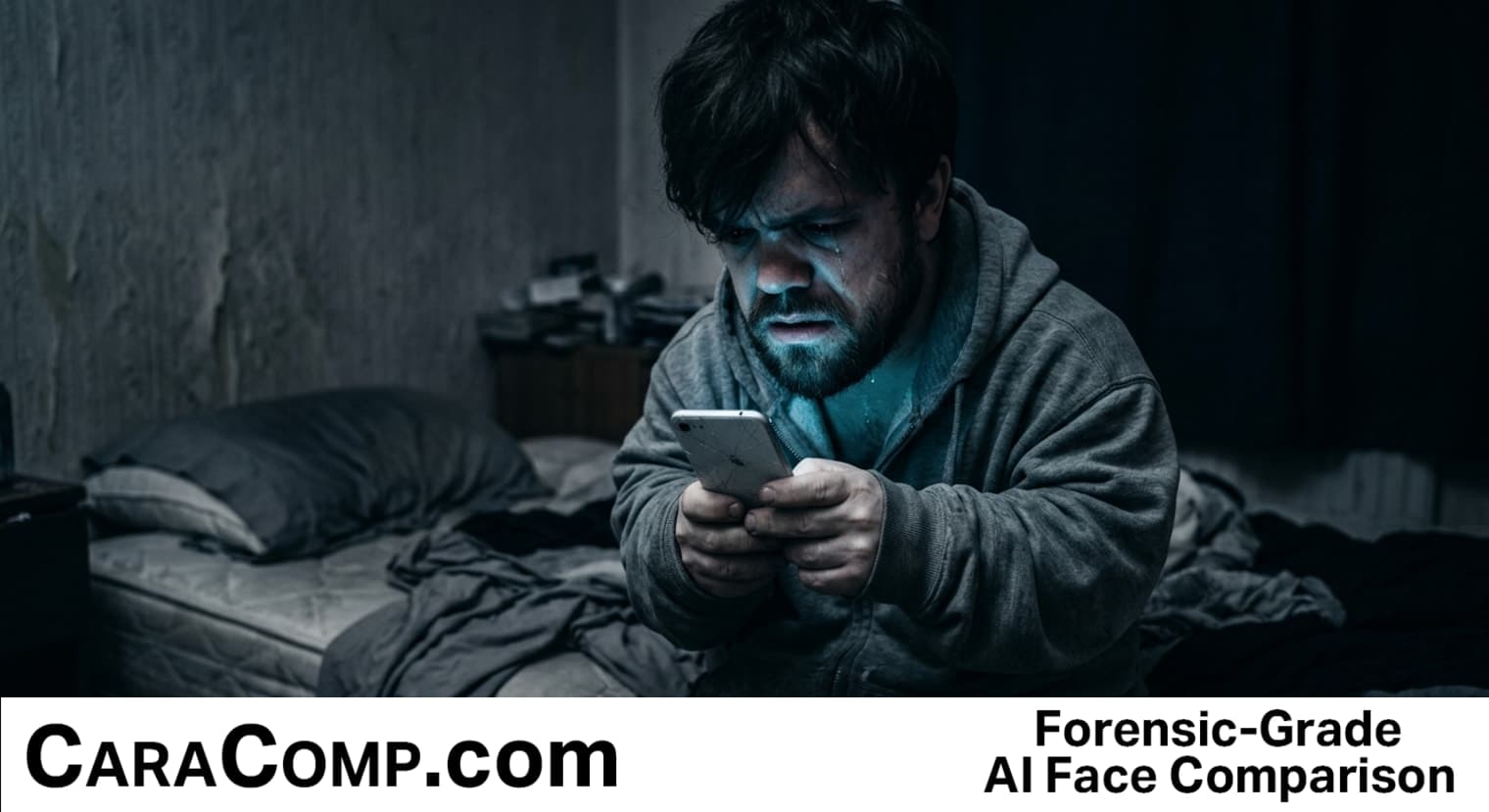
Here's the thing nobody tells you about deepfake ai: looking closer will not save you. Your instinct, when someone sends you a photo and says "is this real," is to zoom in. Squint. Check the eyes. That instinct is not just unhelpful anymore, it is actively wrong, and understanding why is the difference between panicking uselessly and knowing exactly where to click first.
Deepfake ai works by generating pixel patterns your eyes cannot judge, which is why AI detection technology catches what humans miss over 99% of the time while human eyes catch fakes only about 70% of the time.
Deepfake ai builds fake images by learning math patterns, not by faking things visually, which is exactly why your eyes cannot spot a modern one and why knowing the detection process matters more than staring at the picture.
In February 2025, a 16-year-old in Kentucky named Elijah Heacock died by suicide after scammers used an AI-generated nude image of him to demand $3,000. He never sent a real photo. There was no real photo. Someone took an ordinary picture off social media, ran it through an AI tool, and manufactured something that looked convincing enough to threaten a kid's whole life over. In October 2025, a 19-year-old college student in Faridabad, India, died the same way, after blackmailers created morphed explicit images of him and his sisters. These are not edge cases. This is the harm this article exists to help you stop.
How Deepfake AI Actually Builds a Fake Photo From Scratch
So how does a criminal turn your kid's harmless school photo into blackmail material in minutes? The short answer is that modern deepfake ai does not "edit" a photo the way Photoshop does. It generates a brand new image, pixel by pixel, based on patterns it learned from millions of other faces. Criminals pull an ordinary, fully clothed photo from a public social media profile and run it through open-source image-generation tools that were never designed for this, but were never locked down against it either. No hacking. No password theft. No cooperation from the victim required. Just a visible face and a few minutes.
That is the part that should genuinely unsettle you. The attacker does not need your child to have done anything wrong, taken any risky photo, or trusted the wrong person. They need one publicly visible picture and access to a tool. That is the entire barrier to entry. If your child has ever posted a photo online (and whose child hasn't), the raw material for this kind of attack already exists.
What Makes Deepfake Detection So Different From Just Looking Closely
Deepfake detection does not work like your eyeballs. It works like a chemist testing a suspicious powder. AI detection technology, built by engineers who specialize in computer vision, runs the image or video through layered systems: convolutional neural networks (a kind of AI trained to spot patterns across every pixel in a photo, the same basic family of technology behind facial recognition) scan for tiny visual glitches, while recurrent neural networks (AI built specifically to track how things change frame to frame in video) look for moments where motion doesn't add up the way real human motion does. Combined, these systems form what engineers call an ensemble approach, meaning several detection methods vote together instead of relying on just one. This article is part of a series, start with Facial Recognition Software 14 Wrongful Arrests So Far.
Why does that gap exist at all? Because the flaws in a modern deepfake image are not visual anymore, they are mathematical. Early deepfakes, the ones from around 2018, really did have obvious problems: flickery eyes, jaws that moved wrong, lighting that didn't match. People saw those and learned a lesson that no longer applies. Models released more recently are, frankly, unnervingly good. Detection systems don't look for "does this look weird." They check things like whether light hitting the left side of a face is physically consistent with light hitting the right side, whether skin texture repeats in ways real skin never does, or whether tiny blood-flow patterns beneath the skin, invisible to your eye but detectable by an AI trained to look for them, are present at all. A generated face usually can't fake those, because the model was never taught what real blood flow looks like. It was only taught what faces look like.
Deepfake AI Detection: Why Your Eyes Will Fail You Even If You're Careful
Here's a question a lot of parents ask: "if I study the photo carefully, won't I notice something's off?" It's a fair question, and the honest answer is that it depends entirely on when the fake was made. If you're picturing shaky, obviously-fake video from 2018, sure, you might catch mismatched lighting or a stiff blink. But that's not the technology in circulation now.
Think of it like a forensic lab working in a pitch-dark room. A human examiner walking into that room with just their eyes finds nothing, not because there's nothing there, but because the evidence isn't visible light at all. It's fingerprint residue that only glows under ultraviolet, or a chemical trace that only shows up under specific reagents. The lab doesn't get better results by squinting harder. It gets results by switching tools entirely, using instruments built to detect exactly the kind of evidence that's actually present. That's deepfake detection software in a nutshell. It isn't a sharper set of human eyes. It's a completely different sense, built for a completely different kind of evidence.
AI-generated videos may get more realistic, but AI can see and hear things that we cannot.
research summary cited by Pindrop
Deepfake Videos and the Tell Most People Miss
One phrase worth remembering: in a lot of manipulated video and images, skin appears too smooth, almost airbrushed, in a way real human skin under real lighting rarely is. That flatness happens because the generative model averages texture across thousands of training faces, and averaging smooths out the small imperfections real skin always has. It's subtle. It's also exactly the kind of thing detection software is built to flag automatically, frame by frame, without getting tired or distracted the way a human reviewer scrolling through a phone at 11 p.m. absolutely will.
The Fraud Side of Deepfake Technology, Not Just the Sextortion Side
It's worth understanding that deepfake ai splits into two very different attack types, and they target completely different people. Minors are targeted mostly for sextortion and what researchers call "nudification," turning normal photos into fake explicit images to extort money or silence. Adults age 35 to 54 get hit hardest by financial deepfake fraud, roughly 35% of victims in that bracket according to industry tracking. These aren't the same crime wearing different clothes. They're two separate risk profiles requiring two separate kinds of vigilance.
The financial version isn't hypothetical either. In June 2025, a finance employee at the engineering firm Arup was fooled by a deepfake video call. The "executives" on that call, generated fakes impersonating the real CFO and other leadership, convinced the employee to wire $25 million. Not a phishing email. Not a suspicious link. A live video call where the faces and voices were fabricated well enough to authorize a massive transfer. Law enforcement has already caught up with some of this: an Ohio man was sentenced to 15 years in prison in September 2026 for cyberstalking and using AI-generated sexual imagery to extort multiple victims, and a man in Harlow, UK, got four years in May 2026 for using an AI app to create indecent images of children. Previously in this series: How Does Facial Recognition Work 512 Numbers Wrong Arrests.
| Old-style manipulated photo (pre-2020) | Modern deepfake ai content |
|---|---|
| Visible blending errors, mismatched skin tones | Skin appears too smooth, blends naturally under casual viewing |
| Flickering or unnatural blinking in video | Consistent motion, detectable only through frame-by-frame AI technology analysis |
| Caught by a careful human roughly most of the time | Caught reliably only by deepfake detection software, over 99% accuracy |
| Required real editing skill and hours of work | Requires one public photo and minutes with a generative tool |
What To Actually Do If Deepfake AI Content Targets Your Family Tonight
If someone sends you a threatening message with a fake image attached right now, the single most important move is this: do not pay, do not negotiate, and do not delete the evidence. Screenshot everything, including usernames and account details, then report it immediately to the platform where it appeared and to the FBI's Internet Crime Complaint Center (IC3), which handles exactly this kind of case. If a minor is involved, the National Center for Missing and Exploited Children's CyberTipline exists specifically for this. Over the past two years, that CyberTipline received more than 7,000 reports tied to AI-generated child exploitation content, so reporting isn't a shot in the dark, it feeds a system that is actively tracking these cases.
What You Just Learned About Deepfake AI
- 🧠 One photo is enoughcriminals need only a public image and a generative tool, not any cooperation from the victim.
- 🔬 The flaws are mathematical, not visualmodern fakes don't have visible glitches, so studying the photo harder won't help.
- 💡 Detection beats inspectionAI detection technology catches over 99% of fakes; human eyes catch roughly 70%.
- 📞 Reporting fast matters more than proving it yourselfthe FBI's IC3 and NCMEC's CyberTipline exist for exactly this.
CaraComp's own research into facial recognition and identity verification runs on the same underlying idea as deepfake detection: machines measuring things about a face that human eyes were never built to measure. That overlap matters, because the same math that lets a system confirm you are you at a border checkpoint is the math that can confirm a photo of your child is not real. It's the same toolbox, pointed in a protective direction instead of a verifying one.
Deepfake AI Detection Software Developers Are Racing To Keep Up
Developers building detection technology face a moving target. Cybersecurity trackers reported roughly a 4x increase in deepfakes detected worldwide between 2023 and 2024, and face-swap attacks alone rose around 300% between 2023 and 2025. Every time a new generative model ships, detection engineers have to retrain their systems against it, which creates a real lag, a window where new fakes outrun the tools built to catch them.
The Misconception That Gets People Hurt: "I'd Know If It Was Fake"
Here's the misconception worth killing tonight: the belief that a careful, smart adult can eyeball a photo or video and tell if it's manufactured. It's an understandable belief. The deepfakes that made news for years were the bad ones, the ones with obvious blinking glitches and warped jawlines, because those made for a good "look how weird this is" news clip. That gave everyone a mental picture of what fake looks like, and that mental picture is now years out of date. Nobody's fault. Nobody teaches an updated version of "here's what a good fake looks like now," because by definition, a good fake doesn't look like anything unusual at all.
The reality is that the flaws didn't disappear, they moved somewhere your eyes can't reach. They're sitting in pixel-level statistics, temporal patterns across video frames, and blood-flow signals under skin, all things a piece of trained AI technology can measure and a human glance simply cannot. This is not a failure of attention or intelligence. It's a mismatch between the tool (your eyes) and the evidence (math).
Deepfake ai content is built from math your eyes cannot audit, so the moment you catch yourself thinking "let me look closer," stop, and instead get the evidence to a reporting channel built with actual detection technology behind it, whether that's the platform, the FBI, or NCMEC.
So here's the actual aha moment, the one worth remembering longer than any statistic in this article: the instinct to protect your family by looking harder at the screen is exactly backwards. Looking harder was the right move in 2018. Tonight, the right move is looking away from the image entirely and toward the report button, because by the time a human eye is scrutinizing that photo trying to decide if it's real, the only thing left to control is how fast you report it, not whether you can spot it. If this were happening to your kid right now, that's the one thing worth knowing before anything else: the fake isn't the thing to study. The clock is. Up next: How Does Facial Recognition Work 512 Numbers Wrong Arrests.
Deepfake AI: Frequently Asked Questions
Can artificial intelligence detect deepfake ai content better than a person can?
Yes. Research summarized by Pindrop found human viewers catch deepfakes about 70% of the time, while dedicated AI detection systems catch them more than 99% of the time. This is because the artificial intelligence behind detection tools checks pixel-level and motion-based patterns that are invisible to human eyes, not visual "tells" people can train themselves to spot.
How do fake images end up looking so realistic in the first place?
Deepfake images are generated by AI models trained on huge datasets of real faces, learning statistical patterns rather than copying a specific photo. This is why fake images can look convincing to a human eye while still containing measurable inconsistencies, like unnatural texture or lighting math, that fraud detection software is specifically built to catch.
What should I do first if I think my child is a victim of a deepfake image scam?
Do not pay, negotiate, or delete anything. Screenshot the messages and account details, report the content to the platform, and contact the FBI's Internet Crime Complaint Center and, if a minor is involved, the National Center for Missing and Exploited Children's CyberTipline. Reporting quickly matters more than trying to personally verify whether the image is real.
Why is creating deepfake content so much easier now than it used to be?
Creating deepfake content used to require real editing skill and hours of manual work. Now it can be done with a single public photo and an accessible generative AI tool in minutes, with no cooperation from the victim needed. That drop in effort is a major reason reported cases have risen so sharply in the last two years.
Is deepfake detection software something regular people can use, or only companies?
Most deepfake detection technology today is built into platform-level fraud detection systems, law enforcement tools, and enterprise security software rather than sold directly to individuals as a simple app. If you suspect fake content, the most reliable path for a regular person is reporting it to the platform, the FBI, or NCMEC rather than trying to run your own detection.
Do deepfake videos always have some kind of visible glitch if you look closely enough?
No, not anymore. Older deepfake videos from around 2018 often had visible glitches like unnatural blinking or mismatched lighting. Models released more recently are far more convincing, and the remaining flaws are usually mathematical rather than visual, meaning they show up in frame-by-frame data analysis, not in anything a human can see by looking closer.
Ready for forensic-grade facial comparison?
Full forensic reports with detailed similarity scoring. Results in seconds.
Run My First SearchMore Education
How Does Facial Recognition Work: 512 Numbers, Wrong Arrests
Your face gets turned into a string of 512 numbers the moment a camera catches it. Here's what those numbers actually do, why they can vary from one image to another, and how a stranger's numbers can end up matching yours.
biometricsBiometric Lock: How a 12-Year-Old's Finger Opened a Gun Safe
The gun safe said "locked." It wasn't. Here's the hidden setting that let a 12-year-old open a biometric lock with his own fingerprint, and how to check yours tonight.
facial-recognitionFacial Recognition Glasses: 1 Glance Pulls a Home Address
Two Harvard students turned ordinary-looking smart glasses into a stranger-identifying machine. Here's exactly how the tech chains together, why the "recording light" won't save you, and what to actually check tonight.