
Catfish Meaning: Online Identity Deception and How to Spot Fake Profiles
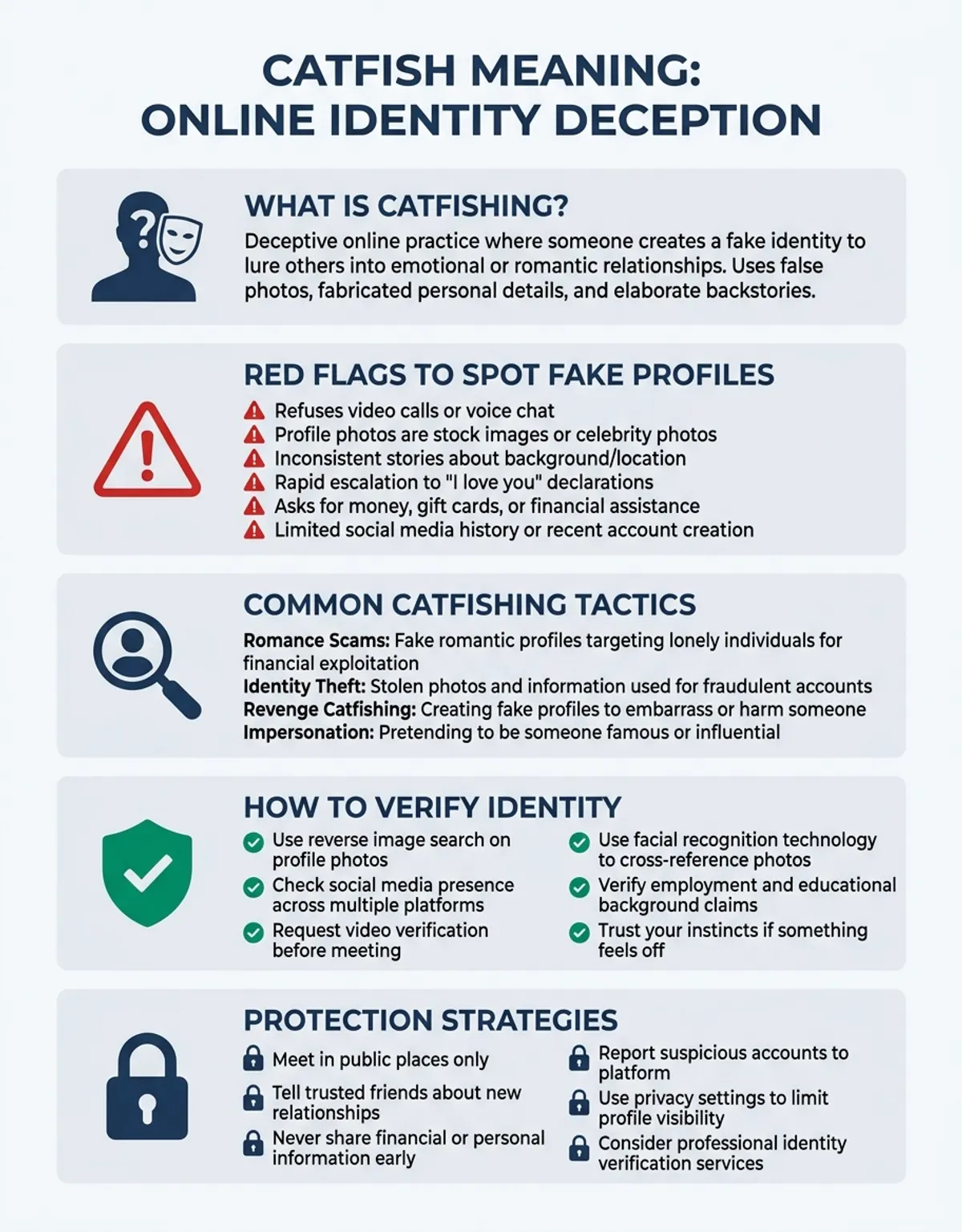
The term "catfish" has evolved from a simple fish species to a widely recognized phenomenon in online dating and social media. Catfish meaning refers to someone who creates a fake online identity to deceive others, often for romantic relationships, financial gain, or emotional manipulation. This deceptive practice has become increasingly sophisticated with photo manipulation tools and AI-generated images, making identity verification more crucial than ever. Modern face comparison technology and facial recognition tools offer powerful solutions for detecting fake profiles and protecting yourself from catfish scams. Understanding what catfishing means and how to identify these deceptive practices can save you from emotional distress, financial loss, and identity theft. Here's the thing - these scams have gotten scary sophisticated in recent years. Digital identity verification has become essential, since you can't take profile authenticity at face value anymore.
What Does Catfish Mean in Online Dating and Social Media?
The catfish definition originated from a 2010 documentary titled "Catfish," which exposed an elaborate online deception. The term draws from an old fisherman's tale about keeping catfish with cod to keep them active during transport. In modern context, catfishing refers to creating fake online identities using stolen photos, fabricated personal information, and fictitious life stories to establish relationships under false pretenses.
Catfish scams have proliferated across dating apps, social media platforms, and professional networking sites. According to recent studies, approximately 53% of online dating users admit to lying on their profiles (Source: https://www.huffpost.com/entry/online-dating-lies_b_1930053), though full-scale catfishing represents a more severe form of deception. These fake online identities often use photos stolen from models, influencers, or unsuspecting individuals whose images appear in public searches.
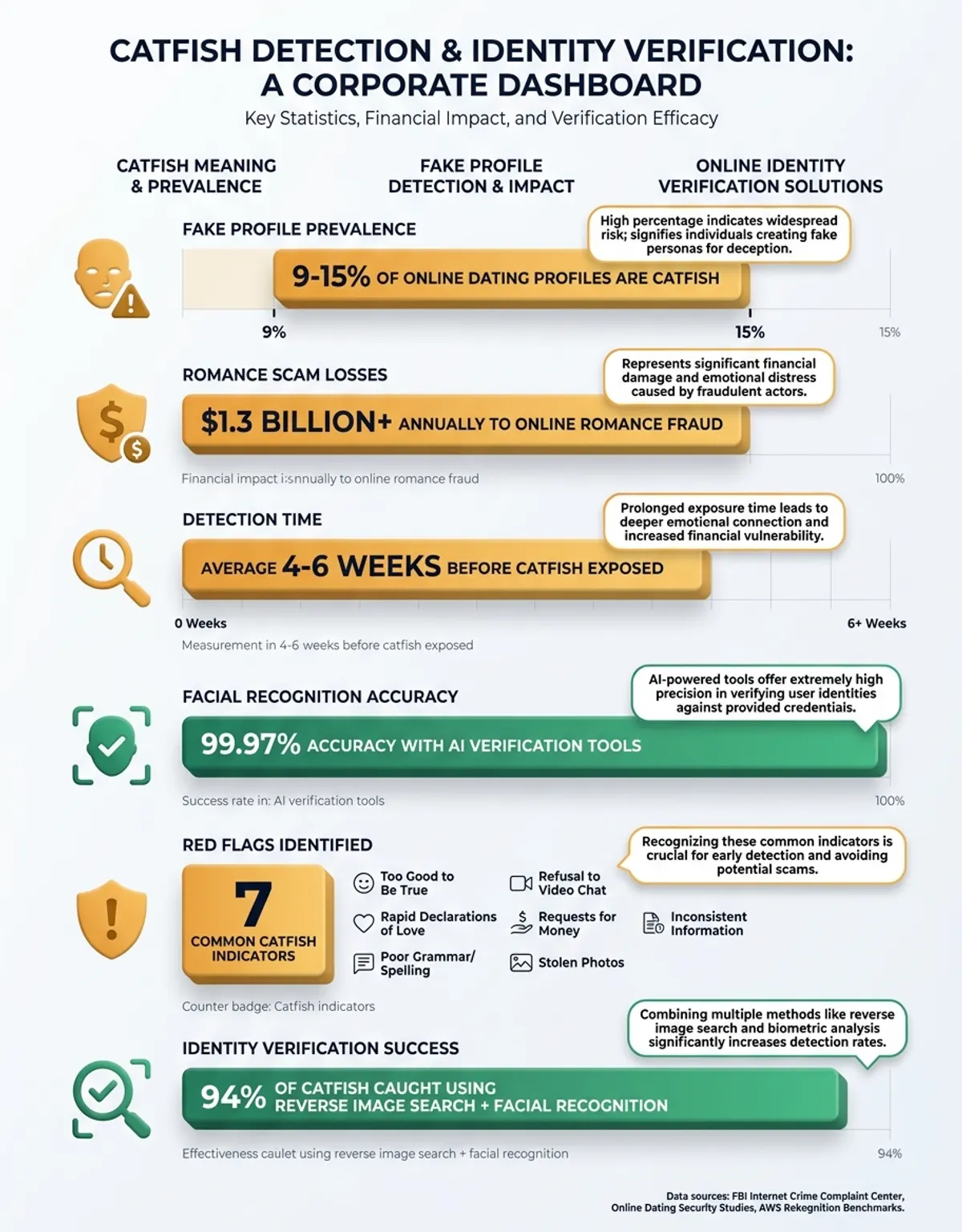
Catfish scam operations cost victims over $304 million in 2020 alone, according to the Federal Trade Commission. (Source: https://www.ftc.gov/news-events/news/press-releases/2021/02/new-ftc-data-show-massive-increase-romance-scams-304m-losses) Romance scams involving fake profiles represent a significant portion of this fraud. The psychological impact extends beyond financial loss, as victims often experience emotional trauma, betrayal, and difficulty trusting future relationships. Catfishing encompasses various motivations: some catfish seek emotional connections they cannot achieve with their real identity, while others deliberately target victims for financial exploitation or identity theft.
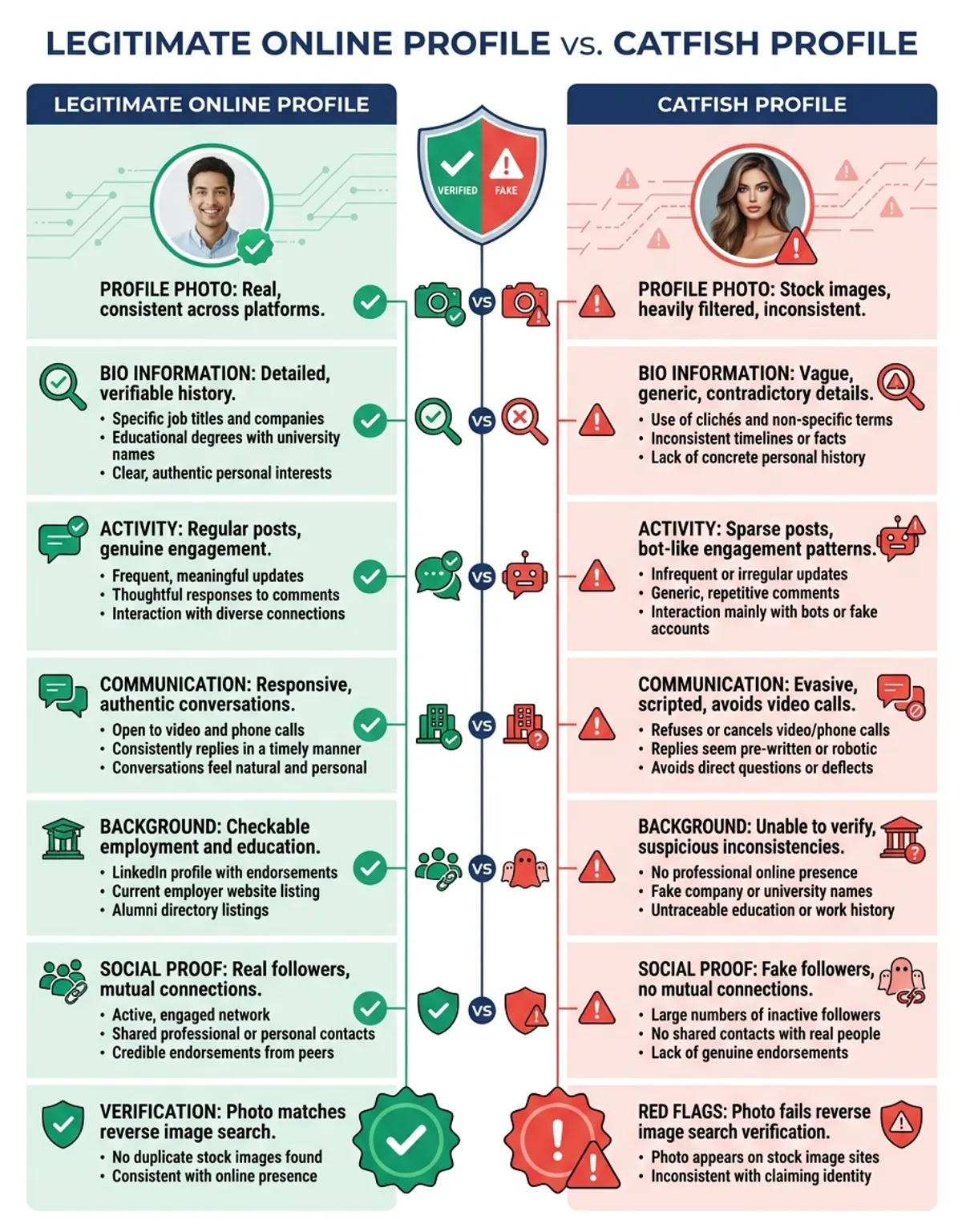
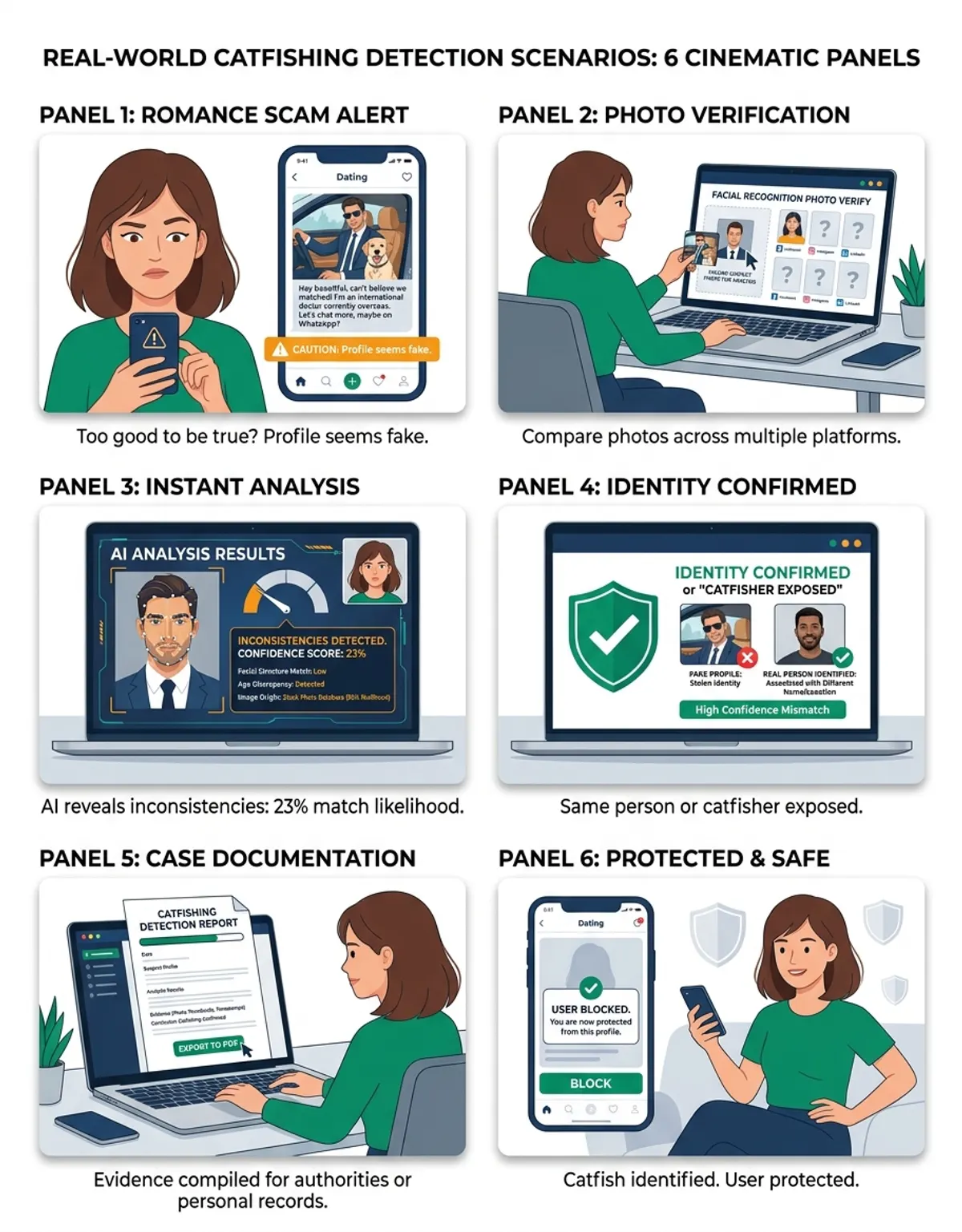
The rise of social media deception has made profile verification essential. A catfish profile typically exhibits consistent patterns: limited photo variety, reluctance to engage in video calls, vague personal details, and stories that don't align with their supposed lifestyle. Face verification technology has emerged as a critical defense against these deceptive practices, allowing users to confirm whether profile photos match the person they're communicating with.
Common Signs of a Catfish Profile
Identifying fake profiles requires vigilance and understanding of common catfish tactics. The most obvious red flag is refusing video calls despite weeks or months of communication. Legitimate individuals comfortable with their identity will typically agree to video verification, while catfish manufacture elaborate excuses to avoid real-time face-to-face interaction.
Photo manipulation is a hallmark of catfish profiles. These scammers often use limited photo sets, usually 3-5 images that appear professionally shot or heavily filtered. These fake photos frequently show only one person across all images, lack casual or spontaneous moments, and may appear dated or low-resolution. Reverse image search tools can often trace these stolen images to their original sources, revealing the deception.
Inconsistent personal information signals potential catfishing. Stories about their background, career, or daily activities may contradict previous statements. Catfish profiles often claim high-status professions like military service overseas, medical work in remote areas, or business travel that conveniently explains why they cannot meet in person. These occupations also create plausible excuses for financial requests.
The too-good-to-be-true persona represents another warning sign. They frequently present themselves as exceptionally attractive, successful, and interested in you specifically. They may share deep feelings unusually quickly, creating intense emotional bonds before establishing real-world connections. This rapid emotional escalation serves to cloud judgment and make victims less likely to question inconsistencies.
Digital identity verification becomes crucial when encountering these warning signs. Modern face matching tools allow you to compare profile photos with real-time images or video calls. Social media analysis across multiple platforms can reveal whether the person maintains consistent identity information. Background check services provide additional verification layers, though these typically require paid subscriptions.
How Facial Recognition Technology Helps Detect Catfish
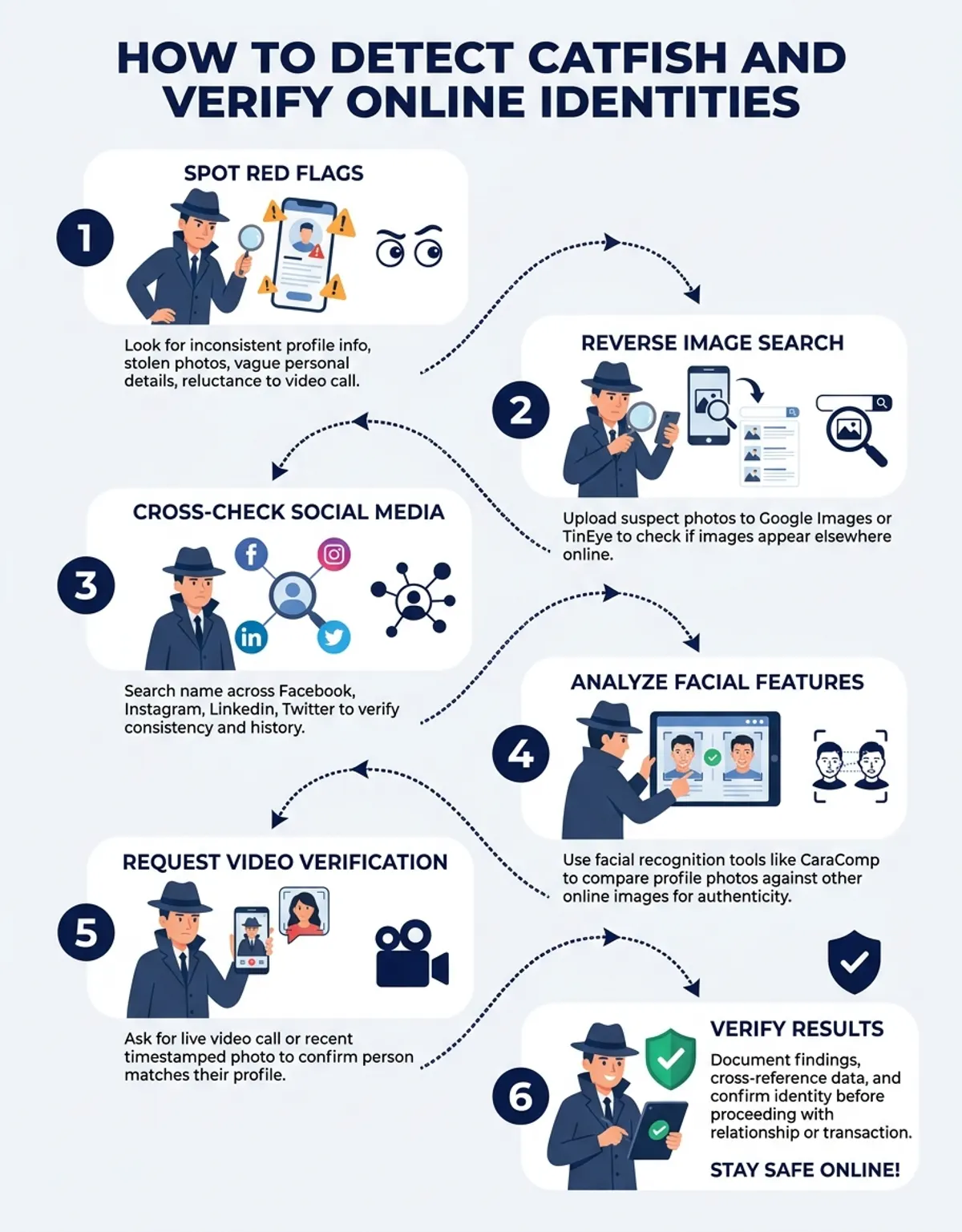
Facial recognition and face comparison tools have revolutionized catfish detection. These technologies analyze facial features, proportions, and unique identifiers to verify whether photos show the same person. Advanced algorithms can detect photo manipulation, AI-generated faces, and inconsistencies that human observers might miss.
Reverse image search remains the first line of defense against fake profiles. Services like Google Images, TinEye, and specialized facial recognition platforms allow you to upload suspected catfish photos and search for their original sources. When photos appear across multiple unrelated profiles or link to modeling portfolios, professional photography sites, or social media accounts belonging to someone else, catfishing is confirmed.
Face verification tools like CaraComp offer sophisticated comparison capabilities. These platforms use biometric analysis to compare facial structures across different images, accounting for angles, lighting, and age variations. Unlike simple reverse image searches, face comparison technology can identify the same person even when photos are cropped, filtered, or slightly modified—techniques scammers commonly employ to evade detection.
AI-generated photos present new challenges in catfish detection. Advanced face synthesis technology can create realistic-yet-fake faces that won't appear in reverse image searches. However, facial recognition algorithms trained to detect artificial images can identify subtle artifacts, impossible lighting conditions, or anatomical inconsistencies that betray AI generation. Features like iris reflections, skin texture patterns, and facial asymmetry help distinguish real photos from synthesized ones. For a comprehensive overview of verifying online identities, explore our reverse image search guide.
Real-time verification through video calls remains the gold standard for confirming identity. Modern face matching platforms can compare live video feeds with profile photos, providing instant verification. This eliminates the possibility of pre-recorded videos or photo substitution. Verification tools that require specific movements or expressions during video calls further ensure the person matches their claimed identity. Learn more about facial recognition search technology for verifying identities online.
The Psychology Behind Catfishing Behavior
Understanding catfish motivations reveals complex psychological factors driving online deception. Loneliness and low self-esteem frequently motivate catfishing behavior. Individuals who feel inadequate or socially isolated may create idealized online personas to experience connections they believe impossible with their real identity. These catfish often genuinely care about their victims but feel trapped in deception they initiated.
Financial exploitation represents another major catfishing motivation. These catfish deliberately target vulnerable individuals for romance scams, gradually building trust before requesting money for fabricated emergencies, business opportunities, or travel expenses to meet in person. Financial catfish often operate as organized groups, using scripts and psychological manipulation techniques refined across hundreds of victims.
Revenge catfishing involves creating a catfish profile to humiliate, harass, or manipulate specific targets. Jilted ex-partners, workplace rivals, or online bullies may catfish to damage reputations, extract embarrassing information, or emotionally torment their victims. This malicious form of catfishing often violates harassment laws and can constitute cyberbullying or stalking.
The impact on catfish victims extends well beyond the immediate deception. Emotional trauma, trust issues, financial loss, and social embarrassment commonly affect those who discover they've been catfished. Many victims report symptoms consistent with betrayal trauma, including anxiety, depression, and difficulty forming subsequent relationships. The violation of trust can be particularly devastating when catfish relationships lasted months or years.
Legal consequences for catfishing vary by jurisdiction and circumstances. While creating a fake profile isn't inherently illegal in many places, catfishing often involves criminal activities: identity theft when using stolen photos or personal information, fraud when obtaining money under false pretenses, or harassment when causing emotional distress. Several U.S. states have enacted specific anti-catfishing legislation, and victims can pursue civil remedies for damages suffered.
Protecting Yourself from Catfish Scams
Proactive verification strategies provide the best defense against catfish deception. Before investing emotional energy in online relationships, conduct thorough identity verification. Use face comparison tools to ensure profile photos show the same person across different images. Request video calls early in the relationship—legitimate users will understand this reasonable precaution given the prevalence of online fraud. You may also find our guide on biometric data protection helpful for understanding identity security.
Reverse image searches should become standard practice when meeting people online. Upload profile photos to Google Images, TinEye, or specialized facial recognition platforms. Examine the results for the same images appearing on other profiles, modeling sites, or social media accounts belonging to different individuals. This simple verification step takes minutes but can prevent months of deception.
Video call verification eliminates most catfish immediately. Insist on live video conversations before developing serious feelings or sharing personal information. During video calls, observe whether the person matches their photos, noting facial features, voice, mannerisms, and background details. Be suspicious if they avoid showing their full face, claim camera problems repeatedly, or make excuses to keep conversations audio-only.
Background check services offer additional verification layers for serious relationships. These platforms can confirm identity documents, employment claims, criminal records, and address history. While paid services require investment, they provide peace of mind when considering meeting someone in person or entering a committed relationship. Free alternatives include searching public records, professional licensing databases, and social media cross-referencing.
Trust your instincts when something feels inconsistent. Catfish often create elaborate stories that seem plausible individually but don't align holistically. If financial requests emerge, particularly early in relationships or during claimed emergencies, recognize these as major red flags. Legitimate romantic interests don't ask for money, gift cards, or cryptocurrency from people they haven't met. Online safety requires balancing openness to connections with healthy skepticism about identity claims.
Real Catfish Cases and Examples
High-profile catfishing cases demonstrate how sophisticated these deceptions can become. The Manti Te'o case shocked the sports world in 2013 when Notre Dame linebacker was revealed to have been in a fabricated online relationship with a nonexistent girlfriend. The catfish maintained the deception for years, even faking the girlfriend's death, before journalists exposed the hoax. This case highlighted how even celebrities with extensive support networks can fall victim to elaborate catfish schemes.
MTV's "Catfish" television series has documented hundreds of catfishing cases since 2012, revealing common patterns and diverse motivations. Episodes show victims who maintained online relationships for years without video verification, sent thousands of dollars to catfish claiming financial emergencies, and traveled across the country to meet people using completely fake identities. The show's investigations typically use reverse image searches and social media analysis to unmask catfish.
Financial catfish scams represent the most damaging category - and the numbers are sobering. In 2019, a Japanese woman was scammed out of $200,000 by a catfish pretending to be a U.S. Army captain stationed in Syria. The catfish used stolen military photos, fabricated deployment stories, and claimed financial difficulties to extract money over two years. In 2021 alone, romance scams cost Americans approximately $1 billion, with average individual losses around $39,000 according to the FBI Internet Crime Complaint Center. (Source: https://www.fbi.gov/contact-us/field-offices/houston/news/press-releases/1-billion-in-losses-reported-by-victims-of-romance-scams)
International catfishing rings operate as organized businesses, particularly in West Africa and Southeast Asia. These groups train members in psychological manipulation, maintain databases of stolen photos, and share successful scripts for extracting money from victims. They often target lonely, recently divorced, or elderly individuals through dating sites, widow support groups, and religious communities. Law enforcement efforts have dismantled several large-scale operations, but new groups continuously emerge.
Comparison Table: Catfish Detection Methods
| Detection Method | Effectiveness | Cost | Ease of Use |
|---|---|---|---|
| Face Comparison Tools (CaraComp) | High - Verifies facial features match across photos | Free to Paid | Easy - Upload and compare instantly |
| Reverse Image Search | Medium - Finds stolen photos but misses manipulated images | Free | Easy - Paste URL or upload image |
| Video Call Verification | High - Confirms real-time identity match | Free | Easy - Requires cooperation from both parties |
| Background Check Services | High - Validates identity, employment, criminal records | Paid ($20-100) | Medium - Requires personal information |
| Social Media Cross-Reference | Medium - Checks profile consistency across platforms | Free | Medium - Time-intensive manual research |
| AI Detection Tools | Medium-High - Identifies synthetic/AI-generated faces | Free to Paid | Easy - Upload and analyze |
| Phone Number Verification | Medium - Confirms location and carrier information | Free to Paid | Easy - Lookup services available online |
Frequently Asked Questions About Catfish
What does catfish mean in online dating?
In online dating, catfish refers to someone who creates a fake profile using stolen photos and false information to deceive others. The catfish meaning encompasses romantic deception, where individuals present themselves as completely different people to form relationships under false pretenses. This can involve using photos of more attractive people, fabricating careers, locations, or life circumstances, and maintaining elaborate lies throughout extended communications. Catfishing in dating contexts often leads to romance scams, emotional manipulation, or financial exploitation. The practice has become so prevalent that verification tools and video calling are now standard precautions when meeting people through dating apps or social media platforms.
How can I tell if someone is catfishing me?
The warning signs are pretty clear once you know what to look for: refusing video calls despite months of communication, using limited or professionally-shot photos, inconsistent personal information, rapid emotional attachment, and requests for money. Use reverse image search to check if their photos appear elsewhere online under different names. Employ face comparison tools to verify the same person appears in all their photos. Request spontaneous selfies with specific gestures or holding written notes—catfish struggle to provide these since they don't have access to the real person in the photos. Check whether they maintain consistent profiles across multiple social media platforms with genuine friend interactions and historical posts. Trust your instincts when stories seem too perfect or explanations for avoiding in-person meetings grow increasingly elaborate.
Can facial recognition technology detect catfish profiles?
Yes, facial recognition technology is highly effective at detecting catfish profiles through several methods. The accuracy has improved dramatically over the last few years. Face comparison tools like CaraComp analyze facial biometrics to verify whether multiple photos show the same person, detecting inconsistencies catfish create by using photos from different individuals. Reverse image search platforms use facial recognition to find where photos originally appeared online, often revealing stolen images from models, actors, or unsuspecting victims. Advanced AI detection algorithms can identify synthetic faces generated by artificial intelligence that catfish increasingly use to avoid reverse image searches. Real-time video verification uses facial recognition to compare live video feeds with profile photos, ensuring the person you're communicating with matches their claimed identity. These technologies have made catfishing significantly more difficult, though sophisticated catfish continue developing countermeasures.
What should I do if I suspect I'm being catfished?
If you suspect catfishing, immediately stop sharing personal information, financial details, or intimate content. Conduct reverse image searches on all their photos to check for stolen images. Use face comparison tools to verify facial consistency across their photos. Request an immediate video call—genuine people will understand this reasonable precaution. Search their name, phone number, and email address to verify information consistency. Check social media profiles for signs of authentic digital footprints: friend interactions, tagged photos from others, and historical posts. If they've requested money, report the profile to the platform and consider filing a fraud report with the FBI's Internet Crime Complaint Center. Document all communications in case legal action becomes necessary. Seek support from friends or counselors if you've developed emotional attachment, as discovering you've been catfished can cause significant psychological distress.
Is catfishing illegal?
Catfishing legality varies by jurisdiction and specific circumstances. Simply creating a fake profile isn't illegal in most places, though it violates the terms of service of virtually all social media and dating platforms. However, catfishing becomes illegal when it involves criminal activities: identity theft (using someone else's photos or personal information without permission), fraud (obtaining money or property through deception), harassment or stalking (causing emotional distress or fear), computer fraud (accessing accounts without authorization), or impersonation of military or law enforcement personnel. Oklahoma has enacted specific anti-catfishing legislation (the Catfishing Liability Act of 2016), while states like California and Texas address catfishing through broader online impersonation and computer crime laws. (Source: https://wjlta.com/2021/02/05/catfish-bait-too-few-state-laws-protect-the-faces-of-catfishers/) Victims can pursue civil lawsuits for damages including emotional distress, financial losses, and defamation. While enforcement challenges exist due to anonymity and international boundaries, successful prosecutions occur regularly for cases involving financial fraud or identity theft.
How common is catfishing?
Catfishing has become alarmingly common in online spaces. Studies indicate approximately 53% of dating app users admit to some form of profile deception (Source: https://www.huffpost.com/entry/online-dating-lies_b_1930053), though full-scale catfishing represents a smaller percentage. The FBI's Internet Crime Complaint Center received over 24,000 romance scam complaints in 2021 alone, with losses exceeding $956 million (Source: https://www.ic3.gov/AnnualReport/Reports/2021_ic3report.pdf)—many involving catfish relationships. Survey research suggests roughly 1 in 4 people using online dating have encountered suspected catfish profiles. (Source: https://catfishfinder.org/catfishing-statistics/) The MTV "Catfish" series has documented hundreds of cases, revealing how widespread the practice has become across all demographics. Younger users (18-29) report the highest catfishing encounter rates, though financial exploitation primarily targets older adults. The problem has intensified with social media proliferation and sophisticated photo manipulation tools making fake profiles increasingly convincing. As online interactions become primary relationship-building methods, catfishing incidents continue rising, making identity verification essential for digital safety.
What's the best way to verify someone's identity online?
The most reliable identity verification combines multiple methods. First, use face comparison technology to ensure consistency across all their photos—tools like CaraComp can detect if different people appear in profile images. Second, conduct reverse image searches on every photo they've shared to verify originality. Third, insist on spontaneous video calls where you can see their full face and request specific gestures or actions proving it's live rather than pre-recorded. Fourth, cross-reference their information across multiple platforms—genuine people maintain consistent identities on Facebook, LinkedIn, Instagram, and other networks with authentic friend interactions and historical content. Fifth, search their phone number and email through verification services to confirm location and registration details. Sixth, request connection with mutual friends or colleagues who can vouch for their identity. For serious relationships, consider professional background check services verifying employment, education, address history, and criminal records. Never send money or sensitive information before confirming someone's identity through multiple independent verification methods.
The Future of Catfish Prevention and Online Identity Verification
The evolution of catfish tactics demands increasingly sophisticated verification solutions. As AI-generated photos become more realistic and photo manipulation tools grow more accessible, traditional reverse image searches may become less effective. However, facial recognition technology continues advancing with algorithms that detect artificial faces, deepfakes, and subtle photo manipulations invisible to human observers.
Blockchain-based identity verification systems represent emerging solutions for online safety. These platforms create immutable digital identities tied to verified real-world documents, making fake profiles significantly harder to maintain. Some dating apps have begun implementing mandatory verification processes using facial recognition and government ID validation, reducing catfish prevalence on their platforms.
The role of face comparison tools like CaraComp will expand as online interactions increasingly replace in-person meetings. Real-time biometric verification may become standard practice for dating apps, professional networking, and even social media platforms. As technology makes catfishing more difficult, platforms that prioritize identity verification will attract users seeking authentic connections.
Education remains crucial for catfish prevention. Understanding the psychology, tactics, and warning signs of catfishing empowers users to protect themselves. The combination of technological verification tools and informed skepticism creates the strongest defense against online deception. By leveraging facial recognition technology, maintaining healthy verification habits, and trusting instincts when something seems inconsistent, you can safely navigate online relationships while protecting yourself from catfish scams and identity fraud.