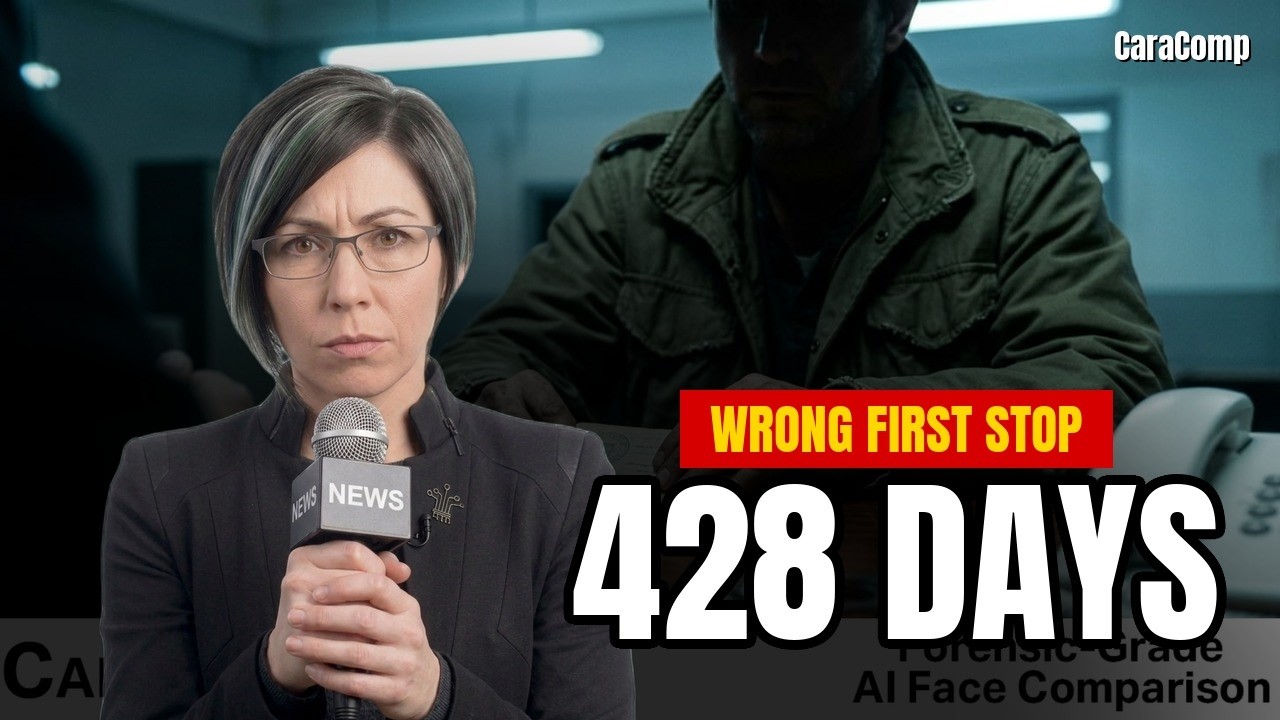
The thief's fake papers beat William Woods's real ones.

In 2019, William Woods walked into a Los Angeles bank. A stranger was running up debt in his name. He came to report identity theft, real I.D. in hand. He missed the security questions, so the manager called the police. The real thief called them too, and faxed in fake papers.
The thief's fake papers beat William Woods's real ones.
According to the National Registry of Exonerations, Woods spent 428 days in county jail. Plus 147 more in a mental hospital. If someone steals your name, don't start at a counter. Call the fraud number on the back of your card. For investigators, police files repeat whatever they hear first.
Who hears you first can decide if you're the victim or the <phoneme alphabet="ipa" ph="ˈsʌspɛkt">suspect</phoneme>.
Real papers didn't save Woods. Next, a father's own face didn't either.
Robert Dillon is a Florida dad with a full beard. Police wanted a clean-shaven man who tried to lure a child. The Jacksonville Sheriff's Office ran a grainy video frame through facial recognition. The software named Dillon a possible match. One worker then picked him from a photo lineup.
Police arrested Robert Dillon for a crime 300 miles away.
According to Komando.com, at least fifteen Americans have been wrongly arrested this way. More than two thousand U.S. police agencies can <phoneme alphabet="ipa" ph="juːz">use</phoneme> these tools. No federal law sets how accurate they must be. It could be any of us. For investigators, a match is a tip, not proof.
A match score says two faces look alike. It can't say where you were.
Police trusted a computer's guess. Apps trust something weaker. A kid's word.
Picture a 13-year-old girl signing up for TikTok. She types a birthday that makes her 16. Nobody checks. The app waves her in. That's how TikTok age verification has mostly worked. Alabama went after exactly that.
A typed birthday isn't proof of a child's age.
According to CNBC, Alabama is the first state to settle with TikTok over teen safety. One study set up test accounts. Those set to age 13 saw harmful videos nearly twice as often as those set to 18. So that one typed number shapes what your child sees. For investigators, a claim isn't proof until it's checked.
A birthday box isn't a guard. It believes whatever you type.
Three stories, one pattern. In Los Angeles, fake papers beat real ones. In Florida, a computer's guess beat a beard. On TikTok, a typed birthday gets waved through. Each time, a claim got treated as proof. The fix is simple. Check first. Decide second.
All three articles, every source and today's CaraComp podcast deep-dives are in the description. Share the card-number tip with someone you love. Back tomorrow with more.