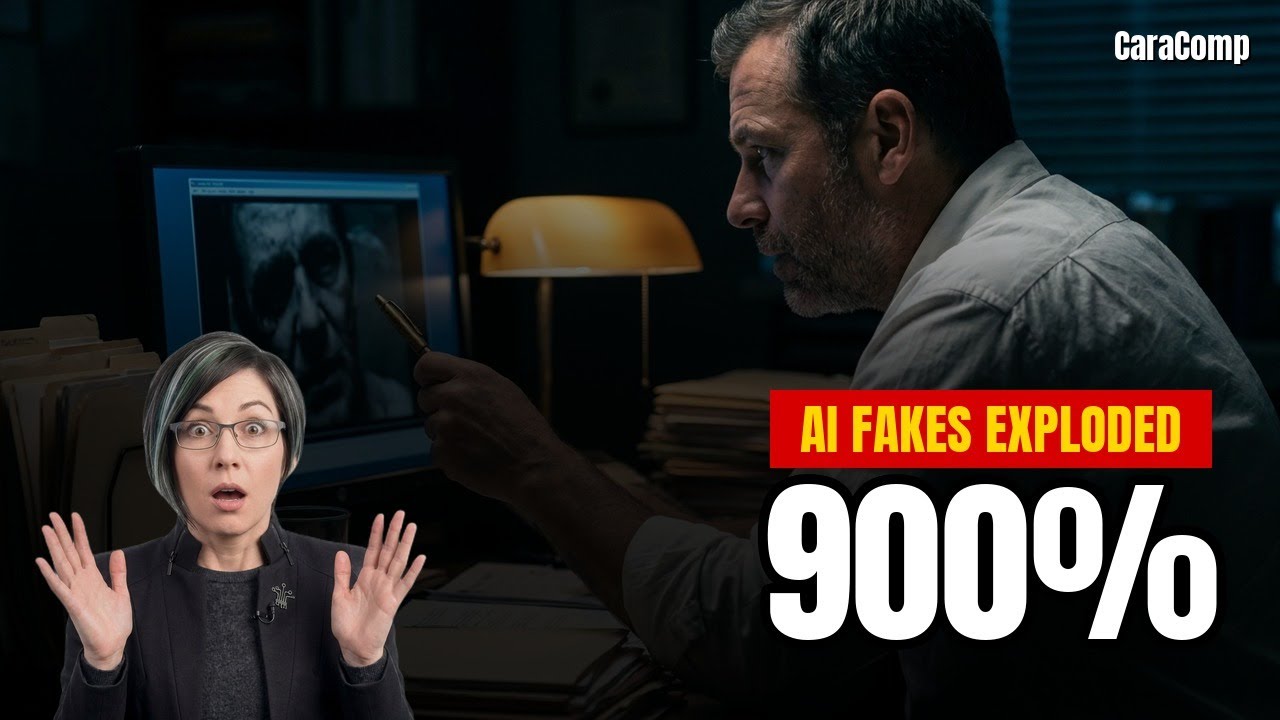
Picture a fraud investigator opening a case file this morning. Inside is a video clip, already forwarded three times. She has to prove it's real, by Friday, in writing, for a judge.
That's the new reality. Thirty U.S. states have passed deepfake laws. The European Union's rules land in August 2026, with fines up to fifteen million dollars. But nobody agreed on what 'verified' actually means.
For the rest of us, that means the photo you sent, the voice note you trusted, the video your bank reviewed, someone now has to prove it wasn't generated.
According to the World Economic Forum, deepfake fraud cases in North America jumped seventeen-hundred percent in a single year. Losses topped two hundred million dollars in just three months.
The question regulators are asking isn't 'can you spot a fake.' It's 'can you show your work.'
Showing your work only matters if the fake reaches you in the first place. One platform is trying to stop that upstream.
A California judge threw out an entire civil case last year. The reason? Someone submitted a deepfake as evidence. He recommended sanctions.
That's why YouTube just expanded its A.I. likeness detection to every adult creator. The tool scans uploads for synthetic versions of your face before the video ever circulates. It started with politicians and journalists. Now it covers everyone.
If you've ever had your photo lifted from social media, this is the first real filter standing between a fake of you and someone's inbox.
According to Business Standard, deepfake content surged nine hundred percent in recent years. Over ninety percent of explicit deepfakes target women.
When synthetic media is rare, checking authenticity is optional. When it's everywhere, skipping the check is negligence.
But even the best detection tool stumbles when the source image is wrong. And that problem starts before the algorithm ever runs.
Imagine an analyst comparing two photos of the same person. Same face. Same software. The match score comes back wildly different. Why? One photo was taken at a distance. The other up close.
The algorithm didn't fail. The data did. Facial recognition turns every face into a string of numbers, then measures the distance between them. Lower resolution stretches that distance, even when the faces are identical.
For anyone whose face sits in a government database or a driver's license file, the quality of that one capture shapes every future check.
According to research published by the National Institutes of Health, adapting thresholds to capture conditions improves accuracy by fifteen percent. Same algorithm. Better discipline.
A confidence score without context isn't evidence. It's just a number wearing a lab coat.
Three stories. One thread. The deepfake laws are landing. The platforms are filtering. The algorithms are matching. But every layer rests on the same fragile question, can you prove what you saw was real, and document exactly how you know.
Links to every story and today's podcast deep-dives are in the description. See you next time.