
Online Identity Verification: One ID, Three Hiring Checks Explained
Quick answer
What is online identity verification when you get hired for a job?
Online identity verification confirms one thing: that the person applying matches the ID they submitted, such as a passport or driver's license. It does not show that someone may legally work or holds a needed license. Those are separate checks, each using different documents and records, and each answering its own question.
Online identity verification has a paperwork problem: about 76% of paper Form I-9s (the federal form every US employer fills out when they hire you) contain at least one error that could trigger a fine. Not one error total across the whole system. One error in three out of every four forms, averaging 3.1 mistakes each, according to Verified First. If the people whose entire job is verifying employees get it wrong that often, what does that tell you about how well the rest of us understand what "checking someone's ID" actually means, or what an account, an access record, or a financial document is really supposed to prove?
TL;DR: Online identity verification for a job is not one yes-or-no check, it's three separate questions bundled into one moment, who you are, whether you're allowed to work, and whether you hold the right credential, and knowing the difference is what lets you spot a sketchy request before you hand over your documents or your account information.
Online identity verification during hiring actually solves three separate problems, identity, work eligibility, and credentials, and mixing them up is the single most common mistake job seekers and employers make.
Digital identity verification: why one photo ID can't answer three questions
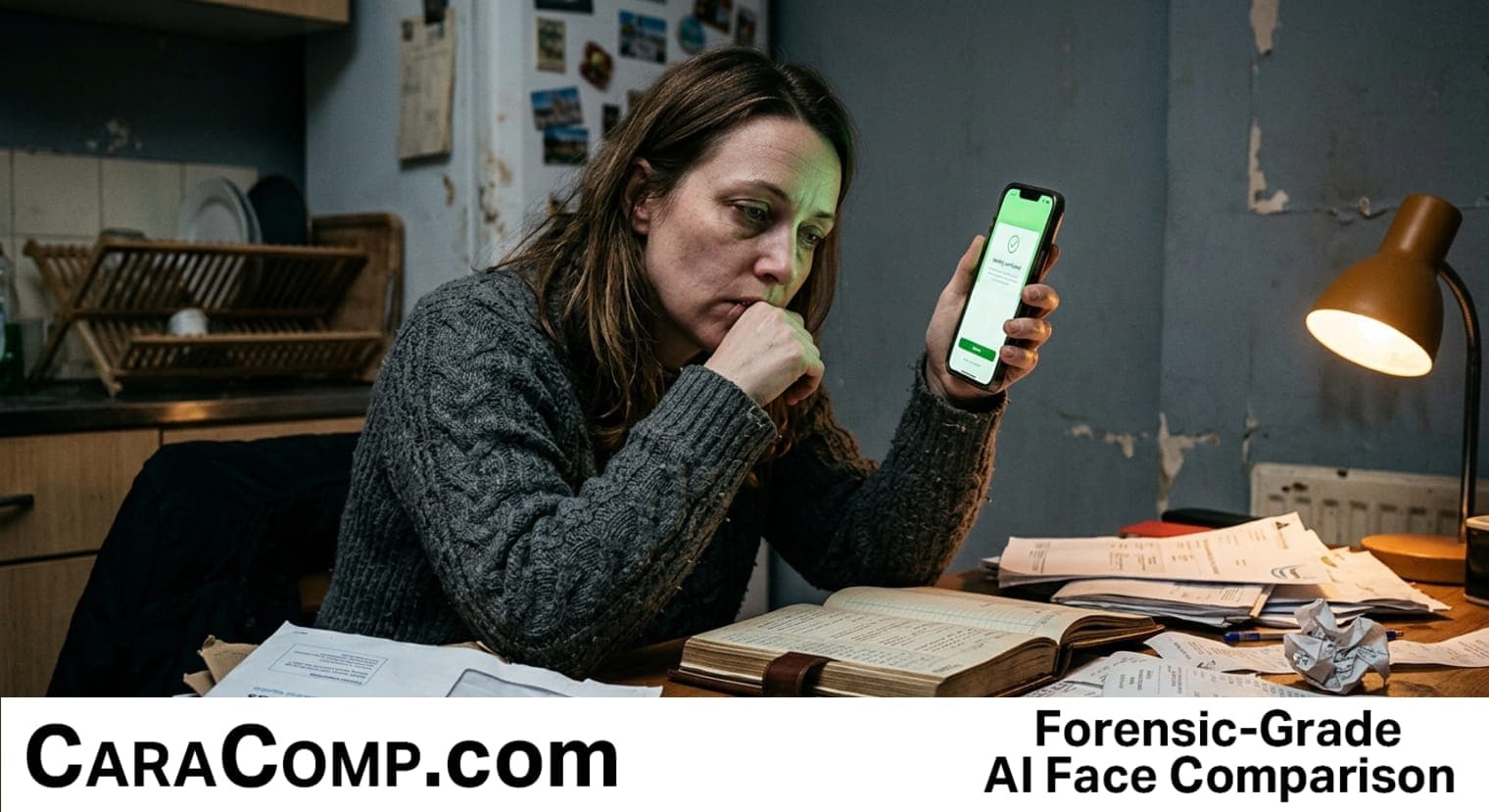
Let's start with the moment that trips almost everyone up. You get hired. Someone hands you a form, or emails you a link, and asks for a photo of your driver's license or passport. You upload it. You feel verified. Done, right?
Not even close. That one document is being asked to do triple duty, and it can only really do one of those jobs well. A driver's license proves you are who your name says you are. It says absolutely nothing about whether the government has decided you're legally allowed to work in the country. And it says even less about whether you're actually qualified, licensed, or certified to do the job you were hired for. Three separate questions. One document. That mismatch is where the confusion, and honestly a lot of the fraud risk, starts.
The US Department of Labor is currently exploring a digital worker identity platform that would link a person's verified identity and employment authorization to their credentials, wages, training records, housing, transportation, and worksite history, according to Biometric Update. Read that list again. Identity is just item one on a much longer chain. The government itself is building infrastructure that treats these as separate, linkable, but distinct data points, not one blob of "verified." It is, in effect, an online process that uses digital data points to link one account to one verified worker instead of leaving each record to stand alone.
What digital identity verification actually checks versus what people assume
Identity verification answers exactly one question: is this the same person the document claims to represent? That's it. It doesn't check your immigration status. It doesn't check your college transcript. It doesn't check whether your nursing license is still active. A face on a card matching a face in front of a camera (which, by the way, is the exact same core process facial recognition systems use, comparing measured points on your face against a stored reference) only ever proves one thing: this human matches this document. Identity verification helps confirm that users are the same person across every account and every access point they claim, nothing more and nothing less. This article is part of a series, start with Uk Age Verification 1 400 Vpn Privacy Signup Surge Podcast.
The three question problem behind employment authentication and access checks
So here's where it gets interesting. Employment law in the US was built around exactly this three-part split, even though almost nobody who's been hired notices it happening. The Immigration Reform and Control Act of 1986 requires employers to verify both the identity and the work authorization of every single person hired after November 6, 1986. Notice that word "and." Not "or." Two distinct facts, checked through the same process, but never treated as one fact.
That process is Form I-9, and it happens about 11.4 million times a year across US employers. Section 1 has to be filled out by you, the employee, no later than your first day. Section 2 has to be completed by the employer within three business days of your start date. Different sections, different deadlines, different responsible parties. Already, that's not "one check," and it is not a single account or a single access grant either, it is two separate records tied to the same hire.
Then there's a step most job seekers never see happening behind the scenes. When employers use E-Verify, your Form I-9 information gets compared against records held by the Department of Homeland Security and the Social Security Administration, according to federal guidance. You handed over one document. It's now being checked against at least two separate federal databases you'll never interact with directly, each one a gatekeeper for a different kind of access. That's not paranoia, that's just how the plumbing works. This is also where authentication becomes distinct from verification: verification confirms who you are, authentication confirms you're allowed to reach a specific system, account, or record, and employers relying on weak authentication expose worker accounts and financial data to unnecessary risk.
The department frames the platform more broadly as infrastructure for labor-market transparency, worker protections, employment compliance, and fraud detection, not solely as an immigration or guest-worker enforcement tool.
reported by Biometric Update
Recent enforcement changes expose employers to immediate penalties for common paperwork mistakes, which is partly why this confusion matters so much right now. Immigration and Customs Enforcement has reclassified a bunch of common paperwork mistakes as substantive violations, eliminating the old 10-day grace period employers used to get to fix small errors. Standard paperwork errors now cost between $288 and $2,861 per form. Knowing violations, where an employer keeps someone on despite red flags, can run up to $28,619. Multiply either number across a workforce of a few hundred people and you can see why employers are suddenly very interested in getting this right, and why some of them, in their nervousness, start asking applicants for way more documentation than the law actually requires, sometimes going as far as asking someone to enter your social security number into an unsecured form before any offer has even been confirmed.
What is identity verification if it's not a full background check
So what is identity verification, really, stripped down to its bones? It's a narrow, specific answer to one question: does this human match this credential? Nothing more. It doesn't check your criminal history, your credit, your work eligibility, or your professional license. Confusing it with those broader checks is the single most common misunderstanding in hiring, and it's an easy one to fall into, because in daily life, showing your ID at a bar or an airport genuinely does feel like the whole checkpoint. In hiring, it's just the first gate of several, and it never doubles as authentication for your accounts, your financial records, or your access to internal systems.
How digital identity verification fits with work eligibility and credential access
Think about it like checking into a flight. Your passport proves you're you (identity). A visa stamp or a citizenship page proves you're allowed to enter or work in that country (authorization). But neither one tells the gate agent whether you're actually trained to fly the plane. That last part, the credential, comes from a completely separate paper trail: pilot certification records, held by a totally different authority, checked through a totally different process. A commercial airline would never let a valid passport substitute for a pilot's license, or for authentication into the cockpit systems that require their own separate access controls. Yet in ordinary hiring, we routinely let one ID document stand in for all three questions in our heads, even though the paperwork behind the scenes never actually does that. Previously in this series: Credit Card Age Verification Steam Skips Age Estimation Podc.
This is exactly the gap Gartner is pointing at when it projects that by 2028, one in four job applicants will be fake, according to reporting from Biometric Update. Notice what that stat is really about: identity fraud, someone pretending to be a different person than they are, in order to gain account access they were never entitled to. It says nothing about how many of those fake applicants also have fabricated work authorization, fabricated credentials, or fabricated financial information, because those are separate fraud surfaces, attacked in separate ways, and defended with separate checks, including a robust identity verification (idv) solution built specifically to catch mismatched accounts before hiring completes.
| Verification question | What document proves it | What it does NOT prove | Status |
|---|---|---|---|
| Identity | Driver's license, passport, state ID | Work authorization or professional credential | Verified via document verification |
| Work eligibility | Social Security card, visa, green card, Form I-9 Section 2 | That the person holding the document is who they claim to be, or that they are licensed for the role | Verified via cross-database access |
| Professional credential | License, certification, transcript | Identity or current legal work authorization status | Verified via licensing board account |
What You Just Learned About Digital Identity Verification
- 🧠 Three separate questionsidentity, work eligibility, and credentials are checked through different documents and different data sources, not one bundled review
- 🔬 Cross-database checkingyour Form I-9 information may get compared against Department of Homeland Security and Social Security Administration records without you ever seeing that step happen
- 💡 Legal deadlines matterSection 1 is due by your first day, Section 2 is due within three business days, so a rushed or delayed request is often just process, not a scam by itself
- 🚩 Vague requests are the red flaga legitimate check asks for specific, limited proof tied to a specific purpose, not "send everything you've got," and never demands financial account access it doesn't need
Where facial recognition, biometric verification, and access checks fit into hiring
This is actually a concept we live and breathe in facial recognition work, and it maps onto hiring almost perfectly. A face match answers one narrow question: does this face belong to this person? It doesn't tell you if that person is authorized to be somewhere, or qualified for something, or telling the truth about their name on some other form. A face match is identity, full stop, and identity authentication for account access is a separate step handled by separate systems entirely. Anyone treating it as proof of authorization or credentials is making the same mistake as an employer who thinks a driver's license photo settles the whole hiring question. Understanding that face matching, work authorization, and credential checks are three separate systems is exactly why identity verification tools are built the way they are, narrow, purpose-built, and never asked to answer a question they weren't designed for.
Here's why the misconception is so easy to fall into, and it's worth some sympathy here: your driver's license really does feel like a master key in most of daily life. It gets you on a plane, into a bar, past a bank teller checking your account. So when a hiring manager asks for it, your brain reasonably assumes it's unlocking the same kind of "you're all set" moment. But hiring isn't one door. It's three doors, each requiring its own key and its own access rules, and the license only opens the first one.
What is identity verification supposed to look like when it's done right
Done properly, a legitimate employer verification request should feel narrow, not overwhelming. It should ask for specific documents tied to a specific, explainable purpose, identity for one form, work authorization documents for another, license or certification records for a third, never a vague catch-all demand for "your personal information," your account passwords, or open ended financial details with no stated reason. If a request feels broad, unexplained, or rushed with no context about which of the three questions it's actually trying to answer, that's worth pausing on. A tired job seeker checking email at 11pm can ask themselves one simple thing: which of the three questions is this document actually answering, does it require account access I haven't agreed to, and does the person asking need it for that? Entrust offers a good example of how a narrowly scoped verification flow keeps identity, authentication, and access requests clearly separated instead of bundled into one confusing ask.
Online identity verification only ever answers "are you who you say you are," so any employer request should make clear which of the three separate questions, identity, work eligibility, or credentials, it's actually trying to answer. A request that can't explain that, especially one asking for account, authentication, or financial access it doesn't need, deserves a second look before you send it anywhere.
So the next time a form asks for your ID during hiring, you'll know exactly what's really happening behind that single upload button. It isn't one gate closing behind you. It's the first of three, and understanding that difference, along with the separate roles of authentication and access, is what separates a routine paperwork step from a request that deserves a harder look, and maybe a phone call to HR before you hit send. Up next: Credit Card Age Verification Steam Skips Age Estimation.
online identity verification: Frequently Asked Questions
What is identity verification in the context of hiring?
Identity verification in hiring is the narrow process of confirming that the person applying for a job matches the document they submitted, usually a driver's license, passport, or state ID. It answers only one question: are you who you claim to be. It does not confirm whether you're legally authorized to work, whether you hold any required professional license, or whether you should be granted account access to internal systems, those are separate checks handled through different documents and different authentication steps entirely.
Why does an employer need more than just my ID photo?
Federal law requires employers to verify both identity and work authorization separately through Form I-9, and many jobs also require proof of a specific credential, like a nursing license or a commercial driving certificate, plus separate account and access setup once you're hired. Your ID photo only covers the identity piece. An employer asking for additional documents isn't being excessive, they're legally required to check work eligibility and, in regulated jobs, credentials, using entirely different paperwork and different information than any account or financial verification step.
How can I tell if an identity request during hiring is legitimate?
A legitimate request should be specific and explainable, tied clearly to identity, work eligibility, or a credential, not a vague ask for "all your documents" or full account access. Watch for unexplained urgency, requests routed through unofficial email addresses, or asks for information that has nothing to do with any of the three verification questions, like your full Social Security number or financial account details sent by unsecured email before you've even signed an offer.
Does a photo ID prove someone is qualified for a job?
No. A photo ID only proves identity, that the person matches the document. It says nothing about whether someone holds a required license, certification, or degree, and it does not grant authentication or access to any internal system on its own. Credential verification is a completely separate process, usually involving direct confirmation with a licensing board, school, or certifying organization, and it's checked independently of both identity and work authorization documents.
What happens if an employer gets Form I-9 verification wrong?
Standard paperwork errors on Form I-9 can cost employers between $288 and $2,861 per form, while knowingly employing someone without proper authorization can run up to $28,619 per violation. Recent enforcement changes have also removed the old 10-day window employers used to get to fix small mistakes, which is part of why employers have become more cautious, and sometimes overly broad, in what they ask applicants to provide, including unnecessary account or financial information that has nothing to do with the actual I-9 requirement.
Is online identity verification the same as a background check?
No, and mixing these up is one of the most common mistakes. Identity verification only confirms you match your ID. A background check is a broader review that can include criminal history, employment history, financial history, and education records. Work authorization, credential checks, and account authentication are separate again. All of these can happen during hiring, but they're distinct processes with different documents, different access requirements, and different legal requirements behind each one.
Ready for forensic-grade facial comparison?
Full forensic reports with detailed similarity scoring. Results in seconds.
Run My First SearchMore Education
EU Digital Identity Wallet: Optional, Hard to Dodge by 2027
The EU digital identity wallet will ask for one big thing up front, then let you share tiny slices of who you are. Here is how it works and where "optional" gets slippery.
privacyPhoto Metadata Remover: 3 Mistakes That Leak Home Addresses
Every picture you send carries a hidden note about where and when it was taken. Learn the three mistakes that leave it behind, and what actually works.
biometricsIris Scan: Eye Codes Sell for $30 and Can Never Be Replaced
A silver orb paid people to look into it, and scans later showed up for sale at about $30. Learn how an iris scan really works and why your eye is harder to protect than your face.