
Mobile Identity Verification: Bank Digital Identity Id Check
Quick answer
How does mobile identity verification work at a bank?
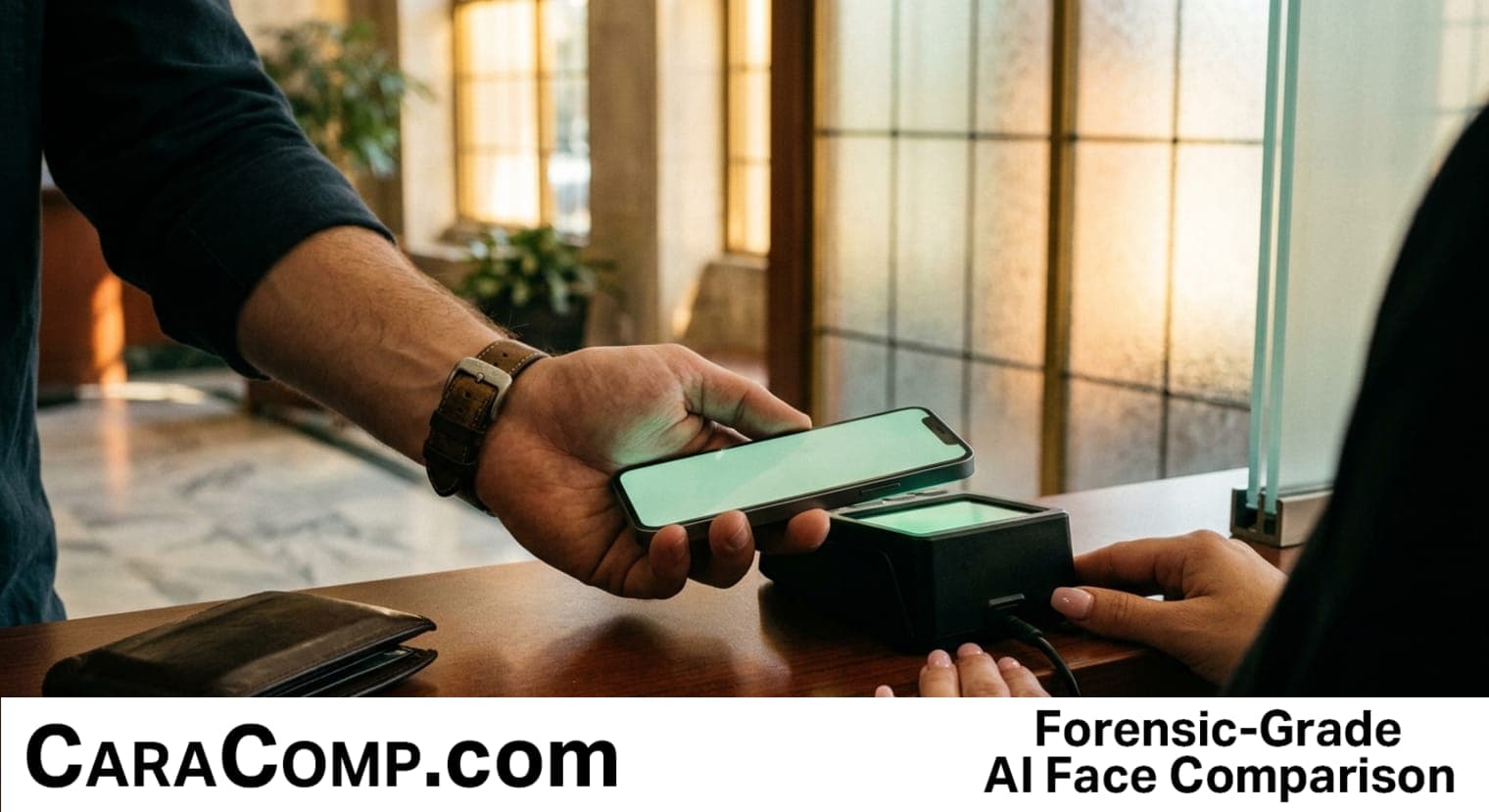
A bank asks your phone for one specific fact, such as your age or legal name. Your digital wallet sends only that piece, signed by the state that issued your mobile driver's license. The bank checks the signature against the state's public key and records the result, without seeing your address or license number.
Here's a weird fact: the piece of plastic in your wallet right now is, in one specific way, less private than the phone in your pocket. Your driver's license can't choose what it shows a stranger. It's all or nothing, address, license number, signature, photo, birthdate, the works, the second you hand it over. Your phone, running the right kind of digital ID, can answer a single question and say nothing else. "Is this person over 21?" Yes. That's it. No address. No license number. No signature. Just yes.
TL;DR: Mobile identity verification lets a bank confirm a narrow fact about you, like your age or your legal name, using a cryptographically signed digital ID that reveals nothing else, and federal regulators just confirmed banks are allowed to use it for opening accounts.
Mobile identity verification lets a bank confirm a narrow fact about you, like your age or your legal name, using a cryptographically signed digital ID that reveals nothing else, and federal regulators just confirmed banks are allowed to use it for opening accounts.
Sounds like magic. It isn't. It's math, and once you see how it works, you'll never look at "please show your ID" the same way again.
Mobile Identity Verification At Your Bank, Explained
Federal regulators recently confirmed that banks and credit unions can use state-issued mobile driver's licenses, sometimes called mDLs, along with other government-backed digital credentials, to check who you are when you open an account. This is what people mean when they say mobile identity verification. It's not a new app or a new gadget. It's a new way for a user to verify who they are that doesn't require anyone to photocopy your whole ID and stick it in a file cabinet (or worse, a database that eventually gets hacked). This is a form of digital identity that puts the user, not the document, at the center of the process.
In plain terms, the system confirms a person's identity using their mobile device instead of a plastic card, and the rule only cares that the bank has genuinely confirmed an individual's identity before the account opens. The mobile credential carries the same state authority the plastic card does.
The regulators, according to Biometric Update, made clear this is a permission, not a requirement. The rule that governs how banks confirm your identity, called the CIP rule (short for Customer Identification Program, basically the checklist a bank follows before it lets you open an account), "neither requires nor prohibits" banks from accepting these digital credentials. Translation: your bank doesn't have to build this. But now it legally can, and that single sentence removes a huge chunk of hesitation that had been sitting in every bank's compliance department for years.
Government Issued Credentials Beat Private Ones
Not all digital IDs are treated equally. A government-issued mobile driver's license has a cleaner legal path than one built by some third-party app, because a state-issued credential can count as an official document verification on its own. If a private company issues the digital ID instead, the bank is still on the hook to prove that company checked identities as carefully as the bank itself would. Government backing shifts who's responsible, from a vendor the bank has to babysit, to a state agency the bank already trusts. This is also where phone-centric identity matters: the credential lives on the device the user already carries everywhere, not in a drawer at home.
How Selective Disclosure Hides Everything Except One Fact
Okay, here's where it gets genuinely interesting. The technical name for what's happening is "selective disclosure" (a fancy way of saying "reveal only the part someone asked for, and nothing more"). It's built into a technical standard called ISO/IEC 18013-5, which is the international rulebook that defines how mobile driver's licenses work. This article is part of a series, start with Social Media Identity Verification Macron Eyes Id Scanning.
Two labels get used loosely here, and they are worth separating. Identity proofing is the first step, establishing that an identity really belongs to a live person. Authentication is the later step, proving the same person came back. Digital identity verification covers both when the credential sits on a phone rather than in a wallet.
Here's the actual mechanic, step by step, because I think this is the part that makes it click:
First, when your state issues you a mobile driver's license, it doesn't just slap a digital photo of your card into an app. It breaks your ID into individual pieces, your name, your birthdate, your address, your license number, and it digitally signs each piece separately using something called a digest (basically a short scrambled fingerprint of that one piece of data). Each fact gets its own signed fingerprint, which is the foundation of document verification done right.
Second, when a bank asks your phone for proof, it doesn't ask for "your ID." It asks for a specific claim, like "age_over_21" (yes, that's genuinely close to the technical term used in the standard). Your phone's digital wallet looks at what was requested and releases only that signed piece. Everything else, your address, your license number, your signature, stays locked inside the phone. This is what people mean by mobile verify: the phone itself becomes the checkpoint.
Third, the bank's system checks the signature using the state's public cryptographic key (think of it like a lock that only the government's private key could have sealed). If the signature checks out, the bank knows that a real government agency vouched for that one fact. Not a screenshot. Not a guess. A cryptographic proof, and increasingly this check happens through an api the bank's app calls behind the scenes without the user noticing any delay.
And here's a detail almost nobody knows about: some implementations "salt" the data before hashing it, meaning they mix in random noise so that the same birthdate produces a different-looking scrambled code every single time it's shared. Why bother? Because it stops your bank and, say, your gym from comparing notes and realizing the "anonymous" age proof you both received actually came from the same person. Even if two companies wanted to team up and track you, the math won't let them. This same discipline underpins verification biometric checks elsewhere, where a face or fingerprint match produces a fresh signature each time instead of storing a reusable copy.
The Adoption Gap Nobody Talks About
Just because regulators said yes doesn't mean your local branch has this tomorrow. Only 13 states have actually issued mobile driver's licenses so far, with a similar number in progress. That means a bank building mobile identity verification today has to plan for a patchwork, not a nationwide standard, at least for the next few years. Digital onboarding at most banks still leans on manual document review as a fallback while mDL coverage catches up.
Is A Digital Credential Safer Than A Physical Card?
Yes, and the reason surprises most people. A physical license can be forged well enough to fool a tired cashier at 11pm, but it takes real skill. A digital credential's signature is machine-checked and can't be faked without literally breaking a government's cryptographic key, something no counterfeiter on earth can currently do. This kind of identity security depends on math, not on a stranger's judgment.
Product names in this space vary from vendor to vendor, id verify, id check, id verification, mobile verify, but the underlying step is identical: the phone releases one signed claim and the bank's software securely verifies that signature against the state's public key. Where the risk is higher, some banks layer face authentication or a liveness detection selfie on top of the credential rather than replacing it.
This is where I want to slow down, because there's a misconception that trips up almost everyone, including plenty of smart people. It goes like this: "A digital ID lives on a phone, so it must be easier to fake than something printed on secure plastic." It's an understandable instinct. We grew up trusting physical things, holograms, watermarks, that little raised seal. Digital stuff feels slippery by comparison, like it could be edited in five minutes by anyone with the right app. Previously in this series: Deepfake Scam Losses Hit S 242 9m As Singapore Acts Podcast.
But that instinct gets the security backwards. The ISO 18013-5 standard builds in digital signatures and cryptographic protections directly into the data itself, according to Dock, meaning every credential carries its own tamper-proof certificate. A bouncer squinting at a hologram is doing visual inspection, a skill that varies wildly from person to person. A bank's system checking a cryptographic signature is doing math, and math doesn't get tired at the end of a long shift. The phone isn't the security feature. The cryptography riding inside it is, and it can even support liveness detection when a bank layers in a selfie check alongside the credential.
The financial institution remains responsible for ensuring the third party uses the same level of authentication the bank or credit union would use.
ID Tech Wire, on regulators clarifying how banks may treat privately issued digital credentials differently from government-issued ones
The Bar Trick That Explains Everything
You've probably already used a version of this without realizing it. Think about scanning your ID at a bar that just needs one thing: proof you're over 21. A well-run system asks for exactly that fact and nothing more. It doesn't need your address. It doesn't need your license number. The bank scenario works on the identical logic, just moved from a bouncer's scanner to a bank's onboarding screen. Instead of a teller squinting at your card and mentally noting your address, the system asks your phone one narrow question, gets a signed yes, and moves on. Many banking apps now build this same logic straight into their app, so the whole exchange happens without the user ever leaving the login screen.
| Handing over a physical license | Mobile identity verification with an mDL |
|---|---|
| Reveals address, license number, signature, full birthdate | Reveals only the requested fact, such as age over 21 |
| Bank often keeps a photocopy or scan on file | Bank stores a verified result, not the underlying document |
| Authenticity checked by a human eye | Authenticity checked by a cryptographic signature |
| Vulnerable to visual forgery skilled enough to fool staff | Vulnerable only to breaking the state's private cryptographic key |
| Identity data collected: everything printed on the card | Identity data collected: only the claim the bank asked for |
| A clerk reads the card to confirm an identity | Software checks a signed identity claim from a mobile wallet |
| Adoption status: universal, every state | Adoption status: 13 states issued, roughly 13 more pending |
Why Banks Have Less Customer Data To Lose
Here's the part that should matter to you even if you never think about cryptography again after today. Every piece of personal information a bank stores is a piece of personal information that can eventually leak. Data breaches involving identity documents are, according to Traders Union, a mounting problem across the entire industry that handles customer identification (that's the broader field called KYC, short for "know your customer"). A bank that only receives a signed "yes, this person is eligible" never had your address to lose in the first place. You can't leak what you never collected.
Banks and their customers end up on the same side of this trade. The fewer identity documents a bank keeps, the less identity data exists for anyone to steal, and a mobile check that ends in a verified result rather than a stored scan is far cheaper to defend after the fact.
This is the reframe worth sitting with: better privacy and better security aren't competing goals here. They're the exact same outcome, described from two different angles. Less data held equals less data exposed equals fewer headaches for the bank's compliance team and fewer 3am panic emails to you about a breach notification.
What You Just Learned
- 🧠 Selective disclosure means your digital ID can prove one fact, like your age, without exposing your address or license number
- 🔬 Cryptographic signatures from the issuing state make each identity fact machine-verifiable, harder to fake than a physical card
- 💡 Regulators allow, not require banks to accept mobile driver's licenses, so adoption depends on each institution's choice
- 💡 Only 13 states have issued mDLs so far, meaning mobile coverage is still patchy nationwide
At CaraComp, this is the same underlying idea we spend most of our time on when we study facial recognition systems, the question of what a system actually needs to know versus what it collects out of habit. A face-matching system doesn't need to store your face to confirm it's you; it can generate a mathematical signature and discard the image. Mobile identity verification runs on the identical philosophy: verify the fact, forget the document.
People Also Ask: Does A Bank See My Full ID?
Not if the system is built correctly. A properly configured mobile identity verification request asks the bank's software to specify exactly which fields it needs, like legal name and date of birth, and the customer's digital wallet only releases those fields. The bank never receives, and therefore never stores, the rest of the document unless it specifically asks for it and the user approves that broader request.
The Question To Ask Next Time Someone Wants Your ID
Next time a bank, an employer, or an app asks to see your ID, here's the one question worth asking out loud: "Do you need to see everything on this, or just confirm one thing about me?" Most of the time, the honest answer is one thing. Your age. Your name. Your eligibility. Not your address. Not your license number. Not your signature. Up next: Social Media Identity Verification Macron Eyes Id Scanning P.
The wild part is that the technology to make that distinction real, cryptographically real, not just a polite request, already exists and federal regulators just gave banks a green light to use it. The plastic card in your wallet was never built to say "just this one fact, please." Your phone finally can. The gap between those two isn't a gadget upgrade. It's a completely different idea about what proving who you are should cost the user.
mobile identity verification: Frequently Asked Questions
What is mobile identity verification and how is it different from showing a physical ID?
Mobile identity verification means a user can confirm who they are using a digital credential, like a state-issued mobile driver's license, instead of a physical card. The key difference is control: a digital credential can be built to reveal only the specific identity fact a business needs, such as age over 21 or legal name, while a physical ID always shows everything printed on it, including your address and license number, whether the business needs those details or not.
Can banks legally accept a mobile driver's license for account opening?
Yes. Federal regulators clarified that banks and credit unions can use state-issued mobile driver's licenses and similar government-backed digital credentials to satisfy identity verification requirements when opening new accounts. This guidance did not create a mandate. Each bank still chooses whether to build the mobile systems needed to accept these credentials, so acceptance will vary institution by institution for now.
Is a digital credential more secure than a physical license?
In the ways that matter for fraud prevention, yes. A physical license relies on a human noticing forged watermarks or holograms, a skill that varies from person to person and gets worse late at night or during a rush. A digital identity credential carries a cryptographic signature from the issuing government agency, checked by a computer, not an eye. Forging it would require breaking that government's private cryptographic key, which is far harder than producing a convincing fake card.
Do all states offer mobile driver's licenses yet?
No. As of the regulatory guidance, 13 states have issued mobile driver's licenses, with roughly a similar number working toward launching their own programs. That means mobile identity verification is not yet available everywhere, and banks building these systems have to account for users holding a mix of digital and physical IDs depending on where they live for years to come.
What happens to my personal data during a bank check?
In a well-built system, very little of your data ever reaches the bank. Your digital wallet holds your full mobile driver's license, but when a bank requests proof of one fact, like your age, the wallet sends only a signed proof of that identity fact. The bank's system verifies the signature against the state's public cryptographic key and records the result, not your underlying personal details like your address or license number.
Why would a bank prefer mobile identity verification over collecting scanned IDs?
Because storing less personal data means less risk for the user and the bank alike. Every scanned ID a bank keeps on file is a potential target if that bank's systems are ever breached. Mobile identity verification lets a bank verify eligibility without holding onto a permanent copy of your full identity document, reducing both the bank's liability and the chance your personal information ends up exposed in a future data breach.
Ready for forensic-grade facial comparison?
Full forensic reports with detailed similarity scoring. Results in seconds.
Run My First SearchMore Education
Iris Scan: Eye Codes Sell for $30 and Can Never Be Replaced
A silver orb paid people to look into it, and scans later showed up for sale at about $30. Learn how an iris scan really works and why your eye is harder to protect than your face.
biometricsHow to Take Passport Photo at Home: 4 Rules Software Checks
A computer, not a person, decides first whether your passport photo passes. Learn the four measurable rules it checks so a bad picture never costs you six weeks.
digital-forensicsFirst AI Generated Image: 9 Years From Blur to Perfect Fake
The first AI generated image was nothing like a photo, and the story from there to today's fakes explains why your eyes can no longer be the test. Learn what to check instead.