
Compare Faces: Face Similarity Scores and Photo Comparison
Master facial recognition technology, photo comparison methods, and identity verification systems with expert guidance.
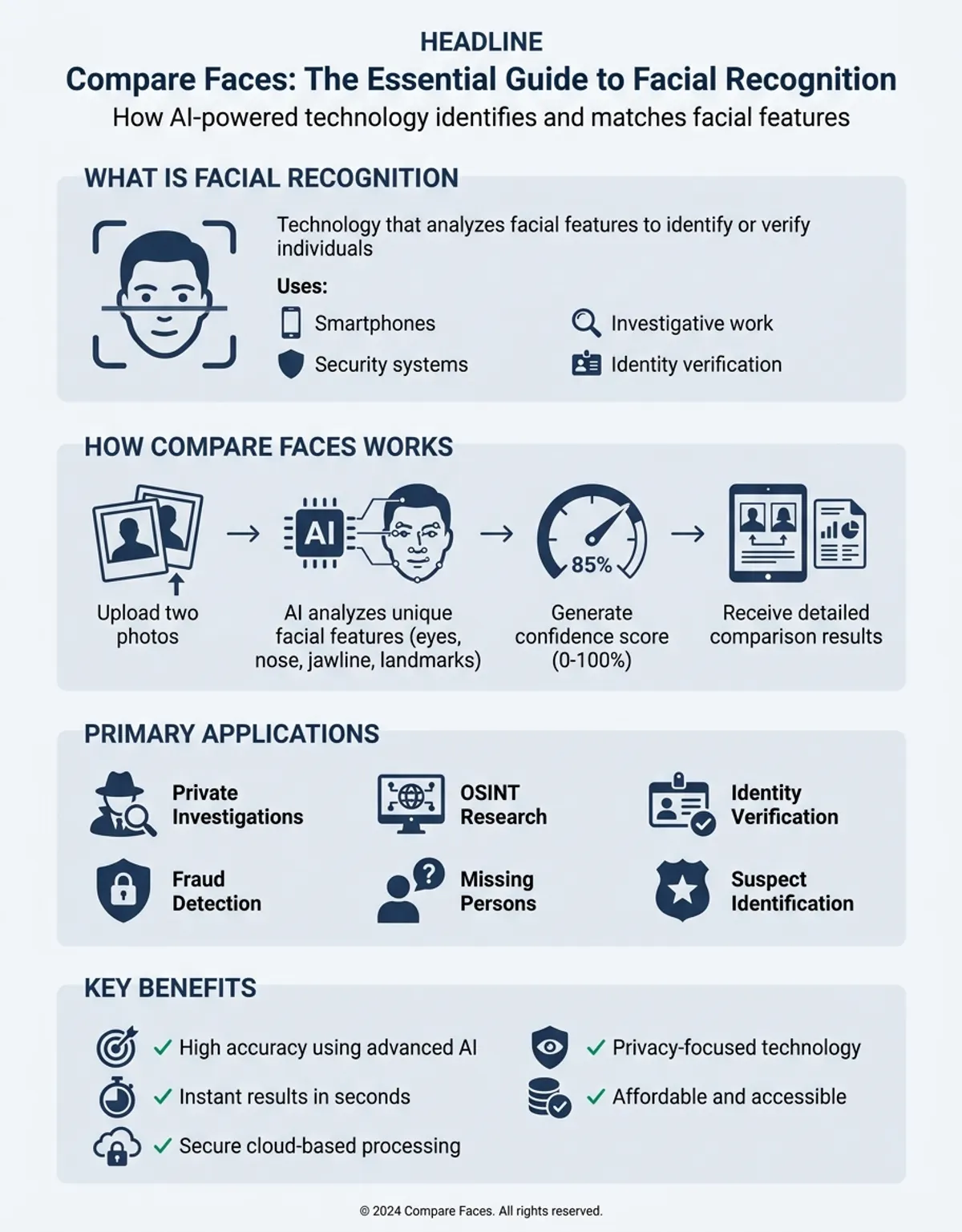
The ability to compare faces has become an essential tool in our digital age, where facial recognition technology powers everything from smartphone security to social media tagging. Whether you need to verify identity through photos, match facial features across multiple images, or analyze facial landmarks for comparison purposes, understanding how face comparison works is crucial.
Face comparison technology leverages sophisticated algorithms that analyze facial features, detect key landmarks, and create detailed mappings of human faces. These systems can compare two faces to determine similarity scores, verify identity, and even match faces across databases. From security applications to finding your celebrity twin, facial comparison has transformed how we interact with photos and recognition systems.
Face Comparison and Similarity Scores
Modern comparison systems use advanced algorithms to analyze and evaluate facial structures. When you compare faces, the technology breaks down each face into measurable components, creating a unique facial signature that can be matched against other photos. This comparison process involves examining multiple data points across the face, from the distance between eyes to the shape of the jawline.
The comparison algorithms work by first detecting the face in photos, then extracting facial features and landmarks to build a mathematical model. This model allows the system to perform accurate comparison operations even when photos are taken under different lighting conditions or angles. The facial comparison process typically achieves high accuracy rates by analyzing hundreds of unique facial points during each comparison operation.
Facial recognition systems use comparison technology to verify identity by matching new photos against stored templates. These comparison tools measure similarity scores, typically expressed as percentages, that indicate how closely two faces match. Advanced comparison platforms can handle multiple photos simultaneously, comparing each face against others to identify matches or similarities. The comparison accuracy depends on photo quality, facial angles, and the sophistication of the recognition algorithms employed.
When evaluating comparison systems, consider factors like processing speed, accuracy rates, and privacy protections. Modern comparison technology can process faces in real time, delivering instant results that show how much two faces look alike. These systems are used across various industries, from law enforcement to entertainment, making comparison an invaluable tool for identity verification and facial analysis.
Face Comparison with Photos
Photos serve as the foundation for all face comparison operations. The quality, resolution, and clarity of your photos directly impact comparison accuracy and reliability. When preparing photos for facial comparison, ensure images are well-lit, properly focused, and show the face clearly without obstructions. High-quality photos enable recognition systems to detect facial landmarks more accurately and perform more reliable comparison operations.
Different types of photos require different comparison approaches. Portrait photos with clear facial visibility provide the best results for comparison purposes, while group photos or angled shots may require additional processing. Recognition systems analyze photos by identifying facial boundaries, extracting features, and comparing these elements against reference photos to determine similarity.
The format and size of photos also affect comparison performance. Most facial recognition systems accept common photo formats like JPG and PNG, processing them to extract facial data for comparison. When uploading photos to comparison platforms, larger file sizes generally provide more detail for facial recognition algorithms to analyze, though modern systems can work effectively with standard resolution photos taken on smartphones.
Photos captured under varying conditions present unique challenges for comparison systems. Lighting variations, facial expressions, and aging can all affect how recognition algorithms compare faces across different photos. Advanced comparison tools account for these variables, using sophisticated normalization techniques to ensure consistent comparison results regardless of when or how the photos were captured.
Privacy considerations are paramount when working with photos for facial comparison. Reputable comparison platforms implement strict data protection measures, ensuring that uploaded photos are processed securely and not stored without permission. When selecting a comparison service, verify that your photos will be handled responsibly and that facial data extracted during comparison won't be misused or shared without consent.
Face Comparison: Similarity Scoring Methods
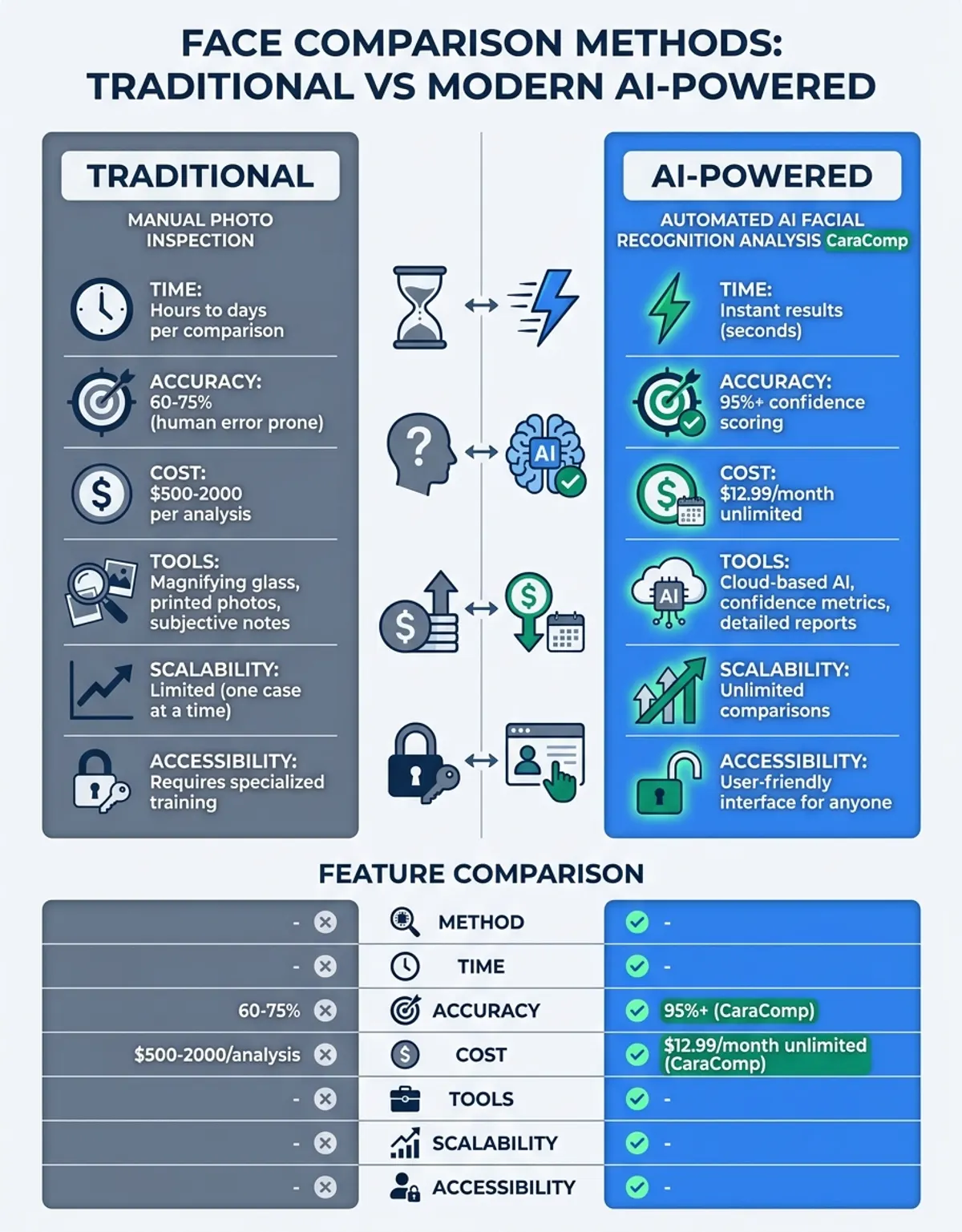
Face comparison encompasses various techniques for analyzing and matching facial features between images. Traditional face comparison relied on manual measurement of facial proportions, but modern digital face comparison uses artificial intelligence to automatically detect and analyze facial characteristics. These systems can compare two faces instantly, generating similarity scores that indicate how closely the faces match.
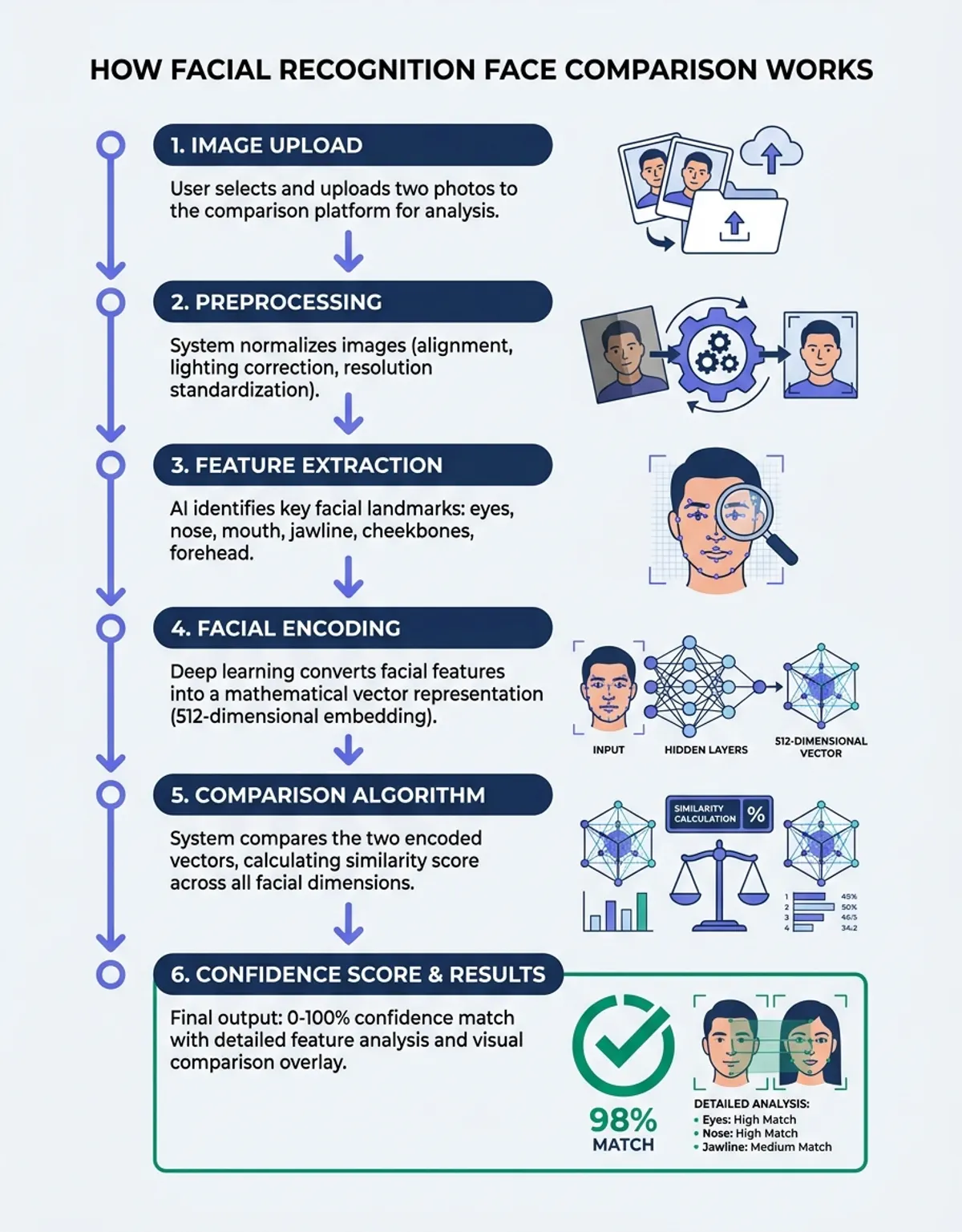
The face comparison process begins with face detection, where algorithms identify faces within photos and isolate them for analysis. Next, facial landmarks are mapped, including eyes, nose, mouth, and other distinctive features. The face comparison algorithm then converts these landmarks into numerical data that can be mathematically compared against other faces. This systematic face comparison approach ensures consistent, objective results.
Face comparison technology is used across numerous applications. Security systems use face comparison to verify identity at access points, while social media platforms employ face comparison to suggest photo tags. Entertainment applications let users compare their faces with celebrities, while forensic experts use face comparison to identify individuals in investigative work. Each application leverages face comparison algorithms tailored to specific accuracy and speed requirements.
Advanced face comparison systems can handle challenging scenarios like comparing faces across age ranges, different facial expressions, or varying image quality. Machine learning enhances face comparison accuracy by training on millions of facial images, helping algorithms recognize patterns and similarities that might not be obvious to human observers. This sophisticated face comparison technology continues evolving, with newer systems achieving remarkable accuracy even with partial facial views.
For those seeking a reliable and user-friendly face comparison solution, CaraComp offers a powerful facial recognition platform that combines accuracy with ease of use. Whether you're verifying identities, organizing photo libraries, or analyzing facial similarities for professional purposes, CaraComp's AI-powered technology delivers precise comparison results in seconds. The platform processes images securely and provides detailed similarity scores, making it an excellent choice for both casual users and security professionals who need dependable facial comparison capabilities.
Photos serve as the foundation for all face comparison operations.
Face Recognition and Similarity Scores
Facial recognition forms the backbone of modern comparison systems, using biometric technology to identify or verify individuals based on facial features. Recognition algorithms analyze facial geometry, measuring distances between key points to create a unique facial template. This template becomes the basis for all recognition and comparison operations, serving as a digital representation of the individual's facial structure.
The facial recognition process involves several stages. First, detection identifies faces in photos. Then, alignment normalizes facial orientation for consistent analysis. Next, feature extraction captures key facial characteristics. Finally, recognition matching compares extracted features against database entries to find matches. Each stage of facial recognition requires sophisticated algorithms that work together to deliver accurate results.
Modern facial recognition systems use deep learning neural networks trained on massive datasets of facial images. These recognition networks learn to identify subtle patterns and features that distinguish one face from another. Facial recognition accuracy has improved dramatically, with leading systems achieving recognition rates exceeding 99% under optimal conditions according to independent testing. (Source: https://www.nist.gov/speech-testimony/facial-recognition-technology-frt-0) This high accuracy makes facial recognition viable for security-critical applications.
Facial recognition technology continues advancing with innovations in artificial intelligence and computer vision. New recognition algorithms can handle difficult scenarios like low-light conditions, partial occlusions, or aging effects. These improvements expand facial recognition applications, enabling use cases that weren't previously feasible. From border control to retail analytics, facial recognition transforms how organizations verify identity and analyze customer behavior.
Privacy concerns surrounding facial recognition have prompted development of privacy-preserving recognition techniques. Some systems now use on-device facial recognition processing, keeping biometric data local rather than sending it to cloud servers. Other recognition platforms implement encryption and anonymization to protect facial data while still enabling comparison functionality. Responsible facial recognition deployment balances utility with privacy protection.
Face Comparison Patterns
Recognition systems identify patterns in facial structures that remain consistent across different conditions. These recognition patterns include the spacing of facial features, the contours of facial bones, and the unique characteristics that make each face distinctive. By analyzing these recognition patterns, systems can reliably identify individuals even when photos are taken years apart or under varying circumstances.
Pattern recognition in facial analysis examines multiple dimensions of facial geometry. Recognition algorithms measure proportional relationships between features, creating a mathematical model that captures the essence of a face. This model-based recognition approach ensures consistency, allowing systems to recognize faces despite changes in expression, lighting, or angle. Advanced recognition systems can even account for aging by understanding how facial patterns evolve over time.
The accuracy of recognition depends on the quality of pattern detection and analysis. High-resolution images provide more detailed pattern information, enabling more precise recognition. Recognition systems trained on diverse datasets perform better across different ethnicities, ages, and genders because they've learned to recognize patterns across a broader spectrum of human faces.
Machine learning has revolutionized pattern recognition in facial analysis. Neural networks learn recognition patterns automatically by processing millions of examples, discovering subtle cues that improve matching accuracy. This learned recognition capability surpasses rule-based systems, adapting to new scenarios without explicit programming. Modern recognition platforms leverage these advances to deliver highly accurate facial comparison.
Recognition patterns extend beyond static facial features to include behavioral biometrics. Some advanced recognition systems analyze how faces move during expressions or speech, adding another dimension to identity verification. This multimodal recognition approach combines multiple pattern types, creating more robust systems that are harder to fool with static photos or masks.
Face Comparison with Similarity Scoring
Verification systems confirm whether two faces belong to the same person, while matching systems search databases to find similar faces. Facial verification serves authentication purposes, comparing a live photo against a stored template to verify identity. Matching applications scan facial databases to identify individuals or find similar-looking people, useful in security and investigative contexts.
The verification process requires high confidence thresholds to prevent false positives. Facial verification systems typically use stricter matching criteria than general comparison tools because the stakes are higher. Whether unlocking a device or accessing secure facilities, facial verification must reliably distinguish between legitimate users and impostors. Modern verification systems achieve this through multi-factor approaches that combine facial analysis with other biometric or knowledge-based factors. For more on this topic, see our guide on face comparison.
Identity confirmation through facial matching has applications across industries. Financial institutions use facial verification to prevent fraud during account opening. Healthcare providers verify patient identity to ensure proper treatment. Government agencies employ facial matching for border control and law enforcement. Each verification scenario demands appropriate accuracy levels and security measures tailored to the specific risks involved.
Spoofing attempts pose challenges for verification systems. Attackers may use photos, videos, or masks to fool facial verification. Advanced verification platforms implement liveness detection that requires subjects to perform actions proving they're physically present. This anti-spoofing verification capability prevents replay attacks and ensures only live faces can complete verification successfully.
Facial verification serves authentication purposes, comparing a live photo against a stored template to verify identity.
Face Detection and Landmark Analysis
Detection forms the first critical step in facial analysis, identifying where faces appear in photos. Modern detection algorithms can locate faces across varying scales, orientations, and lighting conditions. Once detection succeeds, landmark identification pinpoints specific facial features like eyes, nose, mouth, and ears. These landmarks serve as reference points for all subsequent comparison and recognition operations.
Landmark detection identifies dozens to hundreds of points across the face, creating a detailed map of facial geometry. Advanced landmark detection systems track 68, 128, or even more facial landmarks, capturing subtle features that improve comparison accuracy. (Source: https://dlib.net/face_landmark_detection.py.html) The precision of landmark detection directly affects recognition quality, as more accurate landmarks enable more precise facial measurements and comparisons.
Detection technology has evolved from simple pattern matching to sophisticated deep learning approaches. Modern detection networks can find faces partially obscured by objects, turned at extreme angles, or captured in challenging lighting. This robust detection capability ensures facial comparison systems work reliably across real-world conditions rather than only in controlled studio environments. For more on this topic, see our guide on face similarity.
Landmark analysis enables detailed facial feature comparison. By measuring distances and angles between landmarks, systems can quantify facial proportions and identify distinctive characteristics. This landmark-based analysis provides objective, measurable data for comparison operations, moving beyond subjective visual assessment to mathematical precision. The landmarks captured during detection form the foundation for all subsequent facial recognition and comparison algorithms.
Similarity Scores and Matching Algorithms
Matching algorithms determine how similar two faces are by comparing their facial features and returning similarity scores. These match scores typically range from 0 to 100 percent, indicating confidence that two faces belong to the same person. Advanced matching systems use multiple algorithms in parallel, combining their results to produce more reliable match scores that account for different facial aspects.
The matching process compares facial templates extracted from photos, calculating distances in mathematical feature space. Faces that map to nearby points in this space are considered a match, while distant points indicate different individuals. Matching thresholds determine when similarity is sufficient to declare a match, with stricter thresholds reducing false matches but potentially missing valid matches.
Machine learning optimizes matching algorithms by learning ideal decision boundaries from training data. These learned matching models outperform hand-crafted algorithms, especially when handling challenging conditions like age progression or facial accessories. The matching accuracy continues improving as systems train on larger, more diverse datasets that cover the full spectrum of human facial variation.
Face Comparison Identity Verification
Identity verification confirms a person is who they claim to be using facial biometrics. Modern identity systems compare live photos against official documents or stored templates to verify identity in real time. This instant identity verification enables seamless authentication without passwords or physical tokens, improving both security and user experience across digital platforms.
Facial identity verification has become standard in banking, healthcare, and government services. Users verify their identity by taking a selfie, which the system compares against official records. This remote identity verification eliminates the need for in-person identity checks while maintaining high security standards. The convenience of facial identity verification drives adoption across industries seeking secure, user-friendly authentication methods. For more on this topic, see our guide on ai face comparison.
Strong identity verification systems implement multiple checks to prevent fraud. They verify that the face is live rather than a photo or video. They check that the face matches the claimed identity. They may also verify that no one else has registered with the same facial biometrics. This multi-layered identity verification approach protects against various attack vectors while maintaining smooth user experiences for legitimate users.
Identity verification confirms a person is who they claim to be using facial biometrics.
Face Comparison Methods Across Platforms
| Platform Type | Primary Use | Key Features | Accuracy Level | Processing Speed |
|---|---|---|---|---|
| Cloud-Based Recognition | Identity verification and security | High accuracy, scalable processing, API integration | 95-99% | 1-3 seconds |
| Mobile Device Recognition | Device unlocking and app authentication | On-device processing, privacy-focused, fast response | 90-95% | Under 1 second |
| Web-Based Comparison | Casual comparison and entertainment | User-friendly, accessible, instant results | 85-90% | 2-5 seconds |
| Enterprise Security Systems | Access control and surveillance | Real-time monitoring, database matching, audit trails | 98-99% | Real-time |
| Forensic Analysis Tools | Investigation and identification | Advanced matching, age progression, detail enhancement | 95-98% | 5-30 seconds |
| Social Media Recognition | Photo tagging and organization | Batch processing, automatic grouping, privacy controls | 88-93% | Varies by batch size |
Frequently Asked Questions
How do face comparison similarity scores work?
Evaluating facial similarity involves analyzing multiple facial features and calculating how closely they match between two images. The system extracts facial landmarks, measures proportions, and compares these elements using mathematical algorithms. The evaluation produces a similarity score indicating how much the faces look alike, with higher scores suggesting stronger matches. Modern evaluation methods use machine learning to weigh different facial aspects appropriately, ensuring accurate similarity assessments even when photos differ in angle or lighting.
Understanding face comparison similarity scores
Comparison technology quantifies how much faces look alike using percentage scores or numerical similarity metrics. A score of 90% or higher typically indicates very strong similarity, suggesting the faces likely belong to the same person. Scores between 70-89% show significant resemblance but may represent different individuals with similar features. Scores below 70% indicate faces that don't closely resemble each other. Here's the thing - the threshold for considering faces as matching varies by application, with security systems using stricter criteria than entertainment apps.
How face comparison shows similarity scores
Modern systems instantly show results through optimized algorithms and powerful processing hardware. When you upload photos for comparison, the system immediately detects faces, extracts features, and compares them using pre-trained neural networks. This parallel processing happens in milliseconds, allowing the platform to display similarity scores and visualizations almost instantaneously. Cloud-based systems leverage distributed computing to handle multiple comparisons simultaneously, ensuring fast response times even during peak usage.
How does face detection work in comparison systems?
Face detection locates and isolates faces within images using computer vision algorithms. The system scans photos for patterns characteristic of human faces, identifying features like eyes, noses, and facial outlines. Once detected, faces are normalized for consistent analysis, adjusting for rotation and scale. Modern face detection uses convolutional neural networks trained on millions of images, enabling accurate detection across diverse conditions including partial occlusion, varied lighting, and different facial angles. (Source: https://arxiv.org/pdf/1504.02351)
Photo quality and face comparison accuracy
Photo quality significantly impacts comparison accuracy because clearer images provide more detailed facial information for analysis. High-resolution photos with good lighting enable systems to detect more facial landmarks and measure features more precisely. Low-quality photos may result in missed features or inaccurate measurements, reducing comparison reliability. However, advanced algorithms partially compensate for quality issues through image enhancement and robust feature extraction, allowing reasonable accuracy even with typical smartphone photos.
Real-time face comparison and similarity scoring
Real time comparison analyzes faces from live camera feeds, comparing them against stored templates or reference images within milliseconds. The system continuously captures frames, detects faces in each frame, and runs comparison algorithms on the detected faces. Results appear virtually instantly, enabling applications like unlocking devices or granting access without noticeable delay. Real time systems optimize processing pipelines to minimize latency while maintaining accuracy, using techniques like frame skipping and predictive tracking.
How face comparison reveals similarity scores
Comparing two images reveals similarities through systematic analysis of corresponding facial features in both photos. The system aligns the faces, maps landmarks in each image, and measures how closely these landmarks correspond. It analyzes texture, shape, and proportions across multiple facial regions, identifying areas of strong similarity and notable differences. The comparison algorithm aggregates these individual measurements into an overall similarity score, providing both a numerical result and often a visual breakdown showing which facial areas are most similar between the two images.
Conclusion
Face comparison technology has transformed identity verification, security, and digital interaction through sophisticated facial recognition and analysis. Understanding how comparison systems work, from initial detection through feature extraction to final matching, empowers users to leverage these tools effectively while maintaining privacy awareness. Whether you need to verify identity, organize photos, or explore facial similarities, modern comparison platforms offer powerful capabilities backed by advancing artificial intelligence.
The future of facial comparison promises even greater accuracy and capabilities as algorithms continue improving through machine learning advances. From everyday smartphone unlocking to critical security applications, face comparison has become an indispensable technology. By choosing reputable platforms that prioritize accuracy and privacy, users can confidently employ facial comparison for their verification, analysis, and recognition needs while protecting their biometric data.