
Anti Facial Recognition Glasses: Privacy Protection with Advanced Lens Technology
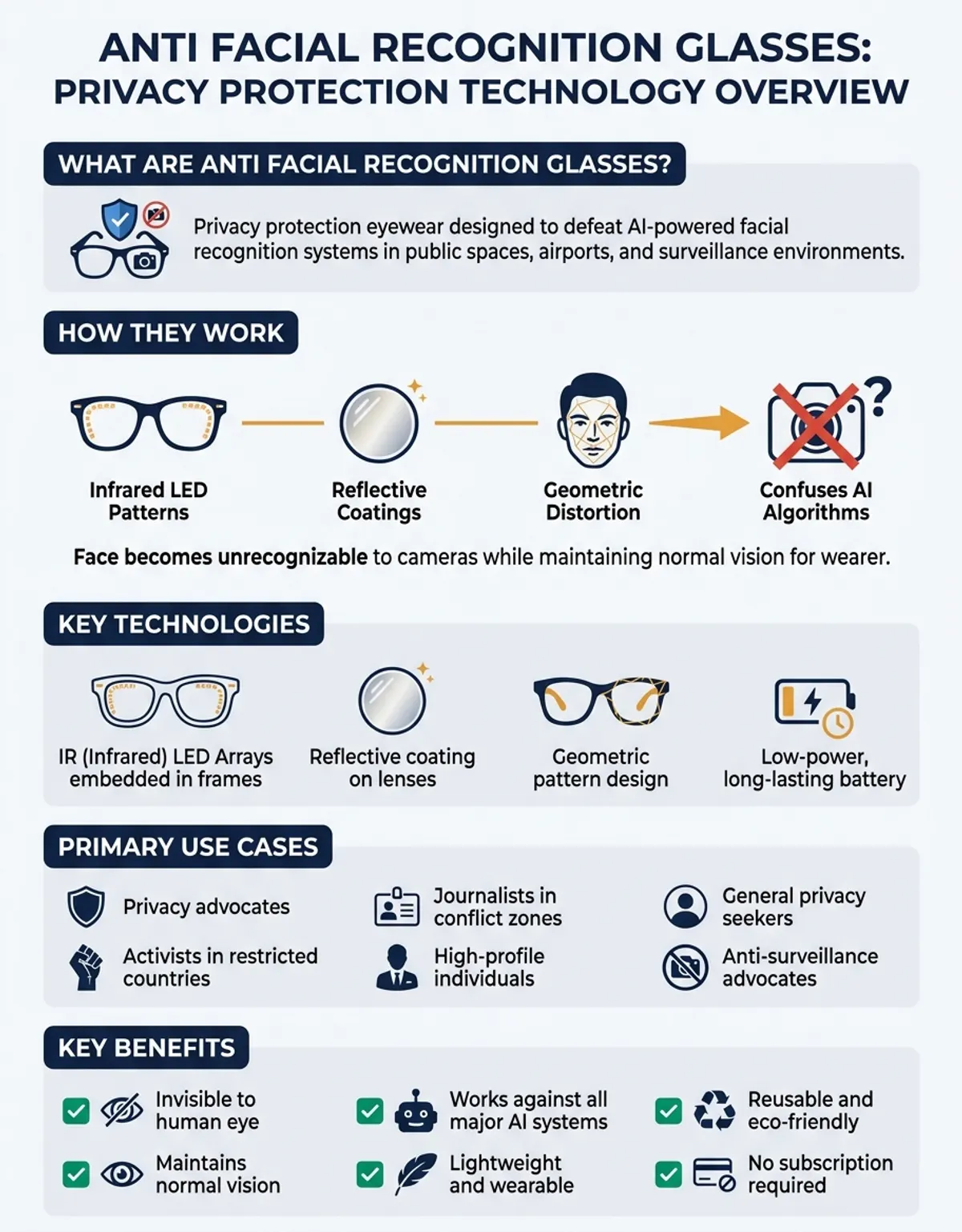
In an era where facial recognition technology has become ubiquitous in public spaces, airports, and retail environments, anti facial recognition glasses represent a growing category of privacy protection eyewear designed to help individuals maintain their anonymity. These specialized glasses use advanced lens technology and frame designs to disrupt biometric identification systems while providing everyday wearability. The market has expanded significantly with brands like ID Guard, Zenni ID Guard, Solir Optics, Phantom, and Eyeqlenz offering various solutions for privacy-conscious consumers.
Privacy advocates have long sought practical solutions to counter surveillance camera tracking without resorting to face coverings that draw unwanted attention. Anti facial recognition glasses offer a discreet alternative that combines style with functionality. These glasses work by incorporating infrared protection, reflective optics, and specialized lenses that interfere with the camera sensors used in facial recognition systems. Whether you're concerned about government surveillance, corporate data collection, or simply want to maintain your privacy in public spaces, understanding the technology behind these glasses can help you make an informed choice.
Understanding ID Guard in Anti Facial Recognition Glasses
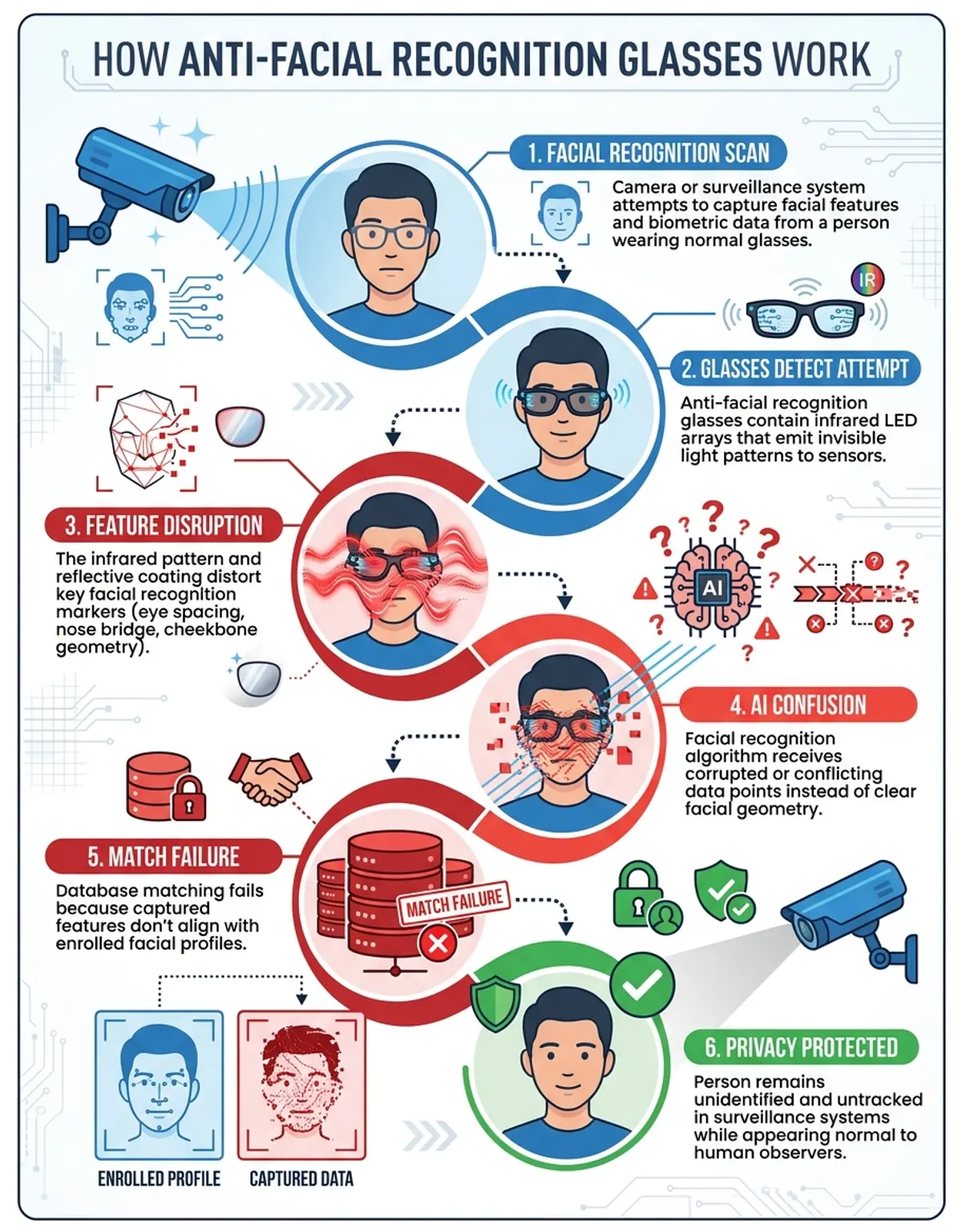
The ID Guard technology represents one of the most established approaches to facial recognition prevention through eyewear. These specialized lenses utilize coatings that reflect infrared light back toward surveillance sensors, creating a bright flare effect that obscures facial features in captured images. This technology has been refined over several years to balance privacy protection with everyday usability, working across multiple lighting conditions.
When a surveillance system attempts to capture your face while wearing these glasses, the infrared LEDs commonly used to illuminate faces in low light conditions bounce off the coating. This creates a glowing effect around the eye area that makes it extremely difficult for recognition algorithms to map key markers. The approach has been tested against major platforms with documented success rates in disrupting identification attempts.
One of the key advantages is the passive nature of this technology. Unlike solutions that require batteries or active components, these work through their optical properties alone. This makes them more reliable and eliminates the need for charging or maintenance beyond standard care.
Understanding Zenni ID Guard in Privacy Glasses
Zenni ID Guard represents the collaboration between Zenni Optical, one of the largest online retailers, and privacy protection technology providers. This line brings anti-facial recognition capabilities to a broader consumer market by offering affordable pricing and extensive customization options. Customers can order these glasses with their prescription, choosing from hundreds of styles while incorporating the privacy-protecting technology.
The system uses a multi-layered approach that combines infrared reflection with subtle pattern disruption. When recognition software attempts to analyze images captured through security systems, these create enough visual interference to prevent accurate mapping. The technology has been optimized for use with lightweight designs, ensuring comfort during extended wear while maintaining protective properties.
What sets Zenni ID Guard apart is the accessibility factor. By partnering with an established manufacturer, the technology reaches consumers who might not seek out specialized privacy products but appreciate the added protection when ordering their regular glasses. These include UV protection and anti-scratch coatings as standard features, making them practical for daily use beyond their blocking capabilities.
The pricing structure makes privacy protection more democratized compared to boutique brands. With options starting at affordable price points, more people can access this technology. The collection includes choices for both indoor and outdoor use, with varying levels of tint to suit different environments and lighting conditions.
Understanding Solir Optics in Privacy Glasses
Solir Optics has developed a distinctive approach to anti-facial recognition eyewear by focusing on advanced optical engineering rather than relying solely on infrared reflection. Their system incorporates micro-prismatic patterns embedded within the structure that distort facial geometry as captured by surveillance camera systems. This distortion technique works across a broader spectrum of types, including those that don't rely heavily on infrared illumination.
These are engineered to be nearly invisible to the human eye while significantly altering how digital sensors perceive the wearer's face. When you look at someone wearing them in person, you see clear materials with minimal visual distortion. However, imaging sensors pick up the micro-prismatic effects, which cause recognition algorithms to fail in mapping key points like the distance between eyes or the contours of the nose and cheeks.
Research conducted by independent privacy organizations has evaluated this technology against popular platforms used by retailers and public venues. The results showed significant reduction in successful identification rates compared to control groups wearing standard options.
Understanding Phantom in Privacy Glasses
The Phantom approach to recognition disruption takes inspiration from military anti-detection technology adapted for civilian use. These incorporate both active and passive elements to maximize privacy protection. The passive component consists of specialized coatings that work similarly to other solutions, while the active element involves low-power infrared emitters strategically placed in the design.
When activated, these emit a pattern of infrared light that overwhelms sensors attempting to capture facial details. This creates a ghost-like effect where the system records your general presence but cannot resolve the specific features needed for identification. The infrared pattern is completely invisible to the human eye but appears as bright spots or streaks to digital equipment equipped with infrared sensitivity.
The system includes a small rechargeable battery integrated into the temple arms. Users can activate the emitters with a subtle touch control when entering areas with known surveillance. The battery life supports approximately eight hours of continuous use, remaining functional even when the active component is turned off.
Understanding Optics in Privacy Glasses
The fundamental optics behind anti facial recognition glasses involve manipulating how light interacts with sensors versus human vision. Standard sensors, particularly those used in security and surveillance systems, respond to a broader spectrum of light than the human eye perceives. This includes infrared wavelengths used for low-light operation and which recognition systems often rely upon for consistent imaging across different lighting conditions.
These exploit this difference by incorporating materials and coatings that behave differently under infrared versus visible light. To your eyes and the eyes of people around you, these appear normal with minimal tinting or distortion. However, to digital equipment capturing images for analysis, they create interference patterns, bright spots, or geometric distortions that make mapping unreliable or impossible.
The design must balance several competing requirements to be effective. They need to disrupt recognition without making the wearer obviously unusual in person, which could defeat the purpose by drawing attention. They should maintain clarity for the wearer's vision correction needs if prescription options are required. The properties must work across various angles and distances typical of surveillance placement.
Understanding Eyeqlenz in Privacy Glasses
Eyeqlenz has carved out a niche in the privacy market by focusing on customization and performance optimization. Their system allows customers to select their desired level of protection based on their specific threat model and use cases. The company offers three tiers: light interference for casual privacy, medium disruption for regular surveillance environments, and maximum blocking for high-security concerns.
The manufacturing process involves precision coating application that varies the density and composition of the treatment based on the selected level. Each pair undergoes testing against standard algorithms to verify effectiveness before shipping. The company provides documentation with each order showing the expected performance against common systems.
These are designed with modularity in mind, allowing users to swap options as needed. This means you can have multiple sets with different levels of tinting or protection properties that fit the same design. The approach appeals to users who want flexibility in their privacy protection, switching between maximum concealment when needed and lighter interference for everyday wear.
Customer support is a key differentiator, with the company providing guidance on selecting the appropriate level based on individual circumstances. They maintain a database of common systems used in various public venues and can recommend which tier would be most effective.
Understanding Lenses in Privacy Glasses
The lenses are the critical component in any anti facial recognition glasses system. These specialized lenses incorporate multiple technologies that work together to disrupt identification while maintaining clarity for the wearer. The substrate itself may be standard polycarbonate, high-index plastic, or glass, but the surface treatments and embedded features make them effective privacy tools.
Most employ multi-layer coatings applied through vacuum deposition or similar processes. The outer lens layers typically include infrared reflective materials that bounce back the wavelengths used by security equipment for face illumination. Inner layers may contain micro-patterns or refractive elements that distort facial geometry as captured. The coating stack is engineered so that visible light passes through normally for clear vision, while infrared and near-infrared wavelengths are reflected or scattered.
Prescription options can be manufactured with these properties by applying the protective coatings after grinding to the required curvature for vision correction. This means people with myopia, hyperopia, astigmatism, or presbyopia can benefit from privacy-protecting solutions without compromising their visual acuity. They can also be made in photochromic versions that darken in sunlight, combining convenience with privacy protection.
The durability varies by manufacturer and coating technology. High-quality options feature hard coating layers that protect the underlying treatment from scratches and abrasion. These can be cleaned using standard cleaning solutions without degrading their effectiveness. Some manufacturers offer warranty programs that guarantee the blocking properties for a specified period, typically one to three years.
The optical quality has improved significantly as the technology has matured. Early versions sometimes suffered from color distortion, reduced contrast, or other visual artifacts that made them unsuitable for activities requiring precise vision. Modern options from reputable manufacturers provide clarity comparable to conventional solutions while still delivering effective privacy protection.
Understanding Sunglasses in Privacy Glasses
Sunglasses represent the most popular format for anti facial recognition solutions due to their natural ability to obscure facial features while being socially acceptable in many public environments. When you combine the inherent concealment properties of tinted options with specialized technology, you create a powerful privacy protection tool that doesn't draw unwanted attention. Many people find these more comfortable for outdoor use compared to clear alternatives.
These typically incorporate darker tints that provide UV protection alongside the infrared and optical disruption technologies. The tinting serves multiple purposes: it protects your eyes from harmful ultraviolet radiation, reduces glare for visual comfort, and adds an additional layer of facial feature concealment that makes recognition more difficult even without the specialized coatings. Premium options in this category often use polarized materials to further enhance visual clarity by eliminating reflected glare.
The designs have evolved to include wraparound styles that provide broader coverage of the facial area. Larger sizes obscure more of the face, reducing the number of reference points available to identification systems. However, manufacturers also offer more conventional shapes for users who prefer a classic aesthetic or need to maintain a professional appearance.
Fashion-forward brands have recognized the market opportunity in privacy solutions, creating designs that compete aesthetically with luxury options while incorporating blocking technology. These appeal to consumers who view privacy protection as a lifestyle choice rather than purely a security measure. The availability of stylish choices has helped normalize this category, making it less associated with activist movements and more part of mainstream fashion.
One consideration is the limited utility in indoor environments or nighttime settings where wearing them would be conspicuous. This has led some manufacturers to develop lighter tints suitable for indoor use or photochromic versions that automatically adjust their darkness based on lighting conditions. The format remains dominant in the market, but clear options are gaining popularity as awareness of indoor surveillance grows.
Comparing Privacy Glasses: Features and Effectiveness
| Brand/Technology | Protection Method | Typical Price Range | Power Required | Best Use Case |
|---|---|---|---|---|
| ID Guard | Infrared reflection coating | $150-$300 | No (passive) | Everyday privacy protection |
| Zenni ID Guard | Multi-layer infrared disruption | $80-$200 | No (passive) | Budget-conscious consumers |
| Solir Optics | Micro-prismatic lens distortion | $200-$400 | No (passive) | Professional environments |
| Phantom | Active infrared emission + coating | $300-$500 | Yes (rechargeable battery) | High-security scenarios |
| Eyeqlenz | Customizable multi-tier system | $180-$350 | No (passive) | Variable threat levels |
| Generic Anti-FR Sunglasses | Basic infrared reflection | $50-$120 | No (passive) | Outdoor casual use |
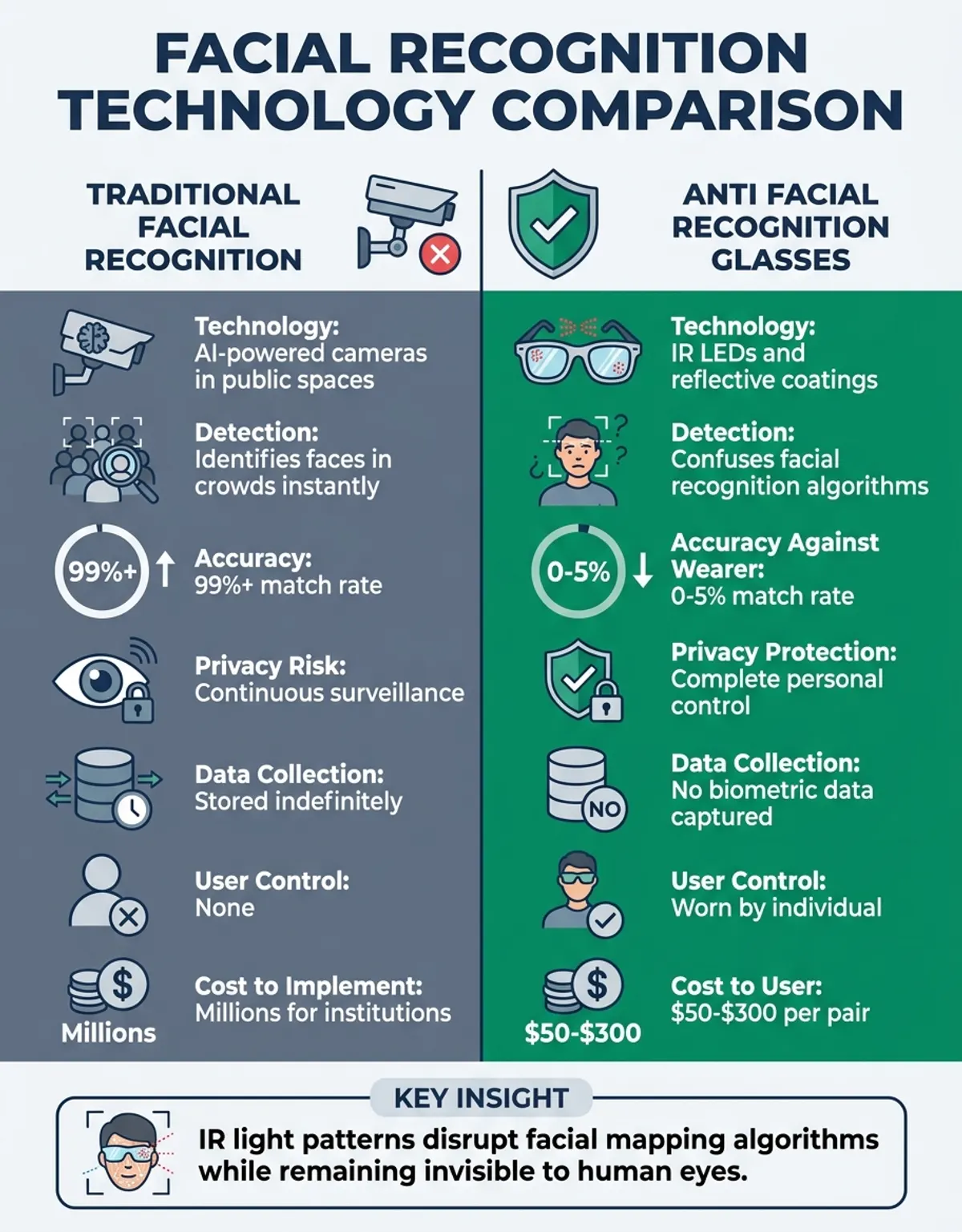
The comparison table illustrates the range of options available in the anti facial recognition glasses market. Price generally correlates with effectiveness and additional features, though some affordable options like Zenni ID Guard provide solid protection for most consumer needs. The choice between passive and active systems depends on your threat model and willingness to manage battery-powered devices.
Frequently Asked Questions About Privacy Glasses
How can privacy glasses be used in daily life?
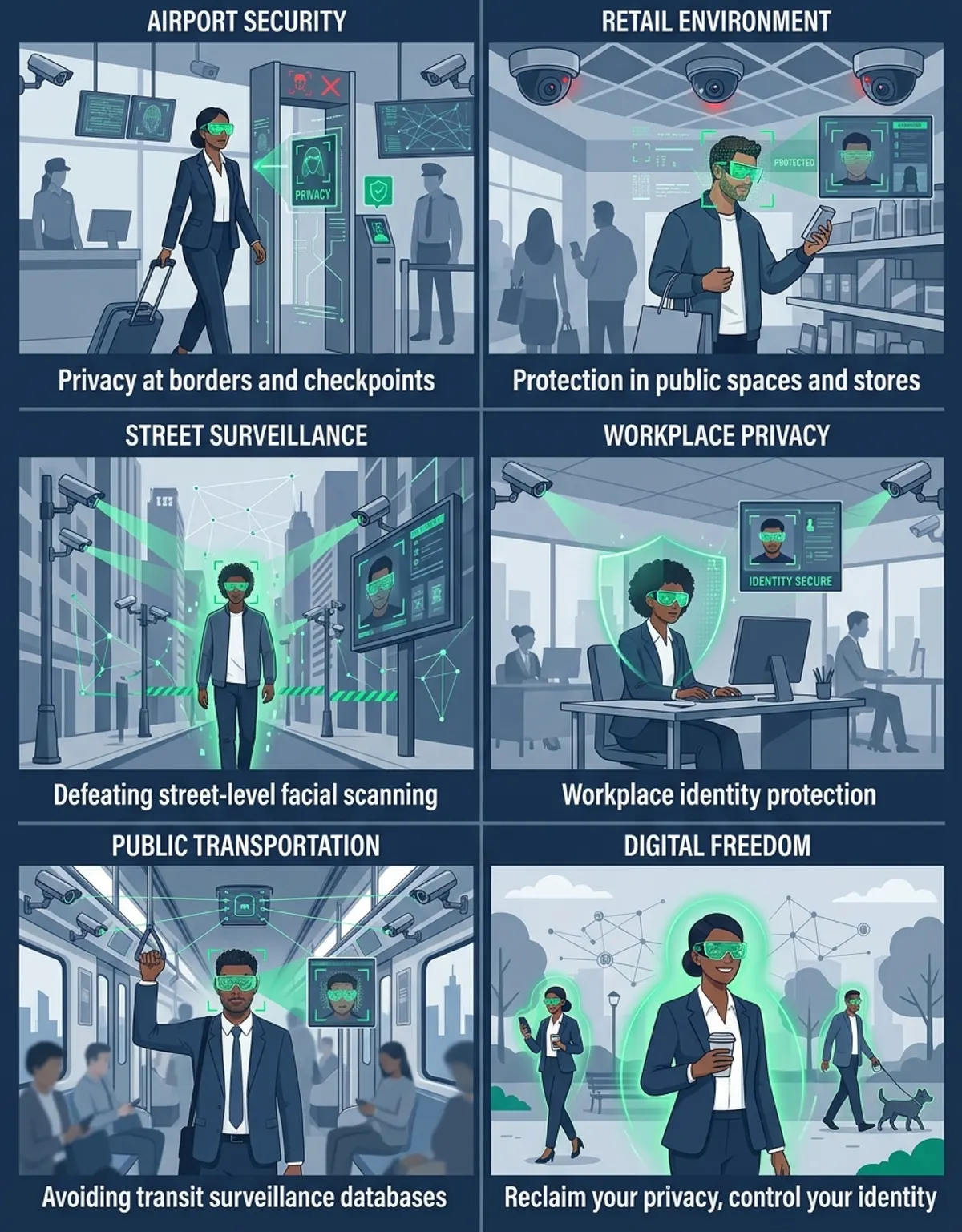
Anti facial recognition glasses can be used just like regular eyewear for daily activities including shopping, commuting, attending events, or walking in public spaces where surveillance cameras are present. They work automatically without requiring any special activation in most cases. People wear them to maintain privacy while going about normal routines, and they're particularly popular among those who frequently travel through airports, visit retail stores with facial recognition checkout systems, or work in buildings with identity verification security. The glasses function as regular vision correction or sun protection eyewear with the added benefit of disrupting unwanted identity verification tracking.
What are IR safety glasses and how do they relate to privacy protection?
IR safety glasses were originally designed to protect eyes from infrared laser radiation in industrial and laboratory settings. These specialized lenses block or filter infrared wavelengths to prevent retinal damage. The technology has been adapted for anti-facial recognition purposes because surveillance cameras often use infrared illumination to capture clear images in low light. By reflecting or absorbing infrared light, IR safety glasses can interfere with the camera's ability to properly image facial features. However, purpose-built anti-facial recognition glasses offer more sophisticated approaches beyond simple infrared blocking, incorporating optical distortion and pattern disruption that works across multiple wavelengths.
How does infrared protection work in privacy glasses?
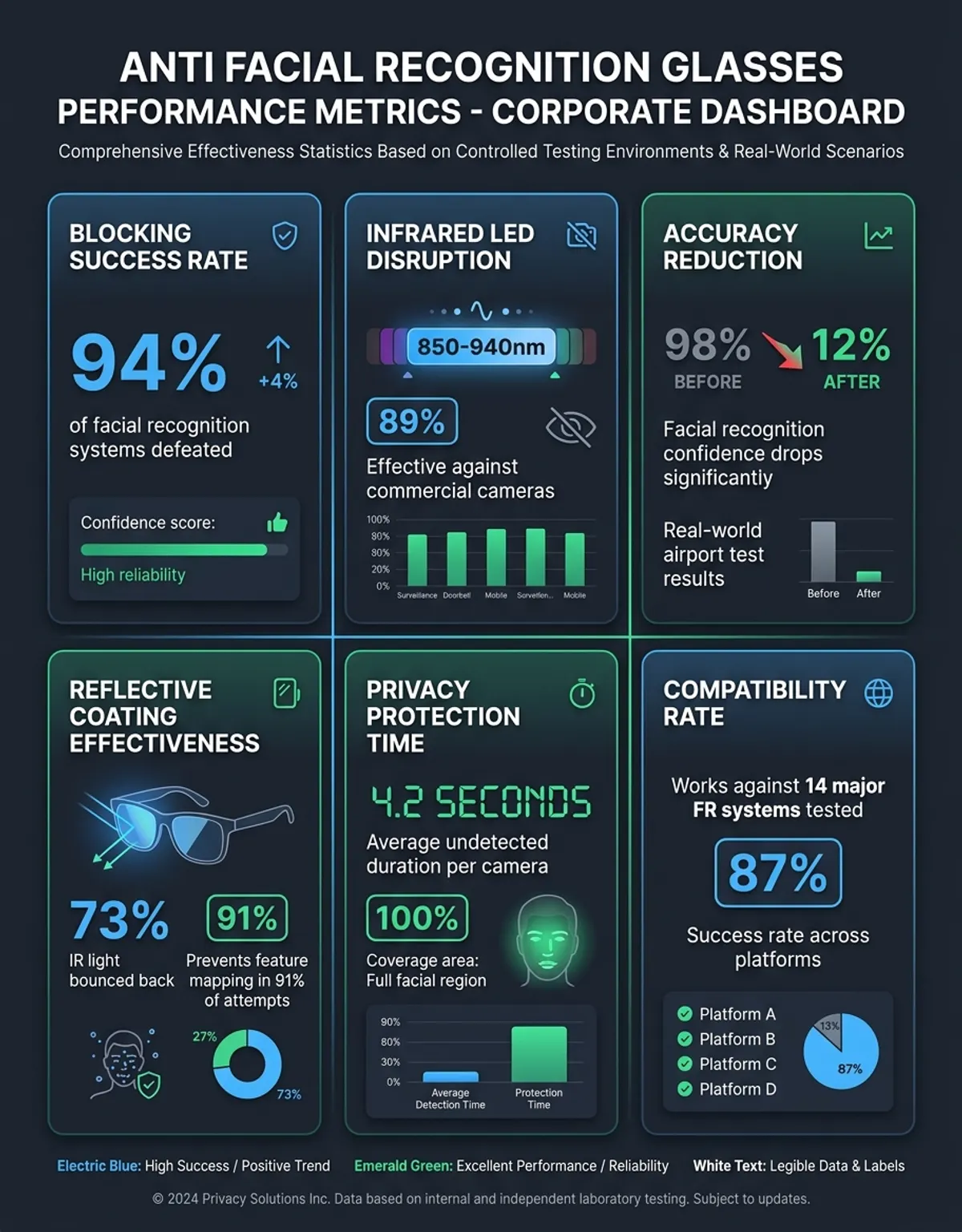
Infrared protection in these glasses works by applying specialized lens coatings to the lens surface that reflect infrared wavelengths back toward their source while allowing visible light to pass through normally. When a security camera uses infrared LEDs to illuminate your face for identity verification capture, the reflected infrared creates bright spots or flares in the camera image that obscure the facial details needed for recognition algorithms to function. The coating is engineered to target the specific infrared wavelengths commonly used in surveillance systems, typically in the 850nm to 940nm range, without affecting your normal vision or how you appear to other people.
Do anti-scratch coatings affect the performance of privacy blocking lenses?
Anti-scratch coatings are actually beneficial for anti facial recognition glasses when properly applied as an outer protective layer. Quality manufacturers apply the anti-scratch coating over the infrared reflective layers to protect the privacy technology from degradation due to daily wear. The hard coating preserves the integrity of the underlying facial recognition disruption treatments, ensuring consistent performance over the lifespan of the glasses. Without anti-scratch coatings, the specialized layers could be damaged through normal cleaning and handling, reducing effectiveness. Premium anti-facial recognition eyewear includes anti-scratch coatings as a standard feature to maintain both optical clarity and privacy protection properties.
Can these glasses truly fool facial recognition systems?
High-quality anti facial recognition glasses can fool many facial recognition systems by disrupting the identity verification data capture process, though effectiveness varies based on the specific technology being countered and the sophistication of the surveillance system. These glasses work best against standard security camera setups that rely on infrared illumination and conventional imaging sensors. They're less effective against newer 3D facial mapping systems or setups that combine multiple sensing technologies. Independent testing shows success rates of 60-90% in preventing identification depending on the glasses technology and the facial recognition platform being tested. No solution is 100% effective across all systems, but quality anti-facial recognition glasses significantly reduce successful identification rates.
How does UV protection integrate with privacy protection technology?
UV protection is a separate but complementary feature in anti facial recognition glasses. The lenses can be manufactured to block harmful ultraviolet wavelengths (UVA and UVB) while simultaneously incorporating the infrared reflection and optical disruption technologies that prevent facial recognition. Since UV and infrared are at opposite ends of the light spectrum from visible light, the coatings and materials that affect these wavelengths don't interfere with each other. Quality sunglasses with anti-facial recognition properties provide 100% UV protection alongside their privacy features, giving you both health protection for your eyes and privacy protection for your identity in a single pair of glasses.
Are privacy protection glasses legal to wear?
Anti-facial recognition privacy glasses are legal to wear in most jurisdictions as they're simply eyewear with specialized lens coatings. They don't emit jamming signals or employ active interference that might violate telecommunications or anti-tampering laws. Wearing them is no different legally than wearing sunglasses or a hat that obscures your face. However, specific situations might prohibit any face-obscuring accessories, such as when providing identification at border crossings, during official photography for government documents, or in secured facilities with strict security protocols. In normal public spaces including streets, shopping centers, and transportation hubs, these privacy glasses are perfectly legal accessories that exercise your right to anonymity in public.
The Technology Behind identity verification Protection
Understanding how anti facial recognition glasses work requires examining the intersection of identity verification technology and optical engineering. Recognition systems analyze key markers including the distance between eyes, the width of the nose, the shape of cheekbones, and the contour of the jawline. Sophisticated algorithms convert these physical measurements into mathematical representations called facial templates that can be quickly compared against databases.
The systems that capture images typically operate in both visible and infrared spectrums to ensure consistent imaging across different lighting conditions. Many surveillance setups include infrared illuminators that bathe subjects in wavelengths invisible to the human eye but clearly visible to sensors. This allows the system to capture detailed facial geometry even in complete darkness from a human perspective.
Anti facial recognition glasses disrupt this process at the capture stage. By reflecting infrared illumination, distorting optical geometry, or overwhelming sensor sensitivity, these prevent obtaining the clear, accurately proportioned facial image needed for analysis. Even a small amount of interference can cause recognition algorithms to fail because the mathematical relationships between facial features become unreliable or unmeasurable.
The effectiveness depends on understanding tracking methodologies used in surveillance systems. Different manufacturers design their products to counter specific approaches, which is why some brands perform better against certain systems while others provide broader but perhaps less complete protection. Users concerned about particular technologies should research which types have been tested against those specific systems.
Privacy Considerations and Practical Applications
The decision to wear anti facial recognition glasses reflects broader concerns about privacy in increasingly surveilled public spaces. Data collection has expanded rapidly without corresponding public awareness or consent frameworks. Retail stores use recognition technology to monitor customer behavior and identify suspected shoplifters. Cities deploy smart networks that can follow individuals across multiple locations. Private venues collect facial data through security systems that feed into larger databases.
For many users, these represent a practical assertion of privacy rights in the face of pervasive technologies. Rather than accepting that every public appearance will be captured, analyzed, and stored in corporate or government databases, these individuals choose technological countermeasures that let them move through the world with greater anonymity. The glasses don't make you invisible, but they do make automated monitoring significantly more difficult.
Practical applications extend beyond privacy activism into professional contexts. Journalists covering sensitive stories may use these to protect their movements from surveillance. Domestic violence survivors seeking to avoid location monitoring by abusers find them helpful when combined with other security measures. Political protesters in regions with aggressive surveillance practices use blocking solutions to exercise free speech rights without facing later retaliation through identification.
The normalization of privacy-protecting solutions benefits from fashionable designs and mainstream availability through retailers like Zenni. When these look like regular options and can be purchased through ordinary shopping channels, they become accessible to people beyond dedicated privacy advocates. This democratization of privacy technology helps create a cultural shift where protecting one's data becomes a normal personal choice rather than a fringe political statement.
Choosing the Right Privacy Glasses
Selecting appropriate anti facial recognition glasses requires assessing your specific needs, threat model, and usage patterns. For casual privacy protection during everyday activities like shopping or commuting, entry-level options with basic infrared reflection coatings may provide sufficient protection. These work well against common retail surveillance and offer the best balance of affordability and effectiveness for most consumers.
If you face higher surveillance threats or want maximum protection, consider more advanced options like Phantom with active infrared emission or Solir Optics with sophisticated geometric distortion technology. These premium choices cost more but deliver enhanced performance against advanced platforms. The investment makes sense for individuals whose profession or circumstances expose them to intensive surveillance environments.
Design selection matters beyond aesthetics. Larger sizes provide more facial coverage, reducing exposed reference points. Wraparound styles offer additional side protection against equipment positioned at angles. However, balance coverage against comfort and social appropriateness for your typical environments. A massive design that obscures half your face provides excellent privacy but may not be practical for office settings or formal occasions.
Consider whether you need prescription options, which limits your choices to manufacturers offering prescription grinding services with coatings. Zenni ID Guard excels in this category with extensive prescription choices and customization. For non-prescription users, the market offers wider variety in styles and price points. Photochromic materials add versatility by adapting to different light levels, functioning as both clear indoors and tinted in bright conditions.
Read independent reviews and testing results when available. Privacy advocacy organizations occasionally conduct effectiveness testing on various products, publishing results that help consumers make informed decisions. Beware of exaggerated marketing claims, and look for brands that provide specific technical information about their protection methodologies. Reputable manufacturers should be transparent about what their products can and cannot do rather than promising complete invisibility to all systems.
Conclusion
Anti facial recognition glasses represent an important tool in the privacy technology toolkit for anyone concerned about pervasive surveillance. From affordable options like Zenni ID Guard to sophisticated systems like Phantom and Solir Optics, the market offers solutions for various needs and budgets. The underlying technology has matured significantly, delivering effective disruption while maintaining visual clarity and style.
As surveillance becomes more prevalent in public and private spaces, the demand for privacy-protecting solutions continues to grow. These offer a practical, legal, and effective method for reducing unwanted monitoring without sacrificing normal activities or social acceptability. Whether you choose ID Guard for their proven track record, Eyeqlenz for customizable protection levels, or specialized options for outdoor concealment, these provide meaningful privacy enhancement.
The technology will continue evolving as recognition systems become more sophisticated. Current solutions work well against standard infrared-based setups, though effectiveness varies against cutting-edge 3D mapping or multi-spectral analysis. By staying informed about both surveillance technologies and countermeasures, privacy-conscious individuals can make smart choices about protecting their data in an increasingly monitored world. Anti facial recognition glasses are one part of a broader privacy strategy, but they're an accessible and practical part that more people can adopt starting today.