
Face Recognition for Digital Payments
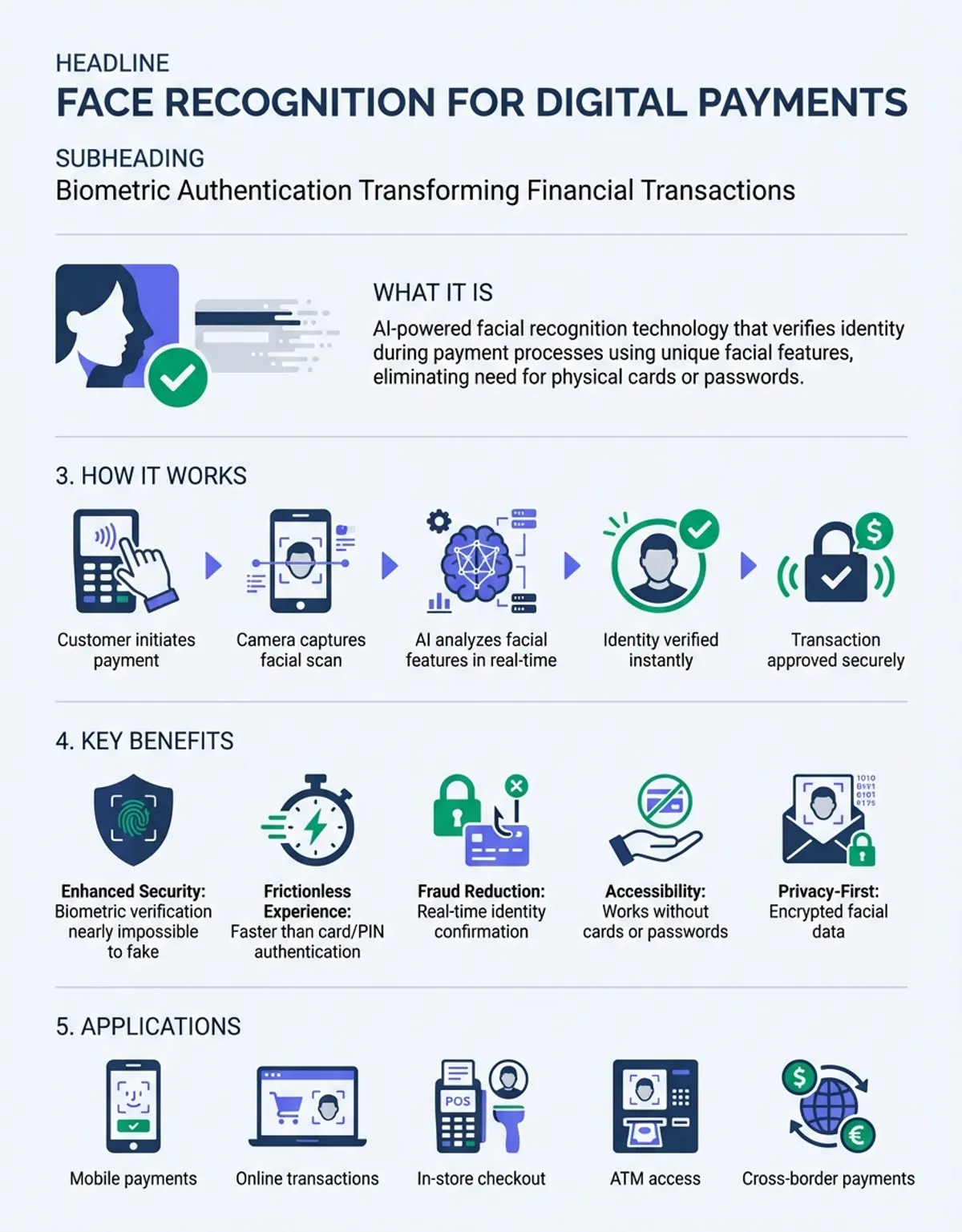
Face recognition for digital payments represents a transformative shift in how financial transactions are authenticated and processed. This biometric authentication technology uses facial features to verify identity during payment processes, eliminating the need for physical cards, PINs, or passwords. As contactless payment methods continue gaining adoption, facial recognition offers enhanced security while delivering seamless user experiences across various applications.
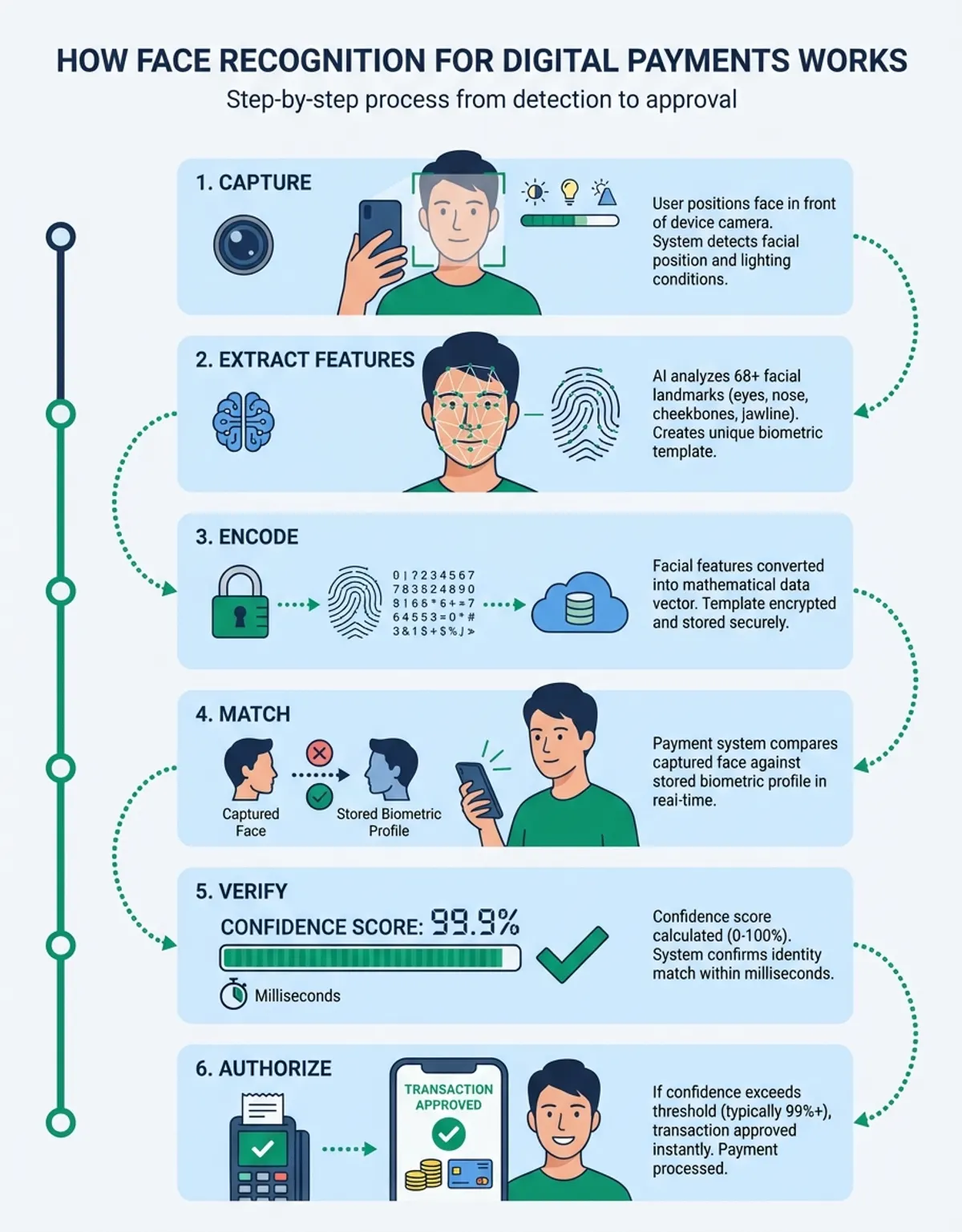
The technology works by capturing a user's facial data through a device camera, converting unique facial characteristics into encrypted biometric data, and matching it against stored templates to complete authentication. Major payment systems worldwide have integrated this capability, with biometric payments projected to process billions in transaction volume annually. Understanding how face recognition enhances security in digital payments is essential for both consumers and businesses navigating the evolving financial landscape.
Understanding Biometric Payments in Face Recognition for Digital Payments
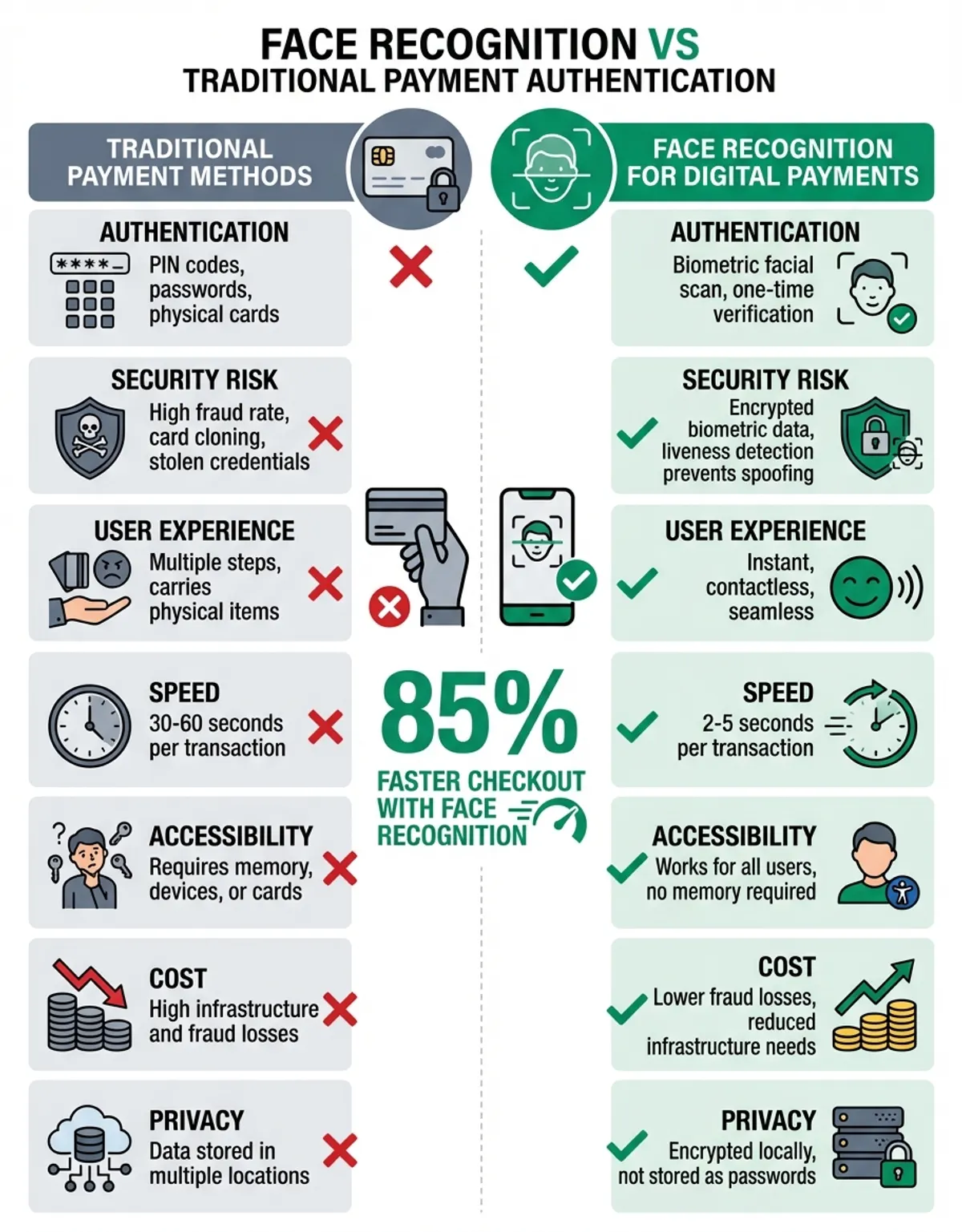
Biometric payments leverage physiological characteristics to authenticate users during financial transactions. Face recognition serves as one of the most convenient forms of biometric authentication, requiring only a brief camera scan to verify identity. Unlike traditional payment methods that rely on something you have (a card) or something you know (a PIN), biometric payment systems authenticate based on who you are.
The adoption of biometric payments has accelerated dramatically as consumers demand faster, more secure transaction methods. Face recognition technology integrates seamlessly with existing payment infrastructure, allowing retailers and financial institutions to upgrade security without requiring significant hardware investments. Modern smartphones already contain the necessary cameras and processing power to support facial recognition payments.
Several key advantages distinguish biometric payments from conventional methods. First, users cannot lose or forget their face, eliminating common frustrations associated with physical payment cards. Second, the authentication process completes in seconds, significantly reducing checkout times. Third, biometric payment systems create detailed transaction logs that help detect fraud patterns and unauthorized access attempts.
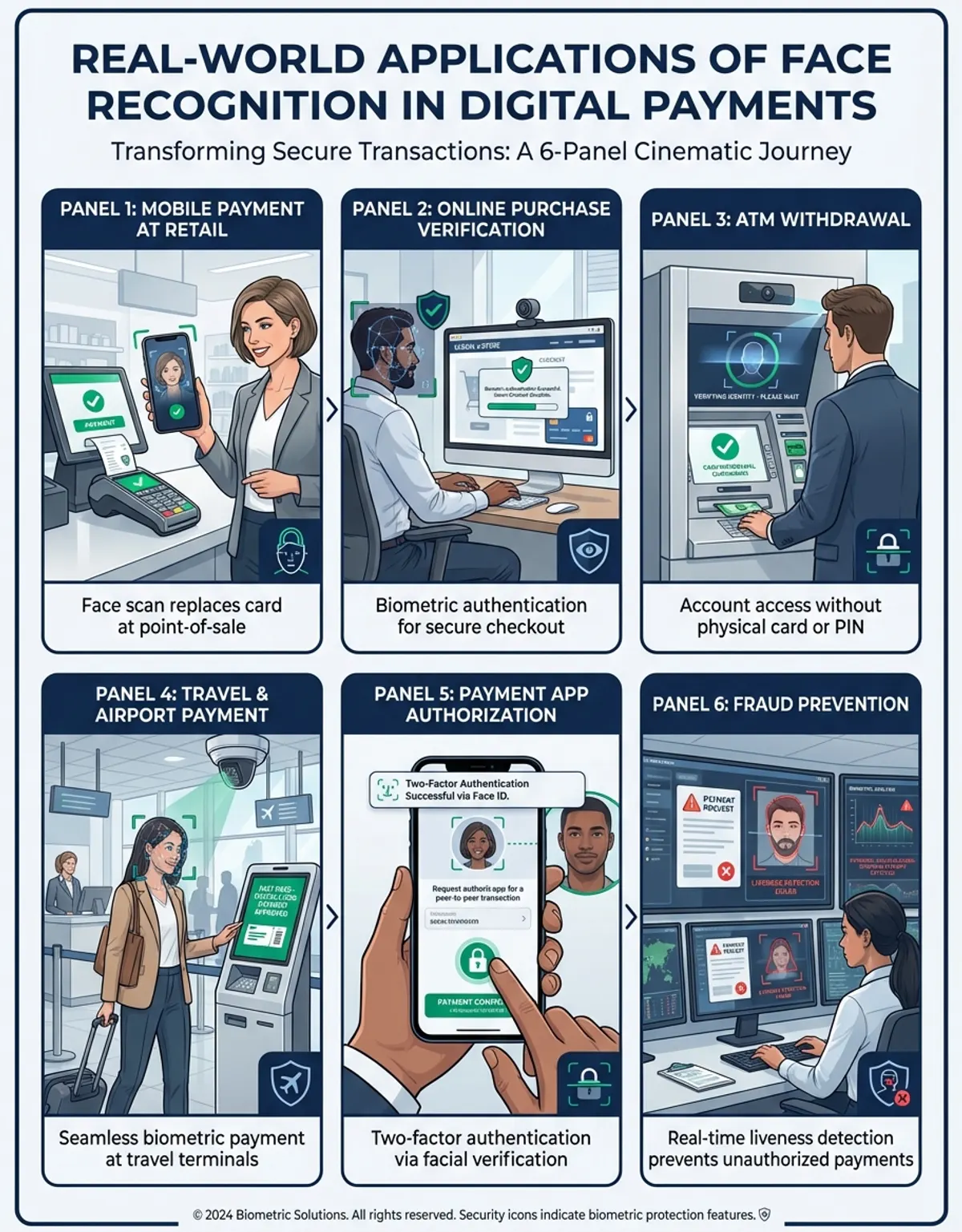
Implementation models vary across different payment environments. Point-of-sale terminals equipped with cameras can scan customer faces during checkout, while mobile payment applications use device cameras for authentication. Some biometric payment systems operate through dedicated kiosks in retail environments, whereas others function entirely through smartphone applications that communicate with payment processors.
Understanding Security in Face Recognition for Digital Payments
Security forms the cornerstone of any payment system, and facial recognition introduces multiple protective layers. Modern face recognition algorithms analyze dozens of facial landmarks, measuring distances between features with sub-millimeter precision. This granular analysis creates highly unique biometric templates that are extremely difficult to replicate or spoof.
Encryption protocols protect facial data throughout the authentication process. When a user enrolls in a facial recognition payment system, their biometric template undergoes encryption before storage. During transactions, the system compares encrypted templates rather than raw facial images, ensuring sensitive biometric information remains protected even if security breaches occur.
Advanced security measures address various attack vectors. Anti-spoofing technology detects attempts to fool the system using photographs, videos, or masks. Multi-factor authentication combines facial recognition with additional verification methods, creating redundant security layers. Transaction limits and behavioral analysis provide further protection by flagging unusual payment patterns that may indicate compromised accounts.
Regulatory frameworks increasingly mandate strict security standards for biometric payment systems. Compliance requirements address data protection, user consent, and system resilience. Financial institutions implementing face recognition must demonstrate that their security measures meet or exceed industry benchmarks, undergo regular audits, and maintain transparent policies regarding biometric data handling.
The security benefits extend beyond fraud prevention. Face recognition creates comprehensive audit trails, documenting exactly who authorized each transaction and when. This accountability deters internal fraud while simplifying dispute resolution. Payment processors can quickly verify whether the authorized account holder was physically present during contested transactions.
Understanding Detection in Face Recognition for Digital Payments
Detection capabilities within facial recognition systems determine their effectiveness at identifying legitimate users while rejecting imposters. The detection process begins when a camera captures an image containing one or more faces. Advanced algorithms locate facial regions, assess image quality, and determine whether sufficient detail exists for reliable authentication.
Modern detection systems employ deep learning neural networks trained on millions of facial images. These networks recognize faces across varying lighting conditions, camera angles, and partial obstructions. The detection phase filters out low-quality captures that could compromise authentication accuracy, requesting additional scans when necessary to ensure reliable results. For a comprehensive overview, explore our face recognition guide.
Fraud detection mechanisms work in parallel with identity verification. Machine learning models analyze transaction patterns, identifying anomalies that suggest fraudulent activity. When detection systems flag suspicious behavior, they can require additional authentication factors or temporarily suspend payment capabilities pending manual review.
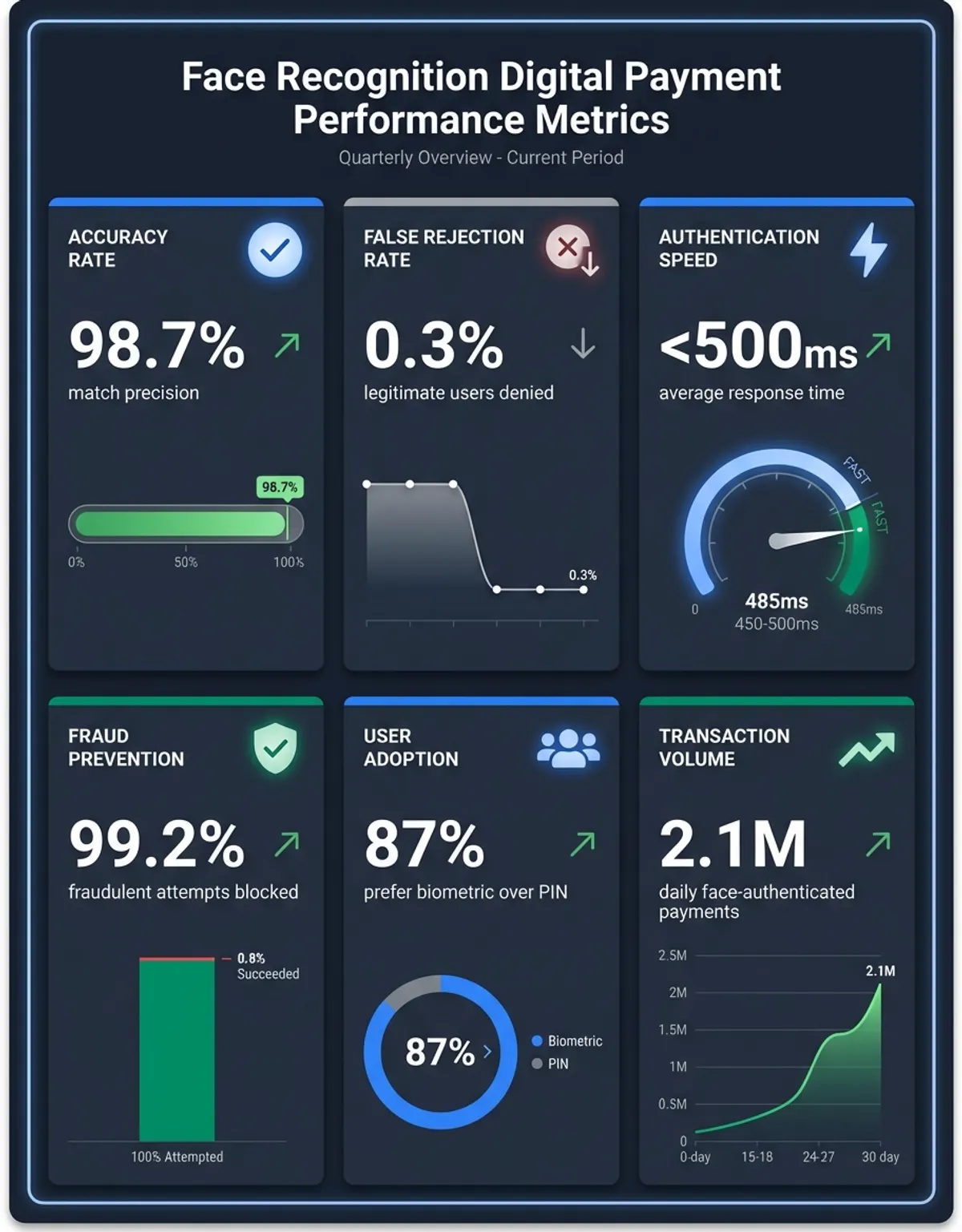
Detection accuracy varies based on environmental factors and system sophistication. Premium systems achieve detection rates exceeding 99.9% under optimal conditions, while budget implementations may experience higher error rates. Payment providers must balance detection sensitivity with user convenience, calibrating systems to minimize both false rejections and security vulnerabilities.
Understanding Liveness in Face Recognition for Digital Payments
Liveness verification ensures the face being scanned belongs to a living person physically present during authentication, not a photograph or video recording. This critical security component prevents presentation attacks where fraudsters attempt to bypass facial recognition using static images or pre-recorded footage of authorized users.
Active liveness detection requires users to perform specific actions during authentication, such as blinking, turning their head, or following on-screen prompts. These dynamic movements prove the presence of a living person rather than a two-dimensional representation. While effective, active liveness checks add seconds to the authentication process and may frustrate some users.
Passive liveness detection analyzes subtle characteristics without requiring user actions. Advanced algorithms detect micro-movements in facial muscles, assess how light reflects off skin surfaces, and analyze depth information to distinguish three-dimensional faces from flat images. Passive liveness provides superior user experiences but demands more sophisticated hardware and processing capabilities.
Hybrid approaches combine active and passive liveness techniques, adapting detection methods based on risk assessment. Low-value transactions might use only passive liveness checks to optimize speed, while high-value payments trigger more rigorous active verification. This adaptive security balances protection with user convenience across different transaction scenarios.
Understanding Authentication in Face Recognition for Digital Payments
Authentication represents the core function where facial recognition systems verify that the person requesting payment authorization matches the legitimate account holder. The authentication process compares the live facial scan against stored biometric templates, calculating similarity scores to determine whether a match exists.
Biometric authentication offers significant advantages over traditional methods. Passwords can be stolen, guessed, or shared, while physical tokens can be lost or duplicated. Facial characteristics remain unique to each individual and cannot be easily transferred, creating inherent security that password-based systems cannot match.
You may also find our guide on Face Recognition In Healthcare Applications helpful for deeper context on this topic.
Authentication thresholds determine how closely a live scan must match stored templates for approval. Stricter thresholds enhance security but increase false rejection rates, potentially frustrating legitimate users. Payment providers carefully calibrate these thresholds based on fraud risk, transaction values, and user acceptance levels.
Multi-modal authentication combines facial recognition with other biometric methods such as fingerprint scanning or voice recognition. This layered approach dramatically reduces fraud risk, as compromising multiple biometric factors simultaneously becomes exponentially more difficult. High-security payment environments often mandate multi-modal authentication for transactions exceeding certain thresholds.
Authentication speed directly impacts user adoption. Modern systems complete verification in under two seconds, matching or exceeding the convenience of traditional payment methods. As processing power continues advancing, authentication times will further decrease, making facial recognition the fastest available payment authorization method.
Continuous authentication monitors users throughout extended sessions rather than verifying identity only at transaction initiation. This approach detects account takeover attempts that occur after initial authentication, providing ongoing protection during complex payment workflows or multi-step purchase processes.
Understanding Biometric Payment Systems in Face Recognition for Digital Payments
Biometric payment systems integrate facial recognition technology with payment processing infrastructure, creating end-to-end solutions for secure financial transactions. These systems encompass enrollment processes, template storage, authentication mechanisms, payment authorization, and transaction processing components working in coordinated fashion.
Implementation architectures vary based on deployment context. Cloud-based biometric payment systems centralize template storage and processing, enabling consistent experiences across multiple devices and locations. Edge-based systems perform authentication locally on user devices, enhancing privacy by keeping biometric templates under direct user control rather than storing them on remote servers.
Integration with existing payment networks requires careful coordination. Biometric payment systems must interface with card networks, banking systems, point-of-sale terminals, and mobile payment platforms. Standardized protocols enable interoperability, allowing users to authenticate via facial recognition regardless of which payment network processes their transaction.
Enrollment procedures establish the foundation for all subsequent authentication attempts. During initial setup, users capture multiple facial images from different angles under varying lighting conditions. These diverse samples enable the system to build comprehensive biometric templates that accommodate natural variations in appearance. The enrollment phase typically requires users to remove glasses or other obstructions that might interfere with facial feature detection.
For further reading on related concepts, explore our Face Recognition By Photo guide.
Template management practices directly impact both security and user experience. Regular template updates accommodate gradual changes in appearance due to aging, while version control ensures systems can roll back to previous templates if updates cause authentication problems. Biometric payment systems maintain strict access controls over template databases, implementing encryption at rest and in transit to prevent unauthorized access to sensitive facial data.
Understanding Payment Systems in Face Recognition for Digital Payments
Payment systems incorporating facial recognition transform how consumers interact with financial services. These platforms support diverse transaction types including retail purchases, peer-to-peer transfers, bill payments, and online shopping. Facial recognition streamlines each use case by replacing manual credential entry with instant biometric verification.
Retail payment systems equipped with facial recognition eliminate checkout friction. Customers approach payment terminals, glance at cameras for authentication, and complete purchases without touching cards or entering codes. This contactless approach gained particular relevance during health crises when minimizing physical contact became paramount.
Mobile payment systems leverage smartphone cameras for facial recognition, enabling users to authorize transactions through applications. Banking apps, digital wallets, and merchant payment platforms increasingly incorporate this capability, providing consistent authentication experiences across different financial services.
Cross-border payment systems face unique challenges when implementing facial recognition. Regulatory requirements vary internationally, template formats may lack standardization, and privacy expectations differ across cultures. Global payment providers must navigate these complexities while maintaining seamless user experiences for international customers.
Enterprise payment systems serve business-to-business transactions where security requirements often exceed consumer-facing applications. Organizations implementing facial recognition for corporate payments benefit from detailed audit capabilities, hierarchical approval workflows, and integration with expense management platforms. These enterprise-focused payment systems support complex authorization rules that may require multiple biometric authentications for high-value transactions.
Subscription and recurring payment systems leverage facial recognition to streamline ongoing authorizations. After initial setup, users can approve recurring charges through quick facial scans rather than repeatedly entering payment credentials. This convenience particularly benefits subscription services, membership organizations, and utility companies processing regular payments from established customer bases.
Understanding Liveness Detection in Face Recognition for Digital Payments
Liveness detection specifically combats spoofing attempts that threaten payment security. Sophisticated presentation attacks employ high-resolution photographs, realistic masks, or deepfake videos to impersonate legitimate users. Advanced liveness detection systems employ multiple verification strategies to defeat these increasingly sophisticated fraud attempts.
Infrared scanning detects temperature patterns unique to living skin, distinguishing real faces from photographs or masks. Depth sensing cameras measure facial topology, identifying flat images that lack three-dimensional characteristics. Texture analysis examines skin properties at microscopic levels, detecting artificial materials used in mask-based attacks.
Challenge-response mechanisms randomly generate verification tasks that would be difficult to pre-record. Users might receive instructions to look in specific directions, speak random phrases, or perform precise facial movements. The unpredictability ensures attackers cannot prepare spoofing materials in advance.
Multi-spectral analysis combines visible light imaging with infrared or ultraviolet scanning to detect subtle characteristics invisible to standard cameras. Living skin exhibits distinct reflectance properties across different wavelengths, creating signatures that artificial materials cannot replicate. Payment systems employing multi-spectral liveness detection achieve superior fraud prevention compared to single-spectrum approaches.
Behavioral biometrics supplement liveness detection by analyzing how users interact with payment interfaces. Factors including device holding angle, facial positioning consistency, and interaction timing create unique behavioral patterns. When these patterns deviate significantly from established baselines, payment systems may trigger additional verification steps even when liveness detection passes initial checks.
Comparison of Face Recognition Payment Technologies
| Technology Type | Authentication Speed | Security Level | Device Requirements | Best Use Case |
|---|---|---|---|---|
| 2D Facial Recognition | 1-2 seconds | Medium | Standard camera | Low-value retail transactions |
| 3D Facial Recognition | 2-3 seconds | High | Depth-sensing camera | High-value payments, sensitive accounts |
| Infrared Facial Recognition | 2-4 seconds | Very High | IR camera array | Financial institutions, enterprise payments |
| Multi-Modal Biometric | 3-5 seconds | Maximum | Multiple biometric sensors | Critical infrastructure, large transactions |
| Passive Liveness + 2D | 1-2 seconds | Medium-High | Advanced standard camera | Mobile payments, general retail |
Frequently Asked Questions
How does face recognition payment work?
Face recognition payment works by capturing your facial features through a camera, converting them into encrypted biometric data, and comparing that data against stored templates to verify your identity. Once authentication succeeds, the system authorizes the transaction and processes the payment through connected financial networks. The entire process typically completes in under three seconds, providing faster authentication than traditional PIN entry or signature verification.
What makes facial recognition secure for financial transactions?
Facial recognition achieves security through multiple layers including unique biometric templates that are extremely difficult to replicate, encryption of stored facial data, liveness detection that prevents spoofing with photos or videos, and detailed audit trails documenting each authentication attempt. Advanced systems analyze dozens of facial landmarks with sub-millimeter precision, creating authentication factors far more complex than traditional passwords or PINs.
How does liveness detection prevent fraud in digital payments?
Liveness detection prevents fraud by verifying that the face being scanned belongs to a living person physically present during the transaction rather than a photograph, video, or mask. Systems accomplish this through techniques like requiring users to blink or move their head, analyzing skin texture and temperature, measuring facial depth with specialized cameras, and detecting subtle micro-movements in facial muscles that photographs cannot replicate.
Can biometric payment systems work with existing payment infrastructure?
Yes, biometric payment systems integrate with existing payment infrastructure through standardized protocols that enable communication between facial recognition systems and traditional payment networks. Modern implementations work with card networks, point-of-sale terminals, banking systems, and mobile payment platforms. This compatibility allows businesses to add facial recognition capabilities without completely replacing their current payment processing equipment.
What happens to my facial data in payment systems?
Your facial data undergoes conversion into encrypted biometric templates that do not store actual images of your face. These templates remain encrypted during storage and transmission, protecting sensitive information even if data breaches occur. Regulatory frameworks increasingly mandate strict controls over biometric data, requiring user consent, limiting data retention periods, and prohibiting unauthorized sharing with third parties.
How accurate is facial recognition for authentication in payments?
Modern facial recognition systems achieve accuracy rates exceeding 99.9% under optimal conditions, with false acceptance rates below 0.01% for premium implementations. Accuracy varies based on factors including image quality, lighting conditions, camera specifications, and algorithm sophistication. Payment providers continuously refine their systems through machine learning, improving accuracy over time as they process more authentication attempts.
What device requirements are needed for facial recognition payments?
Basic facial recognition payments require only a standard camera capable of capturing clear facial images, though more secure implementations benefit from depth-sensing cameras, infrared sensors, or specialized biometric hardware. Most modern smartphones contain sufficient camera and processing capabilities to support facial recognition payments. Retail environments may use dedicated payment terminals with integrated cameras or tablet-based systems running specialized payment applications.