
AI Face Recognition: Facecheck, Lenso AI & Azure Detection Tools
Comprehensive guide to leading facial recognition platforms, from enterprise Azure solutions to specialized search tools like Facecheck and Lenso AI.
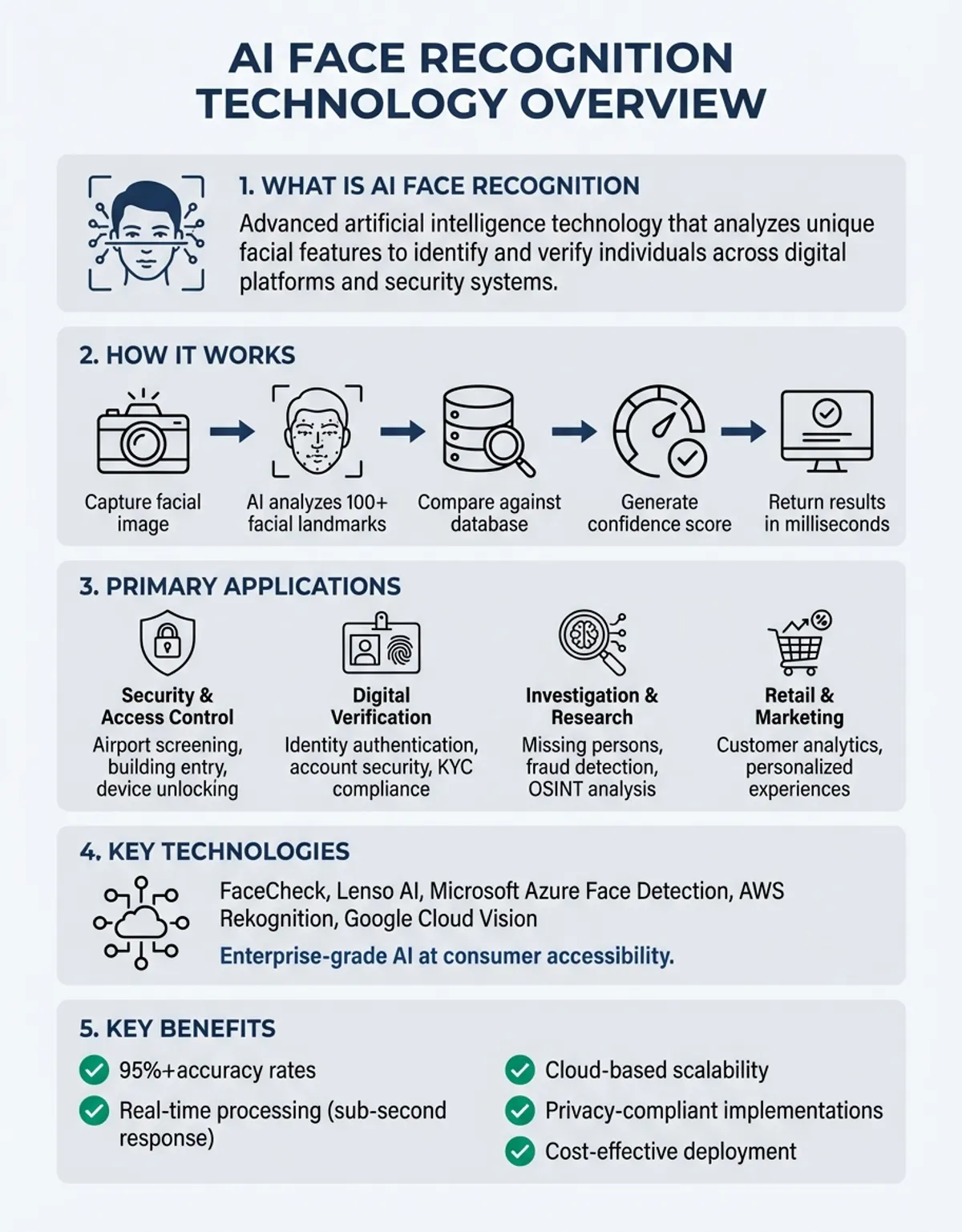
AI face recognition technology has revolutionized how we identify individuals across digital platforms, security systems, and online services. Modern facial recognition leverages artificial intelligence to analyze unique facial features, enabling applications from unlocking smartphones to enhancing security detection protocols. Here's what you need to know about the leading platforms including Facecheck, Lenso AI, and Microsoft Azure face recognition solutions that are transforming identity verification and image search capabilities.
The advancement of AI face recognition has made it possible to process millions of faces within seconds, delivering accurate results that support various use cases. Whether you're implementing security measures, managing digital identities, or conducting online investigations, understanding the capabilities of different face recognition systems is essential. The right choice depends on your specific needs - from basic face comparison to enterprise-scale deployment.
Understanding Facecheck in AI Face Recognition
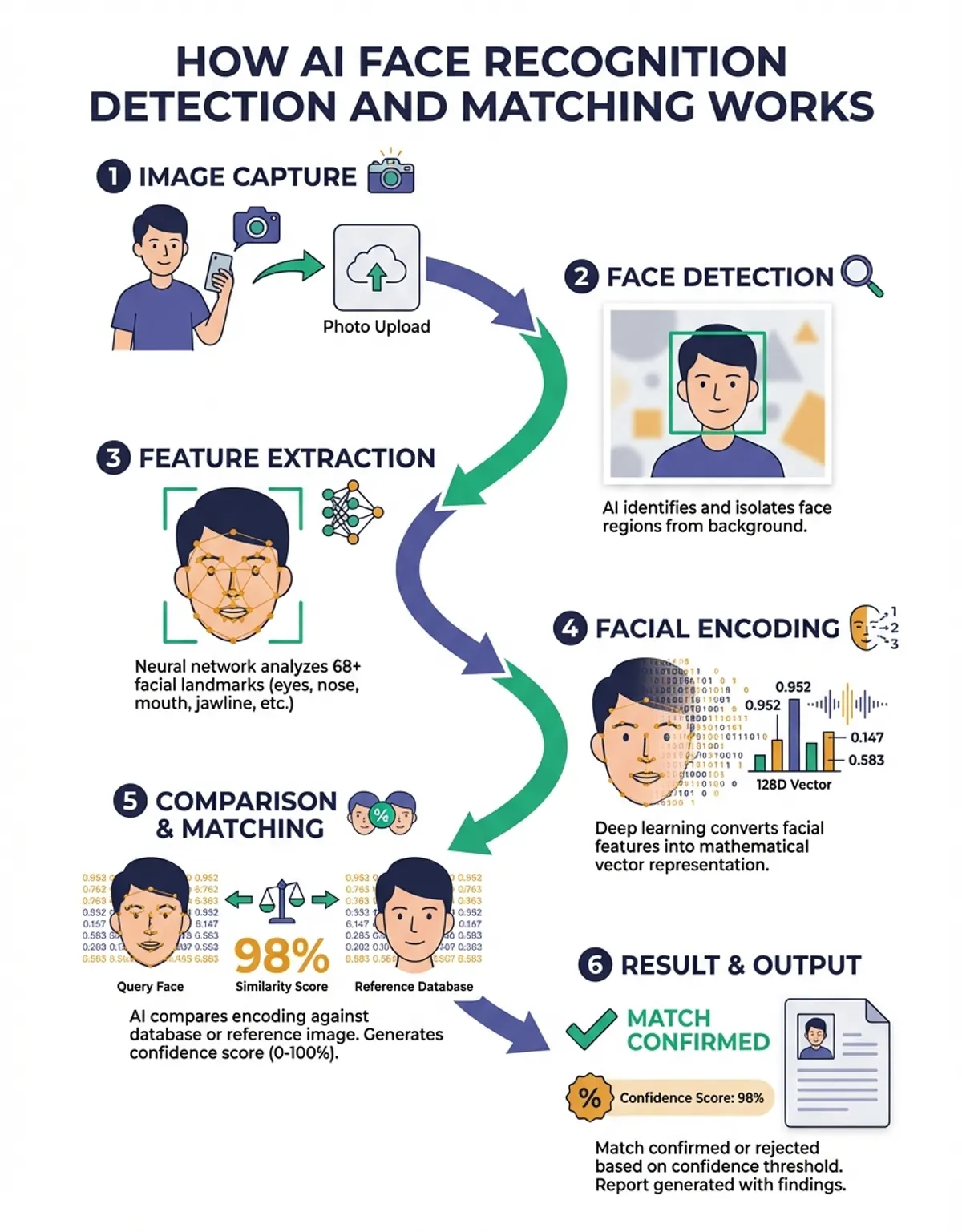
Facecheck represents one of the most powerful tools in the AI face recognition landscape, offering specialized capabilities for searching faces across the internet. This platform utilizes advanced facial recognition algorithms to help users locate images of specific individuals across various online sources. Facecheck has become particularly valuable for investigators, security professionals, and individuals seeking to monitor their digital presence.
The core strength of Facecheck lies in its ability to scan millions of publicly available images and match them against a query photo. When you upload an image to Facecheck, the system extracts facial features and compares them against its extensive database. The platform provides results that show where similar faces appear online, making it an invaluable tool for identity verification and online security monitoring.
Facecheck's detection accuracy improves continuously as its artificial intelligence learns from new data. The system can identify faces even when they appear in different lighting conditions, angles, or with partial obstructions. This robustness makes Facecheck suitable for professional applications where reliability is paramount.
Organizations implementing Facecheck benefit from its straightforward interface that doesn't require extensive technical knowledge. The platform processes images quickly, typically returning results within minutes. For businesses concerned about brand protection or individuals monitoring their online presence, Facecheck offers a practical solution that bridges the gap between consumer-friendly usability and professional-grade accuracy.
Understanding Lenso in AI Face Recognition
Lenso has emerged as a versatile image search platform that incorporates face recognition capabilities alongside broader visual search features. Unlike tools focused exclusively on facial identification, Lenso provides a comprehensive approach to finding similar images across the web. This multi-faceted capability makes Lenso particularly useful when you need to locate not just faces but also objects, places, and other visual elements.
Modern face recognition systems can process millions of faces within seconds, enabling instant identification across vast databases.
The platform's face recognition functionality works by analyzing the visual characteristics of faces in uploaded images and comparing them against indexed content from across the internet. Lenso employs machine learning algorithms that understand facial structures, enabling the system to find matches even when images have been cropped, filtered, or modified. This flexibility extends Lenso's usefulness beyond simple duplicate detection.
Lenso supports various search methods, allowing users to upload images directly or provide URLs for analysis. Once the system processes an image containing a face, it generates results showing similar appearances across different websites and platforms. The search results often reveal unexpected connections, helping users trace how images propagate online.
For content creators and brand managers, Lenso offers valuable insights into how their visual content spreads across digital channels. The platform's ability to track images containing specific faces helps identify unauthorized usage, monitor brand ambassadors, or simply understand content distribution patterns. This combination of face recognition and general image search creates a powerful tool for digital asset management.
Understanding Lenso AI in AI Face Recognition
Lenso AI represents the advanced artificial intelligence layer that powers the Lenso platform's facial recognition capabilities. This dedicated AI platform employs deep learning neural networks specifically trained on facial features, enabling more accurate and nuanced recognition compared to traditional computer vision approaches. Lenso AI continuously improves its performance through machine learning processes that refine its understanding of human facial characteristics.
The artificial intelligence behind Lenso AI processes photos by breaking down faces into numerous data points that represent unique characteristics. These data points form a mathematical representation of the face, which the platform can then compare against other stored representations. This approach allows Lenso AI to recognize faces even when physical appearance changes due to aging, makeup, or different expressions.
Lenso AI's machine learning models have been trained on diverse datasets representing various ethnicities, ages, and genders. This comprehensive training reduces bias and improves accuracy across different demographic groups. The platform can handle challenging scenarios where traditional face recognition might struggle, such as group photos, partial face views, or photos with poor lighting quality.
Developers working with Lenso AI appreciate its API access, which enables integration of face recognition capabilities into custom applications. The AI platform provides confidence scores with each match, helping developers implement appropriate thresholds for their specific use cases. Whether building security systems, social media platforms, or content moderation tools, Lenso AI offers the intelligence layer necessary for reliable facial identification.
Understanding Microsoft in AI Face Recognition
Microsoft has established itself as a major player in the AI face recognition space through its Azure Cognitive Services platform. The company's extensive research in computer vision and artificial intelligence translates into robust facial recognition tools that serve enterprise customers worldwide. Microsoft's approach emphasizes both accuracy and ethical considerations, providing developers with powerful capabilities while encouraging responsible implementation.
Enterprise facial recognition solutions must balance powerful AI capabilities with privacy protection and ethical implementation standards.
The Microsoft face recognition platform analyzes facial features to create unique face signatures that can be compared against stored profiles. This technology powers various applications from attendance tracking systems to personalized customer experiences in retail environments. Microsoft continues to refine its algorithms to improve identification accuracy while addressing privacy concerns through built-in compliance features.
Microsoft's investment in AI research has produced face recognition models that excel at handling diverse scenarios. The platform can process photos captured in different environmental conditions and still maintain high accuracy. This reliability makes Microsoft a preferred choice for organizations deploying face recognition at scale, where consistency across millions of transactions is critical.
For developers, Microsoft provides comprehensive documentation and support resources that simplify integration of face recognition into existing applications. The platform includes SDKs for multiple programming languages, making it accessible to development teams with varying technical backgrounds. Microsoft's cloud infrastructure ensures that face recognition services scale efficiently as usage grows, eliminating concerns about performance degradation during peak demand periods.
Understanding Azure in AI Face Recognition
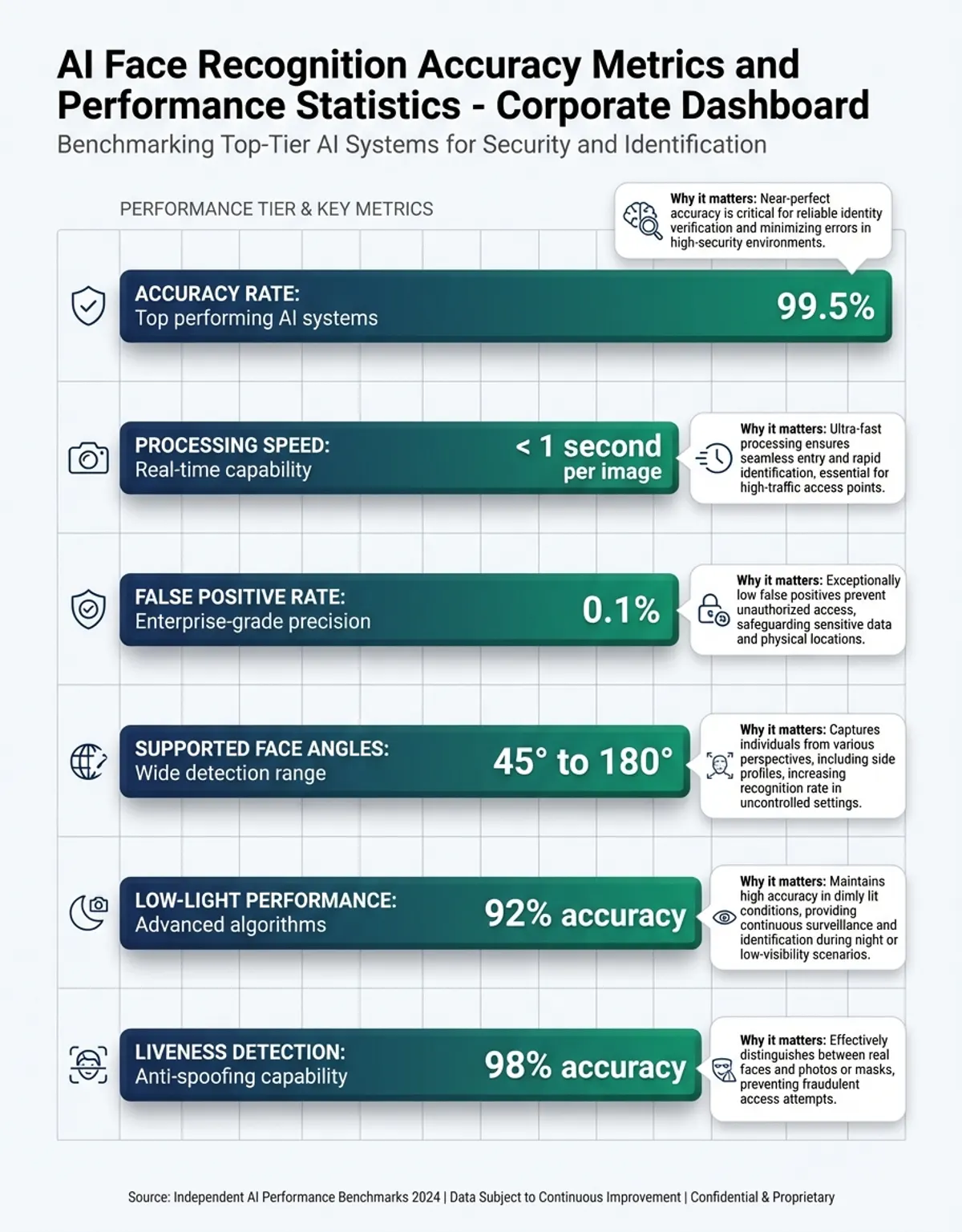
Azure Face is Microsoft's dedicated cloud service for facial identification, recognition, and analysis. This powerful platform provides developers with API access to sophisticated face recognition capabilities without requiring expertise in machine learning or computer vision. Azure Face handles the complexity of AI implementation, allowing businesses to focus on building applications that leverage facial recognition for their specific needs. (Source: https://learn.microsoft.com/en-us/azure/ai-services/computer-vision/overview-identity)
The Azure platform offers several key features including face identification, which identifies faces within photos, and face verification, which confirms whether two faces belong to the same person. Azure also provides face identification capabilities that match a face against a group of faces, making it suitable for access control and personalization scenarios. These functions work together to create comprehensive facial recognition solutions.
Azure Face excels in scenarios requiring real-time processing of large volumes of photos. The cloud infrastructure automatically scales to handle varying workloads, ensuring consistent performance whether processing hundreds or millions of faces. This scalability makes Azure particularly attractive for applications like event security, where sudden spikes in processing demands are common.
Security and privacy protections are built into Azure Face at multiple levels. The service encrypts data both in transit and at rest, protecting sensitive biometric information from unauthorized access. Azure also provides detailed logging and monitoring tools that help organizations maintain compliance with regulations like GDPR. These security features make Azure a trustworthy platform for handling sensitive facial recognition data.
The Azure ecosystem integrates seamlessly with other Microsoft cloud services, enabling developers to build comprehensive solutions that combine face recognition with data storage, analytics, and AI capabilities. This integration reduces development complexity and accelerates time to market for new applications. Organizations already using Azure for other workloads find it natural to extend their infrastructure to include face recognition capabilities.
Azure's global presence through distributed data centers ensures low latency regardless of where users are located. This geographic distribution supports international deployments while helping organizations comply with data residency requirements. The platform's management tools provide visibility into usage patterns and performance metrics, empowering teams to optimize their face recognition implementations.
For businesses evaluating cloud-based face recognition solutions, Azure offers a compelling combination of technical capability, enterprise-grade security, and comprehensive support. The platform's pricing model allows organizations to pay only for resources consumed, making it cost-effective for projects of any scale. Whether implementing basic face identification or building complex identification systems, Azure provides the foundation for reliable facial recognition applications.
Understanding Detection in AI Face Recognition
Detection forms the foundational step in all AI face recognition systems, representing the process of determining that a face exists within an image or video frame. This critical capability determines where faces are located before any identification or verification can occur. Modern detection algorithms use artificial intelligence to distinguish faces from backgrounds and other objects, even in challenging conditions.
Face detection algorithms analyze photos to identify patterns characteristic of human faces, such as the arrangement of eyes, nose, and mouth. Machine learning models trained on millions of face photos can recognize these patterns across various orientations, lighting conditions, and partial obstructions. The accuracy of detection directly impacts the overall effectiveness of any face recognition platform.
Advanced detection systems can locate multiple faces within a single image simultaneously, making them suitable for processing group photos or monitoring crowded environments. The system draws bounding boxes around detected faces, which then serve as inputs for subsequent recognition steps. This multi-face detection capability is essential for applications like attendance tracking or security monitoring.
The speed of detection processing has improved dramatically with modern neural network architectures optimized for face detection. Real-time detection now runs on devices ranging from smartphones to security cameras, enabling instant responses in interactive applications. This performance makes detection viable for use cases requiring immediate feedback, such as unlocking devices or controlling access to secure areas.
Detection quality metrics include precision (avoiding false positives) and recall (avoiding missed faces). Leading detection systems achieve high scores on both metrics, ensuring they reliably find actual faces while minimizing incorrect detections. Organizations implementing face recognition prioritize detection systems with proven accuracy to avoid downstream errors in identification and verification.
Understanding Online in AI Face Recognition
online face recognition services have democratized access to powerful AI capabilities that were once available only to organizations with significant technical resources. These cloud-based platforms allow anyone to upload photos and receive face recognition results without installing software or managing infrastructure. The online delivery model has accelerated adoption of face recognition across diverse industries and use cases.
Cloud-based online face recognition offers several advantages over on-premises solutions. Users benefit from continuous updates that improve accuracy as providers refine their AI models. The online platforms handle computational demands in the cloud, eliminating the need for expensive hardware investments. This accessibility makes face recognition practical for small businesses and individuals who couldn't justify traditional deployment costs.
online face recognition services typically provide web interfaces for casual users alongside API access for developers building integrated applications. This dual approach serves different audiences effectively—non-technical users can upload photos through browsers while developers automate face recognition within their applications. The flexibility supports various workflows from one-off searches to high-volume automated processing.
Privacy considerations are paramount when using online face recognition services. Reputable providers implement strong data protection measures including encryption, secure data deletion, and compliance with privacy regulations. Users should review service providers' privacy policies to understand how their facial data will be handled, stored, and potentially shared. Selecting providers with transparent privacy practices helps mitigate risks associated with biometric data processing.
The online face recognition market includes both free and paid services with varying capabilities and limitations. Free services often impose restrictions on usage volume or image quality, while paid services offer higher accuracy, larger databases, and additional features. Organizations should evaluate their requirements carefully to select online services that balance capability, cost, and privacy protection appropriately.
Understanding Images in AI Face Recognition
photos serve as the primary input for all face recognition systems, making image quality and characteristics crucial factors in recognition accuracy. The way photos are captured, processed, and prepared significantly impacts how well AI algorithms can detect and recognize faces. Understanding these image-related considerations helps users optimize their face recognition implementations for best results.
Image resolution directly affects face recognition accuracy—higher resolution photos provide more facial detail for algorithms to analyze. However, even low-resolution photos can work well if faces occupy sufficient pixels within the frame. Most modern face recognition systems specify minimum face sizes (typically 100-200 pixels across) below which accuracy degrades substantially. Users should ensure their photos meet these thresholds for reliable recognition.
Lighting conditions present another critical variable affecting image quality for face recognition. photos with balanced, diffuse lighting produce the best results, while harsh shadows or extreme backlighting can obscure facial features. Many AI systems now incorporate preprocessing steps that normalize lighting variations, but starting with well-lit photos still improves outcomes significantly.
Image format and compression also influence recognition accuracy. While face recognition systems accept common formats like JPEG and PNG, excessive compression can introduce artifacts that degrade facial details. For critical applications requiring highest accuracy, using lossless formats or minimal compression helps preserve the visual information needed for precise recognition.
The angle at which faces appear in photos affects how easily they can be recognized. Front-facing photos provide the most information and typically yield the highest accuracy. Profile views and angled perspectives present more challenging scenarios, though advanced AI models trained on diverse pose variations handle these situations increasingly well. Multi-image systems that capture faces from multiple angles can compensate for single-perspective limitations.
Image preprocessing techniques can enhance face recognition performance by standardizing inputs before they reach the AI algorithms. Common preprocessing steps include cropping to isolate faces, adjusting contrast, and normalizing size. Some advanced systems employ facial landmark identification to align faces to standard orientations, further improving recognition consistency across varied input photos.
Storing and managing large volumes of face photos requires consideration of both technical and privacy factors. Image databases should implement secure access controls, encryption, and data lifecycle management to protect sensitive biometric information. Organizations building face recognition applications must design their image management systems to support both operational requirements and regulatory compliance obligations.
Choosing the Right Face Recognition Solution
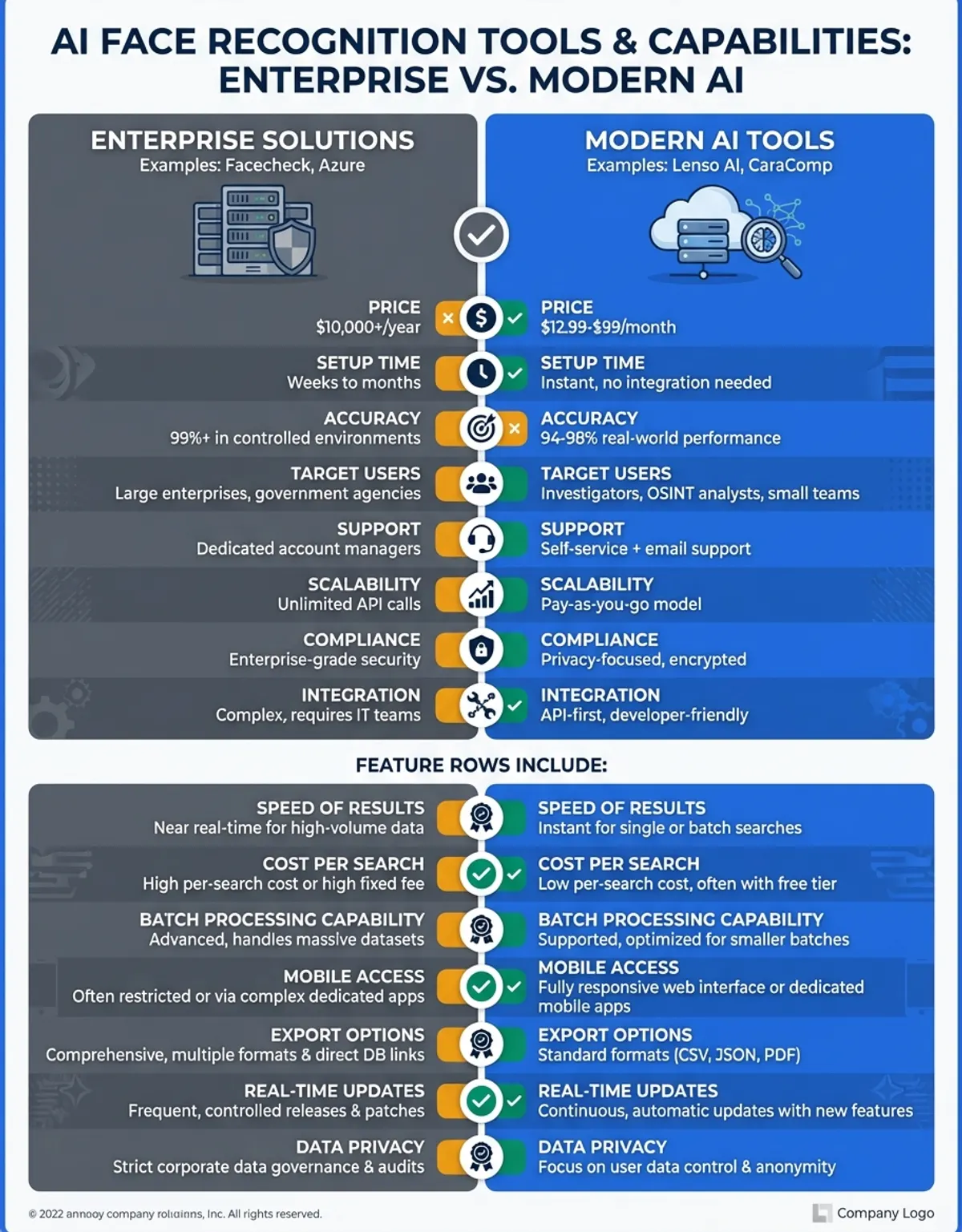
For users seeking a straightforward and accessible face comparison solution, CaraComp offers a user-friendly platform designed specifically for comparing facial similarities without the complexity of enterprise systems. Whether you're verifying identity documents, organizing photo collections, or analyzing facial matches for personal projects, CaraComp delivers professional-grade facial recognition results through an intuitive interface. The platform combines advanced AI algorithms with practical features that make face recognition accessible to non-technical users while maintaining accuracy comparable to enterprise solutions. CaraComp handles various photo qualities and lighting conditions effectively, making it a reliable choice for both casual users and professionals who need dependable face comparison capabilities without extensive setup or technical expertise.
Comparison Table: Leading AI Face Recognition Platforms
| Platform | Primary Use Case | Cloud/On-Premise | API Access | Best For |
|---|---|---|---|---|
| Facecheck | Online face search | Cloud | Limited | Investigators and security professionals |
| Lenso | Visual search with face recognition | Cloud | Available | Content tracking and brand monitoring |
| Lenso AI | Advanced AI-powered recognition | Cloud | Full API | Developers building custom applications |
| Microsoft Azure Face | Enterprise face recognition | Cloud | Comprehensive | Large-scale enterprise deployments |
| Azure Cognitive Services | Multi-function AI including faces | Cloud | Full SDK support | Organizations needing integrated AI services |
| Open Source Solutions | Custom implementations | Both | Self-managed | Organizations with ML expertise and specific requirements |
Frequently Asked Questions

How does scylla face recognition work?
Scylla face recognition operates by analyzing facial features through deep learning algorithms that identify unique characteristics in each face. The platform creates mathematical representations of faces that can be compared against databases to find matches with accuracy levels as high as 99.85%. When processing an image, Scylla extracts facial landmarks and converts them into numerical vectors, enabling rapid comparison against stored face data. The platform is designed for high-speed processing and can function from extreme distances and angles, making it suitable for applications requiring real-time identification across large populations. (Source: https://www.scylla.ai/face-recognition-technology-how-it-works/)
How do faces work in AI recognition systems?
Faces in AI recognition systems are processed through multiple stages beginning with detection, where the system locates faces within photos. Once detected, the AI extracts facial features including the distance between eyes, nose shape, jawline contours, and other distinguishing characteristics. These features are converted into mathematical representations called face embeddings. The platform then compares these embeddings against stored templates to determine identity or verify matches. Modern AI uses neural networks trained on millions of face photos to achieve high accuracy across diverse populations and conditions. You may also find our guide on deep learning for face recognition helpful for understanding the neural network architectures that power modern AI systems.
How does mediapipe face detector task work?
MediaPipe face detector task utilizes Google's machine learning framework to identify faces in photos and video streams in real-time. The platform employs a lightweight neural network architecture optimized for performance on mobile devices and browsers, based on BlazeFace technology. MediaPipe processes frames to locate face regions, then extracts facial landmarks including eyes, nose, mouth, and face contours. This task provides the foundation for subsequent recognition or analysis steps. The detector handles various face sizes and orientations, making it versatile for applications from augmented reality filters to authentication systems. (Source: https://developers.google.com/mediapipe/solutions/vision/face_detector)
How does AI-powered facial recognition work?
AI-powered facial recognition combines computer vision and deep learning to identify individuals based on facial features. The process starts with face detection algorithms locating faces in photos. Next, the AI extracts distinctive features and creates a unique facial signature or template. This signature is compared against a database of known faces using similarity algorithms. Modern AI systems use convolutional neural networks trained on diverse datasets to achieve high accuracy. The artificial intelligence continuously learns from new data, improving recognition performance over time. Advanced systems can handle challenges like aging, accessories, and varying expressions.
How does artificial intelligence work in face recognition?
Artificial intelligence in face recognition leverages neural networks that learn to identify discriminative facial features through training on large image datasets. The AI analyzes faces at multiple scales and orientations, learning patterns that distinguish individuals. During training, the neural network adjusts internal parameters to minimize errors in identification. Once trained, the AI can process new faces by extracting learned features and matching them against known profiles. Deep learning architectures like convolutional neural networks have dramatically improved face recognition accuracy by automatically discovering optimal features rather than relying on hand-crafted algorithms. This AI-driven approach enables systems to handle real-world variability in lighting, pose, and expression.
How does AI face search work?
AI face search works by converting face photos into searchable digital signatures that can be matched against large databases. Users upload a query image containing a face, which the AI platform analyzes to extract distinctive features. These features form a unique identifier that the search algorithm compares against indexed faces. The platform ranks results by similarity, showing matches with the highest confidence scores first. Advanced AI face search platforms can scan millions of photos within seconds, finding matches even when faces appear in different contexts or with altered appearances. The technology supports various applications from finding missing persons to monitoring unauthorized use of personal photos online.
How can you check if your face is being used online?
You can check if your face is being used online by utilizing reverse image search tools and specialized face recognition services. Start by uploading a clear photo of yourself to platforms like Facecheck or general image search engines. These services scan indexed web content to find similar faces. Regularly searching for your face helps identify unauthorized usage across websites and social media. Some online reputation management tools offer automated monitoring that alerts you when new instances of your face appear online. For comprehensive protection, combine multiple search methods and review results periodically to maintain awareness of your digital footprint.
Conclusion
AI face recognition technology continues to evolve rapidly, offering increasingly sophisticated capabilities across platforms from Facecheck and Lenso AI to enterprise solutions like Microsoft Azure. Understanding the strengths of different systems helps organizations and individuals select appropriate tools for their specific needs. For a comprehensive overview of face recognition technologies and implementation strategies, explore our face recognition guide. Whether implementing security identification systems, managing online presence, or building custom applications, modern face recognition delivers accuracy and performance that were unimaginable just a few years ago.
The future of face recognition lies in balancing powerful AI capabilities with privacy protection and ethical implementation. Learn more about the limitations of face recognition software to understand important challenges and considerations when implementing these systems. Leading platforms increasingly incorporate safeguards that protect user data while delivering the functionality that makes face recognition valuable. As artificial intelligence continues advancing, we can expect face recognition to become even more accurate, accessible, and integrated into everyday applications that enhance security, convenience, and personalization across digital experiences.