
From 27 Maybes to 3 Leads: Facial Comparison Triage | Podcast
From 27 Maybes to 3 Leads: Facial Comparison Triage | Podcast
This episode is based on our article:
Read the full article →From 27 Maybes to 3 Leads: Facial Comparison Triage | Podcast
Full Episode Transcript
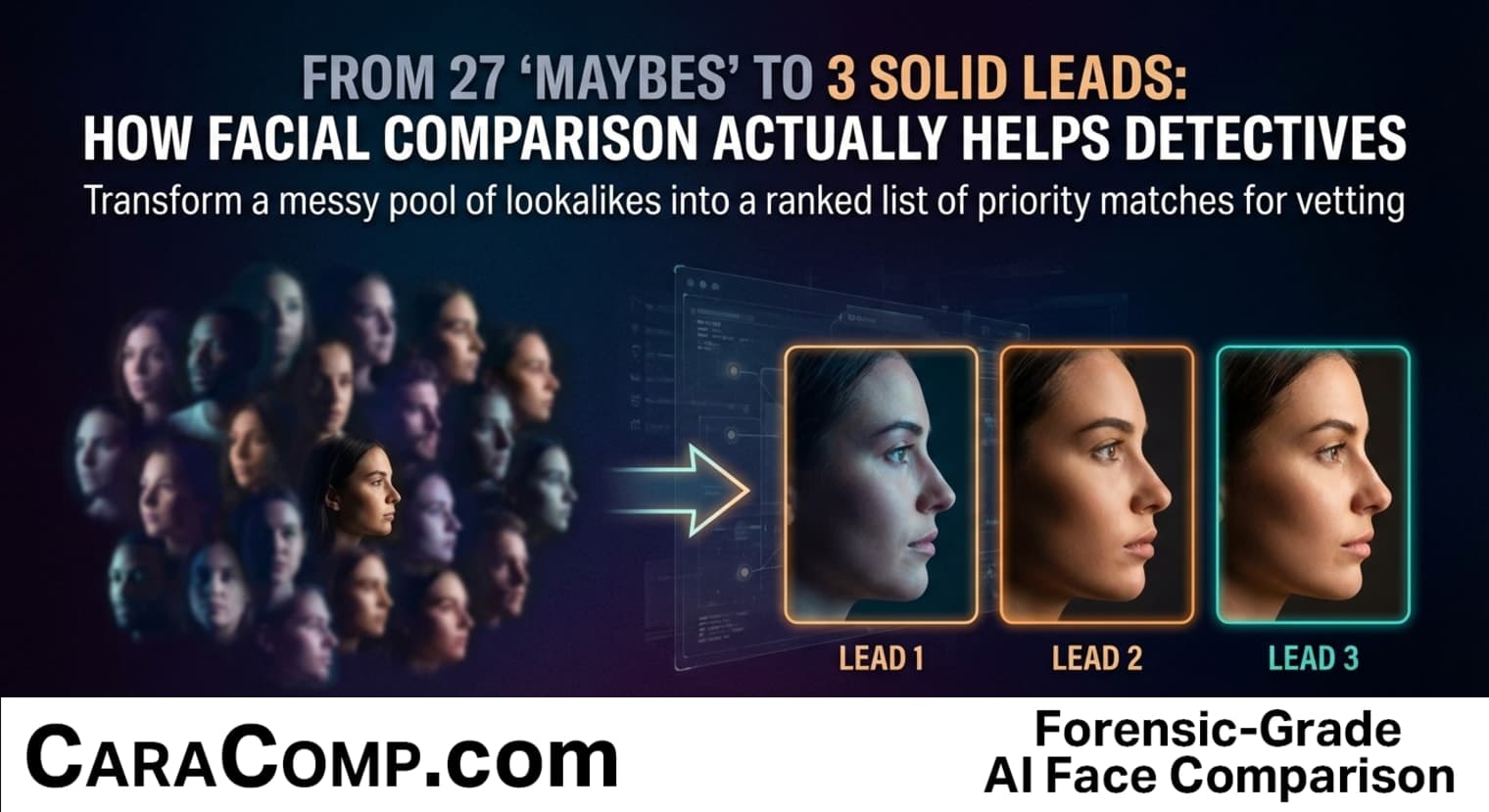
Imagine this. Six cameras. Twenty-seven faces. A midnight deadline. And a detective who needs to figure out which of those faces actually matter. How do you cut through that kind of chaos without missing the one face that breaks the case?
If you've ever watched a crime show where someone
If you've ever watched a crime show where someone says "enhance that image" and gets a perfect match, that's not how it works. Not even close. This is something real investigators deal with constantly. And understanding how facial comparison actually triages a case changes how you think about both A.I. accuracy and human bias. So here's the driving question. When you've got dozens of possible faces, how do you narrow it down without letting your own brain trick you?
Let's start with the first building block. Facial comparison doesn't give you a yes or no answer. It gives you a ranked list based on similarity scores. Think of it like a teacher grading essays on a scale, not pass-fail. One face might score a ninety-one out of a hundred. Another scores a sixty-three. That ranking turns triage into math instead of gut instinct. And that matters because detectives can focus their time on the top-scoring faces first.
So what's actually doing the scoring?
Here's the second piece
Here's the second piece. The algorithm maps landmarks on a face, eyes, nose, jawline, into a kind of geometric space. Then it measures the distance between those points across two images. It's similar to how you'd compare two city maps by measuring the distance between landmarks. Two faces that look alike to your eye might actually sit far apart mathematically. The math overrides your pattern bias. That's powerful, but it's not perfect.
Now you might be wondering, what trips the system up?
Angles and obstructions. Peer-reviewed research confirms that accuracy drops once a face rotates beyond about thirty degrees sideways. Think of it like trying to read a book spine when it's tilted away from you. In multi-camera investigations, where every camera catches a different angle, the system has to weigh how confident each score really is. Not all scores are created equal.
The Bottom Line
Now here's what most people get wrong. They think the biggest risk is the technology making a mistake. But N.I.S.T. research shows the bigger risk is the human reviewer. After reviewing just three or four possible matches manually, examiners start anchoring to a mental template. They stop comparing to the original image and start comparing to their own memory. The algorithm doesn't drift. It scores face twenty-seven with the same precision as face one.
So here's the bottom line. Facial comparison doesn't identify your suspect. It ranks every possible face by a math-based similarity score, and hands the detective a short, defensible list instead of a pile of maybes. The real value isn't speed. It's consistency. Worth thinking about next time you hear someone say a facial recognition system "identified" a suspect. What it probably did was eliminate two dozen wrong answers, and that's the actual breakthrough.
Ready for forensic-grade facial comparison?
Full forensic reports with detailed similarity scoring. Results in seconds.
Run My First SearchMore Episodes
Deepfake AI App: One Photo, 225,000 School Fakes
According to survey data from U.S. schools, as many as two hundred and twenty-five thousand deepfake nudes may have circulated in a single school year. Not of celebrities. Of ordinary students — kids in grades six through
PodcastDeepfake lawsuit: Grok turned a clothed photo into abuse
A photographer in Bentonville, Arkansas took a normal photo of a little girl. A professional shoot. She was fully dressed. Then someone fed that photo into an A.I. chatbot and typed a command to strip her clothes off. <br
PodcastAI Deepfake Laws: 15,736 Victims in Six Months
A middle school student in Henderson is now facing charges. Police say the student used artificial intelligence to create explicit fake images of classmates — and then shared them. Not a celebrity. Not a stranger online.